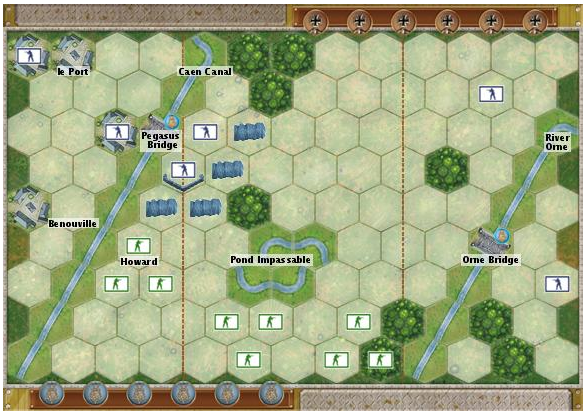
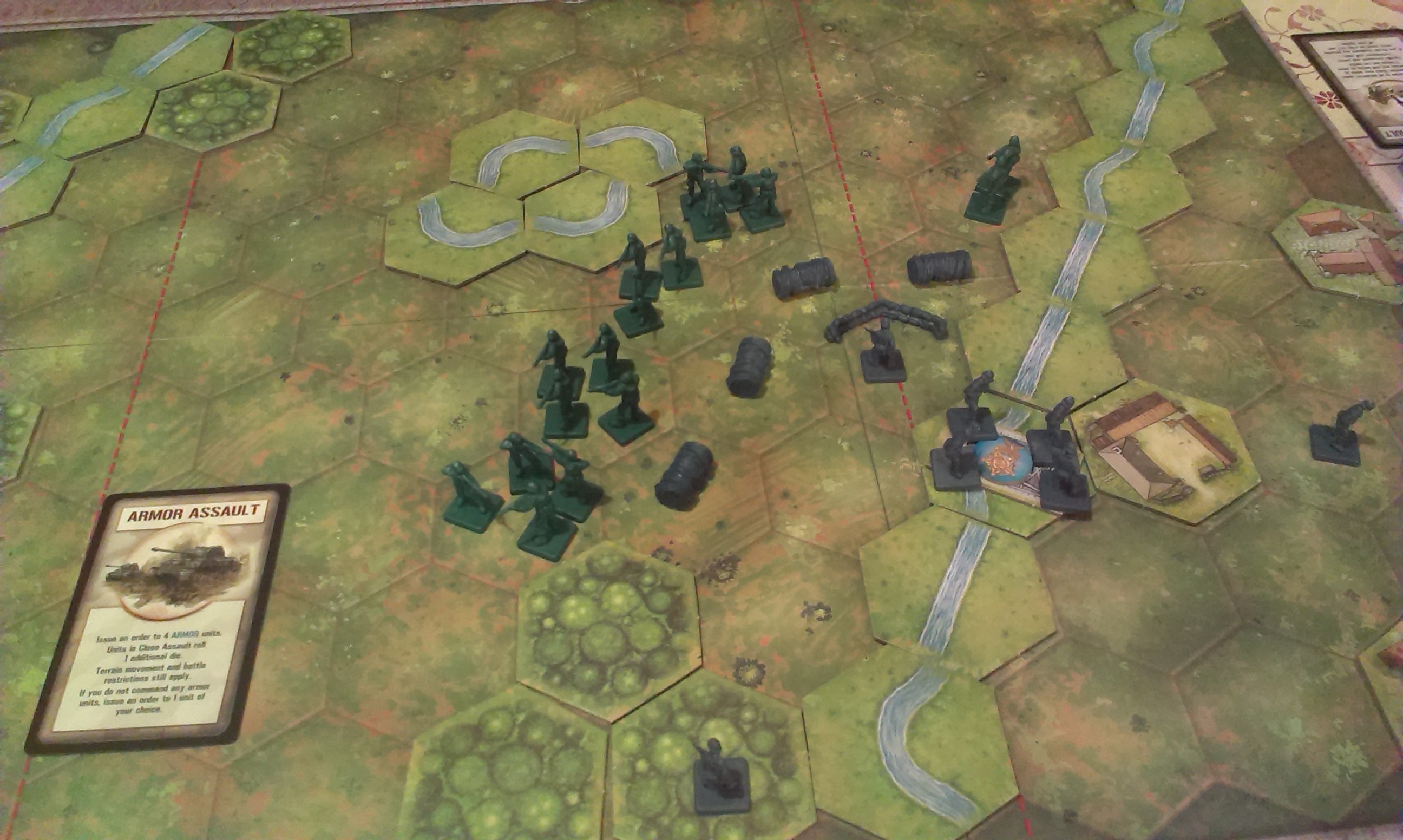
Set on the night of June 5th, 1944 this scenario recreates the brief battle for Pegasus Bridge. Or Bénouville Bridge, as it was known at the time, in Normandy, France. Major John Howard led the men of the Oxford and Buckinghamshire Light Infantry in the first airborne assault of D-Day, his objective being to capture both Pegasus Bridge and Orne Bridge. At a few minutes past midnight the Horsa Gliders land in a patch of field only yards away from their objective. The men stream out of the gliders totally surprising the German forces, there’s a brief and furious fight involving a machine gun in a sandbag nest right by the Pegasus Bridge. The British forces secure the Bridge, and the Orne equally as quickly, losing only two men in the process.
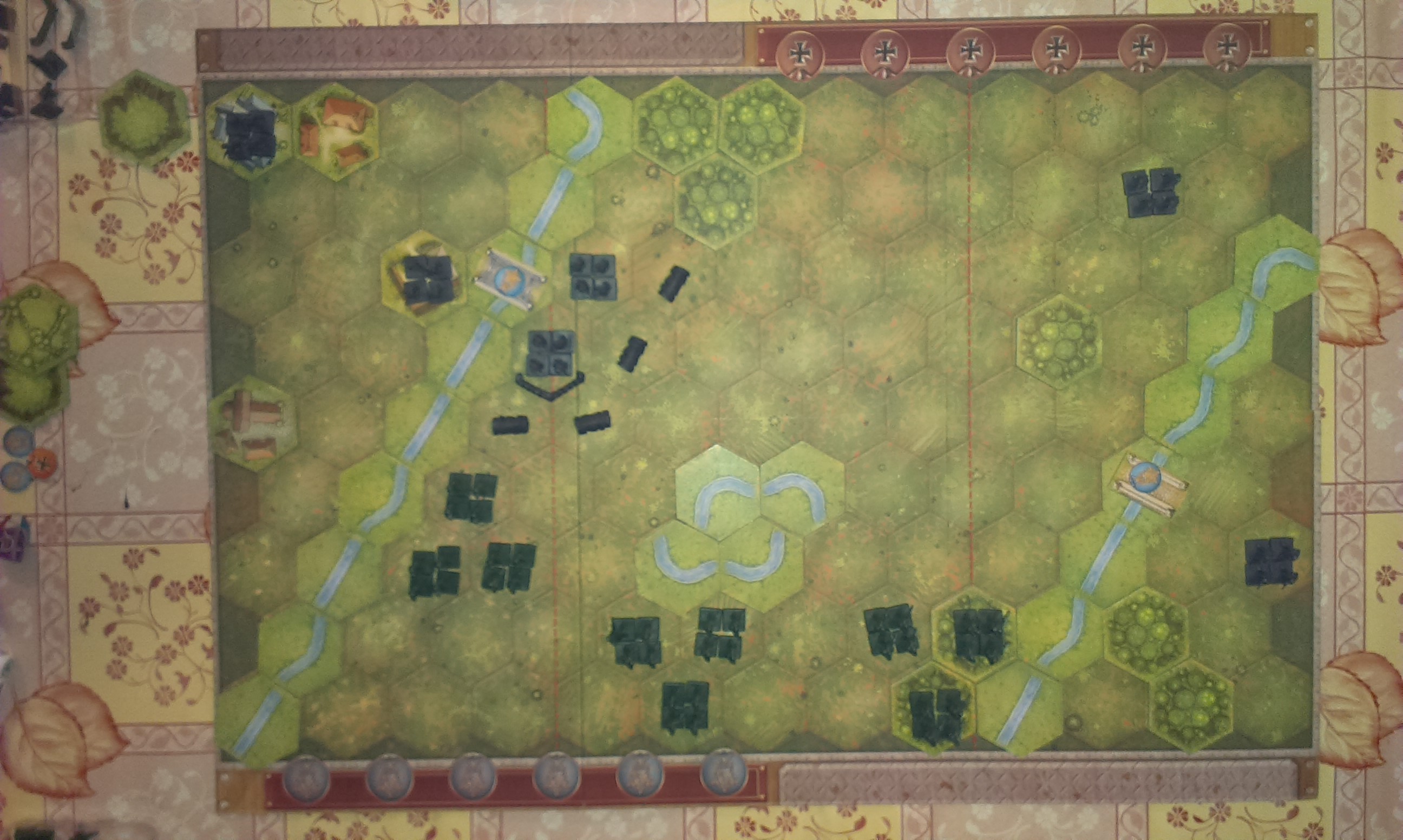
The bulk of British troops here start behind the impassable pond, meaning that they must be maneuvered around it to get involved in the battle. The Allied player has the natural advantage in this scenario; they have more men to begin with, receive more Command Cards, and play first.
Strategy and Tactics:
The Allied player here has the upper hand, but if they play badly that’s going to be completely irrelevant. In this game a certain amount of your success as a player is determined by which Command Cards you draw, as on some occasions you may need to give orders to a section of the board that you don’t have the Command Card for, and so can’t. How quickly and efficiently you kill enemy units is also determined by the roll of the battle dice. So some amount is down to luck and chance. But aside from that we’ve found so far that once you’ve found a decent defensive position (for example in a patch of trees) it’s ideal to stay there for as long as possible, all the while you can fire on your enemy from there you should stay as the woods reduce the chances that you’re going to lose men when the enemy fires on you.
In this scenario the German forces have barbed wire and sandbags. These are inconvenient, for an Infantry unit to be able to remove them they have to move into the space that the barbed wire is in, and then remove it instead of battling. So it can be completely suicidal to remove them as you end up adjacent to you enemies units and unable to attack them. Leaving you as a clear target. It’s also important to remember that the rive does not effect line of sight. You can fire on an enemy unit across a river provided that they are within range and no other terrain restrictions that would prevent you attacking them apply.
I found, when playing as the Allied forces, that trying to take the patch of wood on the right flank of the board, by the Orne Bridge, was a strong position to be in. That bridge is under defended and so the woods is a good position from which to either attack the lone German unit at the top of the board there, or to swoosh down and take the bridge from the other German unit. The blue medals on the two bridges count as victory points if the bridges are held by British forces. Meaning that that player has to destroy less of the Axis units to win the scenario.
For Axis forces it’s tactically ideal to get you lonely unit in the top of the right flank down into the patch of woodland before anyone else can, this is a good defensive position to be in, to prevent anyone trying to take the Orne Bridge. Your second unit there could then be on the bridge, between them they’ll put up a good fight against any optimistic British forces.
When we played this scenario we left the Axis units mostly where they were in the center and on the left flank, only really moving the one in the top left corner to bring it closer to the action. On reflection it would probably have been a good idea to shift the unit in the town right next to Pegasus Bridge further down the river to attack the British, because we didn’t actually use it that much.
To Conclude:
This is the starter scenario, so it’s been simplified from the original battle. The Germans has a machine gun in their sandbag nest by Pegasus Bridge that’s been replaced with regular Infantry in this one. But as starters go it’s very good, it’s an easy board to navigate, and the use of only one type of unit allows you to completely get to grips with how they move and battle. It would’ve rated higher, but that it’s been deliberately simplified for learning purposes, so the scenario doesn’t have as much going for it as some of the later, more complex ones do. It’s well designed as an introduction though, and sets you up in good stead for future scenarios.
We should really include that in all the titles/opening paragraphs for this blog, since I can’t immediately think of any game that we haven’t played wrong at least once. Memoir ’44, as has been stated at least once now, is a fantastic game. I don’t think we’re likely to ever get bored of it. Based on real scenarios from the Second World War it’s not only interesting for its historical accuracy, but also as a strategic game.
What’s In The Box:
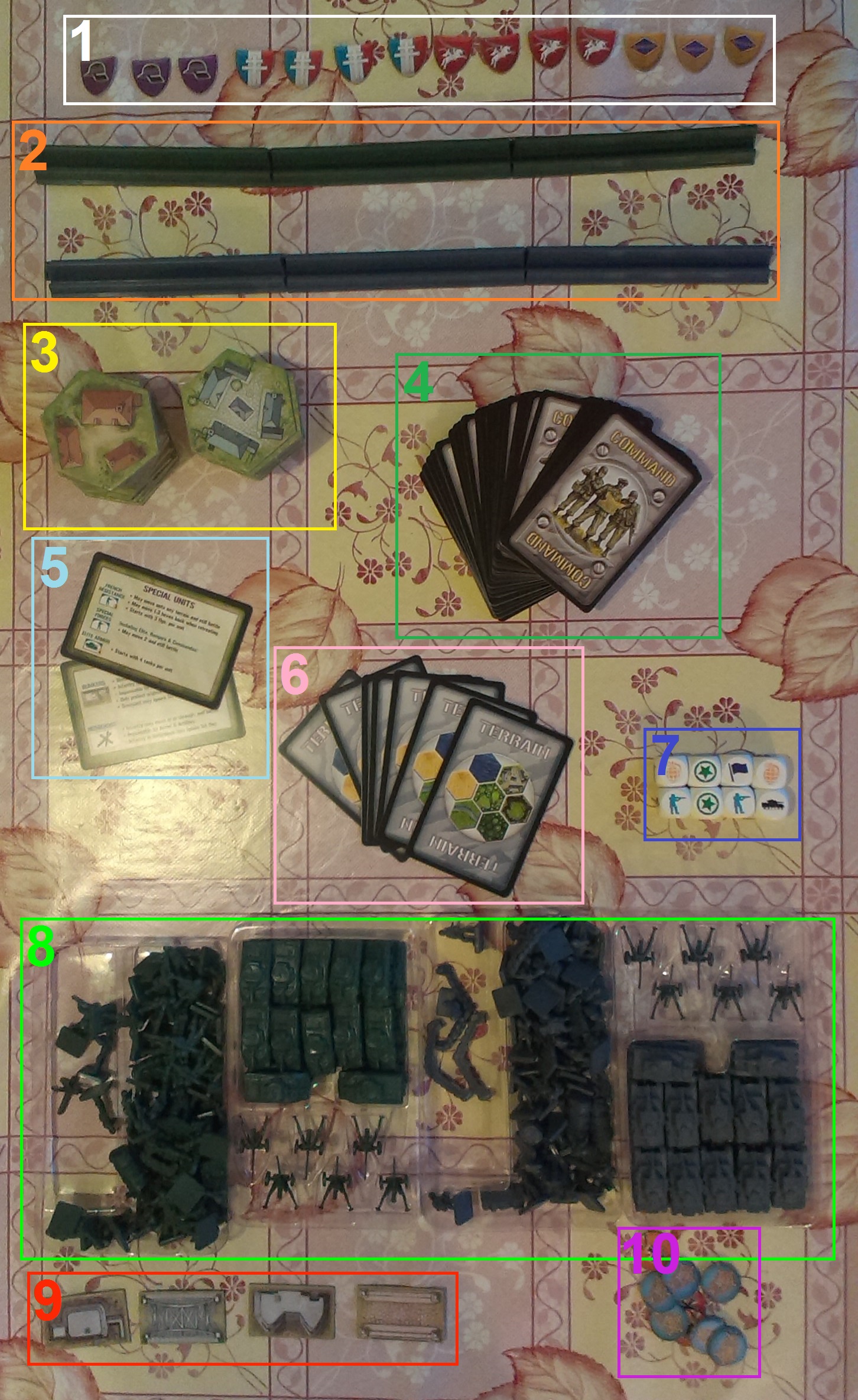
The Stuff
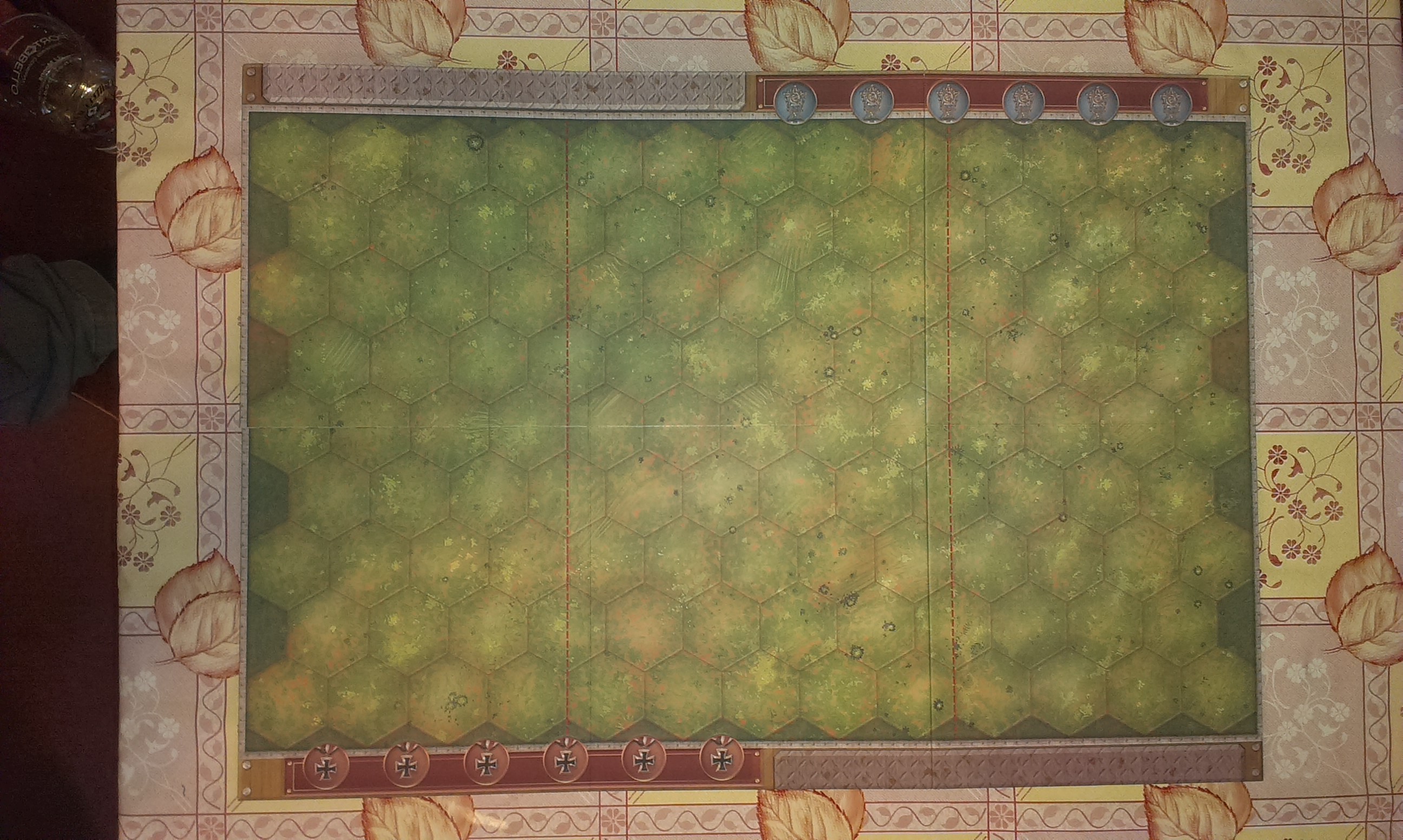
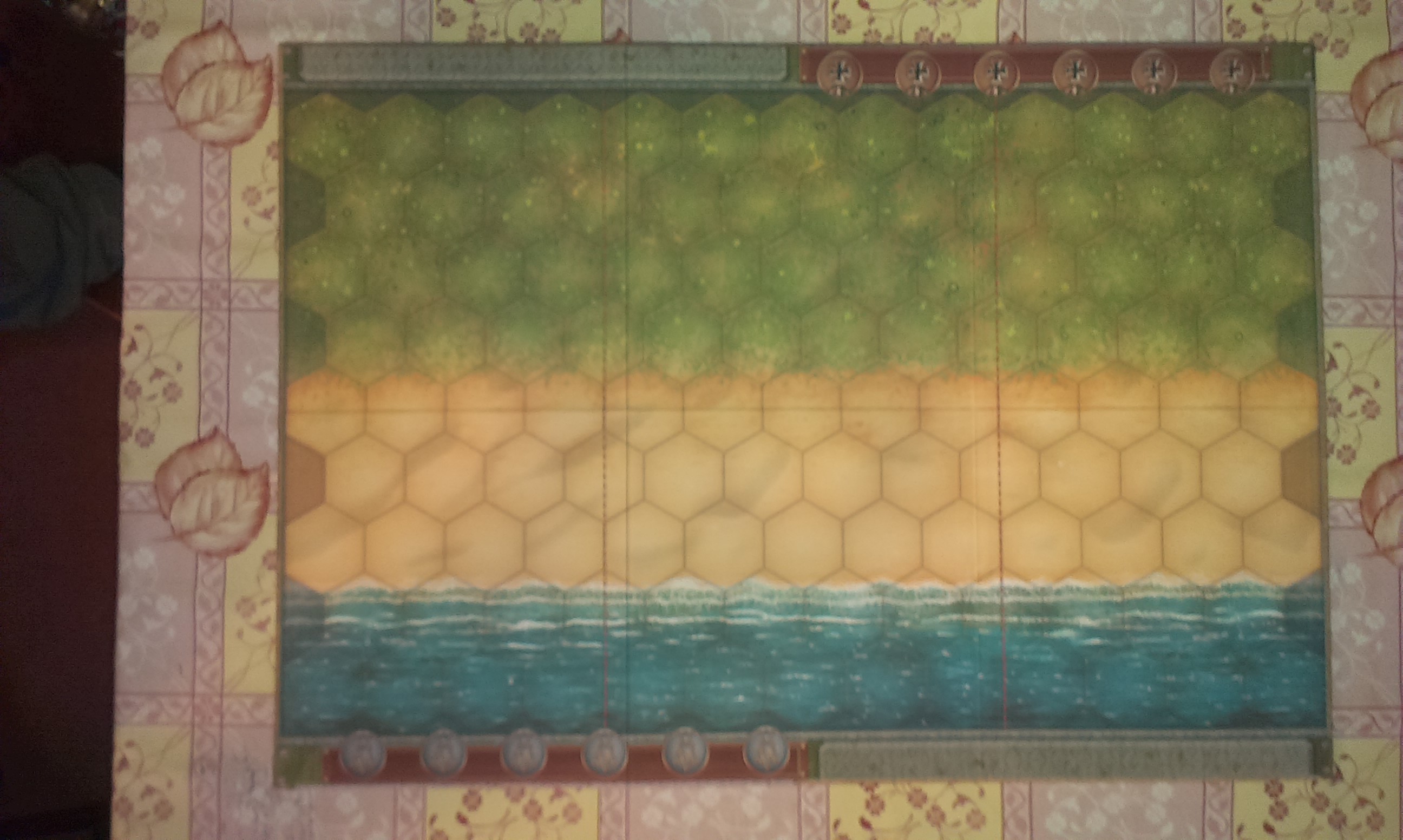
Countryside side of the boardBeach sideThe Rules
14 Special Forces Badges
3 Blue and 3 Green Command Card Holders
44 Double-Sided Terrain Hex Pieces
60 Command Cards
1 Double-Sided Obstacle Summary Card and 1 Double-Sided Unit Summary Card
7 Terrain Cards
8 Battle Dice
2 Sets of Army Miniatures; Green = Allied Forces, Blue-Grey = German/Axis Forces
4 Double-Sided Bunker and Bridge Tiles
10 Double-Sided Victory Medals
1 Double-Sided Battlefield Board Map
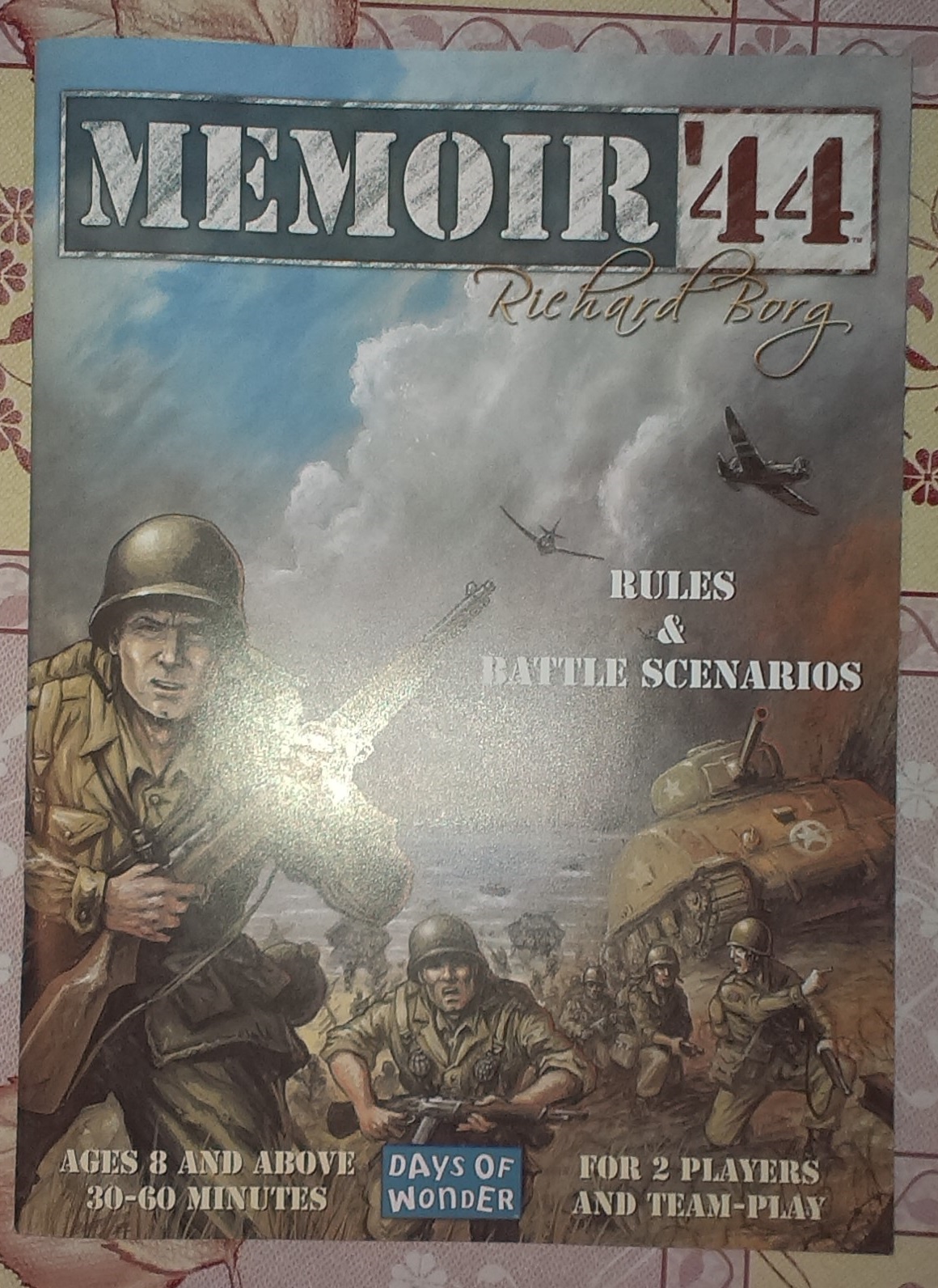
1 Rules and Scenario Booklet
Playing The Game:
Objective: To fulfill the scenario’s victory conditions before your opponent and score more points after you’ve switched sides.
When you read the rules for this game you’ll see that the first scenario it recommends you play uses only the Infantry Units available to each side. This is very good, as the game builds you up to a thorough understanding of each of the different types of unit available to you in different scenarios by introducing them one at a time into gameplay.
You start by setting up the board, as directed in the instructions for the scenario you’re playing. You change the look and layout of the board by using the terrain hexes to put in woods, hills, villages, rivers etc.
The starting set up of the first scenario in the rule book
Once you’ve set the board up for the scenario you then decide who’s playing as who. In the rule book the scenario instructions will tell you which side plays first, and how many Command Cards each player is dealt to begin with. Players then take turns. There will be a preset condition for victory in each scenario.
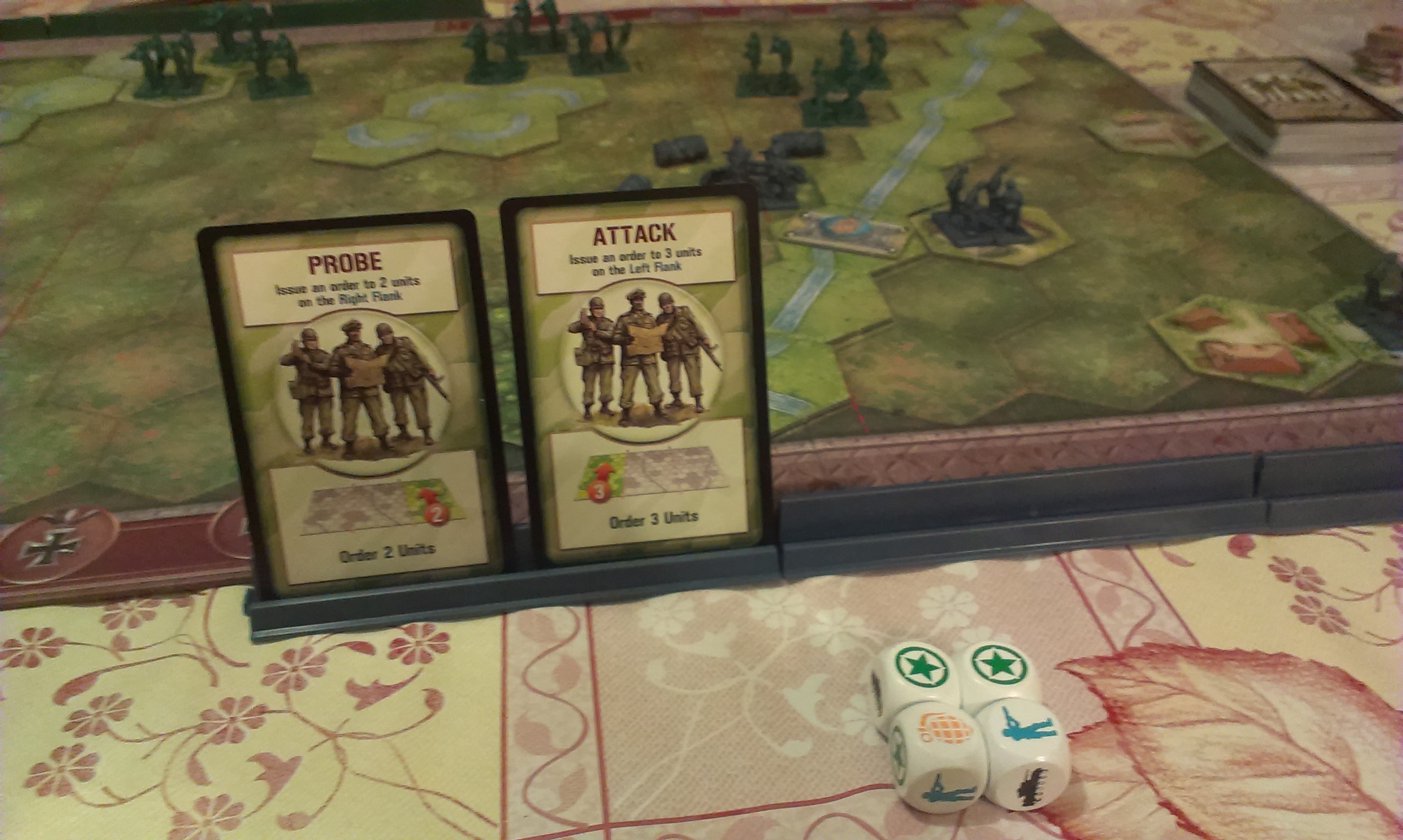
The Command Cards contain an array of things a player can do on their turn, standard orders or special commands. These mostly look like this:
an example of the Command Cards most commonly in play
The special command cards look like this, but are all different:
A special command card
Winning The Game:
There is no time limit to the scenarios, players continue taking turns until someone manages to destroy enough enemy units to fulfill the victory conditions for the scenario. Then the board is reset and players switch sides. A note is kept of the score from the first round, for example, if the victory condition was that someone needed to have completely destroyed 4 of their enemy units and the other player had destroyed 2 when this happened you would then make a note, and at the end of the following round the victorious players score would have to be the highest total number of units destroyed.
Strategy:
We realized fairly early into the playing stages of this that the scenarios are usually relatively heavily weighted towards one player, they may have an advantage in the number of Command Cards they have, or in having bunkers or sandbags. But despite this, if you play reasonably tactically, all the scenarios we’ve played so far could go either way.
We started out just playing the most obviously useful card we had in our hand at the start of each turn, and seeing where it got us. Because the destruction of a unit is determined by a combination of the card you played, the position of your units, the terrain around you and the rolling of battle dice it can be unreasonably hard, on occasion, to annihilate a unit that should have been wiped out the first time you attack it. This is both true to the slightly unpredictable nature of a battle, and completely inaccurate as an Armour unit fighting Infantry at what is more or less to be considered point-blank range should not somehow manage to miss all of them. But that aside, it is possible, tactically, surround and destroy units, using terrain disadvantages to your advantage.
There is a lot to be said about strategy on this game, but we’ve decided that in the interest of keeping you interested, we’ll go into much more detail on tactics and strategy, as well as historical overview and other exciting things like that as we write about each scenario individually.
History and Interesting Things:
The game was designed to commemorate the men and women of WW2 and the sacrifices they made.
It was published in collaboration with the Mission for the 60th Anniversary of the D-day Landings and Liberation of France.
In 2004 it was awarded the International Gamers Award for the General Strategy: 2-Player category.
There are eleven expansions for this game, all of them require the original to play.
The game can be played with up to six people, playing in teams of three, each commanding a different section of the board.
There is more to write, but we want to look at the history of each scenario in greater detail over the course of the month, as we’re doing with our Strategy section of each post.
To Conclude:
As is evident, we love this game. We hope that over the course of the month these posts will show us gaining a better understanding of the game, and knowledge of the historical associations of each scenario. As well as actually letting us play a game more than once, which will make a nice change to our usual style of review. If you can get a copy of this game and a friend or two who might be interested, do it. Otherwise, stay tuned for our upcoming post of the first scenario of the game Pegasus Bridge!
Taboois an absolutely hilarious game, even more so when you play with people you know really well. It’s only kind of a quiz game, in that it’s not actually about how much stuff you know, it’s about your ability to describe.
What’s In The Box:
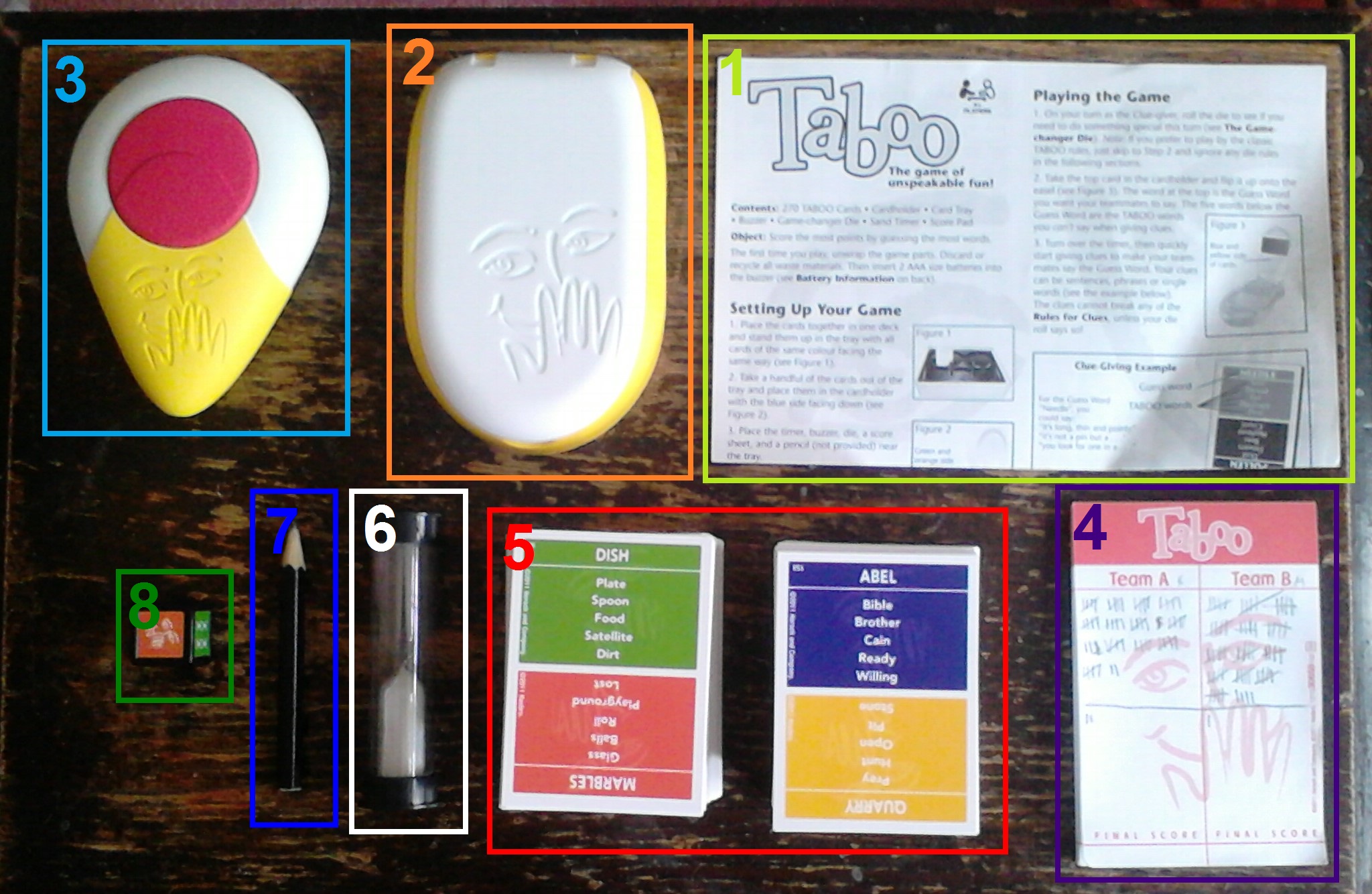
The Stuff.
1 Rulebook
1 Taboo Easel
1 Really Annoying “Nuh-Uh” Button
1 Score Pad
2 Reversible Word Decks
1 Timer
1 Pencil
1 Die
Playing The Game:
Objective: To get more points than your opponent by accurately describing more words to your team.
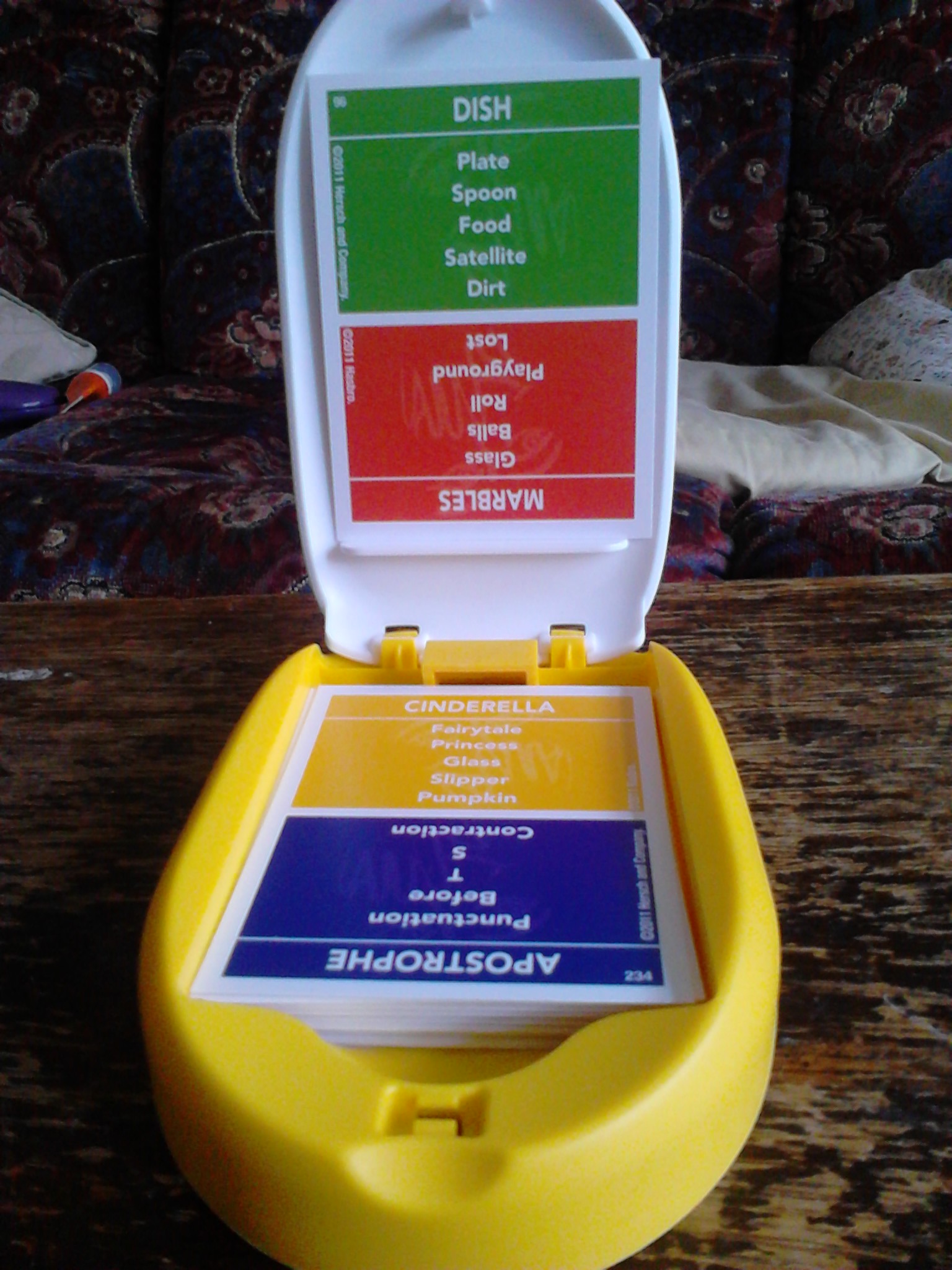
This game’s pretty simple, essentially you just divide up into teams, and then take it in turns to do some describing. You choose one player from your team to describe, and one to guess. The describer then places one card up on the easel, like this:
This is how you put the cards you’re describing.
As you can see, there are four colours on each card, which is great, is allows you to play four different games, and the colours have different kinds of words on them. We were playing to describe the green words, so the deck is placed accordingly face-down inside the easel and only one card at a time is revealed. Once the top card is turned up it’s the job of the describer to describe the word in such a way that their partner can guess it. BUT, they aren’t allowed to say the word on the card, or any of the words underneath it. These are “Taboo” words, and saying any of these causes you to give away a point to your opponents, as does passing because of the difficulty of a word to describe. They’re also not allowed to say the letter that the word begins with, or make explicit gestures.
Whilst you’re doing this you sit with one of the players from the other team; they’re given the annoying “Nuh-Uh” button and if you say anything you shouldn’t, they hit it so everyone knows you’ve made a mistake. For every word your partner guesses correctly, you get one point. Every time you finish a word, either because it’s been correctly guessed, passed or you said a Taboo word, you then flip up another card, trying to get through as many as possible per turn. The timer is used to regulate turns, each team is only allowed to turn it over once per turn and when it runs out your turn is over.
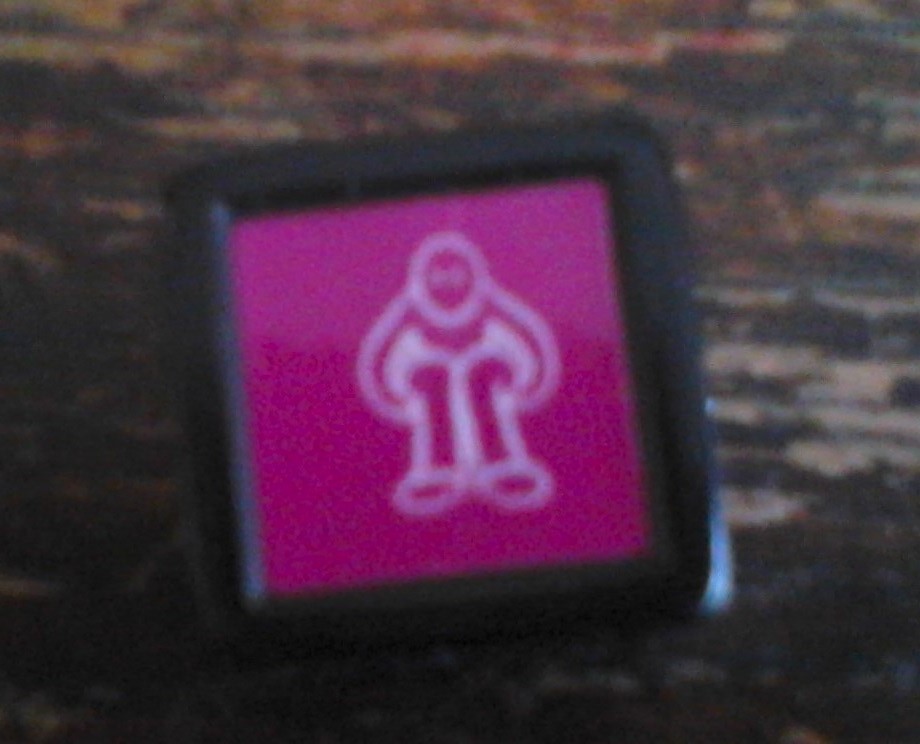
There is a second, slightly different version of this game, wherein the die is used. The only difference this makes is that at the start of each turn the describer has to roll the die, and then slightly different conditions apply. For instance, this side of the die means that the player describing must sit still like a statue:
Sit on your hands! (I also appreciate that the quality of this photo is terrible – Dave’s away so these photos were done on my phone)
The die does make the game slightly more interesting, but can be frustrating if you continually forget to roll or only get that face showing…
Winning The Game:
Points are scored how I said above, players pre-determine how many rounds or sections of the deck are going to be played before play starts. Once that number of cards has run out, the game is over, and the winner is the team left with the most points!
Strategy:
I can’t really figure one for this game, don’t waste your time waving your arms around? Try and partner up with someone who thinks similarly to you, sometimes you get a word that you can make an obscure film or song reference to, to help your partner guess it. But that’s no help if they’ve no idea what you’re on about!
History and Interesting Things:
There was a game show based on Taboo, hosted by Chris Wylde, in 2002.
In 2010, Cassandra Dominguez scored a record of 38 points in a four-round game at the World Board Gamers Convention.
The buzzer for the game featured on the Special Project episode of The Office.
Originally there was a board with the game, like in Tension, but this is no longer in the current editions of the game.
As far as history goes, that’s about it, it was only published in 1989, so not very long ago. It’s been on the radio and appeared in a few different TV shows, but other than that it’s not got much to say for itself.
To Conclude:
Taboo is a great game, a lot of fun, very light hearted and generally very silly. Like most games, it’s more fun with more people. Also, the fact that the rules explicitly say that you’re allowed to burst into song to help your partner guess a word really appeals to our family.
Tension is an interesting game, in the sense that it says; “NO! Not all answers to this question are right… Only the ones that I randomly preordain as right will score you points”. So. You end up getting angry at it because you name every James Bond film except for the ones written on the card.
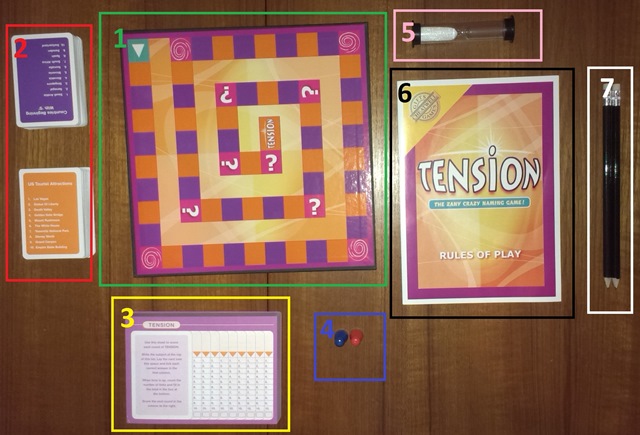
What’s In The Box:
The Stuff!
The game board.
1 Orange and 1 Purple deck of Quiz cards.
Pad of scoring sheets.
Two playing pieces.
Sand timer.
Rules book.
Two pencils.
Playing The Game:
Objective: To be the first player/team to reach the ‘Tension’ marker in the middle of the board.
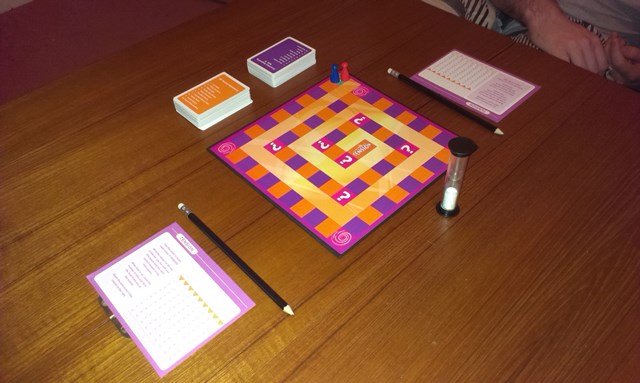
The starting setup.
Each player/team places their piece at the start, then the opposite team draws a card of choice (either purple or orange). They write the title of the card on their score sheet (you are effectively keeping score for the other team). Then they read out the title of the card and flip the timer over. The other team has until the timer runs out to guess as many of the ten things written on that card, that fall into that category – for example “James bond Films”, “Madonna Hits” or “British Inventions” – as possible. The team who reads the card out ticks off each one they get right on the score card until the time is up. The team then gets to moves the amount of spaces they got right. The colour of the square they are now on dictates the colour of the next card that will be drawn for them. They then do the same
for the other team.
The additional factors are the question mark squares and the whirlpool squares:
Question mark squares – The player must guess how many answers they are going to get right before the title of the card is read. If they get at least that many right they may move the amount the guessed (and no more) forward, if they get less than what they guessed they have to move the amount they guessed backwards. The colour of the card they get for these squares is chosen by the other team.
Whirlpool squares – If you land on one of these at the end of your move, the move you just made is immediately made again e.g. if you moved 7 and ended on a whirlpool you get to move 7 again straight away.
The player to reach the middle of the board first wins!
Strategy:
Possible strategy to this game is limited but here are a few things:
BE REALLY SMART OR PICK THE SMART PERSON TO BE ON YOUR TEAM – Basically knowing a lot about a lot of things is helpful… As in all quiz games.
TACTICALLY TRY TO HIT WHIRLPOOLS – If you can think fast enough you can try to hit Whirlpools intentionally. For example if you know you need eight to land on one, stop guessing once you know you’ve got eight right, because they you’ll move sixteen over all.
TACTICALLY TRY TO MISS QUESTION MARKS – Try to miss question marks by making sure you get more or less than the amount needed to land on one.
History and Interesting Things:
There is almost no history to be found on this game except that there are two editions of the game; the first one published in 1992 as Tension: The Crazy Naming Game and the second edition published more recently as Tension:The Zany Crazy Naming game, this is the edition we have which has more up to date topics/answers than the original.
To Conclude:
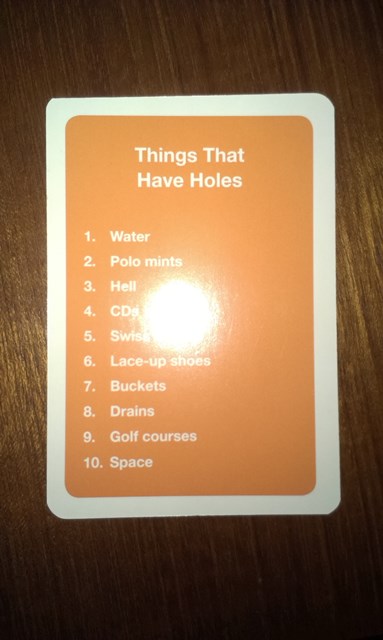
This could be a very good game; it’s easy to see how the concept could be expanded to make it more of a board game as well. You could add more of a maze type board and directional options that allow you to choose between which type of cards you’re more likely to get given. This would make it less based on just knowing stuff – yeah I know it’s a quiz game, but it could be that and so much more. Also some of the cards are a bit questionable as to who could possible guess those 10 answers correctly, like this one:
The one that can’t be read because of the flash is “Swiss Cheese”.
Not only is the question so broad it literally has millions of answers but the 10 answers picked to be “the chosen few” are mostly ridiculous! If the questions where a little better devised and the general game design a little more complex it could be a very good game. Additionally I see no real reason why it needs to be only two players/teams, apart from the fact that the teams/players who aren’t guessing or reading are sitting around doing nothing… But that’s true of most board games ever… If it’s not your turn, you’re not doing anything.
It does have the advantage that it’s easy to play, quite quick, and a good laugh, so it’s not all bad… It could just be so much better!
It’s completely possible, and quite likely, that the first thing that comes to mind upon hearing the word Mastermindis the TV Quiz Show, and although there is a board game of this, this is not it. This game of Mastermind pre-dates the TV show (by 1 year) and is a very simple, quick and fun game that anyone can pick up. But I want it noted here that the version featuring in our photos is in fact the Junior Mastermind, version of the game produced for children, featuring small, brightly coloured jungle animals as the pieces and having only three holes across for the code, rather than 4.
What’s In The Box:
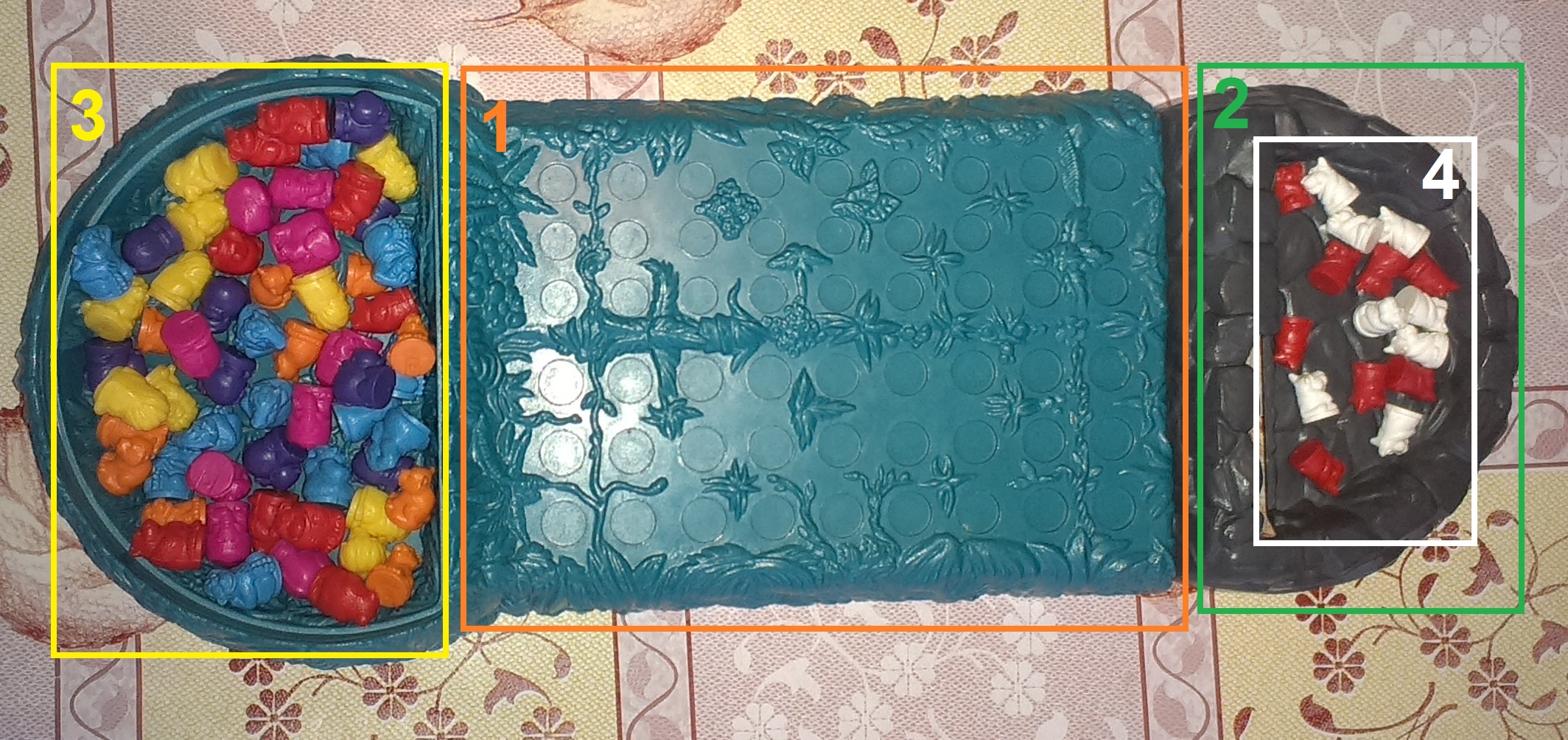
You can probably tell that we’re missing some of the pieces…
Green jungle playing board
Rocky mountain section (used to hide the code)
An assortment of 6 coloured animals
15 red creatures and 15 white creatures (supposedly)
Playing The Game:
Objective: to crack your opponents code before you run out of pieces, or to create a code that your opponent cannot crack.
To start the game you choose one player to be the code-maker, and one to be the code-breaker; then you position the board accordingly. The code-maker then takes a minute or two to secretly decide what the code’s going to be and put the pegs (or in our case little animals) in the shielded section of the board. After this, play starts.
It’s now the job of the code-breaker to pick out pegs (or animals), and position them on their side of the board in the order that they think the code is. The code-maker then uses their red or white creatures to signal which, if any, of these guess are right. To be right a piece must have both the correct position in the code (i.e. central, left or right hand end, from the point of view of the code-maker) and be the right colour.
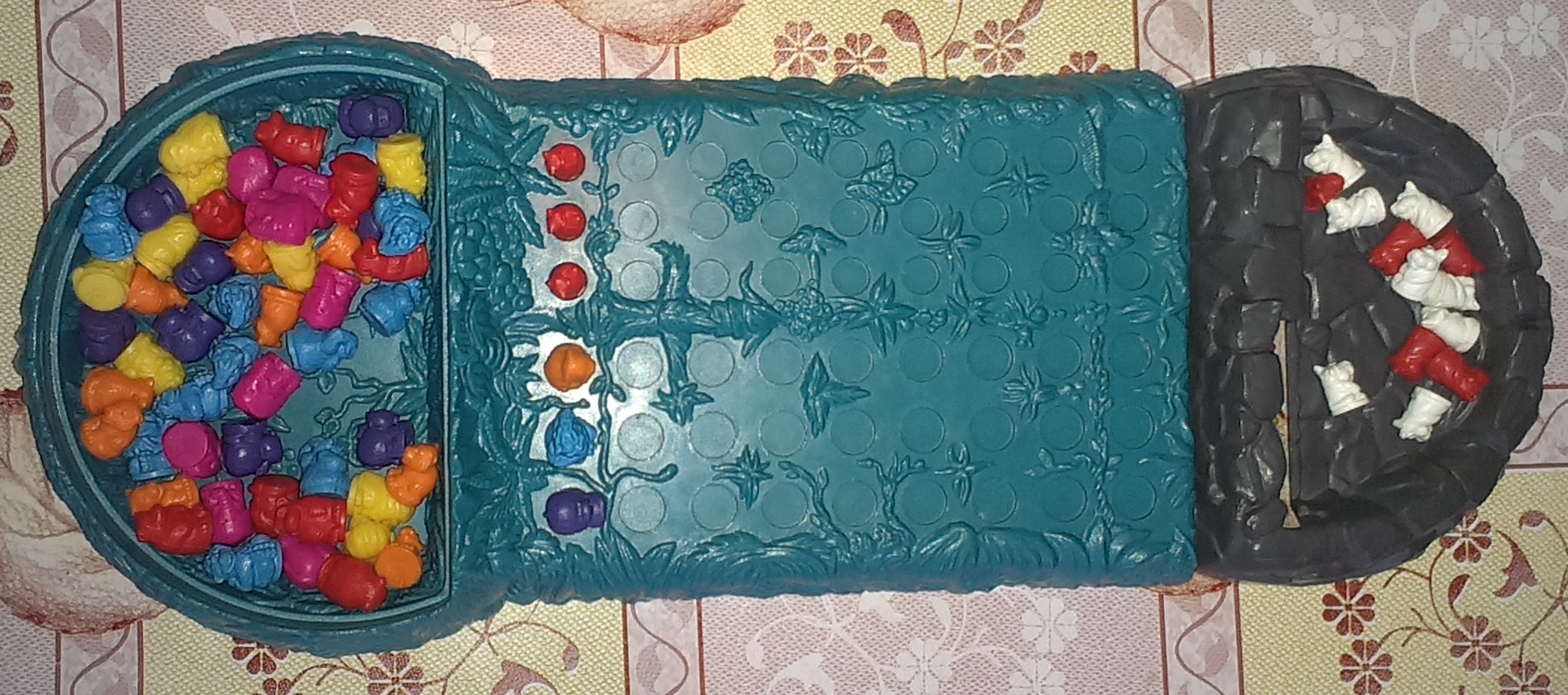
So the first turn of the game might look something like this:
And they’re all wrong
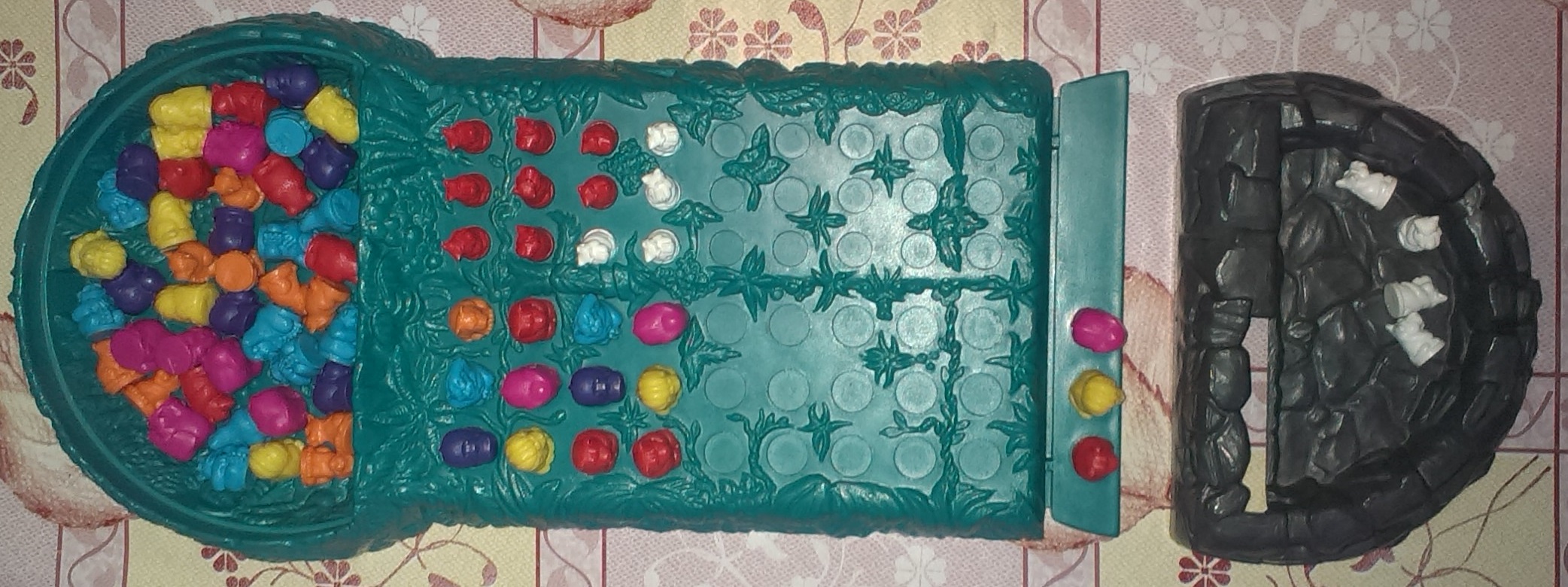
Play continues in this manner until the either the code is cracked, or you’ve played to the end of the board. Like this:
And Dave wins
Winning The Game:
Traditionally this game is played in rounds; the players decide before starting how many rounds are going to be played (always and even number) with the roles of code-maker and code-breaker alternating every round. The winner is the player with the most points at the end of this. Points are scored by the code-maker. S/he gets one point for each guess the code-breaker makes, and is given an extra point if the code-breaker doesn’t manage to accurately guess the entire code in their last move. Points are kept track of across the rounds and added up at the end.
Strategy:
For the Junior version of this game there isn’t a great deal of strategy required, but for the adult version (which has a four-peg code, rather than three, and one more option for indicating yes or no to part of a code) you can be a little more logical about it. Unless you’re a mathematician (which I’m definitely not, but the internet’s a wonderful place to learn things) you probably won’t be able to work out in your head the maths that accompanies this game, but the most important thing to remember is that duplicates are allowed in the code.
History and Interesting Things:
The modern game, played with pegs, closely resembles a pen and paper game called Bulls and Cows that may be over a century old.
The rights to the game have been held by Invicta Plastics since 1971, initially they manufactured it themselves, but have since licensed it to Hasbro, Pressman Toys and Orda Industries for production across the world.
The 1973 edition of the game features a well-dressed white man sitting in the foreground with an attractive Asian woman standing behind him. Bill Woodward and Cecilia Fung reunited in 2003 after 30 years to pose for another publicity photo.
In a standard set of the game, allowing a four-peg code, with six colour options, there are 1,296 different possible code patterns (including, and allowing for duplicates).
In 1977 Donald Knuth showed that the code-breaker can solve in a maximum of five moves, using this algorithm.
There have been computer versions of the game produced, as well as multiple different editions released.
The difficulty level of the game is altered simply by changing the number of pegs allowed for the code, or the way in which the code-maker indicates a correct or incorrect guess.
To Conclude:
I like Mastermind a lot, it’s a simple game that’s good for burning time or just chilling out, it doesn’t require a lot of concentration, and it doesn’t take long to play. I’d strongly recommend teaching it to kids too, the length of time it takes to play is well-suited to the generally shorter attention span of kids. But don’t let the really little ones get their hands on it – swallowing one of those pieces could end really badly!
So to conclude classic games month we have Battleships… A game so iconic that they made a film out of it. A terrible, terrible film. Which is a shame, because the trailer made it look like it could have been quite good:
But if you haven’t seen it, really don’t! Any film starring Rihanna is probably going to be terrible and Taylor Kitsch doesn’t have the best track record either (although I maintain John Carter was nowhere near as bad as people said it was). Anyway I have already digressed severely, so to the point!
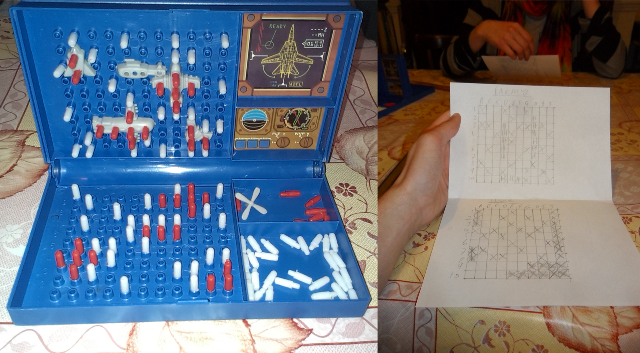
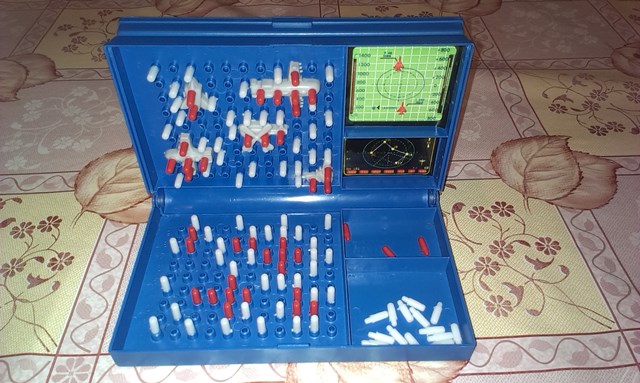
Two different ways to play battleships.
What’s In The Box:
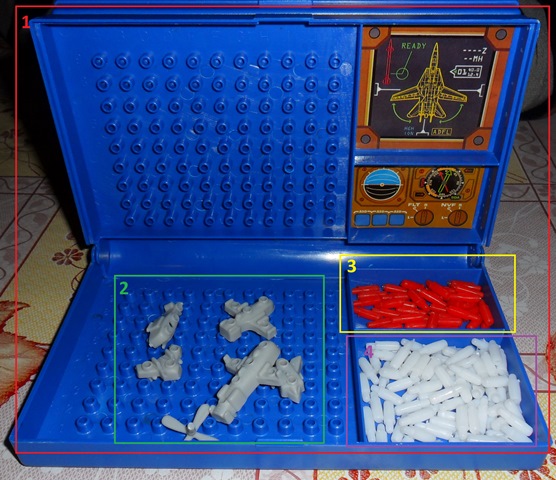
Well we played this game the original way; which is on paper a bit like noughts and crosses (see the history section at the bottom for more info) and we played a newer version of the game that’s called Air Battle. So, for the paper one all you need is two pieces of paper, two pencils and a ruler/straight edge is handy, but not essential. But for Air Battle and most other variations of Battleships you will find these pieces (or similar).
The Stuff!
A box with two sides each with a grid on the divider and a grid on the bottom.
Five (amount may vary) battleships or similar craft.
A load of red pegs for marking hits
A load of white pegs for marking misses.
Playing The Game:
Objective: To sink all the other persons battleships by guessing correct grid co-ordinates until you’ve hit and sunk all their ships before they can do the same to you.
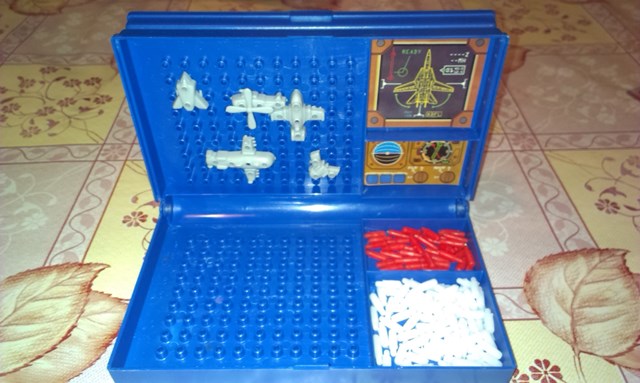
The game starts by by both player secretly placing their ships on there grid so only they can see.
The start of the game.
Each player then takes it in turns to guess the grid co-ordinates of the other persons ships; the other person must tell honestly if they have hit any of their ships. The player making the guess then records hits and misses on the grid that they have not placed their ships on so they can remember what they have and haven’t guessed. The other player also records where that player’s guessed if it’s a hit or a miss on the grid that they have placed there battleships on.
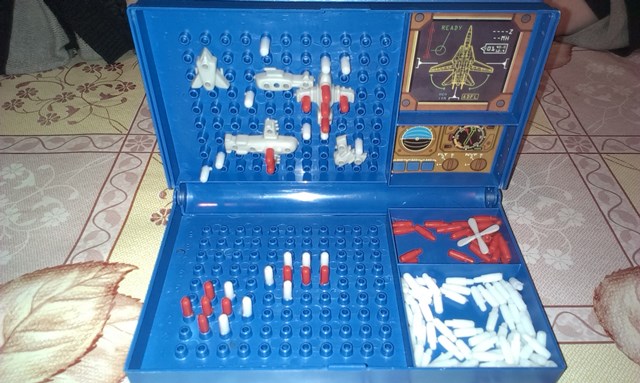
The red pegs mark hits and white pegs mark misses. The top grid shows your battleships and the hits and misses your opponent has made and the bottom grid shows the hits and misses you have made.
A player must announce when a ship is sunk and when all a players ships are sunk they’ve lost the game.
A finished game.
Strategy:
TO CLUSTER OR NOT TO CLUSTER… That is the question. Sometimes it pays off to cluster all your ships together, because then when one ship is sunk your opponent thinks that’s it for that section of the board and goes to guessing some place else. However, once they catch on that this is what you’ve done they very soon defeat you.
SEMI CLUSTER? – I find the best tactic is to put two of you ships together so it makes the shape of a one of the larger ships, that way at any point if you say sunk they think they’ve sunk a larger ship and stop bombing that area whilst really they’ve probably only sunk one of the two ships you put together.
READ HER POKER FACE – As always it pays to know they way your opponent thinks.
BE GOOD AT GAMES OF COMPLETE CHANCE – Because that’s really what this game comes down to.
History and Interesting Things:
The original game was developed as a pen and paper game (which is why we played it on paper too) and was sold by multiple companies in the 1930s.
It was released as a plastic board game by Milton Bradley in 1967.
The game is thought to have originated from the French game L’Attaque.
There is a Salvo variation to the rules that allows a player to call out 1 to 5 shots all at once to simulate the simultaneous discharge of guns.
It was one of the earliest games to be produced as a computer game. A version of it was released on a Z80 Compucolor in 1979.
That was then followed by Atari’s Battle Zone in the 1980s.
In 2010 an ‘updated’ version of the game was released which use hexagonal tiles and had islands on the board, also players could only place ships in their half of the board.
There are many, many variations of the game, including different sized grids versions, multiplayer versions, versions with submarines, versions with aircraft (like the one we played) and version with many different shaped craft.
There is a terrible film inspired by the game that came out in 2012… I know I’ve already mentioned it but if you doubt its terribleness watch this:
To Conclude:
Obviously Battleships is iconic; its also good fun to play and takes next to no skill so anyone can do it. However it’s just a game of guessing, so gets easily boring and you can quite legitimately be beaten by a child at it… And that might tend to make you angry.
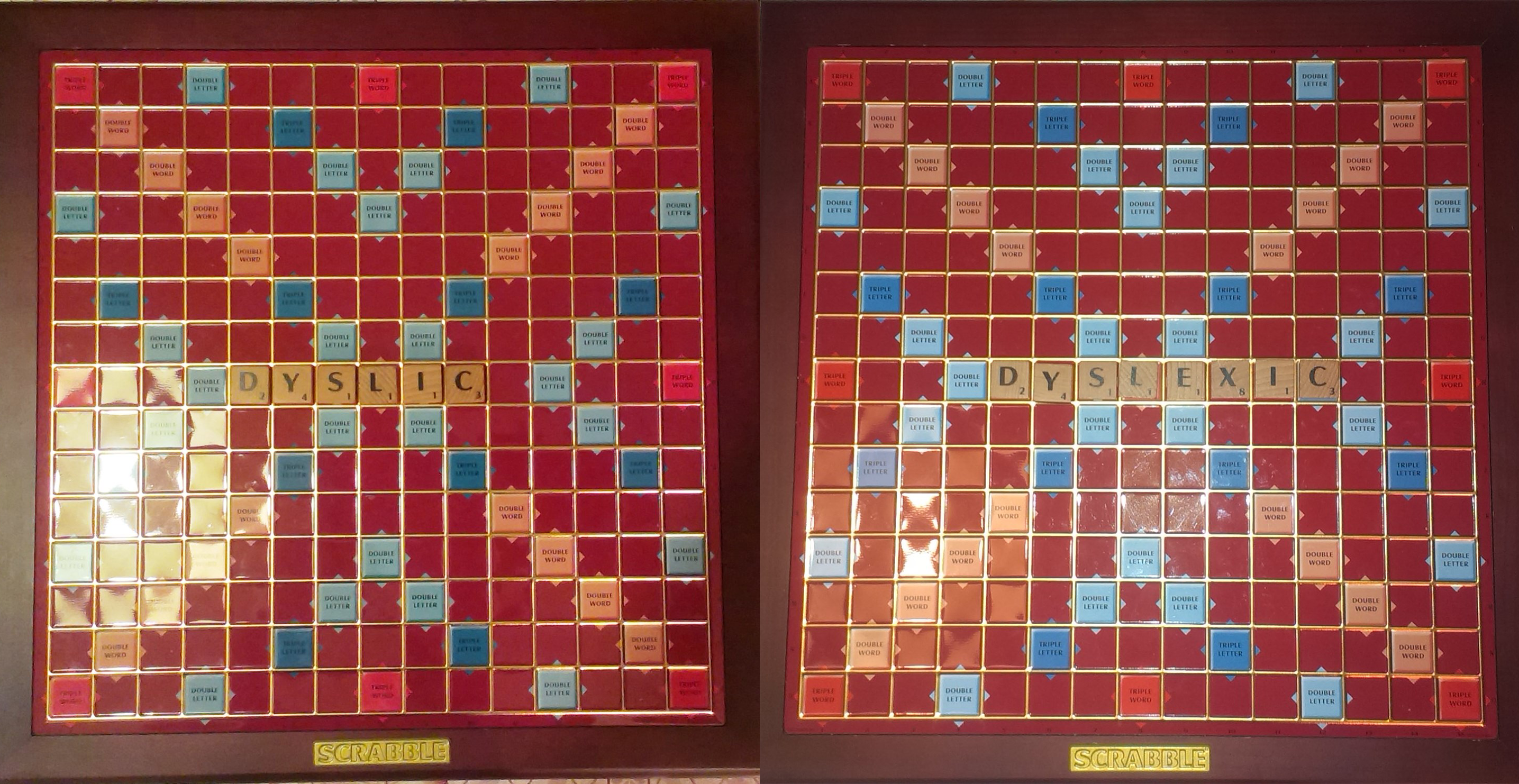
Scrabble is one of the classics of classics. There’s a high chance that you’ve played this game at some point in your life, or, failing that, have seen a copy floating around in your grandparents house that they like to get out at Christmas and encourage everyone to play together. Either way, it’s a fun game to play, especially on teams, and especially especially if there are dyslexics around.
What’s In The Box:
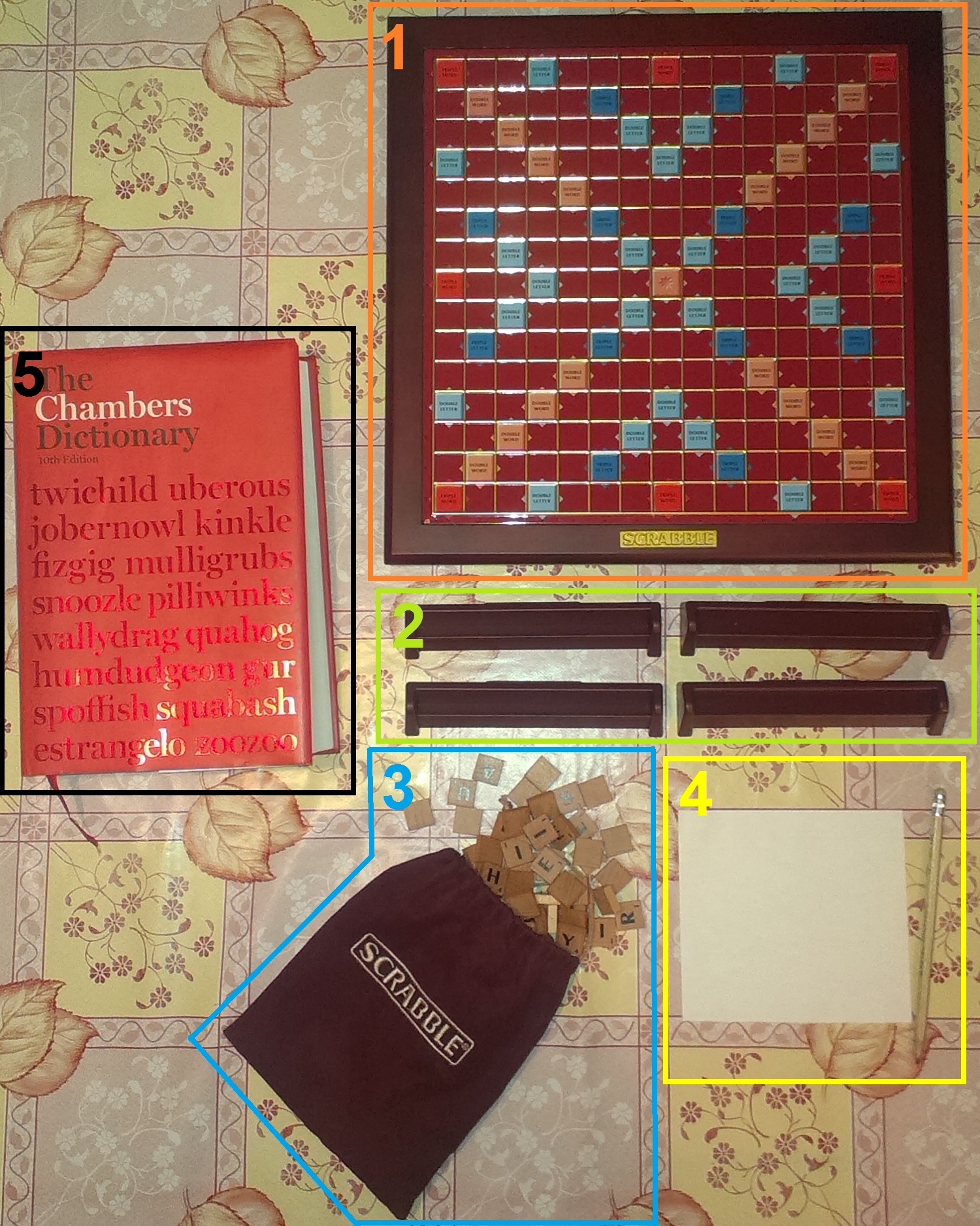
The stuff.
1 Game Board
4 Tile Racks
1 Bag containing 100 Letter Tiles
1 Pencil and Score Sheet
The Chambers Dictionary (not actually included in the box, or used by anyone I’ve ever met when playing this game)
Playing The Game:
Objective: To have scored the most points by the time one player plays their last tile and there are none remaining in the draw bag.
To determine who plays first each player takes one tile at random from the draw bag, the player with the letter closest to the start of the alphabet is the starting player. From them play proceeds clockwise around the board. All of these tiles are then returned to the bag, and new tiles are drawn. In play order players draw 7 tiles and place them on their tile rack, keeping them out of the sight of the other players.
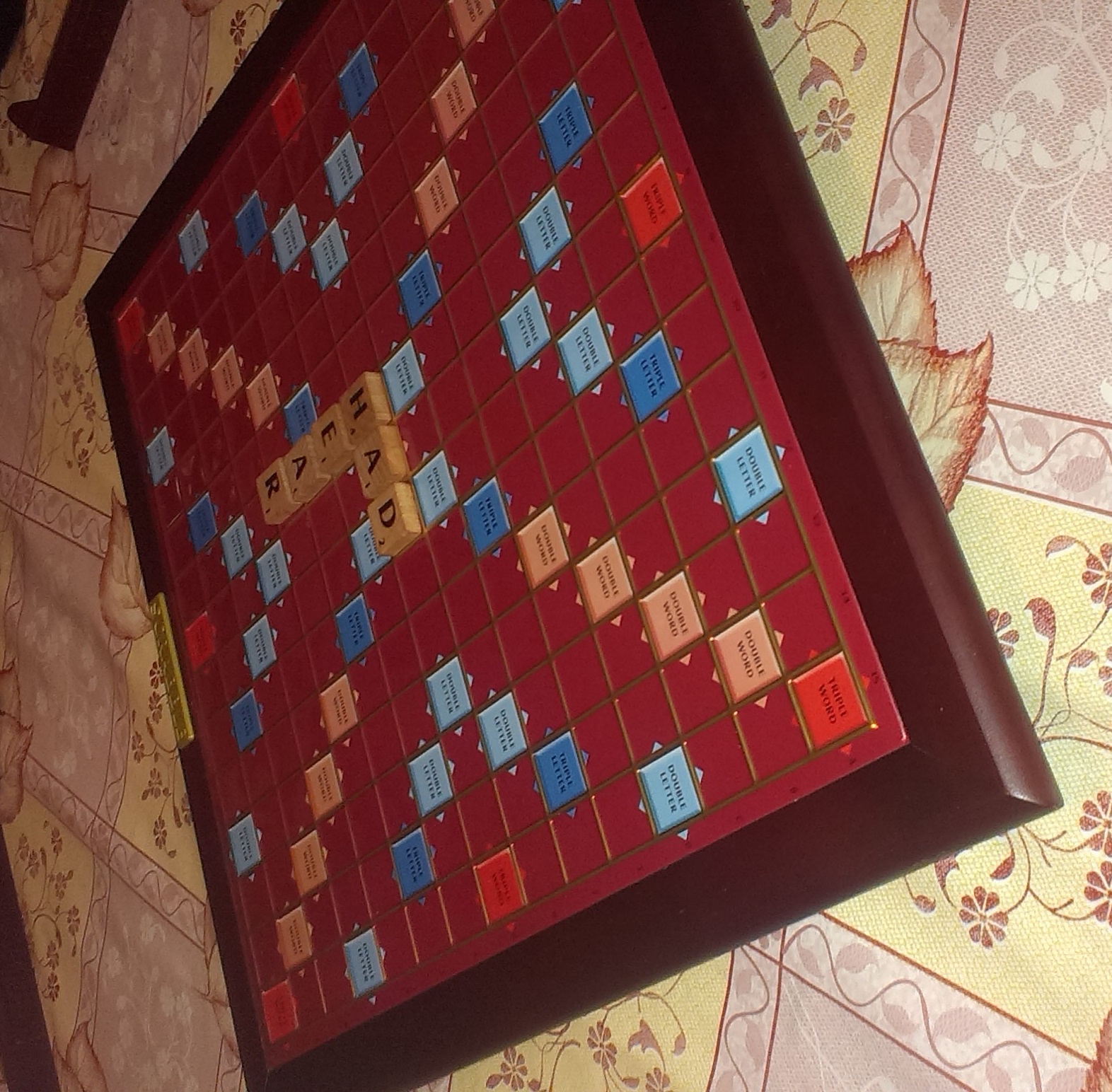
Once all players have their tiles, player one places a word on the board. All words must be at least two letters long and the first player places their first word across the red Double Word space in the middle of the board. After the first word has been played other players can lay words; new words must either be played through other words, crossword style, or be added on to the end of a word already on the board, for instance by adding an “S”. All words played must be real words, and names (of both places and people) and foreign languages are not considered legitimate words.
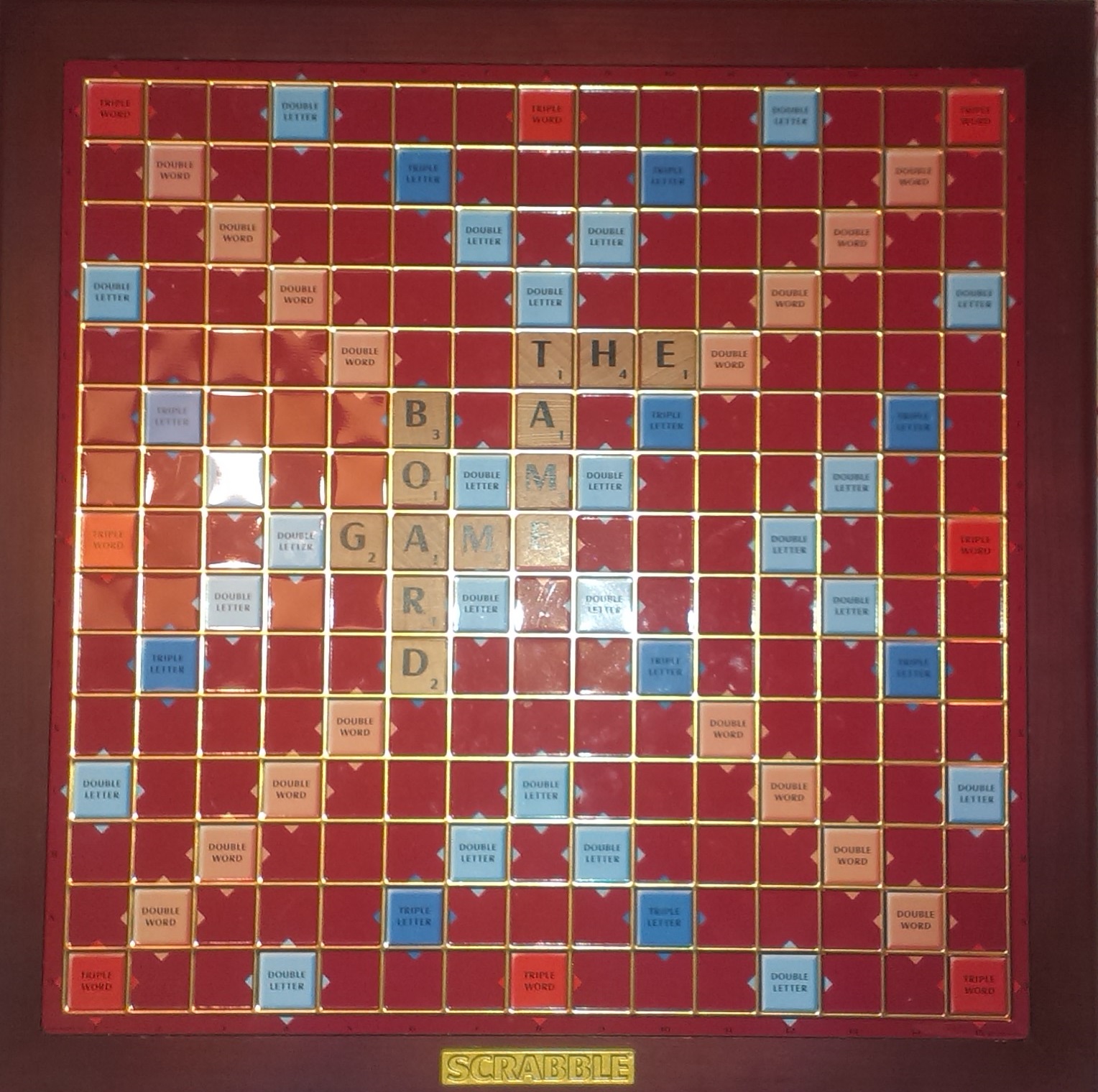
I don’t really know what was going on with this picture. I assume artistic license has something to do with it…
So you can kind of see what the opening words of a game might look like, even though the angle of that photo is weird as. Once a player has played a word, they then draw the same number of new tiles at random from the Draw Bag as they placed on the board. This can be interesting, because there’s no knowing which letters you’re going to be blessed with next. You can end up with a rack that only contains vowels, or consonants. Which is often not a huge amount of use.
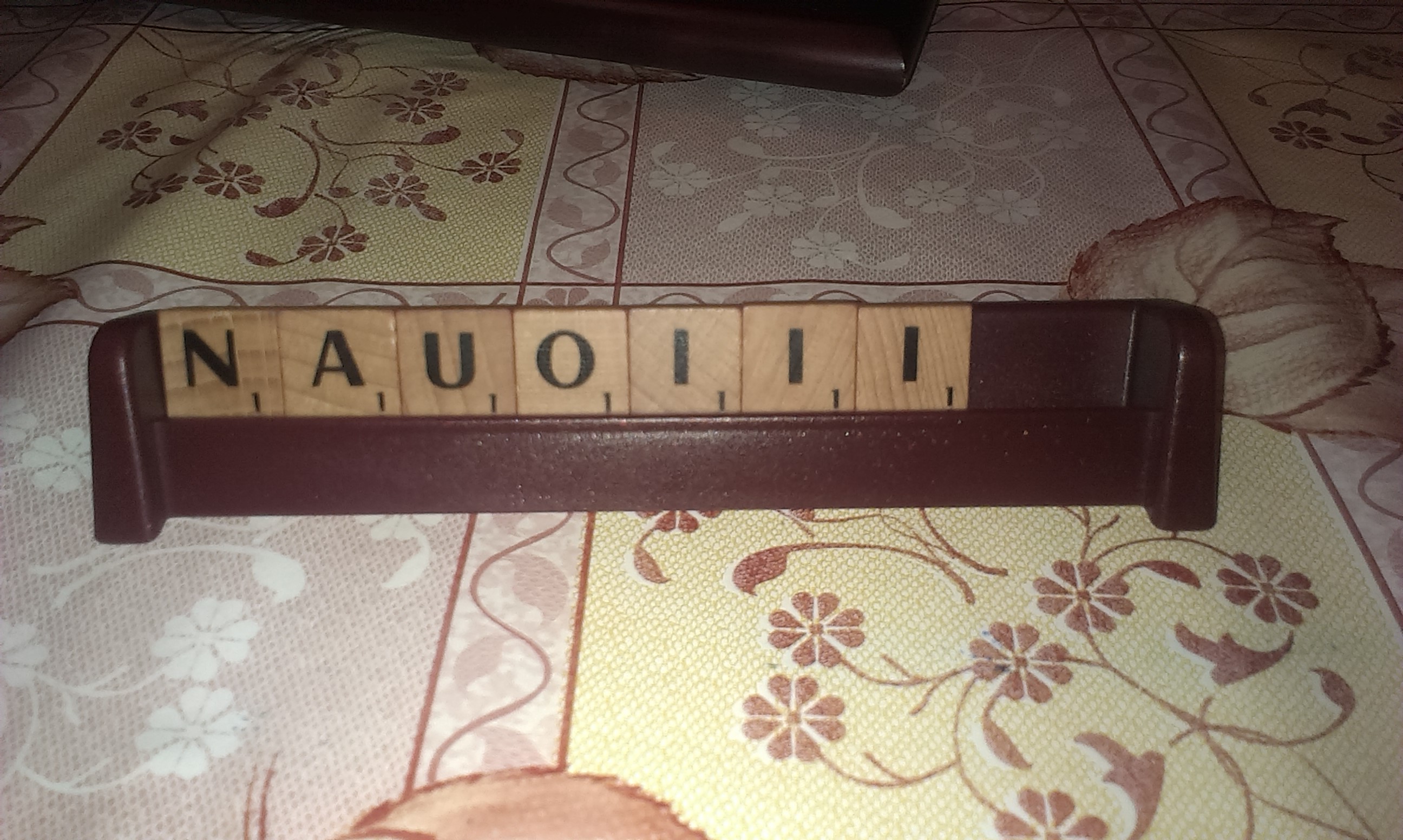
However, there is a rule that allows a player to forfeit a turn to change all of their tiles, to do this the player must wait until it’s their turn, and then exchange their whole rack for fresh tiles from the Draw Bag. Play then immediately passes to the next player. This is a good rule that can allow you do something about getting rid of a rack that looks like this:
Had I chosen to do so, that rule would’ve allowed me to replace these tiles with new ones from the Draw Bag
Play continues in this way, with one player keeping track of score until one player plays their last tile after the Draw Bag has been emptied. To score a player has to take into account both the value of the letter tiles played (the number on the bottom right hand corner of the tile), and whether or not the word has been played over any double/triple word/letter score tiles on the board. If it has then you must increase the score of that word for that player accordingly. If a player plays a word that changes a word already on the board, for example playing a word that starts with “S” and adding the required S onto the end of a word already existing on the board, the player adds up to total for the word they have changed, as well as the word they played, to be the score for that turn.
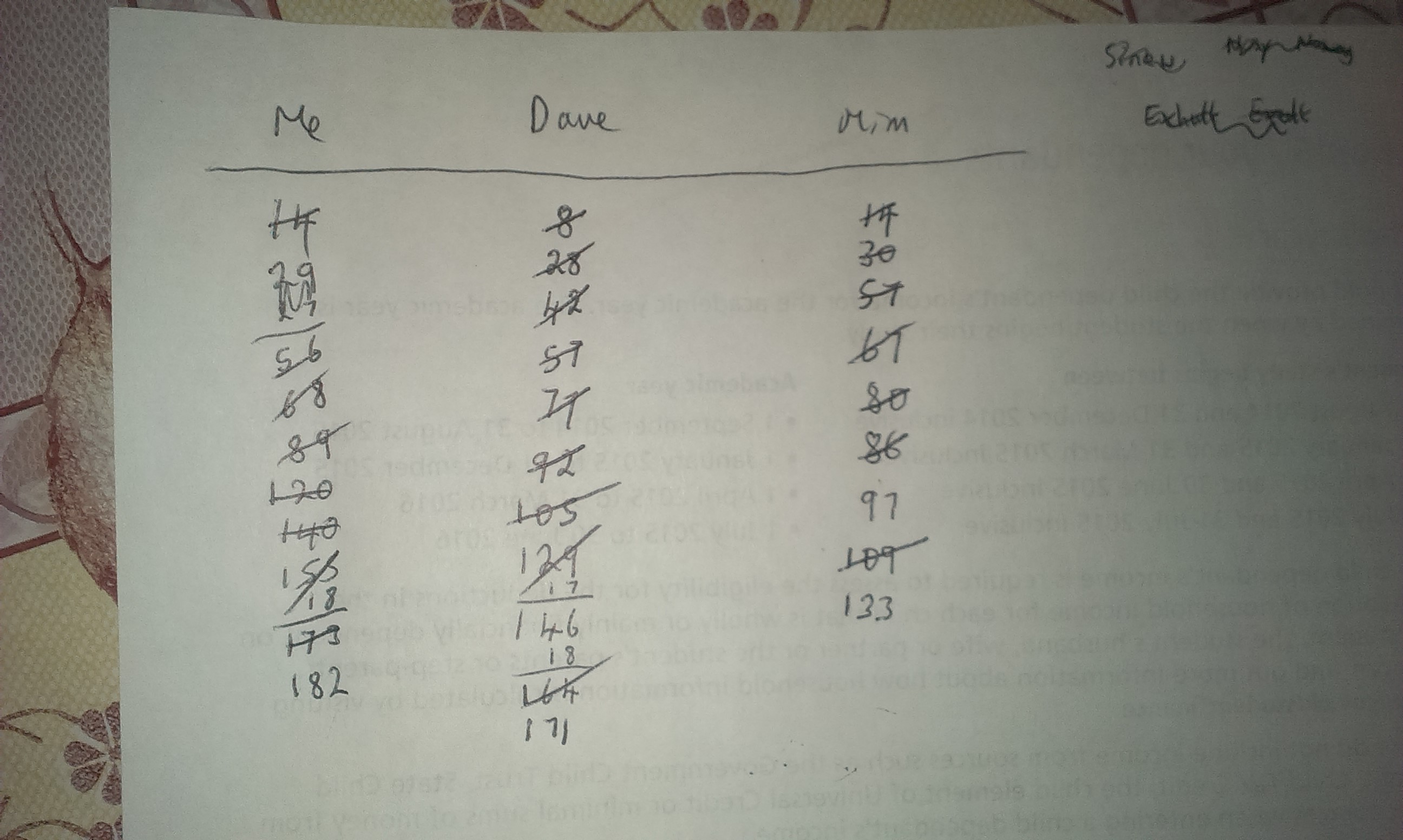
A generally accepted method of keeping score is to draw out columns on your score sheet with the initial or name of each player at the top of a column, you then keep a running total going in the columns so you can see exactly where each player’s at throughout the game, like this:
Our score sheet. As per the norm, I lost.
Strategy:
The best kind of strategy for this game is to look out for the bonus point spaces on the board, because there’s no point in making an absolutely fantastic word that lets you play lots of your letters but doesn’t get you any extra points if it then creates easy access to a double/triple word/letter tile that another player can use to score some ridiculous amount of points. Other than that this is really a “be as imaginative as possible” kind of game, where the weirder the words you play are, the better the game gets.
History and Interesting Things:
The game was invented by an American out-of-work architect called Alfred Mosher Butts in 1938. He created the game by combining features of anagrams and crosswords.
It was originally called LEXIKO and then CRISS CROSS WORDS before becoming Scrabble.
Although everyone thinks of this game as a word game, it’s actually fundamentally a number game, to create the game a series of painstaking letter-frequency calculations were needed to determine how many times each letter should appear in the game.
The game was rejected by many games manufacturers, until Butts met James Brunot who loved the game.
Between Butts and Brunot they refined the rules of the game and came up with the name Scrabble which means “to grope frantically”.
The game was trade marked in 1948.
To produce the game the Brunot’s rented an abandoned schoolhouse in Dodgington, Connecticut, where, asissted by friends, they turned out 12 games an hour, stamping letters onto the wooden tiles one by one.
As with many games the game lost money in its first year, but, over a few years, the game steadily grew in popularity, until the president of MACYS came across the game on holiday and ordered some for his store. Soon after this it became a must-have, and Brunot realized that they could no longer produce the games fast enough to meet demand. They licensed Selchow & Righter to produce the game until, in 1972, they purchased the trademark from Brunot.
Selchow & Righter were bought by COLECO in 1986, but when they declared bankruptcy in 1989 the trademark was bought by Hasbro, the largest games manufacturer in America.
The game is now found in one in every three American houses.
To Conclude:
A very good game, although only rated 3 out of 5, this isn’t a reflection on how much I like the game, more of a reflection on how accessible it is for everyone. For instance, although it’s a great game for everyone in that it can be very fun and silly, it’s an unbelievably challenging game for anyone with literacy difficulties, as well as occasionally being very frustrating due to the random selection of tiles. That said, it’s a game everyone should play a few times, even if it’s just to discover that your friends know words that they didn’t know they knew so you can argue over whether or not they’re allowed on the board.
Clue is probably one of the most popular board games of all time after Monopoly. For those of you living in the UK and a few other places your know this game by the name Cluedo. While it’s a classic its far less boring (and infinitely continuous) than Monopoly and even has a slightly role playing feel to it without directly inviting you to step into a character at all (you may choose to anyway due to physiological imbalances… Like my self).
What’s In The Box:
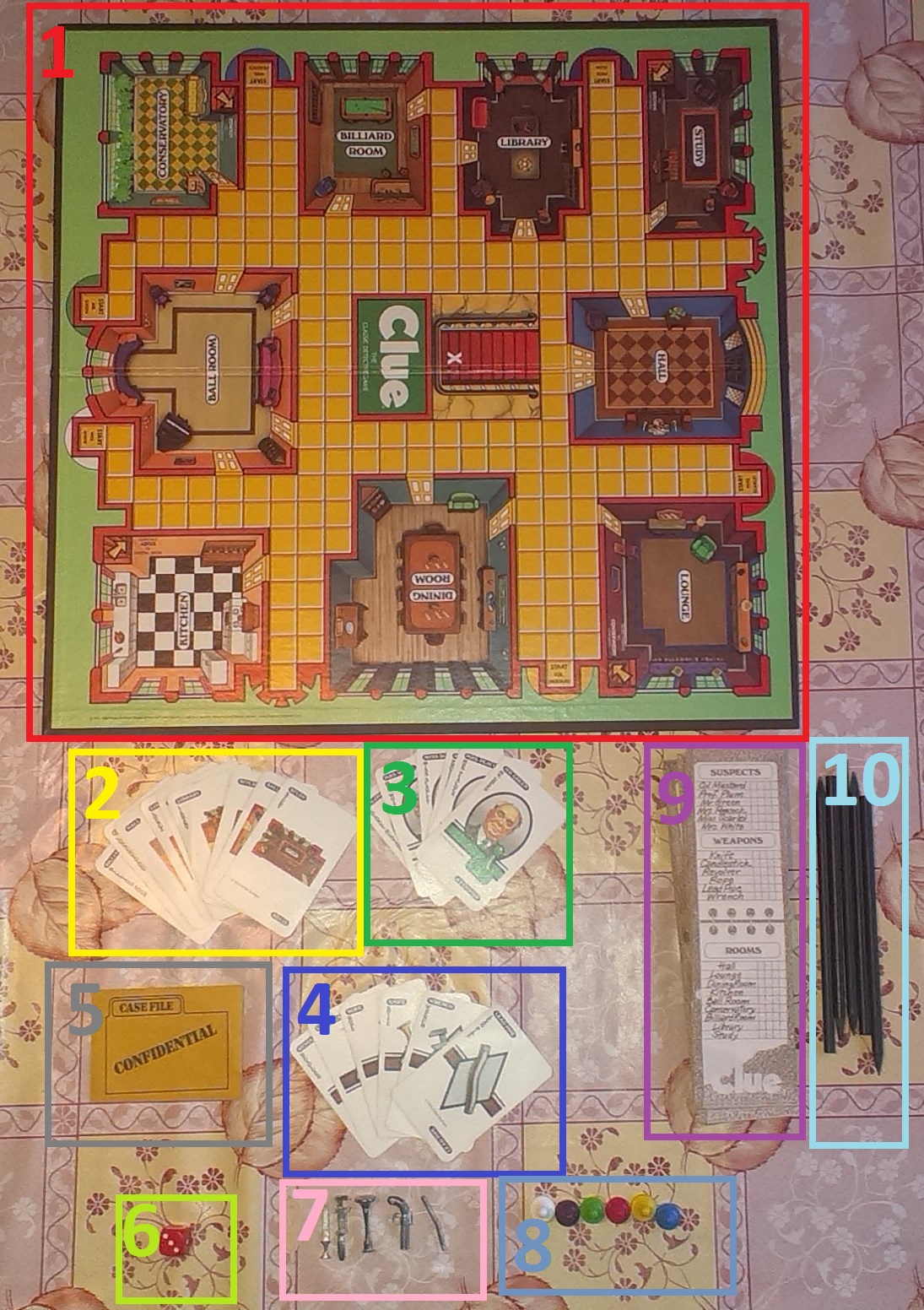
The Stuff!
Game Board (with 9 Rooms)
9 Room Cards
6 People Cards
6 Weapon Cards
1 Confidential Case File
1 Die (2 dice in later editions of the game)
6 Miniature Weapons:
Lead Pipe (Lead Piping in Cluedo)
Rope
Knife (Dagger in Cluedo)
Wrench (Spanner in Cluedo)
Candlestick
Revolver
6 Character Pawns:
Miss Scarlet (spelled Scarlett in Cluedo)
Professor Plum
Colonel Mustard
Mr. Green (Reverend Green in Cluedo)
Mrs. White
Mrs. Peacock
Pad of Detective Notebooks
Confidential Case File
Instructions – found printed on the box of our copy (not pictured)
Playing The Game:
Objective: To be the first player to correctly accuse the right person of the murder in the right room with the right weapon.
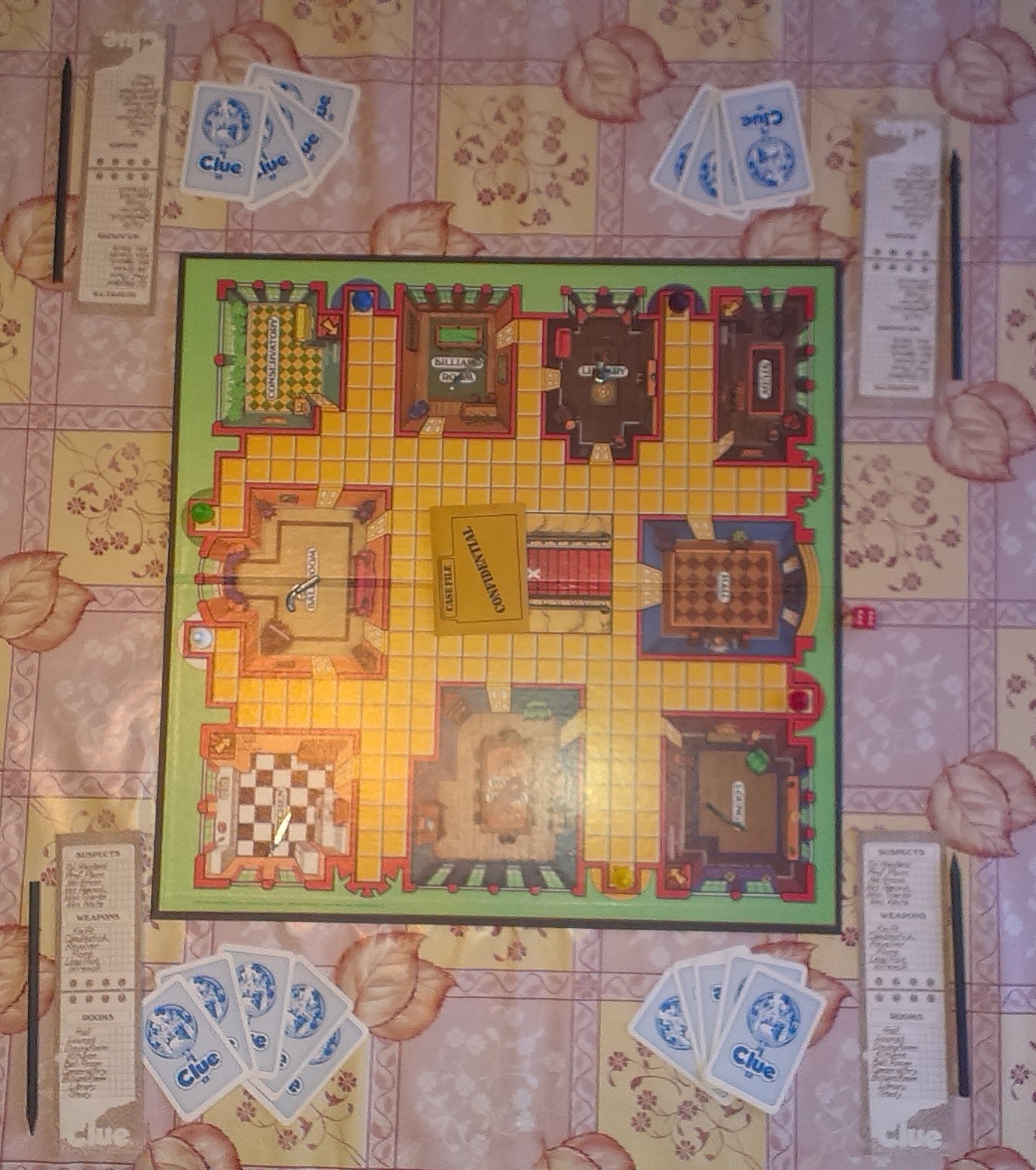
The game starts by the three decks of card being shuffled separately and the top card of each deck being placed into the case file (without anyone knowing what they are). The rest of the cards are shuffled together and dealt between the remaining players. Each player also has a detective notebook and a pencil. The weapons are randomly distributed between the rooms (only one per-room).
The starting set up.
Each player may then look at the cards in their hand and mark them off on their detective notebook so they know they’re not the cards in the case file. Make sure your notebook and cards are kept out of the sight of other players. Play then starts with Miss Scarlet who roles the dice and moves accordingly (you cannot move diagonally). Play then proceeds clockwise around the board.
Suggesting:
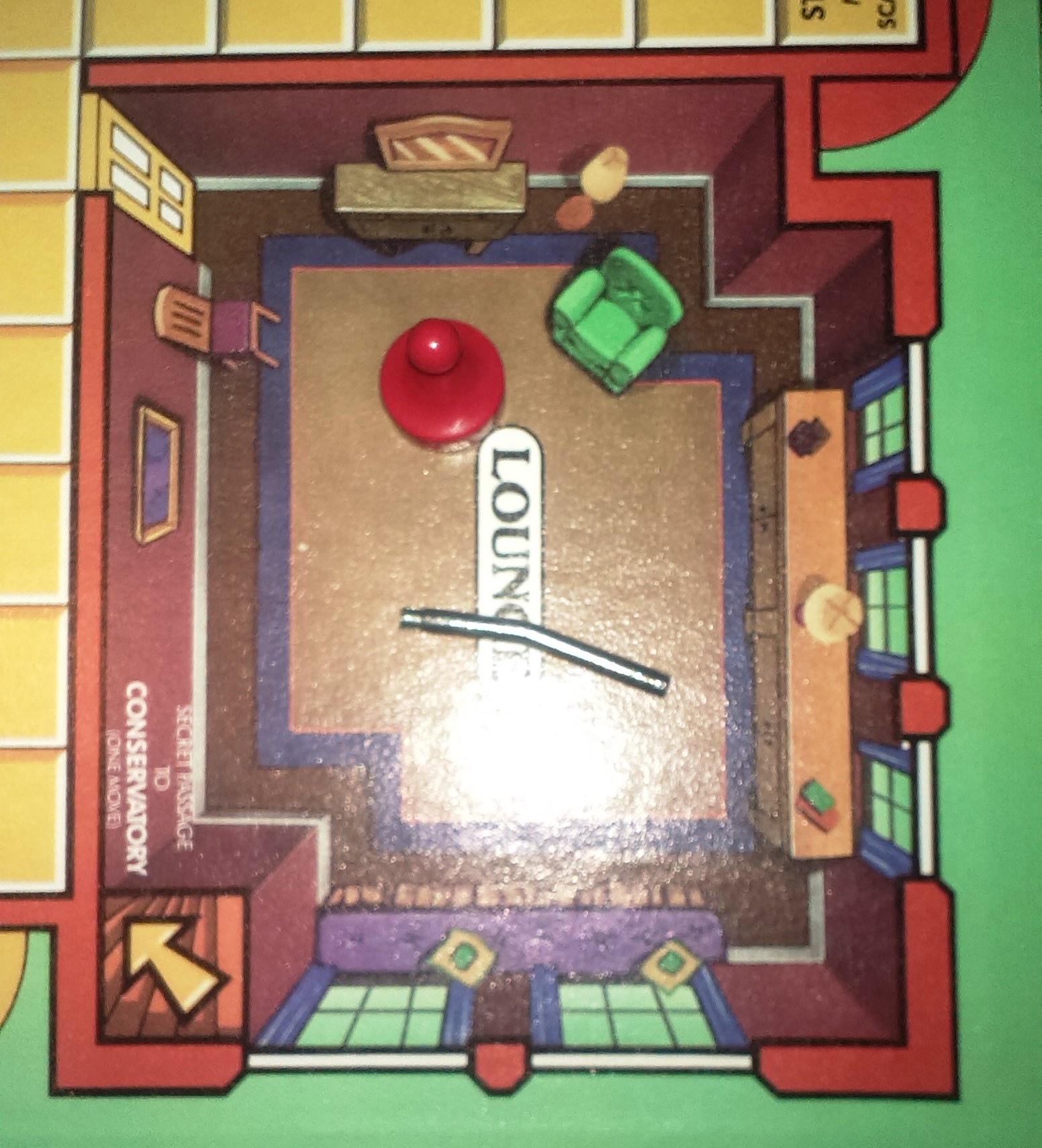
When a player enters a room he/she may make a suggestion of who committed the murder. They can suggest any character (even themselves or one not controlled by a player), on doing so they move the character to the room they are in and then they also choose the weapon they think they may have used and move that into the room.
So this is a suggestion of Miss Scarlet in the Lounge with the Lead Pipe.
The player to the left of the person making the suggestion must then show one of the cards relevant to the suggestion if they have one, if they do not then the next person must show one relevant card and so on. They must only show the player making the suggestion and none of the other players. If the player to the left of the one that made the suggestion has more than one of the relevant cards they may choose which one to show, and as the game progresses this can be used to your advantage to throw the other players off by making them believe you don’t have a a card that you’re actually holding.
Accusations:
Once you have done this enough and someone is confident they know which three cards are in the confidential case file (and therefore not in play) they may make an accusation. To do this they say “I am accusing, <a person>, in <a place> with <a weapon>”. They do not move the relevant pieces, nor do they need to be in the correct room. They then look in the case file to see if they are correct; if so they are the winner, if not they are out of active play and only stay to show their cards upon the suggestions of other players.
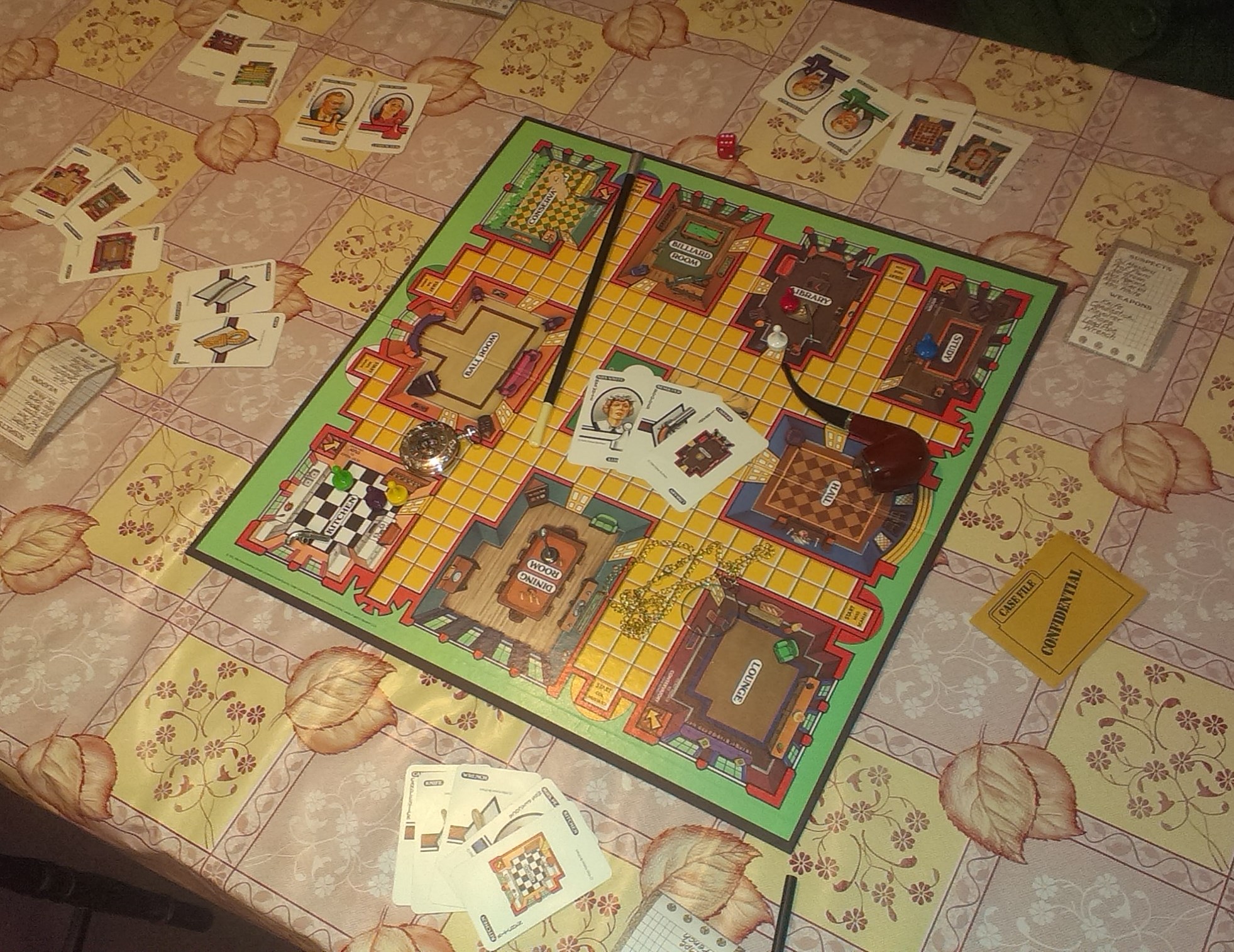
At the end of the game, all prop pieces down.
Strategy:
Like in real life DON’T BE TO QUICK TO ACCUSE – While you might be eager to win the game and are being hasty to attempt to beat the other players to it, be sure of your facts before you go yelling accusations – otherwise it’s game over for you!
BE AWARE OF WHO’S SHOWING CARDS ON SUGGESTIONS – Always take mental notes of who’s showing cards with regards to certain things. If a suggestion gets all the way round the board with no one showing any cards then the only person who might have any of the components of the suggestion is the person who made the suggestion themselves.
PLAY YOUR CARDS CLOSE TO YOUR CHEST – An easy game to accidentally cheat on, especially if someone’s stretching at the right time or “just leaning back”. So keep your cards and your detective notebook well covered.
History and Interesting Things:
The game was initially patented in 1944 by Anthony E. Pratt under the name Murder!
The game was originally created to be played in air raid shelters during the War.
Anthony E. Pratt’s wife then presented it to Waddingtons‘ executive, Norman Watson, who purchased it.
It was then given the name Cluedo which was a play on the words Clue and Ludo (which means ‘I play’ in latin).
Whilst the game was created in 1944 and the patent granted in 1947 the game was not launched ’till 1949 due to war shortages.
The game was also licensed to Parker Brothers and renamed Clue to be distributed in the United States at the same time as it was launched in the UK.
The game that was launched in 1949 differed in a few ways from the original concept. The games original design had been to have ten characters one of which was randomly assigned as the victim at the beginning of the game, leaving eight playable characters and nine suspects. Mr. Brown, Mr. Gold, Miss Grey, and Mrs. Silver where eliminated from the game and Nurse White was renamed Mrs. White and Colonel Yellow was renamed Colonel Mustard. Originally there were also eleven rooms, this was canceled down to nine, eliminating the gun room and the cellar. There was also supposed to be nine weapons, some of the eliminated or replaced weapons were the bomb, syringe, shillelagh (walking stick), fireplace poker and the (later used) axe and poison. Some of these weapons and characters were used in later spin-offs of the game.
Additionally, the game play was different from the published version. The cards were distributed into the rooms for the players to collect. Players also had to land on other players to make suggestions about them through the use of tokens that, once exhausted, prevented you from making any more suggestions.
Both Parker Brothers and Waddingtons‘ produced a number of unique editions between 1949 and 1992 when they were both purchased by Hasbro in the early 1990s. Hasbro continued to produce unique editions for each market until 2002/2003 when it produced the modern version of Clue/Cluedo which was unified for all markets with only localised spelling and regional changes made to each edition.
The version we own (appearing in this post) is a 1989 Parker Brothers North American copy (even though we live in the UK) and we also own the modern UK version.
To Conclude:
Clue (Cluedo) is a good game… It’s easy to see why it’s been such a commercial success. However, in my opinion, it suffers from the same thing Monopoly does… It’s boring. Now this isn’t because it’s inherently boring, it’s just because most people most places have played it LOADS since they were children and therefore have no interest in it. In a sense it’s a victim of its own success when it comes to catching my interest. Like when you’re sitting there with some people and you go “Hey guys, let’s play some Monopoly” and everyone groans and goes “PLEASE NOOOO!” it’s a similar response with Clue just not quite to the same extreme. This being said, it’s still a good and well developed game, and its easy to understand why it’s been around and been popular for over half a century.
If I Can Just Get Past Your Hotel, I’ll Be Fi- NOOOOOOOOOOOOOOOOOOOOOOOOOOOOO
Monopolyis probably the first game that comes to mind when someone says to you “What’s a really old board game?” either that or Clue. I’m fairly sure that most of the world is familiar with the concept of Monopoly even if they’ve never played it, it’s just one of those games you know about. Now, in our house we have a slightly different approach to Monopoly. We collect it. I think the list is currently at Star Wars Original Trilogy Collectors Edition, Star Wars Episode I, The Simpsons, Lord of the Rings Trilogy Editionand Travel Monopoly. The copy of original Monopoly featuring in this post actually belongs to our sister and brother-in-law, and before them, our Grandma.
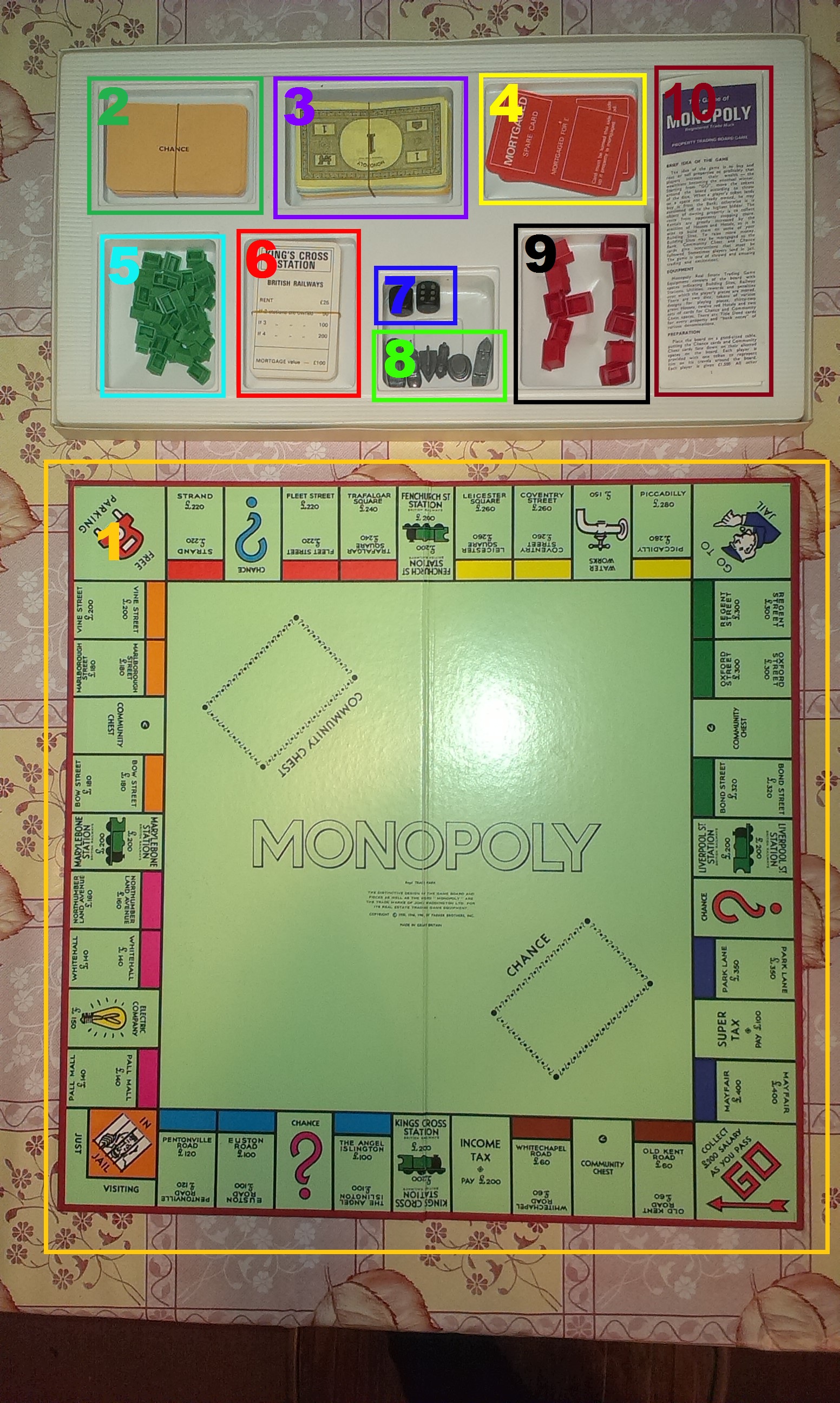
What’s In The Box:
The Stuff.
Game Board
16 Chance cards and 16 Community Chest cards
Game Money in denominations of 1, 5, 10, 20, 50, 100 and 500
2 Spare (blank) Title Deed cards
32 Houses
28 Title Deed cards
Two standard 6-sided dice
6 Playing Tokens
12 Hotels
Rule book
Playing The Game:
Objective: Buy and develop the most properties to either achieve Monopoly or bankrupt all your opponents.
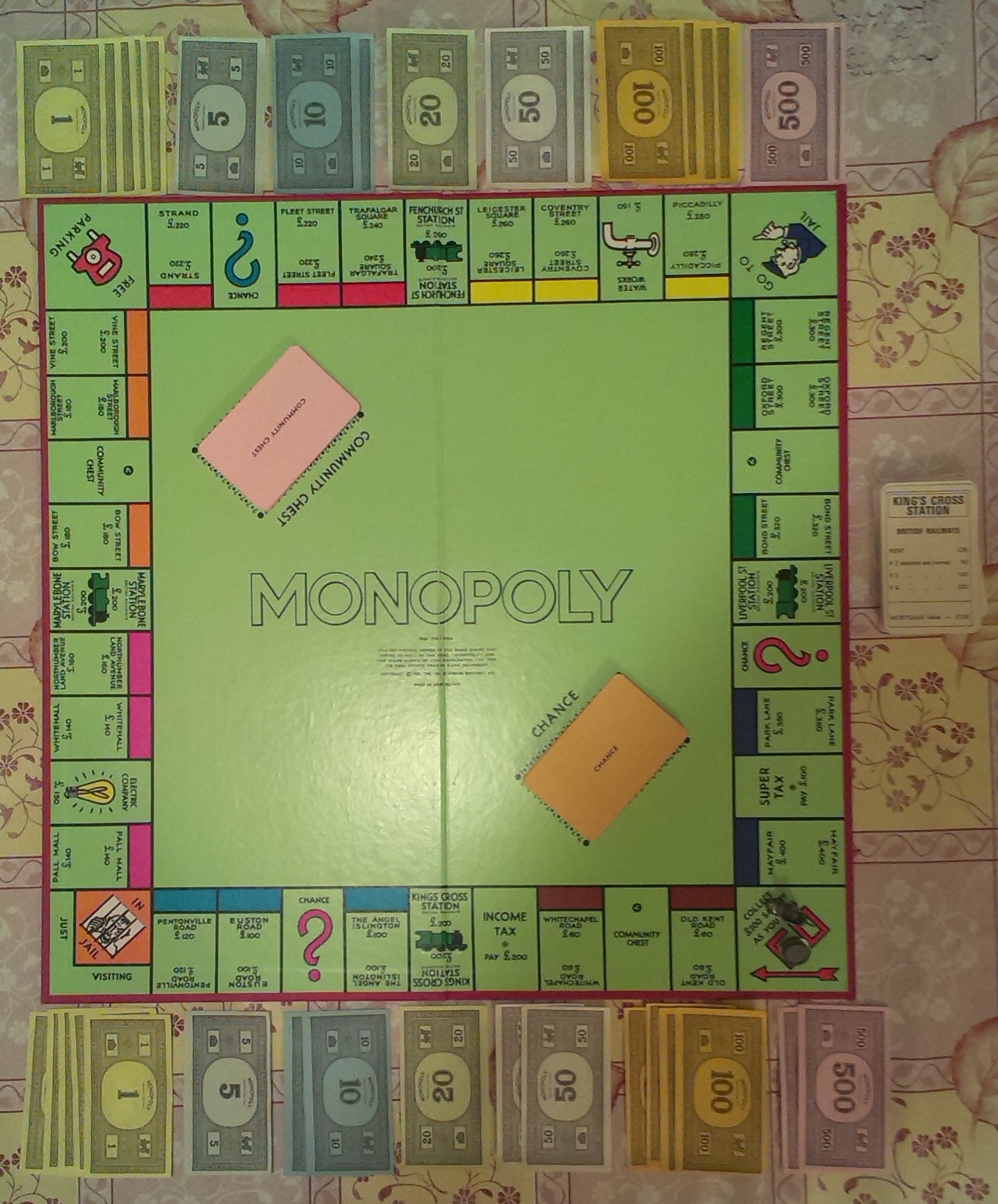
Because the world is generally so familiar with Monopoly I’m going to try and keep this section brief. Essentially, to start the game you need to separate the Chance and Community Chest cards, shuffle them, and put them in their allotted spaces on the board. Then elect one player to be Banker, they’re in charge of making sure the correct amount of money goes in and out of the bank for the rest of the game. To start they deal out 2 x 500, 4 x 100, 2 x 50, 1 x 20, 2 x 10, 1 x5 and 5 x 1 to every player. Lastly you choose Tokens, put them on GO and then roll the dice to see who plays first. Highest roll starts.
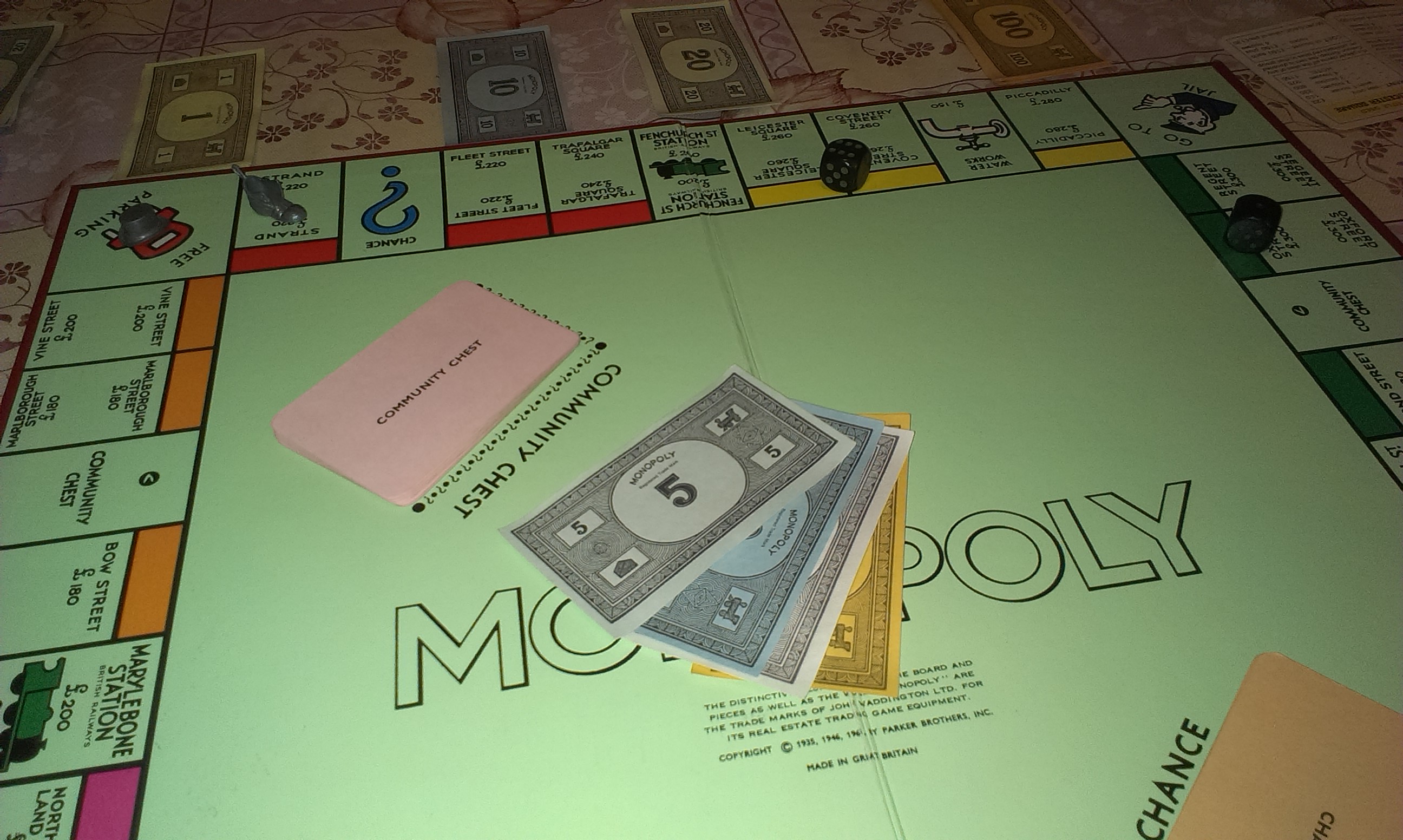
Starting set up for a game with two players
Moving and Rolling Doubles:
Starting with the player who rolled the highest number players take it in turns to roll the dice and move the shown number of spaces around the board, moving clockwise. If a player rolls a double they may move, complete all actions associated with that move (buying property, collecting money on Chance cards, etc) and then roll again, and move again. However, if a player rolls three doubles in a row, they must go to jail. There are several options for things it’s possible to land on, the most common of which is a Property space.
Landing on a Property:
If you land on an unowned property you may buy it by exchanging the amount of money shown on the space with the Banker for the Title Deed for the property you landed on. However, if another player has already bought the property you land on you must pay them rent for stopping there. The amount of rent paid varies from card to card, increasing as you go further round the board. It also changes when a player owns all of a set of one colour of property, or develops the property by buying Houses or Hotels for it.
Chance or Community Chest:
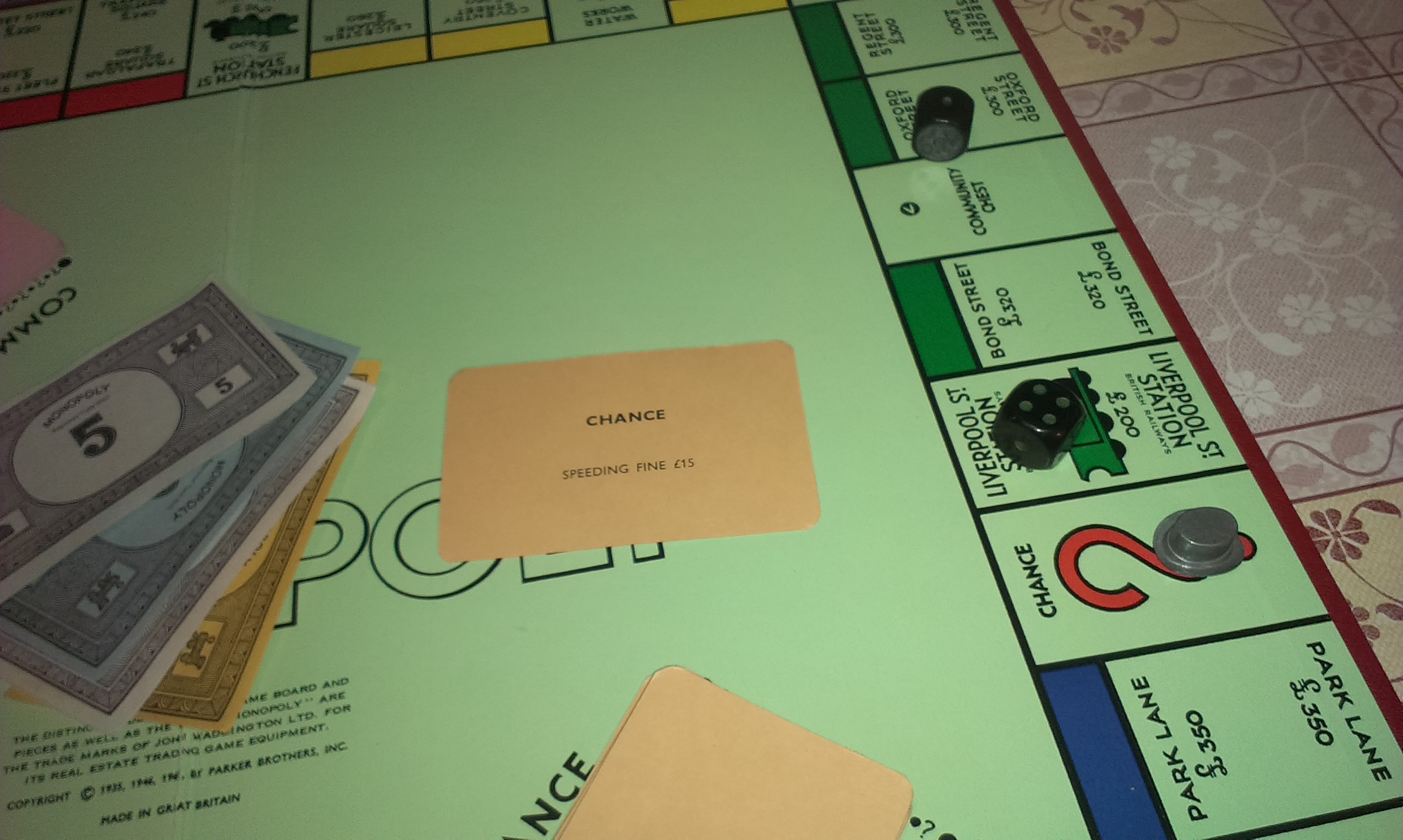
There are three Chance and three Community Chest spaces around the board. If you land on one of these you must draw the top card from the relevant deck and follow all instructions on the back. Once completed you return the card to the bottom of the deck you took it from, unless the card specifies that it make be kept and used later, the only one of these in the decks is the Get Out Of Jail Free card. Once this has been used it is also returned to the bottom of the deck. Chance and Community Chest are a mixture of good and bad cards, they can be helpful things, like cards that allow you to roll again, or take some money from the bank. But they can also be bad, forcing you to pay taxes or go to jail, so landing on one is always a bit of a gamble. Unless the cards specifies money to be paid either to the bank or to another player, all money lost to these cards in placed in the middle of the board and can be claimed by landing on Free Parking.
I landed on Chance and had to pay a speeding fine to the middle of the board.
Income Tax and Super Tax:
These are the only two spaces on the board that can force you to pay money, and this money is paid straight to the bank.
Jail and Go To Jail:
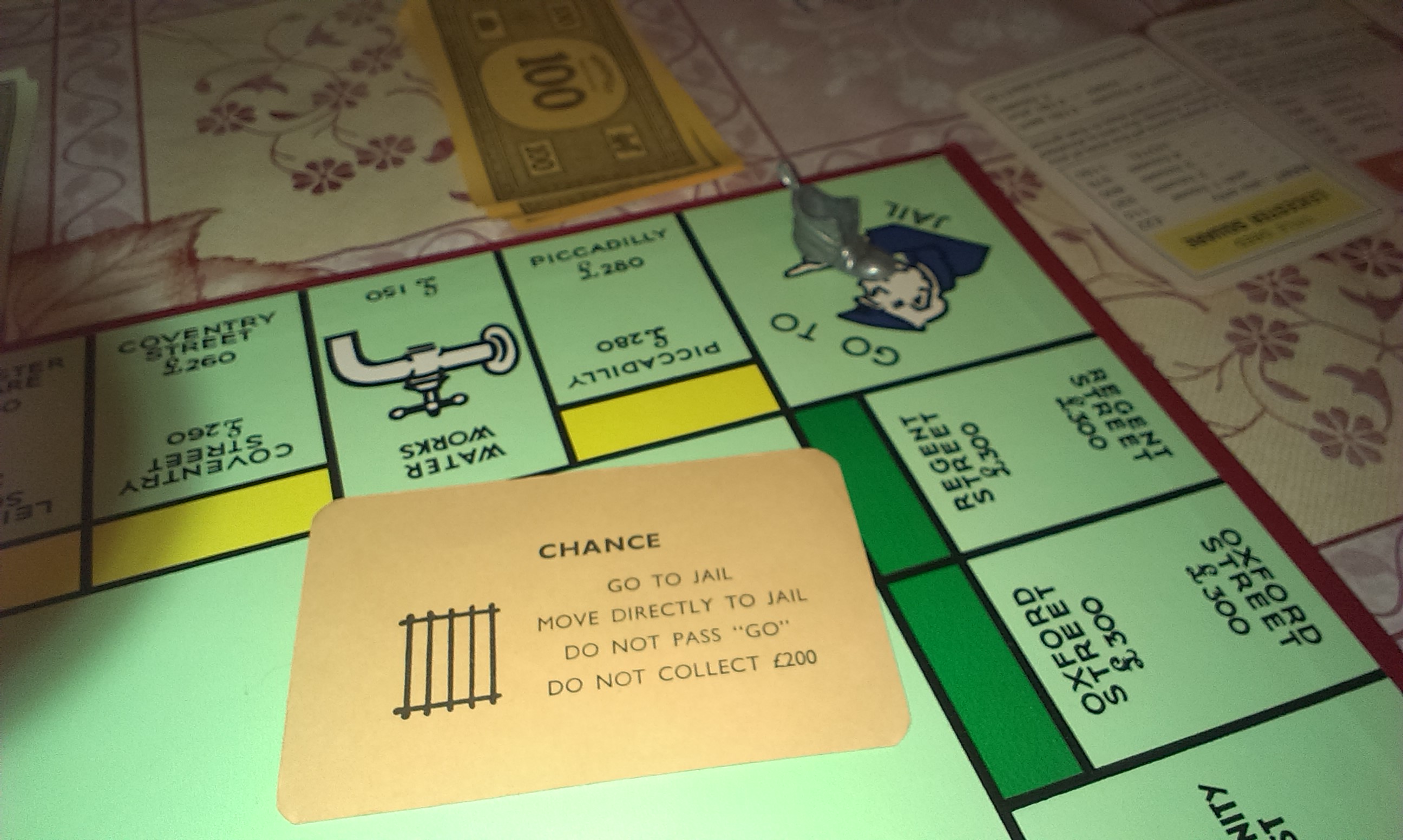
These two spaces are diagonally opposite to each other on the board. The jail space itself is most irrelevant to game play – acting as a space where nothing happens – unless you get a Chance or Community Chest card that sends you to jail, you land on the Go To Jail space, or you roll three doubles in a row. These are the only three actions that can send a player to jail.
GO TO JAIL.
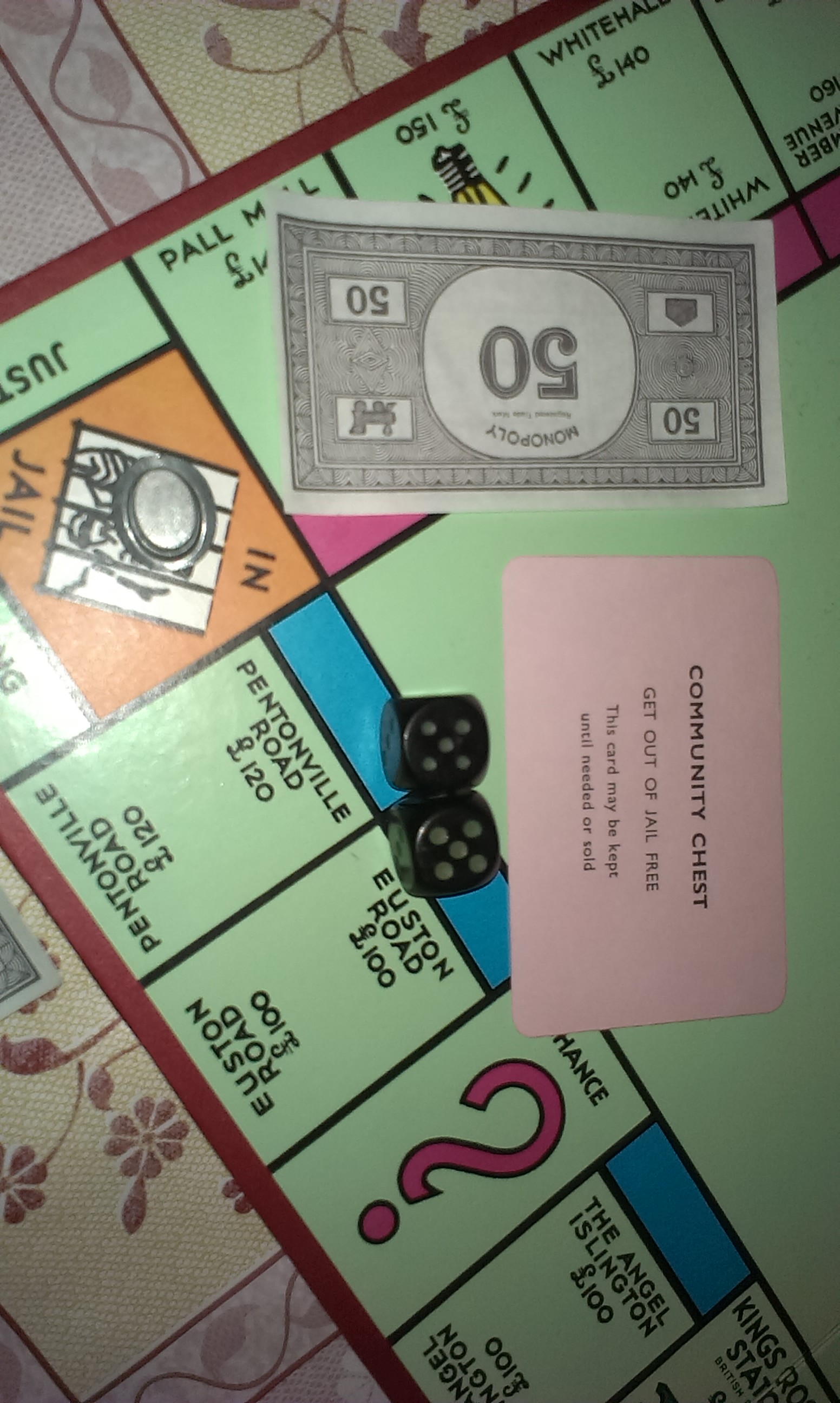
Getting out of jail is slightly harder than getting in, you can get out of jail by doing one of the following: throwing a double on any one of the three turns following you being sent to jail, playing a Get Out of Jail Free card, either by already having it in your possession before you went to jail, or by buying it off another player for an agreed price, or, paying a fine of £50. If you choose to try and roll your way out of jail, but on your third roll do not succeed in throwing a double, you must then pay the fine.
All the various ways of getting out of jail.
After this is paid a players turn may continue as normal, moving and buying property. Whilst in jail a player may also collect rent, buy or sell properties and build Houses or Hotels. The only thing they really miss out on is moving and passing GO.
GO:
When a player passes or lands on GO at any point after the start of the game (with the exception of if they’re being sent to jail) they collect £200 from the bank.
Landing on GO!
Houses and Hotels:
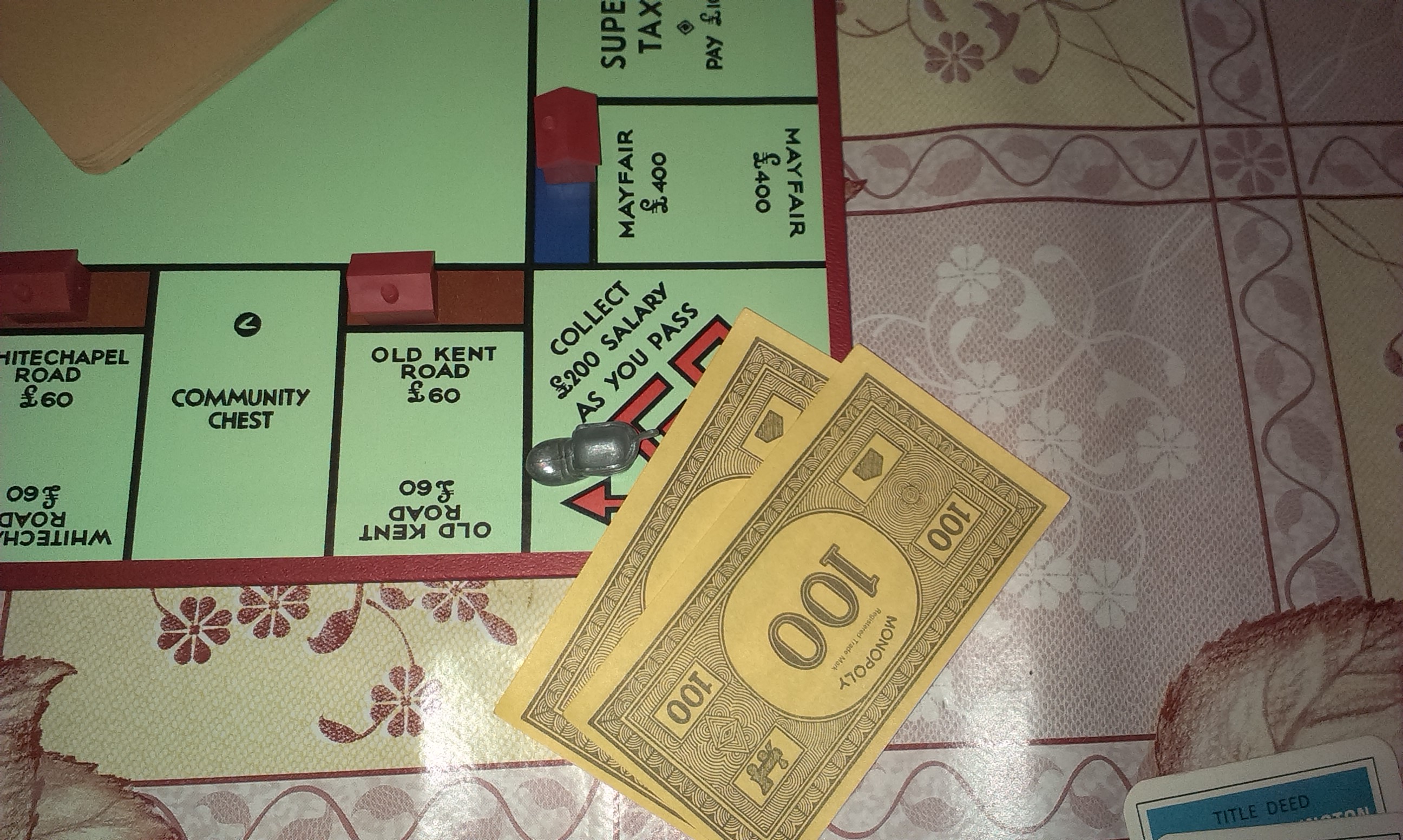
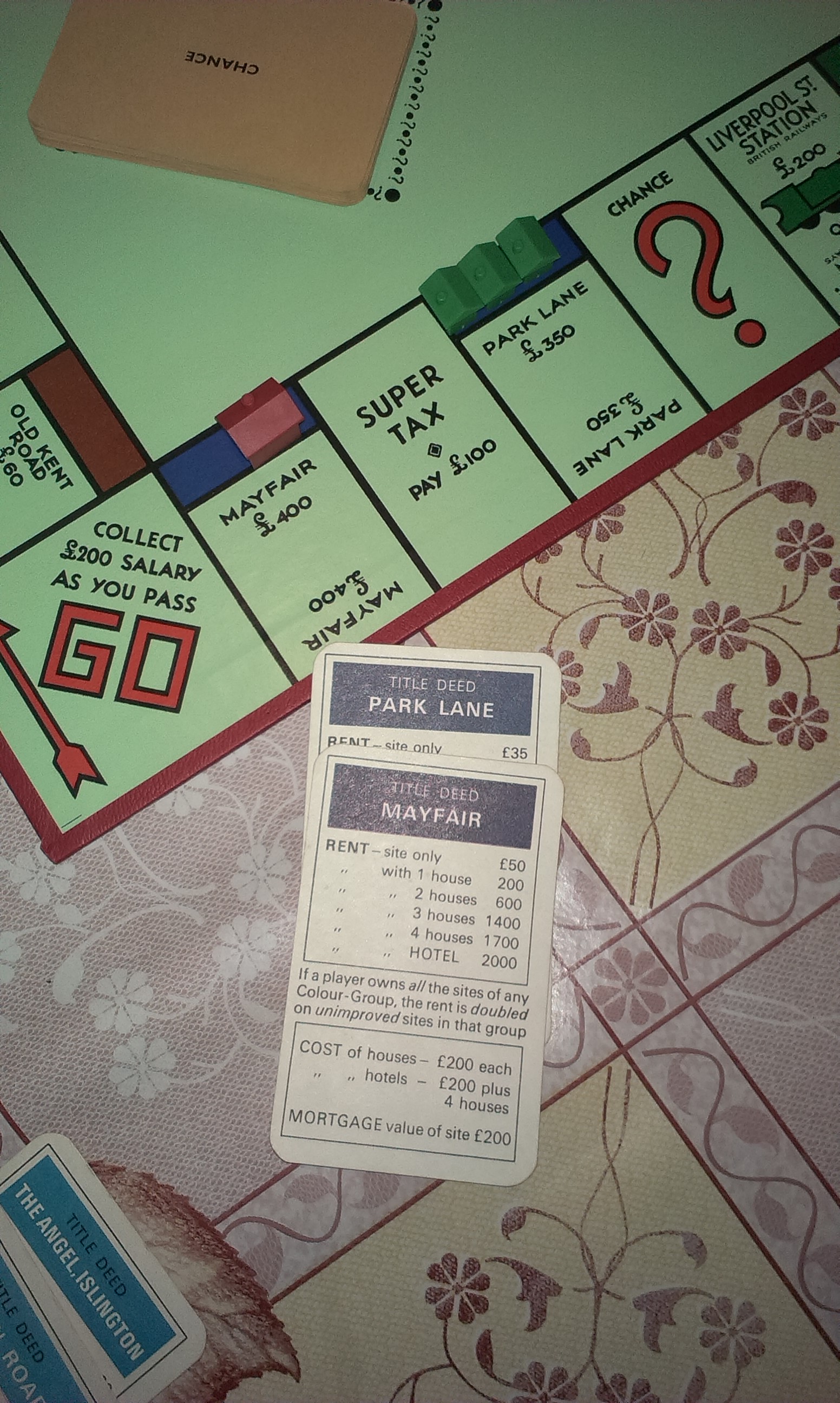
A player can purchase these when they own all of one set of a property. For example, they own both Park Lane and Mayfair they would be able to purchase Houses, and then Hotels for them, like this:
Mayfair has a Hotel, Park Lane has three houses. The long and the short of it is that I’m screwed.
Before buying a Hotel for a property a player must first buy four Houses. They cannot jump ahead a put a Hotel straight onto the most expensive property they own.
Free Parking:
When a player lands on Free Parking they can collect any money that’s currently in the middle of the board, this is a nice bonus, especially if it was mostly your money to begin with.
I landed on Free Parking, so I got to reclaim my money from the middle of the board.
Winning The Game!
A player wins the game when they have either bankrupted all their opponents, or they’ve achieved Monopoly by buying every single property on the board. This is a simple objective that’s actually pretty hard to achieve. When we play we usually end up ascertaining a winner by cashing up at the point that everyone agrees they’re bored. The person with the most money (inclusive of property value) is then proclaimed the winner.
Players in debt to other players can mortgage their properties to the bank to try and pay off their debts, these properties are place face down in front of their owner, and can be bought back from the bank at a later stage of the game. Properties can also be given to a player as part of paying off a debt if you don’t have enough money.
Strategy:
Buy as many properties as possible! I am deadly serious about this, if you don’t buy anything because you’re holding out for one particular property (which you may or may not land on, depending on the roll of the dice) and end up hoarding your money, it’s not going to do you any good. You’ll be able to just pay rent and taxes and such for a while, but then, as there are more and more spaces on the board that you have to pay to stop on, you’ll find that you fast run out of money. Buying up lots of properties also prevents your opponents from being able to complete sets of properties and therefore stops them buying Houses or Hotels. This gives you good trading leverage later in the game.
Don’t be rash. If an opponent wants to trade a property with you, don’t accept whatever they offer first, see if they’ll give more, and if they won’t, keep it until they desperately need it. When this happens, you should be able to name your price.
If you’re playing with someone who’s irritatingly good at this game, team up against them! Rope in all the other players and support each other with loans and stuff to try and bankrupt this one player. Once that’s done and they’re out of the game you can then turn on each other. Not very sportsman-like, I know, but hey, it’s a dog-eat-dog world out there.
Other than that, don’t be too open about which properties you really want, if you’re trying to get a specific set for some reason, this only drives up the price if you want to buy or trade one off another player.
History and Interesting Things:
The first version of the game was designed by an American, Elizabeth Magie, and patented in 1904 under the name The Landlord’s Game.
It was originally intended to show the consequences of Ricardo’s Law of Economic rent and Georgist concept of a single tax on land value.
The game went through so many changes and revisions between its original publication and the Monopoly that we’re all familiar with now that by the 1970’s it had become popular folklore that Charles Darrow was the sole creator of the game.
This was so much believed that it was printed in the rules for a fair few years as well as in a book about Monopoly printed in 1974, and was cited in a book about toys as recently as 2007.
No family I’ve played this game with has ever played it the same way, or followed all the rules, for example, in our house we have a rule that if you pass GO you collect £200, but if you land on GO you can collect £400. I believe this rule was invented by our mother as a way of getting her more money when she was losing to her various children.
When playing the long version of the game it can literally go on for days. Our record was 5 days, a game left out on the living room floor for almost the whole of a rainy half term.
I don’t think I’ve ever played a game where someone’s managed to achieve Monopoly. We’ve all gotten bored and gone away before that happens.
When Ralph Anspach created Anti-Monopolyin 1973, Parker Brothers tried to sue him for copyright infringement, the case went to trial in 1976, but in 1979 Anspach won on appeals, the ruling being that the Monopoly trademark was generic, and therefore unenforceable.
There have been several video game versions of Monopoly. I remember that we used to have a PC game of Monopoly, which was one of the only things we were allowed to do on the computer when we were small.
One of the most classic of classic games, really good fun for all ages, but can be the cause of a vast number of arguments. If you haven’t played it, you should, at least once. There’s a reason this game’s sold so many copies and been reproduced in so many countries and versions – because it’s awesome. Having said that, I have only rated it 3 out of a possible five on our ratings at the top of the posts, this is mostly because the game can take days, and games that have definite ends tend to be more desirable, and less overwhelming when you sit down the play them.
I read about the history of the game on Wikipedia (and we all know that it’s super-trustworthy information) here.
Number of Players: 2 – as many drunk people you can fit round a deck of cards (wouldn’t recommend with less than 3 people)
Year of Publication: Who knows?
Creator: The Irish
I Guarantee You Will Laugh More Than Any Other Game:
So this has to go down as one of my favourite card games of all time. It’s very simple, huge amounts of fun and anyone can play it (they might just be bad at it, which will make it funnier).
Appreciate our custom cards!
What’s In The Box:
Unlike most of the games we review this game only needs one thing:
1 x Standard 52 deck of cards
Playing The Game:
Objective: Don’t be the person holding all the cards at the end of the game!
Now there are quite a few variations of this game what with it being quite ambiguous and not actually having an official publication or official set of rules, so it’s up to the people playing it to decide what to play by. But here’s how we play it:
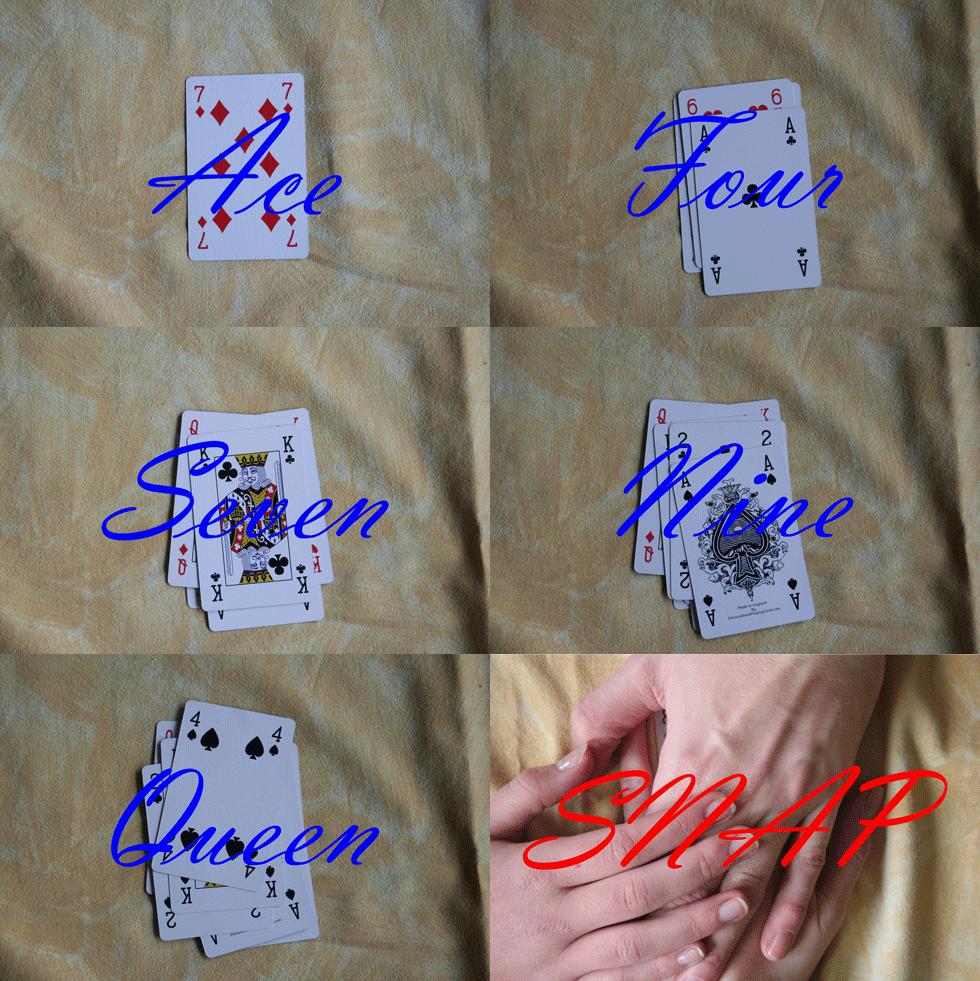
The basic principle is the same as Snap (I hope you are all familiar with the concept of Snap – although its real name is Slapjack). The difference between it and snap is that it’s the card that matches what the person is saying rather than the card under it. So the cards are split, face down, equally between players. The first player puts a card in the centre and says Ace, now if the card is an Ace hands go in, the last hand in is the loser and picks up the cards. If its not an Ace the next person puts a card down face up and says Two, if it’s a two hands go in, if not play continues to Three, Four etc. all the way to King and then back to Ace. The picture below should demonstrate what I mean:
You only snap when the card played is the same as what was said
Now in addition to this you can also choose to snap on actual snap cards, say someone puts a ten down and the next card is also a ten. The game gets interesting when people start to lose all the cards. The person who loses all their cards is NOT the winner, in fact they’re not even out of the game, they still have to say the right card when it comes round to them and their hand still has to go in when snap happens. This way a player can go through phases of having and not having cards multiple times in a game. The game is only over when only one person is left with all the cards in their hand. So even when there’s only one person, or even in a rare case where no one is playing any cards the game is not over until the final snap and one person is left with the whole deck.
For a more concise and directly playable version of the rules see here.
Additional Rules:
These rules you may only want to introduce after playing it a few times:
Flinching – if a person flinches they have to pick up all the cards.
Pace – You have to keep a steady fast rhythm to the game and if you break it by forgetting what you’re supposed to be saying or by not noticing it’s your turn you have to pick up.
Queens – Some rules state that you snap on a Queen too, but this is really up to you.
Change of direction – When Jacks are played (or a card of the players choosing) the direction of play changes.
Word confusion – Changing the word for some of the cards to something obscure and if a player forgets this when saying it they have to pick up.
DRINKING! – This is the most obvious additional rule (it being called Irish Snap and all) but the player who picks up has to drink.
Variations:
Winning – The first and most major variant is that players to lose all their cards are actually out of the game and win… I personally believe this version is for losers with no real commitment.
No speaking – Numbers are counted in your head and you snap in the same way you would if they were said. Makes it much harder as you have to pay even more attention. I tried an interesting variation of this rule (sort of) where half the people playing were Polish and they said the cards in Polish and the English people said them in English… It got very interesting.
Strategy:
HAVE QUICK HANDS! – There is very little strategy that can actually be applied to this game except having quick hands and not getting distracted!
DRUG THE OTHER PLAYERS! – We don’t actually suggest this… But it would help. Also keep in mind you just want to make them a bit slow, not knock them out.
To Conclude:
Ok, the loss of life may be a bit extreme.
First of all take heed of the picture above, this is why the drinking version is good… After a while you start to not feel the pain – but this also how hands are lost.
Note I have not put a “History and Interesting Things” section in this post; that’s because this game doesn’t seem to have a history. Well it probably does, but not a documented one, so if anyone knows anything interesting about it or finds anything beyond my lazy research capacity then please let me know in the comments. I would strongly advise playing this game, it’s only a 2 or 3 out of 5 on a purely objective level but is also a 5 out of 5 because of the huge amount of fun and endless hours of entertainment it has given me.





 Tame The Board Game