So since my last update post I’ve successfully posted…. 1 game.
This is a little underwhelming I know. But I have been formulating a plan in the time since then, and I promise it doesn’t involve every second post being an update! The first part of the plan involves my sister, Bex, blogging about books over at anarmchairbythesea, and Terry Pratchett, well-known author of the Discworld series of books, among other things.
The second part of the plan involves Christmas!
A little explanation is in order? Perhaps.
I don’t want to say too much in case of two things;
I fail epically at making any of this happen, OR,
I fail at making you (the reader) excited about it, and therefore unlikely to return to read the fruit of these plans.
Part 1:
A basic sum-up of the plan can, however, be given. The part involving Bex goes like this: she’s organizing and partially hosting a Discworld Readathon or ‘Discworldathon’ (as she’s taken to calling it) on her blog, starting in January and continuing for one full year with each month having a Discworld-novel theme.
Since Terry Pratchett also authorized the creation of several board games based on the books, which we have already reviewed on this blog (the reviews can be read here) we thought it could be a nice idea to tie in the Discworldathon with some kind of replay or re-enjoyment of the related games. As of now we’re not 100% sure what the best way to work this out is, but we’re theorizing and planning and scheming and such, and we’ll undoubtedly come up with something.
Part 2:
This is the part of the plan involving Christmas. As some avid and dedicated readers may remember we did a series of posts entitled “Twelve Games of Christmas” in 2013. These, based on the statistics of the site, were quite popular. So I intend to bring them back this year. I’m hoping to be organized enough to make this possible, and I’ve already compiled a list of potential games to use for this.
That about sums up everything that’s in the works at the moment, and my hope is that even if posting is sporadic there should be a decent amount of posts going up around Christmas and some definite ones happening in the New Year in connection to Bex’s Discworldathon.
That’s everything for now, and I sincerely hope that my next post is not an update!
Ever wanted to go travelling, but just didn’t have the time? Ever wanted to become a friar but you were too female to join a monastery? Well inVillageyou can fulfill all of those unfulfilled life dreams that you may have had any time in your life. Take control of four generations of one family to make your all dreams come true! (Okay, maybe I’m lying about all your dreams coming true, but it’s still good fun, okay?)
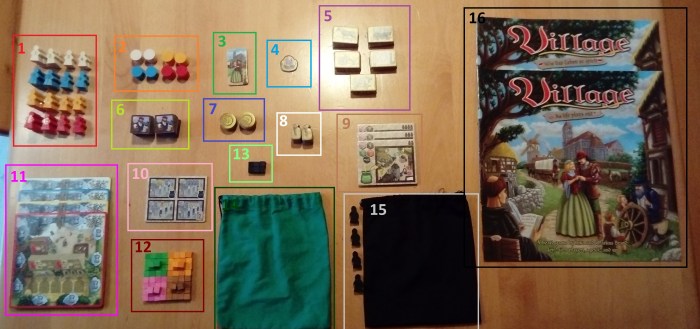
What’s In The Box:
44 Family Members in four colours
32 Markers in four colours
1 Starting Player Marker
1 Next Starting Player Marker
40 Goods Tiles
24 Customer Tiles
15 Coins
20 Bags of Grain
3 Setup Cards
1 Mass Overview Card
4 Farmyards
72 Influence Cubes (Brown, Pink, Orange, Green)
6 Plague Cubes (Black)
1 Green Bag
1 Black Bag and 4 Black Monks
2 Rule Books (German and English)
1 Game Board
Playing The Game:
Objective: To efficiently manage the lifespans of each of your family members so as to gain the maximum number of prestige points.
To start the game each player chooses a family, and is given a farmyard, one gold coin and all of their coloured markers. One marker is placed on the closed book symbol in the top left-hand corner of the board. Each family has four generations of people. To begin the game only the four people marked with a 1 are placed on the farmyard.
Setting Up The Board:
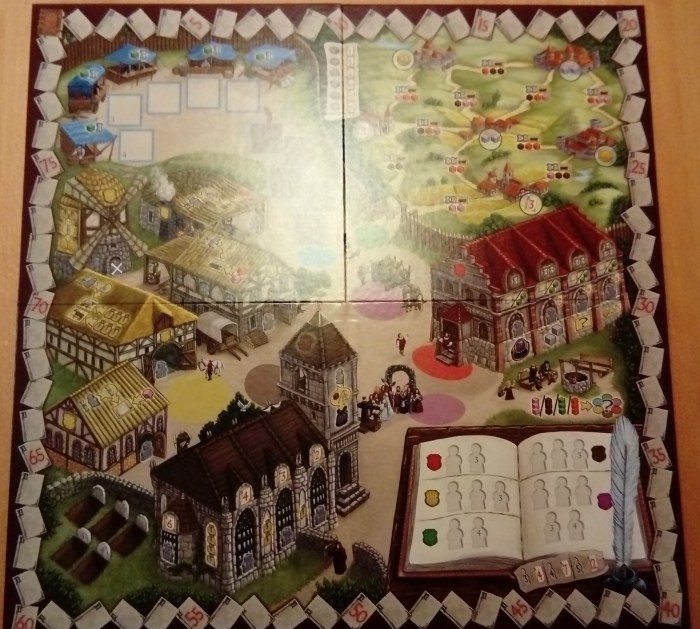
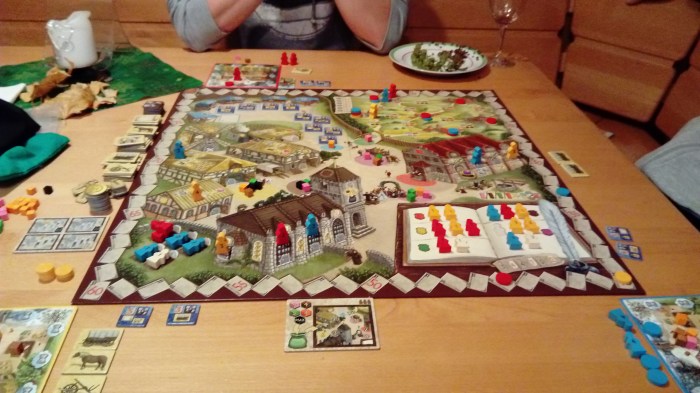
Once you’ve chosen your family and claimed all of the pieces you need to begin you then follow the instructions relevant to the number of players there are. As you can see there is a big book in the bottom right-hand corner of the board. This is call the Village Chronicle, it’s the dream of all the villagers to have their name written in this book when they die. When playing with less than four players there are spaces there, and in the unmarked graves (bottom left-hand corner) which are marked with a 3 or a 4. These spaces have to be filled with a member of an unclaimed family at the start of a two or three-player game. This helps to control how long the play time of the game is.
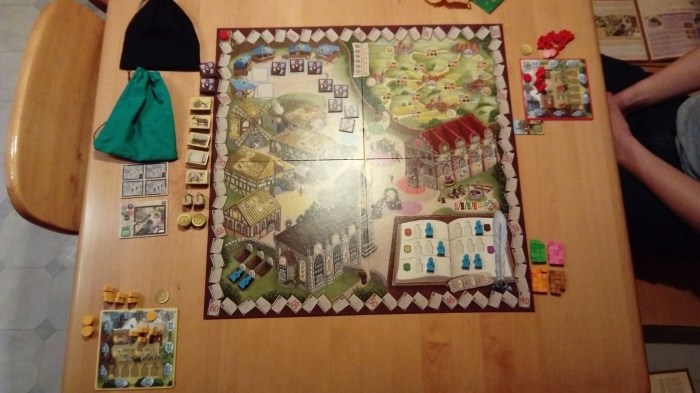
Basic starting setup for two players.
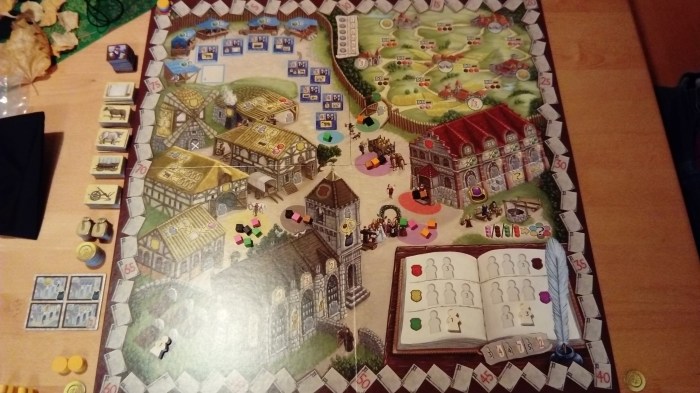
At the start of the game the oldest player immediately becomes first play (you can see the red player in this game has the strange marker with the couple on it next to his farm). This player then takes a pre-determined number of the coloured Influence Cubes from the pool at the side of board and puts them, and all the Plague Cubes into the green bag. These are then drawn at random and used to Seed the board. The Setup Card for the number of players indicates how many cubes should be placed on each coloured patch of the board. Each of these patches represents a potential action that you can take on your turn.
The only other thing left to do now is place customer tiles on the indicated number of marker squares on the board. Once this is done you’re ready to play!
As you can see, Influence Cubes and Plague Cubes have been randomly distributed to the different coloured patches on the board according to the Setup Card and Customer Tiles have been placed in the Market area.
The Rules:
We found that the rulebook for this game is very well written. It’s quite clear what is and isn’t allowed, and there’s very little ambiguity, this makes the game pretty straightforward to play as there’s little opportunity for argument about whether one action is or isn’t allowed.
Taking Your Turn:
This game is quite clever; because each round consists of a few turns for each player – but the actual turn itself is quite short – the game should keep going at a reasonable pace, making the impatient among us much happier as their turn comes round more often. To begin your turn you take an Influence or Plague Cub from the action spot of your choice, the choices are:
Grain Harvest – if you have one or more family members on your farmyard you can perform this action. Take an Influence or Plague Cube from the spot with the wagon on it and then immediately take 2 bags of grain from the supply. If you do not have any family members on your farmyard you cannot perform this action.
Family – when you perform this action a new family member is born! Take a cube from the patch with all the people standing next to it and then take a new family member from the next generation of your family (if you have all of the 1st generation on your farm or the board somewhere then take one from generation 2 and so on) and put them on your farm. Alternatively, instead of taking a new family member from the supply, you can also use this action to recall a family member from somewhere on the game board to your farm.
Crafts – Take a cube from the yellow patch by the workshops. You can now send a family member to one of the workshops to learn a skill. Each workshop will show on it how much time must be spent to train a family member, and then again how much time must be put in to create. Note: the train cost of time only has to be paid once per family member in a workshop.
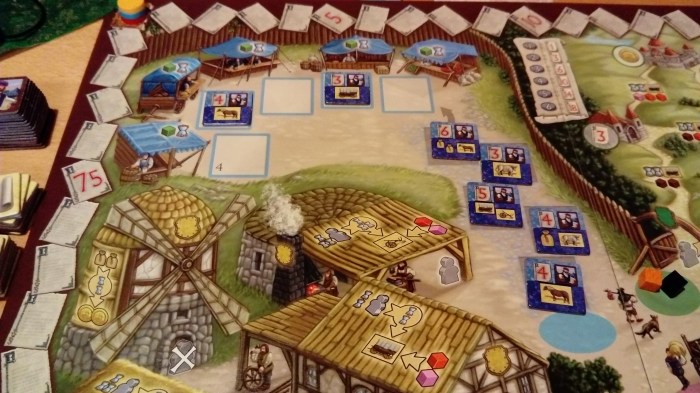
Market – when a Cube is taken from the blue patch by the market place a market day is immediately triggered. Each player has a chance now to trade at the market. However, only the spaces directly in front of a market stall can be traded with. The player who triggers the market day performs the first trade action and can perform this for free. Every other player who wishes to trade at the market must pay both one time and one green Influence Cube before they can trade.
As you can see, we have only traded with the customers who were directly in front of the market stalls. No other customers have been served.
Travel – The green patch near the gate out of the village indicates travel. You can use this patch to send a family member to other villages. This gains you prestige points and other benefits depending on where you go.
Council Chamber – taking a Cube from the red patch by the council building allows you send a family member into the local council. As you train them they gain influence in the council and the benefits you receive from them increase.
Church – the brown patch nearest the church allows you send a family member to orders. Once sent this family member goes into the Black Bag with the Monks and is not used again until Mass is said at the end of the round.
A Family Member Dies:
As each action costs you time eventually someone will have to pay. On your farm you will see clouds with sand-timers in them around the edge of the farmyard. Each time you perform an action that requires time you must move your marker the requisite number of spaces. Every time your marker passes the bride at the top of your farm, a family member from your oldest generation has to die. When this happens you may complete the action that you were performing fully before choosing which family member to kill.
Note: with the exception of Market Day. If Market Day is trigger by taking a Plague Cube you must immediately pay the 2 time and if someone dies they must be removed from the board before completing the Market action.
It is beneficial to plan which family members will die as there are a certain number of spaces in the Village Chronicle for each profession. Once these are full no other people who die whilst in this occupation can go there and must be buried in the unmarked graves. This is important because you gain Prestige Points at the end of the game for the number of family members in the Village Chronicle, but you do not gain points for any in the unmarked graves.
Here you can see family members in both the Village Chronicle and the Unmarked Graves. Orange and Red have here achieved the most strategic deaths so far.
Ending A Round And Saying Mass:
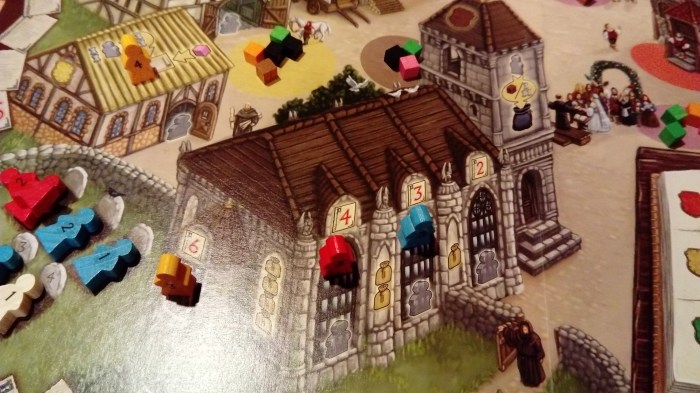
Once the last Influence or Plague Cube has been taken from the board the round ends once that player has completed their action. At this point Mass is said. Four monks are drawn from the Black Bag to say Mass. If any player has a family member in the bag they are allowed to pay one gold coin to have their family member definitely say Mass. If the players do not pay them those saying Mass are drawn randomly. Any coloured Monks drawn from the bag are placed on the first window of the church, and any black Monks are returned to the bag. Players may now move their Monks further up the church hierarchy by paying the indicated number of Bags of Grain back to the supply. Once this is done the player with the highest number of family members in the church is awarded two prestige points. If there’s a tie then the player with the highest ranking family member wins, if there is still a tie then the tied players all receive two Prestige Points.
Here, Orange has paid the most grain and been made Abbot in exchange. Red is a senior Monk of some sort, and Blue is sadly just a Novice still.
Once Mass is ended the board is re-Seeded and a new round begins.
Ending The Game:
The game ends once either all the spaces in the Village Chronicle or the unmarked graves have been filled.
Winning The Game!
At the end of the game Prestige Points from all the different aspects of your life in the village are added up. The player with the most Prestige Points wins!
Note: The board is clearly marked with which actions will give you more Prestige Points when continued with for longer periods of time.
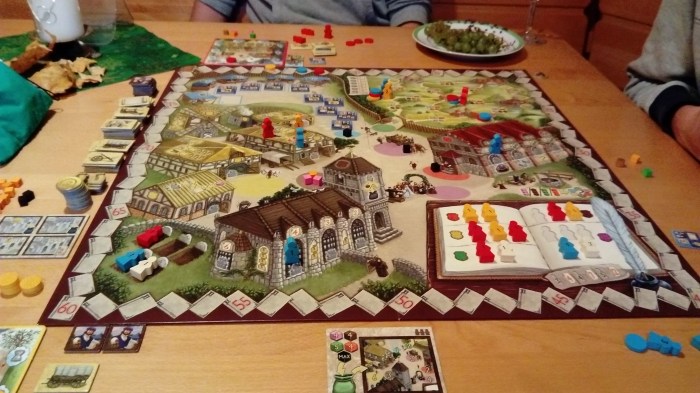
Red is victorious! Orange not far behind, and Blue seriously lacking in Prestige…
You can see that the score has been added up by moving each players coloured counter around the track on the edge of the board. Red has won, but not by much!
Strategy:
There are several different strategies that can be adopted for this game. The one I played (I was orange) was to try and have family members in as many different professions as possible, so as to be able to spend a lot of time and have them in the maximum number of available Village Chronicle spaces. I gained a lot of Prestige Points from this. The other aspect of my plan was to try and get reasonably high in the church, as you get points from this, and to have traveled a reasonable amount, for the same reason. I didn’t win the game though, the winning strategy was to build things using the Crafting action and to travel as much as possible. Although this strategy won, it only just won, so it would be worth playing again and seeing if I can alter my strategy a little to make it the winning one!
Both of us playing used the Market action. I had more Market points and I know from a previous time we played this game that if a player is focused enough it is also possible to win using only the Crafting and Market actions. But this requires serious dedication and single-mindedness.
Tactically it is also worth triggering a Market Day when you can trade but you know no-one else can. Even if you only have one thing to trade. You may only get a few points for this action, but no-one else gets any, which gives you a bit of an edge.
History and Interesting Things:
Between 2011 – 2014 this game won 7 awards, and was nominated for 14!
It’s set in a kind of 1700’s era Village.
To be honest, the game was only published in 2011 and doesn’t have much extra-curricular information about it, so I’m going to have to fail at giving any extra points here!
Further Reading and Other Editions of the Game:
This game is still relatively new – only five years old – but it has four expansions:
As you can see, I have actually had very little to write about the history or background info to this game, but having said that, I would recommend the game. It’s not particularly complicated and it’s good for a chilled-out afternoon with family or friends. It’s also great for playing with friends who like board games, but aren’t fanatic enough about them to spend more than about 2 hours playing one. I particularly enjoyed it because you can explore so many different ways to win. Having played the game twice in the last three days I can say that at the moment one of the strongest win-strategies seems to be trying to travel to all six of the other towns.
Set on the night of June 5th, 1944 this scenario recreates the brief battle for Pegasus Bridge. Or Bénouville Bridge, as it was known at the time, in Normandy, France. Major John Howard led the men of the Oxford and Buckinghamshire Light Infantry in the first airborne assault of D-Day, his objective being to capture both Pegasus Bridge and Orne Bridge. At a few minutes past midnight the Horsa Gliders land in a patch of field only yards away from their objective. The men stream out of the gliders totally surprising the German forces, there’s a brief and furious fight involving a machine gun in a sandbag nest right by the Pegasus Bridge. The British forces secure the Bridge, and the Orne equally as quickly, losing only two men in the process.
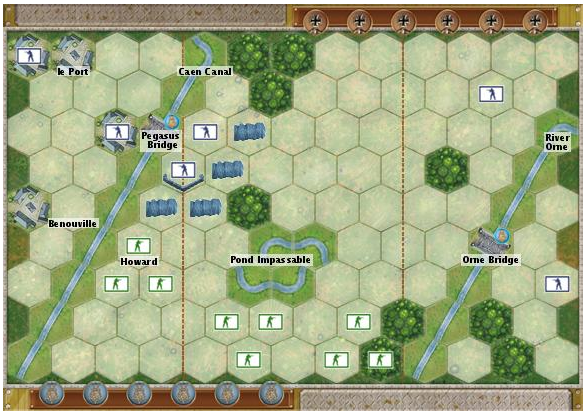
The bulk of British troops here start behind the impassable pond, meaning that they must be maneuvered around it to get involved in the battle. The Allied player has the natural advantage in this scenario; they have more men to begin with, receive more Command Cards, and play first.
Strategy and Tactics:
The Allied player here has the upper hand, but if they play badly that’s going to be completely irrelevant. In this game a certain amount of your success as a player is determined by which Command Cards you draw, as on some occasions you may need to give orders to a section of the board that you don’t have the Command Card for, and so can’t. How quickly and efficiently you kill enemy units is also determined by the roll of the battle dice. So some amount is down to luck and chance. But aside from that we’ve found so far that once you’ve found a decent defensive position (for example in a patch of trees) it’s ideal to stay there for as long as possible, all the while you can fire on your enemy from there you should stay as the woods reduce the chances that you’re going to lose men when the enemy fires on you.
In this scenario the German forces have barbed wire and sandbags. These are inconvenient, for an Infantry unit to be able to remove them they have to move into the space that the barbed wire is in, and then remove it instead of battling. So it can be completely suicidal to remove them as you end up adjacent to you enemies units and unable to attack them. Leaving you as a clear target. It’s also important to remember that the rive does not effect line of sight. You can fire on an enemy unit across a river provided that they are within range and no other terrain restrictions that would prevent you attacking them apply.
I found, when playing as the Allied forces, that trying to take the patch of wood on the right flank of the board, by the Orne Bridge, was a strong position to be in. That bridge is under defended and so the woods is a good position from which to either attack the lone German unit at the top of the board there, or to swoosh down and take the bridge from the other German unit. The blue medals on the two bridges count as victory points if the bridges are held by British forces. Meaning that that player has to destroy less of the Axis units to win the scenario.
For Axis forces it’s tactically ideal to get you lonely unit in the top of the right flank down into the patch of woodland before anyone else can, this is a good defensive position to be in, to prevent anyone trying to take the Orne Bridge. Your second unit there could then be on the bridge, between them they’ll put up a good fight against any optimistic British forces.
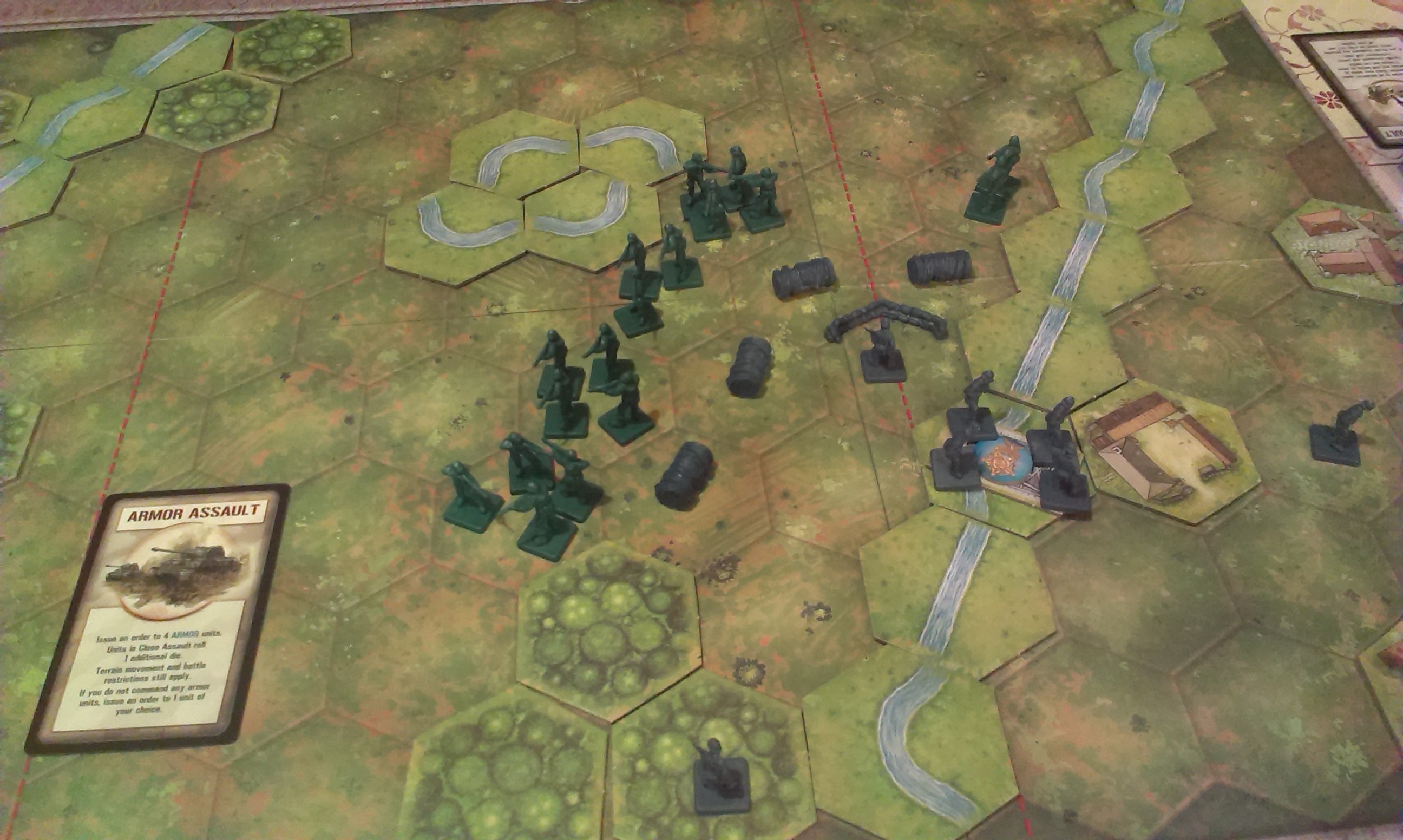
When we played this scenario we left the Axis units mostly where they were in the center and on the left flank, only really moving the one in the top left corner to bring it closer to the action. On reflection it would probably have been a good idea to shift the unit in the town right next to Pegasus Bridge further down the river to attack the British, because we didn’t actually use it that much.
To Conclude:
This is the starter scenario, so it’s been simplified from the original battle. The Germans has a machine gun in their sandbag nest by Pegasus Bridge that’s been replaced with regular Infantry in this one. But as starters go it’s very good, it’s an easy board to navigate, and the use of only one type of unit allows you to completely get to grips with how they move and battle. It would’ve rated higher, but that it’s been deliberately simplified for learning purposes, so the scenario doesn’t have as much going for it as some of the later, more complex ones do. It’s well designed as an introduction though, and sets you up in good stead for future scenarios.
We should really include that in all the titles/opening paragraphs for this blog, since I can’t immediately think of any game that we haven’t played wrong at least once. Memoir ’44, as has been stated at least once now, is a fantastic game. I don’t think we’re likely to ever get bored of it. Based on real scenarios from the Second World War it’s not only interesting for its historical accuracy, but also as a strategic game.
What’s In The Box:
The Stuff
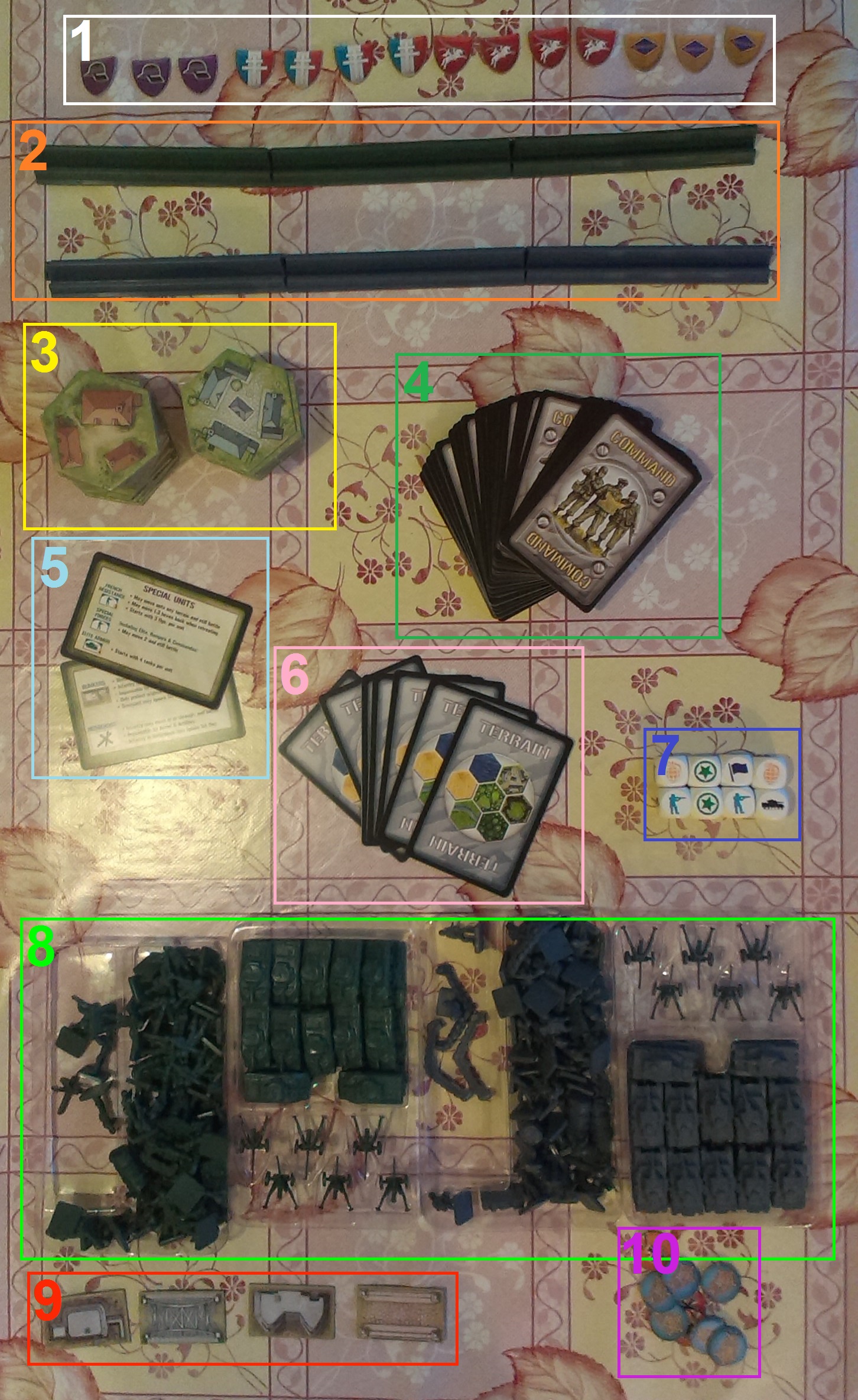
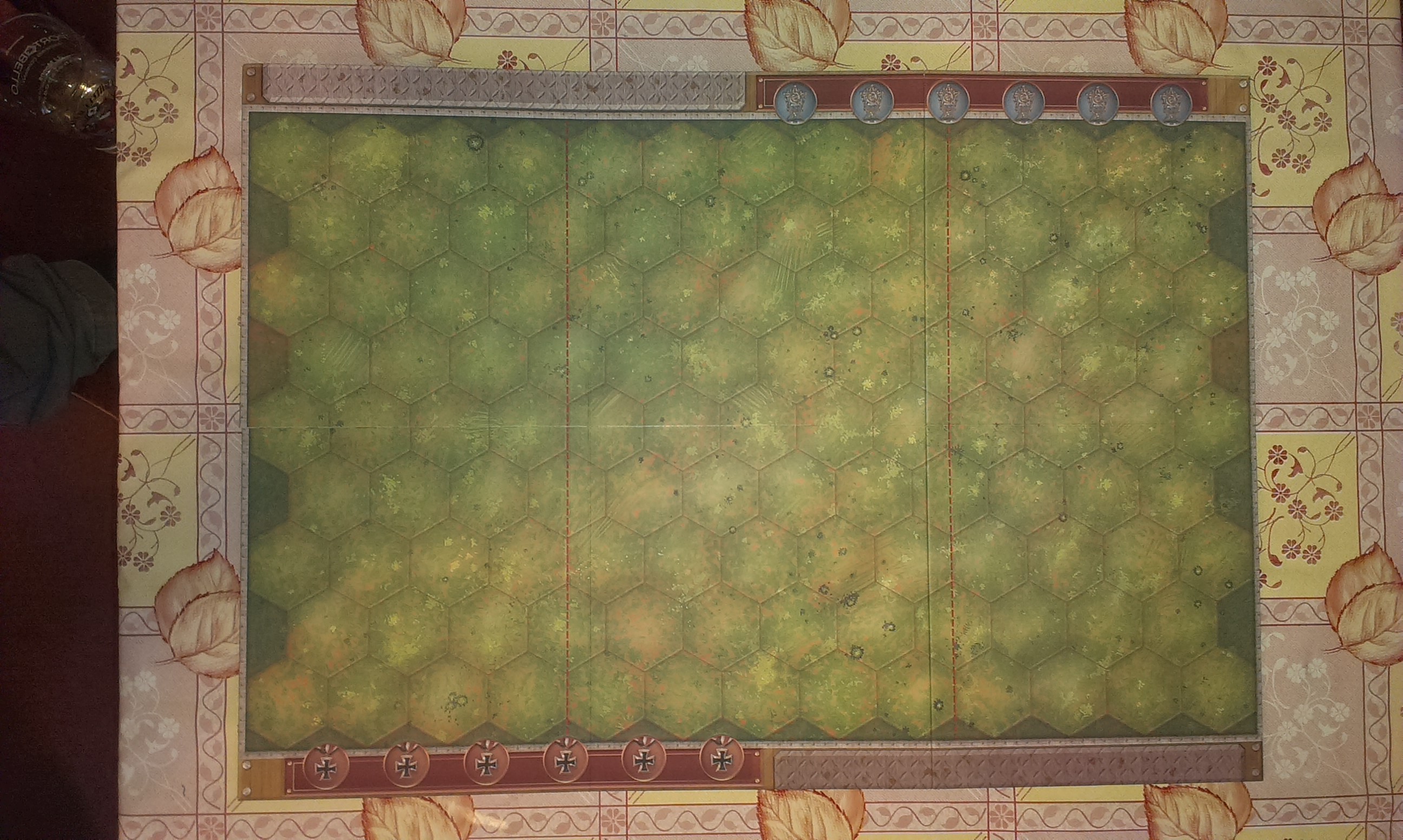
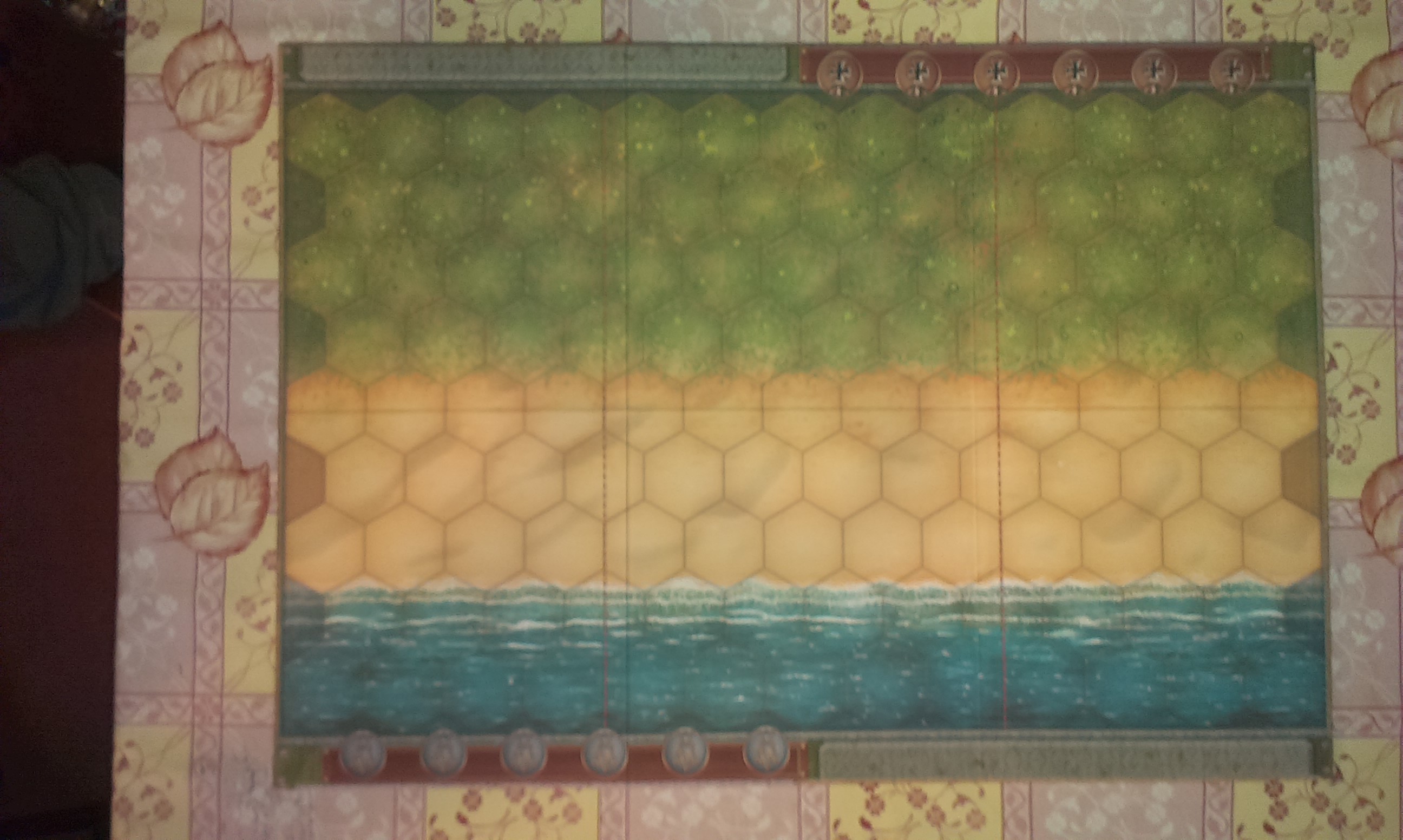
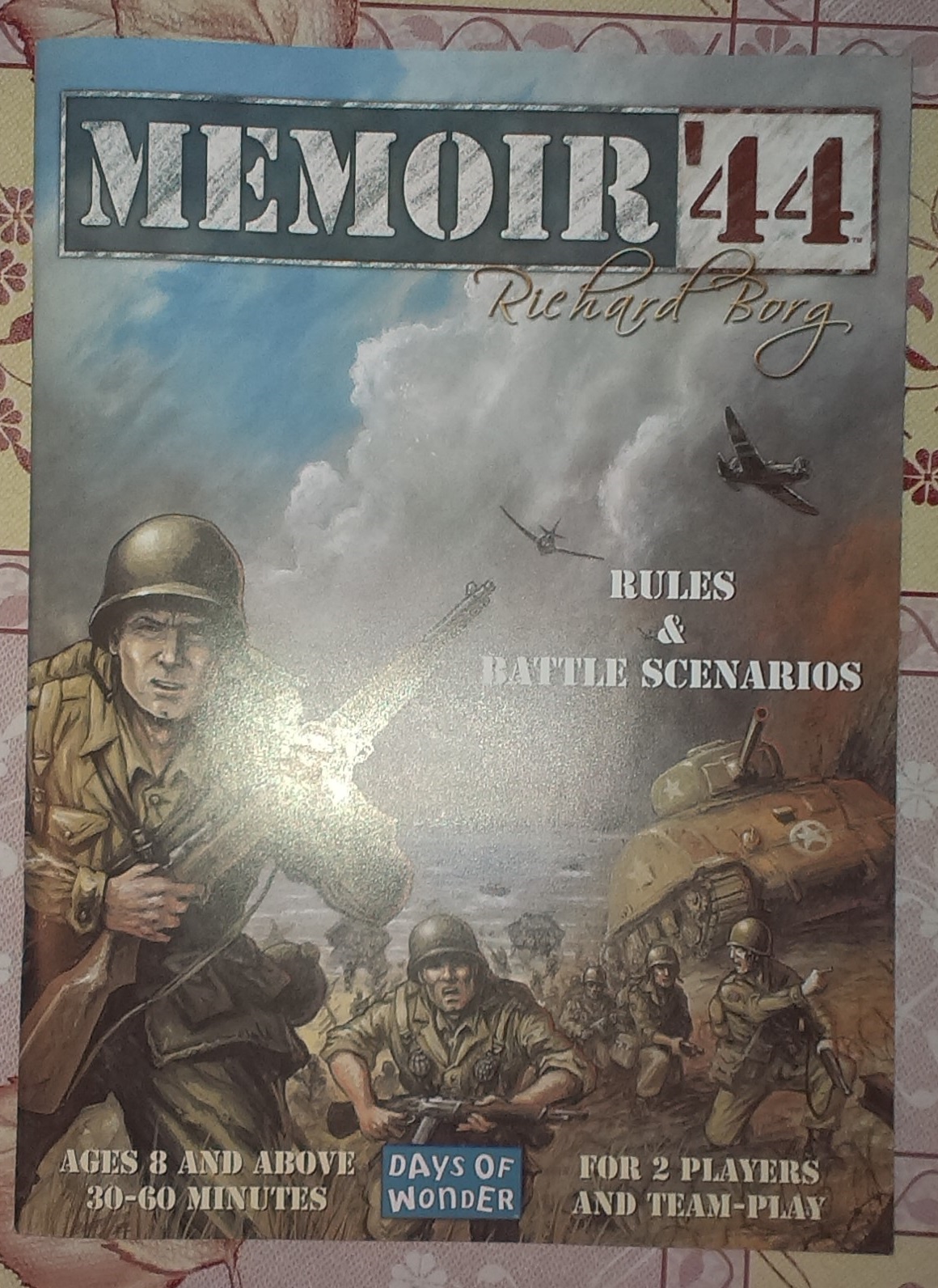
Countryside side of the boardBeach sideThe Rules
14 Special Forces Badges
3 Blue and 3 Green Command Card Holders
44 Double-Sided Terrain Hex Pieces
60 Command Cards
1 Double-Sided Obstacle Summary Card and 1 Double-Sided Unit Summary Card
7 Terrain Cards
8 Battle Dice
2 Sets of Army Miniatures; Green = Allied Forces, Blue-Grey = German/Axis Forces
4 Double-Sided Bunker and Bridge Tiles
10 Double-Sided Victory Medals
1 Double-Sided Battlefield Board Map
1 Rules and Scenario Booklet
Playing The Game:
Objective: To fulfill the scenario’s victory conditions before your opponent and score more points after you’ve switched sides.
When you read the rules for this game you’ll see that the first scenario it recommends you play uses only the Infantry Units available to each side. This is very good, as the game builds you up to a thorough understanding of each of the different types of unit available to you in different scenarios by introducing them one at a time into gameplay.
You start by setting up the board, as directed in the instructions for the scenario you’re playing. You change the look and layout of the board by using the terrain hexes to put in woods, hills, villages, rivers etc.
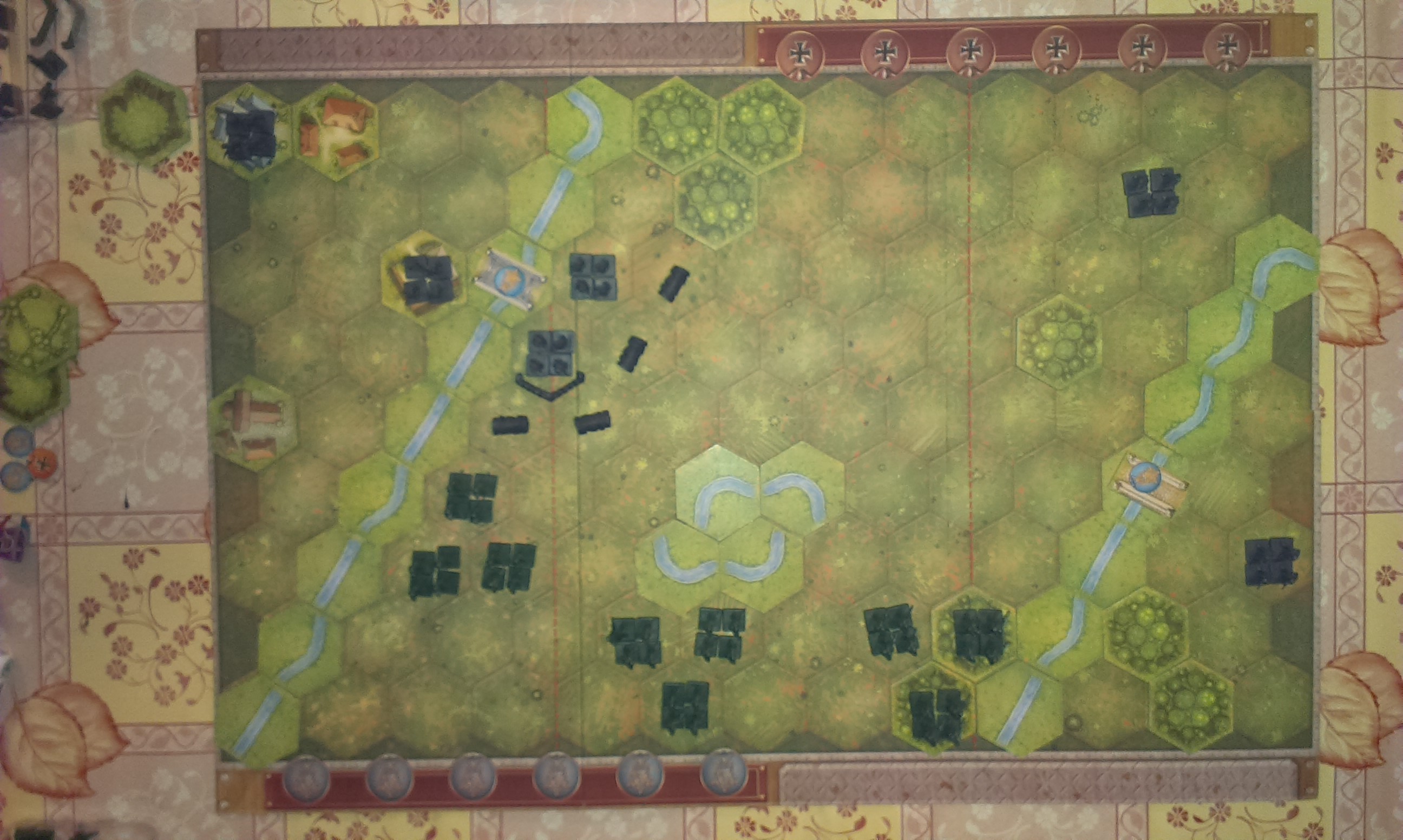
The starting set up of the first scenario in the rule book
Once you’ve set the board up for the scenario you then decide who’s playing as who. In the rule book the scenario instructions will tell you which side plays first, and how many Command Cards each player is dealt to begin with. Players then take turns. There will be a preset condition for victory in each scenario.
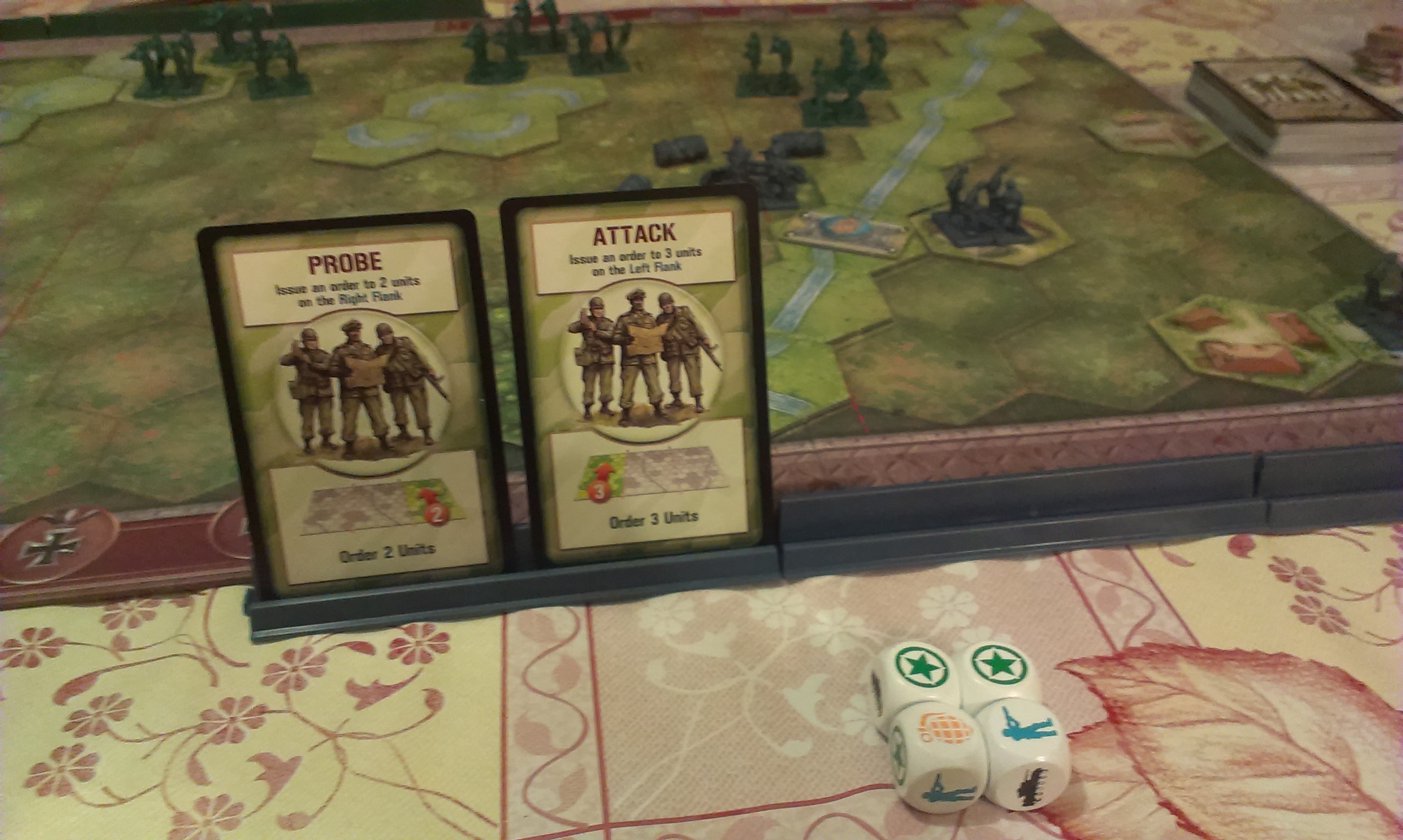
The Command Cards contain an array of things a player can do on their turn, standard orders or special commands. These mostly look like this:
an example of the Command Cards most commonly in play
The special command cards look like this, but are all different:
A special command card
Winning The Game:
There is no time limit to the scenarios, players continue taking turns until someone manages to destroy enough enemy units to fulfill the victory conditions for the scenario. Then the board is reset and players switch sides. A note is kept of the score from the first round, for example, if the victory condition was that someone needed to have completely destroyed 4 of their enemy units and the other player had destroyed 2 when this happened you would then make a note, and at the end of the following round the victorious players score would have to be the highest total number of units destroyed.
Strategy:
We realized fairly early into the playing stages of this that the scenarios are usually relatively heavily weighted towards one player, they may have an advantage in the number of Command Cards they have, or in having bunkers or sandbags. But despite this, if you play reasonably tactically, all the scenarios we’ve played so far could go either way.
We started out just playing the most obviously useful card we had in our hand at the start of each turn, and seeing where it got us. Because the destruction of a unit is determined by a combination of the card you played, the position of your units, the terrain around you and the rolling of battle dice it can be unreasonably hard, on occasion, to annihilate a unit that should have been wiped out the first time you attack it. This is both true to the slightly unpredictable nature of a battle, and completely inaccurate as an Armour unit fighting Infantry at what is more or less to be considered point-blank range should not somehow manage to miss all of them. But that aside, it is possible, tactically, surround and destroy units, using terrain disadvantages to your advantage.
There is a lot to be said about strategy on this game, but we’ve decided that in the interest of keeping you interested, we’ll go into much more detail on tactics and strategy, as well as historical overview and other exciting things like that as we write about each scenario individually.
History and Interesting Things:
The game was designed to commemorate the men and women of WW2 and the sacrifices they made.
It was published in collaboration with the Mission for the 60th Anniversary of the D-day Landings and Liberation of France.
In 2004 it was awarded the International Gamers Award for the General Strategy: 2-Player category.
There are eleven expansions for this game, all of them require the original to play.
The game can be played with up to six people, playing in teams of three, each commanding a different section of the board.
There is more to write, but we want to look at the history of each scenario in greater detail over the course of the month, as we’re doing with our Strategy section of each post.
To Conclude:
As is evident, we love this game. We hope that over the course of the month these posts will show us gaining a better understanding of the game, and knowledge of the historical associations of each scenario. As well as actually letting us play a game more than once, which will make a nice change to our usual style of review. If you can get a copy of this game and a friend or two who might be interested, do it. Otherwise, stay tuned for our upcoming post of the first scenario of the game Pegasus Bridge!
So as you’re all aware from Dave’s updates, I’ve been out and about in Europe for the last month or so with a friend. But I’m back now and we’re ready to get the blog back on schedule(ish) for the rest of the summer!
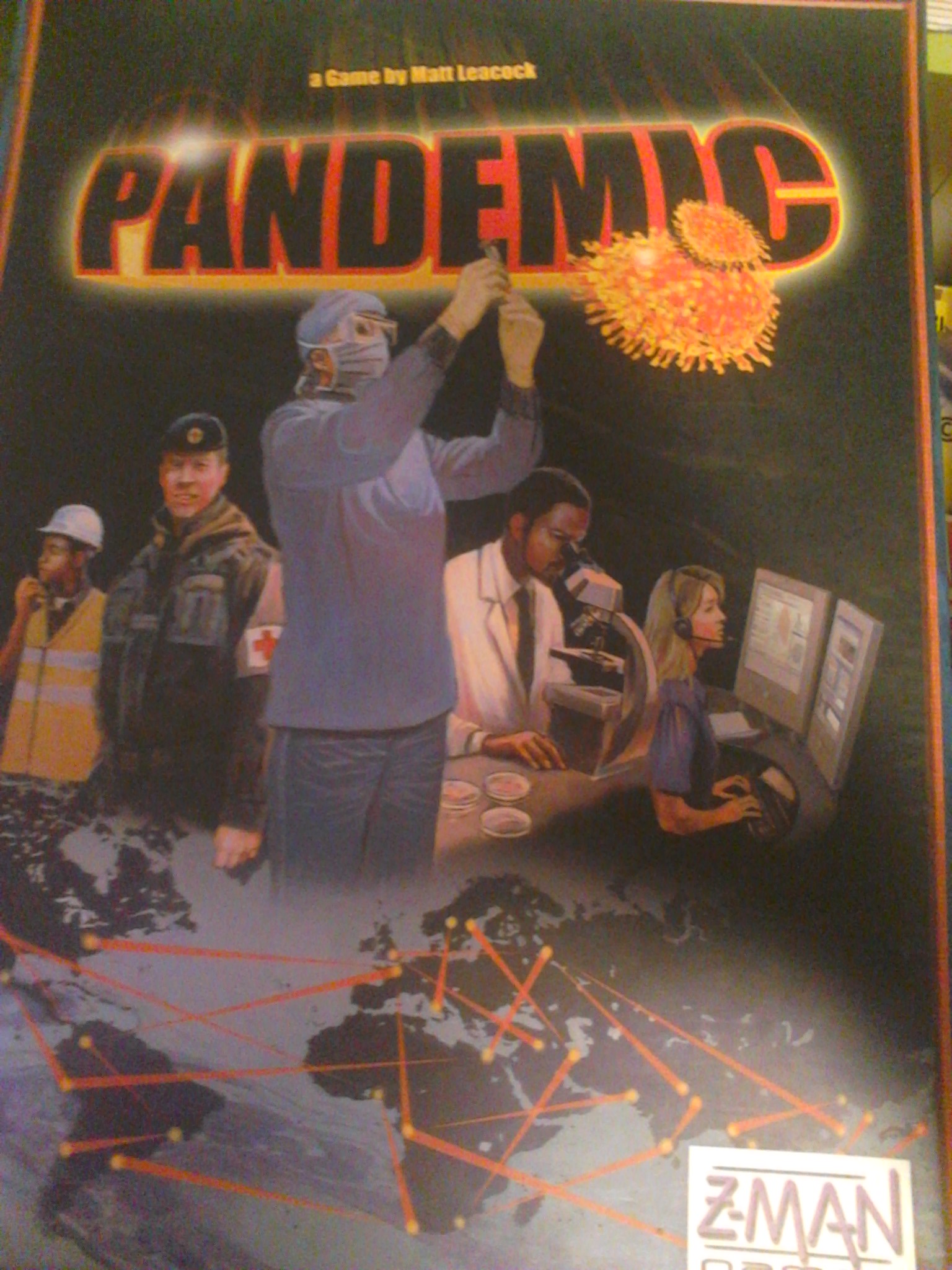
However, whilst on our travels, Rosie and I have come across, and played, many a game. Some that we’ve already reviewed, like Cripple Mr Onion. But other (more interesting games) that we found in hostels we stayed in, such as Pandemic! (Turns out we’re terrible at this game, we’re just too good at destroying all of humanity…) So below are a few photos of the game related things that we did:
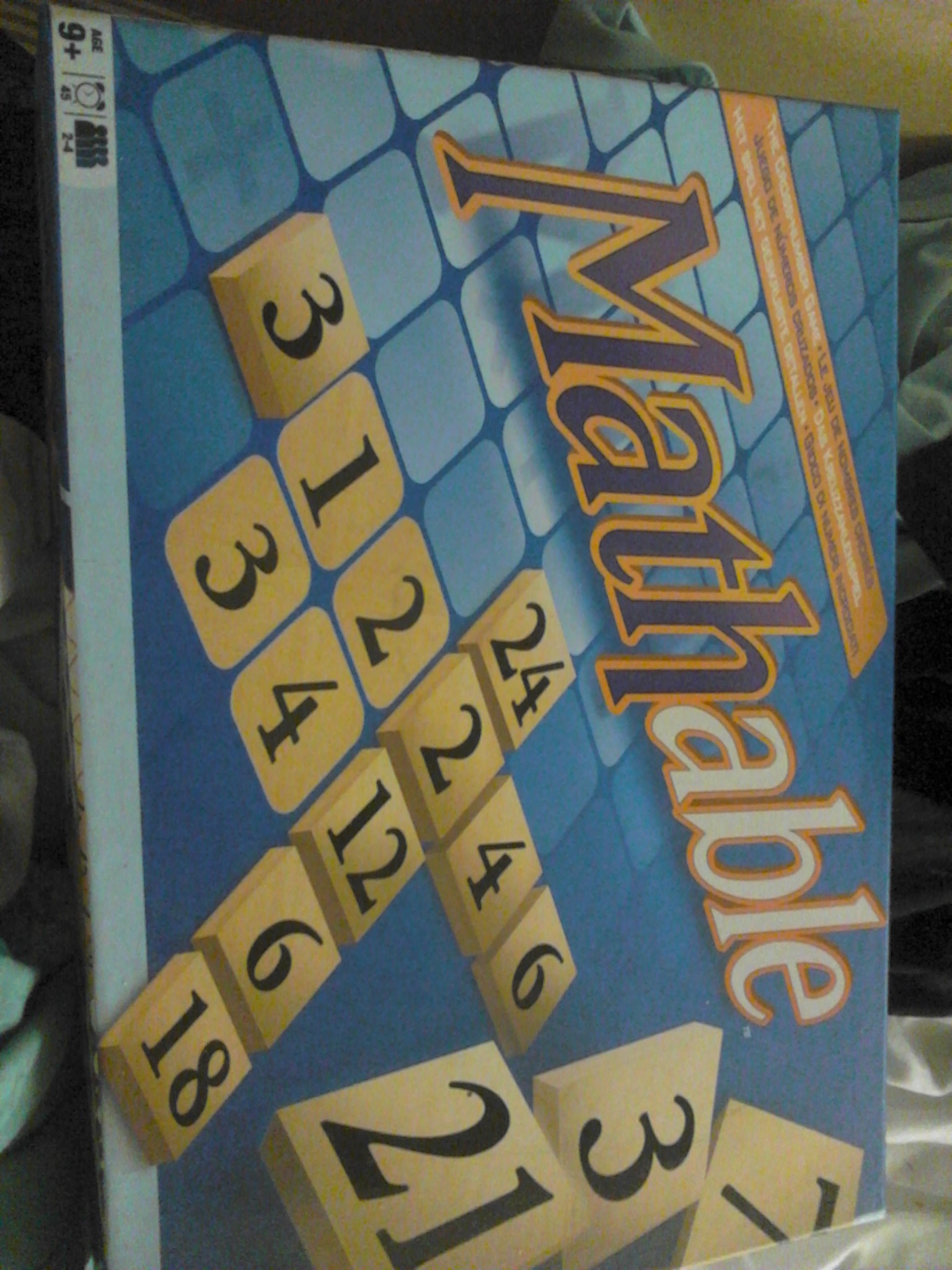
This was waiting for us (by my bed) in the hostel in Stockholm, the first city we visited, because we’re both terrible at maths, we didn’t play it.
For some reason, it won’t let me turn it the right way up…
In between Mathable and the next photo we also managed to play English Scrabble with a German Scrabble set. Needless to say scoring was interesting. Unfortunately, we forgot to take photos. 😦
Switzerland appears to have been the best country for board games in the hostels, most of the other places had chess, Copenhagen did have a few other interesting-looking games, but they were mostly in Danish, which neither of us could speak or read.
We found this in the hostel in Zurich:
PANDEMIC! It’s a race to save humanity
We freaked out a few people sharing the common area with us for the five hours that we spent playing this. Apparently we were taking saving the world from four deadly diseases far too seriously…
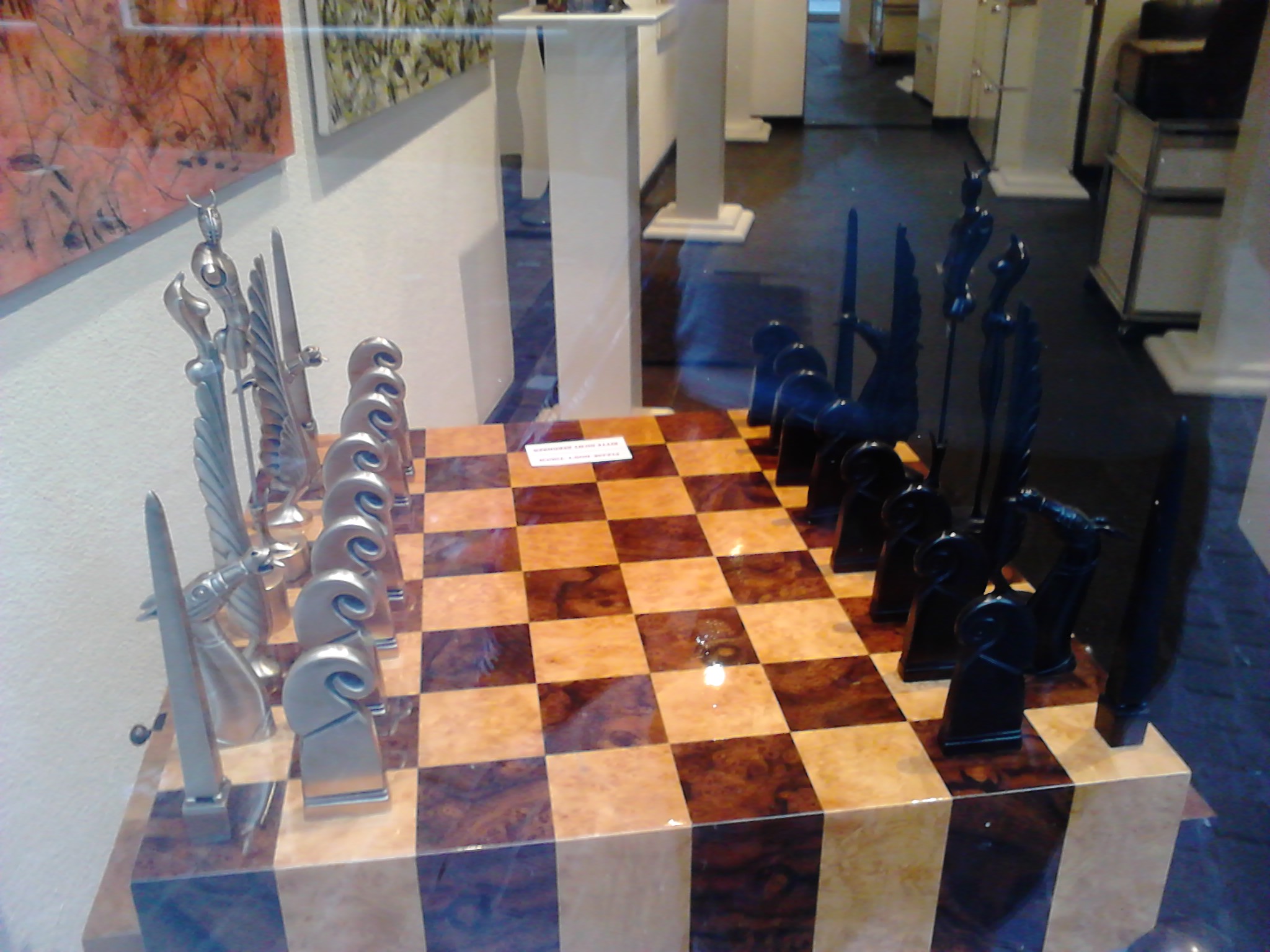
Also in Zurich I wanted to get this for Dave:
Because it’s just beautiful, as chess sets go
But it was a little out of my price range. He got a bar of Toblerone instead.
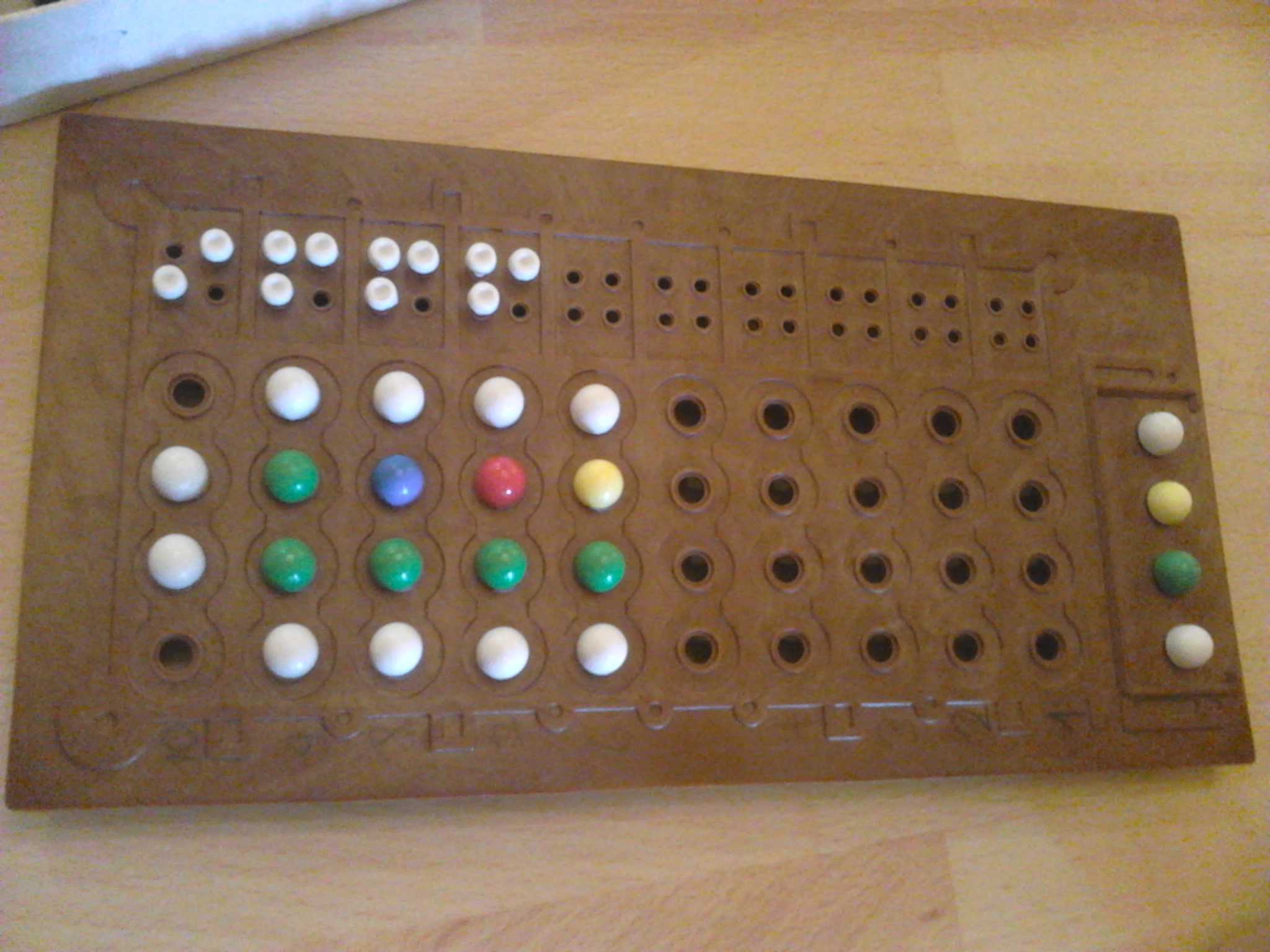
From Zurich we headed to Bern, and in Bern we found (but didn’t get a photo of) a giant Nine Men’s Morris set, an outdoor one, like the chess sets they have in schools and parks. It was awesome. But we also managed to play Mastermind in Bern, albeit, with a set that was missing a few pieces…
Slightly makeshift game of Mastermind
Once again, we apologize for the slightly hiatus in posts, but we’re hoping to be back on track, spamming you all with geeky board game reviews within the next few days!
Taboois an absolutely hilarious game, even more so when you play with people you know really well. It’s only kind of a quiz game, in that it’s not actually about how much stuff you know, it’s about your ability to describe.
What’s In The Box:
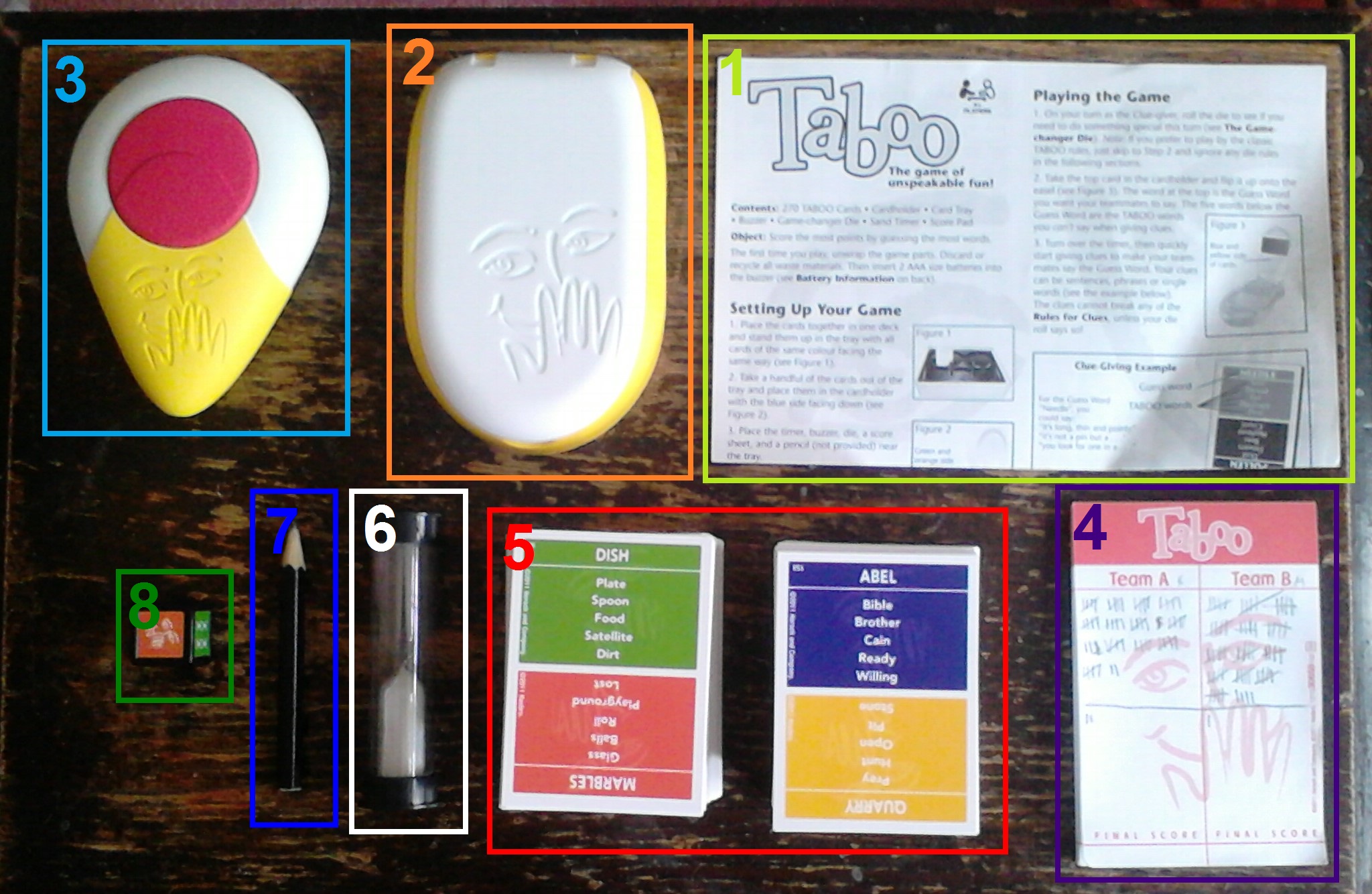
The Stuff.
1 Rulebook
1 Taboo Easel
1 Really Annoying “Nuh-Uh” Button
1 Score Pad
2 Reversible Word Decks
1 Timer
1 Pencil
1 Die
Playing The Game:
Objective: To get more points than your opponent by accurately describing more words to your team.
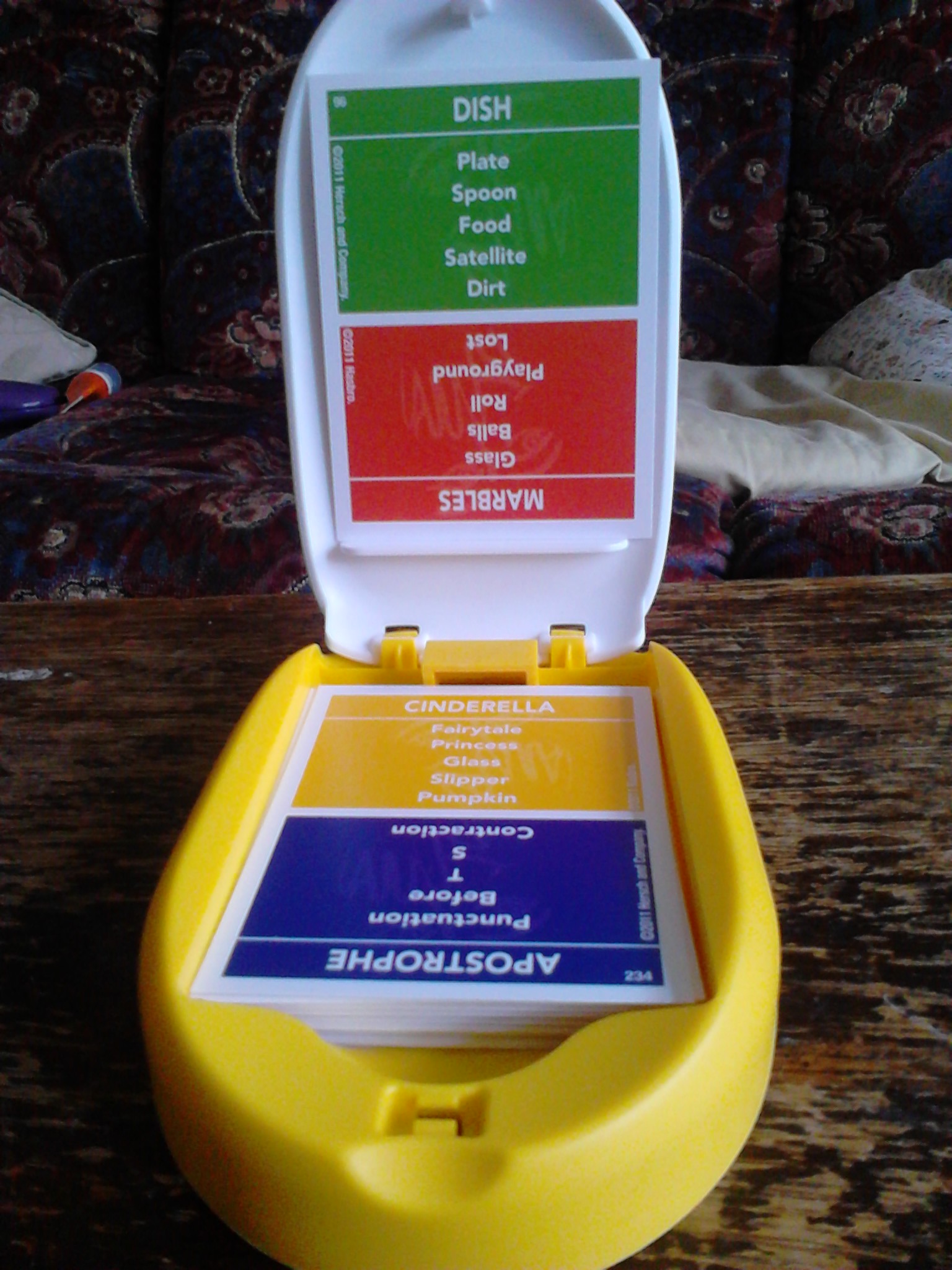
This game’s pretty simple, essentially you just divide up into teams, and then take it in turns to do some describing. You choose one player from your team to describe, and one to guess. The describer then places one card up on the easel, like this:
This is how you put the cards you’re describing.
As you can see, there are four colours on each card, which is great, is allows you to play four different games, and the colours have different kinds of words on them. We were playing to describe the green words, so the deck is placed accordingly face-down inside the easel and only one card at a time is revealed. Once the top card is turned up it’s the job of the describer to describe the word in such a way that their partner can guess it. BUT, they aren’t allowed to say the word on the card, or any of the words underneath it. These are “Taboo” words, and saying any of these causes you to give away a point to your opponents, as does passing because of the difficulty of a word to describe. They’re also not allowed to say the letter that the word begins with, or make explicit gestures.
Whilst you’re doing this you sit with one of the players from the other team; they’re given the annoying “Nuh-Uh” button and if you say anything you shouldn’t, they hit it so everyone knows you’ve made a mistake. For every word your partner guesses correctly, you get one point. Every time you finish a word, either because it’s been correctly guessed, passed or you said a Taboo word, you then flip up another card, trying to get through as many as possible per turn. The timer is used to regulate turns, each team is only allowed to turn it over once per turn and when it runs out your turn is over.
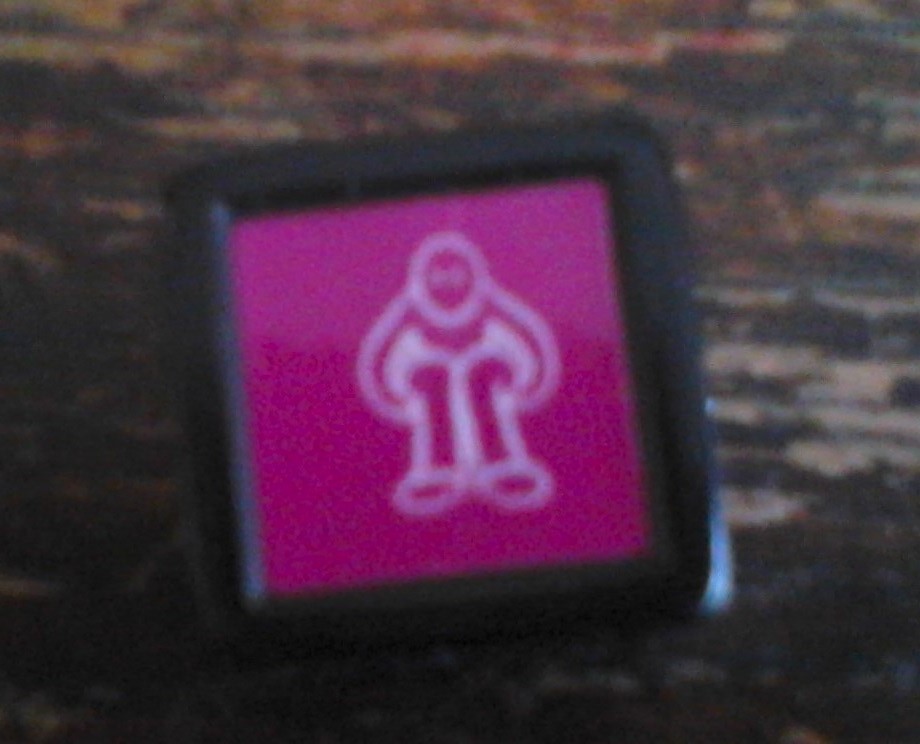
There is a second, slightly different version of this game, wherein the die is used. The only difference this makes is that at the start of each turn the describer has to roll the die, and then slightly different conditions apply. For instance, this side of the die means that the player describing must sit still like a statue:
Sit on your hands! (I also appreciate that the quality of this photo is terrible – Dave’s away so these photos were done on my phone)
The die does make the game slightly more interesting, but can be frustrating if you continually forget to roll or only get that face showing…
Winning The Game:
Points are scored how I said above, players pre-determine how many rounds or sections of the deck are going to be played before play starts. Once that number of cards has run out, the game is over, and the winner is the team left with the most points!
Strategy:
I can’t really figure one for this game, don’t waste your time waving your arms around? Try and partner up with someone who thinks similarly to you, sometimes you get a word that you can make an obscure film or song reference to, to help your partner guess it. But that’s no help if they’ve no idea what you’re on about!
History and Interesting Things:
There was a game show based on Taboo, hosted by Chris Wylde, in 2002.
In 2010, Cassandra Dominguez scored a record of 38 points in a four-round game at the World Board Gamers Convention.
The buzzer for the game featured on the Special Project episode of The Office.
Originally there was a board with the game, like in Tension, but this is no longer in the current editions of the game.
As far as history goes, that’s about it, it was only published in 1989, so not very long ago. It’s been on the radio and appeared in a few different TV shows, but other than that it’s not got much to say for itself.
To Conclude:
Taboo is a great game, a lot of fun, very light hearted and generally very silly. Like most games, it’s more fun with more people. Also, the fact that the rules explicitly say that you’re allowed to burst into song to help your partner guess a word really appeals to our family.
So on Saturday the 31st of May we went to the UK Games Expo in Birmingham. It was amazing! We’d been debating about going for all three days, but decided to go just for the day as we were unsure if it would be worth it or not. On reflection we can say it’s definitely worth going for the full thing and we will be going for all three days next year! Anyway, being the proud owners of a video camera we took that with us and videoed some bits; here’s what happened:
Because it was in Birmingham it was a LONG day; we left our house in London at 5am and got home at 11pm, give or take a bit, and all that for only six hours or so at the Expo.
The Biggest Problem With The Expo Was Staying Rich!
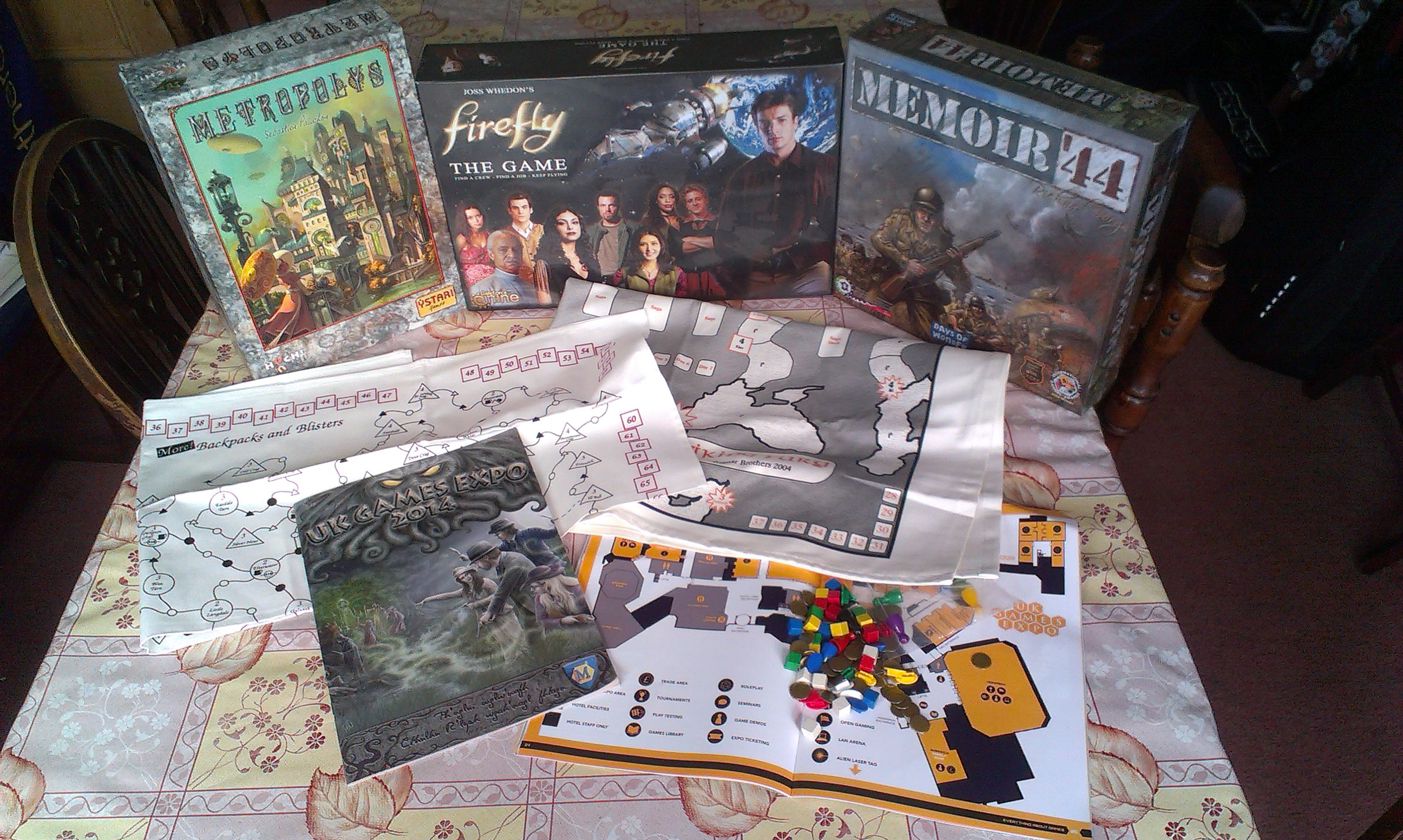
All the things we bought! And the programs.
We bought three board games, some surplus canvas boards that looked cool and a whole load of games pieces. Now that may not seem like much but actually that was about £100 worth of stuff… Totally worth it. Especially as all the games are AMAZING! The Firefly game is quickly becoming my new favorite game!
Chris Barrie Was There:
As you may have noticed from the video (if you watched it) Chris Barrie was there, who is famous for portraying this man/hologram:
So that was really cool as I’m a HUGE Red Dwarffan!
What I Realised…
…Was that there are WAY more people into board games than I thought. There’s a lot of people doing really cool stuff and developing really really cool games. Like the Ragnar Brothers who are in the throes of developing a really cool looking card game called Steam Donkey, having had a little help from Kickstarter. That will definitely be a game we’ll be getting and reviewing once its released.
To Conclude:
The Games Expo was AMAZING and we’re definitely going back next year. Also if you live in the UK and like that kind of think I can’t recommend it enough.
It’s completely possible, and quite likely, that the first thing that comes to mind upon hearing the word Mastermindis the TV Quiz Show, and although there is a board game of this, this is not it. This game of Mastermind pre-dates the TV show (by 1 year) and is a very simple, quick and fun game that anyone can pick up. But I want it noted here that the version featuring in our photos is in fact the Junior Mastermind, version of the game produced for children, featuring small, brightly coloured jungle animals as the pieces and having only three holes across for the code, rather than 4.
What’s In The Box:
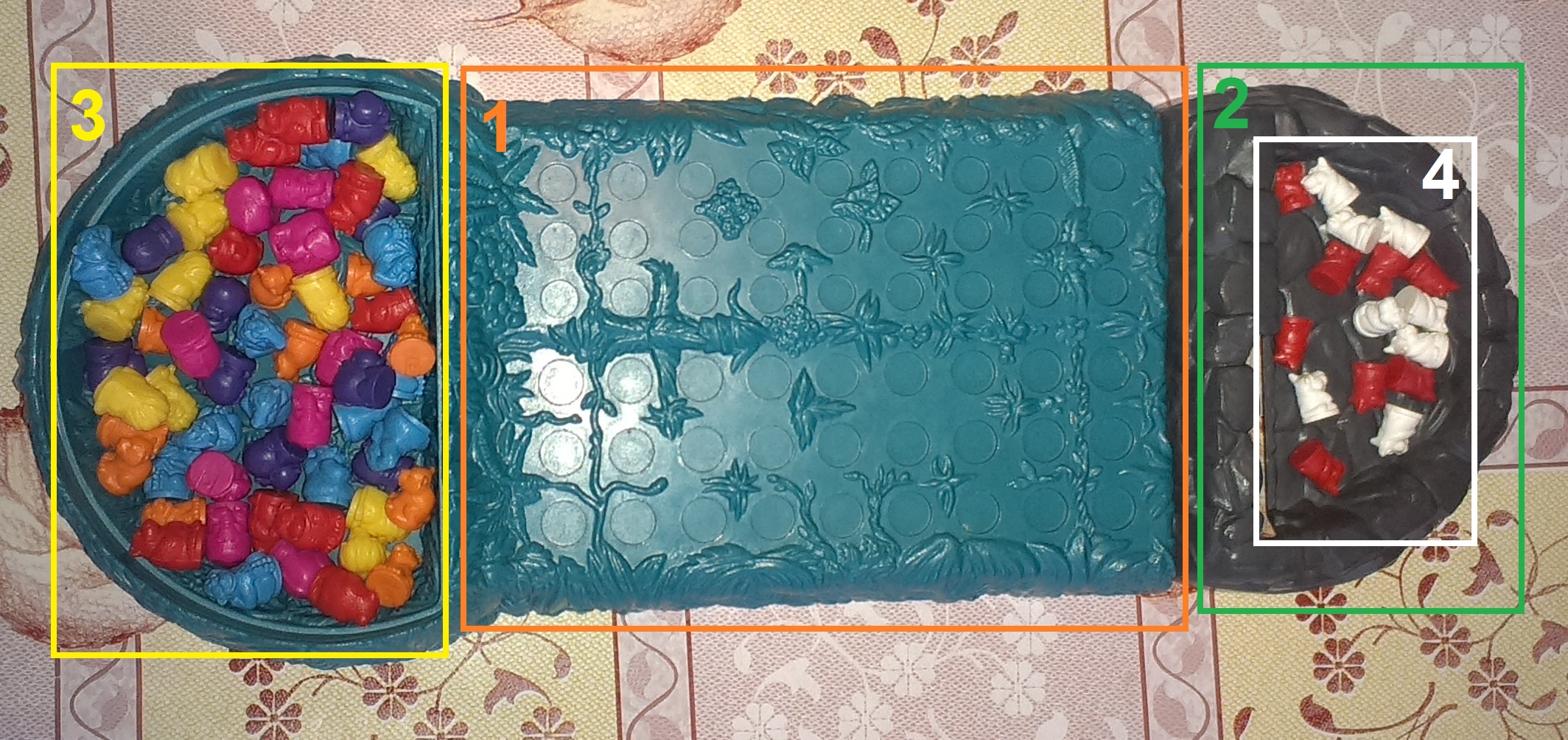
You can probably tell that we’re missing some of the pieces…
Green jungle playing board
Rocky mountain section (used to hide the code)
An assortment of 6 coloured animals
15 red creatures and 15 white creatures (supposedly)
Playing The Game:
Objective: to crack your opponents code before you run out of pieces, or to create a code that your opponent cannot crack.
To start the game you choose one player to be the code-maker, and one to be the code-breaker; then you position the board accordingly. The code-maker then takes a minute or two to secretly decide what the code’s going to be and put the pegs (or in our case little animals) in the shielded section of the board. After this, play starts.
It’s now the job of the code-breaker to pick out pegs (or animals), and position them on their side of the board in the order that they think the code is. The code-maker then uses their red or white creatures to signal which, if any, of these guess are right. To be right a piece must have both the correct position in the code (i.e. central, left or right hand end, from the point of view of the code-maker) and be the right colour.
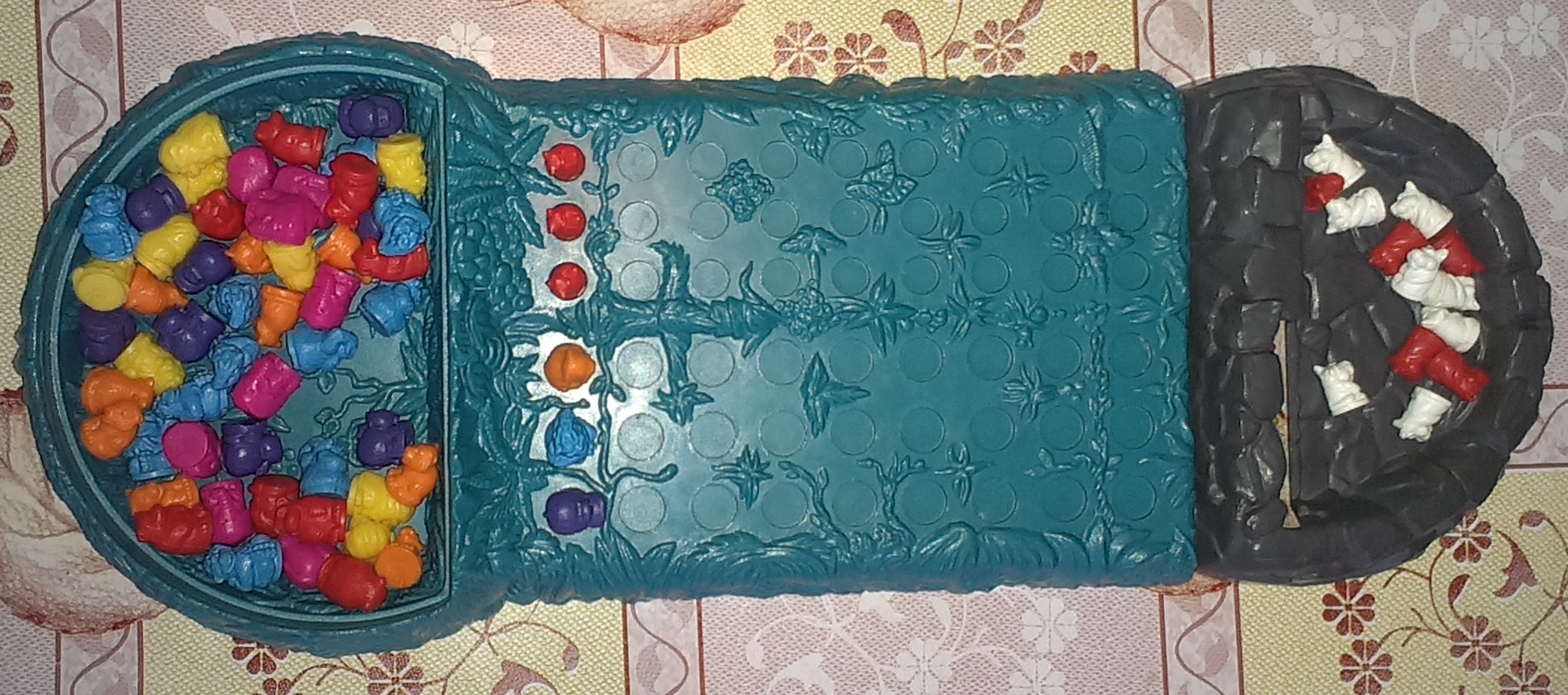
So the first turn of the game might look something like this:
And they’re all wrong
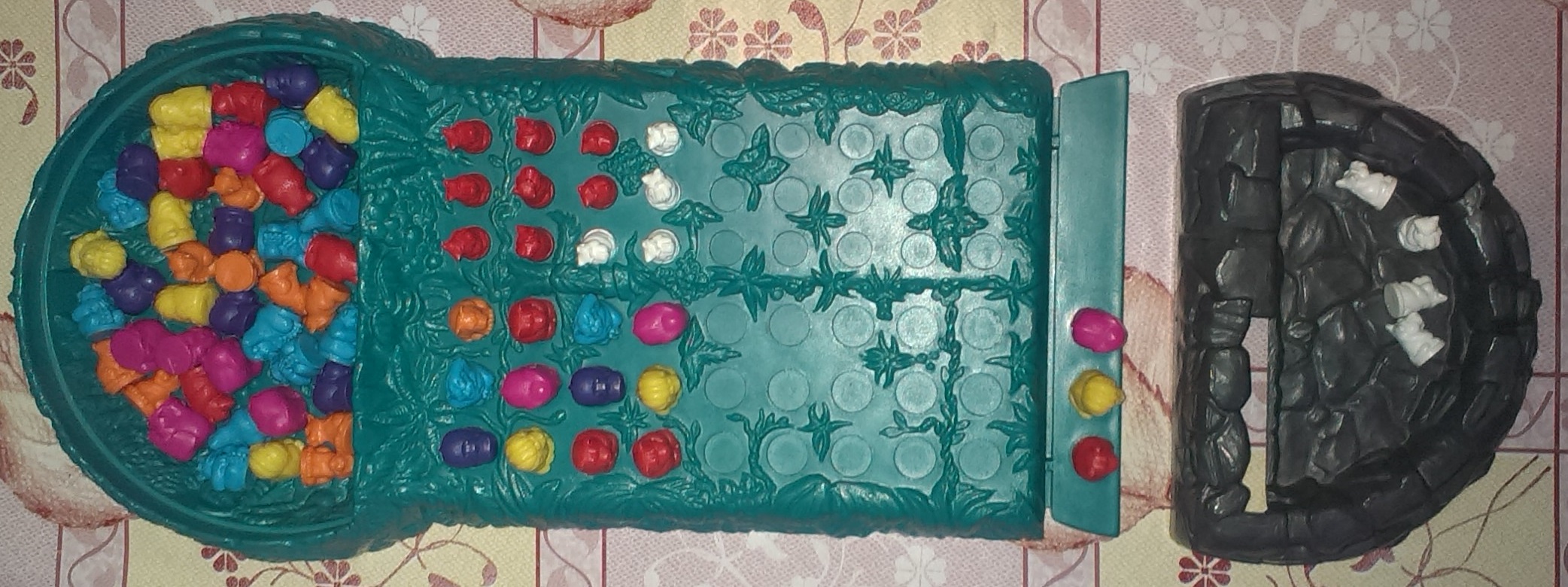
Play continues in this manner until the either the code is cracked, or you’ve played to the end of the board. Like this:
And Dave wins
Winning The Game:
Traditionally this game is played in rounds; the players decide before starting how many rounds are going to be played (always and even number) with the roles of code-maker and code-breaker alternating every round. The winner is the player with the most points at the end of this. Points are scored by the code-maker. S/he gets one point for each guess the code-breaker makes, and is given an extra point if the code-breaker doesn’t manage to accurately guess the entire code in their last move. Points are kept track of across the rounds and added up at the end.
Strategy:
For the Junior version of this game there isn’t a great deal of strategy required, but for the adult version (which has a four-peg code, rather than three, and one more option for indicating yes or no to part of a code) you can be a little more logical about it. Unless you’re a mathematician (which I’m definitely not, but the internet’s a wonderful place to learn things) you probably won’t be able to work out in your head the maths that accompanies this game, but the most important thing to remember is that duplicates are allowed in the code.
History and Interesting Things:
The modern game, played with pegs, closely resembles a pen and paper game called Bulls and Cows that may be over a century old.
The rights to the game have been held by Invicta Plastics since 1971, initially they manufactured it themselves, but have since licensed it to Hasbro, Pressman Toys and Orda Industries for production across the world.
The 1973 edition of the game features a well-dressed white man sitting in the foreground with an attractive Asian woman standing behind him. Bill Woodward and Cecilia Fung reunited in 2003 after 30 years to pose for another publicity photo.
In a standard set of the game, allowing a four-peg code, with six colour options, there are 1,296 different possible code patterns (including, and allowing for duplicates).
In 1977 Donald Knuth showed that the code-breaker can solve in a maximum of five moves, using this algorithm.
There have been computer versions of the game produced, as well as multiple different editions released.
The difficulty level of the game is altered simply by changing the number of pegs allowed for the code, or the way in which the code-maker indicates a correct or incorrect guess.
To Conclude:
I like Mastermind a lot, it’s a simple game that’s good for burning time or just chilling out, it doesn’t require a lot of concentration, and it doesn’t take long to play. I’d strongly recommend teaching it to kids too, the length of time it takes to play is well-suited to the generally shorter attention span of kids. But don’t let the really little ones get their hands on it – swallowing one of those pieces could end really badly!
. . . 7 Hours Later We Have An Interesting-Looking Cake
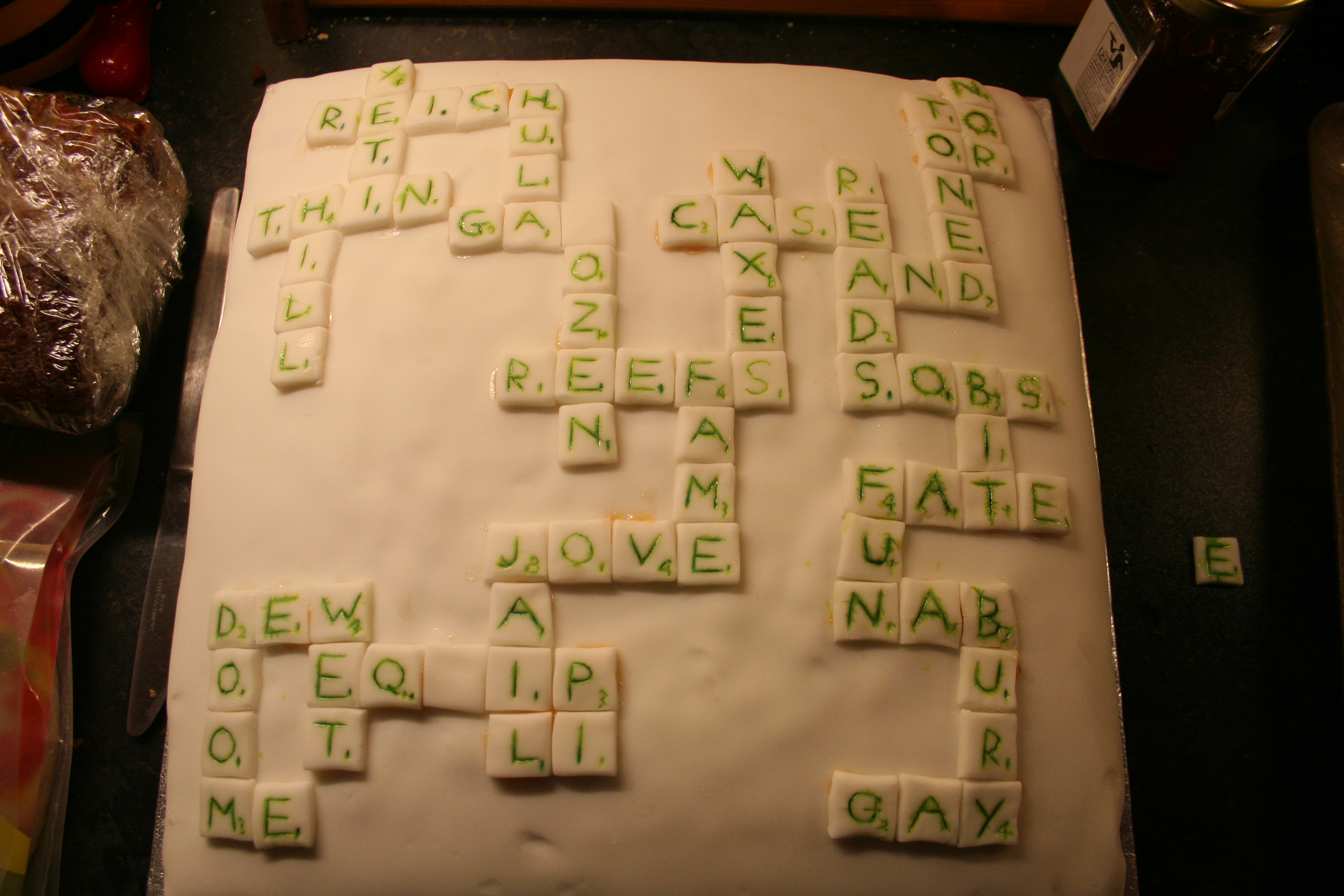
A while ago Dave and I decided that it might be fun to branch out a little into Board Game-related other things, so behold, Scrabble-cake!
My first attempt at a Scrabble-cake. The next one’ll look less odd.
So anyone that knows me will know that I do a lot of baking, the weirder the cake, the better. A while ago I had an idea for a really cool cake to make Dave for his next birthday; unfortunately this idea came about three weeks after his most recent birthday. The only plus side is that I’ve now got the better part of a year in which to make it a few times and discover the most practical way to go about it. Which I didn’t have with this cake.
The idea for Board Game cakes came from a “hey, why don’t we choose a Board Game of the Year, at the end of every blog-year?” idea (different to calendar years, but similar to academic years because the blog started at some point last September). And turned into “I could totally make a cake that was the board of the game we choose!” Then, back at the end of March, it was my friend’s birthday, and her favourite game of all time is Scrabble, the official post for which is also now up.So I set myself the task of making her a Scrabble-cake.
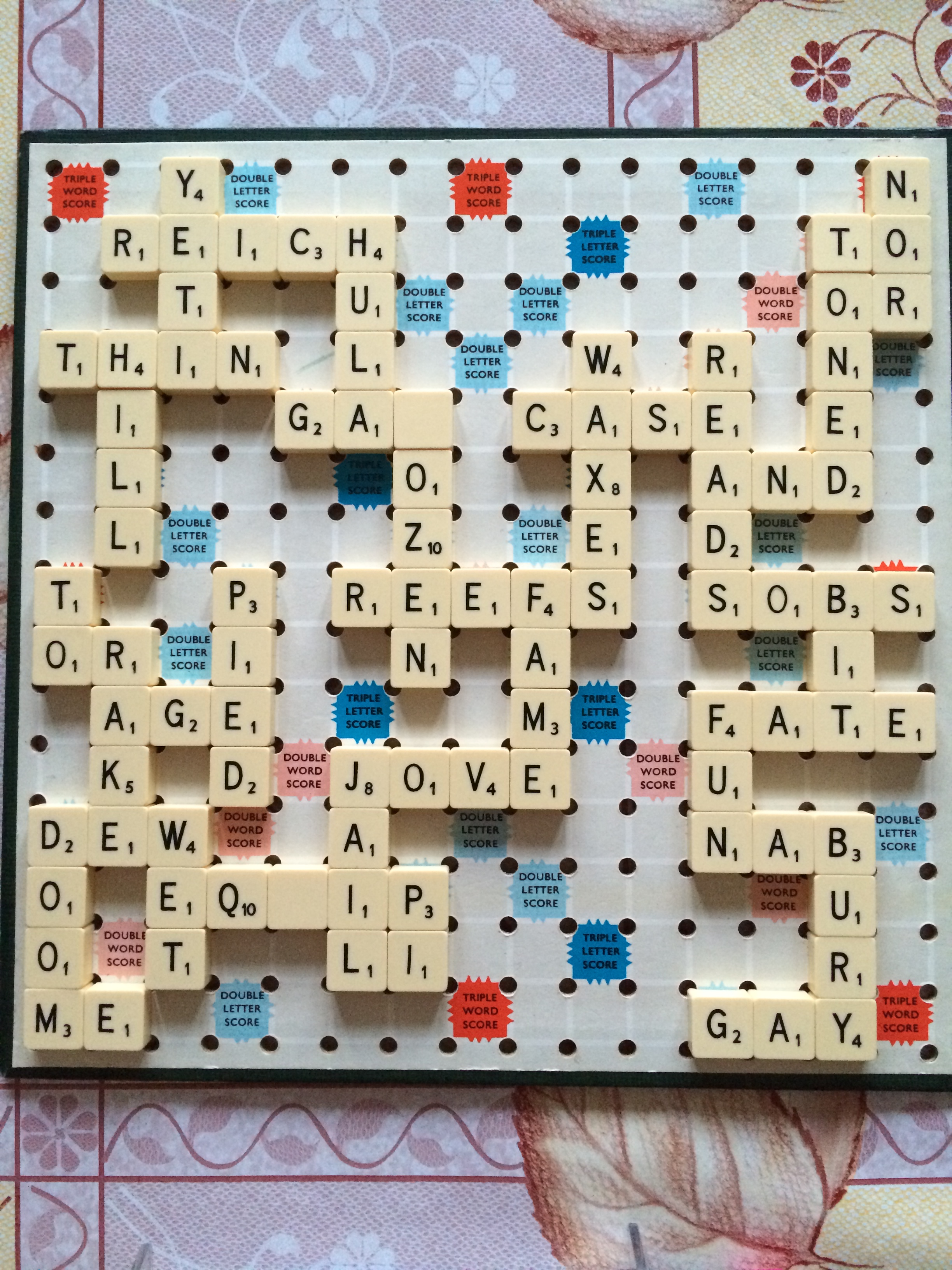
The above photo is the end result of my first (and currently only) attempt at such a thing. The game represented there is one we’d actually played a week or so before. I do also realize that there’s some dubious words on there, as far as the real rules for Scrabble go. But we’ve always had a more flexible approach to it than most.
Things You Will Need/Whatever It Was I Used:
I made a fairly standard (albeit huge) chocolate cake for this, because a) chocolate cake is awesome and, b) I needed something relatively solid to squidge lots of icing onto.
The Cake Recipe:
This chocolate cake is amazing, super-simple, and takes next-to-no time to make, but I need you to keep in mind when looking at the amount of each ingredient you’ll need that I’m giving you the double-dose that I used for this cake, so it’ll turn out pretty big.
You will need:
250g Soft Butter
2 teaspoons of Vanilla Essence
550g Caster Sugar
4 Eggs
400g Self-Raising Flour
100g Cocoa Powder
320ml Water
Method (I love this method):
Combine all ingredients in a large bowl, beat on low speed with electric mixer (or on standard speed if doing this by hand) until all ingredients are combined. Increase speed to medium (or beat faster until your arm wants to fall off) for about three minutes or until the mixture is smooth and has changed to a lighter colour. Spread into a large square tin (pre-greased, of course). Bake on 180 degrees Celsius until cooked when poked. Stand the cake for five minutes before turning out onto a wire rack to cool.
My favourite thing about this recipe is that the method essentially just tells you to bash everything together in a bowl, stick it in a tin, and shove it in the oven; after seeing so many complicated, lengthy cake recipes, this one makes me very happy.
Making the Scrabbly-Bit:
The Things I Used:
A large pack of roll-out white icing
2 thin bladed sharp knives
1 bottle of green food colouring
1 sterilized pin (but if you can get icing pens, or have a steady enough hand to substitute a clean paintbrush, I highly recommend it)
1 small paper square template
How I Went About It:
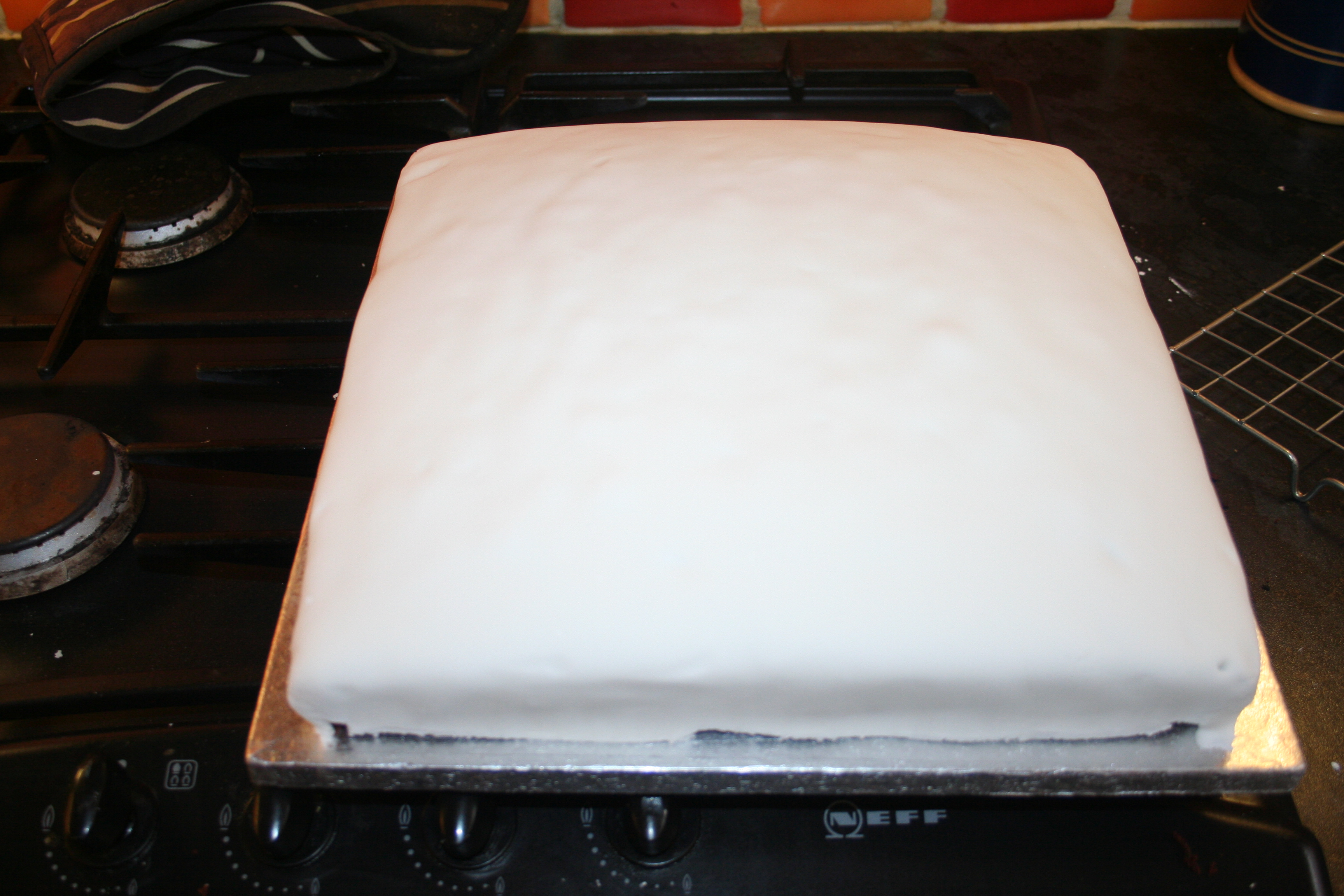
First, after the cake had cooled a bit (I didn’t let it cool completely, which I should’ve, because I’m impatient and wanted to get on with things), I completely covered it with a big square of the roll out icing, this was to provide a surface on which to recreate the Scrabble board, although it wasn’t as flat as I would’ve like. So your basic cake, before you start anything complicated, should look like this:
My Scrabble-cake-board
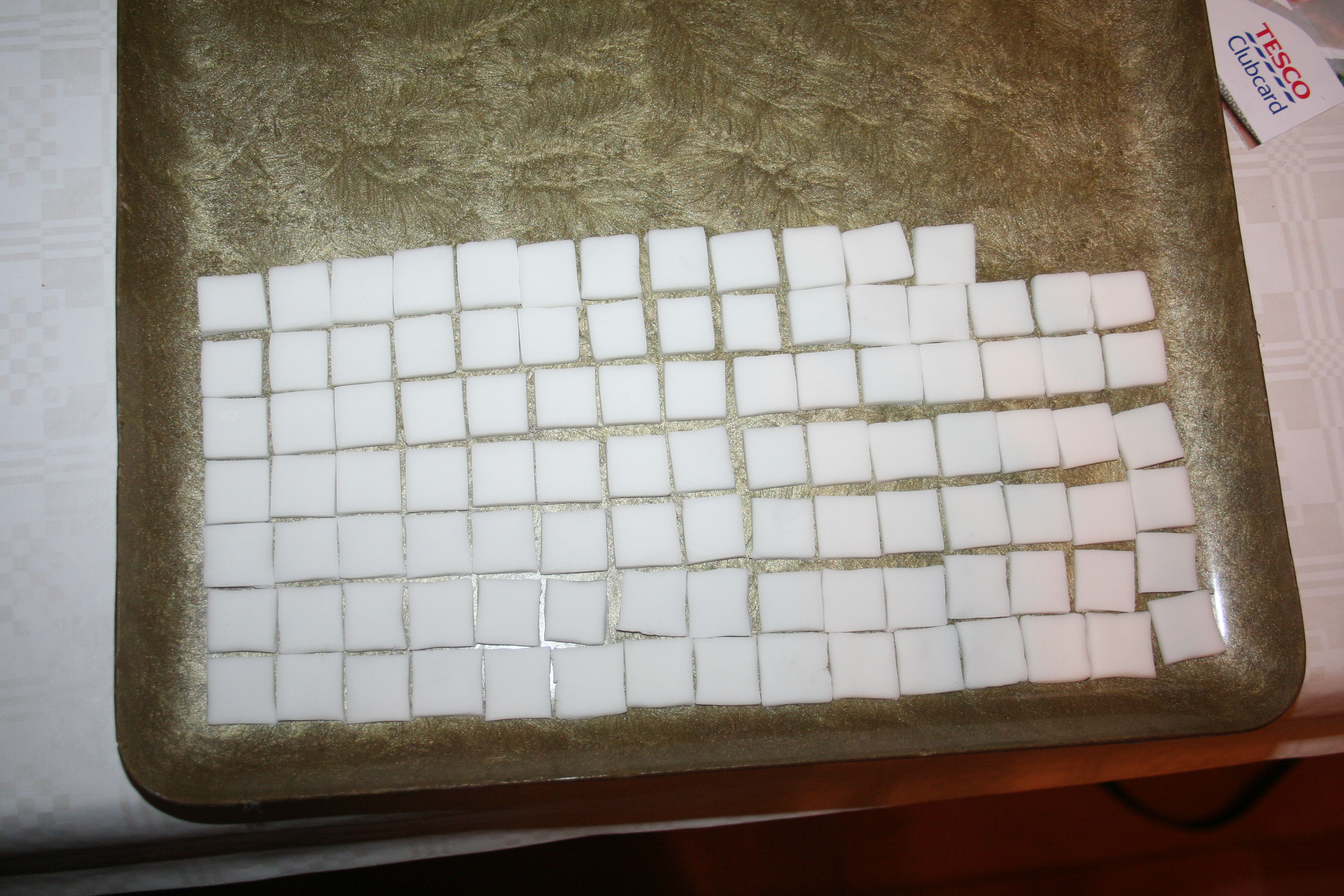
Making the tiles and putting letters on them was the hardest bit, and, on reflection, there were probably better ways to go about it. I briefly considered making all 100 Scrabble letter tiles, before realizing that we hadn’t used all 100 (although we weren’t far off it) in the game. So instead, I got up the photo of the game and counted how many tiles I needed. I then rolled out a whole kitchen-tables worth of icing, and started cutting out tiny squares. After many hours of painstakingly trying to keep the squares actually square as I cut them out, I’d achieved this:
My blank Scrabble tiles, not perfect, but not bad
The next step was to actually make them into letters; I did this by using a bowl of green food colouring (because we didn’t have any black or blue, and yellow and pink are crap colours for this kind of thing) and a pin. I used to tip of the pin to etch the letters and their point value into each tile, and then tipped the pin with food colouring, to make them visible. I decided the easiest way to prevent mistakes was to make the game one word at a time, starting from the top left-hand corner, which I did. This is the photo of the game that I was working from:
This game was played on our travel-Scrabble board, rather than the (much nicer) board, that features in our actual Scrabble post.
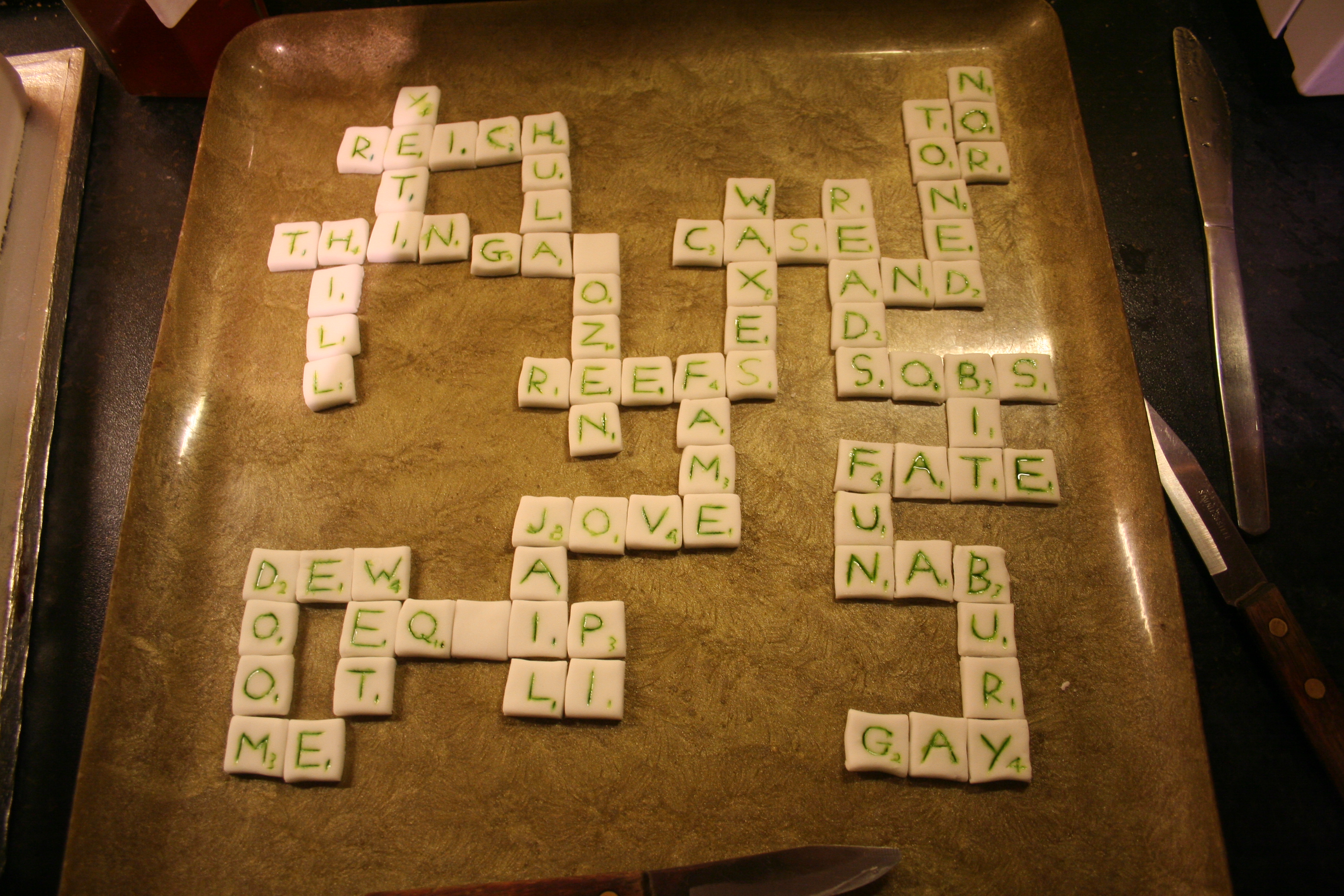
My recreation of this game looked like this (before I put it on the cake):
The game.
Now all that was left was for me to transfer this, to the cake. A part of me still thinks that this should’ve been a simple job, but because the cake wasn’t all that flat across the top, it became much harder than it initially appeared….
Initially, I moved the tiles onto the cake without fixing them down in any way to make sure they all fit, and to space them out properly. Prior to cutting out the tiles I had done the maths of measuring the width of the cake and then working out from that the dimensions that each tile needed to be, to ensure that I could fit them all on and keep it accurate to a real Scrabble board (albeit with a lot of artistic license), so I shouldn’t really have needed to put them on loose first, I could’ve just stuck them straight down. Buuuut, my maths skills are not the best; I have been known to not be able to count to five in the past, so I second-guessed myself, and made everything take that much longer by checking it was all okay.
After I’d done this I managed to convince myself that I had got it more or less right, and stuck the tiles down. For this I used jam of some description that I found in the fridge, warmed in the microwave. I spread a little of this on the back of each tile, and then fixed it to the cake. However, I warmed it slightly too much, and some of the tiles closer to the edges of the board started sliding, which was irritating, because I then had to hold them until the jam set a bit.
Once I’d got through this, the cake looked like this:
A somewhat jammy, almost finished cake!
Finishing The Cake!
I realize that at this point the cake still doesn’t look an awful lot like a Scrabble board, and in the finished photo, it doesn’t hugely either, because I took a lot of artistic license at this point, in the interest of being able to go to bed. My sister, Ruth, had suggested that using Magic Stars would be a really nice way of putting the double/triple word/letter scores onto the cake, without having to write anything onto it, so I did that. And that was all I did. After that I decided that the cake was finished, and went to bed.
Things I’ll Do Differently Next Time:
BUY ICING PENS. Seriously, these would’ve made my life much, much easier, using a pin to create the letter tiles was unbelievably awkward, and so easy to mess up.
Use sugar paste instead of jam to stick the tiles down, although I’d probably still have the problem of them sliding a bit, the stuff is at least the same colour as the icing, so the mistakes are less noticeable.
Try harder to make the cake come out flat/chop the lumpy bit off before starting to ice it. This would’ve made my life much easier if I had been working onto a flat surface, rather than one that was curved.
Draw on the board. Next time, I’m definitely going to draw out the actual Scrabble board onto the cake, and recreate a game onto that.
All that said, this cake was awesomely fun to make, and it was so big that Rachel and I managed to feed around 40 people with it! So I’m definitely doing this again. And there will also be more themed-cake posts in the future. If you try making this, please let me know how it turns out, and send photos, I’d love any kind of feedback!
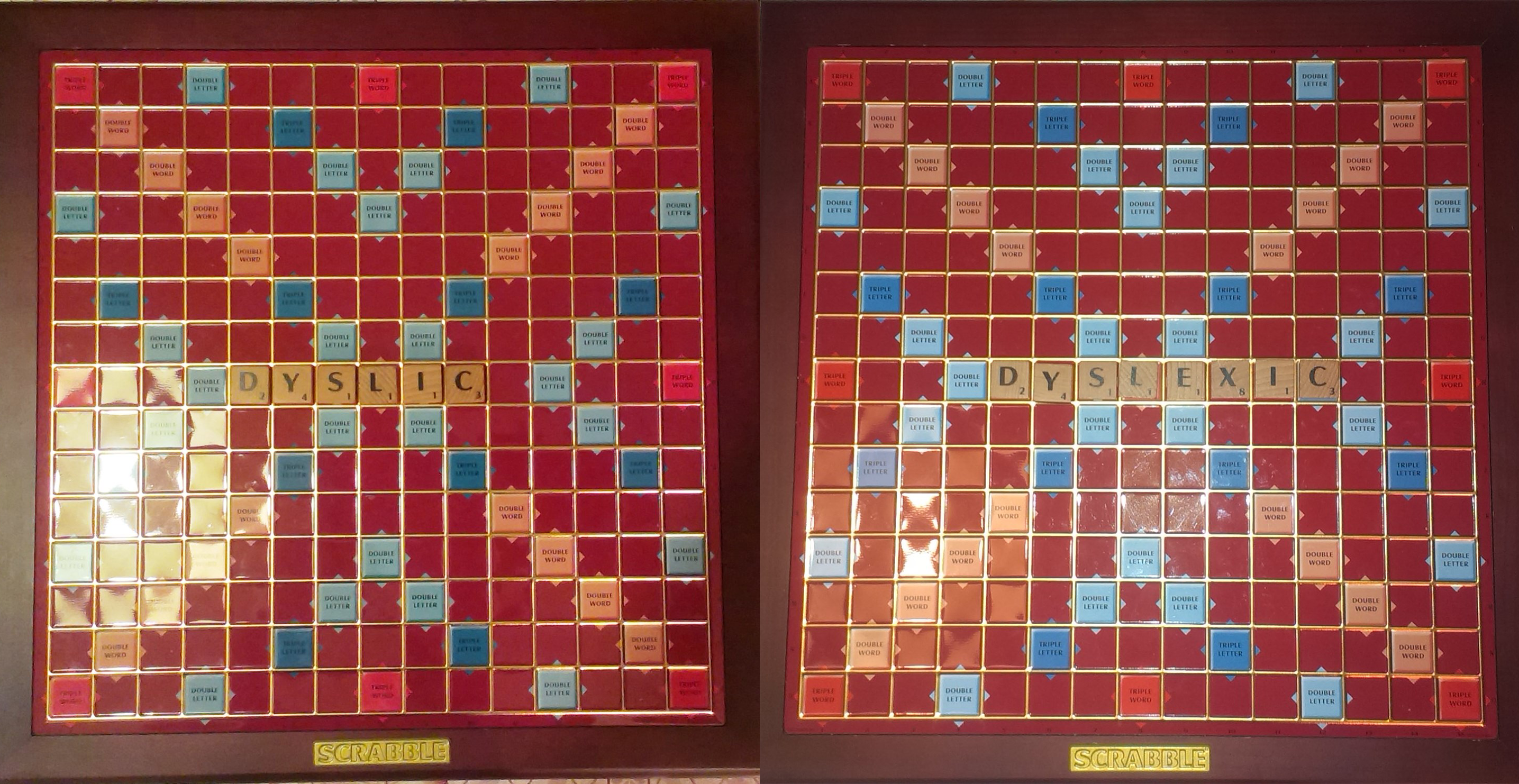
Scrabble is one of the classics of classics. There’s a high chance that you’ve played this game at some point in your life, or, failing that, have seen a copy floating around in your grandparents house that they like to get out at Christmas and encourage everyone to play together. Either way, it’s a fun game to play, especially on teams, and especially especially if there are dyslexics around.
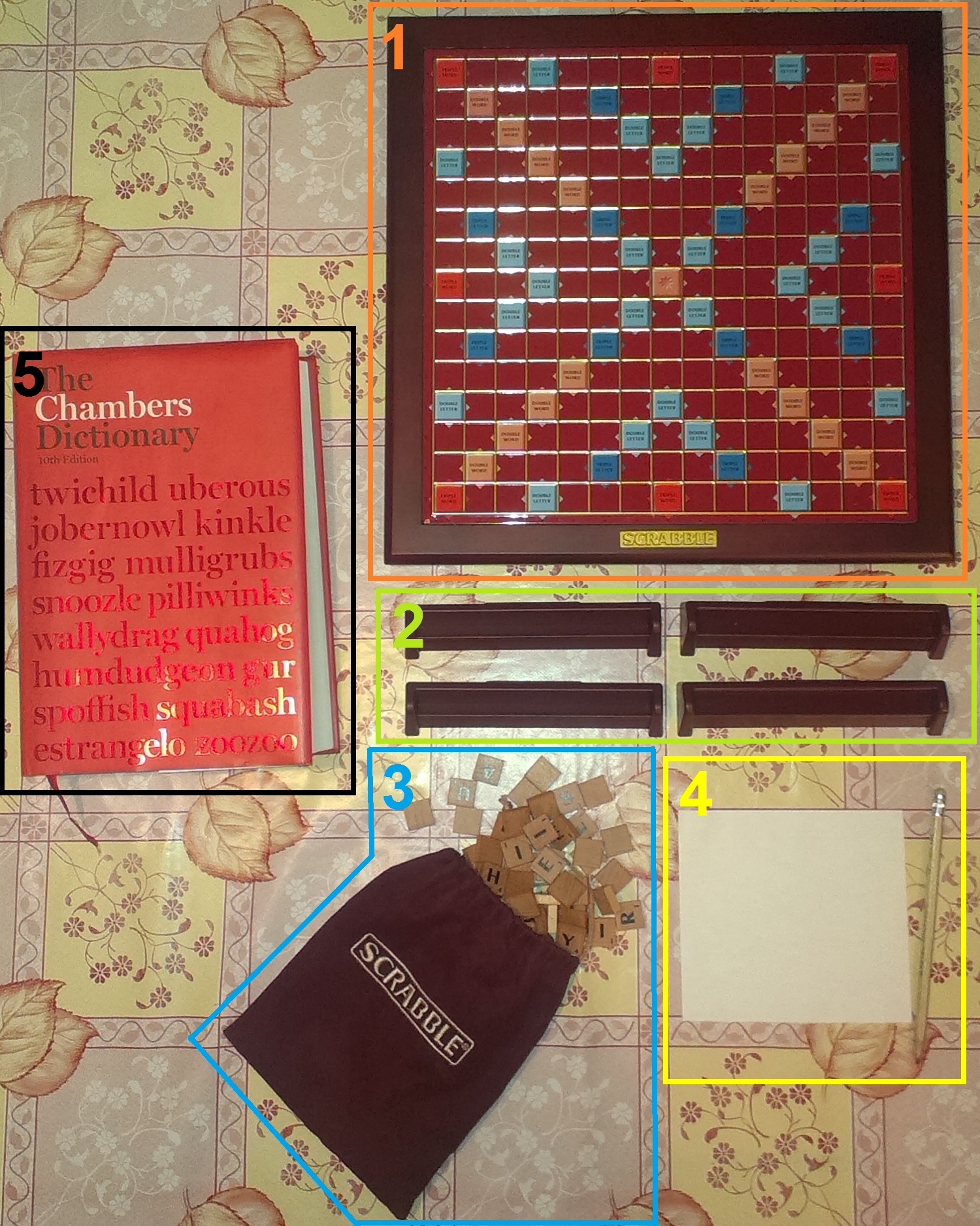
What’s In The Box:
The stuff.
1 Game Board
4 Tile Racks
1 Bag containing 100 Letter Tiles
1 Pencil and Score Sheet
The Chambers Dictionary (not actually included in the box, or used by anyone I’ve ever met when playing this game)
Playing The Game:
Objective: To have scored the most points by the time one player plays their last tile and there are none remaining in the draw bag.
To determine who plays first each player takes one tile at random from the draw bag, the player with the letter closest to the start of the alphabet is the starting player. From them play proceeds clockwise around the board. All of these tiles are then returned to the bag, and new tiles are drawn. In play order players draw 7 tiles and place them on their tile rack, keeping them out of the sight of the other players.
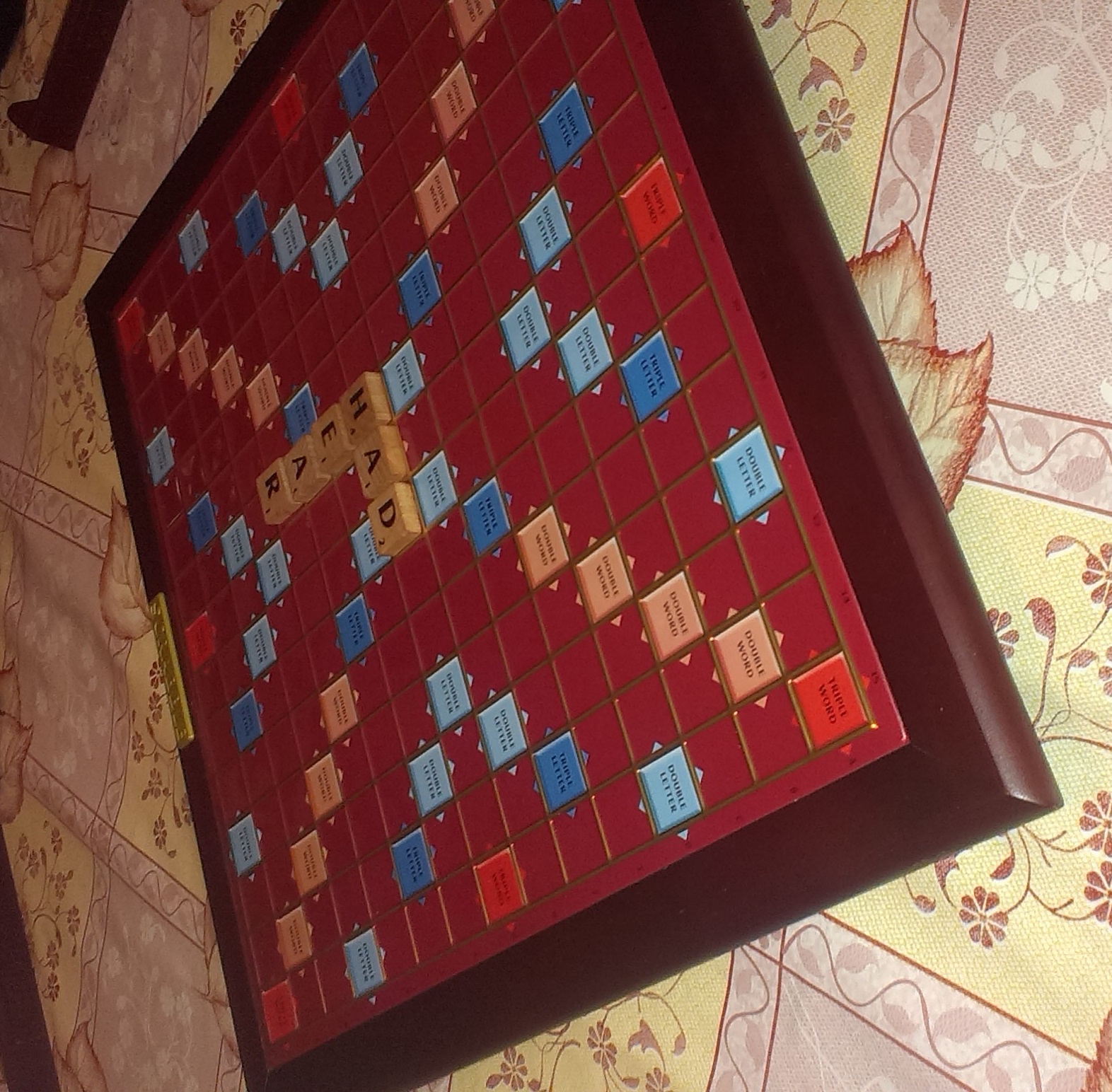
Once all players have their tiles, player one places a word on the board. All words must be at least two letters long and the first player places their first word across the red Double Word space in the middle of the board. After the first word has been played other players can lay words; new words must either be played through other words, crossword style, or be added on to the end of a word already on the board, for instance by adding an “S”. All words played must be real words, and names (of both places and people) and foreign languages are not considered legitimate words.
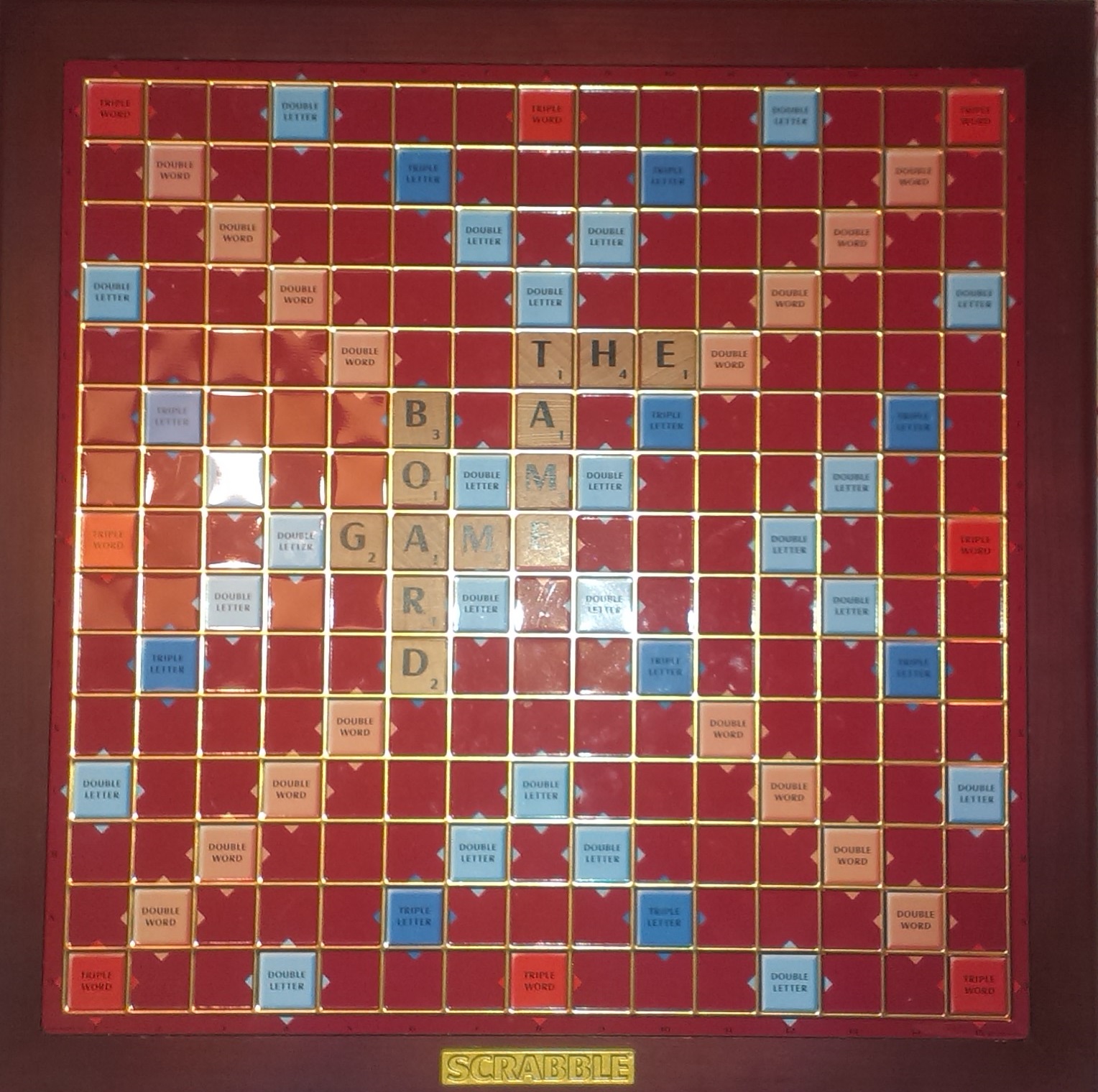
I don’t really know what was going on with this picture. I assume artistic license has something to do with it…
So you can kind of see what the opening words of a game might look like, even though the angle of that photo is weird as. Once a player has played a word, they then draw the same number of new tiles at random from the Draw Bag as they placed on the board. This can be interesting, because there’s no knowing which letters you’re going to be blessed with next. You can end up with a rack that only contains vowels, or consonants. Which is often not a huge amount of use.
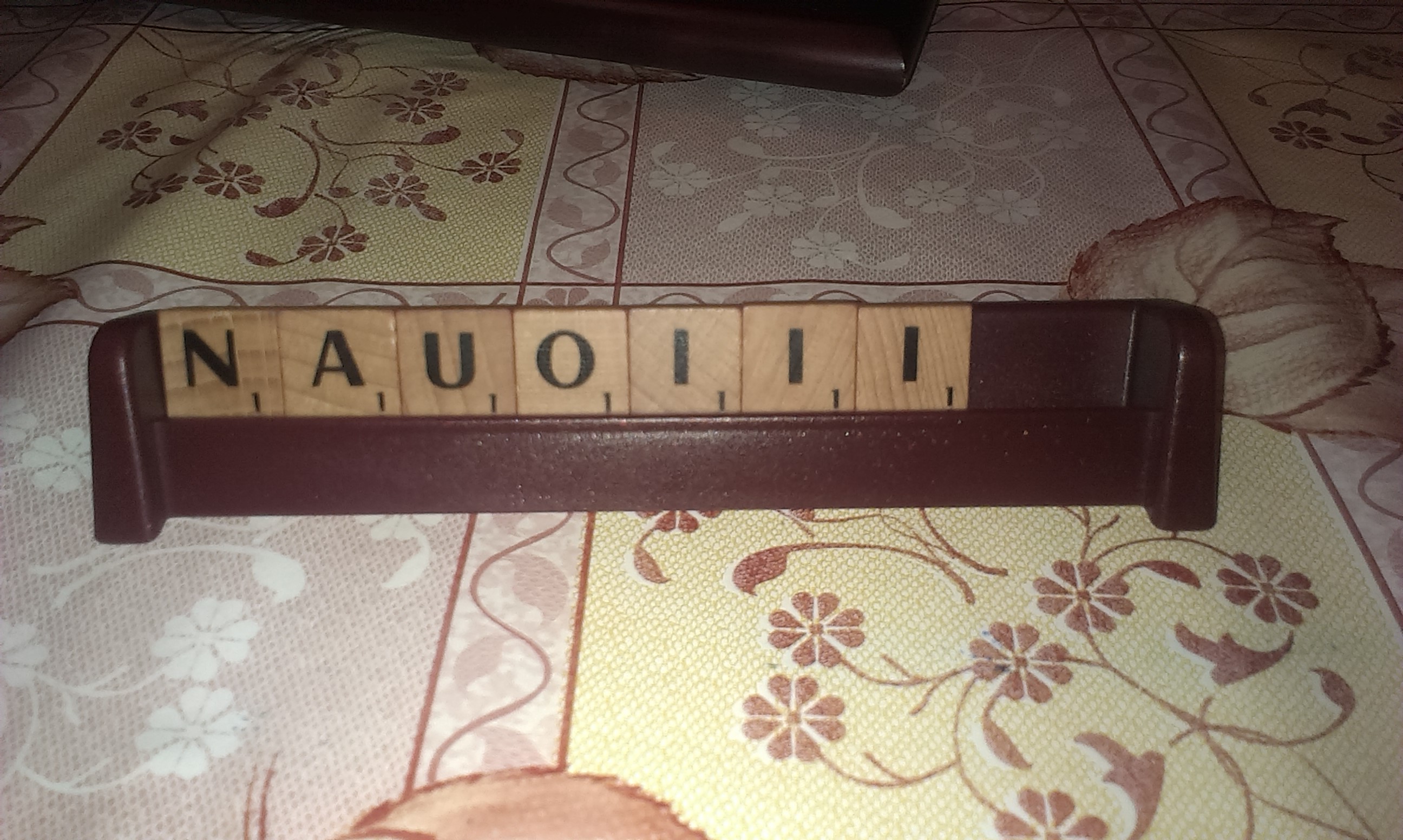
However, there is a rule that allows a player to forfeit a turn to change all of their tiles, to do this the player must wait until it’s their turn, and then exchange their whole rack for fresh tiles from the Draw Bag. Play then immediately passes to the next player. This is a good rule that can allow you do something about getting rid of a rack that looks like this:
Had I chosen to do so, that rule would’ve allowed me to replace these tiles with new ones from the Draw Bag
Play continues in this way, with one player keeping track of score until one player plays their last tile after the Draw Bag has been emptied. To score a player has to take into account both the value of the letter tiles played (the number on the bottom right hand corner of the tile), and whether or not the word has been played over any double/triple word/letter score tiles on the board. If it has then you must increase the score of that word for that player accordingly. If a player plays a word that changes a word already on the board, for example playing a word that starts with “S” and adding the required S onto the end of a word already existing on the board, the player adds up to total for the word they have changed, as well as the word they played, to be the score for that turn.
A generally accepted method of keeping score is to draw out columns on your score sheet with the initial or name of each player at the top of a column, you then keep a running total going in the columns so you can see exactly where each player’s at throughout the game, like this:
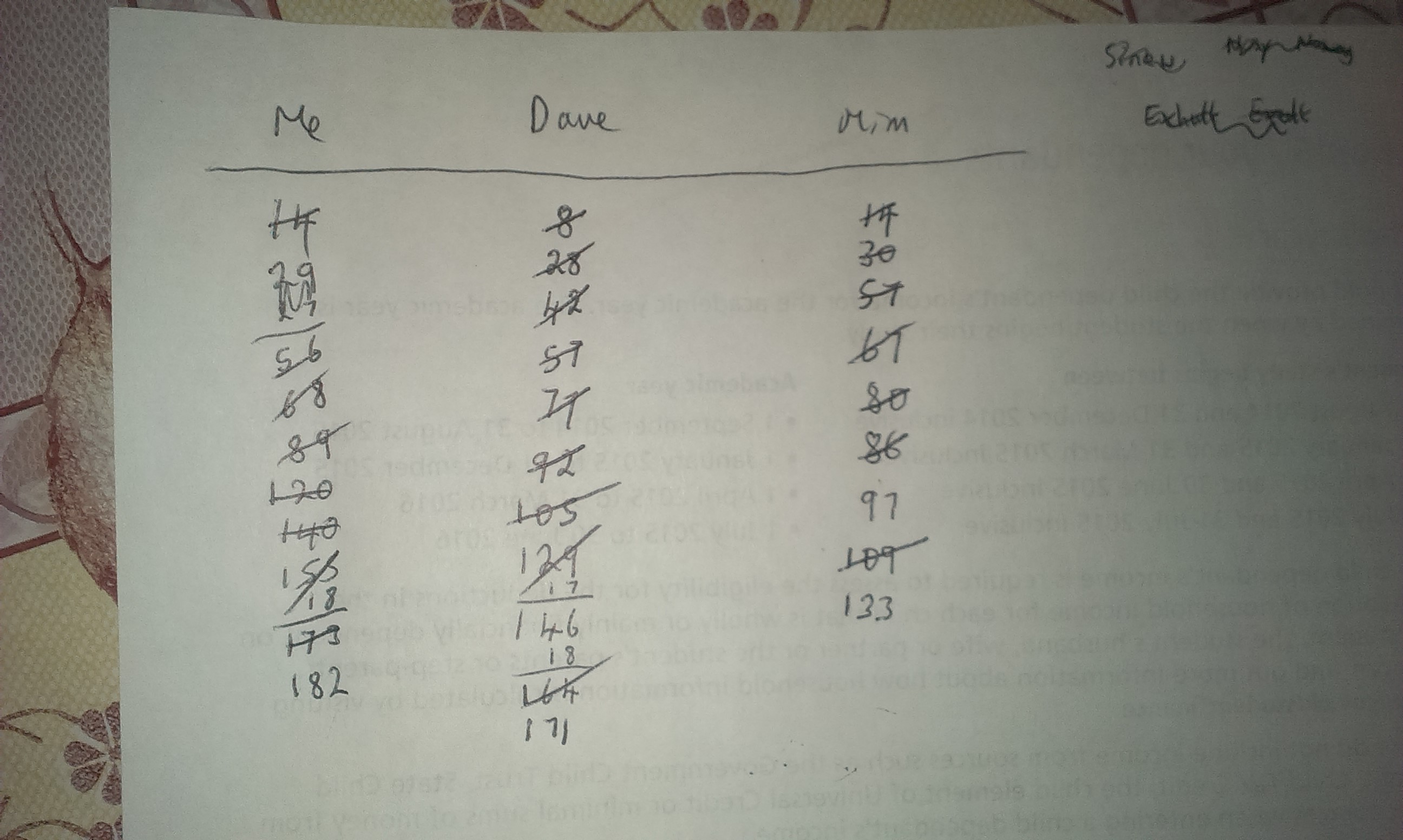
Our score sheet. As per the norm, I lost.
Strategy:
The best kind of strategy for this game is to look out for the bonus point spaces on the board, because there’s no point in making an absolutely fantastic word that lets you play lots of your letters but doesn’t get you any extra points if it then creates easy access to a double/triple word/letter tile that another player can use to score some ridiculous amount of points. Other than that this is really a “be as imaginative as possible” kind of game, where the weirder the words you play are, the better the game gets.
History and Interesting Things:
The game was invented by an American out-of-work architect called Alfred Mosher Butts in 1938. He created the game by combining features of anagrams and crosswords.
It was originally called LEXIKO and then CRISS CROSS WORDS before becoming Scrabble.
Although everyone thinks of this game as a word game, it’s actually fundamentally a number game, to create the game a series of painstaking letter-frequency calculations were needed to determine how many times each letter should appear in the game.
The game was rejected by many games manufacturers, until Butts met James Brunot who loved the game.
Between Butts and Brunot they refined the rules of the game and came up with the name Scrabble which means “to grope frantically”.
The game was trade marked in 1948.
To produce the game the Brunot’s rented an abandoned schoolhouse in Dodgington, Connecticut, where, asissted by friends, they turned out 12 games an hour, stamping letters onto the wooden tiles one by one.
As with many games the game lost money in its first year, but, over a few years, the game steadily grew in popularity, until the president of MACYS came across the game on holiday and ordered some for his store. Soon after this it became a must-have, and Brunot realized that they could no longer produce the games fast enough to meet demand. They licensed Selchow & Righter to produce the game until, in 1972, they purchased the trademark from Brunot.
Selchow & Righter were bought by COLECO in 1986, but when they declared bankruptcy in 1989 the trademark was bought by Hasbro, the largest games manufacturer in America.
The game is now found in one in every three American houses.
To Conclude:
A very good game, although only rated 3 out of 5, this isn’t a reflection on how much I like the game, more of a reflection on how accessible it is for everyone. For instance, although it’s a great game for everyone in that it can be very fun and silly, it’s an unbelievably challenging game for anyone with literacy difficulties, as well as occasionally being very frustrating due to the random selection of tiles. That said, it’s a game everyone should play a few times, even if it’s just to discover that your friends know words that they didn’t know they knew so you can argue over whether or not they’re allowed on the board.



 Tame The Board Game