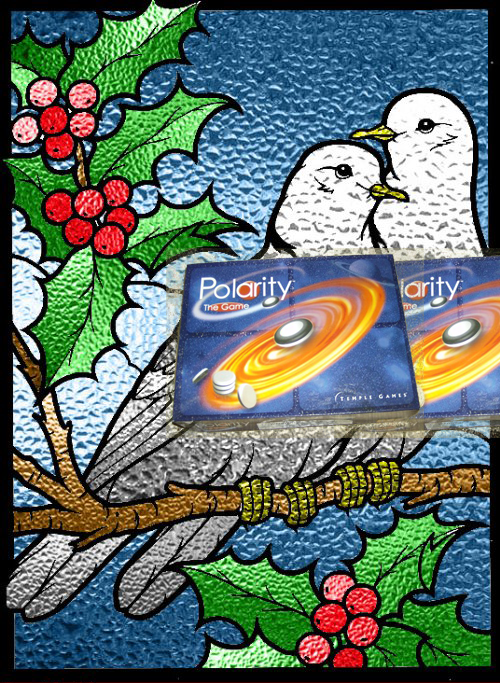
…A Two-player Game and Promised The Evening To Me – Two Polarity Doves
Two Polarity Doves…not world class photo-shopping
The Rules:
The aim of Polarity is difficult to describe, it involves magnets (hence the name) and some skill, patience and a steady hand. However rather than going into it in great detail here I will simple link you to the very detailed post my sister has done on it (on this very blog and only two days before this post) that’s very informative and right here!
For Christmas?
I personally would consider this a great game for Christmas, one to bust out and show the relatives as something a bit different from the average board game and something I’m sure everyone will want ago at. It might even stop Aunt Jean from recounting the endless tales of here youth to you as she infers how lucky your generation are and how things weren’t this easy back in her day! However she may consider the balancing magnets as witchcraft declare you all heathens and start shouting “The power of Christ compels you”. But hey whats Christmas without a slight mental break down by someone.
You may consider this a cop-out as we have already posted about Polarity, well then just to warn you a few of the posts will be things we have already done posts on and the others will be ones we are doing full post on very soon and we are not chickening out we are simply highlighting good games we think you should all play regardless of weather we have posted about them yet or not!
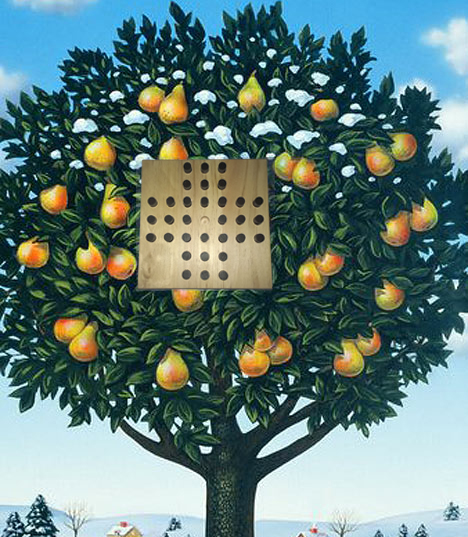
…A Single Player Game and a Card Saying “Sorry!” – Solitaire…in a Pear Tree
The natural environment for any single player game!
The Rules:
The Aim of Solitaire is to have one piece left in the middle of the board, after removing all of the other pieces by taking them. Taking is accomplished by jumping over other pieces in a Draughts (Checkers) type fashion. Unlike Checkers, jumping my only be done horizontally and vertically and you may only move to take, so, once all taking options have run out, the game is over, and unless you are left with one piece in the middle slot you have lost!
For Christmas?
Well this game could be good on Christmas if you’re alone or just want a few moments to yourself amidst the hubbub, chaos, and potentially drunk distant relatives. The game only takes a moment to understand, but it’s quite hard to get the hang of, however, once you’ve figured out one win strategy, you can win every time, so pros and cons. You may be called anti-social if you’re caught playing it on Christmas Day when Aunt Jean has just turned up and she only gets to see you once a year and wonders why you’d rather play with little wooden pieces than hear about her 13 dogs and a guinea pig… I appear to have digressed.
So on that note this is the first of twelve posts going up over (you’ll never guess it), the next twelve days which will touch briefly on twelve different games we suggest that everyone should play in 2014, the aim originally was to have them go up in player amount according to the day but we don’t have games to cover every player amount, so really they’re just be games we suggest you should play! See the Twelve Games of Christmas – 2013 page for the full list (will only be complete after the Twelve Days).
For further information on good one player games see this list!
A while ago I found this game, Polarity, in Oxfam. It’s one of the only games i’ve come across that involves magnets. I’ve played it a few times now, and, although there is obviously some strategic element to this game, I have yet to discover what it is. This isn’t a quick game, and it does require a certain level of skill, dexterity and attention to play – at least, if you want to improve the way you play after getting your head round the rules.
Origins:
It was originally invented in 1985 by a failed Canadian artist called Douglas Seaton, and was first published in 1986. The rights to the game have changed hands several times since its’ invention, it’s been published by Telemotion Technologies, Irwin Toy, Mattel, and is currently published by Temple Games.
Playing The Game:
The game is played with 52 black and white discs and 1 red disc. The black and white discs somewhat resemble Othello pieces (if you haven’t heard of Othello, go read about it here!). The black side of the disc is the North pole of the magnet, and the white side the South. The red disc is also a manget and has a dot on one side and a line on the other. This is used to determine which player goes first. One player tosses the disc and the other calls line or dot, the same as flipping a coin. The player that wins the toss chooses whether they play as black or white, and therefore first or second. In this game, white always plays first, so the winner of the toss can choose to play as black to deliberately play second.
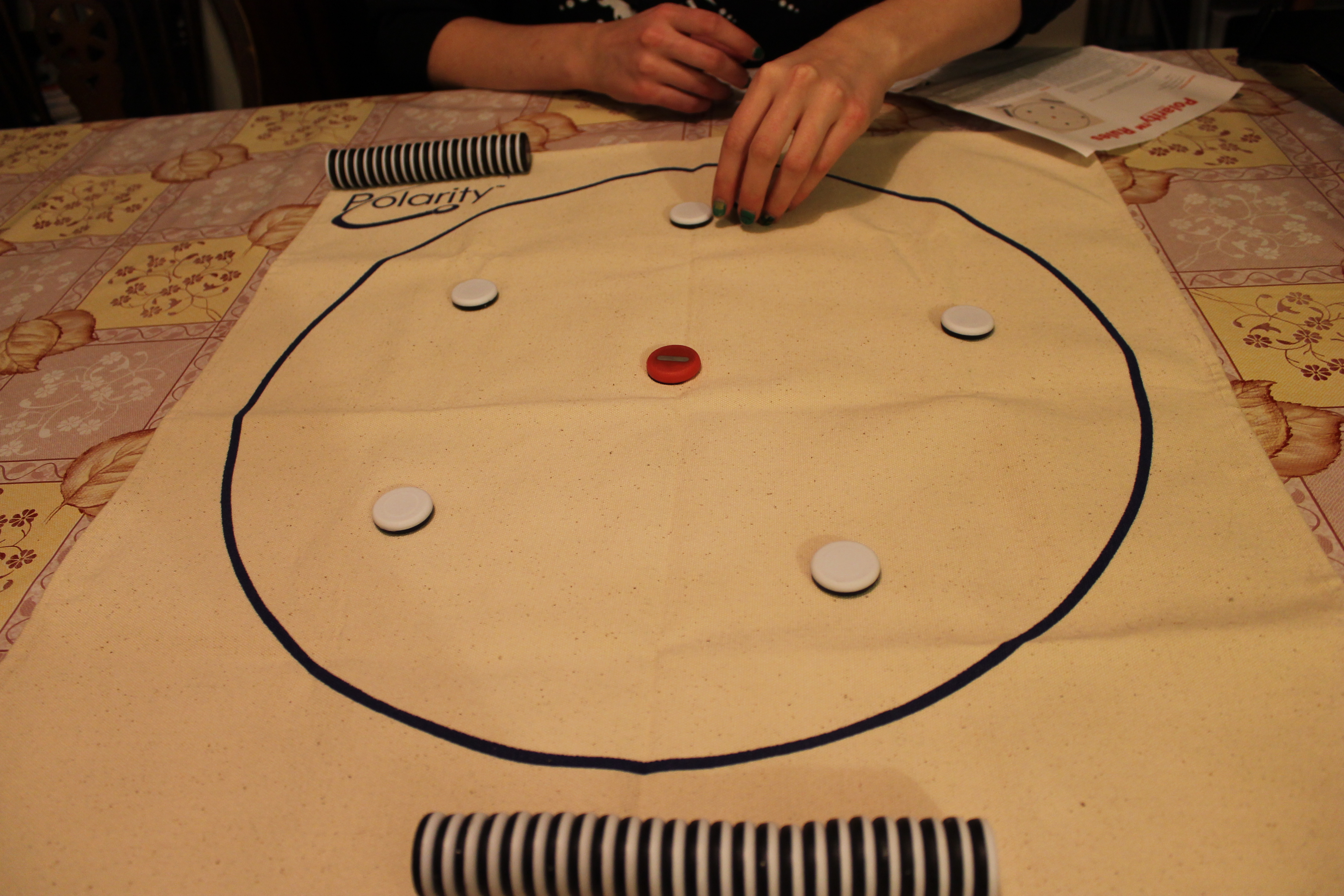
Initial game set up – white places five pieces called “Foundation Discs”
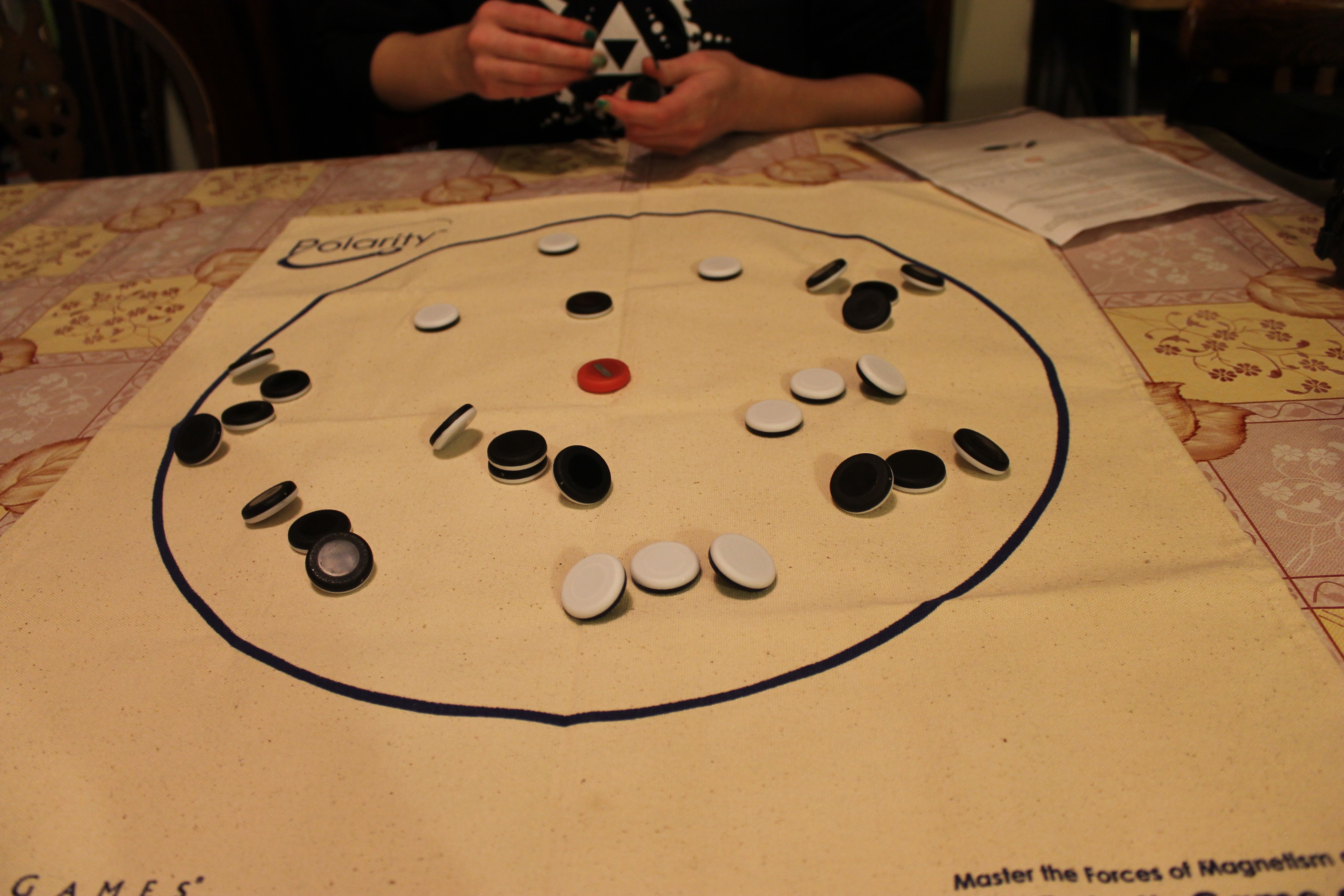
So the red disc is placed in the center of the mat, there is a large black dot beneath in on the mat that you can’t see in this picture. This dot is important because if at any point in the game the red disc moves completely off it, the player responsible for causing this instantly loses the game. White plays first and places five discs anywhere inside the circle. These are called Foundation Discs, they lie flat on the mat with the players colour facing upwards. Once White has finished placing discs, Black then places their first five.
Once this is done play reverts to White and the game really begins. There’s probably something strategic about where you place your first discs, but i’ve so far found that just trying to make sure they’re relatively evenly spaced is a good start as you then get minimal magnetic interference from your own discs later in the game.
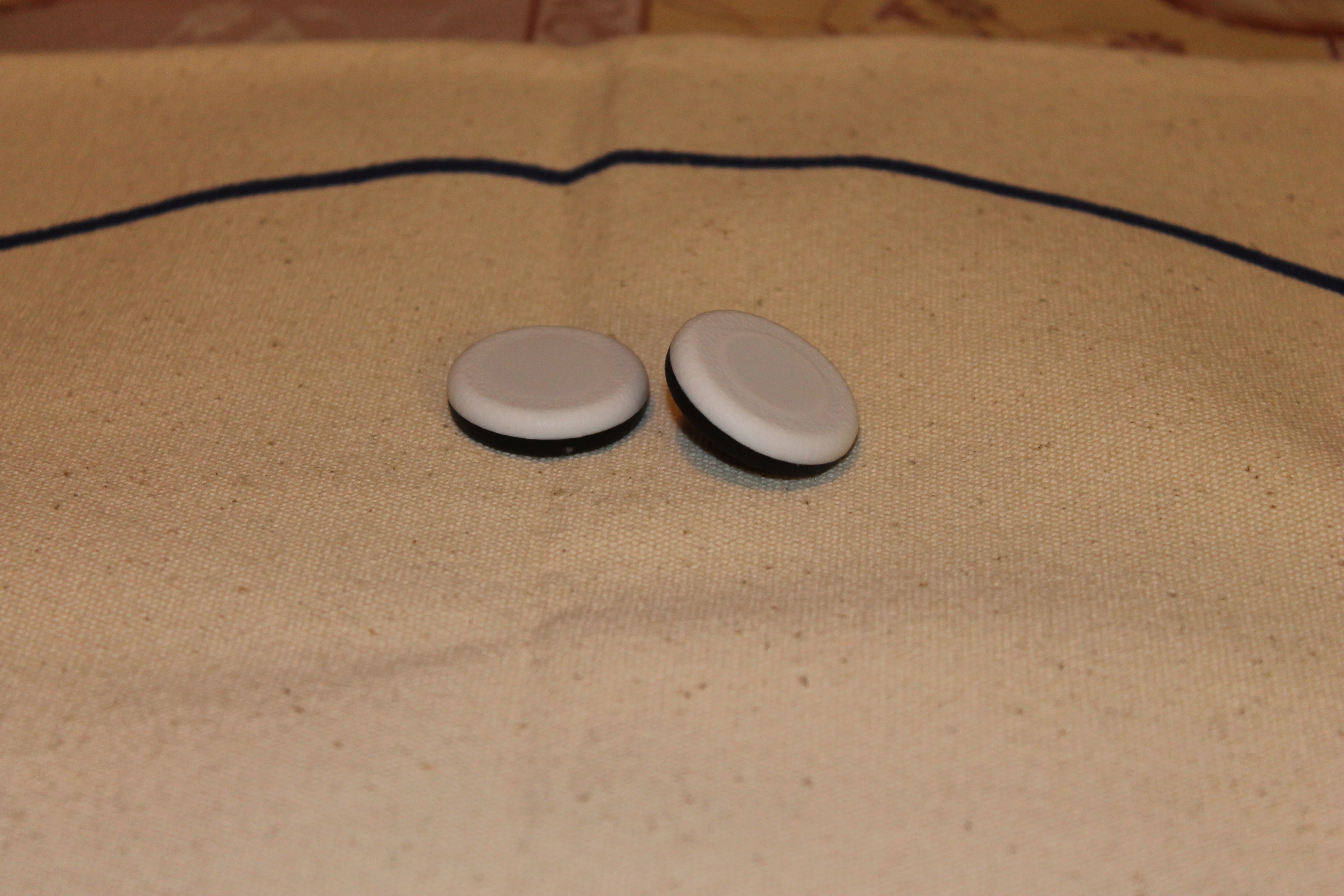
From this point on players take it in turns to place other discs, but you are no longer allowed to place discs flat on the mat. You must attempt to use the magnetic cushion around your colour discs to make the disc you’re placing float or “lean”.
Here White has played a successful Leaner against one of their Foundation Discs
As you can see, White has successfully placed a piece in a position so that it is supported magnetically and appears to float a little off the mat. Once a successful Leaner has been placed White can continue to place other Leaners until they create a Fault. The disc you’re playing at any one time is called the Action Disc, until it is safely on the board and your turn has ended.
A Fault is when one of the following things happens:
Placing the Action Disc causes two or more discs that were previously not touching, to touch
Making a Leaner already on the mat fall flat
When a disc on the mat snaps up onto the Action Disc
Causing a Foundation Disc or a Tower to move more than their diameter on the mat
Making a disc in play (inside the circle) move entirely outside of the circle
AFTER A FAULT HAS BEEN CREATED:
After a Fault has been created a few things happen; firstly, it automatically ends the turn of the player who was responsible for it, but, if the Action Disc is still in their hand when this happens, it”s returned to the unplayed stack of discs, rather than placed on the mat.
Following this the nature of the Fault must be considered;
If the Fault has caused other Leaners to fall flat on the mat, but they are not touching any other disc, they are left where they land, however, if your Fault causes an opponents Leaner to flip over to your colour, they then get a chance to capture it at the start of their turn
If any discs snapped up onto the Action Disc and it remained in hand, these are then all returned to the unplayed stack
If the Fault caused discs to snap together on the mat, your opponent is allowed the chance to capture them
If a disc is forced completely out of the circle, it is added to the players unplayed stack, and if a Tower or Foundation Disc is forced to move more than its’ diameter, but is not touching any other disc, nothing further happens
The middle of gameplay. Both players have placed several successful Leaners and only one Tower has been created.
Capturing Faults:
If, at the start of your turn, there are any discs that have either snapped together on the mat, or were Leaners that have flipped over to your opponents cover, you are now given the chance to capture them. Capturing must take place at the start of your turn and if there is an opportunity to capture, you must take it before you play.
To make a capture, grab one disc or Tower section of the Fault, and attempt to lift it clear of the play mat, any other discs connected to this Fault should now snap up onto the disc you lifted, creating a Tower. You can then place this new Tower anywhere on the mat, with your colour facing upwards. If the Fault is already in Tower form, you may choose to leave it where it is and simply declare it captured. NOTE:A capture must be made without creating another Fault. If a Fault is created the normal Fault rules apply and play reverts to your opponent.
Conversions:
It can occasionally be to your benefit to intentionally create a Fault, especially later in the game when it becomes harder to find places to play successful Leaners, you can use the Action Disc to force a Leaner to fall flat on the mat. This creates a Fault, ending your turn, but also gives you another Foundation Disc to play off of on your next turn.
Winning The Game:
The first player to successfully place their last piece ends the game, the winner is then determined by points. Points are scored by counting the number of discs in the Towers of your colour. The number of pieces remaining in your unplayed stack (if you were not the player to end the game) is then subtracted from your Tower points and the player with the most points after this wins.
So, although it sounds complex, this game is easy to play after you’ve given yourself a few tries. Personally, I think it’s something i’m going to continually come back to, and hopefully, i’ll always be able to find someone like-minded enough to play with! I highly recommend this game, and think that if you can play it well enough, to the point where you develop a strategy, you’re doing brilliantly!
Anyone interested in the strategy of the game, there is guide here, I found it endlessly interesting (although I must admit that I haven’t finished it yet).
The most important question you must consider when playing any Morris game, is who was Morris? Now considering it dates back to… God knows when and God knows where, this could be very hard to discover and for more information on this one should view our earlier post here! I like to think Morris was a man who discovered this game while playing Tic Tac Toe drunk…Or high on opium, maybe? If it was first played in China? but I’ll let you formulate your own ideas!
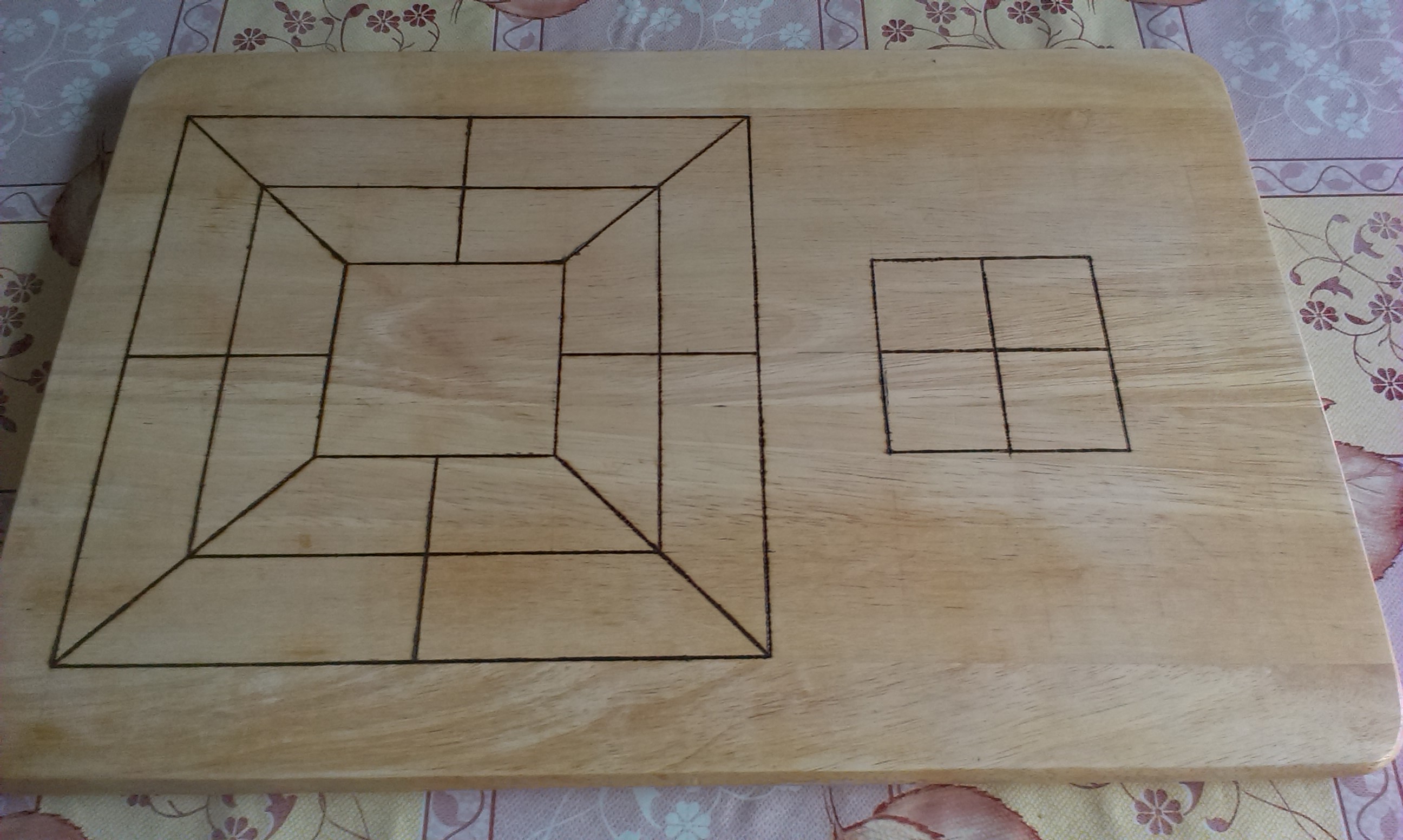
I made this myself in the same way I made (and on the back of) my Fanorona board which you can see here and also see the technique for making one.
Why did I make my own I hear you ask? Well I’ll let Ron Swanson form the show Parks and Recreation explain:
(this video will start at the relevant quote but watch the whole thing for the full effect)
Aside from that, versions are expensive and difficult to come by. So when you have a piece of wood, the tools and the know-how, just make one!
Three Men’s Morris:
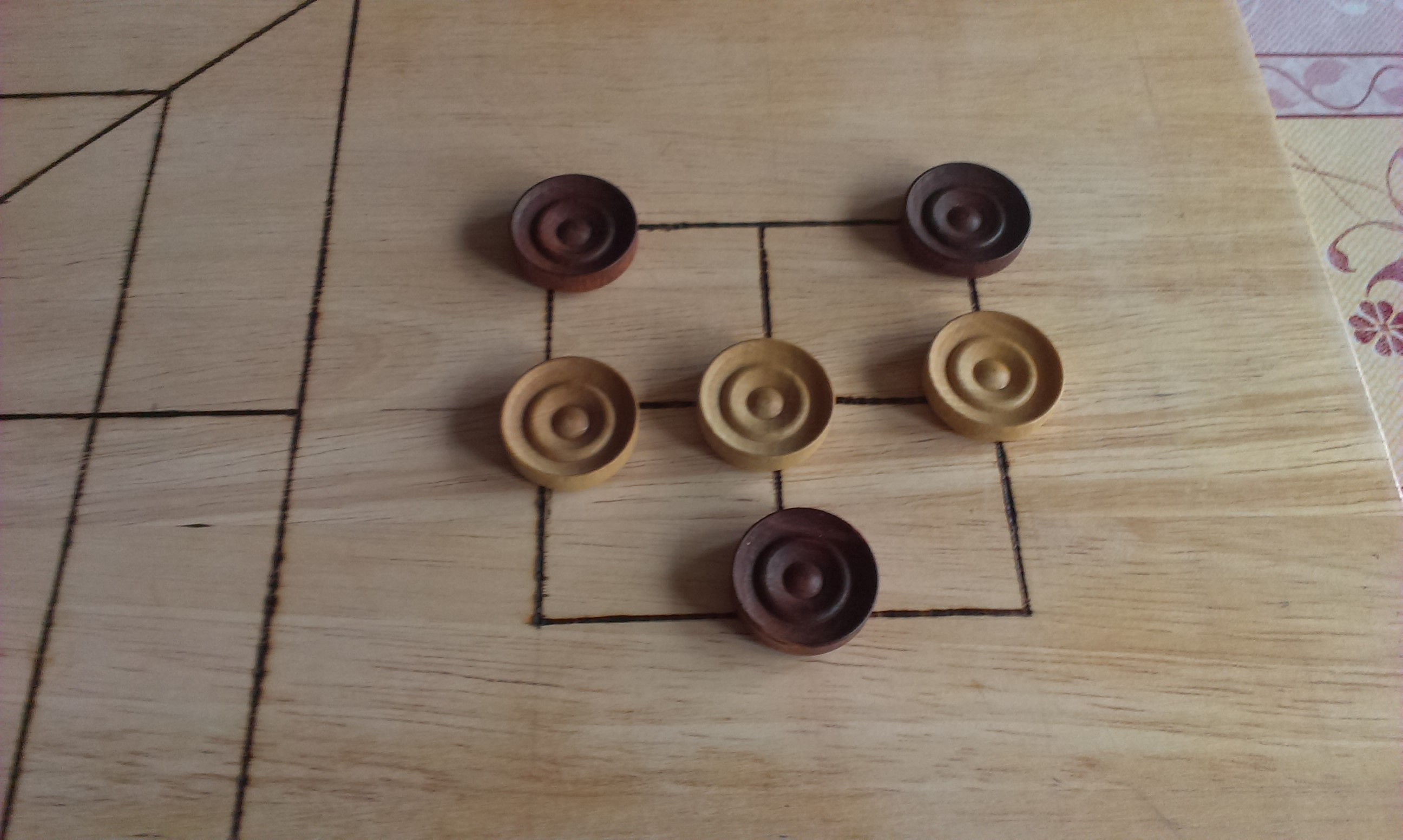
Now there are different versions of Three Men’s Morris but one of them is exactly the same as Tic Tac Toe, So I made the one that wasn’t (for obvious reasons). Quite possibly the shortest game I have ever played taking literally about a minute to play (like Tic Tac Toe) and coming to an immediate win, lose or draw! However even the version I created, which lacked the diagonals of Tic Tac Toe could still just as easily by played on paper because there is no movement phase like in Nine and Twelve Men’s Morris. So is it worth spending an hour branding a game board for it? Probably not, just variate your games of Tic Tac Toe every once in a while.
Three in a row, just like Tic Tac Toe!
Twelve Men’s Morris:
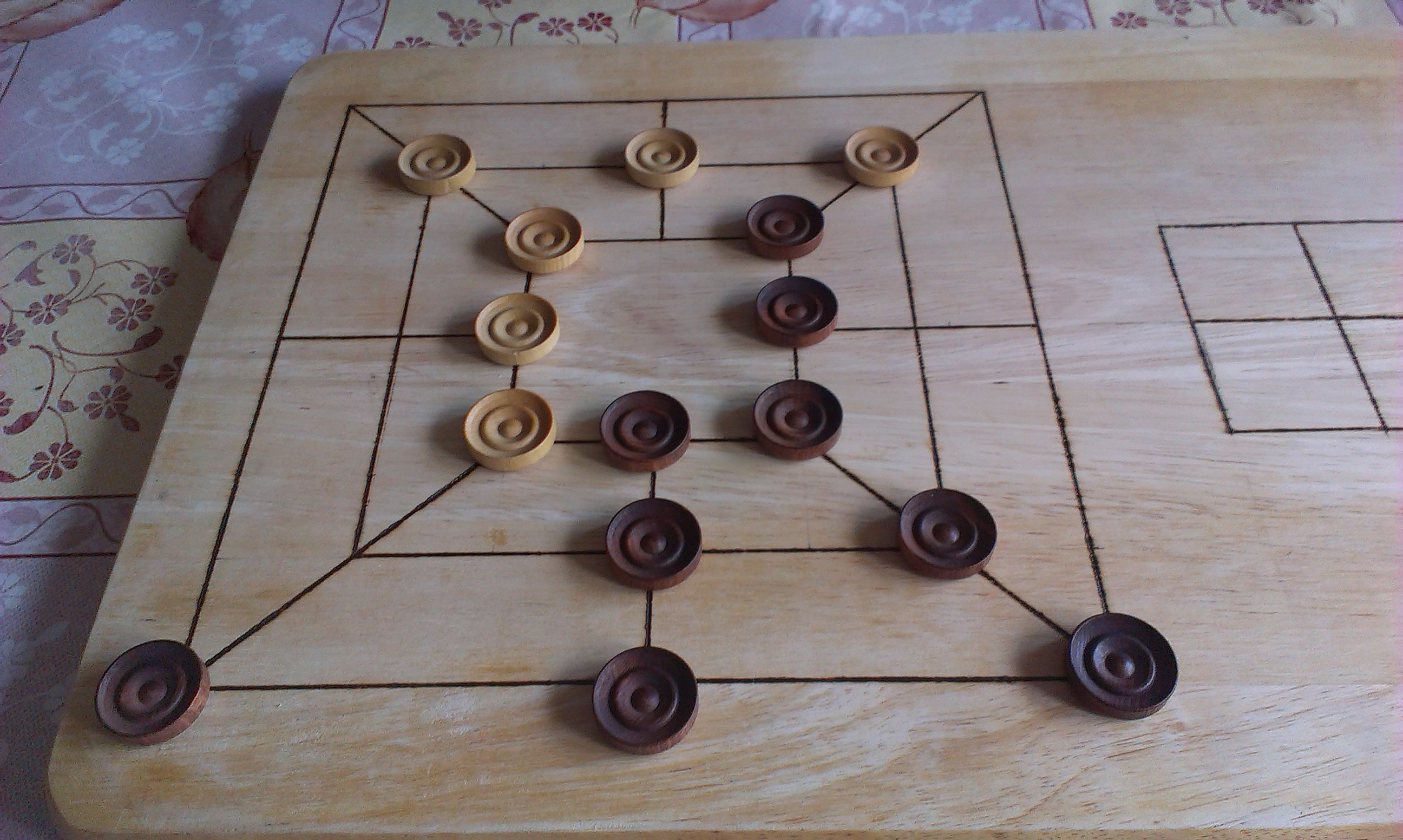
This is a game that is much more complex and I’me much happier I went to the effort to make a board for it. With all of the aspects of Nine Men’s Morris but even more to think about (as you have more pieces and diagonals to consider) it can be a quite challenging game. It is played exactly the same as the Nine Men version but with Twelve pieces and a board with diagonals on it. So, you could just draw diagonals onto your Nine Men’s board, or even imagine them! But why do that when you can spend hours with a soldering iron?
A game in mid swing.
I would recommend anyone who’s a fan of Nine Men’s Morris to give this ago or even a fan of Chess or Droughts. Additionally if you don’t want to buy a physically version HERE is a website where you can play all the different versions of all the Morris games either against a computer or a human. Or if you want an excuse to buy a video game under the premise that it has some educational value or at least some strategic thinking value the Morris game in various forms can be found in both Assassins Creed III and Assassins Creed IV: Black Flag so buy them now!
On Another Note – Breach The Keep:
To anyone who cares we ordered the first real print of our very own board game Breach The Keep which you can find more information on here. Hopefully they’re going to look great, they’re being printed in the US and shipped to the UK (because for some insane reason that’s cheaper than just printing them in the UK. So expect pictures and an update on the free games give away some time soon. If all goes to plan the game should be ready to go in less than two months!
…
But we all know life never goes to plan.
Additionally we’re also planning a video blog to go alongside/be part of this blog. We’re just contemplating structure and formatting and getting hold of equipment etc. But that could happen anytime soon so keep an eye out for that too!
So, having been pretty quiet for a while, I’m making a return to my quick games chain of posts, with Manacala. I’ve been playing this game my whole life, although, as children my brother and I played it as a mini game on an educational computer game we owned and it was called Mother Bird’s Eggs. I wasn’t introduced to it as a non-virtual reality game until a few years later.
The board, the pieces, and how to play!
Objective: The objective of the game is to have the most pieces in your Mancala at the end.
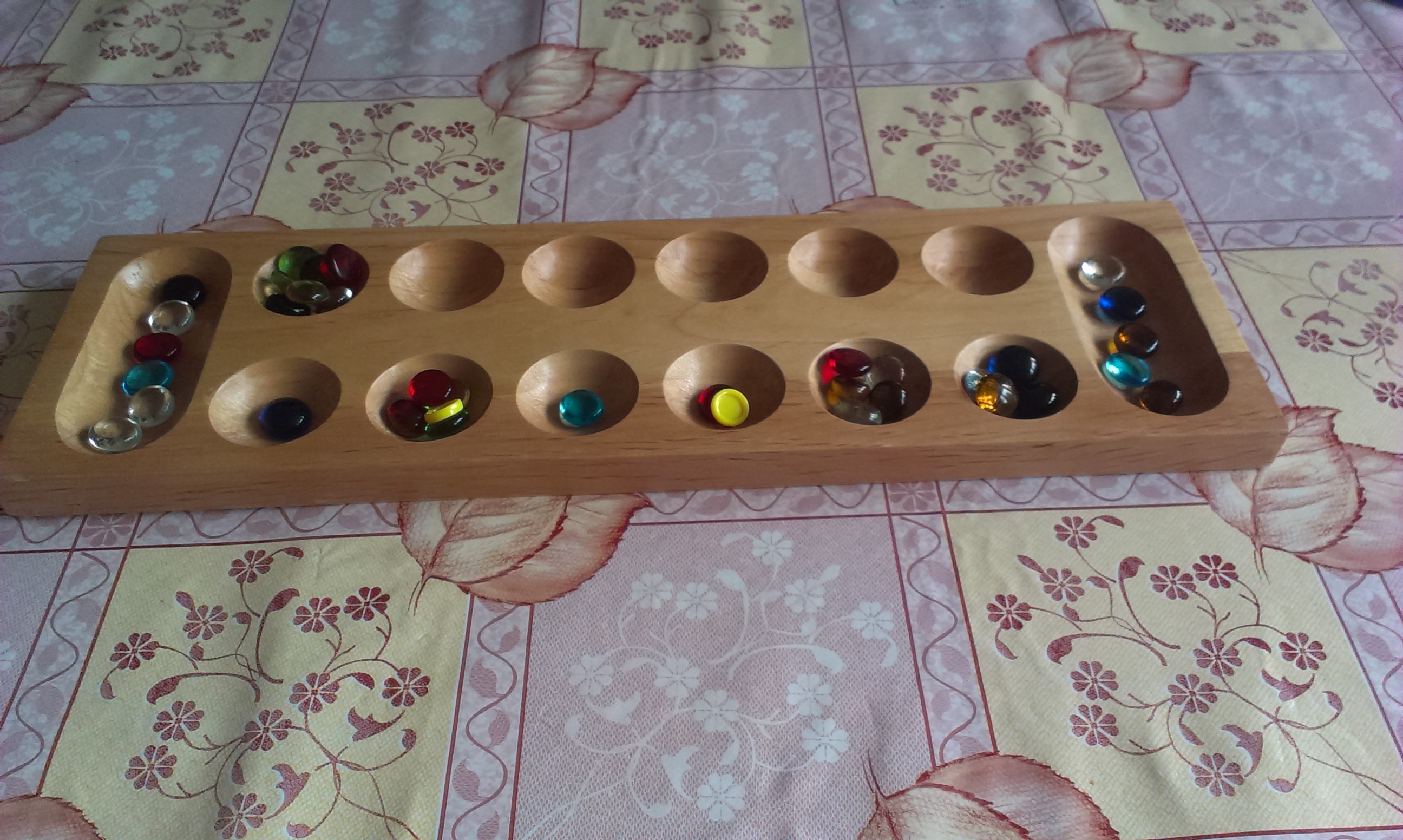
It ‘s a very quick game to learn, the board is (usually) made of wood, is oblong in shape and has several hollows carved into it. There will be one long hollow carved vertically into each of the short ends, so that they run parallel to the end of the board. Then there will be six small circular hollows carved into each long side of the board. Each of the circular hollows will then have three playing pieces placed in it before the game begins. Pieces could be anything, from small stones to pieces of glass, to counters you’ve borrowed from another game.
A Mancala board set up for play (with three “connect four” pieces used to make up for three missing dragon drops)
Each player plays to their right, so the long hollow on the end of the board to their right becomes their “Mancala”, similarly, the hollows on the side of the board you are sitting on, are yours – this is very important – you are not allowed to move pieces from your opponents hollows. Before play begins you will determine who plays first and they will then choose one of their hollows, and move the pieces from it. To move your pieces, you pick up all the pieces from the hollow you’ve chosen and place one in every subsequent hollow (including your Mancala if you have that many, but excluding your opponents Mancala) until you run out. You may find, when moving pieces from a hollow containing a lot of pieces, that you place pieces in all of your hollows and then have to continue round to those of your opponent. This is often irritating, as you are providing them with the opportunity for more pieces, but is sometimes unavoidable.
A game in mid swing.
Apart from what i’ve already described, there are very few rules to this game. If a player is moving their pieces and, in placing them in the hollows, manages to place the last one in their Mancala, they take another turn. This can be both advantageous and disadvantageous as your opponent may have strategically stockpiled some of their pieces in one hollow, and, to force them to move it, you are trying to stall, by moving as few pieces in each turn as possible, so you would not want to be giving yourself extra turns if you can avoid it.
Taking Pieces:
Players may also take their opponents pieces. If, when you are moving your pieces, your last piece lands in one of your hollows, which is empty, and your opponent has pieces in the hollow directly opposite it, you take these, and place them in your Mancala.
Ending the Game:
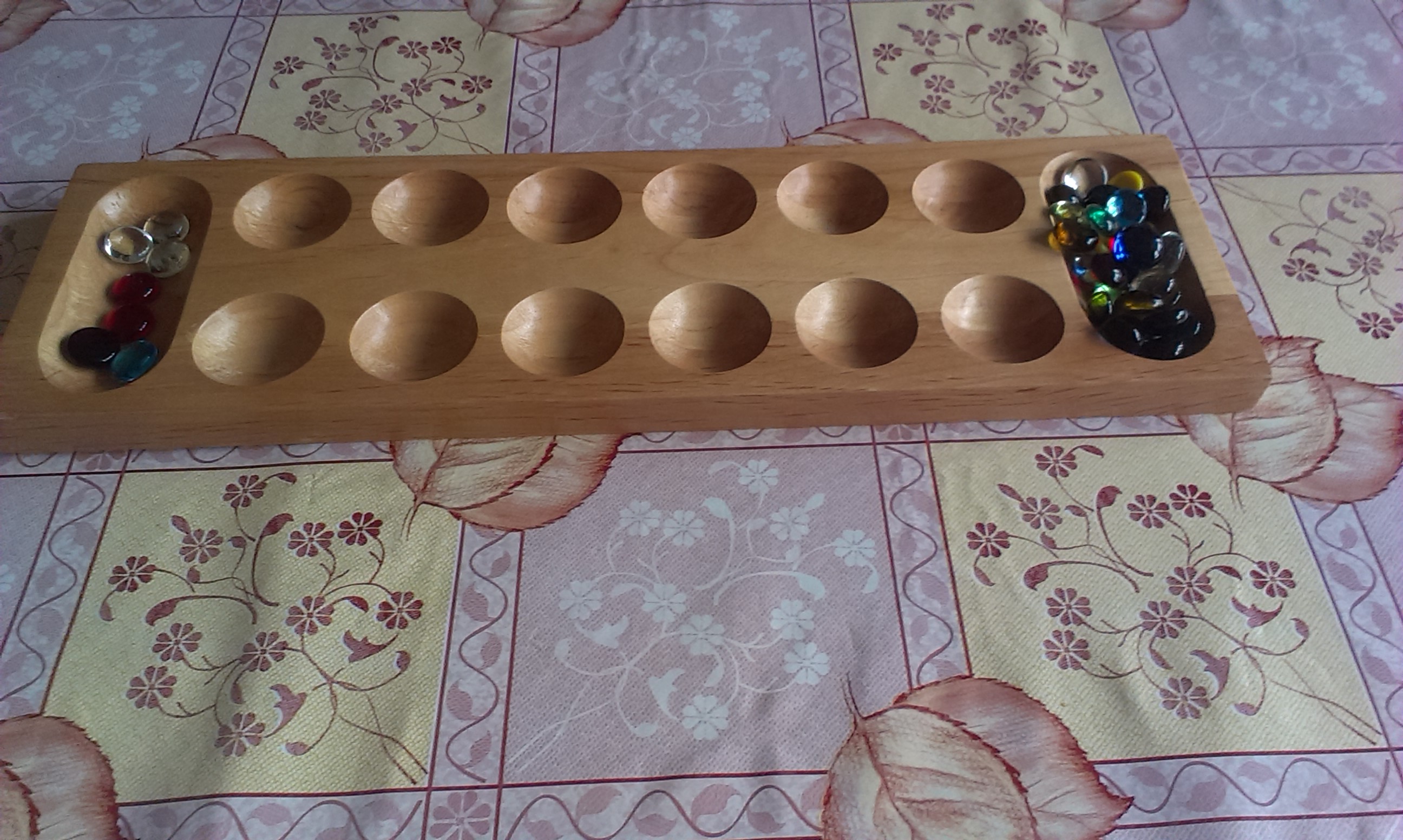
The game ends when one player runs out of pieces in their six hollows. When this happens anything that remains in their opponents hollows is added to their opponents Mancala, and the number in each is counted. The winner is the player with the most pieces stored in their Mancala.
Someone quite obviously won that one!
Due to a lack of photos of us playing the game (this has now been amended), this description has been pretty wordy, however, I hope it makes some sense and is even a little interesting. If you’re bored of game play info, keep going down to find out a little of the history of this very old strategy game!
History and Things (my 10ish interesting points):
This is the only ancient game surviving in the world with an Arabic name – the name does not apply solely to this game, but to this family of games.
It is possible that this is the oldest game in the world, one of the reasons for this being that it is simple and can be played using whatever materials are to hand – tribes in Africa would scoop out hollows from the earth and play on the ground with pebbles.
Although there is now a generally played version of the game, with six hollows for each player and three pieces per hollow, the game can be played in many different ways as it has been played for thousands of years in Africa and the Middle East. Here each tribe would have a slightly different way of playing the game, varying from the number of pieces used to how many “ranks” (rings) there were around the board.
Mancala is the most widely-known (at least in the Western world) name for the game, however, there are many others, a small sample here: Wari, Warri, Ware, Walle, Awari, Aware, Awaoley, Awele, Oware, Owari, and Wouri.
The game is, and was, played for recreational purposes, but there are also some areas, such as the West Indies, that have associated it with religion. It was played in a house of mourning in the belief that the soul of the departed would be amused until burial.
Despite its primitive origins, the game is completely mathematical, and some of the more complex versions of it have as much standing as Chess.
Two-rank boards have historically been found North of the Equator, whilst the four-rank boards are found South of the Equator.
Stone Mancala boards found carved into temples in Memphis, Thebes and Luxor date the game in Egypt back before 1400BC.
I made eight points, that’s not bad going. 10 may have been slightly ambitious of me…
For anyone interested I found a selection of my interesting history points here, and here! Happy reading and hopefully there’ll be some more regular posting going on from now on!
Unfortunately due to life being… Well, life, having time to play games and time to write about them has been difficult recently, it’s at times like this that I’m quite glad no one cares about this as it means we don’t let anyone down! However we also want people to start caring so any suggestions on how to achieve that would be appreciated.
Anyway, to the point! A very obscure balancing game (or two) purchased from the shop “Tiger” and without more of a name than “Balance Game” (or Balancespil, which I assume is Balance Game in Danish as Tiger is a Dutch company) and instructions that read “Roll the dice and place a brick of the same color as shown on the dice on the tipping moon.” We thought we could do better than this, well we thought they could probably do better than this but apparently some very obvious things to make this game better just never occurred to them!
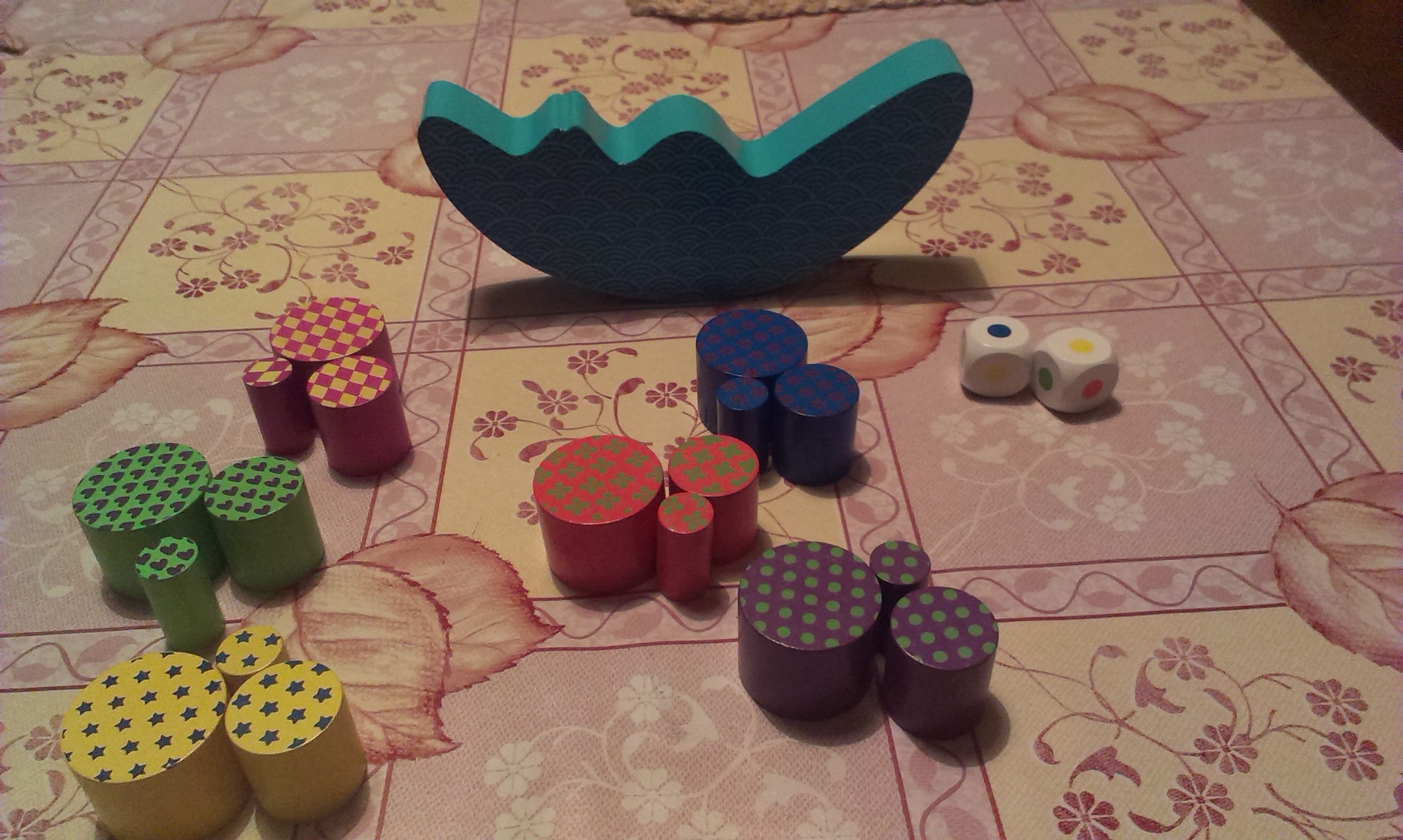
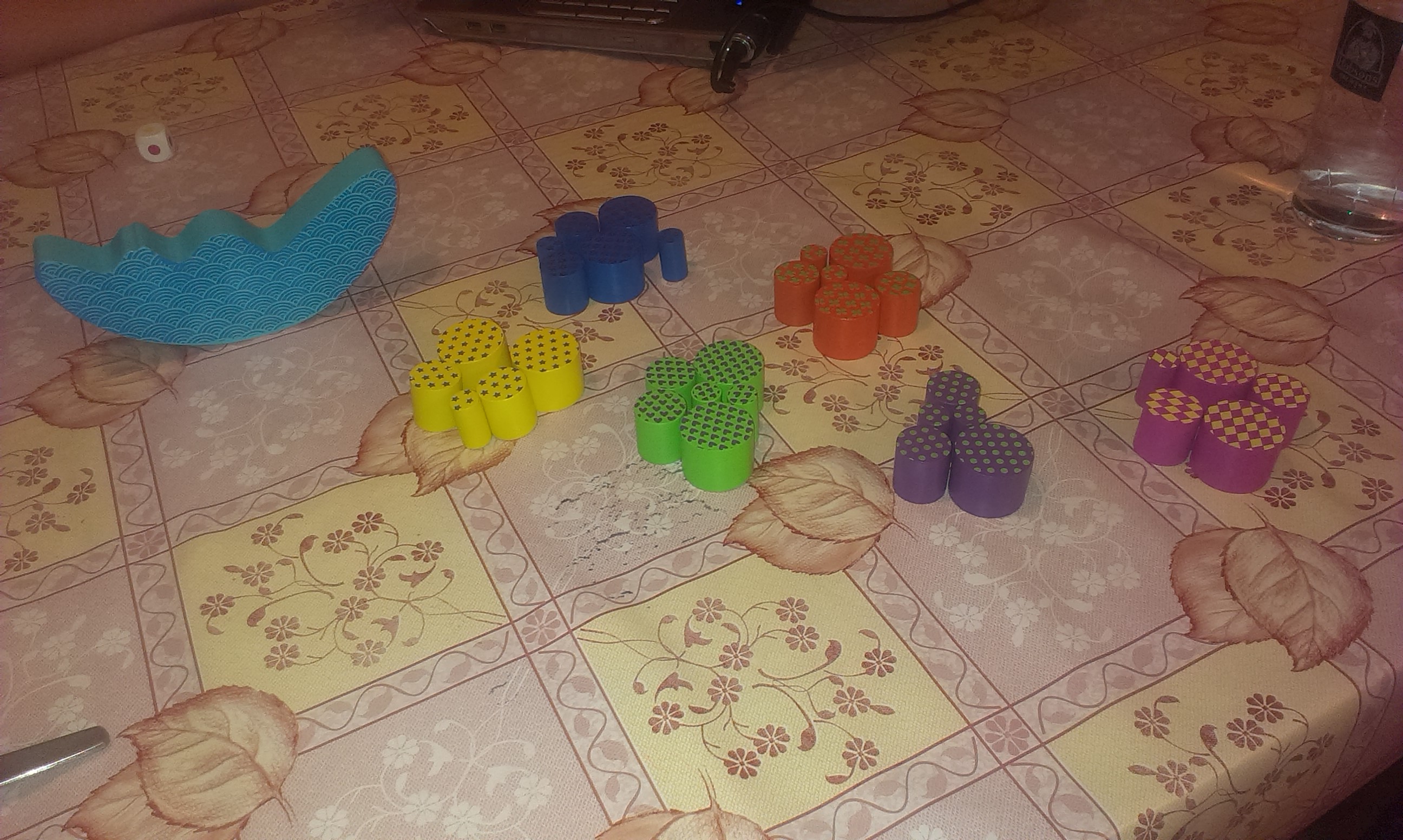
The contents of the box – One “Tipping Moon”, 6 different color sets each with three circular pieces of different sizes and two dice with each of the colors shown on each of its sides.
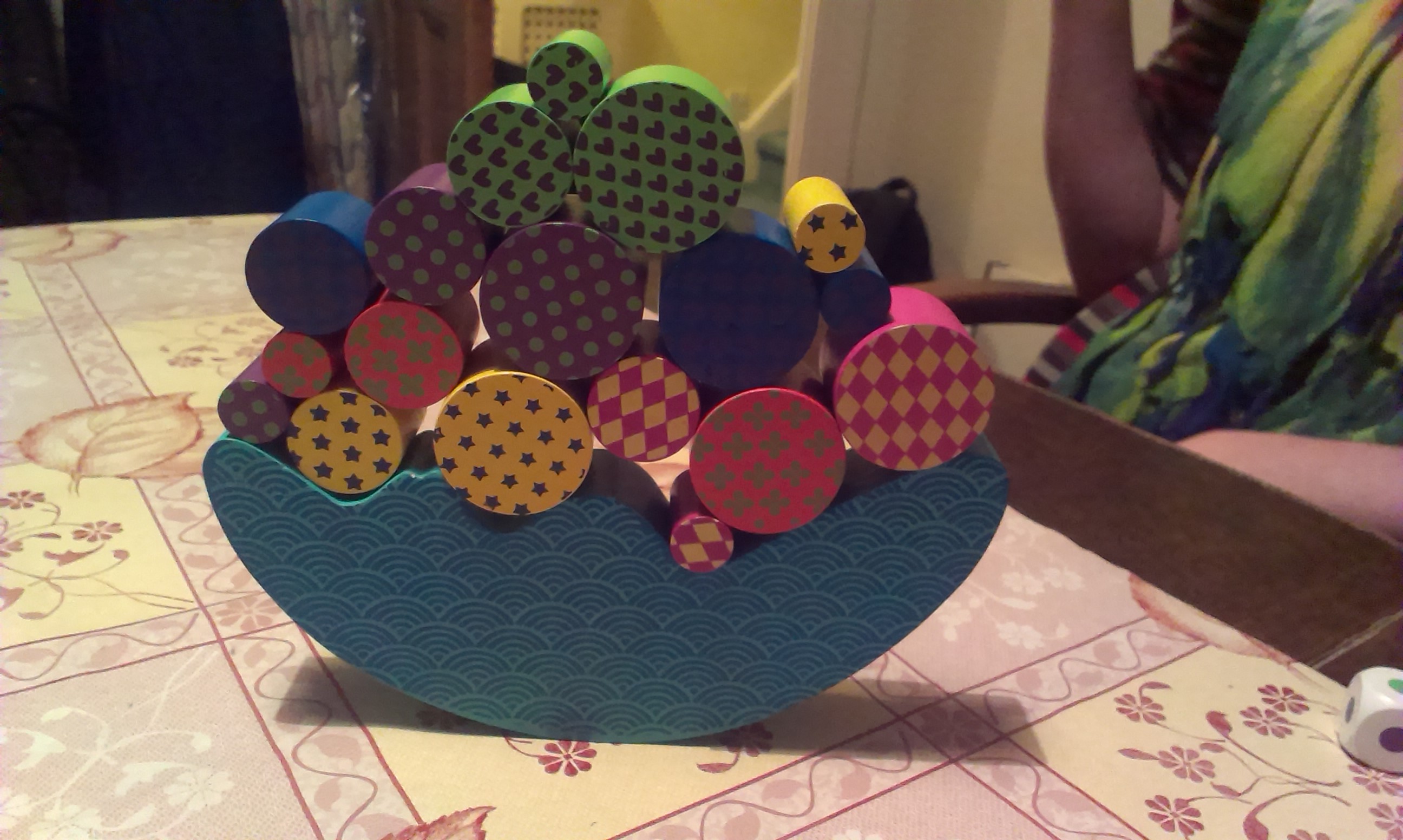
So to begin with we played the game the way they suggested, which was good, you could see the potential in the idea and if the box had had an age range on it saying 4 – 10 or something similar I would say the game was perfectly acceptable and needed no help. However it did not and therefore needs lots of help! The fist problem we ran into was that it’s possible to stack all of the pieces onto the “Tipping Moon” without any of them falling off… So no one can win!
The “Tipping Moon” with all the possible pieces on it
So at this point we decided this wasn’t good enough and we could do better! So we tried various versions of the game to find a better way of playing. The first thing we did was get another copy of the game (however the other copy was written off and therefore missing some pieces, but was good enough for our needs).
Variation 1:
We played the standardized version of the game with almost double the amount of pieces – using the second set. This worked much better as it was now impossible to fit them all on so someone had to lose! In fact if they had made the original with four pieces to every color set instead of three this would have sufficed.
The game with another (almost full) set of pieces.
Variation 2:
So being the adventurous types that we are (board game enthusiasts) and not just happy that we’d found a good version of the game we decided to go even further and assign a value to each piece depending on its size. We tried a few values but found that it works best using 4 for the largest piece, the middle piece as 2 and the smallest as 1. You now roll both the colored die and a standard die together and must place the value of the standard die in the color the other die shows. If you cannot play because there are not enough pieces in that color you re-roll one of the dice and if you still cannot play you re-roll the other die and keep re-rolling until you can play a piece/s.
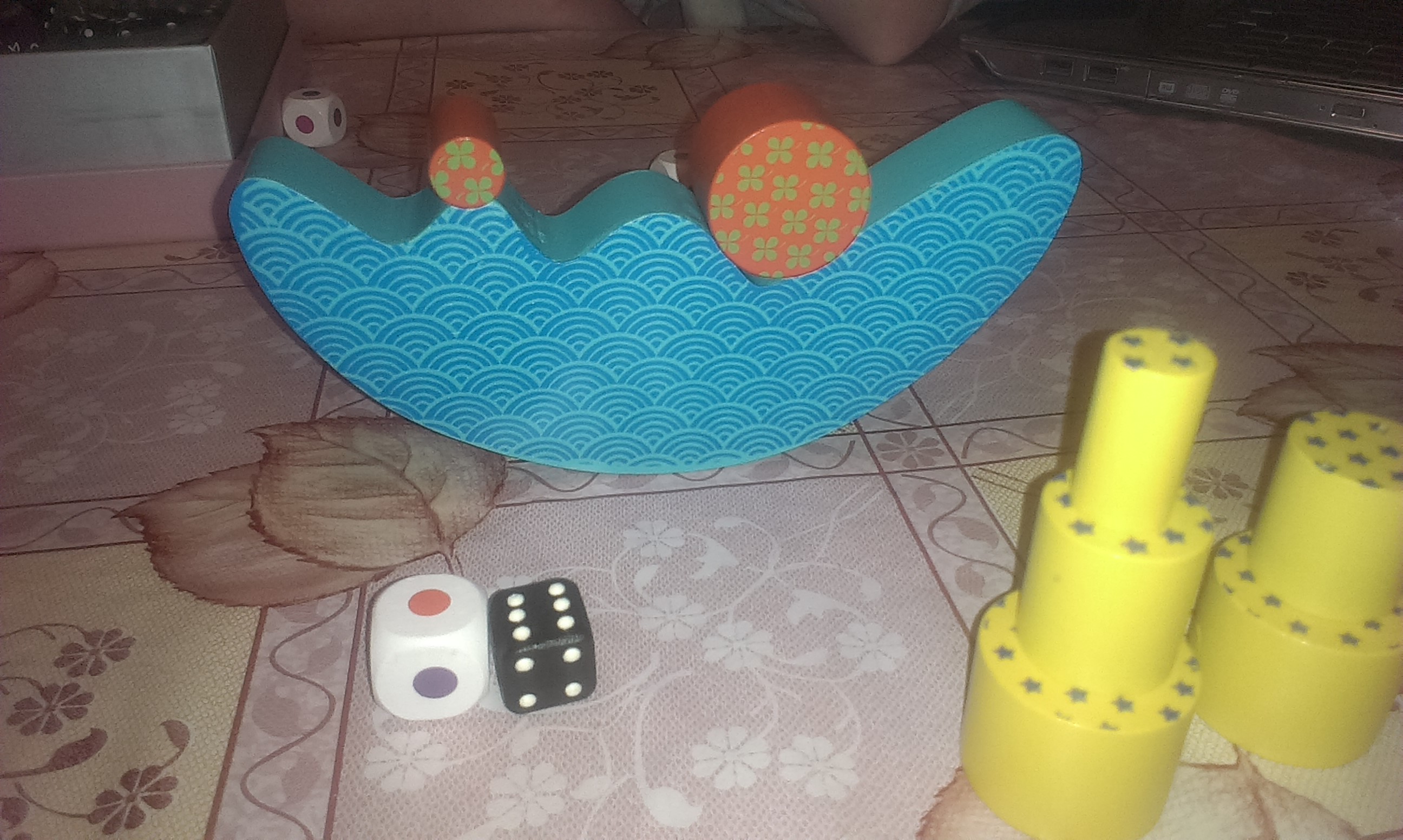
A standard dice showing a 6 with the color orange so a large piece that equals 5 and small that equals one are added together to make 6. (this was our original attempt at this idea where we used 5, 3 and 1 but found too many 1 pieces were needed.)
We found this to be a great way of playing which lead to the idea to make a better version of the game altogether! Why have a “tipping moon” when you can have a boat with barrels with numbers indicating their weight on them, and you have to add the weight to the boat and you can call the game “Don’t Rock the Boat” or something to that effect!
Variation 3:
Still not happy that we’d found the best version of the game we continued to make alterations! This time we played the same as before but we made the purple on the dice a wild color meaning you could play any color you wanted and added the purple pieces into the other colors to increase the amount you had to work with. All the other rules still applied!
This we found to be good too as it meant you spent less time re-rolling dice as the game came to the end.
Variation 4:
Now still not happy we decided to scrap the color idea altogether and lose the color dice but keep the weight/value system. So now all pieces were only judged by their weight… Not the color of their skin… Which is a step in the right direction but perhaps not all the way to a harmonious society! In addition we added the idea that you could remove pieces from the boat to make the number. So say you roll a two you can add a large piece that equals four and remove a two piece that’s already on the boat, this adds an addition tactical element to the game as you can change the weight distribution of the boat drastically quite easily. We ruled that you had to place your piece or pieces (up to two per turn) before removing your piece or pieces (up to two per turn). This made the game very interesting, and a lot more fun as you had a “steady hands” Jenga type aspect to the game of removing the other pieces.
Variation 5:
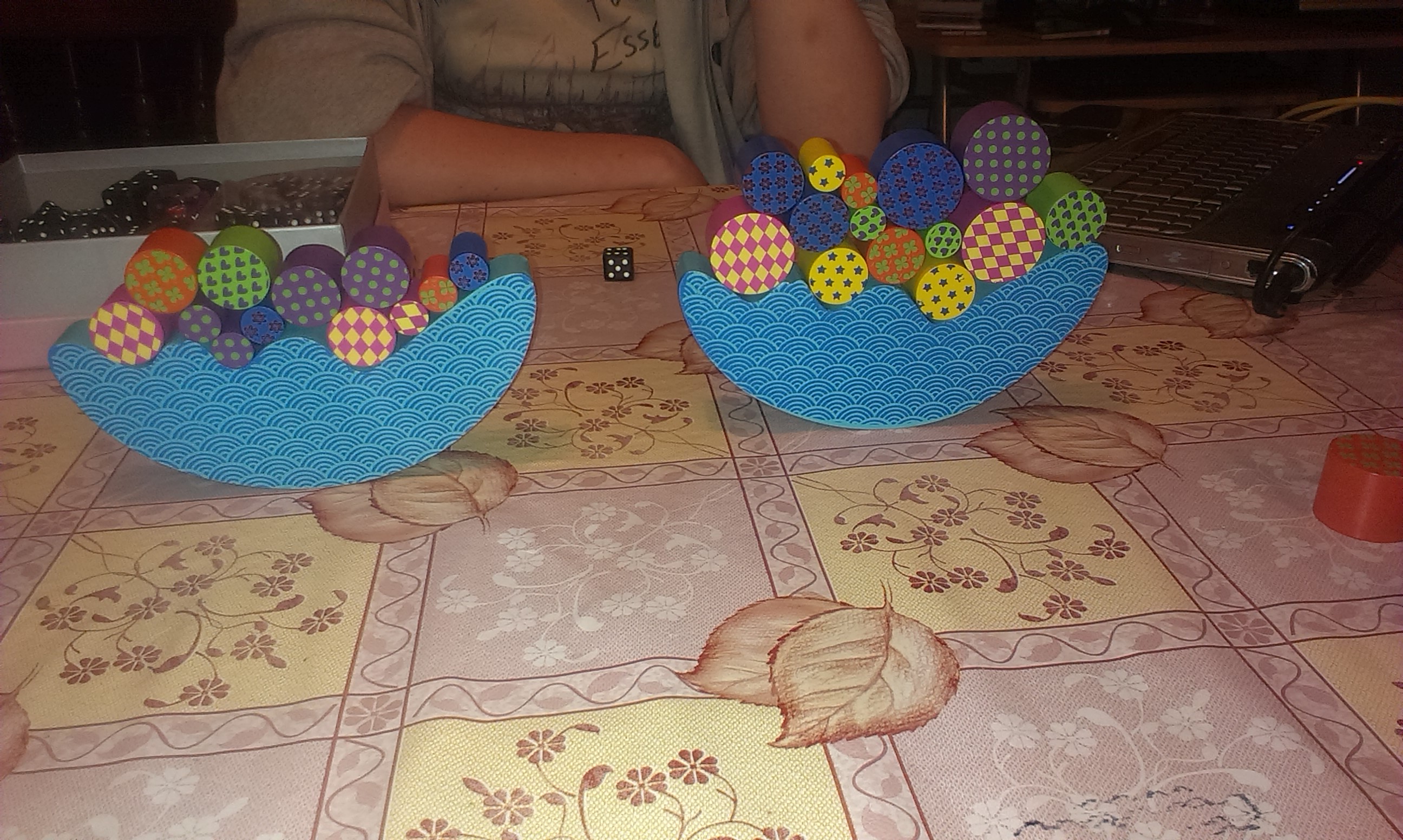
Then finally (happy we had found the best way of playing with one boat or “tipping moon”) we decided to see what would happen if you played with two! We changed the point distribution to make the biggest piece worth eight but keep the others at two and one and kept rolling a single six sided dice and ignoring the colors. We then made one “tipping moon” a Plus boat and the other a Minus boat and you had to make up the number by adding to both boats but the Plus boat counted towards the number you had to make and the minus counted against so if you rolled a six you could add an eight piece to the Plus boat and a two OR two one pieces to the Minus boat (again a maximum of two pieces could be placed on each boat each turn). The first one to tip either boat lost.
The one on the left is the Minus boat and the one on the right is the Plus boat.
This was very interesting, and requires a very large number of pieces to play properly, but holds great promise!
Don’t or Do Rock the Boat:
After all our experimenting we decided just to make our own version of the game called “Don’t Rock the Boat” OR “Rock the Boat” OR something else if we come up with a better name. (Feel free to throw out suggestions)
We decided our game should be like this:
The “tipping moon” should be a boat and the pieces should be barrels that you have to load onto the boat.
The pieces would have no color classification just weights of 4, 2 and 1 and it would be played with one standard die that would dictate the required weight to be added to the boat.
You could play the game in two variations. One just by adding pieces to make the required weight and two by adding and then taking off barrels to make the required weight.
The loser would be the first one to make pieces fall off the boat, excluding the piece they are placing. Any piece(s) that moved but stayed on the boat didn’t count as a loss.
Additionally we decided that you could make it so if you got two copies of the game you could play it with Plus and Minus boats so we would paint a Plus and Minus on opposite side of the boat so with two sets you could play it how we played in variation 5.
I addition to all of this we decided that there needed to be more of each of the pieces per set so it was impossible to fit them all on the boat. However due to time and horrible things like having to work to live, this wonderful concept for this game has not been made yet but hopefully will get made soon so keep you eyes peeled for “Don’t Rock the Boat – Balance Game – Part 2” post sometime soon… Hopefully, I make no promises as to when!
Creator(s):Elliot Rudell (Designer) and artists are unknown
These are definitely not my brother’s forte, what with him being very dyslexic and all. However, I like them enough that they warrant their own post, even if it is going to be pretty short (and sadly without any pictures). I was considering writing about Scrabble, but then I realized two things; A) That’s boring by itself and, B) We have acquired a much more interesting word game recently that I can write about. SO, I shall only be writing about Scrabble in conjunction with Up Words!
I had no idea of the existence of this game until a friend of ours took it upon herself to make us a copy using squares of foam to write letters on, and brought it to our house. For this we, (or at least I) am very grateful. I have since learnt that the game was developed by an American, with the aim of helping people to improve their English.
Now, rules and such:
As with Scrabble, each player takes seven tiles at random to begin. Player one then places a two-or-more letter word at the centre of the board. It is advisable to have a pad handy for keeping score, and a dictionary, if you’re the type who likes to challenge people about the words they make. Personally, I think it’s more interesting to play without a dictionary as you then test each others knowledge of the actual words as well as their spelling ability. Words must read either right to left, left to right, top to bottom or bottom to top. They cannot read diagonally. Tiles can be placed on top of other tiles to change the word, but the height cannot reach above 5 tiles high. When words are built on top of other words at least one tiles from the original word must remain uncovered, and words cannot be created by adding letters such as “S” to the end.
Points:
Points are counted per word made, rather than per tile, as in Scrabble. If only one level of tiles is used for the whole word, each tiles is worth two points, i.e. the word “back” would be worth 8 points. If a tile is placed on top of another tile to change a word then all tiles, including the one that has been covered up, are worth one point, i.e. the word “flap” has a “C” placed over it, so it becomes “clap” and the word is worth 5 points. Two bonus points are given for a single-stack word using the “Qu” tile and you receive 2 bonus points if you use all 7 of your tiles in the same turn. Multiple word scores are counted separately, including repeated tiles.
Illegal Words:
Words are considered “illegal” for the following reasons:
If it is misspelled
If it is a proper pronoun, for example, someone’s name
If it is foreign
If it includes a symbol or apostrophe
Winning the Game:
A winner is declared when either the tiles run out, or there are no more available moves. Five points are deducted for any remaining tiles and the person with the highest score, wins.
This has been a very short post, I hope you’ll forgive me for it, it’s more like a filler-post this week. We’ve fallen behind a bit due to a deficit of time in which to play any game that takes longer than half an hour. Hopefully though we’re a little better organised now and can start putting up some more in-depth posts!
I read about the rules for Up Words here.
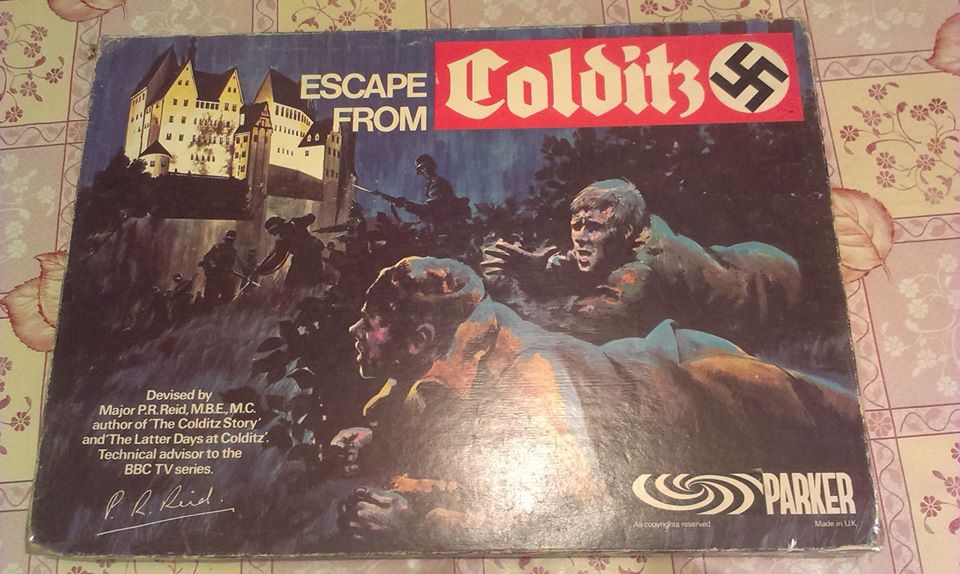
This one is not, under any circumstances a quick game, and is likely therefore, to be a long-ish post. The fastest time we’ve ever played it in is an hour, and that’s because we set ourselves a time limit. Otherwise the game could take days. Escape From Colditz is a game set in the World War II prison camp at Colditz Castle. The idea for the game came from a plan formed by a group of British POW’s (Prisoners of War) to escape from Colditz using sheets and floorboards to create a glider. The game itself is a little more complicated than that, but that is the story the game is based on.
We used to play Escape From Colditz when we were younger, and we never had our own copy of the game. So recently my brother decided that it was a game we definitely needed, and he bought a copy. Since it arrived in the post we’ve played it several times with different numbers of players and different time limits.
Rules and Interesting Things:
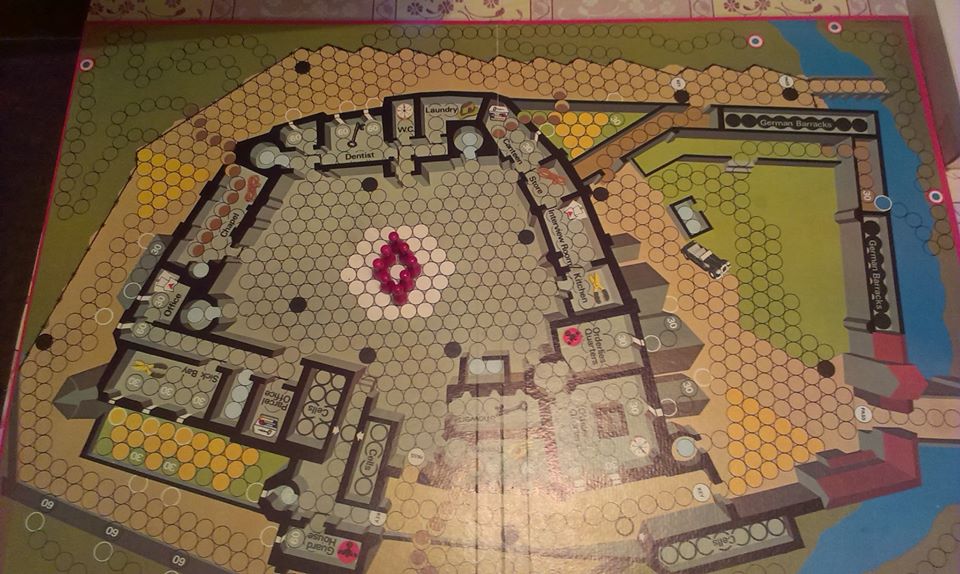
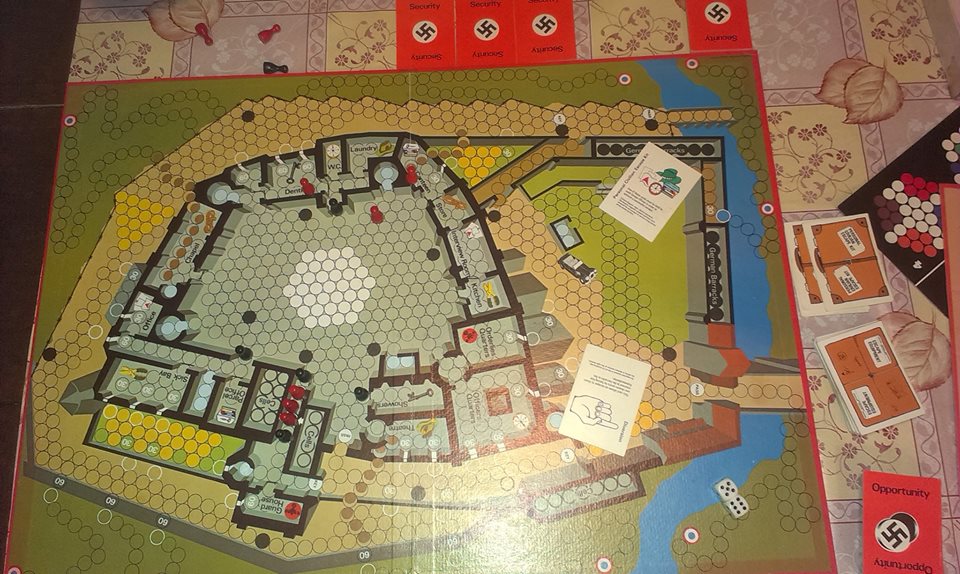
This game was created by Pat Reid, a British Army Officer, and one of the few to successfully escape from Colditz Castle in World War II. The game is for 2-6 players, and the board is the floor plan of Colditz. The rule book tells us that the board is based on a true plan of the castle, but that was adapted to have all necessary features on one floor. This accuracy to Colditz is one of its most interesting features.
At the beginning of the game each player decides who they are going to play as, there are five escape teams to choose from, British (red), French (brown), American (blue), Dutch (orange) and Polish (green) and one player must play as the Security Officer (black). A different number of POW’s and Guards are allocated depending on how many players there are, as follows:
2 players: 8 POW’s and 6 Guards
3 players: 7 POW’s per player: 12 Guards
4 players: 6 POW’s per player: 14 Guards
5 players: 5 POW’s per player: 15 Guards
6 players: 4 POW’s per player: 16 Guards
The fact that the Guards are always outnumbered by the POW’s is historically accurate, as, during the war, the prisoners always vastly outnumbered the Guards. It was only by the harsh way of living, random public executions, and other similar means, that the Guards were able to keep authority over the prisoners.
Pieces are moved by the throw of two dice. A player may use all their moves on one piece or otherwise split the roll between as many of their pieces as they like. They have to move the whole number thrown and they cannot allocate any of their number of moves it to another player’s pieces. A double entitles the player to another roll.
There are five packs of cards involved in the game, Personal Civilian Escape kit, Escape Equipment, Escaper’s Opportunity, German Security and Do or Die cards. The Opportunity cards, Escape Kits, Escape Equipment and Do or Die cards are all only useful for the escapee’s, the only cards the Security Officer can use are the German Security cards.
To attempt escape, each prisoner must collect an “escape kit”, this consists of food, a compass, forged papers, and a disguise. Once collected this cannot be taken from you or lost in any way. The items collected as part of the escape kit do not exist as escape equipment. To obtain the escape kit the player must get four of their POW’s into the rooms in the castle that have the relevant symbols for each necessary item, they can then claim an escape kit.
To make a successful escape attempt each player must also collect other escape equipment, this can be rope, which comes in 30ft lengths, wire cutters, keys and forged passes. Ideally each player would have some of everything. To collect equipment a player must get their POW’s into a room with the symbol of the piece of equipment they want, they must have either two POW’s in the same room, or one in each of the rooms with that symbol, before they can collect the relevant equipment.
Start positions if playing with two people. EO is playing as Britain.
Opportunity and Security Cards:
Opportunity cards are specifically for the use of the POW’s. Likewise with Security Cards, which are specifically for the Security Officer. To collect a Security or Opportunity card a POW or the Security Officer must roll either a 3, 7 or 11. They are then allowed to take a card from the top of the deck before they continue with their turn. Opportunity Cards can be used as soon as they’ve been collected, or they can be held for later. However, each POW or Security Officer can only hold three at any one time. POW’s have an advantage over the Security Officer here, as, if playing with more than two players, they can choose to either discard one of their Opportunity Cards or they can pass it over to another POW. The Security Officer must discard a card if he/she has collected more than three. Opportunity Cards and Security Cards are incredibly useful, an Opportunity Card might provide a POW with a piece of equipment, or allow them to hide from the Security Officer at some point, it may even allow them access to a tunnel, which will aid their escape attempt. For the Security Officer, Security Cards are a little different, they may allow you to search a room (the SO cannot enter any of the rooms in the castle without the relevant card giving them permission to search it, meaning that POW’s are generally safe whilst in the rooms), or call Appel, which recalls every players pieces to their starting position, and other similar things.
Do or Die:
A Do or Die card is dealt to every Escape Officer at the beginning of the game, these are not read and are kept face down until they are used. Once an EO has decided to use their Do or Die card, they then turn it over and read it. It will tell them how many rolls of the dice they have to try and get one of their prisoners out of Colditz. The prisoner starts from anywhere inside the grey area of the board (the inner courtyard) and must reach one of the safe targets outside of the castle walls within the number of throws specified. The prisoner must leave through the main gate and pass and key points no longer effect them. If the prisoner does not manage to escape, they are “dead” and their whole team is removed from the board and from play.
There are even more rules to this game than i’ve mentioned in my brief (haha) overview here, however, you can gather the general outline of the game. It’s quite strategic, and definitely a challenging game for anyone! We thoroughly recommend it for hours of fun, we played the other evening and had a very silly argument, that anyone who has either of us on facebook may well have seen, about whether or not I, playing as the SO could continue to shoot one of his escaping prisoners if he was playing a diversion card (one of the Opportunity Cards). I said no, therefore I won. He said yes, which would mean he had won.
Our unresolved ending.
This argument has no resolution so far.
All the information presented to you here came either from our experiences of playing the game, or from the rule book itself, if you’re interested, go find a copy!
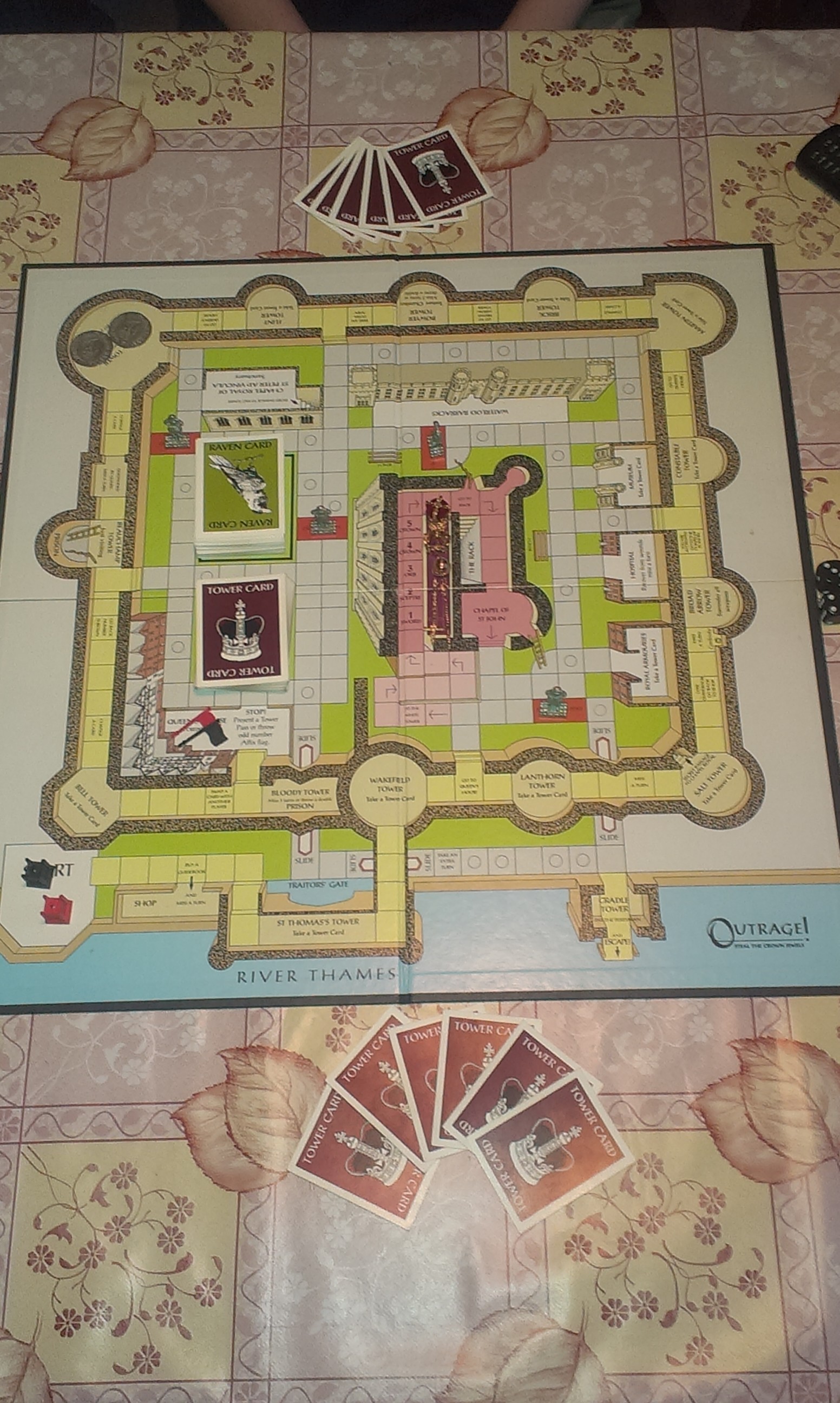
What’s more fun, catching a criminal or being one? Probably neither in reality but in the world of board games I’d say being a criminal! For example being Mr X in Scotland Yard is more fun than trying to catch him, and attempting to steal the crown Jewels in Outrage! is a lot of fun.
The box
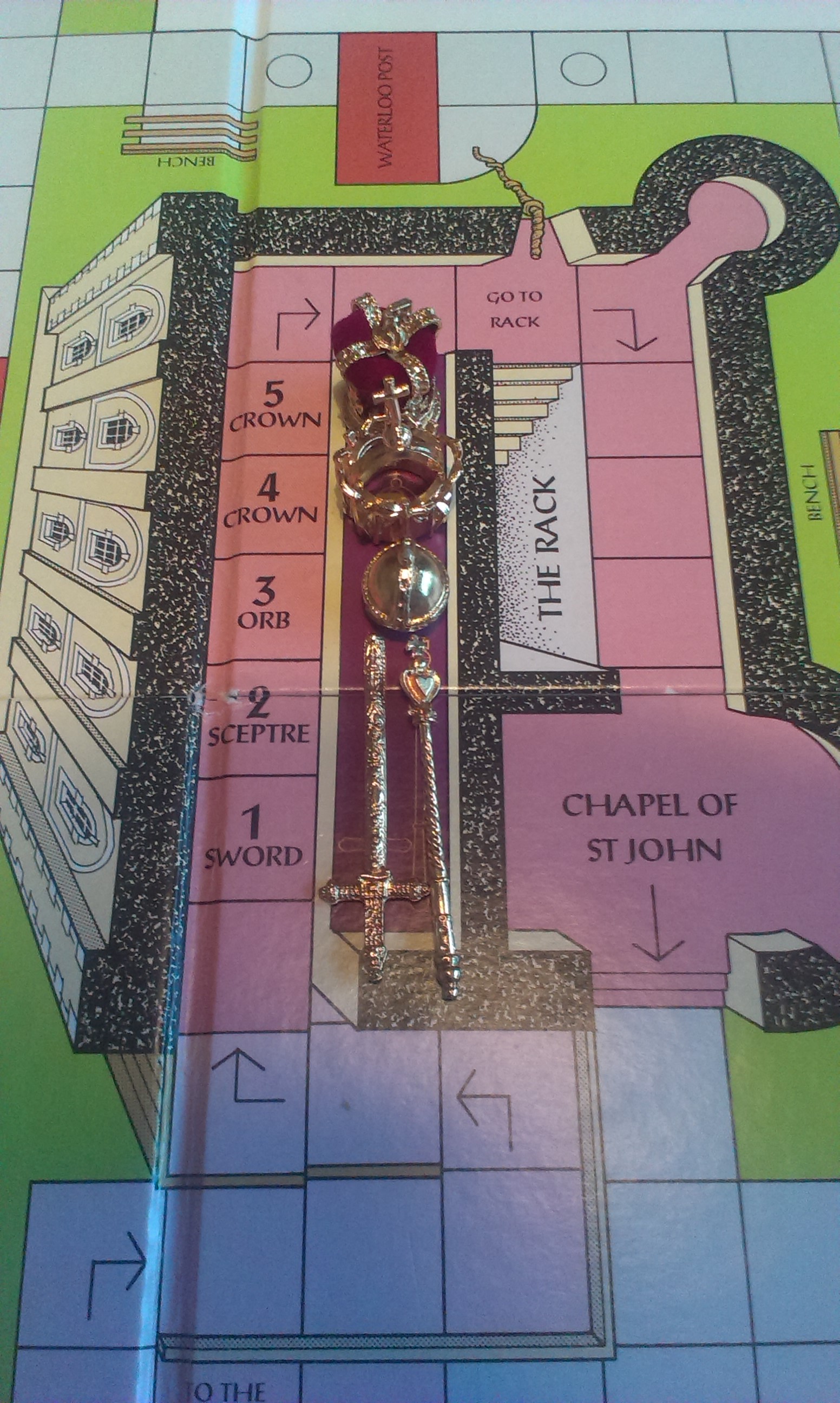
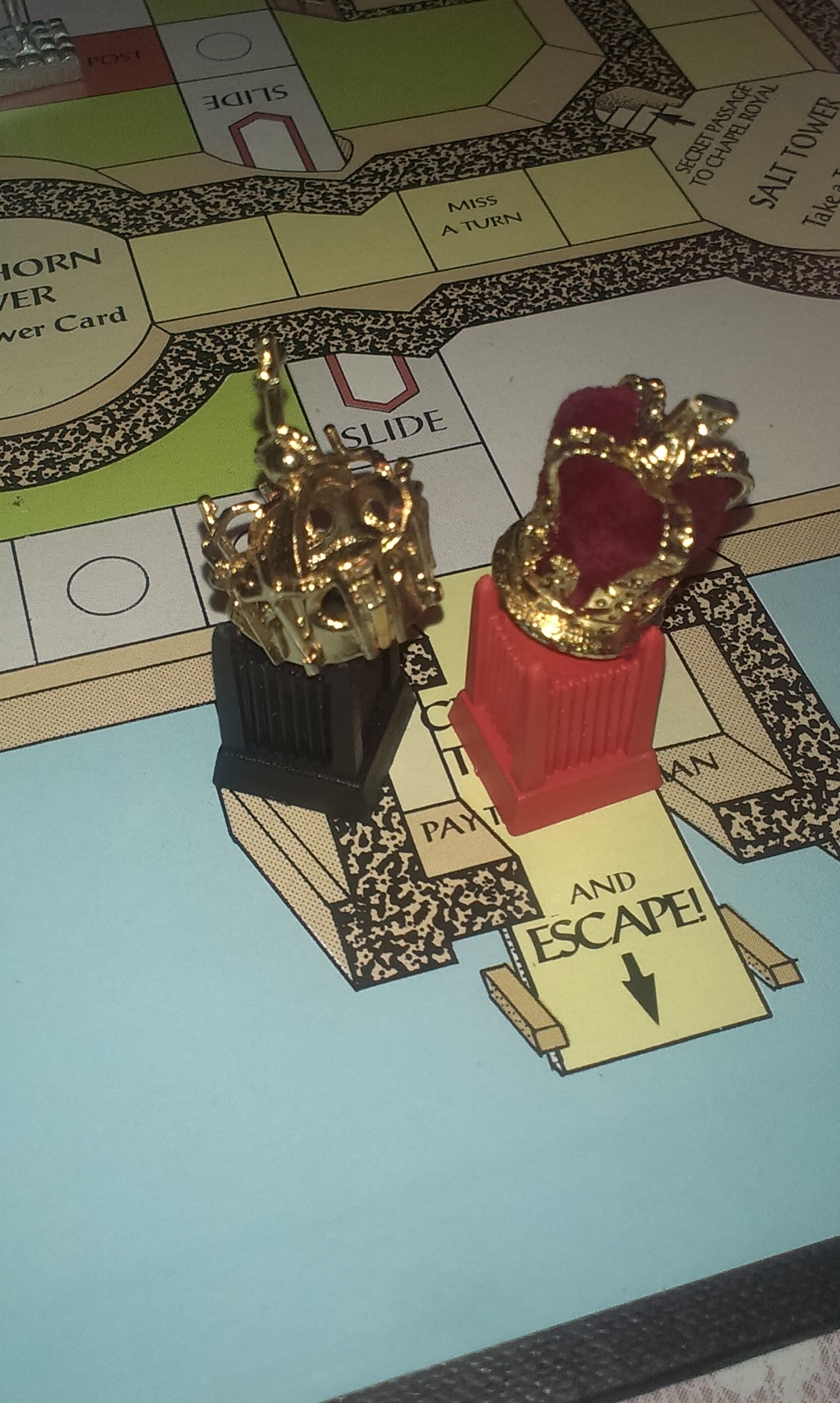
The aim of the game is obvious, it’s even in the name! But, the cool thing about the game is you get a whole set of mini crown Jewels to try and steal! Only problem with them is they are liable to get lost or broken. However, providing you’re careful and don’t feed them to any small children or animals you should be OK.
The jewels. Out Orb is slightly broken.
Outrage! Is a game for 2 – 6 people and is more fun with more people as with 2 it can be slow moving. You have to move around the board, which is the layout of the tower or London, acquiring burglary tools, weapons and armor (in the form of Tower Cards) while avoiding the Yeomen Warders posts.
A Yeoman Warder at his post.The board all set out ready to play.
You can play by two strategies depending on what weapons or tools you have. You can either go for a crown jewel OR you can wait for someone else to steal one and attack them for it. Which can be super frustrating because after lots of careful planning you can steal a jewel and be ready to make your escape, then someone else can attack you and take it from you and win after all your hard work! But it does add an addition edge to the game.
You can set two win parameters for the game, either its the first person out with any Jewel OR you can play until all Jewels are stolen and the player with the most amount in points wins.
The pieces wearing the Crowns; which is actually the biggest design flaw in the game is they don’t fit on top of them, which is upsetting, but additionally I don’t think they are supposed to.
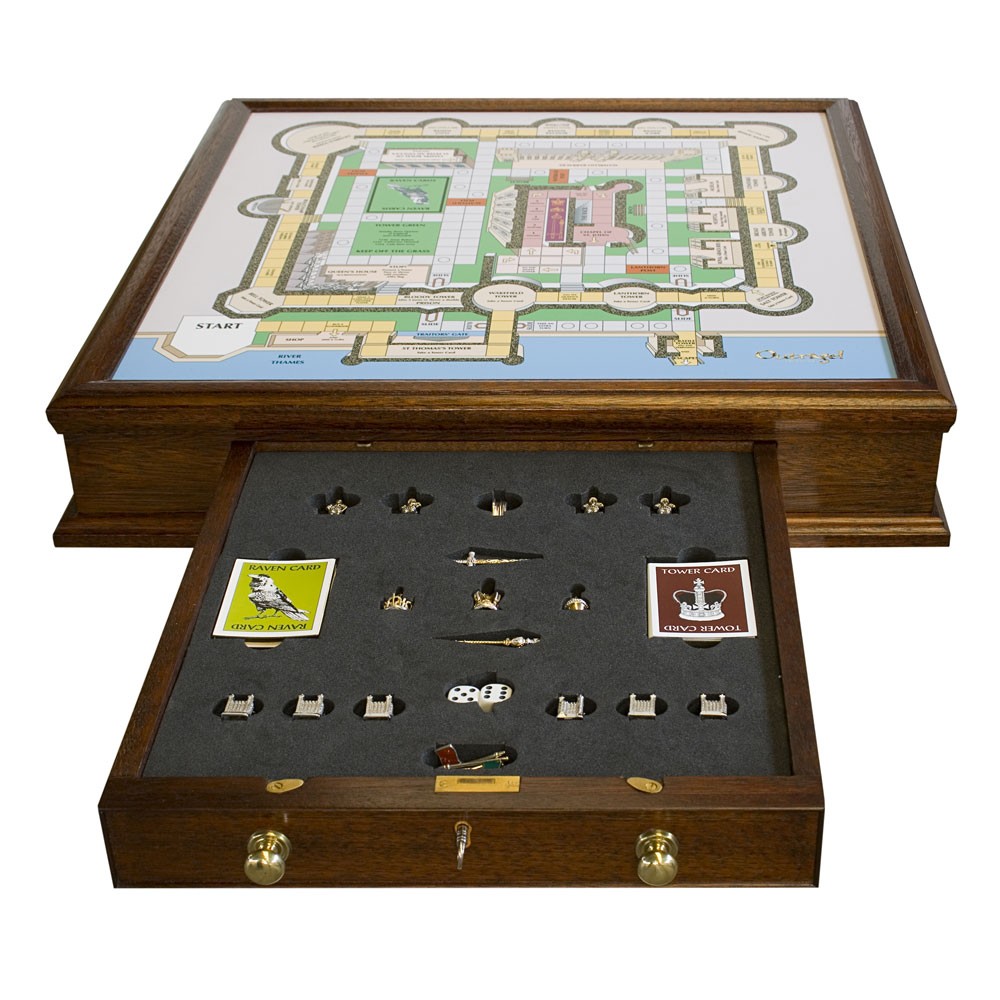
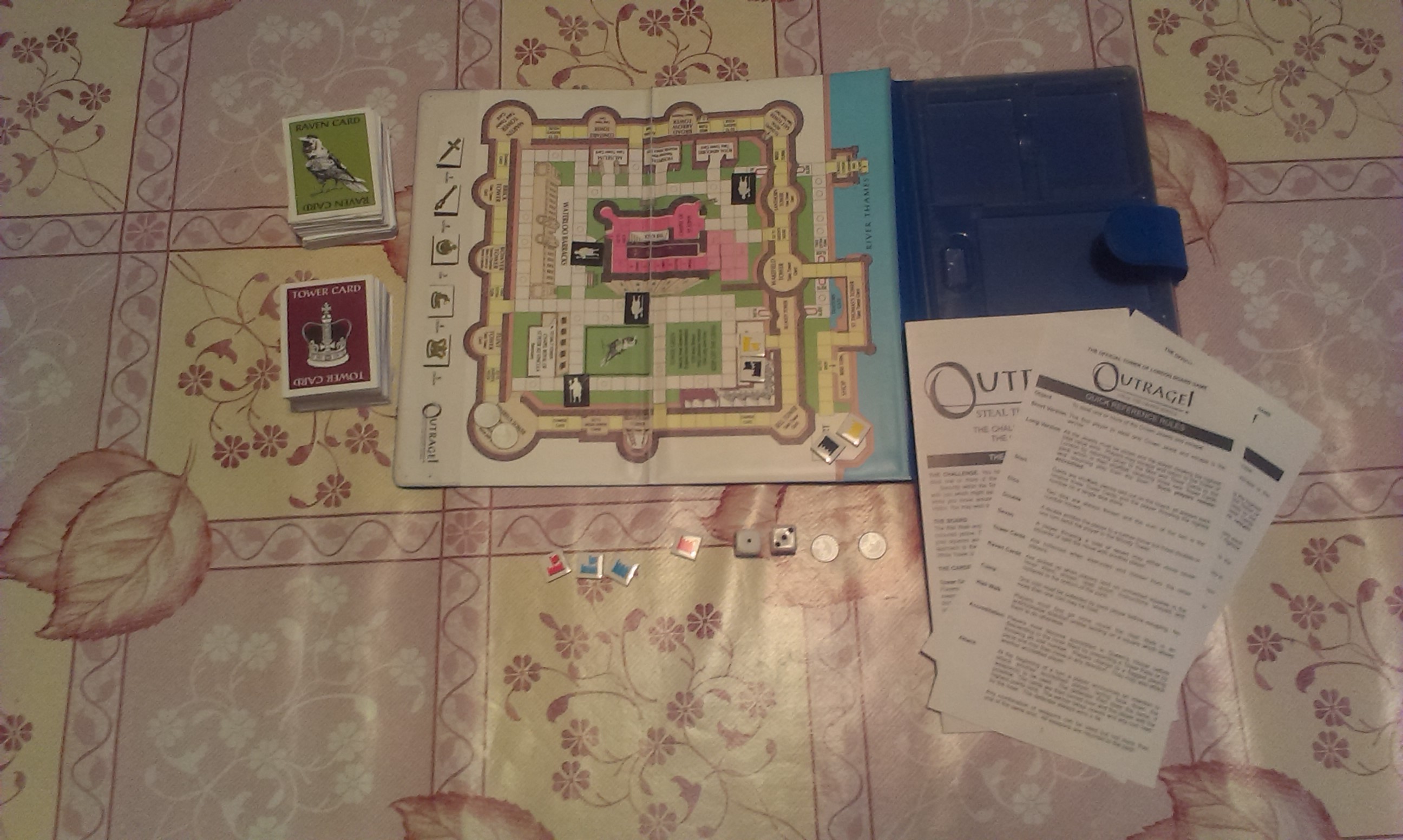
It can be an extremely fun game, but like many games it can vary a lot in time depending on how lucky a player is or is not. Also there are two other versions of the game a travel version which I recently managed to pick up in a charity shop for about £3 (around £6 cheaper than ebay) and a Deluxe edition of the game which (according to wikipedia, the greatest source of completely accurate and unquestionable knowledge EVER) is the most expensive board game in the world valued at £7995, the Jewels are made out of real precious metals.
Image coutesy of http://www.historicroyalpalaces.com/ as surprisingly we didn’t own one to take a picture of.Outrage! Travel edition, I bought this from a charity shop for £2.99.
Breach The Keep – Board Development:
Now I know you’ve (I don’t know who I mean by that) all been wondering how our board game Breach The Keep has been coming along and here’s the answer, the result of giving it to a highly paid graphic designer (ha! if only):
The board development so far!
What do you think?
Genuinely I want to know what people think so any comments or criticisms are most welcome. Its still arguably a work in progress. I’m thinking to texturize the grey at each end, which is where your pieces start, to a stone type texture but I can’t make up my mind.
Anyway it has been sent to be printed properly in full size so I can see how well that works and then work from there. So next week (hopefully) there will be pictures of a real board and perhaps some pieces (if we’re really organised) ready to go up, additionally I might release the full rules document on the very small off chance there’s anyone interested in reading them.
Thoughts, comments, suggestions and criticisms all welcome.
Also remember we will be giving ten of these away for free once they are done, to get feedback, so keep on checking in to see how close we are to the give away and be ready to email us as soon as the post goes up!
Creator(s): Designer is unknown and Dieter Zander is the Artist
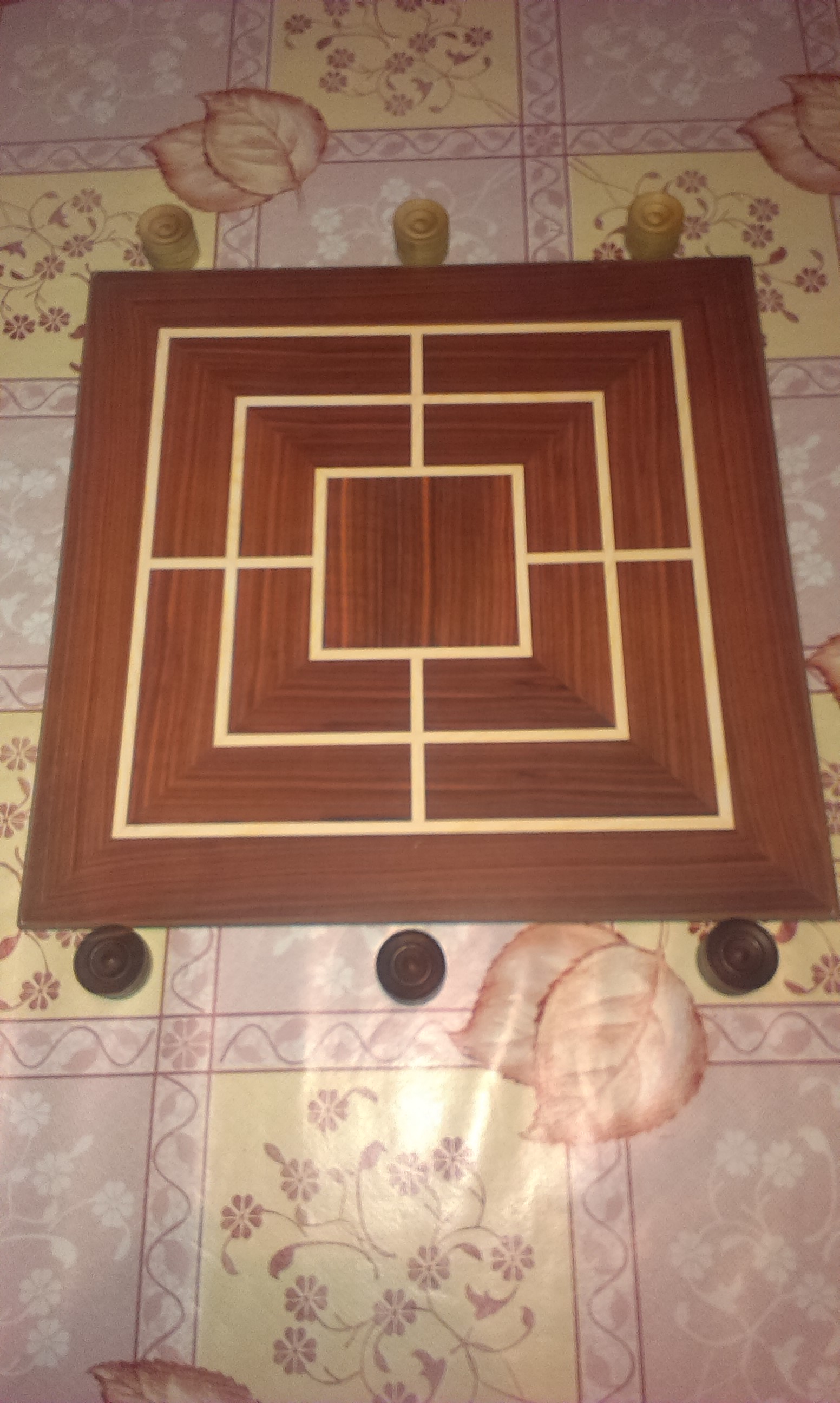
Having taken a quick break from this chain of posts to write about Elixir, I’m back on fast games! This one’s all about Nine Men’s Morris. Another very old game, a board for which was found cut into a wall in the temple at Kurna, Egypt, that dates back to 1440 BC (although there is doubt as to whether this is an accurate dating of the carving as Coptic crosses were also found carved here that could not have been put there by the Egyptians at the time). Anyone who’s played Assassins Creed III might be familiar with this game – it’s one of the mini games available within the game. Variations of it are also Three Men’s, Six Men’s and Twelve Men’s Morris. Unfortunately, we don’t yet have copies of the others, so this post will mainly (but with some references to the others) be focused on Nine Men’s Morris.
A Nine Men’s Morris board and pieces before a game begins.
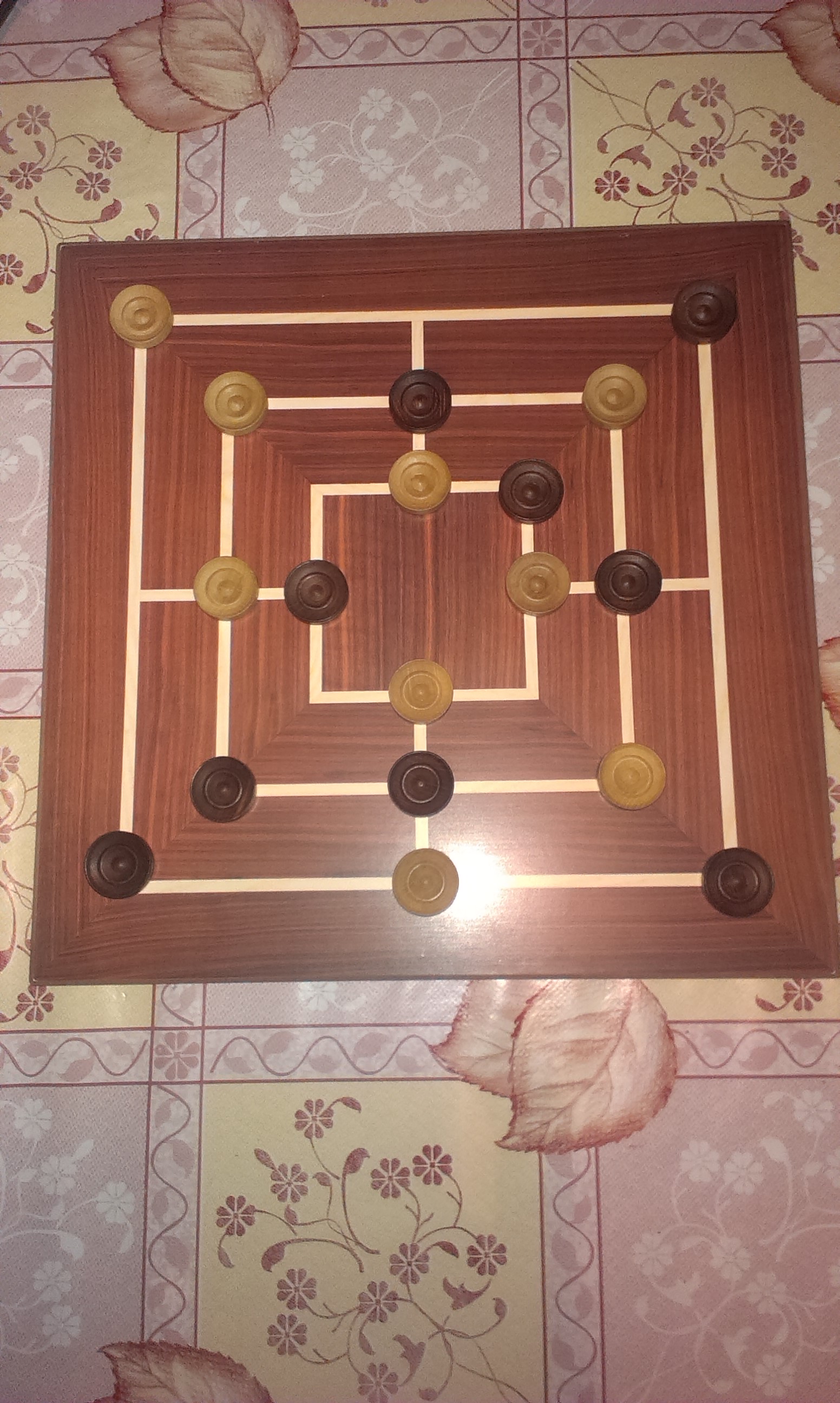
It’s a very easy game to learn, each player has 12 pieces in either black or white. The board is comprised of three squares inside each other, each with intersecting lines midway down each side. White plays first and you take it in turns to place pieces on the corners of the squares or the midway points created by the intersecting lines. The objective is to create lines of three, either horizontally or vertically, called mills. Once a player has created a mill they are then allowed to remove one of their opponents pieces from the board. If a mill is created whilst players are placing their pieces the player who created it is still allowed to remove one of their opponents pieces.
A game where all the pieces have been placed just before the moving phase begins.
After all the pieces have been placed players take it in turns to move. Each turn you may move one piece one space. You cannot move, or create mills on, the diagonals. A player who has achieved a mill or two when placing their pieces is going to be in a stronger starting position than their opponent, as they will have more pieces left to manoeuvre round the board.
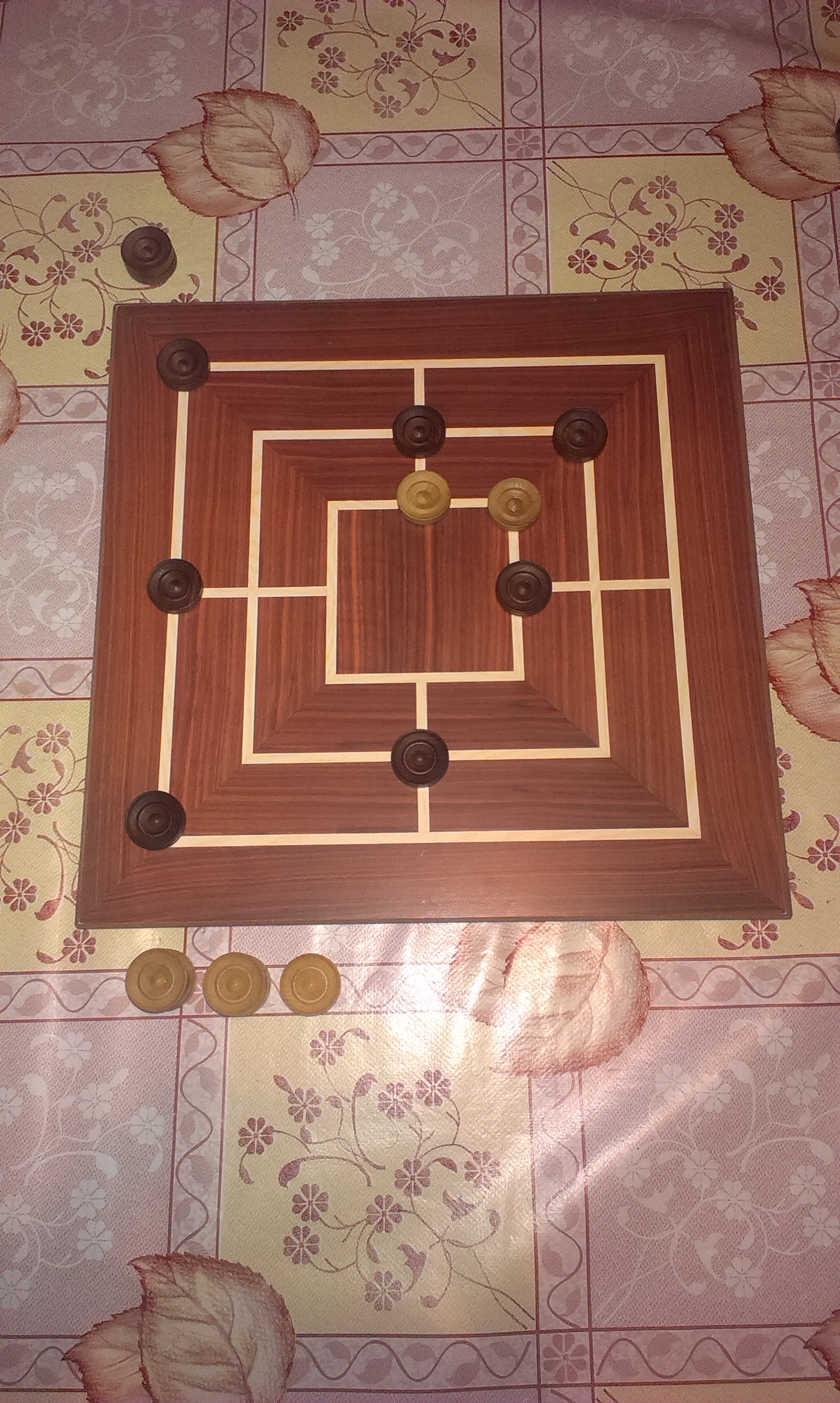
When a player has lost so many pieces that they have three or less pieces left on the board they are then able to move their pieces anywhere. They are no longer restricted to moving one piece one space. They can move one piece from any space on the board to any other space. This makes it considerably harder for their opponent to continue to make mills. Once a player has lost all of their pieces, or both agree that a point in the game has been reached where neither player can win, the game ends.
The end of the game and black is the winner having reduced white to less than three pieces.
History Things:
These first five points are all about Three Men’s Morris, not Nine!
In line for “oldest game in the world” – with Go, Backgammon and Chess.
Noughts and Crosses or Tic Tac Toe are the same as the variation of Three Men’s Morris that involves the use of the diagonals for making mills.
According to Thomas Hyde the Chinese played it in 500BC.
Ovid mentions it in “Ars Amatoria” – the Romans played on wooden or stone boards, although occasionally more exotic materials were used.
Three Men’s Morris was widely played in England 1300 AD – boards can be found carved, by monks, into the cloister seats in Norwich, Canterbury, Gloucester and Salisbury Cathedrals, and Westminster Abbey.
Other Nine Men’s Morris boards have been found in Ceylon – carved in the reign of Mahadithika Maha-Naga (9-21AD), and European boards have been found in places like the first city of Troy, a Bronze Age burial site in Ireland and at the Acropolis in Athens.
The game reached peak popularity in Europe in the fourteenth century.
In old England the game was played with black and white pebbles on a board that was drawn out on the village green using a trowel, or drawn onto a pub or tavern table with chalk.
Shakespeare references it in A Midsummer Nights Dream in Act II, Scene I – “The Nine Men’s Morris is filled up with mud!” ~Titania – this must be what happened to the boards drawn on the green whenever it rained!
A version of the game called Morabaraba which is played using the diagonals on the board is still very popular, and played to a competitive level, in South Africa.
Because the game was popular in Medieval England there has been some speculation as to whether the name “Morris” is related to the English Morris Dance. However, Daniel King says that it is coincidence- the word Morris in this context actually deriving from the Latin “Merellus”, meaning a counter or a game piece.
I have, once again, achieved ten points of history about the game! I wonder how long this is going to last…
Pretty much everything I’ve put up about the history of the game I found here.
But I supplemented some of the points with information from our trusty old friend Wikipedia!








 Tame The Board Game