Elixir – The Quest For Eternal Life! (Not a quick game)

4 - 5

Number of Players: 2-4

Year of Publication: 1987

Creator(s): Nik Sewell (Designer) and Chantry House Studios Limited (Artist)

So, for this post, i’m going to move away from my Quick Games posts to write about a brilliant board game that we’ve had for longer than I’ve been alive; rather than things we’ve just come across like Java (which is awesome, in case anyone was unsure). 

Definitely As Obscure As We Thought!

Elixir is a game we’ve been playing as long as we can remember – published in 1987 it’s been around far longer than either of us (almost 27 years now!!). As far as we can make out, this game was never released on a large scale, and it was withdrawn from production only a year or two after it was first produced, so very few copies have survived – a look on Amazon or Ebay will tell you that to acquire this game you’re looking at spending, at the very least £50, or closer to $100+ for anything coming from the United States. Even harder than getting a copy, is getting a complete, or undamaged copy; that seems to be nigh impossible – I know our copy is battered and has a few of the gold pieces missing from all the times we’ve played it over the years, but when I consider how many people have played it, and how little we were when we were first introduced to it, i’m amazed that it’s in as good condition as it is!
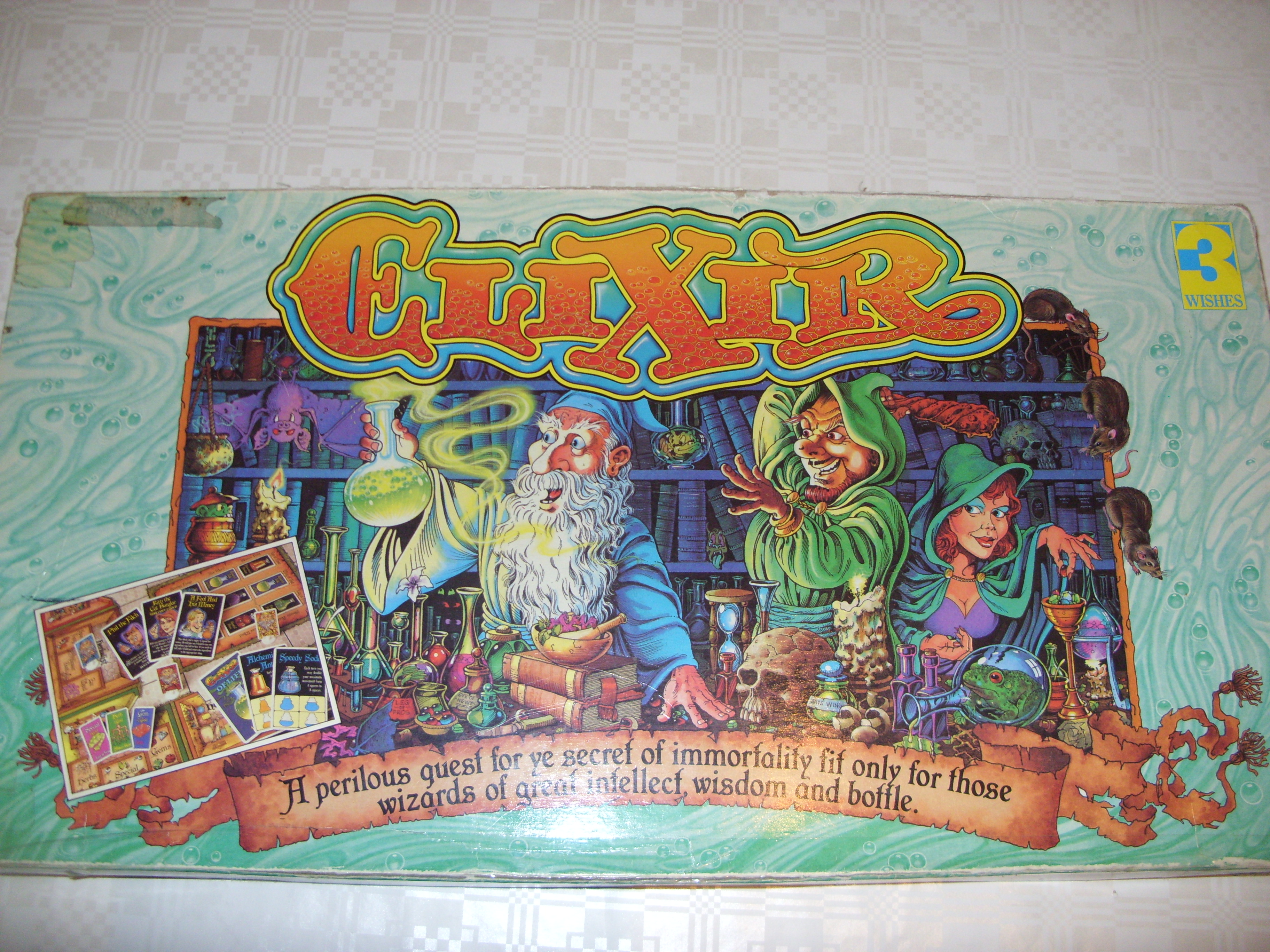
SDC13262

Playing the Game!

Elixir isn’t a complicated game at all. You play as one of four Wizards, either Red, Blue, Yellow or Green and your objective is to be the first to brew all three parts of the Elixir of Life – simple, right? There are three shops on the board, Special Ingredients, Herbalists and Jewelers. To brew any potion you need at least one Special Ingredient, Herb and Jewel. You can move four spaces per turn and you move around the board entering shop and purchasing ingredients for your potions. At the start of the game you are given six gold pieces and you are given one more at the beginning of every turn. These are used to pay for your ingredients. Once you have everything you need to brew a potion, you return to your lab and commence brewing.
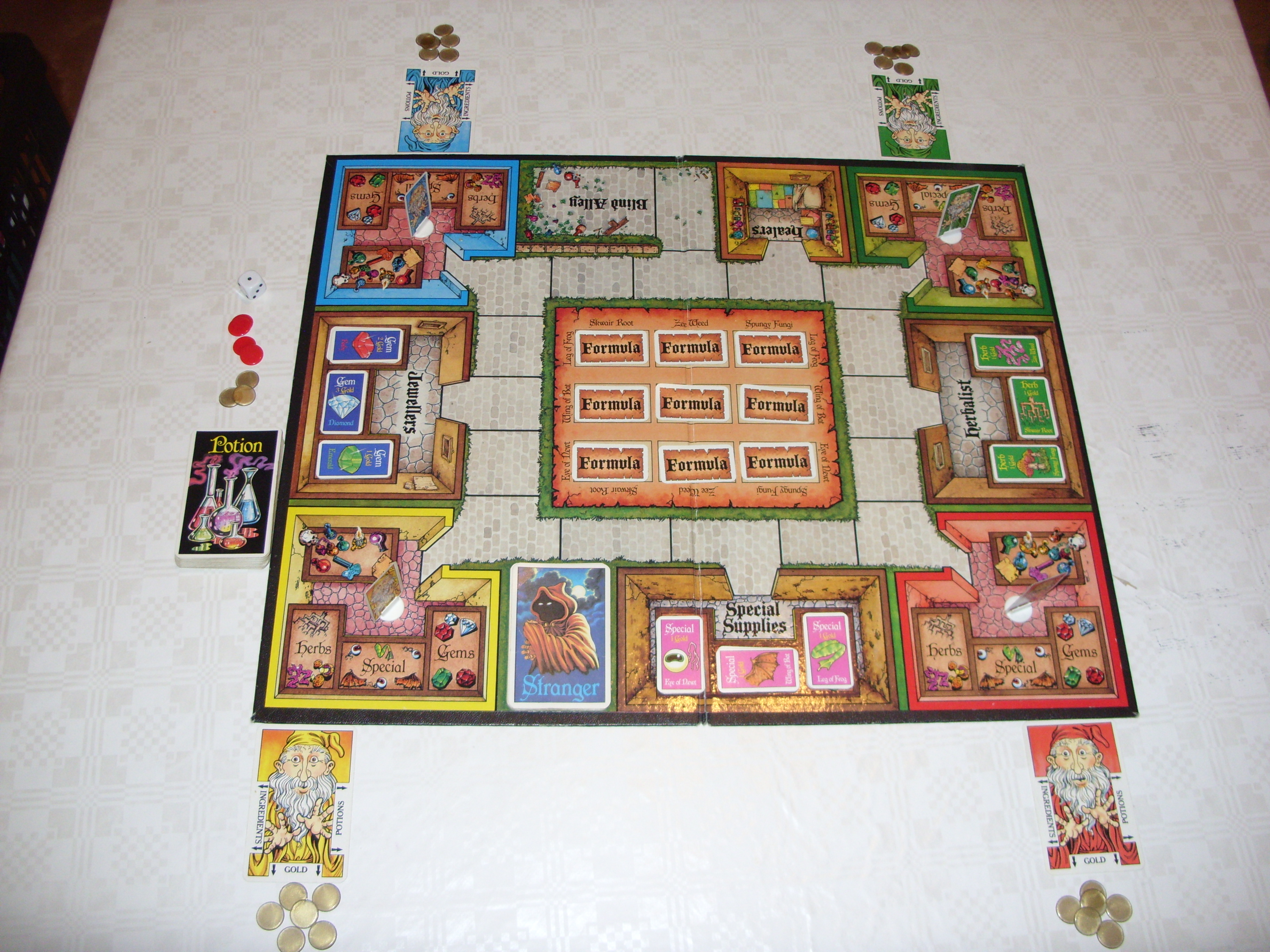
Starting set up for Elixir. Each Wizard starts in his or her laboratory.

But you need to be wary! Every time you stop on one of the grey street squares you must take a Stranger card, these are random and are a mixture of good and bad. Some Strangers might offer to buy ingredients or potions off of you, others might offer to sell you ingredients at a special rate. Some are for hire, you can use them to incapacitate or rob your opponents. Others will simply try to mug or curse you. It’s completely down to chance which card is on top of the deck when you draw a card. There is another element of chance thrown into the game with regards to Stranger cards; and potion brewing too. For each Stranger that attacks you, or you hire to attack or steal from another Wizard there is a success rate on the bottom of the card. For this you role a die. It is the same with brewing. The jewel used in brewing the potion determines the likelihood of a successful brew, and using anything less than a diamond can result in failure when rolling the die, there is a chart in the rule book that states which combinations of jewels and which numbers on the die will yield success or failure for you. When you brew a potion successfully, or if you fail, you must return all three components to the shops that they came from. In this way players are able to continue brewing potions throughout the game, without ever running out of ingredients.
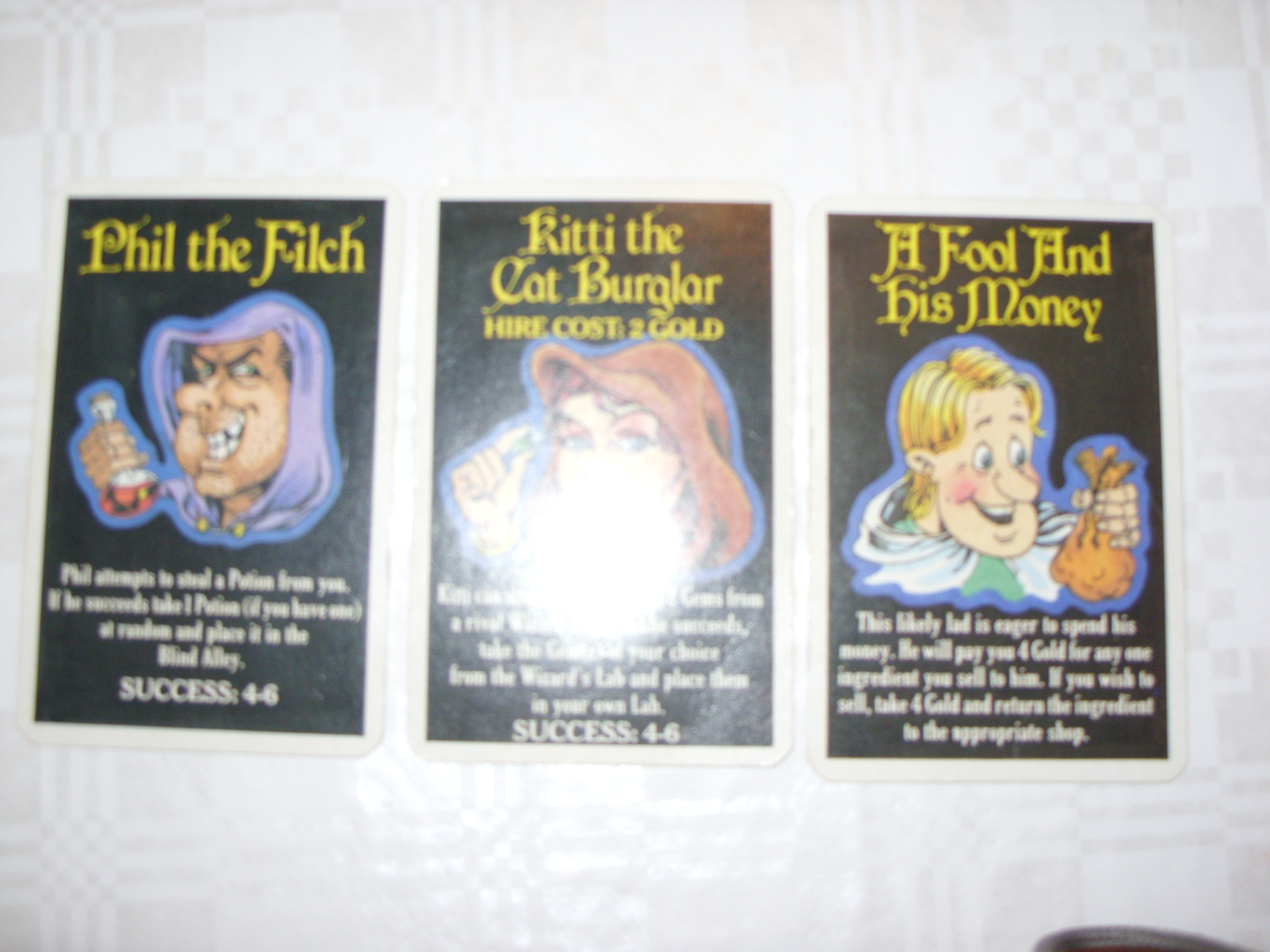
A selection of the stranger cards that can be picked up when stopping on the grey squares.

The Special Ingredient and Herb that you use determine what potion you brew. There are nine possible potions that can be brewed and once you have successfully brewed you look at the relevant Formula card and then find that potion in the potion pack. The middle of the board is taken up by a 3×3 grid, this is divided up into the Special Ingredients and the Herbs. There are nine Formula cards that are shuffled at the beginning of each game and placed in this grid. In this way the game remains unpredictable and it is impossible to know from one game to the next which combination of ingredients will give you the Elixir. Of these nine available, three are the respective parts of The Elixir Of Life, the other six are all different. Each potion has a description on it, which tells you what it is useful for, for example, Speedy Soda is a potion that will allow you to move eight squares instead of four each turn for four turns after you activate it. However, other potions such as Baneful Brew are much less helpful. Although it will not harm you to hold this potion, it can have negative effects on anyone trying to attack or mug you, but you cannot “drink” it, as you do the other potions. So whilst it may seem like an unfortunate potion to brew in your quest for the Elixir, it does have its perks!
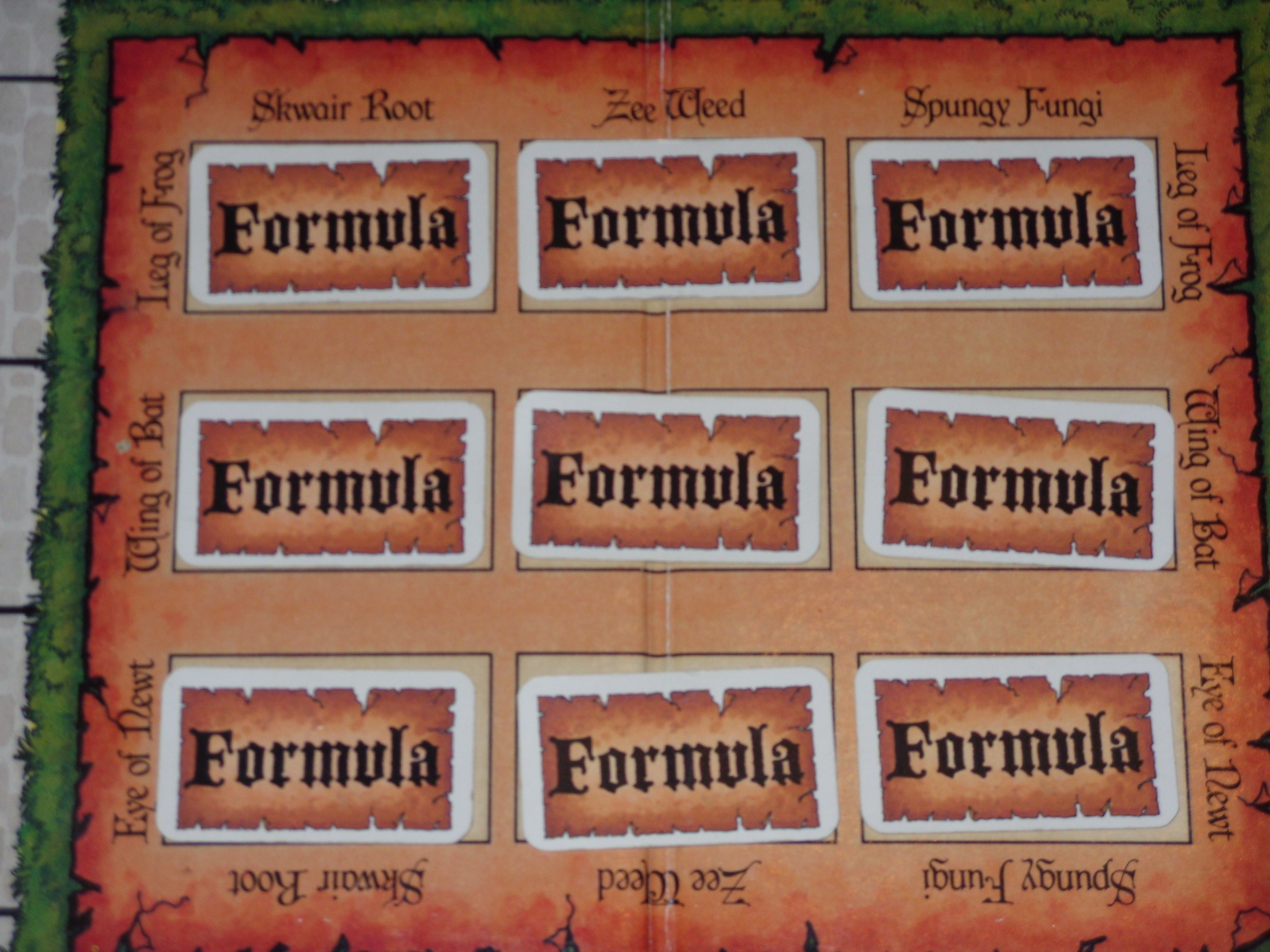
The layout of the potion cards on the brewing grid.

Strategy!

It’s wise to note down which combinations of ingredients your opponents are using so that if they then start to “drink” a potion, you have the chance of knowing one of the combinations that will not give you the Elixir. To drink a potion, you simply place the card face up on the table, showing the other players what it is. The potion, if it is drinkable (the only ones that aren’t are the three parts of the Elixir and Baneful Brew) will have four squares on the bottom, showing a small image of the potion bottle with varying amounts of liquid in it. You then take a red counter from the box and place it over the first of these squares. Every turn you take you must move the counter, until you’ve “drunk” the entire potion. For every turn that the potion is activated, you can enjoy the advantages it gives you, be it taking an extra piece of gold for your turn, or being able to move eight spaces instead of four, however, if you do not use the advantage of the potion on one turn, you must still move the counter along as if you had. Planning your turns once you’ve activated a potion is important!!
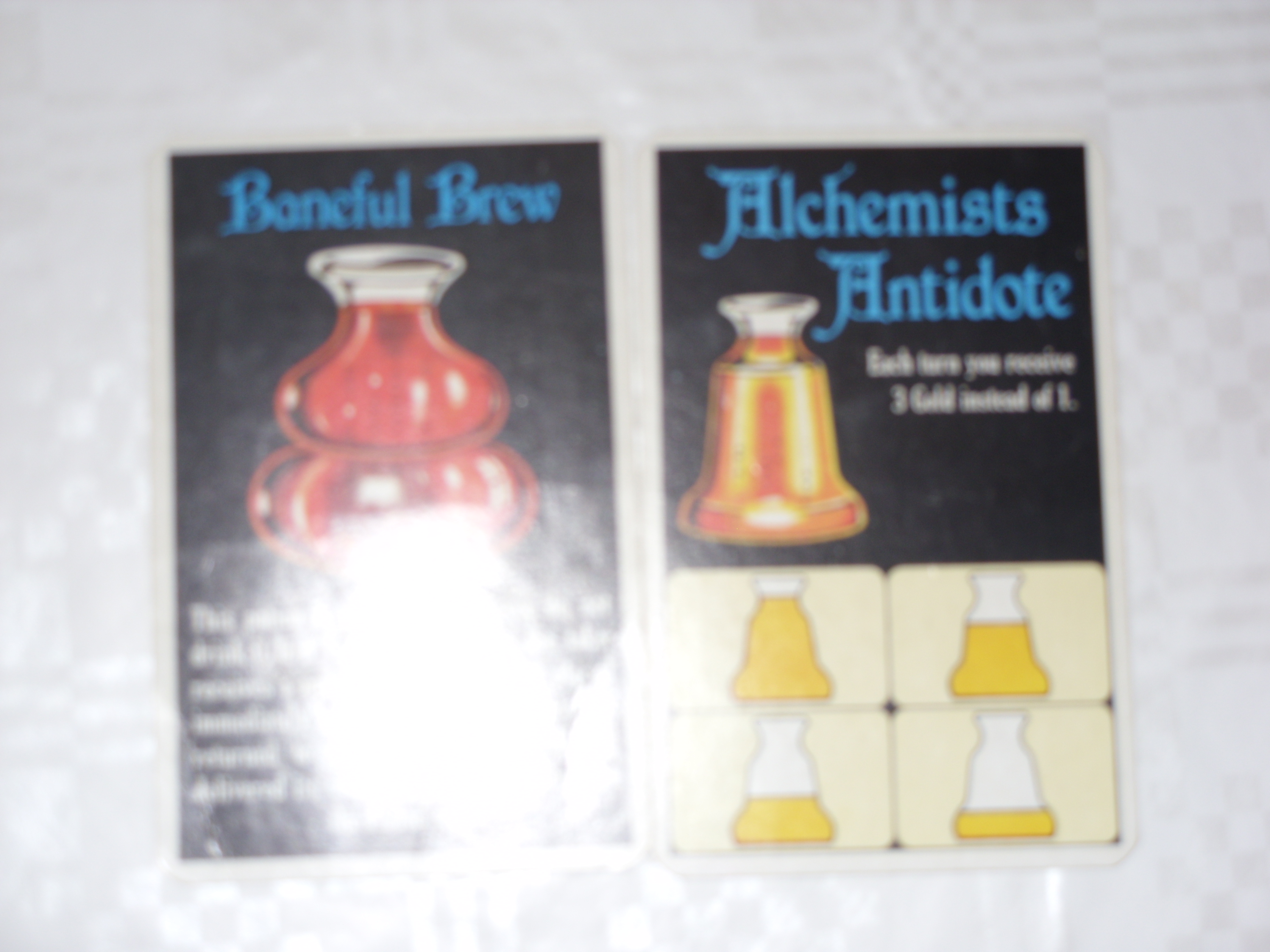
Two of the potions available to brew during the game.

It’s also possible to slightly obstruct your opponents in their quest for the Elixir. You can go into any shop and buy all of one, or all or the ingredients, providing you have enough gold. Once you have these, the other players cannot brew until you have, unless they mug you or steal from you. Using this tactic will slow the game down a bit, and probably make you the object of unwanted attention!
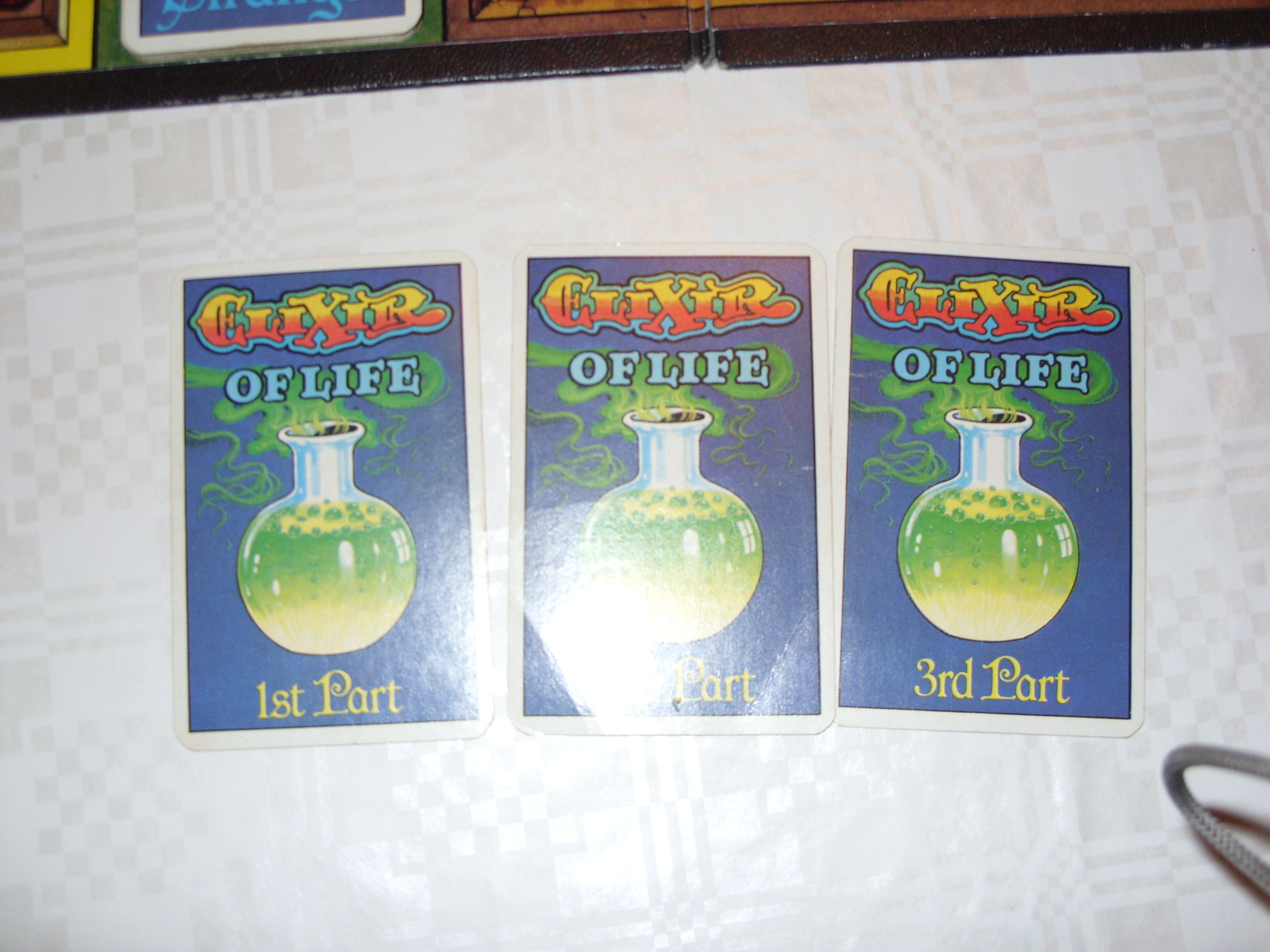
The three parts of the Elixir of Life! Once you've got these, you've won the game and you're set for eternity.
The three parts of the Elixir of Life! Once you’ve got these, you’ve won the game and you’re set for eternity.

If anyone’s interested, my next post will be about Nine Men’s Morris, another one in the Quick Games chain of posts, and that should (fingers crossed!!) go up Thursday evening!

For the people that occasionally fill their procrastination time reading our posts, firstly, thank you, for filling your procrastination time with our ramblings, but also, if there’s any game you’d like to see us write about that you’ve played, please, don’t hesitate to tell us in a comment! We’d love to know which games you love and have grown up with!

To Catch a Criminal – Scotland Yard and Some Chairess

From the Depths of The Less Obscure Than we Thought:

4 - 5

Number of Players: 3-6

Year of Publication: 1983

Creator(s): 

Scotland Yard is a game we’ve had since…. Well, since forever, so naturally we did no research and just assumed it was obscure. However it turns out it’s sold over 4 million copies worldwide and is still widely available.

The Box.
The Box.

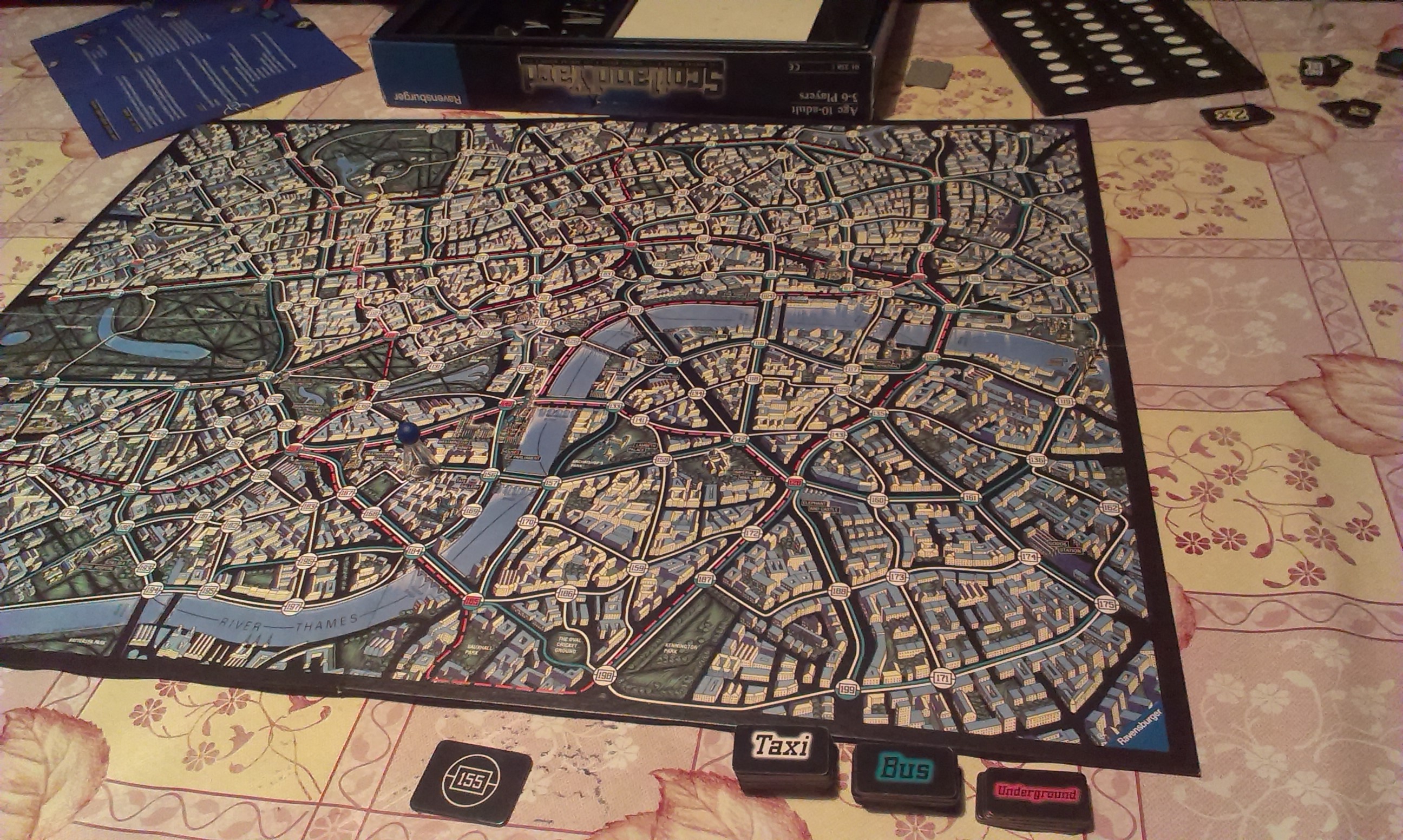
The game is basically a depiction of detectives trying to catch a criminal called Mr X, but if they had no cars… No money… And the only transport option available to them were transport vouchers that would only take them one stop at a time. Even on Taxis that done have stops. Not to sound to stupid but one of the best things about this game is its simplicity, you don’t have to spend an hour reading the rules just to play for half an hour, and on top of that the board is an awesome map of London!

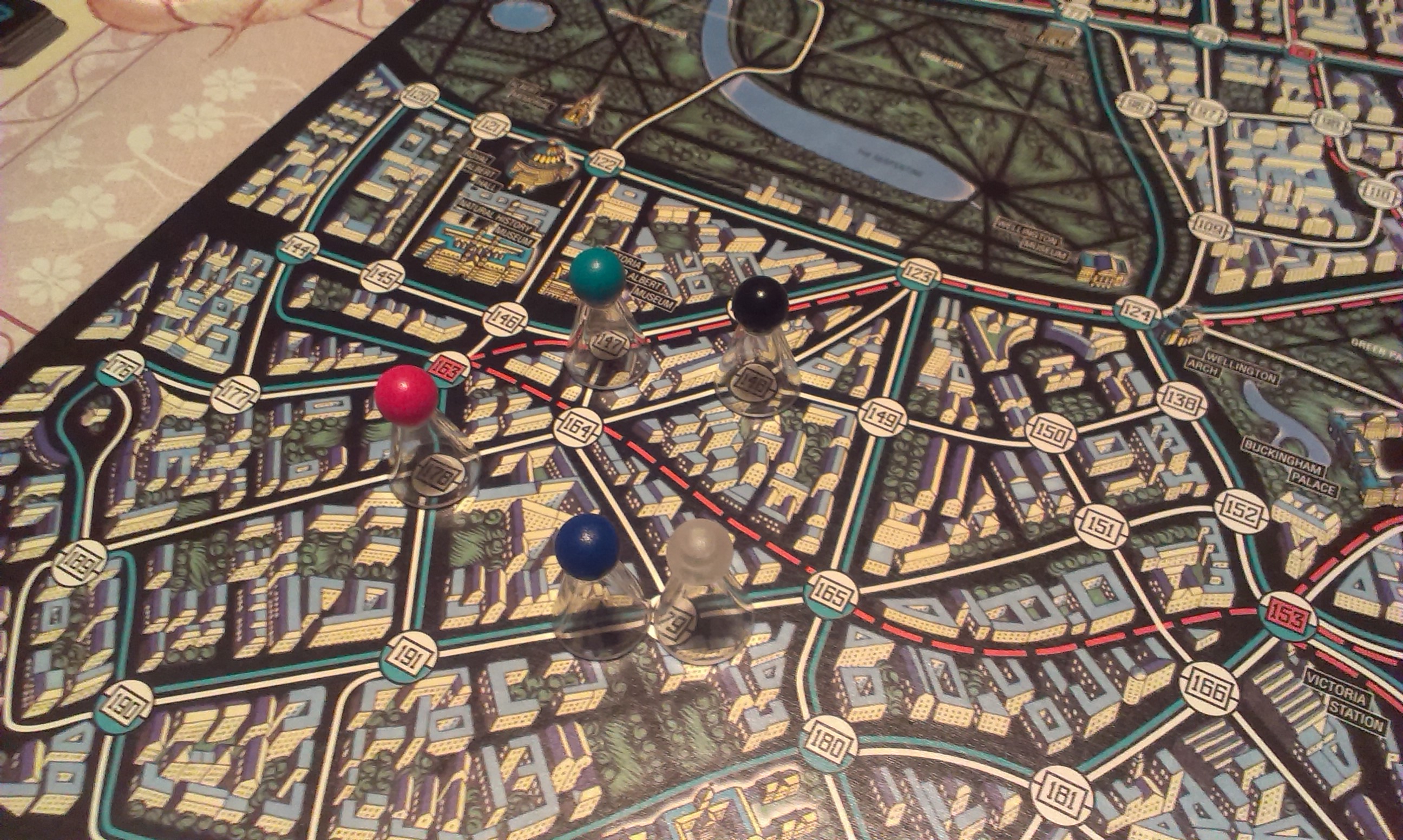
The board, The starting card, my detective and the travel tokens.

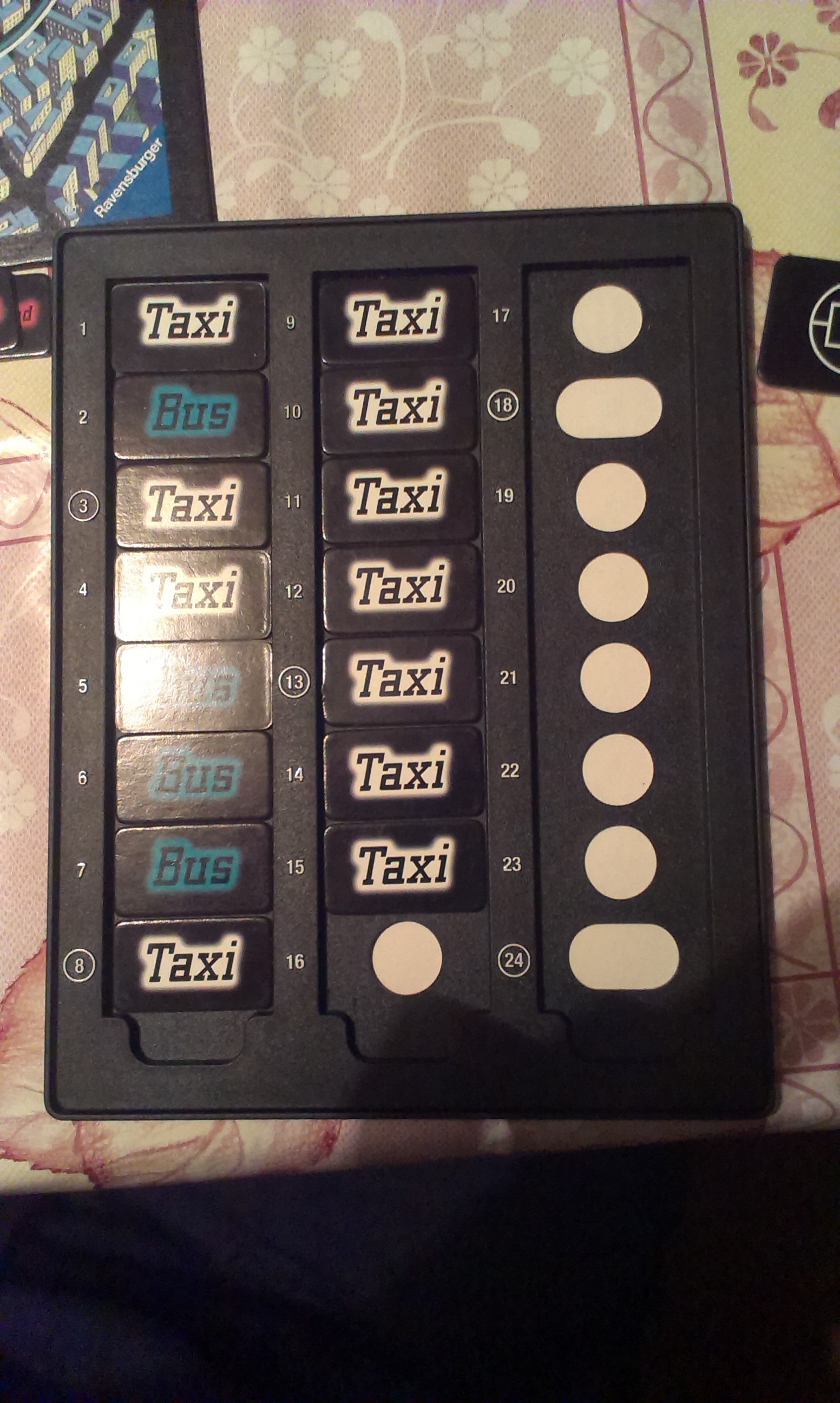
Every station or stop on the board is numbered. You each start on a stop chosen at random from and deck of cards with the stop numbers on. Mr X doesn’t show where he starts, instead he has a pad where he writes where he is. Every time he moves he writes on the pad the number of the stop he has moved to and then covers it with the travel token for whichever transport method he has used. After three moves he has to show the other detectives where he is then it’s every fifth move after that.

Mr. X Travel recorder and the best clue the detectives have to work out where he is.

In this way the detectives must try to land on the same space as Mr X using the knowledge of where he has been and what travel methods he has used. However the detectives have a limited number of travel passes for different things and as they use them they pass them over to Mr X, so, for example, when they run out of ones for the underground they can no longer travel by it and when they run out of all of them they lose because Mr X will never run out. So potentially the game can be fairly short as board games go and it has a finite ending and cannot pull a monopoly on you.

And blue is the winner!
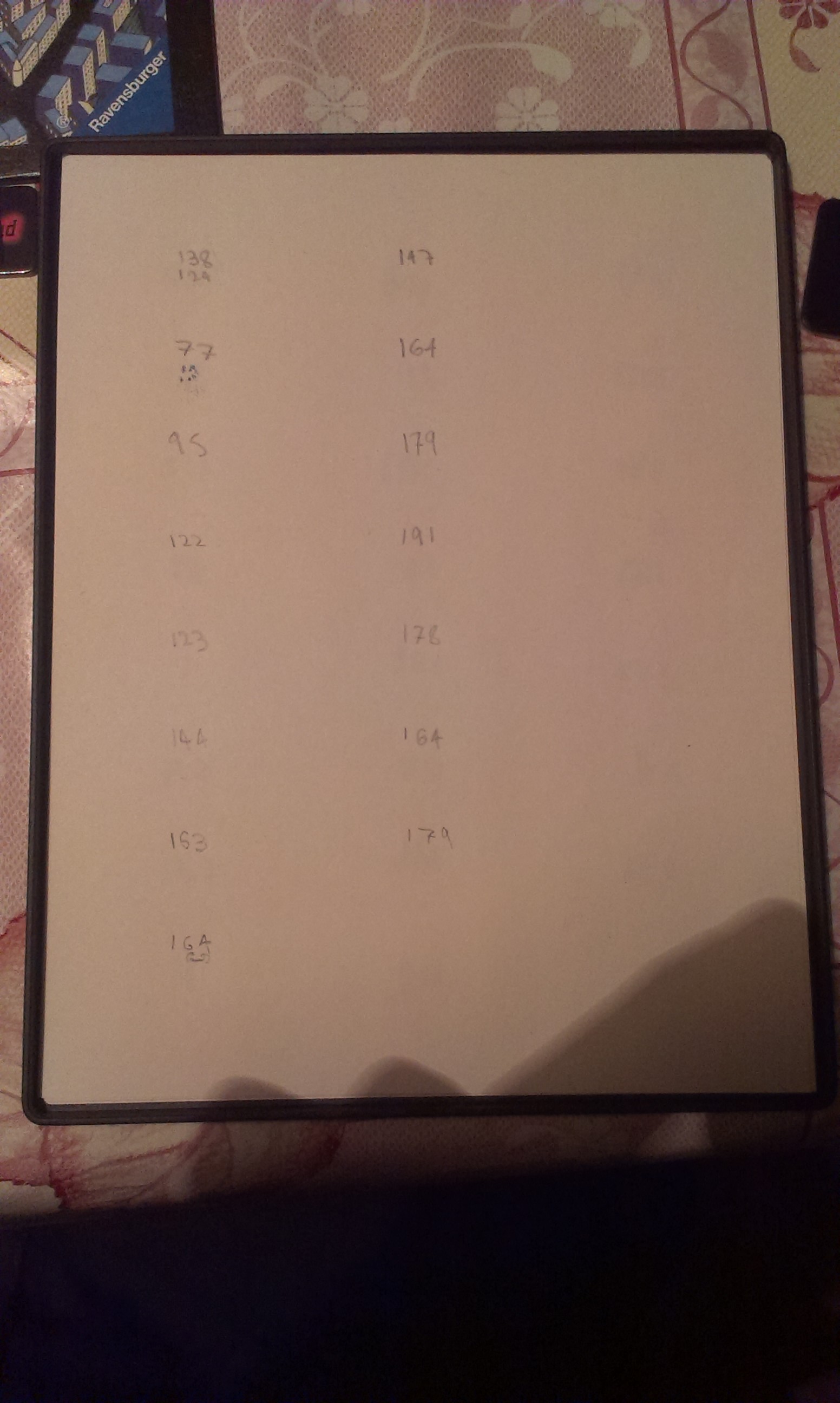
The list of Mr X. movements can then be examined to see how close the detectives where at any one time.
The list of Mr X. movements can then be examined to see how close the detectives were at any one time.

Chairess:

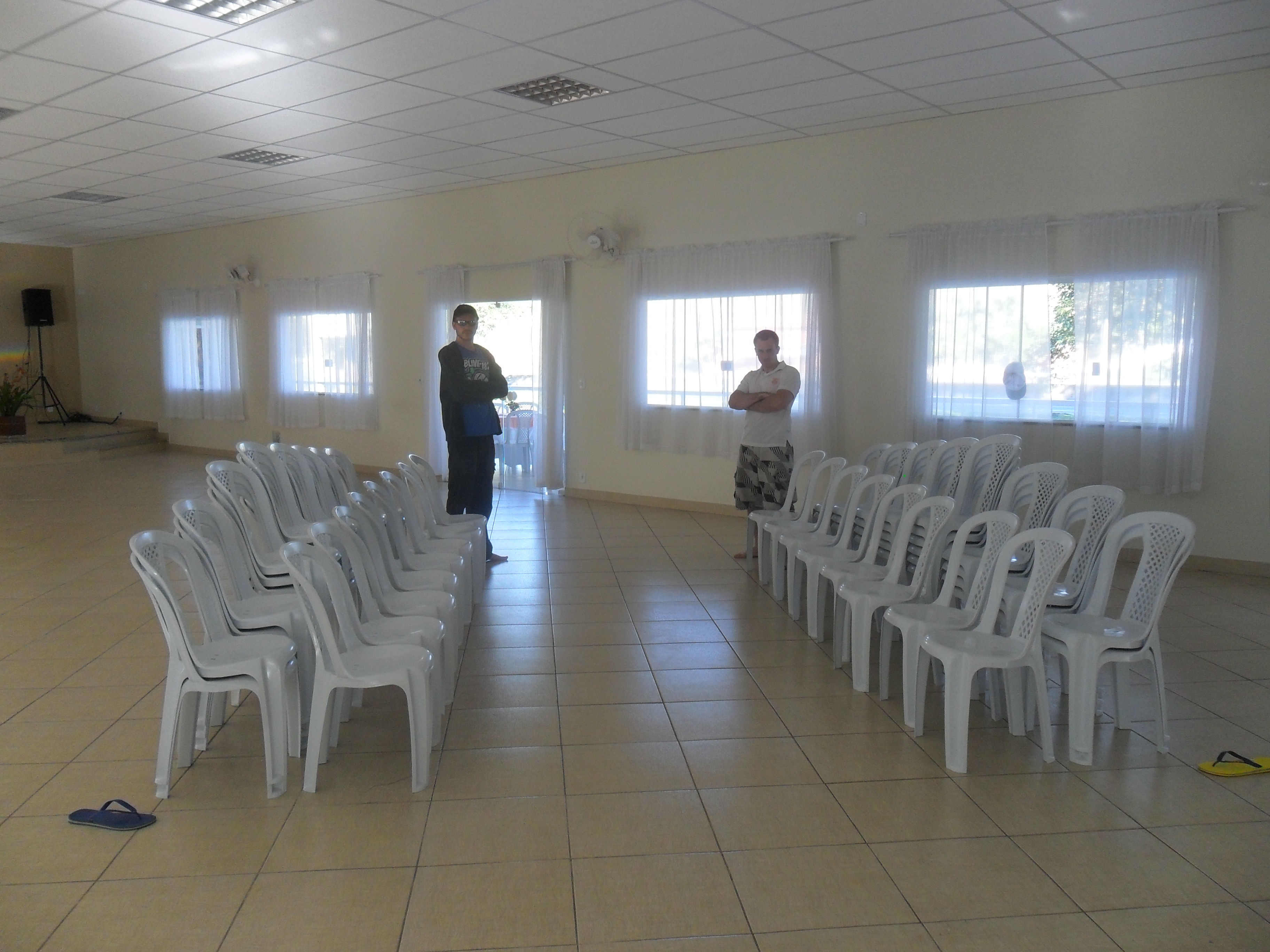
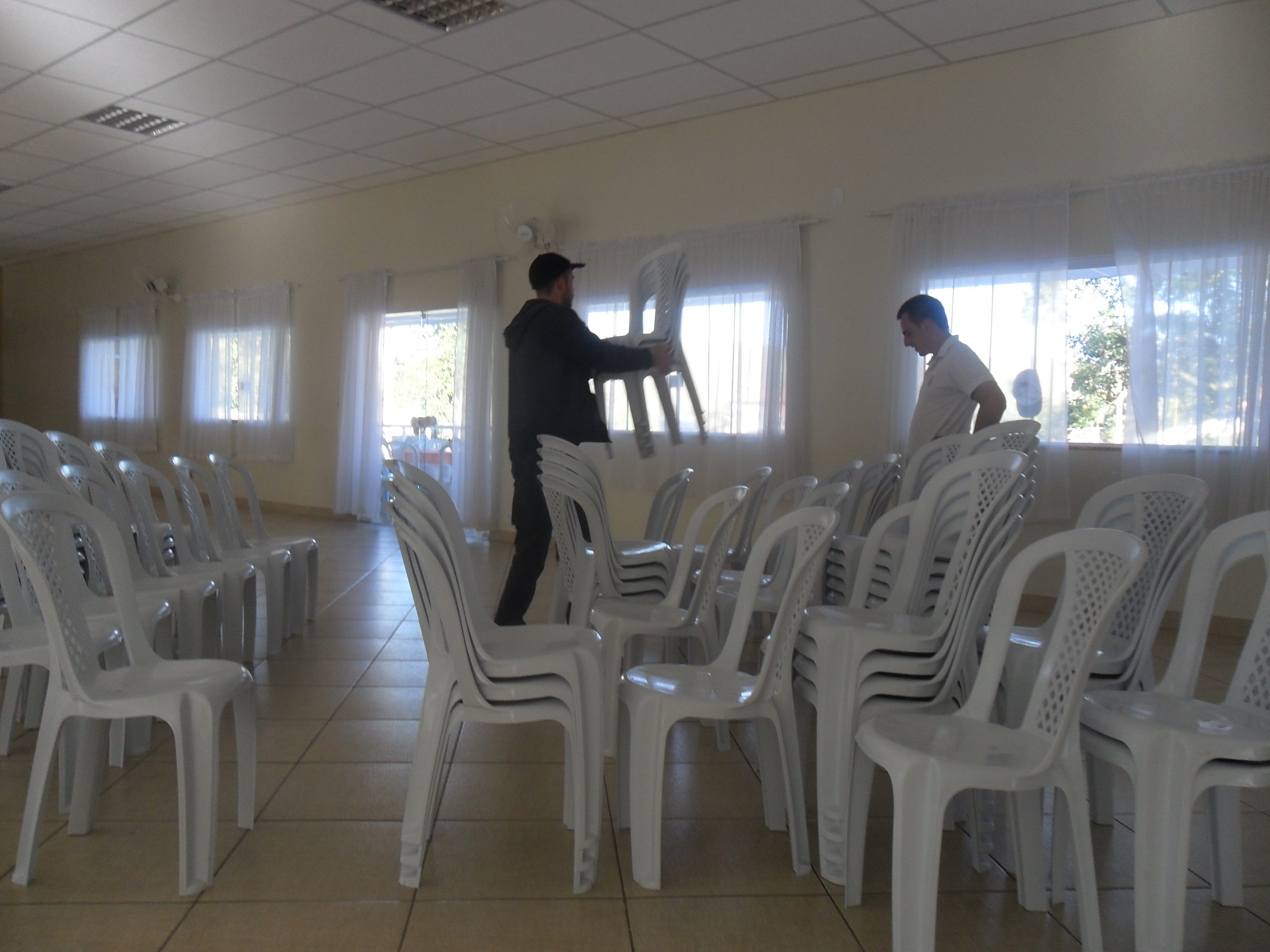
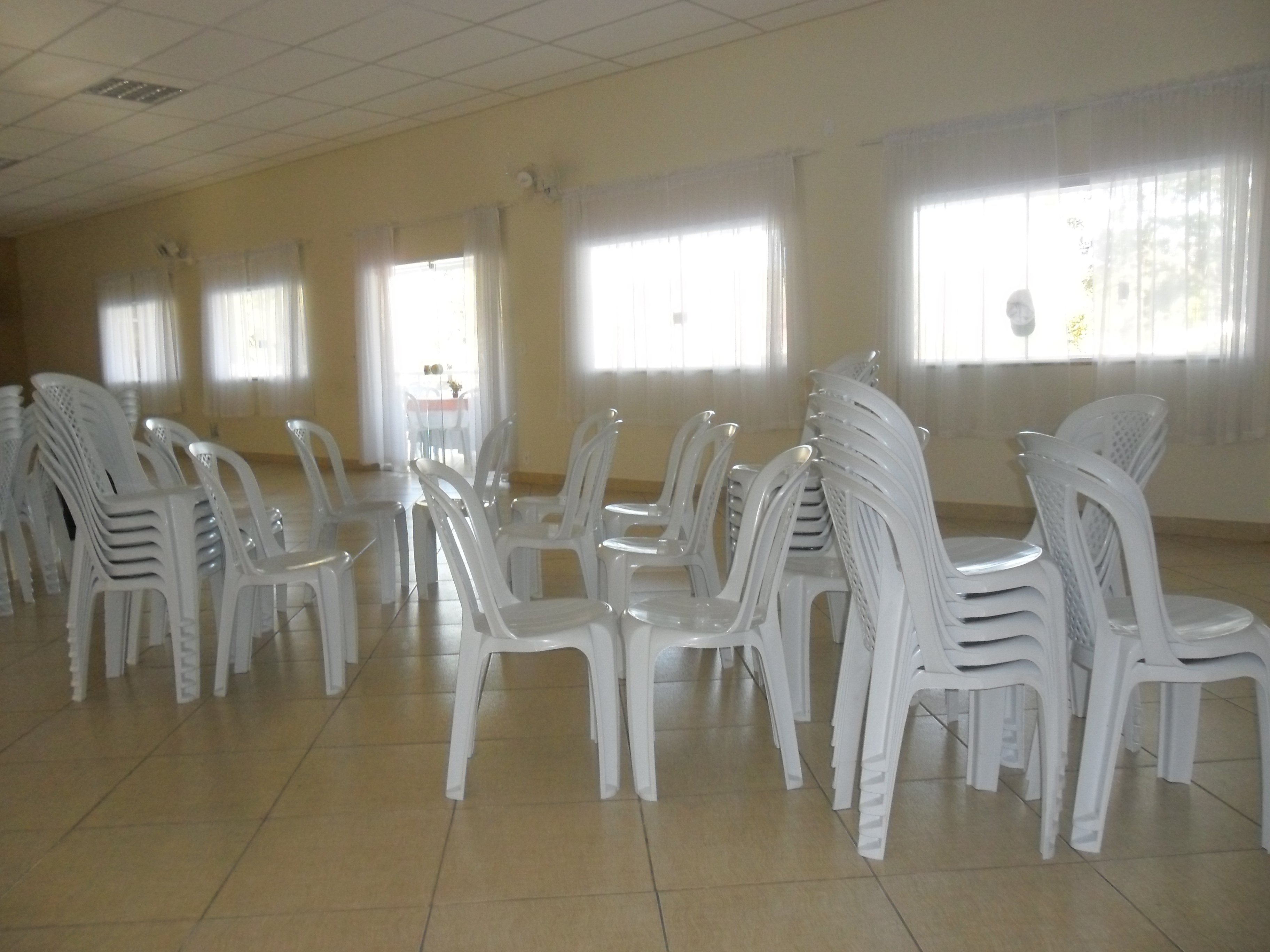
What is Chairess I hear no one ask… WELL! Its Chess… Played with Chairs on a tiled floor when you don’t have a chess board. Recently we were in Brazil, as one often is, and we were bored, so me and my friend looked at the assets we had to entertain ourselves. They happened to be a very large room with a tiled floor and a LOT of plastic chairs and this is what happened:

The initial set up of Chairess.

Unfortunately due to the lack of other colored chairs both sides where white. But! We combined our great intellects and came up with the idea of using which way the chairs were facing to determine which side they were on and the way we stacked them to determine what piece they were:

  1. for Pawns
  2. for Castles
  3. for Knights
  4. for Bishops
  5. for a Queen
  6. for a King
Taking pieces was interesting.

Lets just say that it was less than ideal when it came to moving anything from the Knight onward. If we had had access to a printer we would have printed off identifiers but alas our sole attributes that day where some white chairs a large room and the flip flops on our feet which we used to mark the corners.

Unfortunately due to the sameness of everything it takes quite a lot of thinking to get your head round Chairess.

As the game progresses it gets harder and harder to keep it straight in your head, because not only do all the pieces look the same they’re also much larger so to take the board in as a whole becomes difficult. This may explain why I lost 2 – 1 to my friend where as on a normal Chess board I beat him 2 – 1.

So if you ever find yourself in a position of boredom and you happen to have a large tiled room and a lot of chairs… You know what to do!

Quick Games – Reversi, also known as, Othello!

4 - 5

Number of Players: 2

Year of Publication: 1880

Creator(s): John W. MollettLewis Waterman (Designers) and Kinetic (Artist)

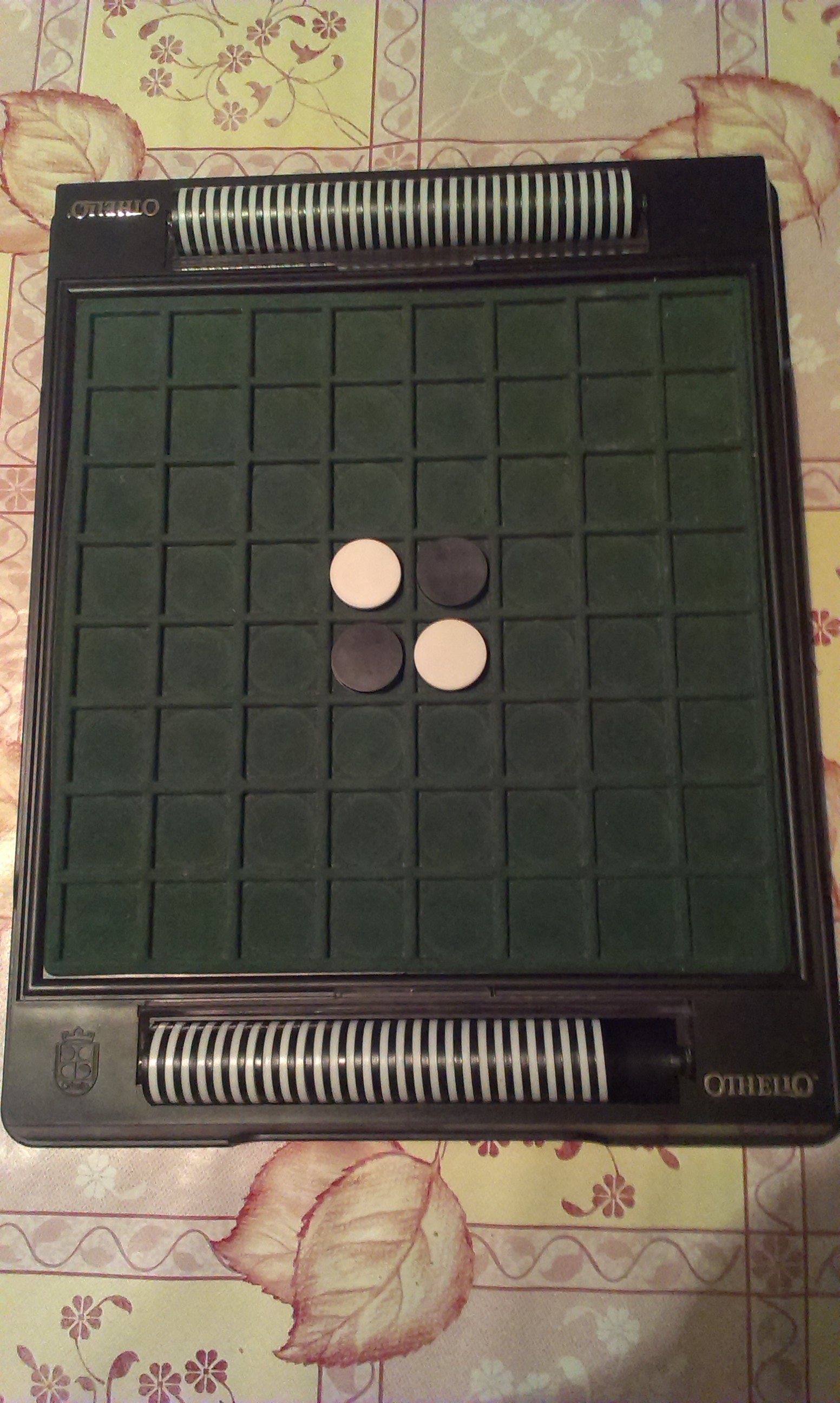
Othello is a great game; for anyone that knows it, they’ll know how much fun it is, and for anyone who doesn’t, it’s quick and easy to learn and it keeps you on your toes as the table can turn at literally any point in the game. You can be winning right up until the last few pieces are laid and then find yourself the loser!

It’s definitely not as quick as Fanarona, but can still easily be played in less than half an hour. The pictures in this post are larger than they have been in previous posts, due to the shape of the board and the angle that we had the camera at. There are also less photos, as the game is not very complicated and we felt that filling the post with pictures would just be throwing images at you that you didn’t need, or, probably, want.

Othello starting position

History and Things:

  1. The game was invented at the end of the 19th century; both Lewis Waterman and John W. Mollett (two Englishmen) claimed to be the inventors of the game.
  2. The first ever versions of the game were produced in 1882 by Waterman and Mollett themselves.
  3. It was patented in 1888 and published under the name Reversi in 1898.
  4. Reversi was based on a game invented by Mollett in 1870 called The Game of Annexation (or Annex for short), the only known difference between this game and Reversi is that Annex is played on a board shaped like a cross. So instead of the 8×8 – essentially a chess board – that Reversi/Othello is played on Annex was played on an 10×4 cross.
  5. In 1880, in a publication of The Queen, Waterman proposed a new version of Annex, called Reversi, to be played on a conventional Chess Board, and named himself inventor, he registered the name in 1887.
  6. In 1886 Mollett published the same game with the name Annex, a game of reverses. Mollett was initially not allowed to use the word ‘reverses’, so he appealed, won and the word ‘Reversi’ was freed.
  7. Whilst the Waterman release of Reversi was not sold with a board – the box stated that you had to play it on a chess board – the Mollett version was sold with a cheap paper 8×8 board and carried the Annex, or Annexation name.
  8. From reading all this it’s clear that Mollett was the primary creator of the game, he was responsible for the original rules and game pieces, where Waterman is responsible for the board shape, size, and the name Reversi.
  9. Jumping forward almost 100 years to 1971. Goro Hasegawa reinvented the game, naming it Othello with the rule set currently used on the international tournament stage; the Japanese games company Tsukada Original published it.
  10. (I managed to make ten points this time!!)
    Othello was chosen as a name for many reasons – all of them deriving from Shakespeare’s play. I’ve put a few in here; Iago makes a direct reference to how he is “two faced” in the play, which accounts for the double-sided black-and-white playing pieces which are continually flipped throughout the game. There is also the conflict between black Othello and Desdemona who is white to be considered. For those who have an interest in Shakespeare, the similarities continue – reread Othello and see how many you can find!

Game Play!
In Othello players take it in turns to place pieces and black always moves first. When placing pieces you must be able to “take” the other players pieces. To take pieces you must be able to trap their pieces between two of your own on a horizontal, vertical or diagonal line, doing this means that you flip all the pieces on that line to your colour. there are occasions when you can place a piece that completes two or more lines, this means you can flip every piece of the other colour that is on a line you’ve just created.

If you cannot place a piece anywhere that allows you to take, or flip, your opponents pieces, you forfeit your turn and your opponent continues to place pieces until a move becomes available to you.

Once all the pieces have been played, each player counts how many of their colour is on the board. The player with the highest number of their colour showing wins. If you have exactly the same number of pieces showing your colour on the board (32), “perfect play” is reached. This implies that the players are evenly matched.

There are some interesting strategies that can be played in Othello, however, the one I found most intriguing was that an experienced player, when teaching/playing with a less experienced player, can add a handicap into the game. As the four corners are the strongest positions to hold on the board, it can be played that the more experienced player allows the game to start with the corners already having pieces of their opponents colour in them. This gives a huge advantage as pieces in the corners cannot be flipped as it is impossible to place a piece on the other side of them to create the necessary line. In this same way, pieces placed right on the edges of the board are harder to take as there is only one line that they can be flipped on.

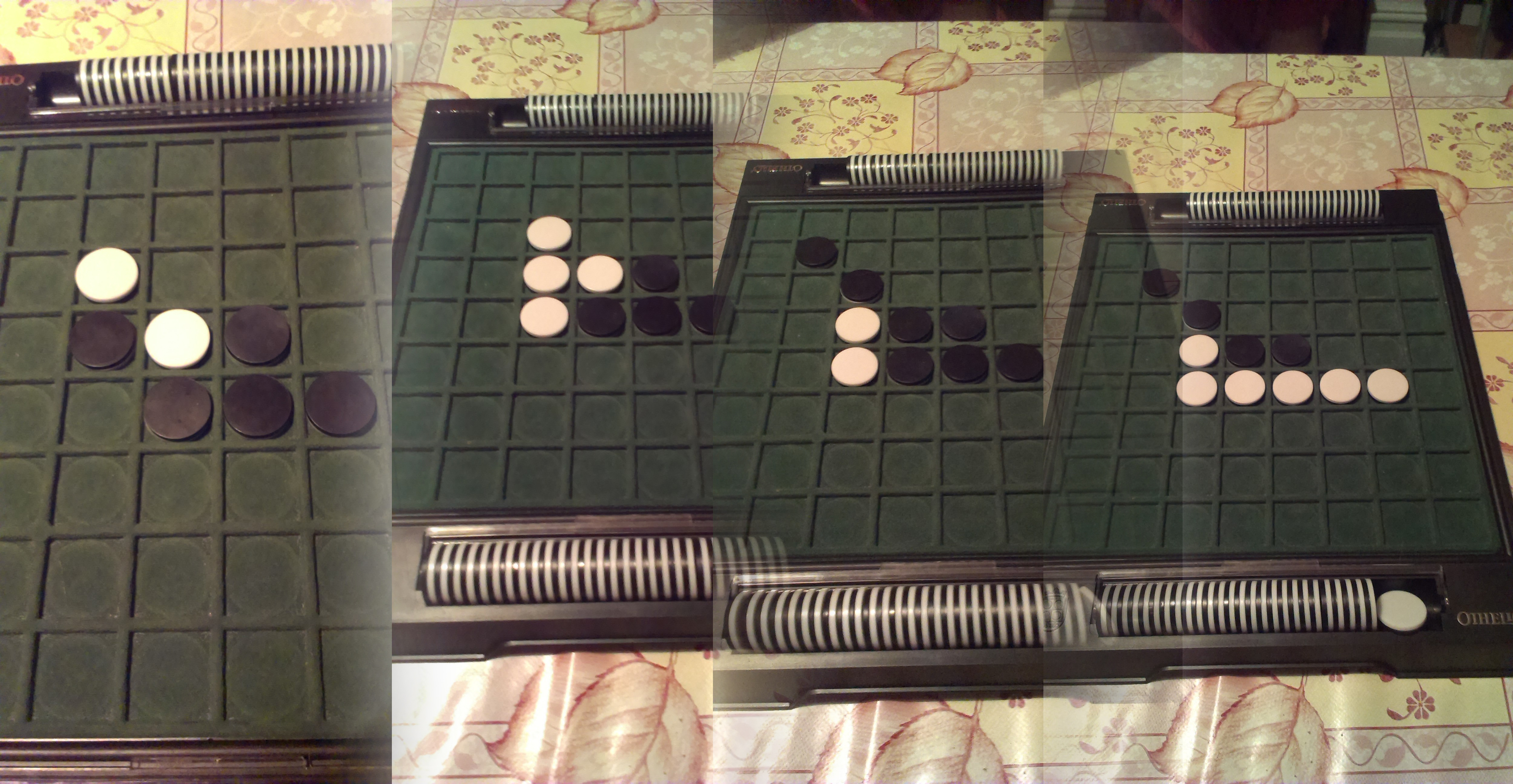
Below is a photographic sequence of moves that gives an idea of how pieces are flipping in the progress of the game.

A sequence of moves in Orthello
A sequence of moves in Othello

Differences between Othello and Reversi: (thought to exist in the games before 1871)

  1. Othello starts from a fixed position. In Reversi players take it in turns to place their pieces on the central four squares, this allows for two possible starting positions. This difference is considered unimportant and each starting formation can lead to a draw in perfect play.
  2. In Othello, if a player cannot place a pieces that flips one of their opponents pieces they must pass, their opponent then continues to place pieces until either they cannot place or until another move becomes available to you. In Reversi, a player can choose to pass. This can be tactical as it can force your opponent to pass at a more crucial moment of the game because you have more pieces left. This could have huge tactical and strategic advantages or disadvantages for each player.
  3. This last difference has speculation as to whether it actually existed or not, but some say that in Reversi originally players could place pieces adjacent to their own pieces without creating a line through which their opponents discs were flipped. This rule, if it existed at all, would make the two games completely different, and also lower the difficultly level of the game considerably.
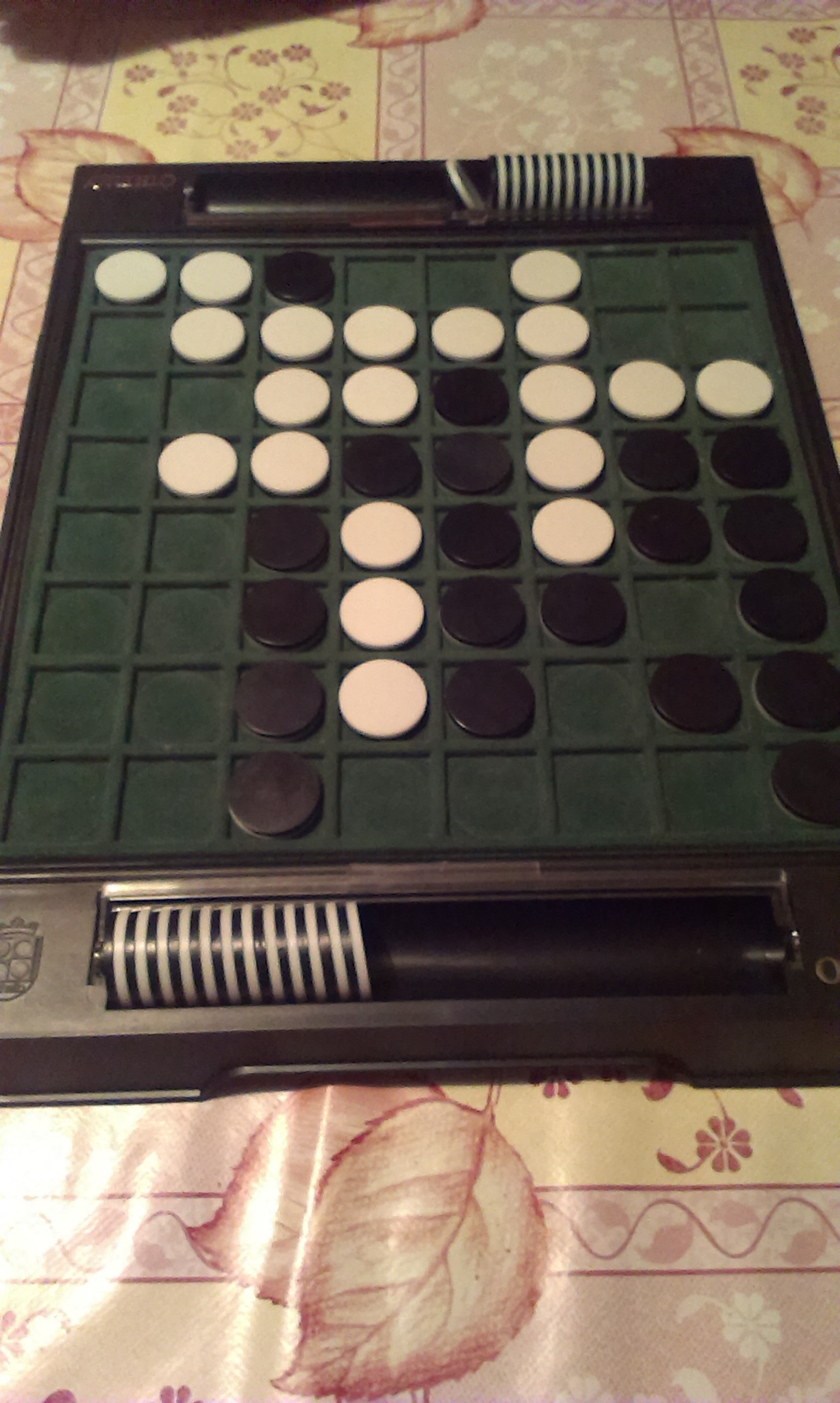
Close to the finish
Close to the finish (this game actually came to perfect play at the end, however we don’t have a picture as we use my brother’s phone camera for these photos, and he was on the phone when the game ended.)

For points of interest, I read about the history of Othello/Reversi here, although some of the information was questionable.
If anyone reading this sees anything that they know is wrong, don’t hesitate to leave me a message telling me what my mistake was and I’ll endeavour to correct it as soon as possible! I struggled a little with this post as there was a lot of information about the game to go through and there were discrepancies between each source I read.

Definitely a Quick One! – Fanorona! (pronounced Fa-noorn)

3 - 5

Number of Players: 2

Year of Publication: 1680

Creator(s): Again, the designer is unknown, but Néstor Romeral Andrés was the artist for the modern board

It gets to be big and bold and exclamation marked in this sub-heading because it’s the first game we’ve managed to cross off our list of Games We Want, which is a noteworthy achievement in the limited history of this blog. Fanorona is also notable as having been bought to the attention of many through the PS3 and Xbox 360 game Assassins Creed III where you can play it as a mini game within the game along with Nine, Six, Three and Twelve Mens Morris.

Fanorona is currently down as the quickest game I’ve ever played, and that’s not only because I’m terrible at it (but better than my brother at the moment). It’s for two players and played on a rectangular board.

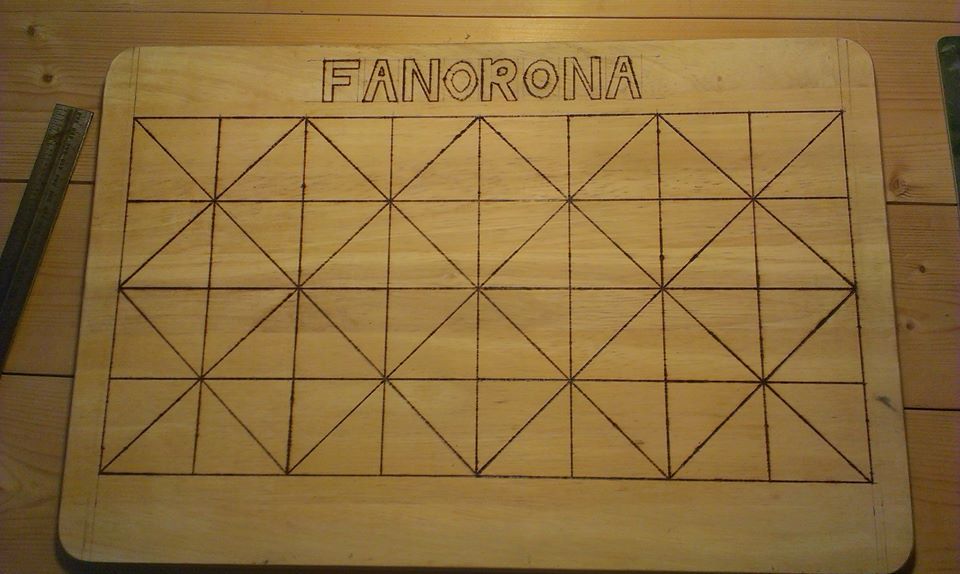
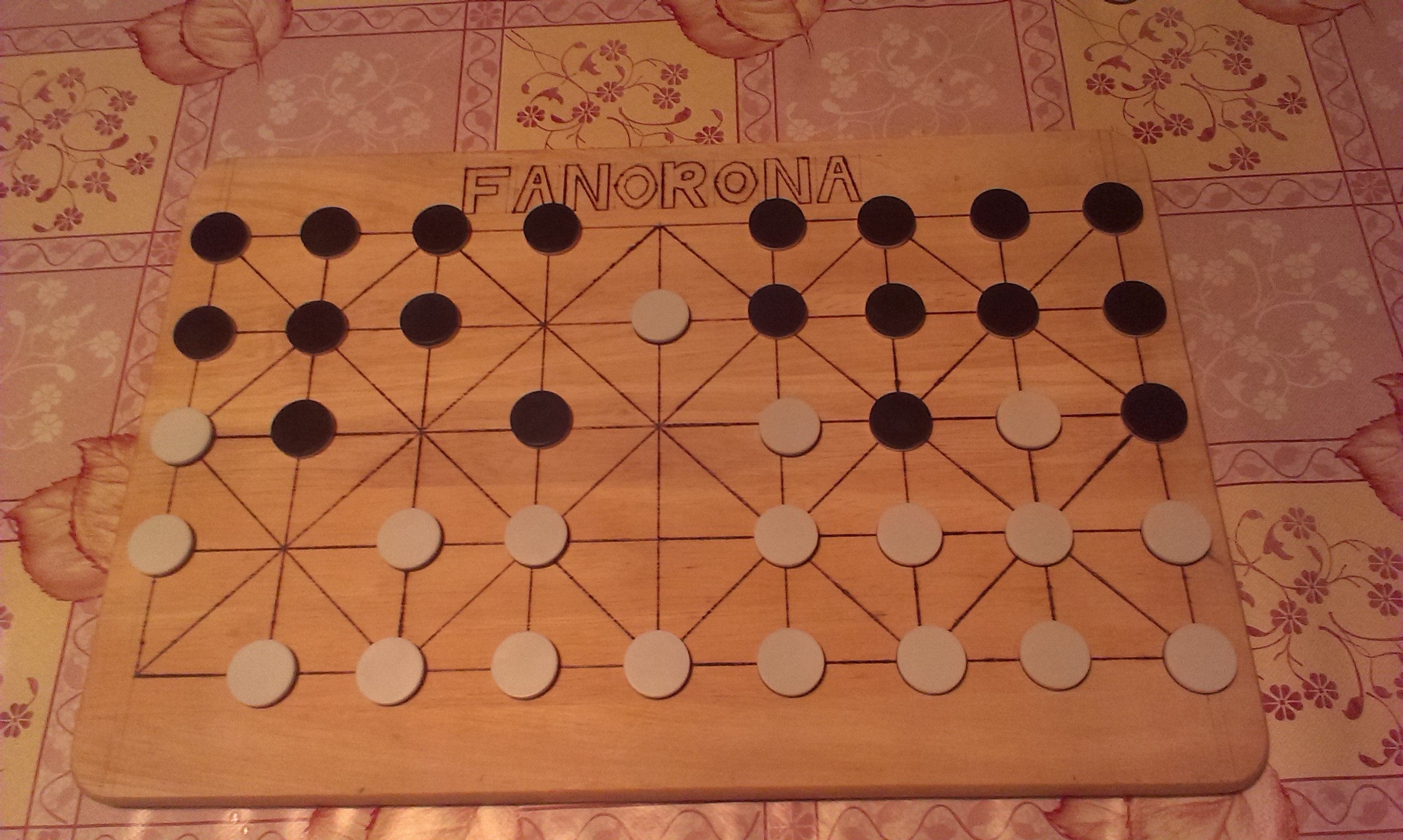
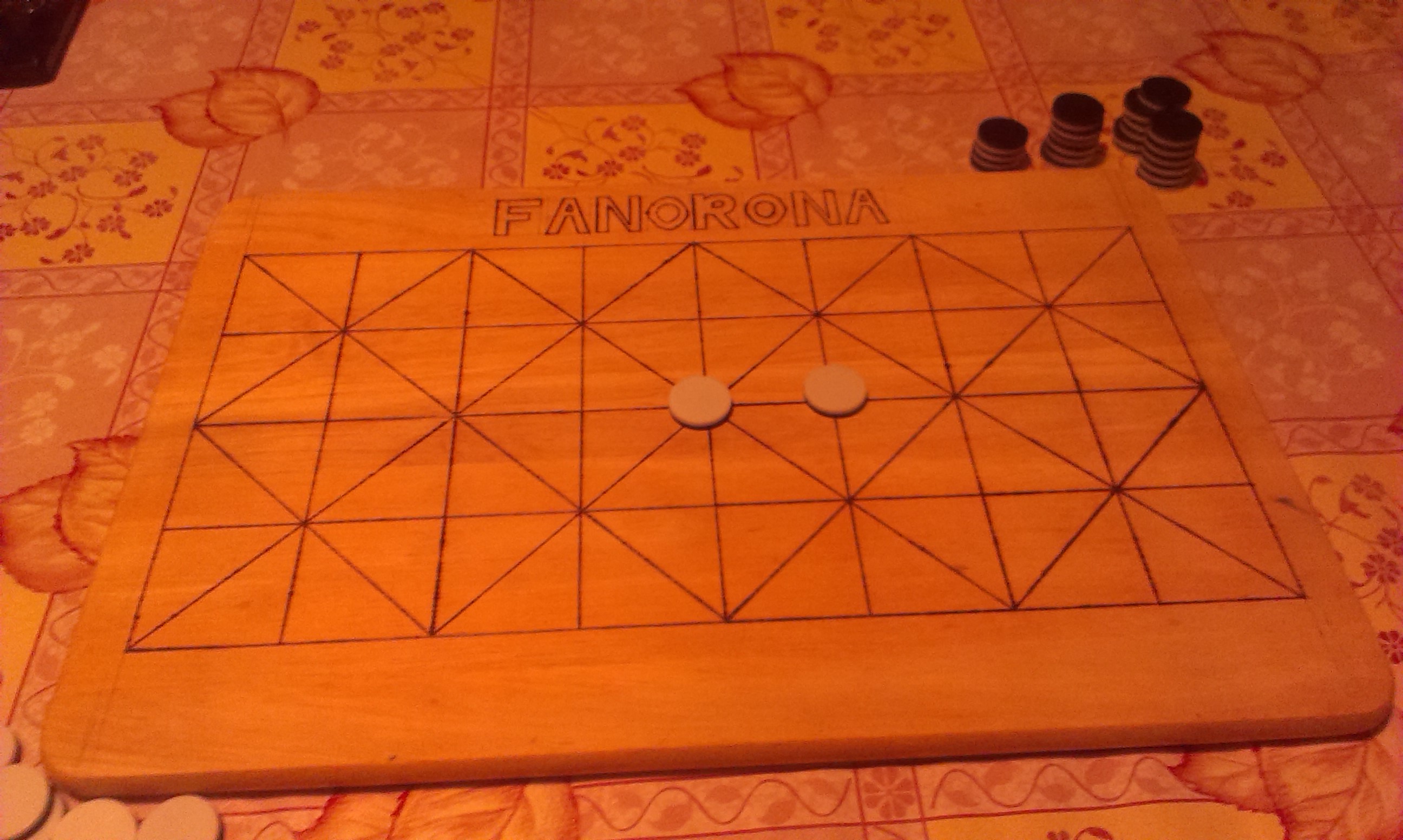
Our home made Fanorona board. Made on a chopping board using a soldering iron to brand.
Our home made Fanorona board. Made on a chopping board using a soldering iron to brand the markings into the wood.

History and Interesting Things: 

This is where I organize all the interesting stuff I found out about Fanorona, if you don’t want to read about the history of the game, skip down a bit and see more pictures of us playing and a bit about the rules and how to move!

10 Things I Found Most Intriguing:

  1. Fanorona is a strategy game, but, like Go, it’s considered a one-off. Not part of any other family of games.
  2. It is believed that it was developed from the game Alquerque, which is most commonly played in Arab countries and may date back more than 3,000 years.
  3. Fanorona comes in three varieties – Fanoron-Telo which appears to be identical to Three Mans Morris (another on the list of Games We Want) – Fanoron-Dimyand the board for which is identical to Alquerque – and Fanoron-Tsivy, more commonly known as Fanorona and the most well-known version of the game.
  4. It’s the national game of Madagascar and is so important there that they have a National Committee for the Coordination of Fanorona and an International Fanorona Society.
  5. The only recurrent story I can find involving Fanorona is the following about a King called Ralombo. He was sick and trying to decide what would happen to his Kingdom when he died, he did not want to divide the Kingdom between his two sons, so he sent for both of them. He reasoned that the son who arrived first was the most loyal to him and should therefore inherit the Kingdom. His oldest son was engaged in a game of Fanorona when the messenger came and was in a situation called telo noho dimy, a very difficult situation involving three pieces against eight. He was so absorbed in the game that he sent the Kings messenger away. He did not arrive at the castle until the following day, by which time his younger brother had already inherited the throne.
  6. I reach point six and find that, given the limited history that is known about Fanorona, I have nothing left to write, so pretend that this is ten points, and keep reading to find out about the rules and game play!!

Game Play:

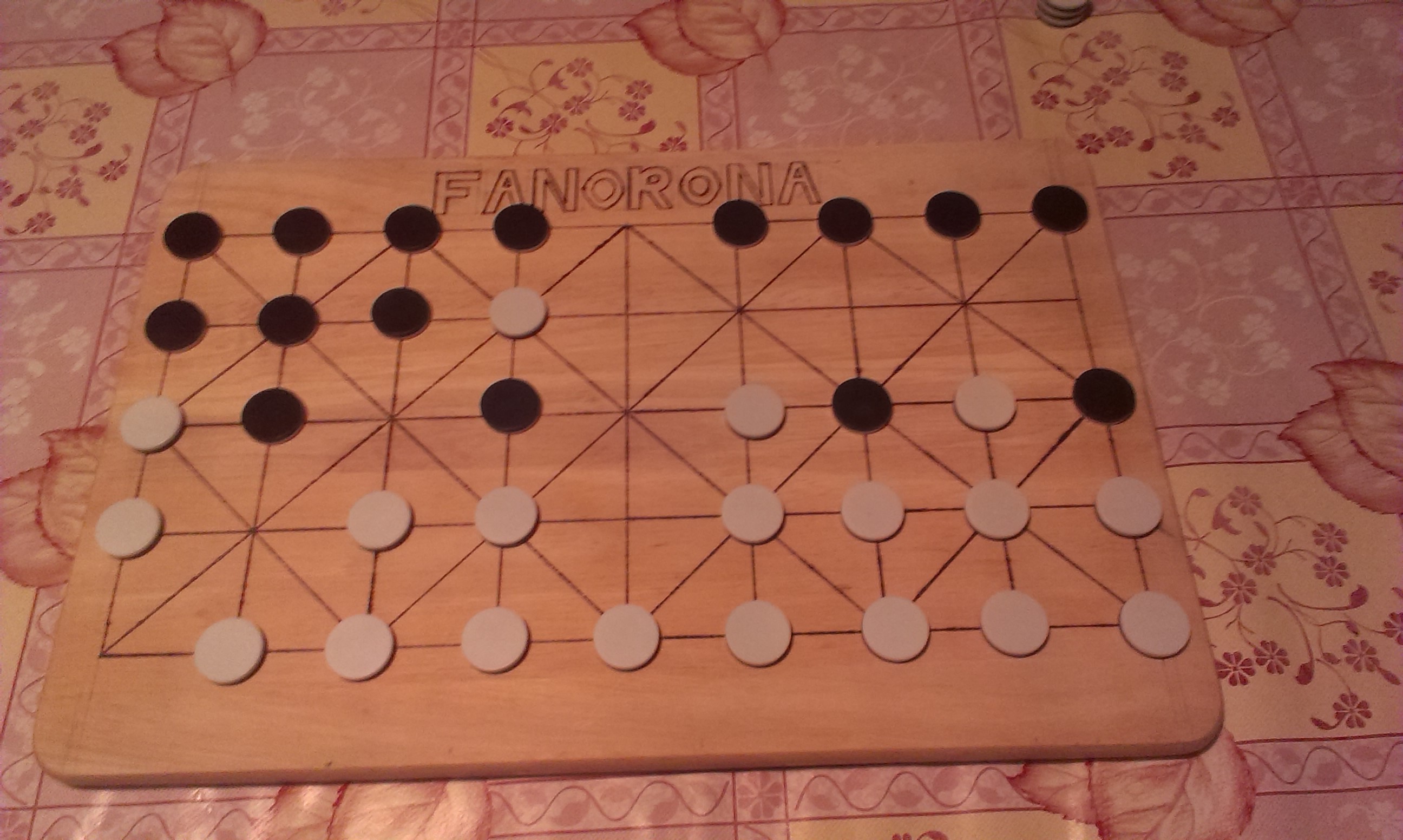
Black and white playing pieces are used for this game, they are set up as shown in the picture below. There is one space left empty in the middle of the board, which allows white to make its first move. These pieces  we stole from a copy of Reversi (more commonly know as Othello) to go with our home made board.

The starting set up of Fanorona on or home made board.
The starting set up of Fanorona on our home made board using Othello pieces.

Anyone who’s familiar with Draughts will understand when I say that the game progresses quickly due to the compulsory taking rule. Also like Draughts, taking moves can be linked. A player can continue to take pieces with the piece they initially moved that turn for as long as there are legal moves available. The nature of the game is sacrificial, for the game to progress each player must lose a large number of their pieces.

To take a piece in Fanorona a player must move one of their pieces either towards or away from the piece(s) they wish to take on a horizontal, vertical or diagonal line. The player then removes the pieces they have taken on that line up to the point where there is a gap between pieces.

The starting position of a taking move.


The white piece then moves forward to take the black piece in front of it
The white piece then moves forward to take the black piece in front of it.
It then moves to the left to take the line it moves away from and that is the end of its move chain.

Initially the game should progress very quickly, with each player taking multiple pieces each turn. When the board begins to empty, the rate of game play should slow as each player will have more options to choose from and cannot afford to be reckless with their remaining pieces.

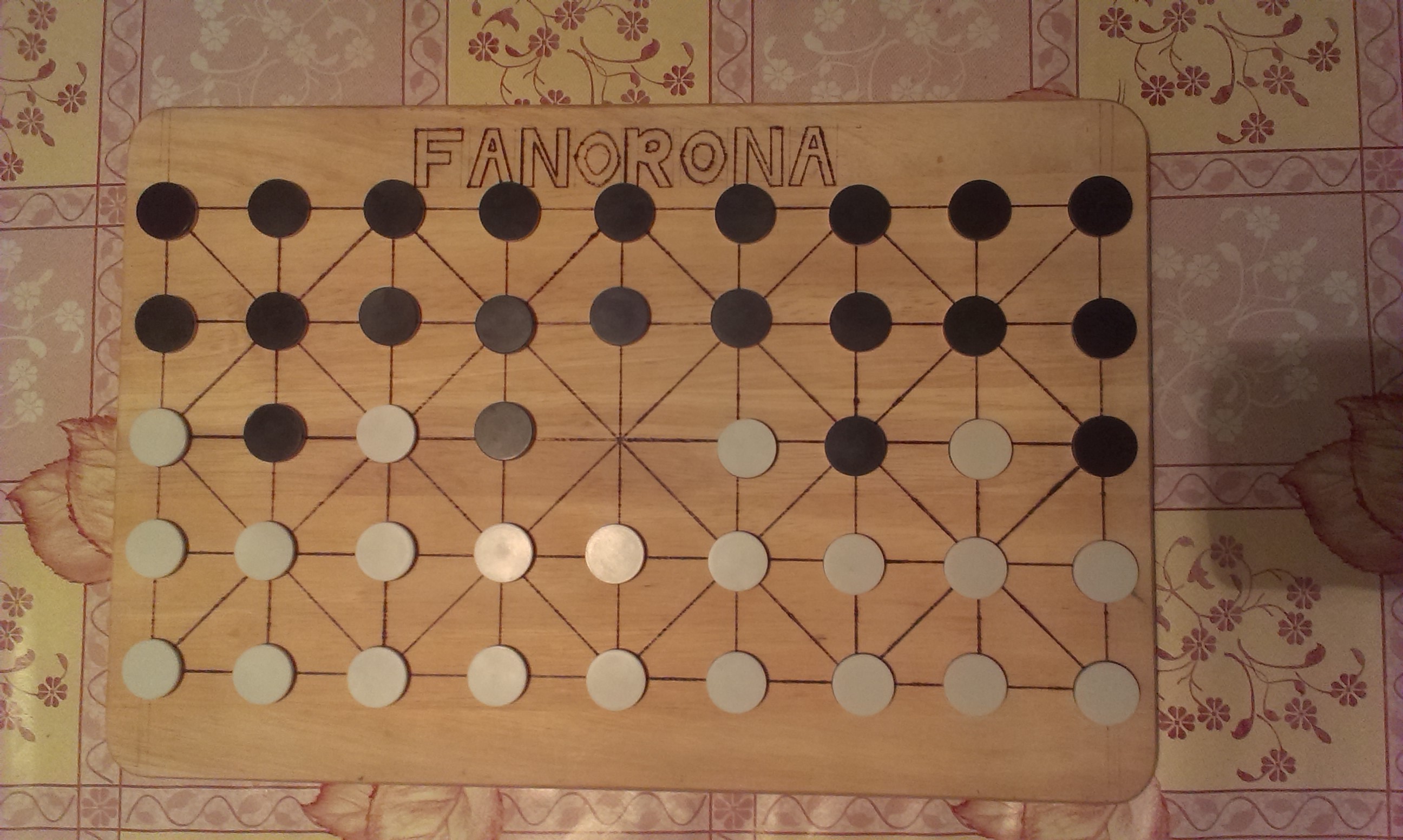
The remaining pieces on the board after only a few minutes of play.

The objective of the game is to either eliminate your opponents pieces from the board or force them into a situation where they cannot move.  If either of these situations arises you win the game. If you reach a point where neither player can move or take another players piece the game comes to a draw.

Once you’ve played maybe, twice, the game becomes easy and can be played in well under 20 minutes. After grasping the initial rules about moving and taking it is then only strategy that remains to be developed by anyone wishing to play regularly.

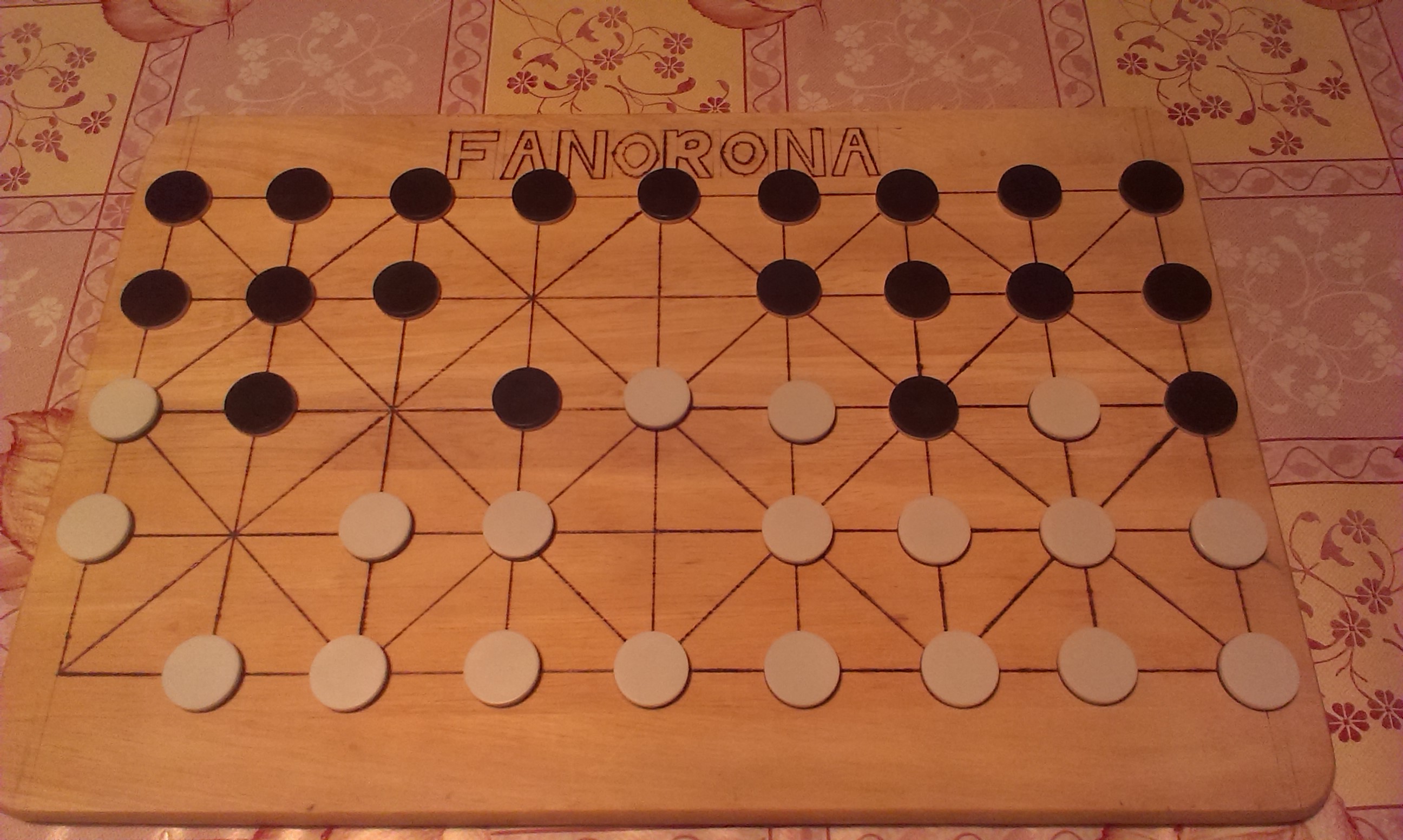
The game close to the end as black finds itself backed into a corner.
White is the winner having removed all of the black pieces from the board.

There will be another Fanarona post going up in the next few days where my brother shows you how he made the board and how you can make your own if you like. Considering that buying copies of this game appears to be rather expensive.

For anyone interested, I read about the history of the game here.

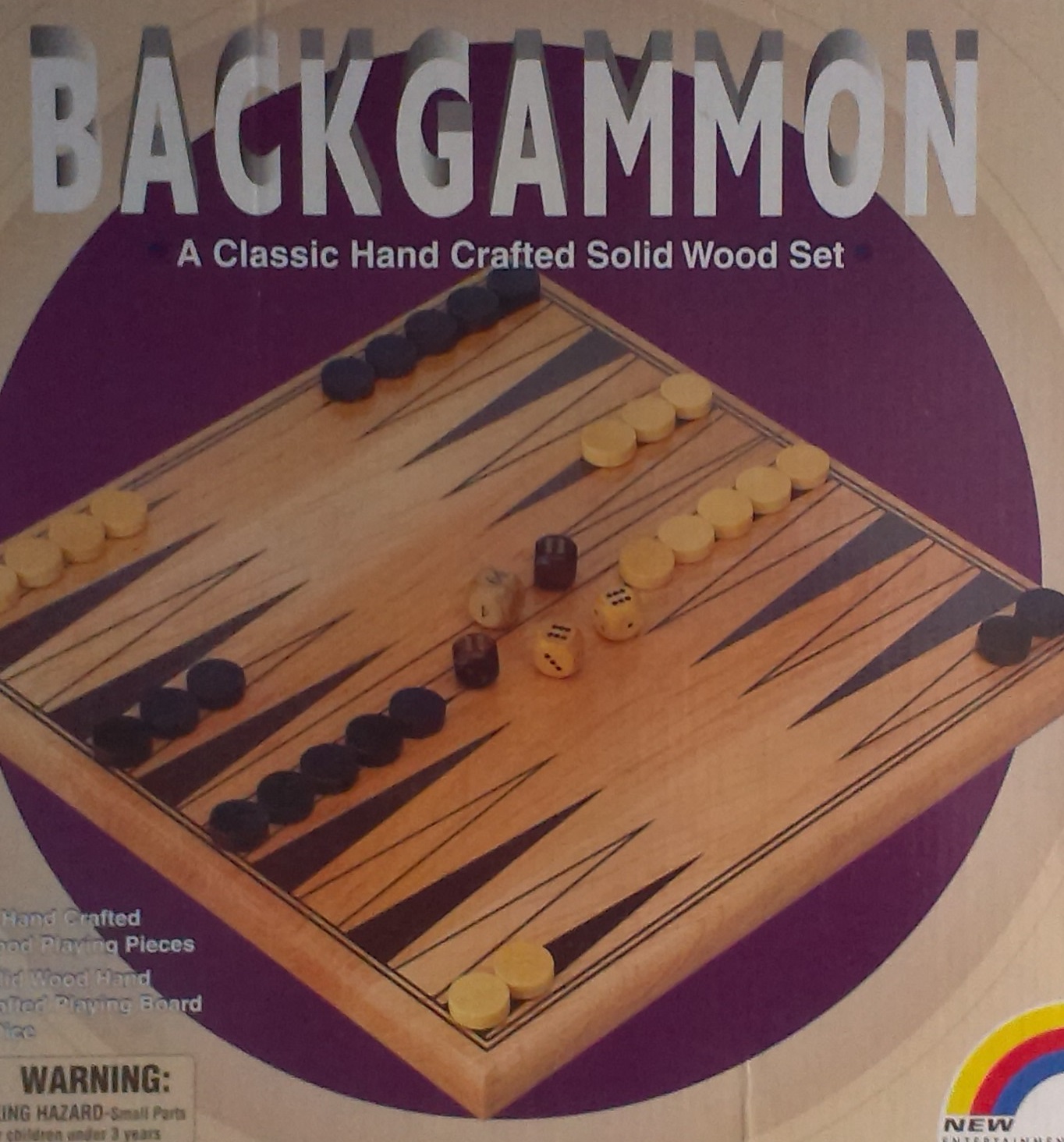
Quick games! Well, relatively – Backgammon

5 - 5

Number of Players: 2

Year of Publication: -3000

Creator(s): Mostly unknown, but Willem Cornelisz Duyster is responsible for the design of the modern board

This is the first in a series of posts, it was initially going to just be one, but I realized that I have far too much to say about each game to make it fair on anyone reading it to put it all together. So this post is just about Backgammon, enjoy.

The games I’m about to talk about in these posts probably don’t count as all that obscure, the names being fairly well-known as far as I’m aware. However, they are games that have fallen out of common play. Which seems like a real shame to us.

IMAG0992

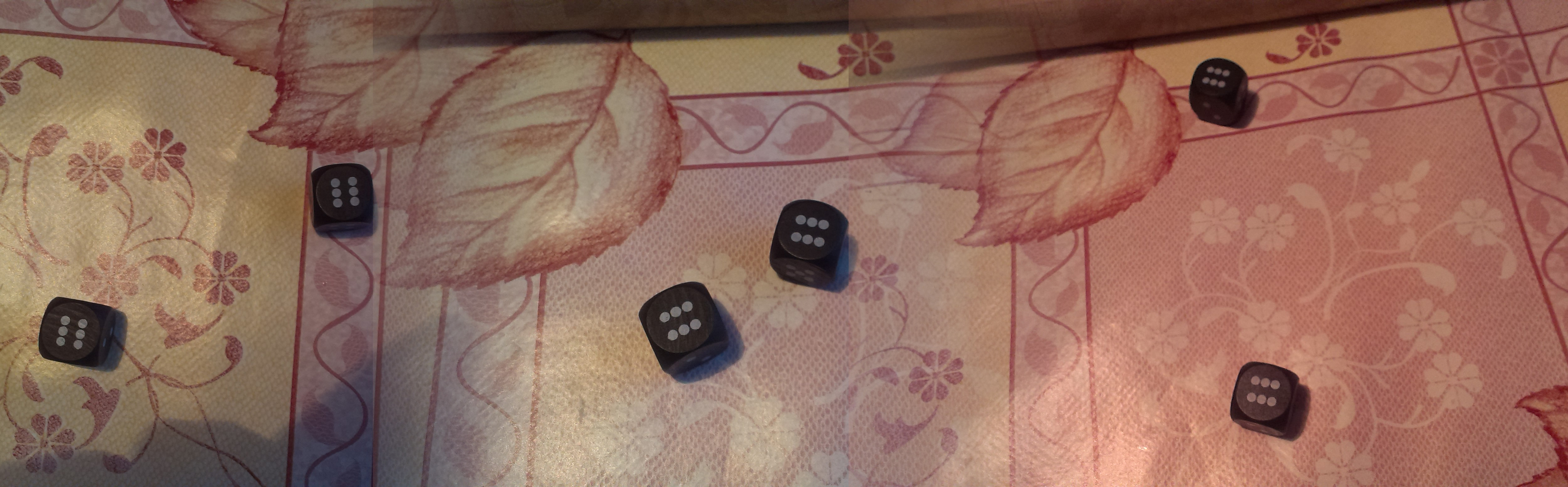
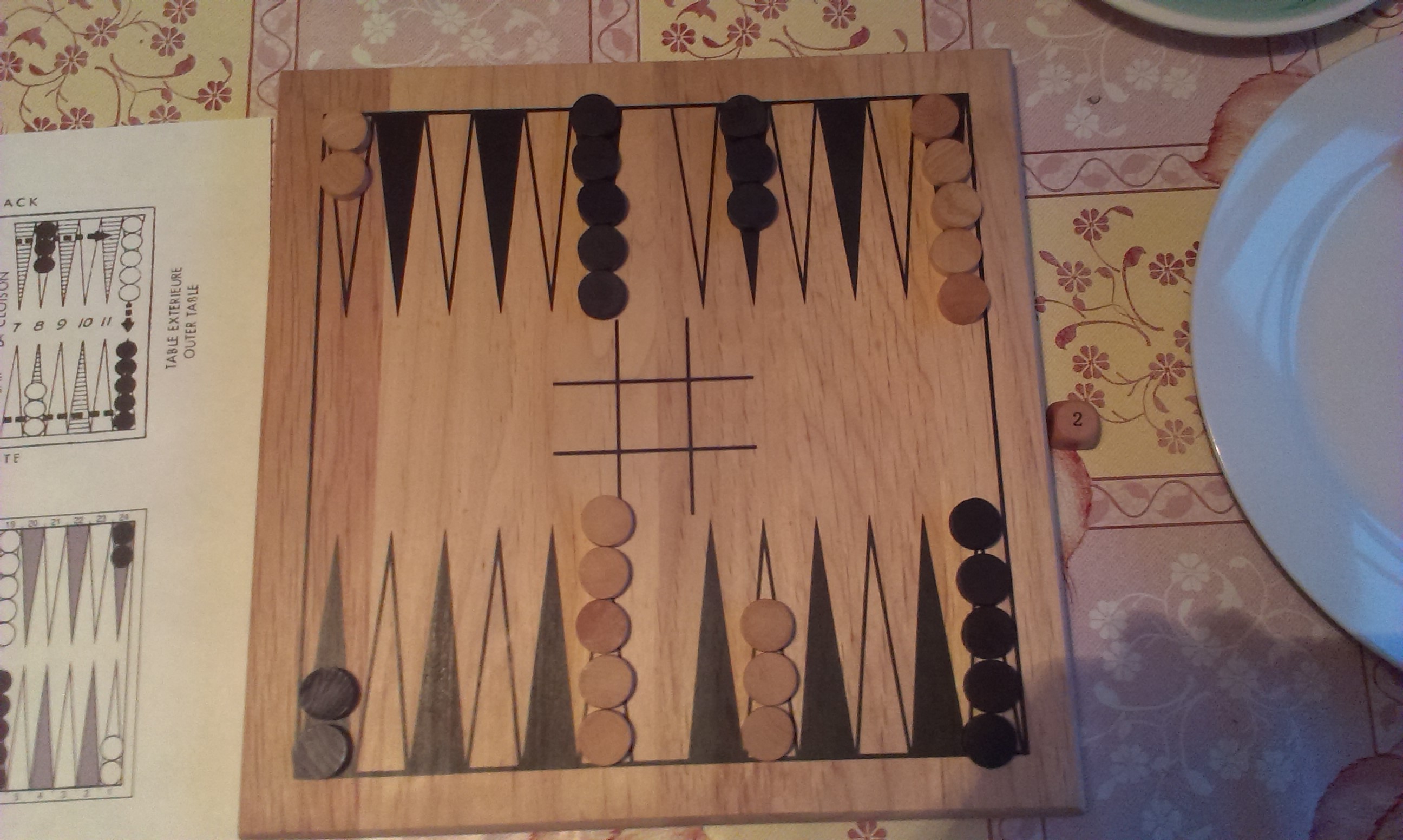
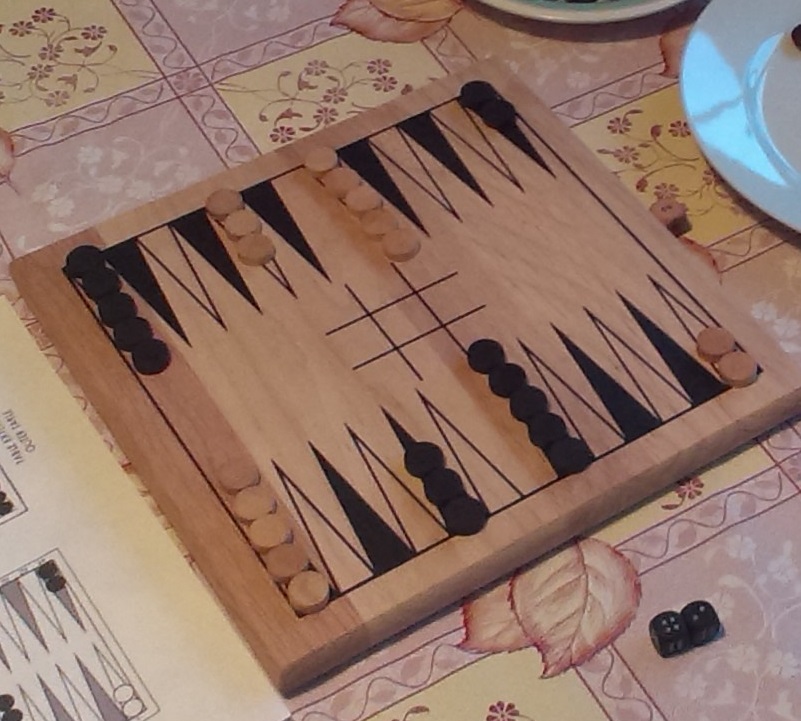
Recently we’ve learnt how to play Backgammon, and we think it’s a great game. Once you’ve played it a few times it’s very easy to remember the rules and to develop your strategies and it can be played in half an hour or so, making it one of the quickest board games I’ve ever come across!

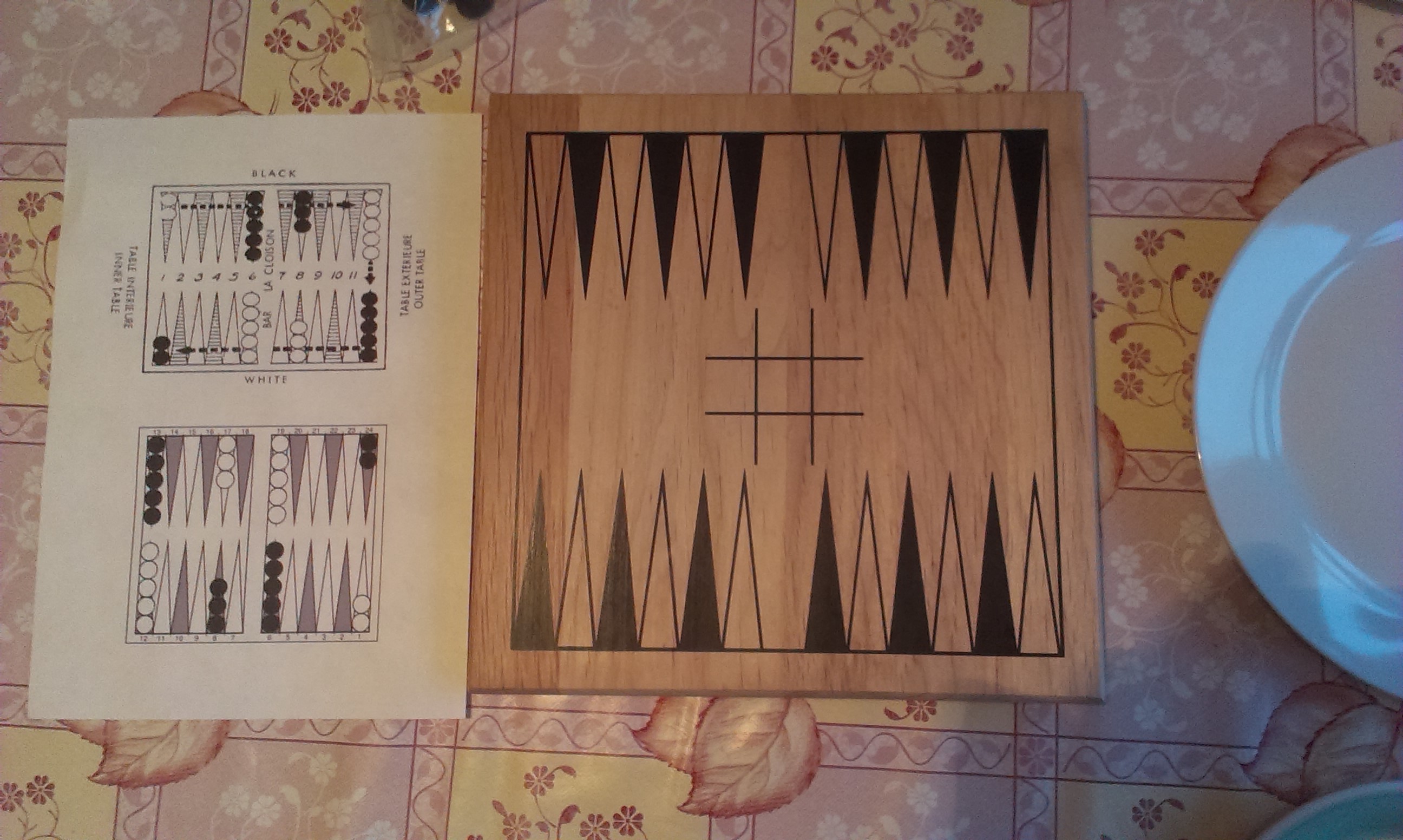
We still require pictures to set up, hence the printout.

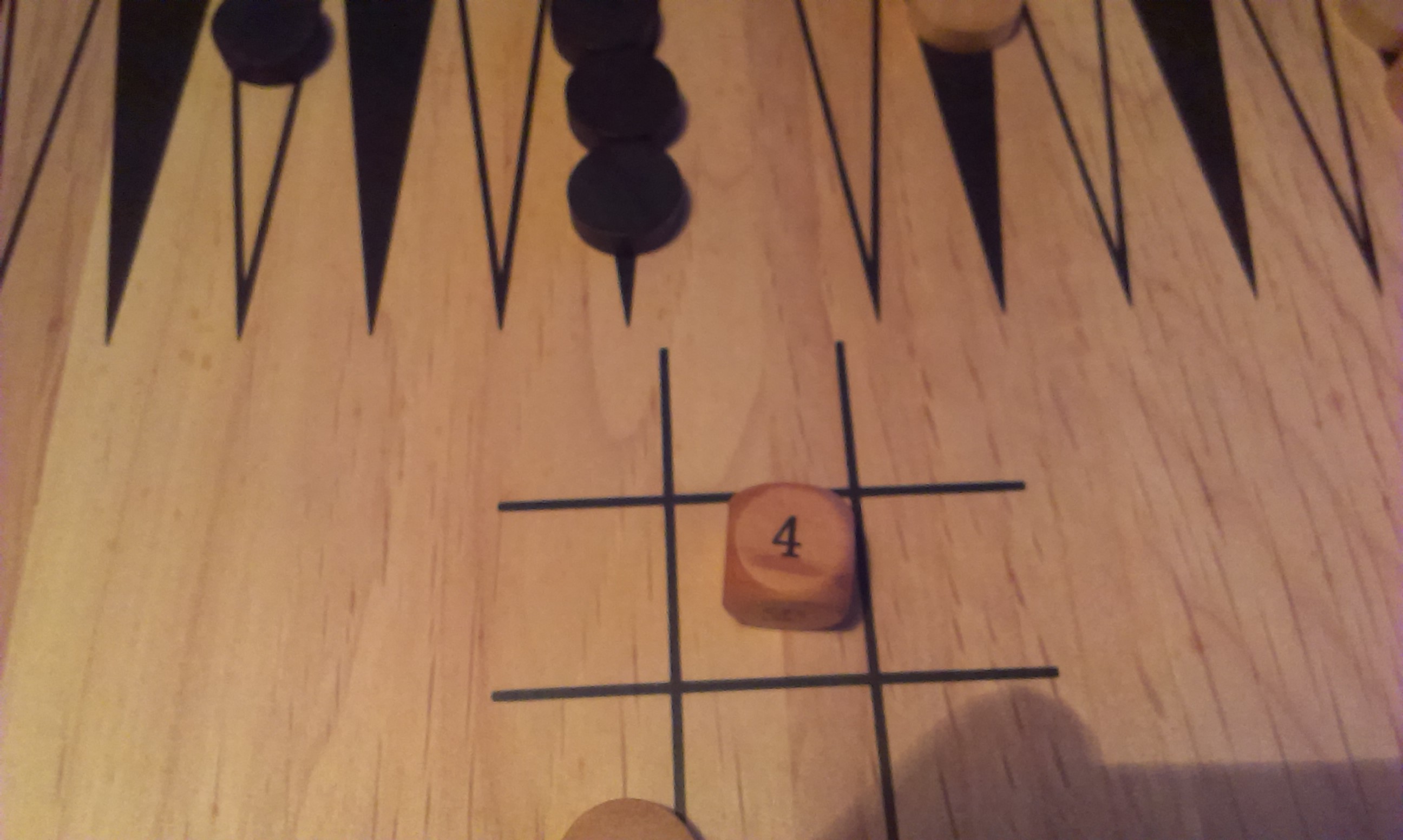
We had a few teething troubles with this game as the copy of the game we own didn’t come with rules. So we went on a quest to Google and learnt the rules off the internet. The only problem with that was that, aside from the two dice each player roles to determine their move, there is a fifth die involved in Backgammon called the doubling die, and the internet rules didn’t explain what this was for.

IMAG1080

Oxfam to the rescue!
I work a few days a week in an Oxfam charity shop, and on my break I went through the board games we had in the storeroom and found a copy of Backgammon to read the rules from. Initially this copy of the rules only told me a little about the doubling die, but was enough to solve our problem temporarily. I learnt that it wasn’t originally part of the game and has been introduced in the last century or so.

I thought this interesting so I’ve been doing some research into the history of the game. General consensus is that the game may be well over 5,000 years old, along with Chess and a game called Go, which we have yet to play, and is likely to have originated from Iraq, which was Mesopotamia at the time.

There are literature and artistic references to Backgammon (although not under that name) all over the world throughout all the ages. Chaucer references it in The Canterbury Tales as Shakespeare does in Love’s Labour’s Lost. It has always been a gambling game – Emperor Nero played for roughly the equivalent of $10,000 per game! – But there was only one stake made in the game, one amount was agreed at the beginning and it is that amount that the winner claimed at the end.

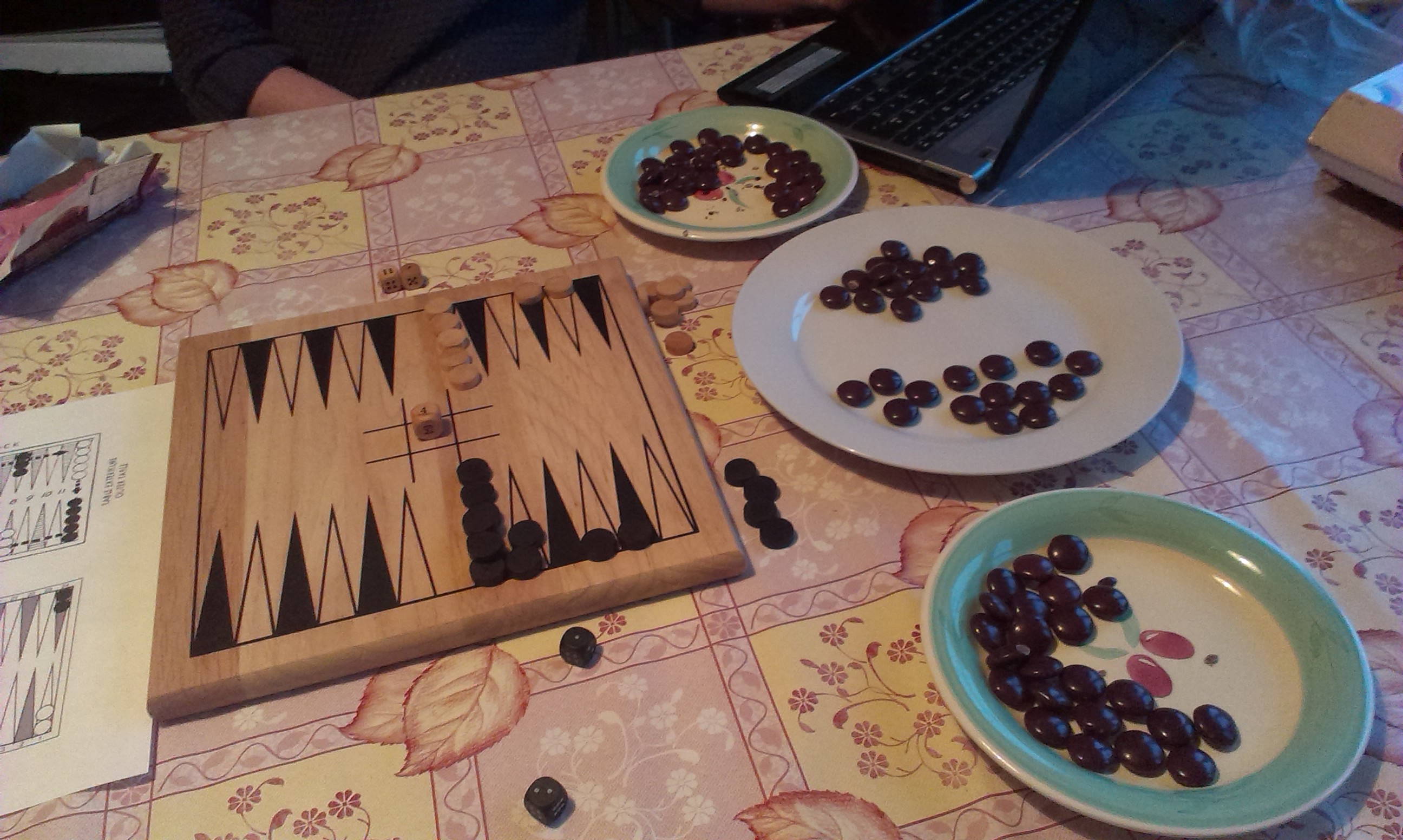
However, as you’ll see in the pictures below, due to a lack of expendable money in our lives we gamble with chocolate instead, you pay less for more “chips”, and you can eat them when you’re finished!

Our horrific gambling tendencies.

In 1920’s America Backgammon was going out of fashion, it was too hard to bet on and took too long to play without anything exciting happening for the players. It’s at this point in history that the doubling die first appears, this element gave the game the extra boost it needed to become a popular casino game again.

Interestingly, although it is fairly easy to track the history of Backgammon in America through strategy books that were written about it, it is nigh impossible to know when it crossed the Atlantic and came to the UK.

YOU GAVE ME LOADED DICE!

I also learnt that Backgammon can be played with the offloading space either to the players left or their right – there is no fixed direction of play. This gave a new dimension to the game as it can give a player an advantage to be able to play the game either way around. It will also prevent confusion for them in the event that they ever have to play the game in the opposite direction to the one they are used to. For this reason we’ve started playing half and half, setting the board up differently for half the time.

If anyone’s interested my next post in this chain will be about the game Fanorona, not to confuse you but there’ll be two posts about it, one from me about game play and history, and one from my brother about how he made his own board. His is likely to be much more interesting!

Load off left!
Load off left!
Load off right!
Load off right!

And if anyone’s at all curious, I found most of the things about the history of Backgammon written here on this page.

Also if anyone wants to learn the rules of Backgammon we recommend looking here or if you’d rather learn to play by doing we recommend playing here (click ‘Play as Guest’) and use the tutorial.

First post, Obscurity, Sneak Peeks and Java

So! First post! If you’re reading this WELL DONE! If not… I don’t blame you.

First post and Obscurity!

The aim of this blog is just to talk about games; mostly obscure ones if we possibly can… Let’s be honest not many people want to talk about Monopoly. The other aim is to show our ideas and designs for games and give some away for FREE, so you can test them and give us your feedback. We have one in the works right now so keep an eye on this space as the first ten people to email us with their addresses will get a properly produced copy sent to them completely free of charge – providing they promise to give us feedback!
Even if it’s just to tell us we’re terrible and should just leave.

Sneak Peeks:

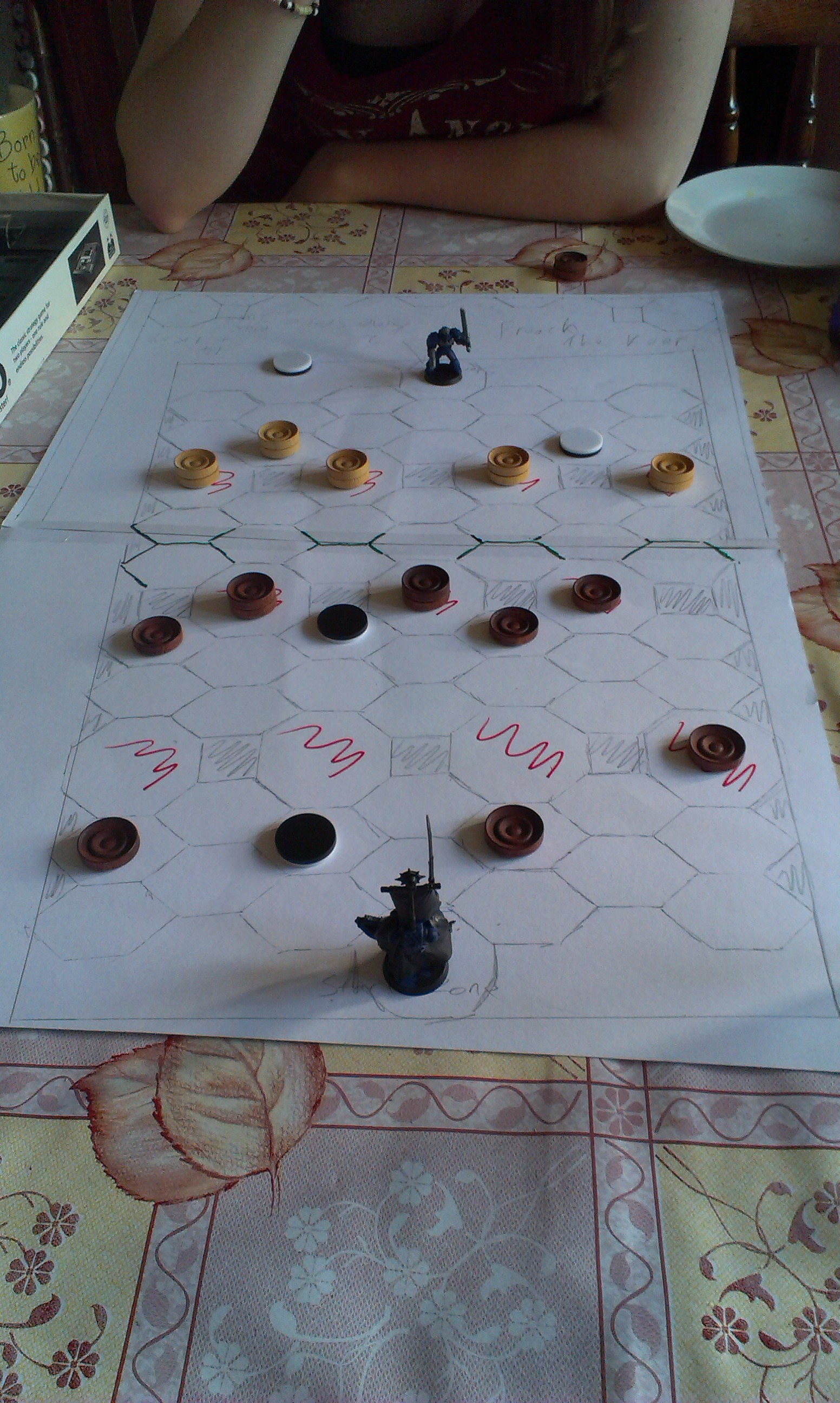
Here’s the tiniest sneak peek of the game under development:

Yes those are Warhammer pieces, Draughts pieces and a few Othello pieces.
The basic concept of the board - It will be much prettier once it is done!
The basic concept of the board – It will be much prettier once it is done!

Java:

4.5 - 5

Number of Players: 2-4

Year of Publication: 2000

Creator(s): Michael KieslingWolfgang Kramer (Designers) and Franz Vohwinkel (Artist)

So the first on our list of Obscure games is an awesome game called Java.

IMAG0989

As far as we can figure from searching for it online it’s pretty hard to come by, lucky for us we picked it up in a charity shop for £3.99 on a whim. It’d never been used before as none of the pieces had been pushed out of their holders. Only downside we could find was a dent in the box but at £3.99 we’re not complaining…. Much.

IMAG0978

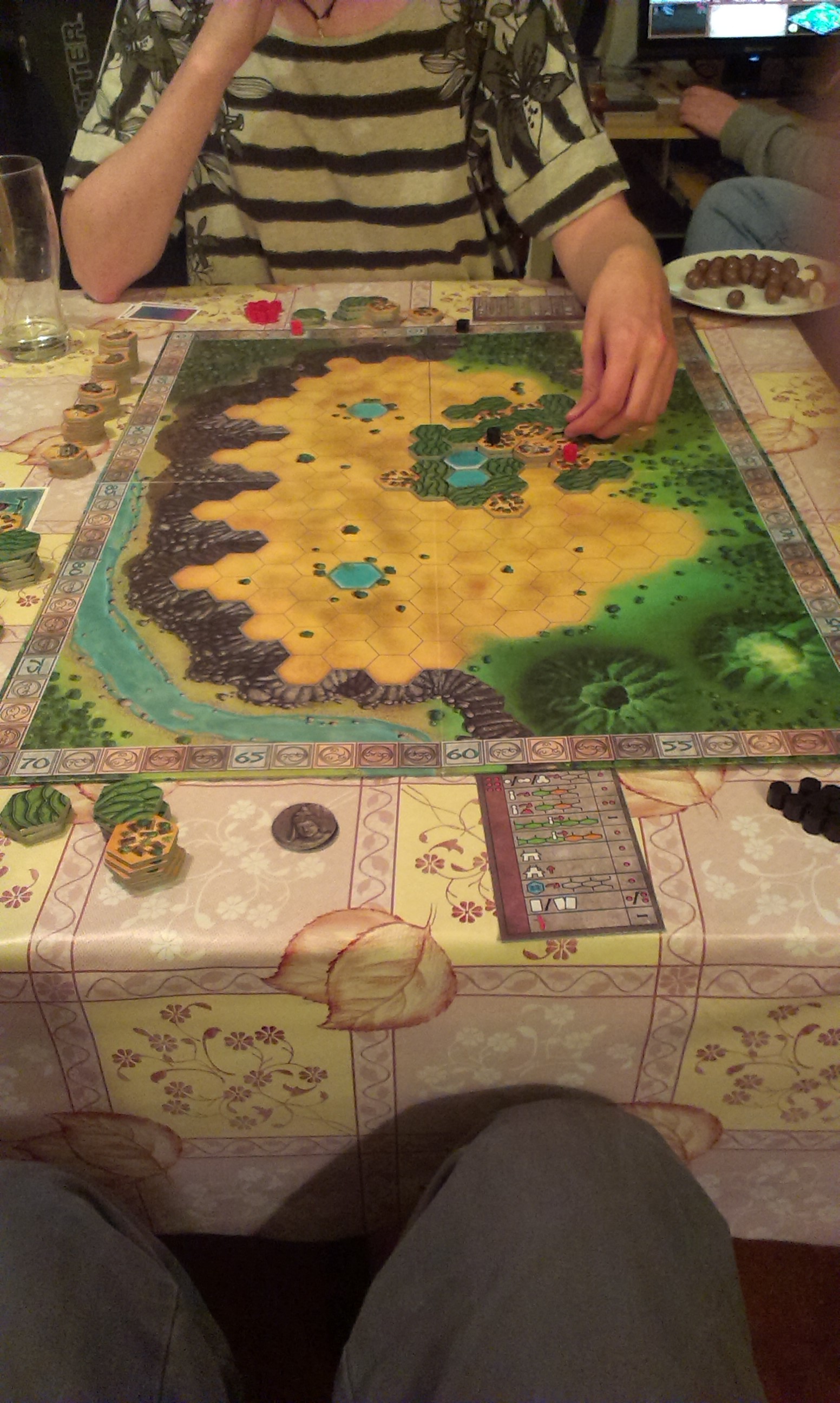
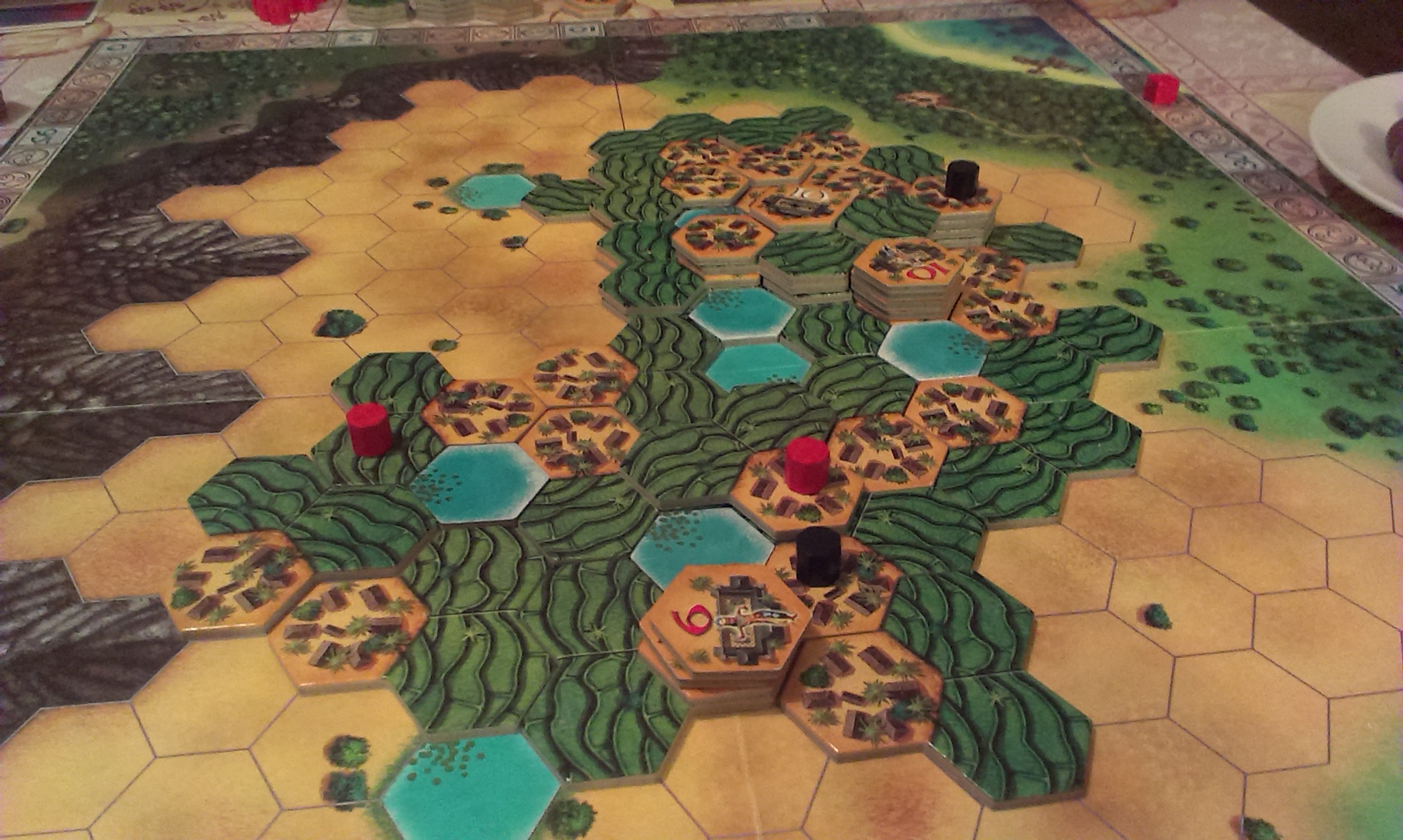
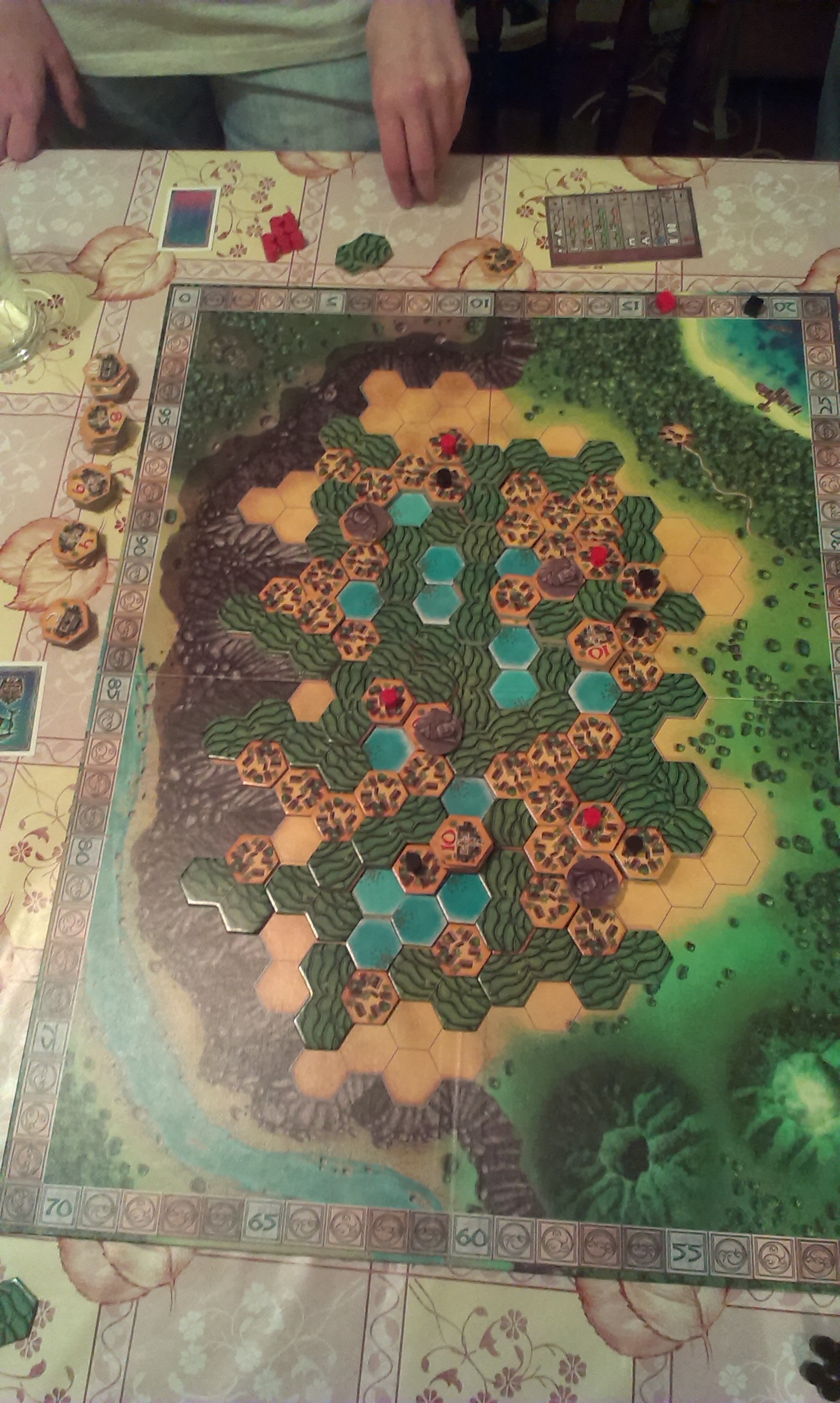
The game in essence can be seen as a strategic planning game. Your aim is to take control of the island of Java through building cities and enlarging them by placing more land pieces strategically. To win you have to score more fame points than your opponent, you accumulate these through building palaces and enlarging them and through palaces festivals or irrigating. From this run down of the game it sounds kind of boring and probably doesn’t make all that much sense… In fact when we were reading the rules we were thinking… Wow this could really suck. However it has a sort of charm to it that is unexpected and you quickly find yourself starting to try to out think your opponent. It also helps that you’re allowed (and encouraged to in the rules) to make the board more three dimensional by stacking pieces on top of each other, this is a visual bonus as the board ends up looking pretty cool!

IMAG0980

Now, as this is the very first post I’m not going to go on too much as I don’t want to bore you to death. If you have the opportunity to get hold of a copy of Java, go for it! It’s entertaining and tactical, it makes you have to constantly watch your opponents moves and think. It’s also very easy to turn the tide so for those who like games that aren’t a set thing from within the first four or five moves this is a good game.

IMAG0987

Hopefully we’ve ticked all the boxes with this post. Next post will be a full update on our own board game – which by the way is called ‘Breach the Keep’ cool name right? And after that we’ll see where life takes us.