Ankh-Morpork

5 - 5

Number of Players: 2-4

Year of Publication: 2011

Creator(s): Martin Wallace (designer), Peter Dennis, Paul Kidby (artist) – Based on the books of Terry Pratchett

Could You Be The Next Lord Vetinari?

Well, actually, in this game, yes!
The Ankh-Morpork board game is an amazing, detailed game that completely encapsulates Sir Terry Pratchett’s brilliant city from the Discworld Universe (if you’re unfamiliar with Terry Pratchett, read our update post about how awesome he is, here). I want to write a bit about the game, but I feel that the opening paragraph from the rule book will tell you everything you initially need to know, and do it far better than I could:

“Welcome to Ankh-Morpork, the largest, smelliest, and most ‘interesting’ city on Discworld. The city’s patrician, Lord Vetinari, has disappeared, and the citizens are calling out for firm leadership. Will one of the noble families take control of the city, or will the people welcome the return of the king to restore peace? Then again, Vetinari’s absence may have been temporary and his spies could be spreading around the city, ready to start pulling the levers of power for their master.”

What’s in the Box:

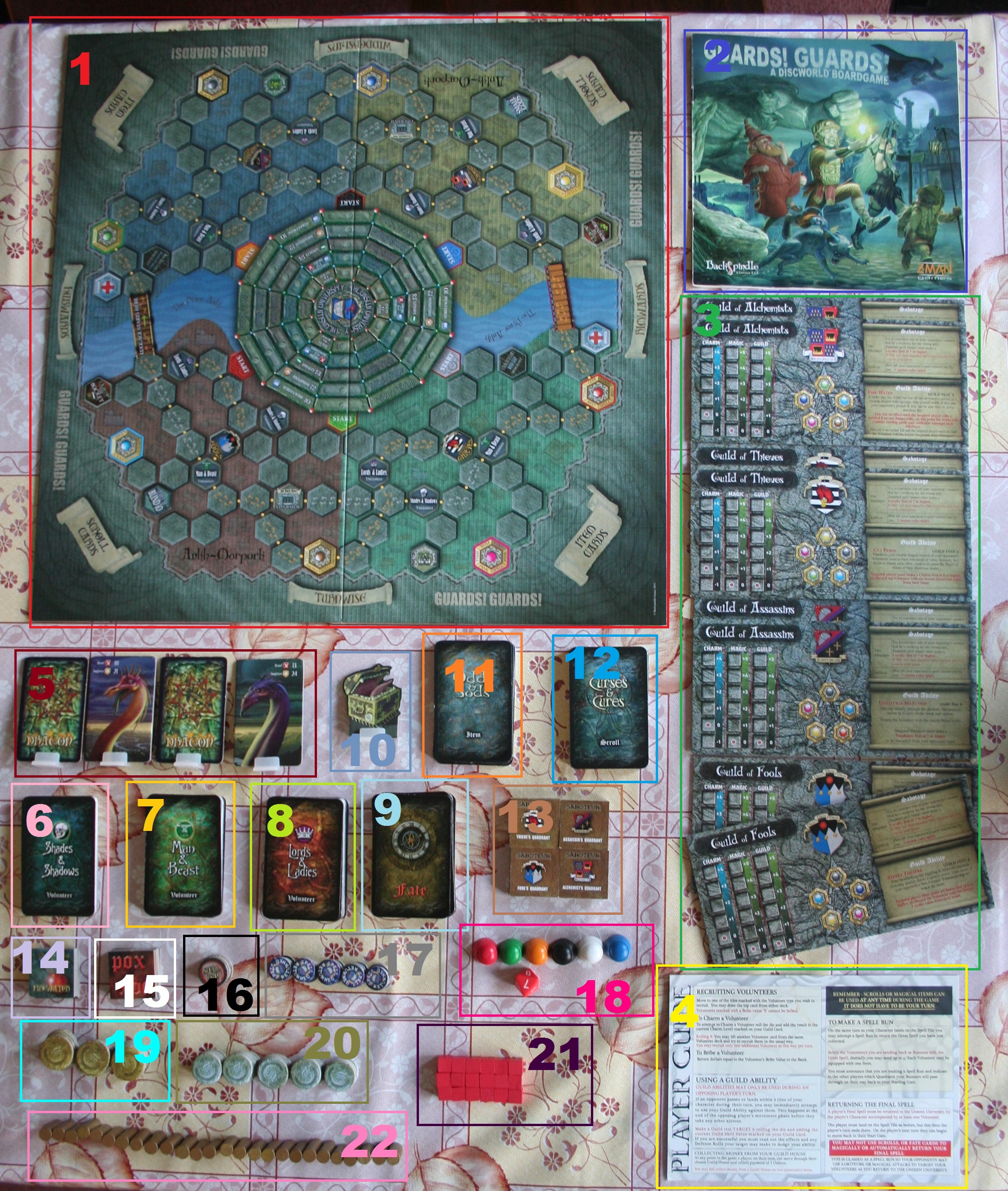
IMG_0016
The Stuff.

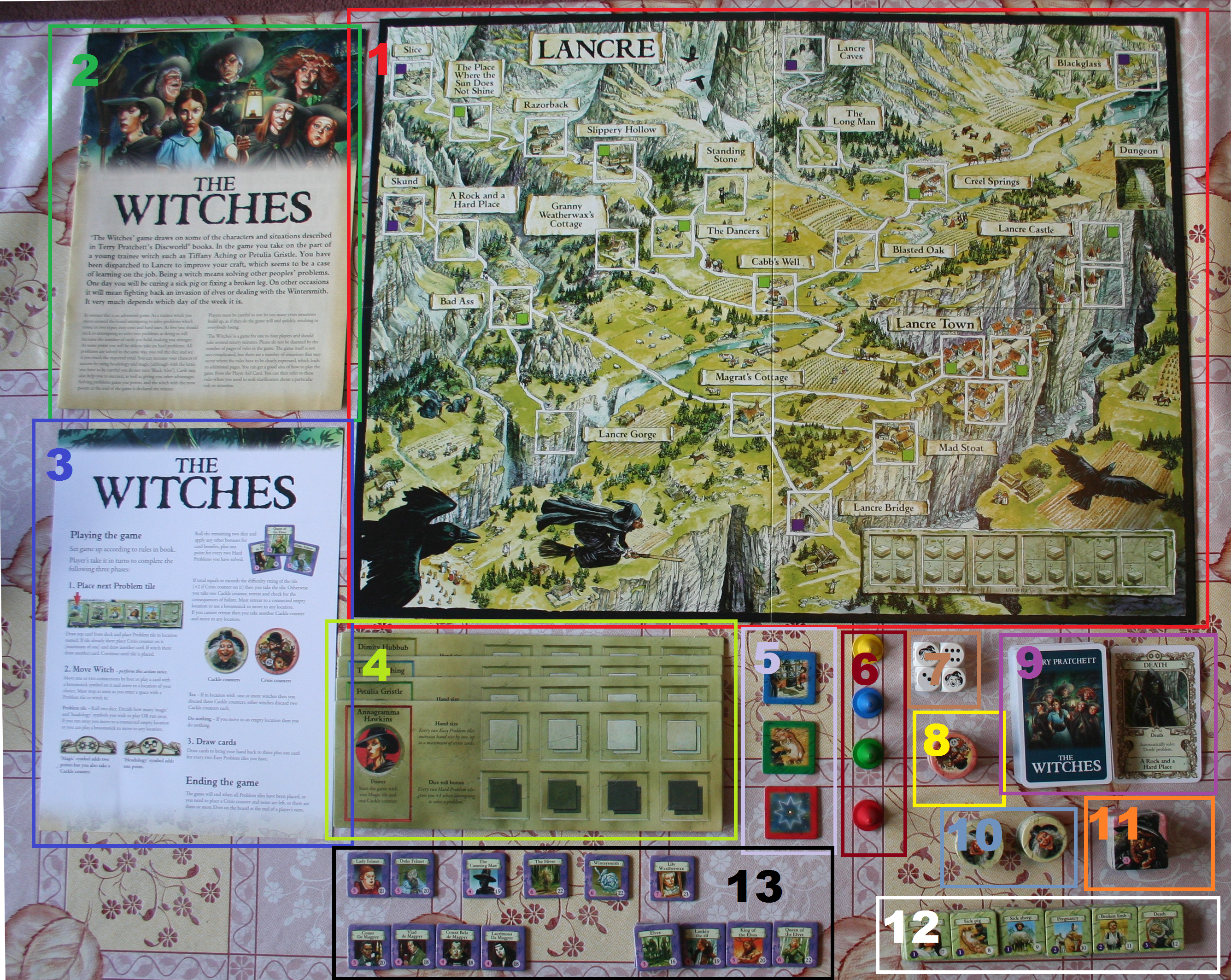
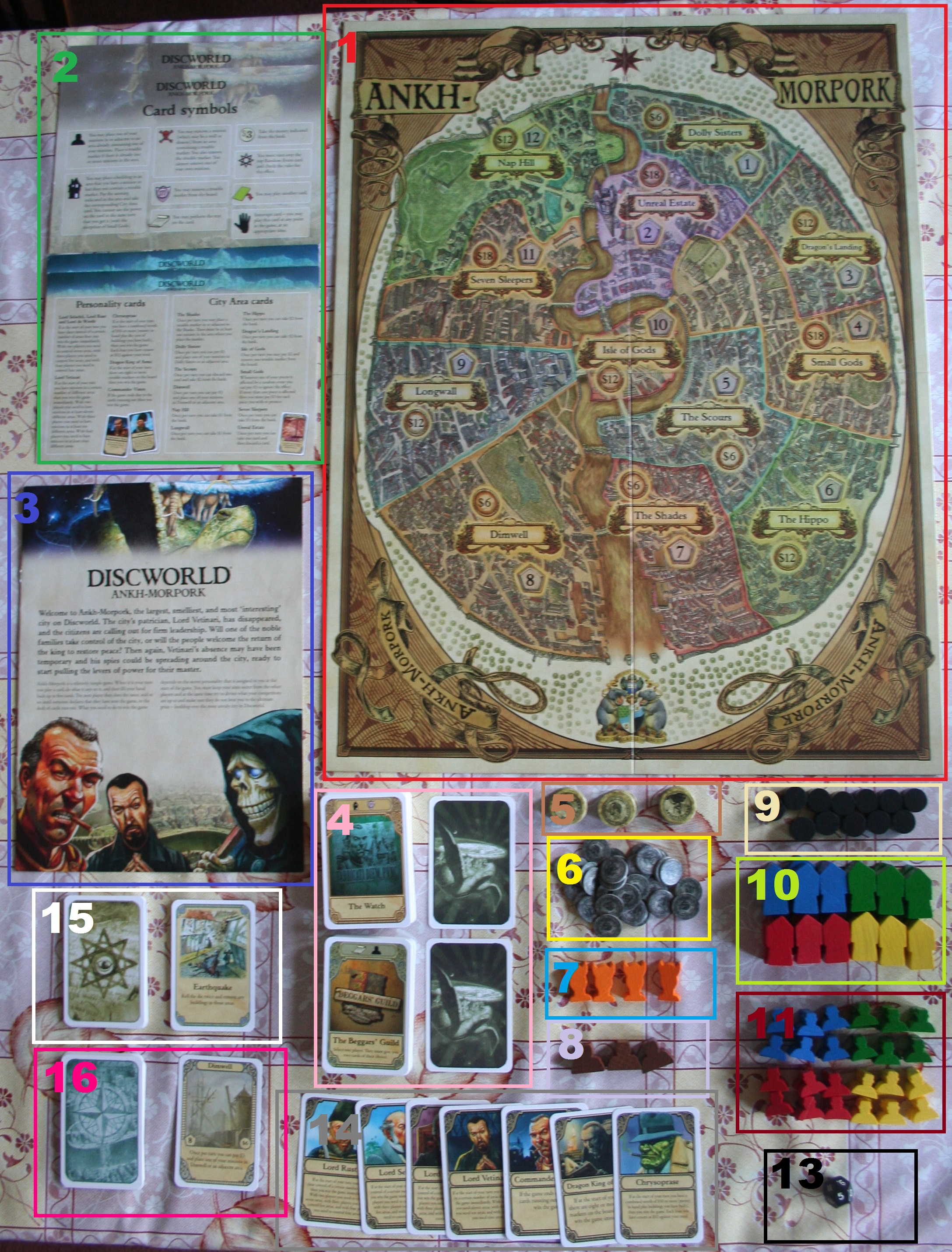
Well, there’s a lot of exciting things in this box:

  1. One Playing Board.
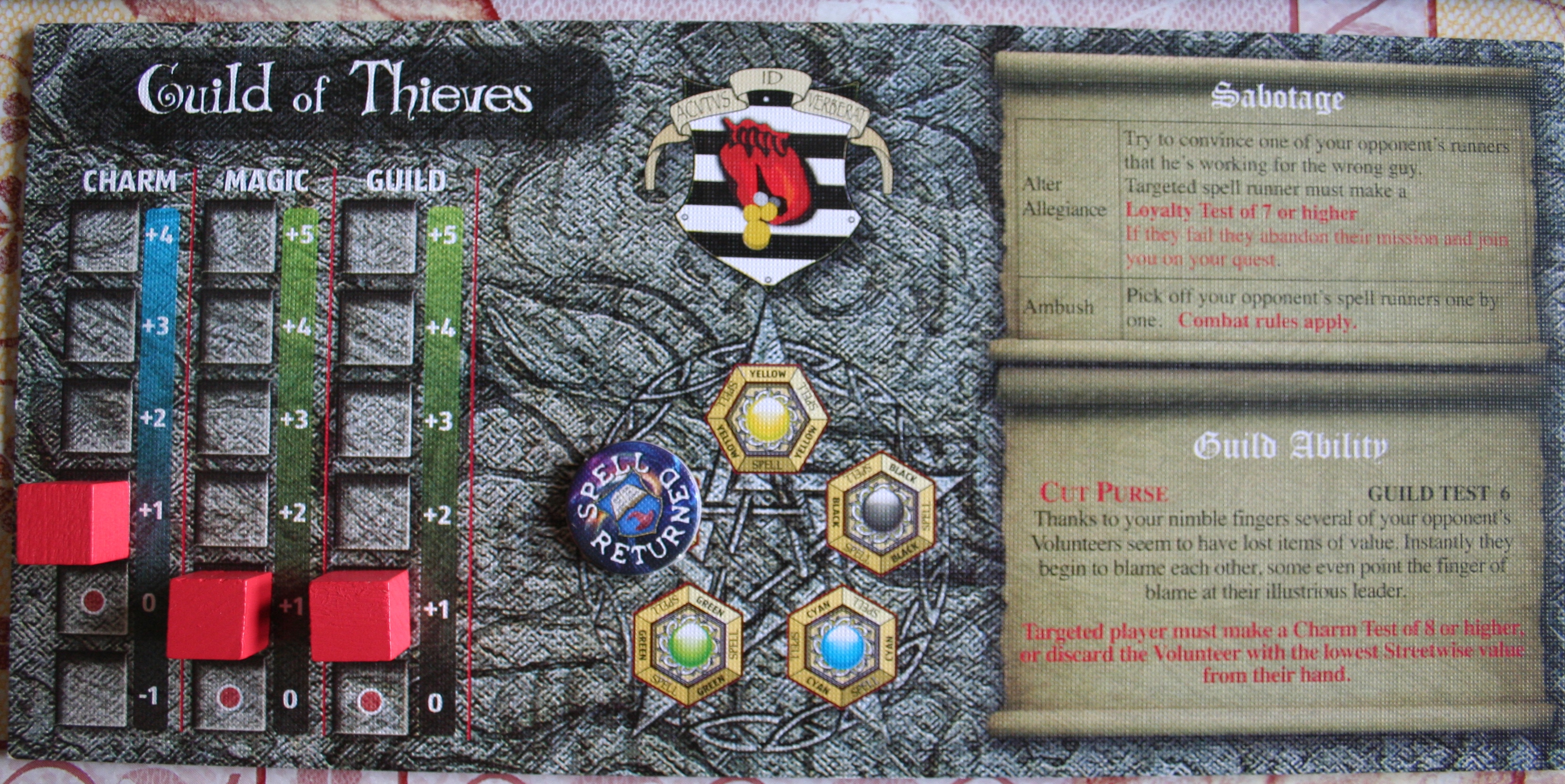
  2. Four Player Aid Cards. These are reference cards for the players and have different important aspects of the game explained on them.
  3. One Rule Book.
  4. Two decks of Player Cards; 48 with a green border, and 53 with a brown border.
  5. 17 gold coins, worth $5.
  6. 35 silver coins, each worth $1.
  7. Four orange Demon pieces.
  8. Three brown Troll pieces.
  9. Twelve black Trouble Markers.
  10. Four sets of six Building pieces in Blue, Green, Red and Yellow.
  11. Four sets of twelve Minion pieces, in Blue, Green, Red and Yellow.
  12. One 12-sided die.
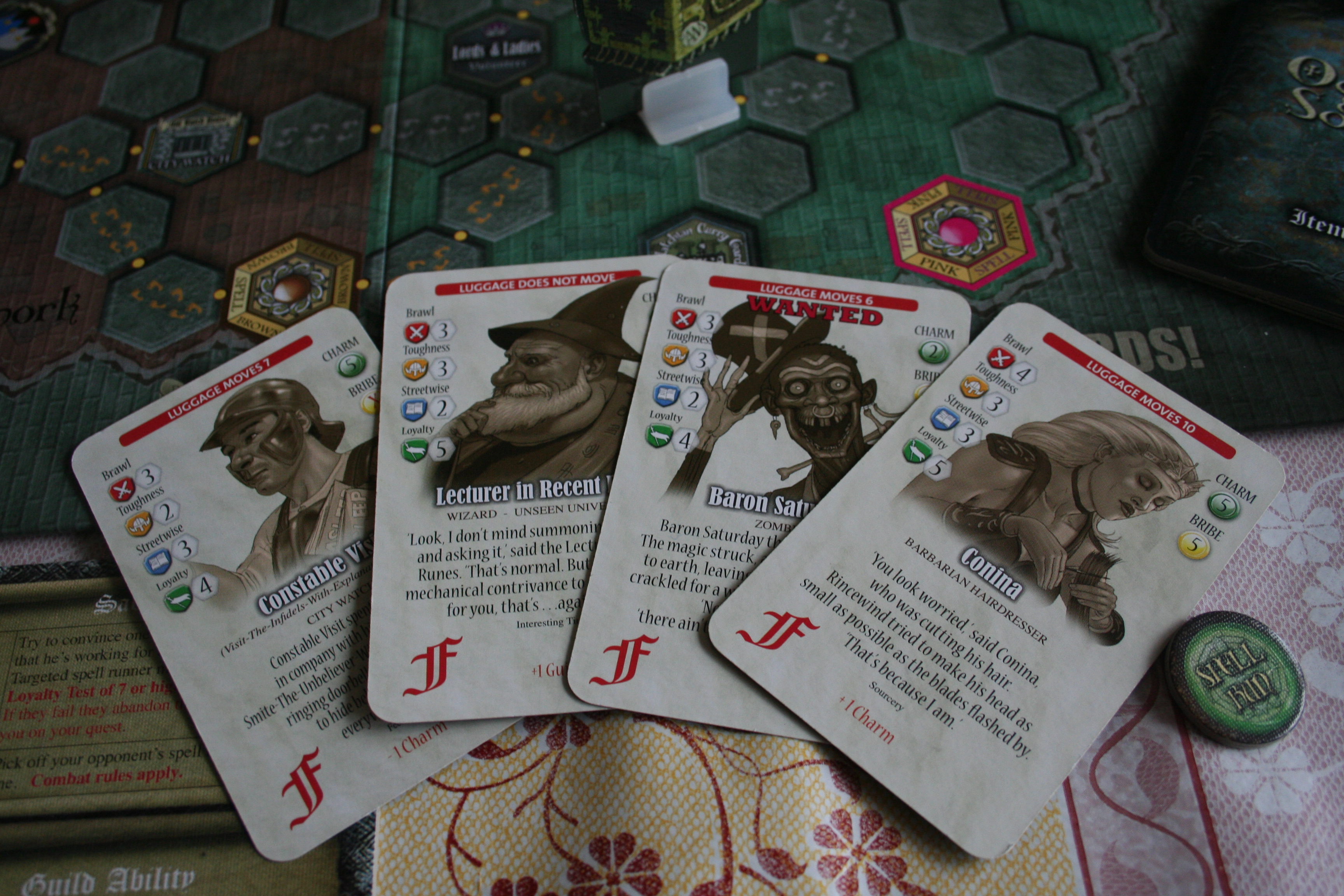
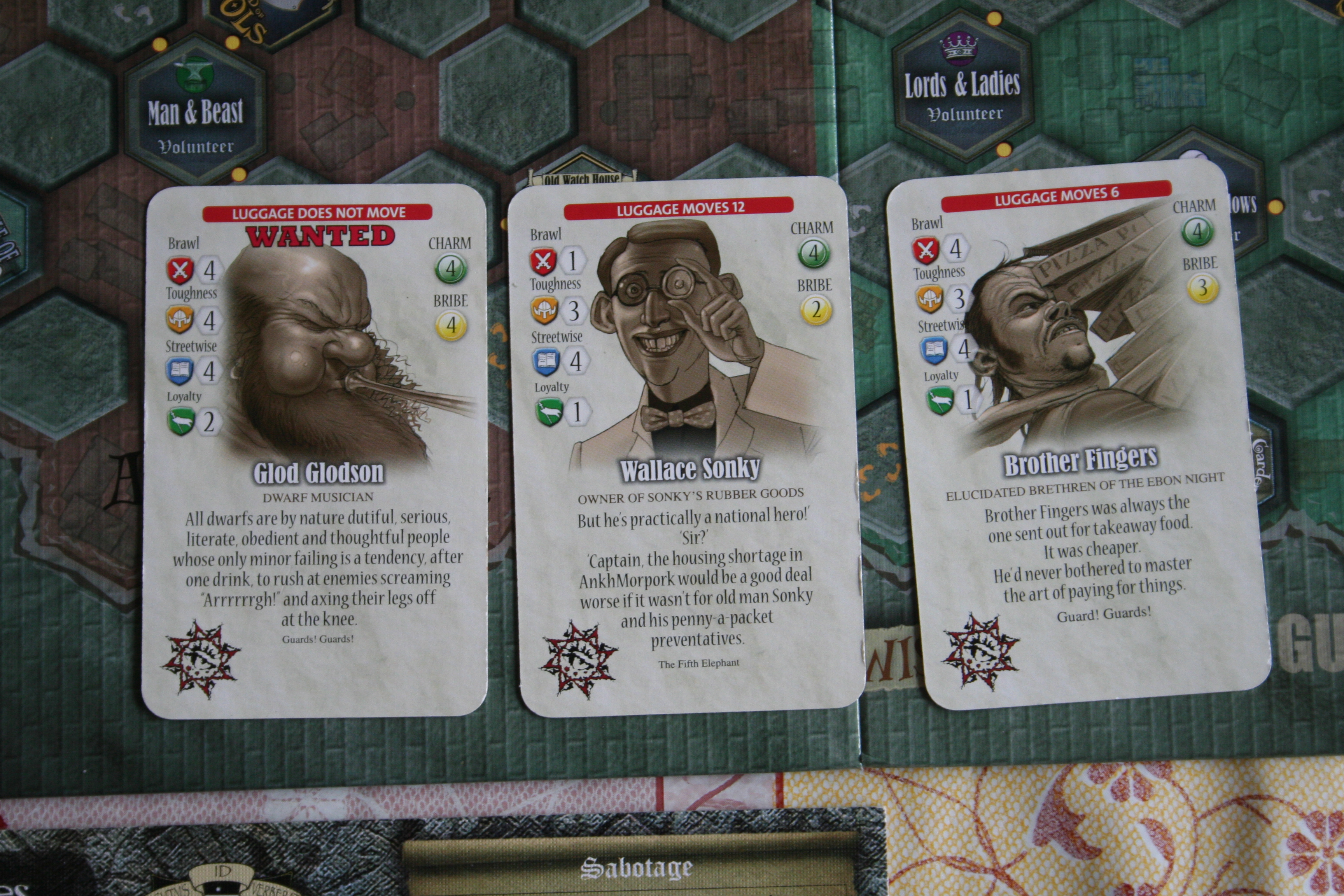
  13. Seven Personality Cards. These are given randomly, one to each player, at the start of the game, they are kept secret and have on them your objective for the game.
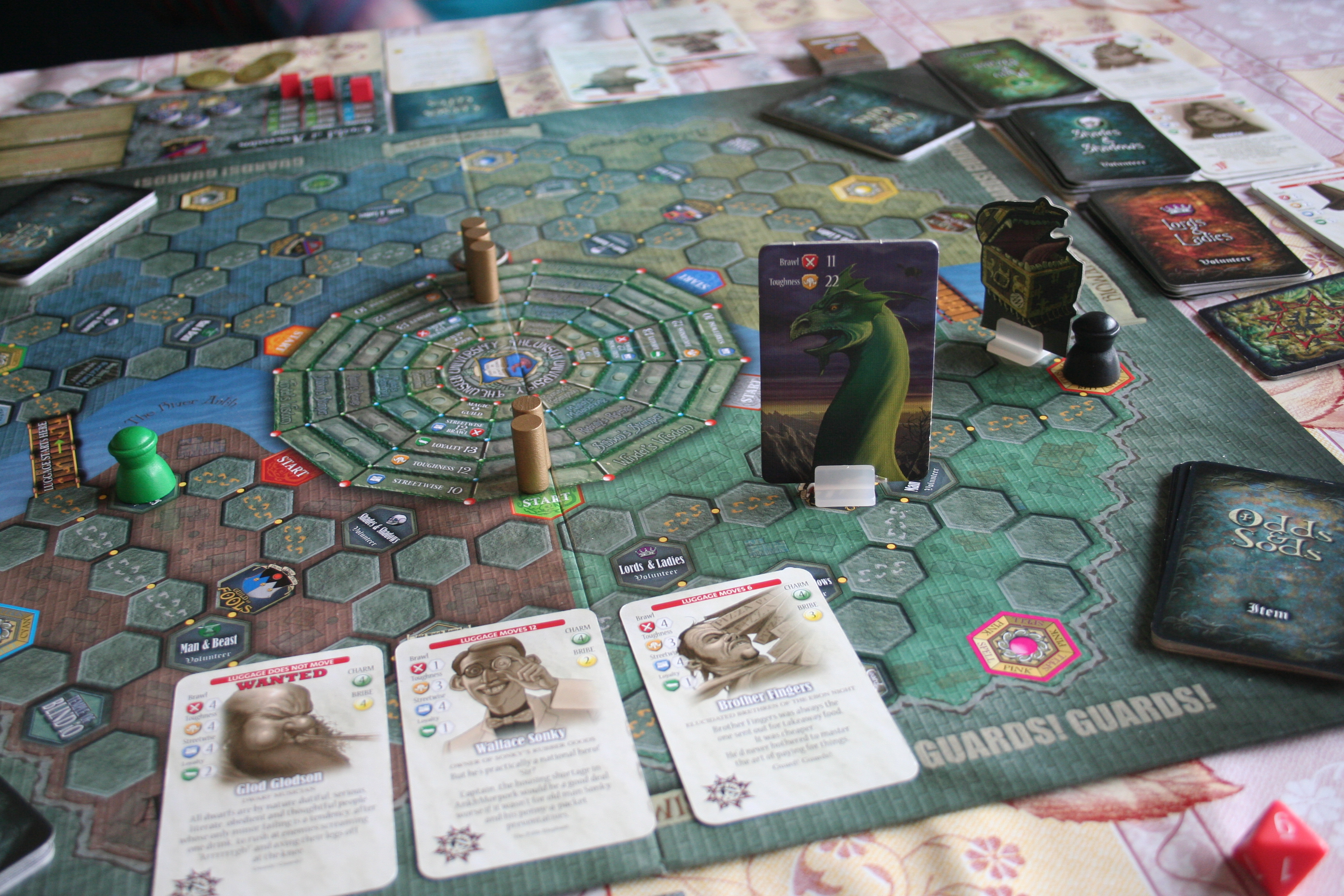
  14. Twelve Random Event Cards, some, or all of these, will be played throughout the game.
  15. Twelve City Area Cards, these match the areas that the board is divided up into, you may be familiar with them from the books.

Playing the Game:

Objective: To achieve the aim on your Personality Card and win the game before anyone else!
To start the game each player chooses a colour and takes all of the Minion and House pieces of that colour. Then they are dealt a Personality Card, because the maximum number of players for the game is four and there are seven Personalities available, they can never all be in play at once. This adds an extra element to the game as part of winning is to figure out what your opponent(s) objective is, and prevent it.

Personality Cards:

There are seven Personalities available in the game, each of which represent well-known characters from the Discworld series (these Personality descriptions are copied straight from the rule book) :

  • Lord Vetinari – You win if at the beginning of your turn you have a certain number of minions in different areas on the board (think of them as your spies). With two players you need to have minions in at least eleven different areas. With three players you need to have minions in at least ten different areas. With four players you need to have minions in at least nine different areas. Areas must be free of demons.
  • Lord Selachii, Lord Rust, Lord de Worde – you win if at the beginning of your turn you control a certain number of areas. If there are only two of you playing then you need to control seven areas, if there are three of you then you need to control five areas, and if there are four of you then you need to control four areas. You control an area if you have more playing pieces in it than any single other player (a playing piece being a minion or a building). You would also have to have more pieces there than the total number of trolls in the area. You cannot control an area that contains one or more demons. The presence of a trouble marker does not affect the control of an area.
  • Dragon King of Arms – If at the beginning of your turn there are eight trouble markers on the board then you win. The rationale is that the city has fallen into more chaos than normal and people want the king back (who would be controlled by you).
  • Chrysoprase – If at the beginning of your turn your net worth (your cash plus the monetary cost of each building you have) is $50 or more then you win the game. Please note that any loans you have taken out count as $12 against your total worth (certain cards allow you to take out loans).
  • Commander Vimes – you win if nobody else wins by the time the draw pile has been exhausted.
Setting Up The Board:

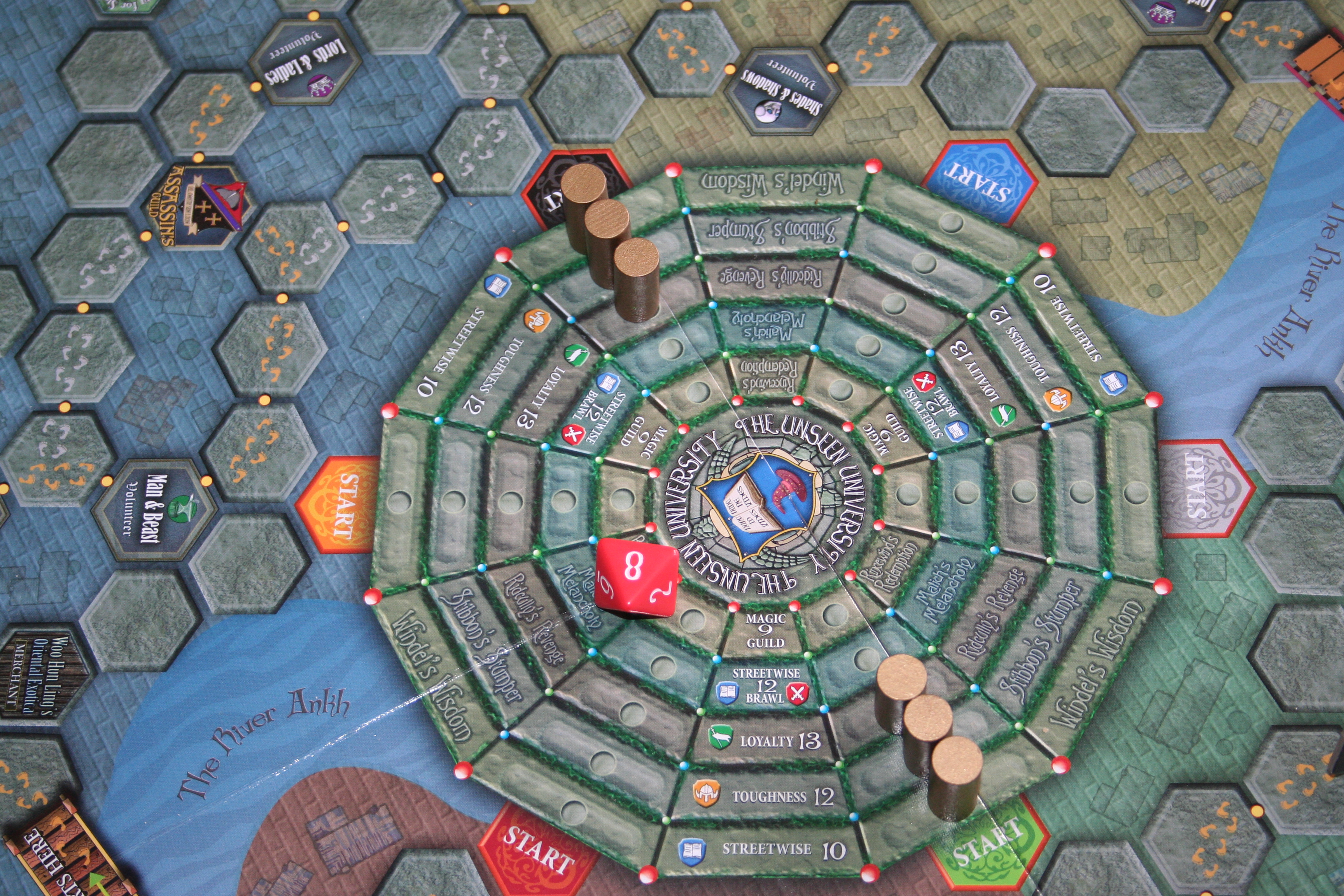
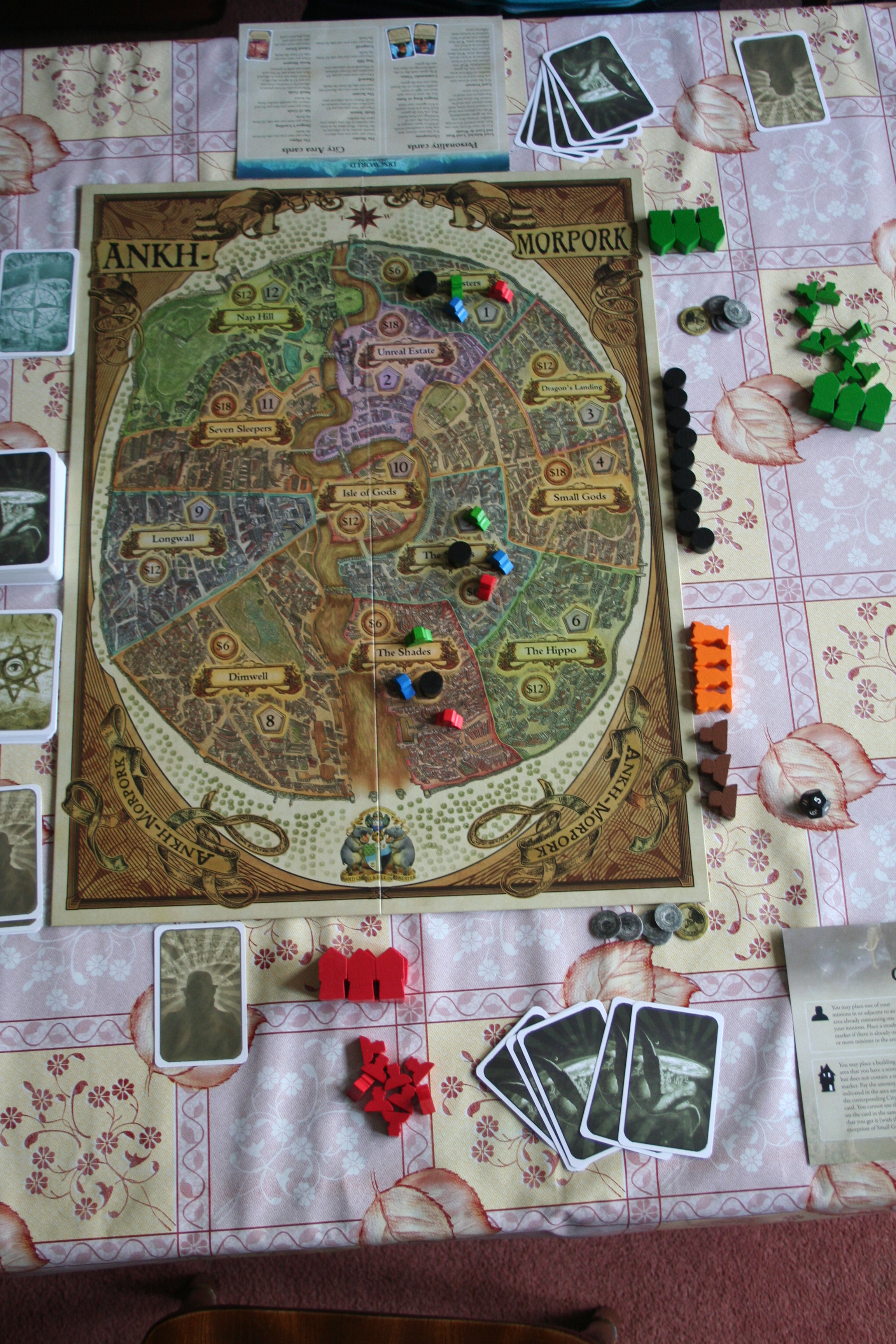
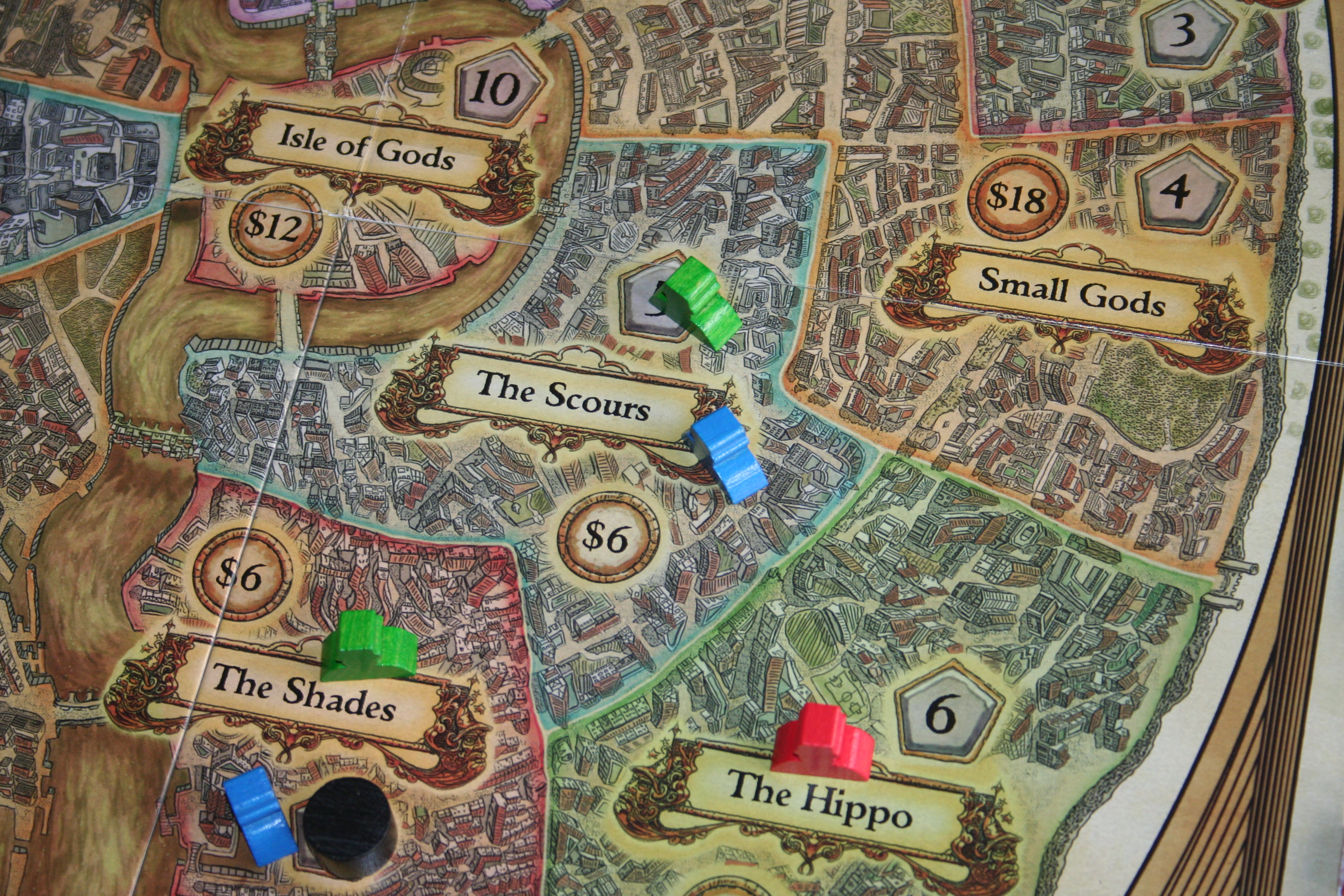
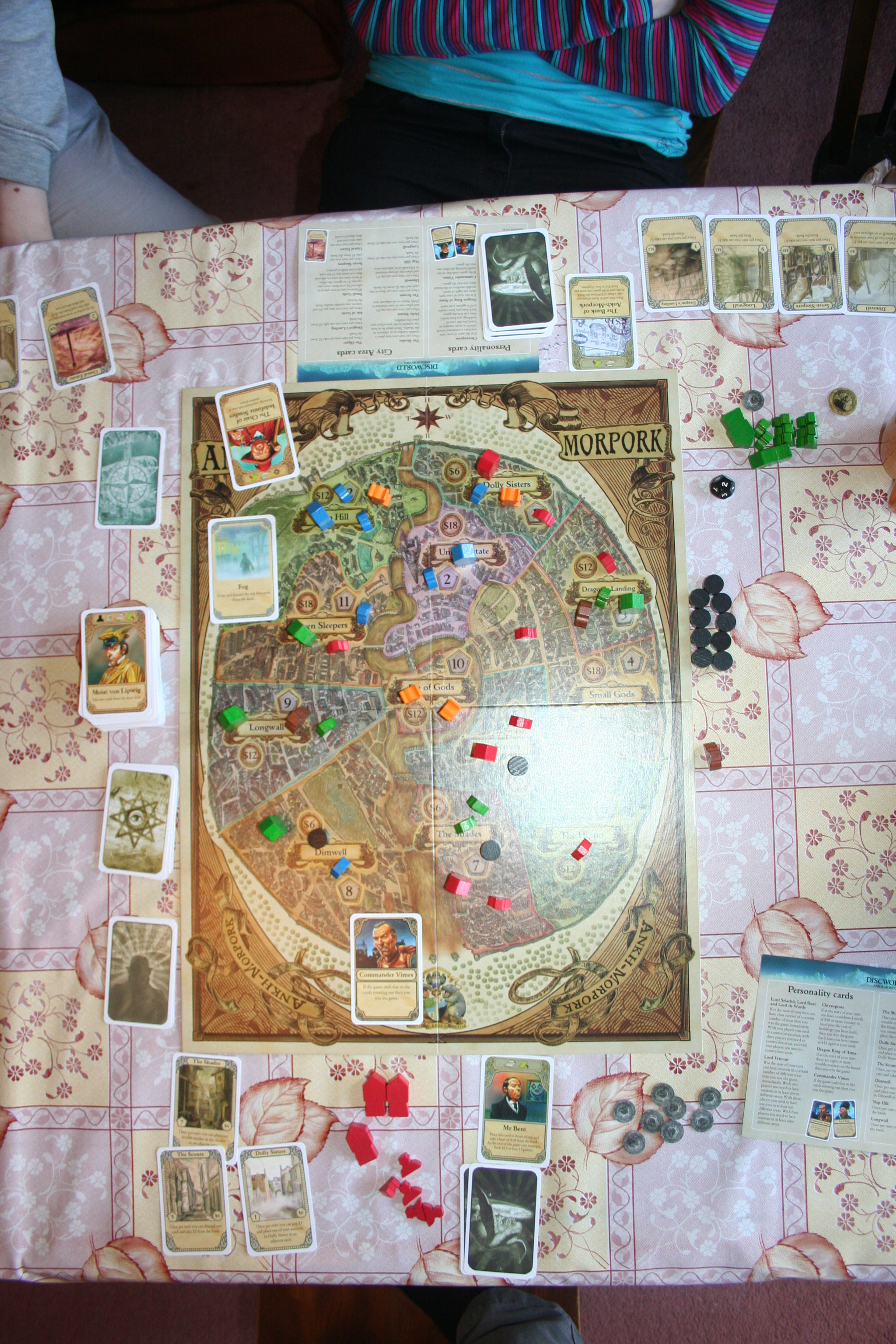
Now that you’ve got your Personality for the game and have chosen which colour you’re going to play as, you need to place your first Minions. Each player starts the game with three Minions on the board, one in each of The Shades, The Scours and Dolly Sisters. Now, because there’s more than one Minion in each of these areas, a Trouble Marker must be placed there. Trouble Markers are important in game play, as they determine how and when Minions can be removed from the board, and are also relevant to one of the Personalities objectives.

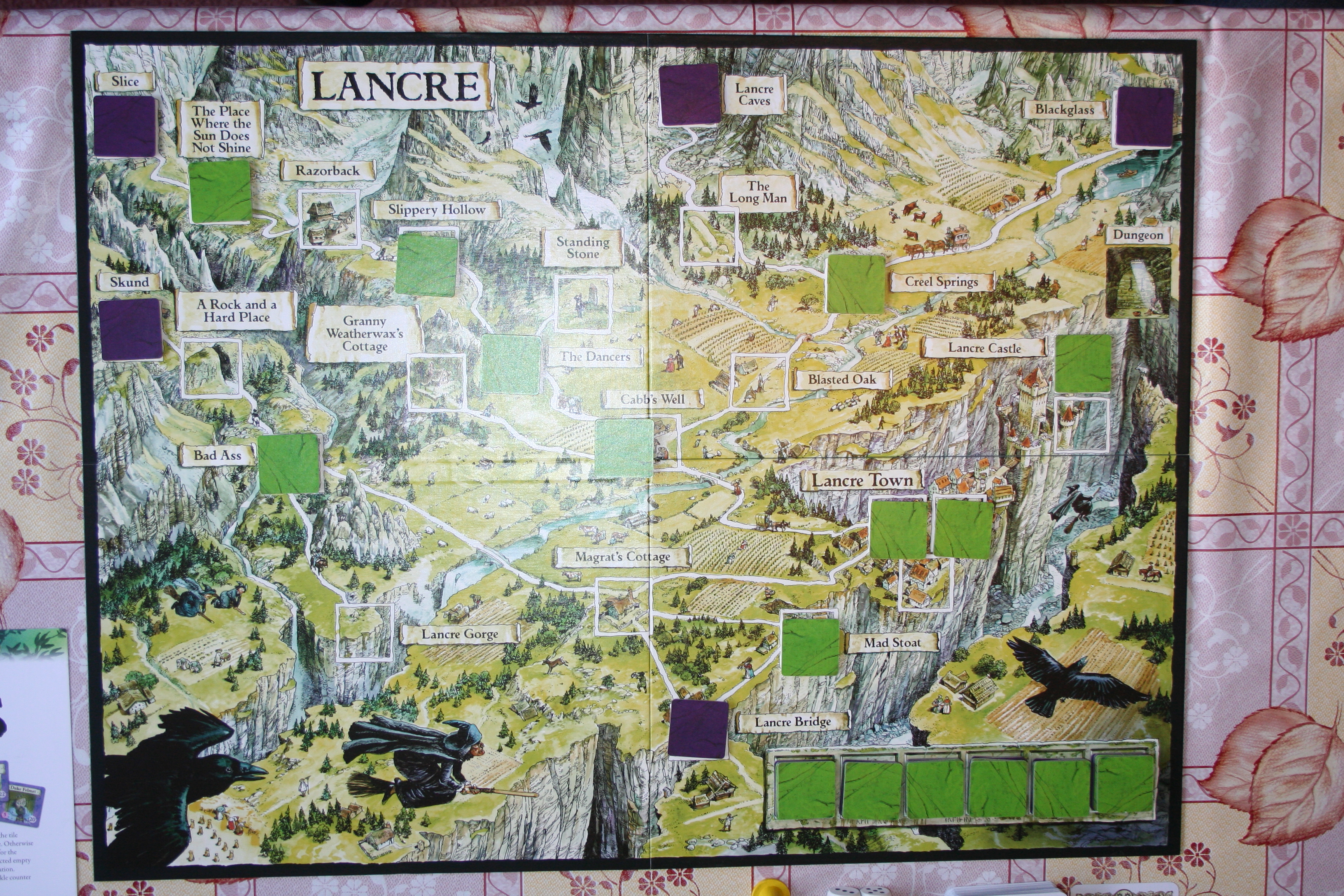
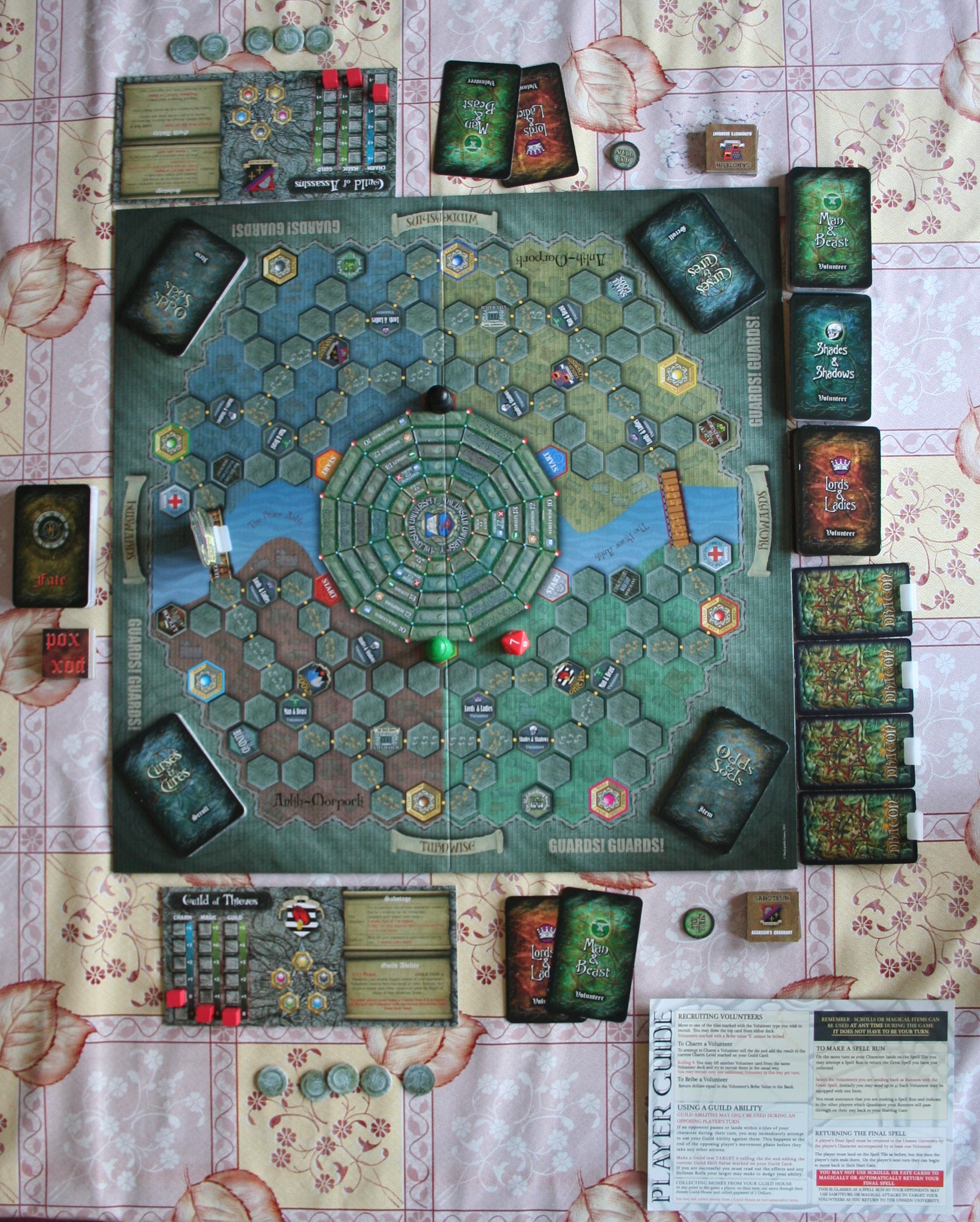
You can't see the actual numbers or names of the areas the board's divided into in this picture, but you can see the minions we  had on the board to start, and that there's a trouble marker in each area with them. Which is good enough for now.
You can’t see the actual numbers or names of the areas the board’s divided into in this picture, but you get the idea of what the board looks like to start the game.

As soon as a Minion is placed into an area with one or more Minions already existing there, a Trouble Marker must be placed there too. However, as soon as a Minion is moved out of an area, or removed from the board, the Trouble Marker is also removed, even if more than one Minion remains in the area.

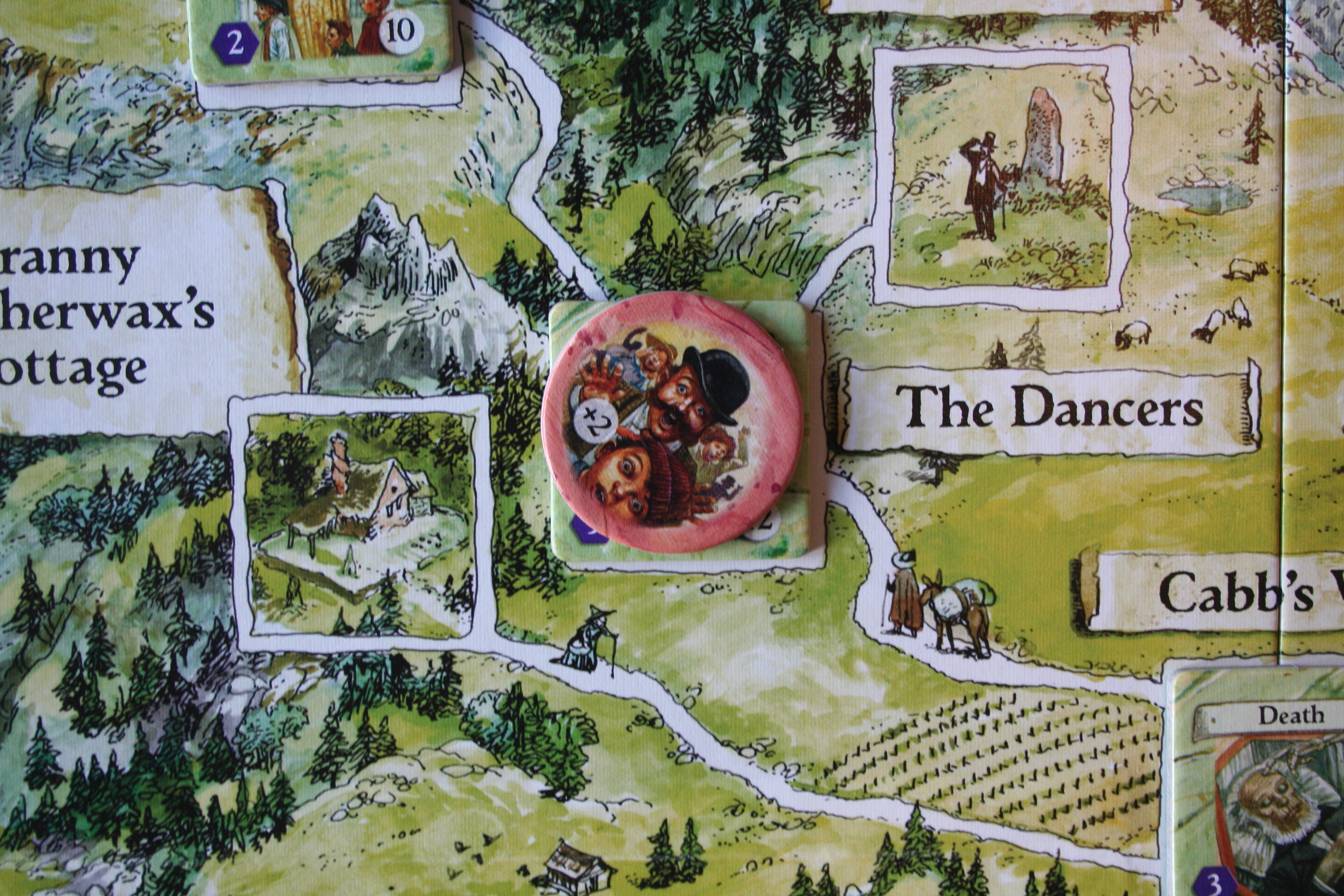
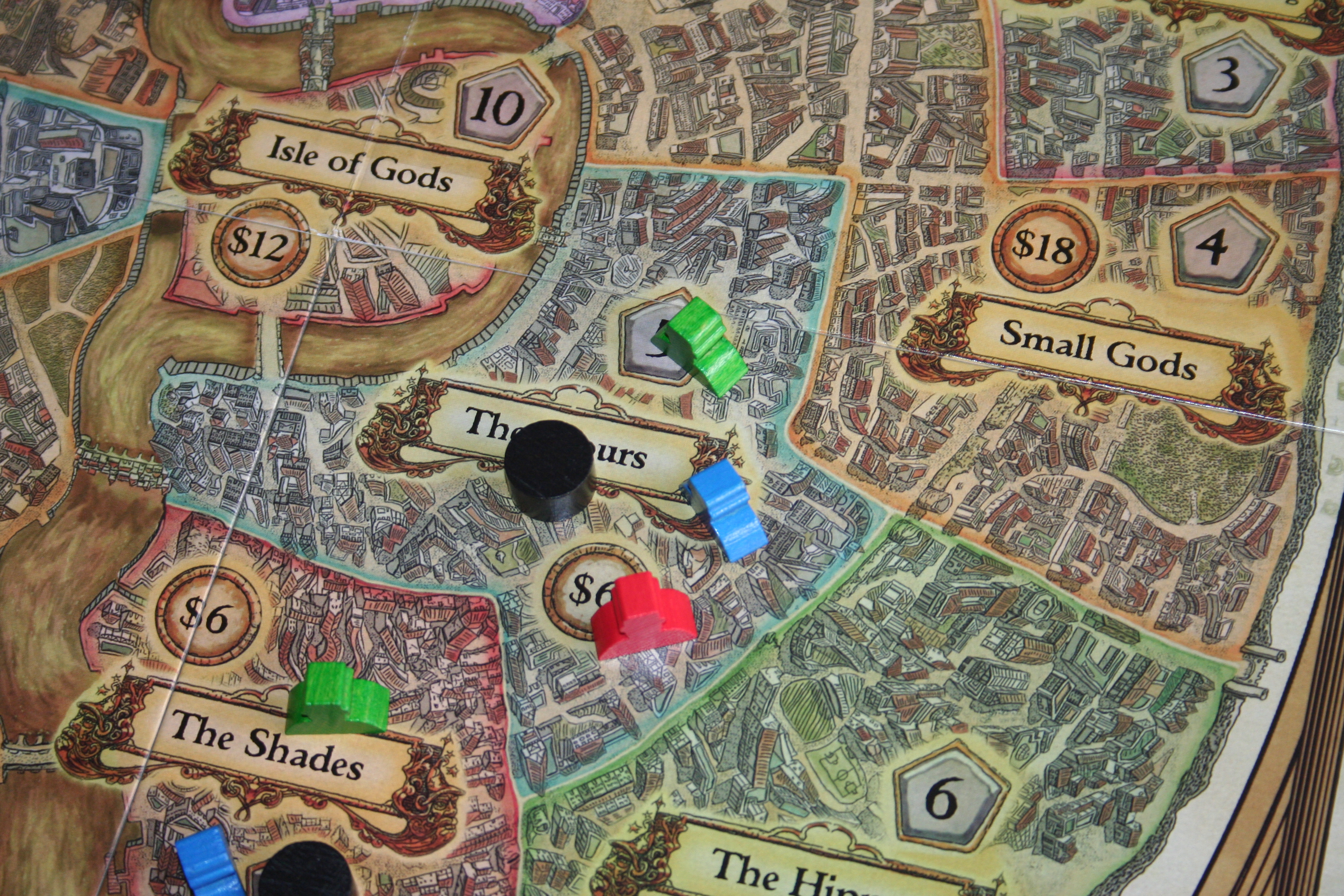
There are three Minions in The Scours, and so a trouble marker has been placed there too.
There are three Minions in The Scours, and so a Trouble Marker has been placed there too.
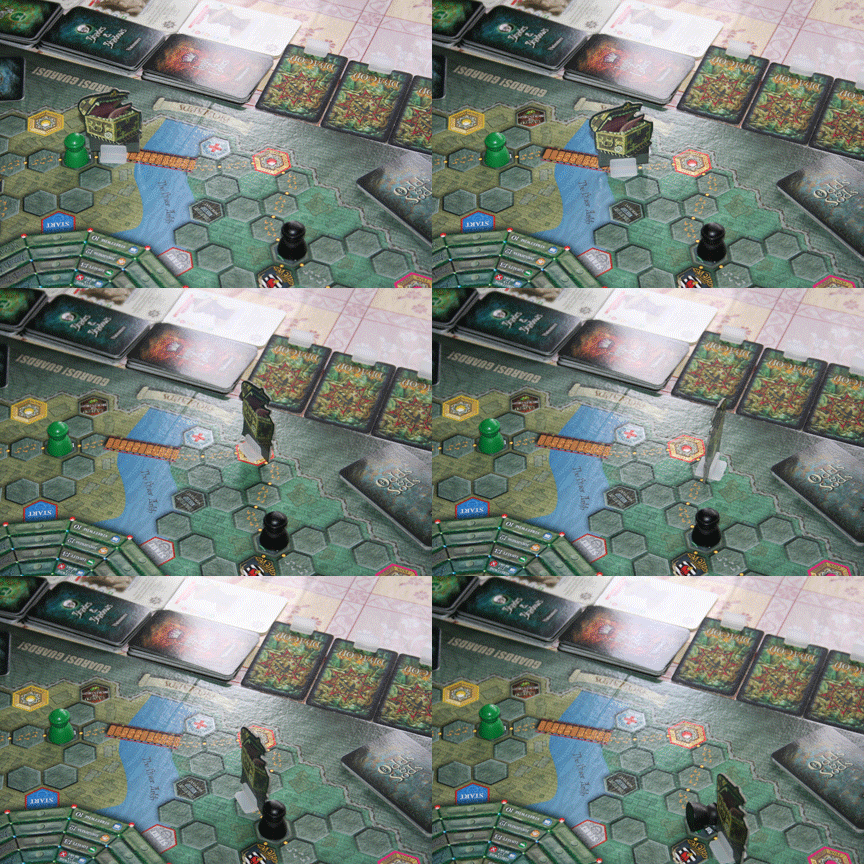
Now the red Minion has been moved to The Hippo, and so the Trouble Marker has been removed. Because red is the only player in The Hippo, no Trouble Marker is placed there.

NOTE: There cannot be more than one Trouble Marker in an area at a time. 

Each player is then dealt five cards from the top of the deck, which they are allowed to look at. The dice is rolled to determine who plays first and play then proceeds clockwise around the board. You’re now ready to start the game!

The Rules:

Essentially, the first rule of this game (and of all board games) is, if in doubt, DO NOT HESITATE TO CONSULT THE RULE BOOK. I don’t know how much we say this, (we should probably get it on t-shirts or something) but it’ll never cease to be the first, and most important, thing you should do, especially if you’re confused about something.

Ankh-Morpork is essentially a card game, played with a board, so you don’t have to hold lots of information in your head all at once. In your turn you play cards, the card(s) you play from your hand dictate how the game progresses. When you set up the board, you split out the green deck from the brown deck and you play through the green deck first. This is important because, as the game progresses and you move from the green deck to the brown deck, different things start to happen.

The Cards:

The cards all have symbols across the top of them, which are played in order from left to right, and it’s these that determine what’s going to happen in your turn. A player may choose to not play some of the symbols on their cards if they wish, with the exception of Random Events, these must be played.
The symbols are each explained on your Player Aid cards and breakdown as follows:

  • Minion – this symbol allows you to place one of your minions in or adjacent to an area you already have a minion.
  • House – this allows you to build a house in an area that you have at least one minion in, providing there are no trouble markers there, and you have the right amount of money, which will be shown on the board in the area you wish to build.
  • Skull and Crossbone – this allows you assassinate one minion of another player, from any area with a trouble marker in it.
  • City Watch Badge – this allows you to remove a trouble marker from any area.
  • Money – the coin symbol will have a number inside it, you can then take this much from the bank.
  • Random Events! – these are represented by an eight-point start. A card is then drawn from the top of the Random Events deck and read out, consequences are dependent on each card.
  • Play Another Card – this is what it says, you can play any other card from your hand.
  • Scroll – you then play the text on the card.
  • Interrupt – a hand sign, this card can be played at any time, even if it’s not your turn, and they usually protect you from something; i.e. they can stop someone who’s trying to assassinate one of your minions.

As with all games with cards, there are good cards and bad cards, useful cards and cards that’re generally a bit naff. Some of the cards can also be considered a bit of a two-edged sword, for example, loan cards. A loan card, when played, allows you to take a loan of $10 from the bank, which can be very useful if you want to build houses, or just want money. However! At the end of the game, if you come to score up, you must pay $12 back to the bank, before you  count your points. Also there are two cards in the deck that, if you play the text, allow you to give them to another player and they must pay you $5, if they refuse they keep that card face up in front of them for the rest of the game, and their hand size is reduced to four. This, ultimately, isn’t the end of the world, but it can become a real nuisance as the game progresses. In my experience, people usually just pay, unless they don’t have enough money, in which case, they’re screwed.

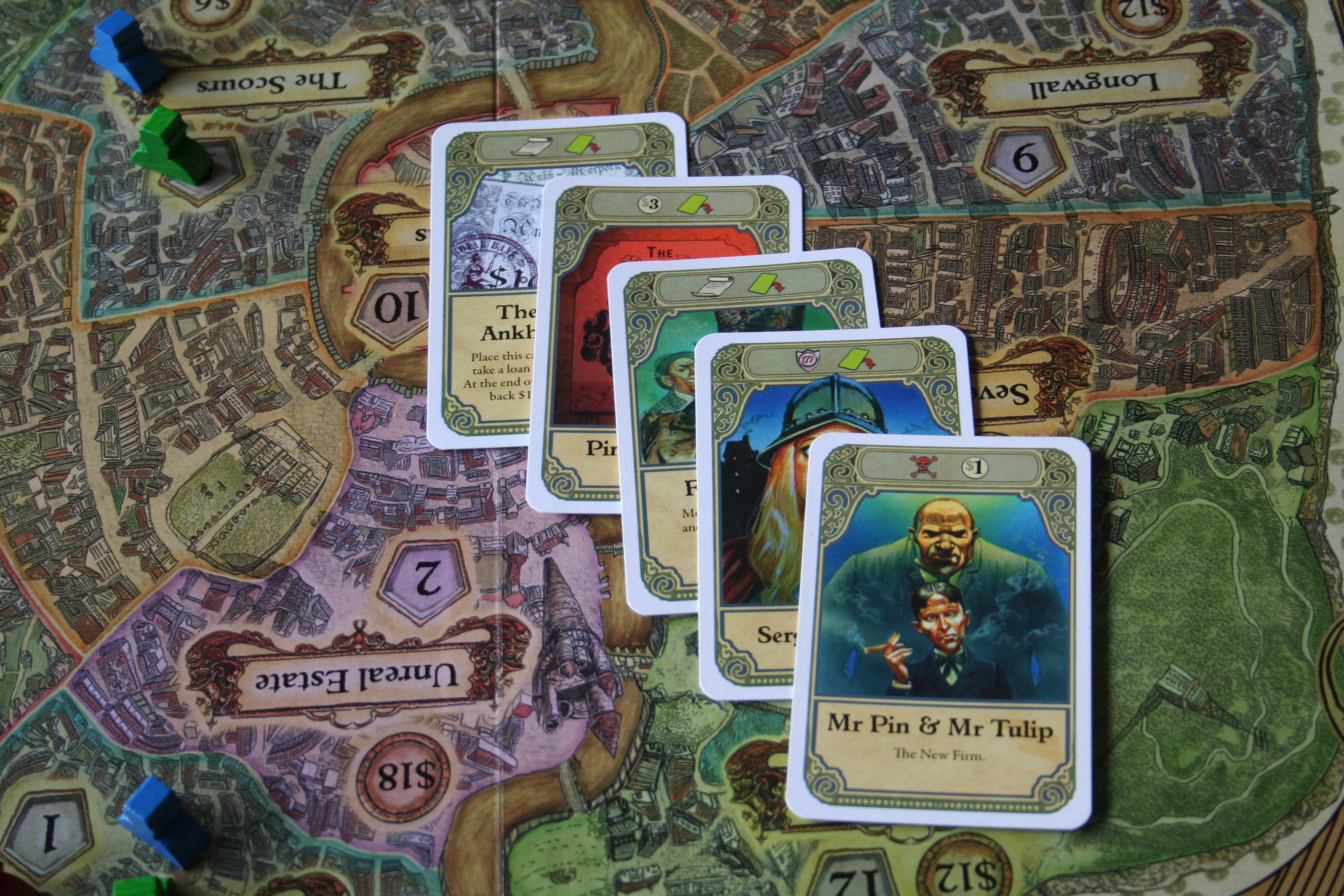
If you have multiple cards with the “Play Another Card” symbol on them in your hand, you can link them to create chains of cards like this:

So, in this chain, (from top to bottom) I was able to take a loan of $10 from the bank, play another card, take $3, play another card, do something I can't read, play another card, remove a trouble marker, play another card, assassinate someone, and finally, take one dollar, for my services to the game.
So, in this chain, (from top to bottom) I was able to take a loan of $10 from the bank, play another card, take $3, play another card, do something I can’t read, play another card, remove a trouble marker, play another card, assassinate someone, and finally, take one dollar, for my services to the game.

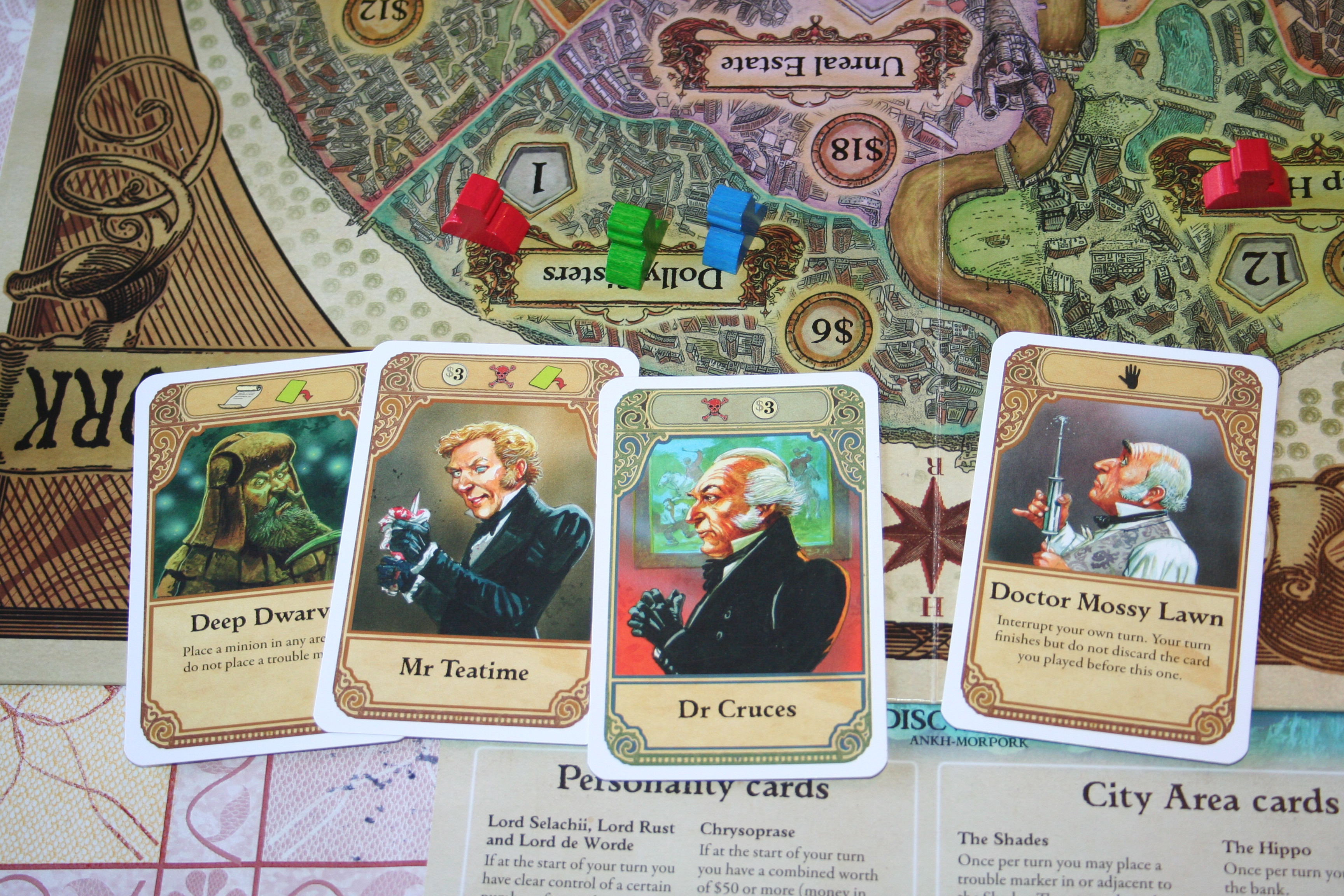
Or this:

Here I was able (from left to right) the place a minion without placing a trouble marker, which can be very a useful at some points in the game, play another card, take $3, assassinate someone, play another card, assassinate someone else, take $3, and I then played Doctor Mossy, to interrupt my own turn and not have to discard Dr Cruces. in this way I was then able to assassinate more people on my next turn!
Here I was able (from left to right) to place a minion without placing a trouble marker; which can be very useful at some points in the game, play another card, take $3, assassinate someone, play another card, assassinate someone else, take $3, and I then played Doctor Mossy, to interrupt my own turn and not have to discard Dr Cruces. in this way I was then able to assassinate more people on my next turn!

There is one card in the deck, called The Peeled Nuts, which is completely useless. All it does, is sit in your hand doing nothing. It has no text on it, and no symbols, and therefore, cannot be played. However, it can be discarded using the text on other cards, or it can be passed to a different player to infuriate them, if they play a card that requires you to give them one of your cards.

 Random Events:

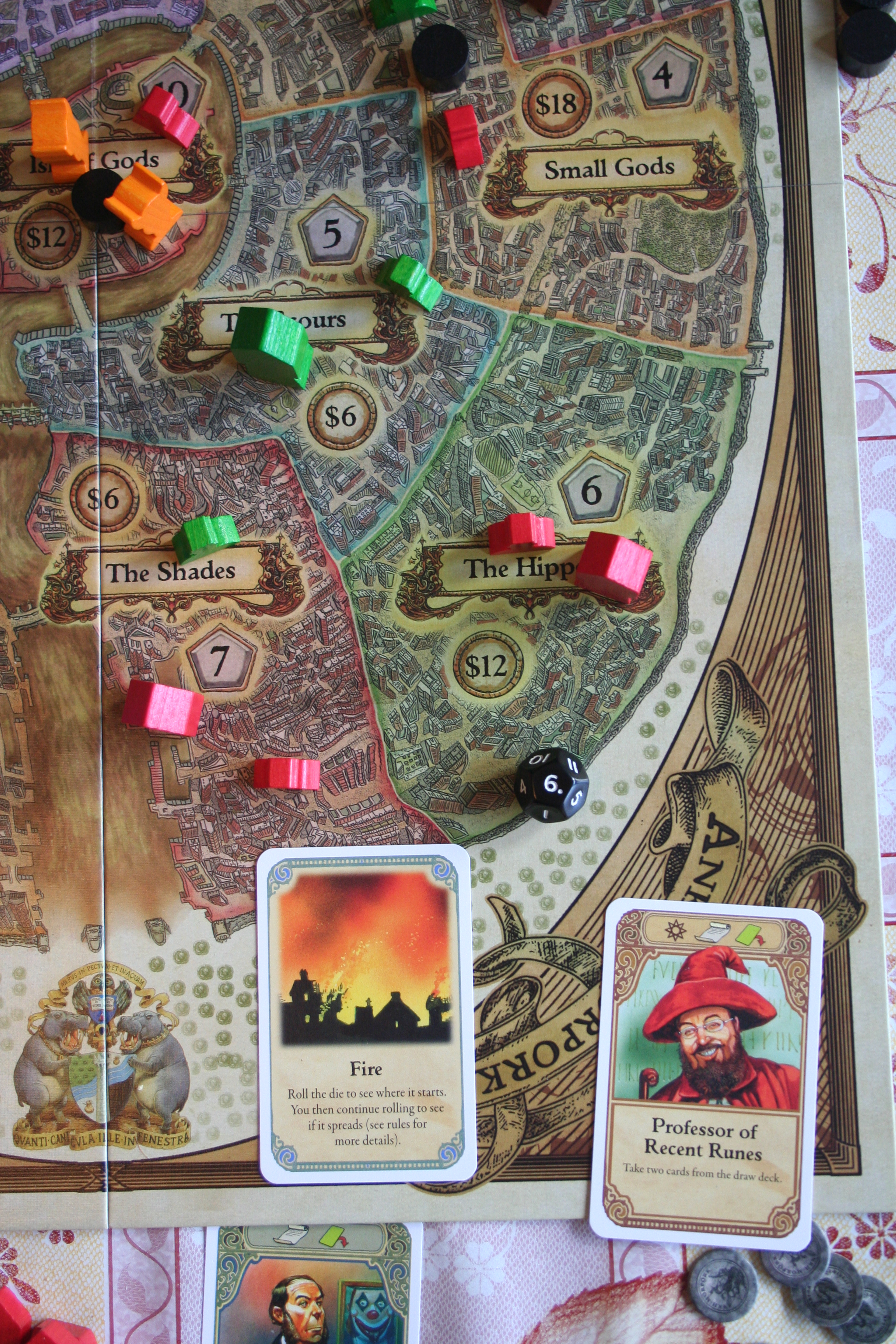
The Random Event are an interesting addition to the game, and represent, for anyone familiar with the Discworld series, real events from the books, such as a dragon lading in the city. There are twelve Random Event cards and they can have drastic effects on the game, or no effect whatsoever, it’s mostly down to the roll of the die and the current set up of the board. Each card will say on it how the consequences of drawing this card should be played, and I’m not going to go through all of them, but as an example of one that can have uncool consequences I’ll tell you about the Fire card.

You can see here, the card that was played that caused the Random Event, and what the actual card looks like, the text on these cards is brief, and tells you our favourite thing - to refer back to the rules!
You can see here, the card that was played that caused the Random Event, and what the actual card looks like, the text on these cards is brief, and tells you our favourite thing – to refer back to the rules! You can also see the City Area rolled, number 6, which means the red house in The Hippo, would now have to removed.

When this card’s drawn, the person that played the Random Event rolls the die to see where the fire starts and, if there are any buildings in the area that corresponds to the number rolled, they’re removed. The player then continues to roll the die to see if the fire spreads, if the next number they roll is adjacent to the area previously rolled, and there’s a building there, this too, is removed. Rolling continues in this way until a number is rolled where there’s no building. If there are no buildings in the areas adjacent to the first area rolled, there’s no need to roll the die again, as the fire cannot spread.

City Area Cards:

The board is divided up into twelve sections, each with a number in it, and a price, shown in dollars. These correspond to the City Area cards available for when a player builds a house. When a player builds a house in an area, they get the card that goes with it, that gives them certain benefits that they can use during their turn, as well as having their house count as one minion in an area, which can be very handy. only one house can exist in an area at one time.

The benefits gained from building houses are as follows (copied directly from the rules):

  1. Dolly Sisters – Once per turn you can pay $3 and place one of your minions in Dolly Sisters or an adjacent area.
  2. Unreal Estate – Once per turn you can draw one card and then discard a card.
  3. Dragon’s Landing – Once per turn you can take $2 from the bank.
  4. Small Gods – Whenever one of your minions or buildings is affected by a Random Event you can pay $3 to ignore the effect. If more than one piece is affected then you must pay $3 for each piece you wish to protect.
  5. The Scours – Once per turn you can discard one card and take $2 from the bank.
  6. The Hippo – Once per turn you can take $2 from the bank.
  7. The Shades – At any point in your turn you can place one Trouble Marker in The Shades or an adjacent area (area must contain at least one minion).
  8. Dimwell – Once per turn you can pay $3 and place one of your minions in Dimwell or an adjacent area.
  9. Longwall – Once per turn you can take $1 from the bank.
  10. Isle of Gods – Once per turn you can pay $2 to remove one Trouble Marker from the board.
  11. Seven Sleepers – Once per turn you can take $3 from the bank.
  12. Nap Hill – Once per turn you can take $1 from the bank.

My favourite place to have a house is The Scours, simply because it’s useful both for drawing more interesting cards, if you don’t have a very good hand, and for giving you money. With the added bonus that, to build in The Scours, it only costs you $6, whereas other areas of the board, such as The Hippo or Small Gods, cost $12 or $18, respectively.

Winning the Game!

Your Personality Card will tell you the different conditions under which a player wins the game, however, there are two other ways to end the game, either a player draws the ‘Riot’ Random Event card,  or the last card is drawn from the deck, and Commander Vimes is not in play. In the event that this happens, all players score up. This is done by adding the amount of money you have at the end of the game, to the total value of any properties held (minus any loans you may have taken from the bank at any point in the game) to the amount of Minions you have on the board. Each Minion is worth five points. If you’ve taken a loan and cannot pay it back, you lose fifteen points from your total score. Then the player with the most points wins.

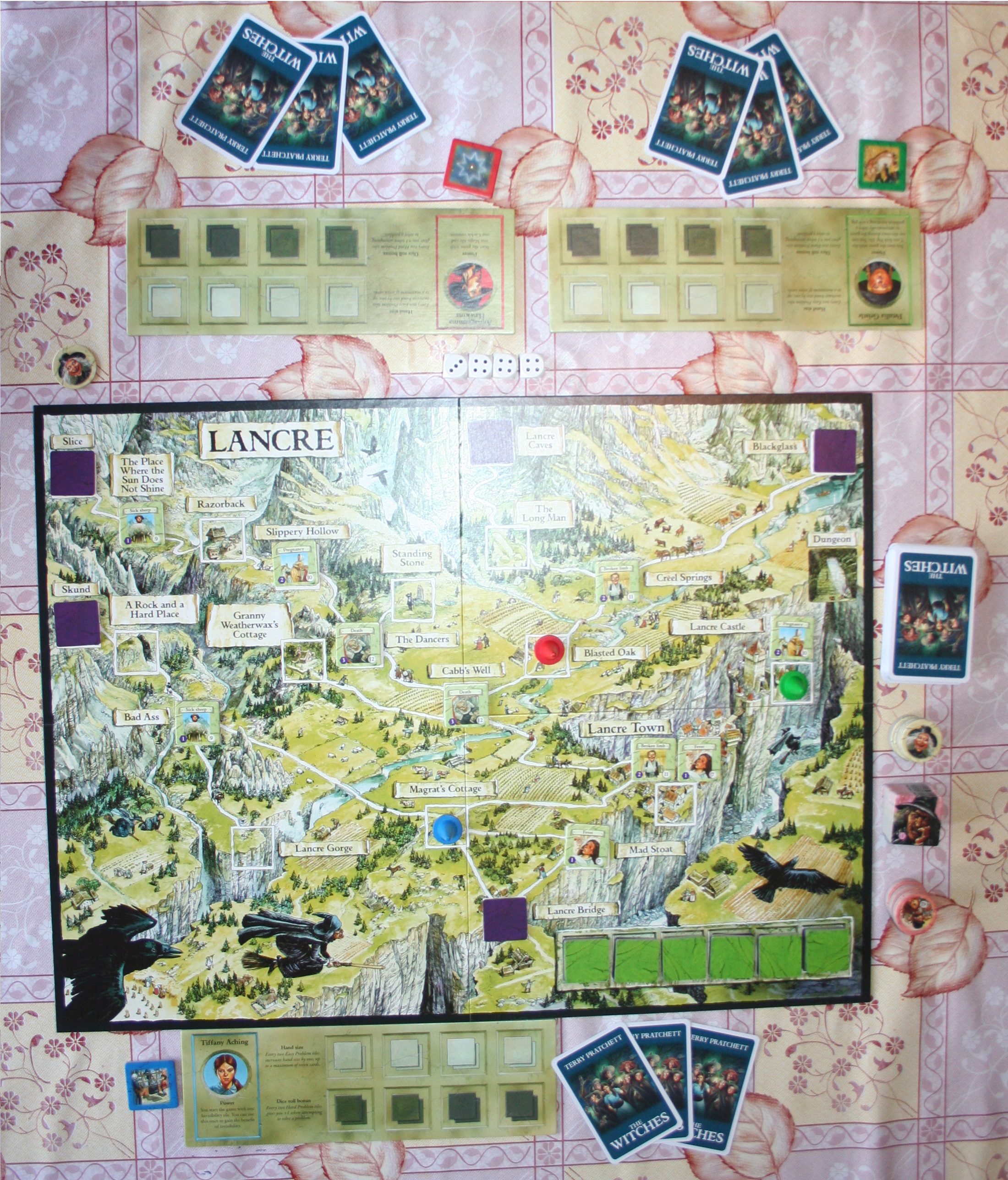
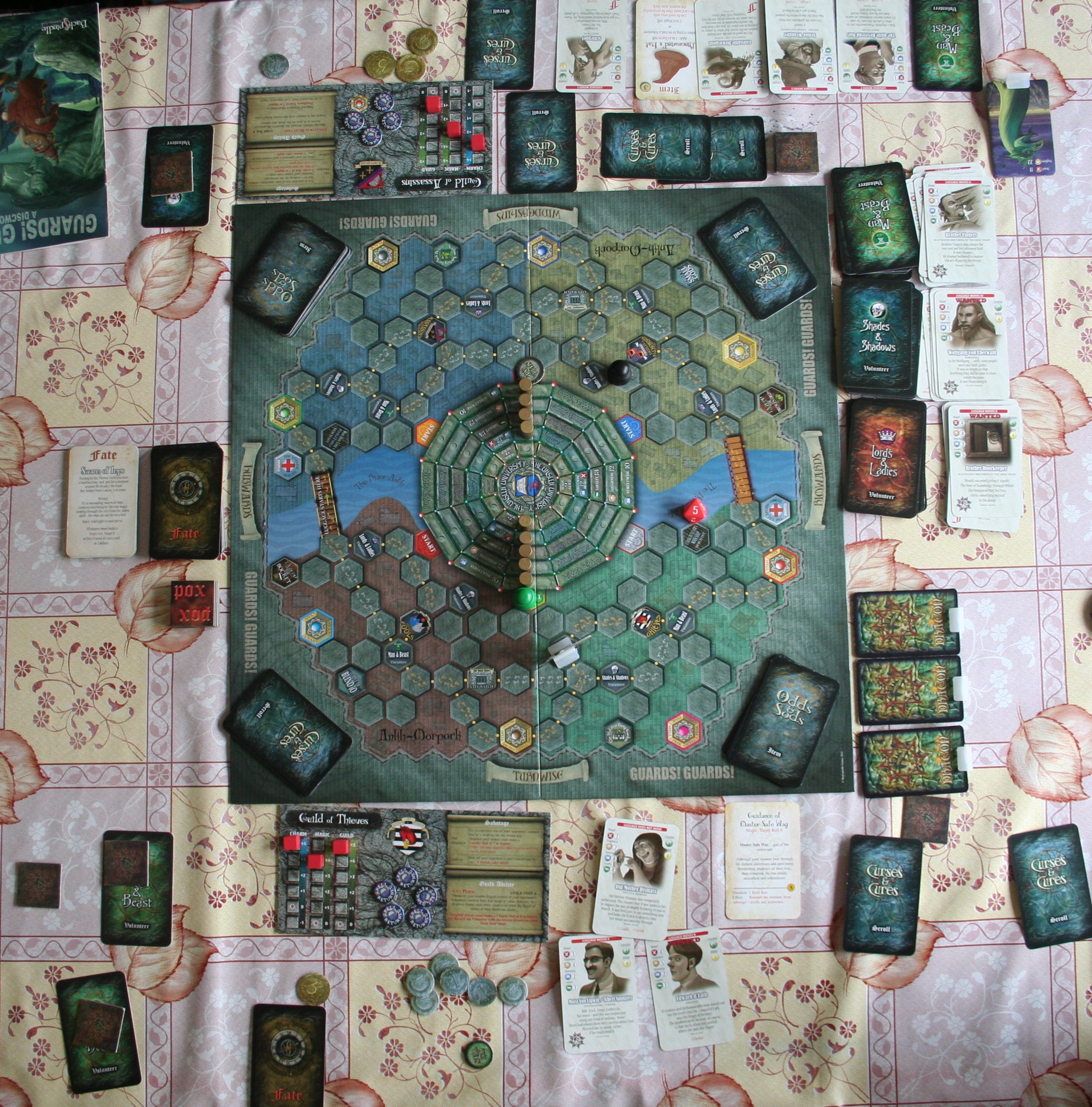
The board at the end of the game. All the Demon and Troll pieces are in play, although I haven't explained them to you - play the game to find out what they're all about!
The board at the end of the game. Commander Vimes has won. All the Demon and Troll pieces are in play, although I haven’t explained them to you – play the game to find out what they’re all about!

Strategy:

Because you want to try and make it as difficult as possible for anyone else to win, whilst secretly carrying out your own objective, double-bluffing plays an important part in this game. One of the sneakiest ways to win (and one that Dave has employed on a few occasions) is to play very well as a personality you’re not to convince everyone that that’s what you’re going for, whilst simultaneously building up to your real objective. I am terrible at this aspect of the game; I once managed to successfully confuse my sister by not actually playing my objective at all. For the whole game she thought I was playing as a personality I wasn’t, simply because I decided I wasn’t going to be able to achieve it, and therefore didn’t try.

Whilst keeping your personality for the game a secret from everyone else plays an important part in how easy it is for you to win, luck of the draw is also a key feature. If you get dealt useless cards, and as a result cannot either advance your own objective, or hinder someone else’s, you just have to keep playing cards hoping that you’ll pick up something much more useful.

History and Things:

There’s not a lot of history around on the game, because it was published so recently, so instead I’m going to provide you with fun facts about the historic city of Ankh-Morpork (you may begin to see parallels between some of these facts and some old stories from our universe):

  • Legend tells us that the city of Ankh-Morpork was founded thousands of years ago by twin brothers, raised by a hippopotamus.
  • The original city was a walled keep, built to protect the Tower of Art. The origins of the Tower are unknown and may well pre-date the Disc itself.
  • At one point it had an Empire that spanned half the Disc, largely the creation of General Tacticus, who later, in his role as King of Genua, declared war on it.
  • There was a Golden Age of Kings in Ankh-Morpork, whom legend recalls to be wise and noble and fair, this line died out around 2000 years before present day, and was then replaced by more realistically corrupt and (occasionally mad) rulers, as referenced in Men at Arms.
  • The Age of Kings ended completely in Ankh-Morpork when “Old Stoneface”, Commander of the City Watch at the time (and ancestor of the current Commander, Sir Samuel Vimes, the Blackboard Monitor), executed the last king, Lorenzo the Kind, who, amongst other things, reputedly was “very fond of children”.
  • From this point forward the Patrician has ruled the city. But like the kings, there have been many who were mad and oppressive.
  • Lord Vetinari replaced Mad Lord Snapcase as Patrician at some point following the revolt in Treacle Mine Road in Night Watch.
  • Under Vetinari the city became multi-cultural as he opened the city to immigration, gradually inviting in all other nationalities as well as species. His pragmatic view on multiculturalism being “Alloys are stronger”
  • Although Vetinari is the tyrant of the city, the only real sign of his tyranny is the banning of Mime Artists. Anyone caught practising Mime is hung upside-down in a scorpion pit with “Learn the words” written on the walls.
  • Lastly, over the course of the Discworld series, the avid reader will see Ankh-Morpork develop from a crumbling, ruinous city, to a well-greased(ish), organized (sometimes), thriving (definitely) city, the second most developed nation on the Disc – after the Agatean Empire.

Further Reading and Other Editions of the Game:

Although the game is pretty new – only three years old – there are two other editions of the game that we don’t have. We own the standard edition of the game, but Treefrog (who publish the game) have also released The Collectors Edition; which comes with wooden coins, a larger board, and a custom twelve-sided die, and the Deluxe Edition, which is the same as The Collectors Edition, but also comes with resin Minions, Buildings, Trolls and Demons.

For further reading I would just recommend you go and read all the collective works of Pratchett. Which should keep you out of trouble for a while!

Conclusions:

3800 words too much? I don’t think so! I actually wanted to write a lot more about this game than I have, if I’d continued as I wanted, I’d have explained every possible Random Event, and given an in-depth consideration to the best way to win as each personality… But in the interest of not making this post any longer than it already is (which is fairly long), I’ve stopped.

I’ve rated this game a five at the top of this post, and Dave agrees with me. It’s possibly one of the best games I’ve ever played, brilliant in conception, design and execution. The rules have little to no ambiguity about them, the cards and personalities are interesting and accurate to the books; providing a few jokes for those that know the series, or just an interesting time for anyone that doesn’t, and the actual pace of game play is excellent. As with most games it’s best played with the full four players, but three’s also a good game, and it’s only with two that the game starts to drag a little, and I think that’s only because it’s much easier to work out what your opponents objective is, and therefore thwart them.

In all, a game that everyone should now go away and play; play it with your brothers, sisters, parents, cousins, friends, dog, neighbours, people you meet in the super market… The possibilities are endless, just play this game!

Special thanks to Wikipedia for all the additional information! I spent far too much time reading it, instead of writing the post, but anything else you wish to know about Ankh-Morpork can be found here.

Thud

2.5 - 5

Number of Players: 2

Year of Publication: 2002

Creator(s): Trevor Truran – Inspired by the books of Terry Pratchett

Thump…Sorry I mean Thud!

Thud is the first Discworld board game! The first of four (true at time of publication) to be precise. It’s a product, initially, of the genius mind of Terry Pratchett (if you are unaware of Terry Pratchett check out this months update post for more details on him HERE!)

What’s in the Box:

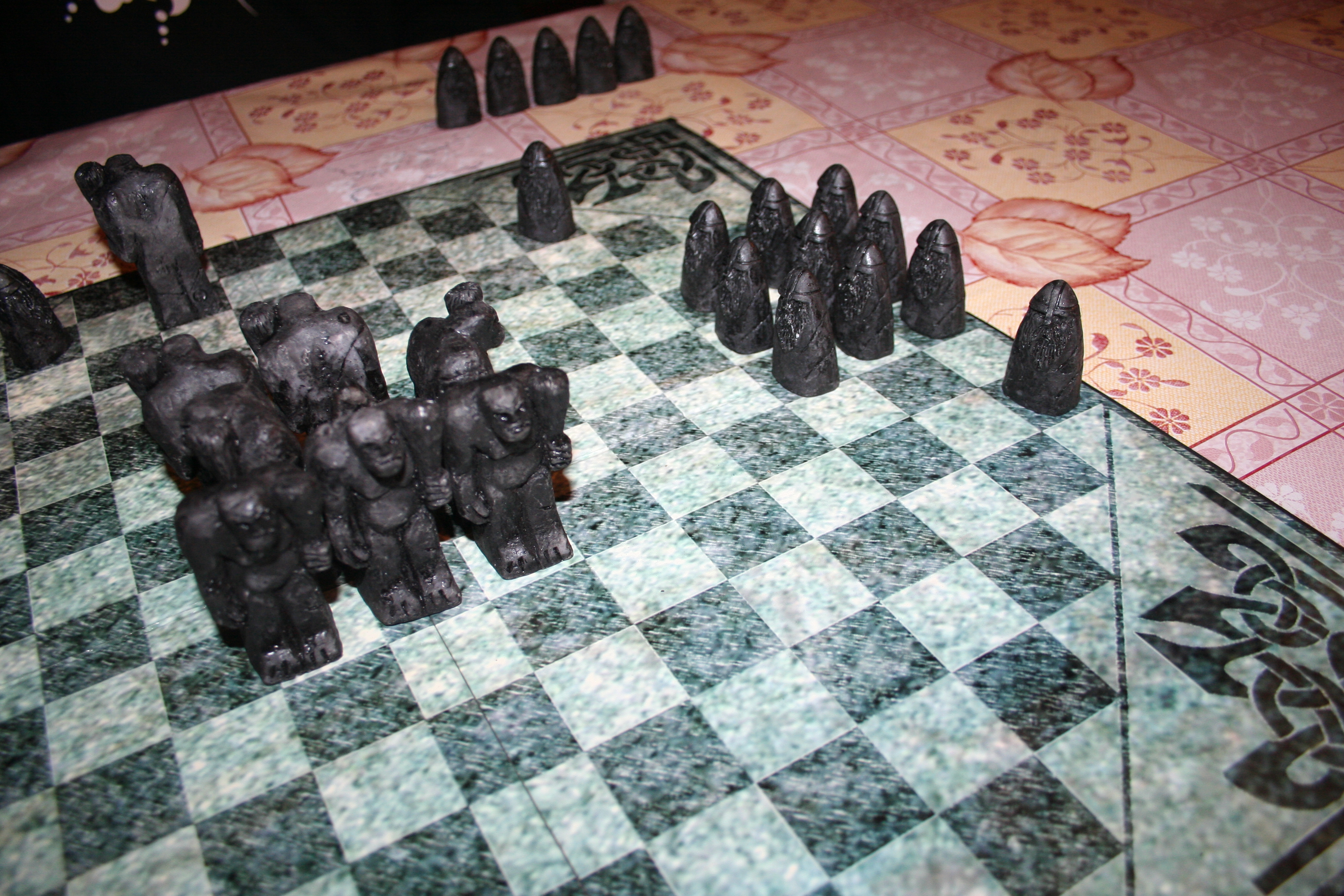
This is the Terry Pratchett game with the fewest pieces.

The Stuff.
The Stuff.
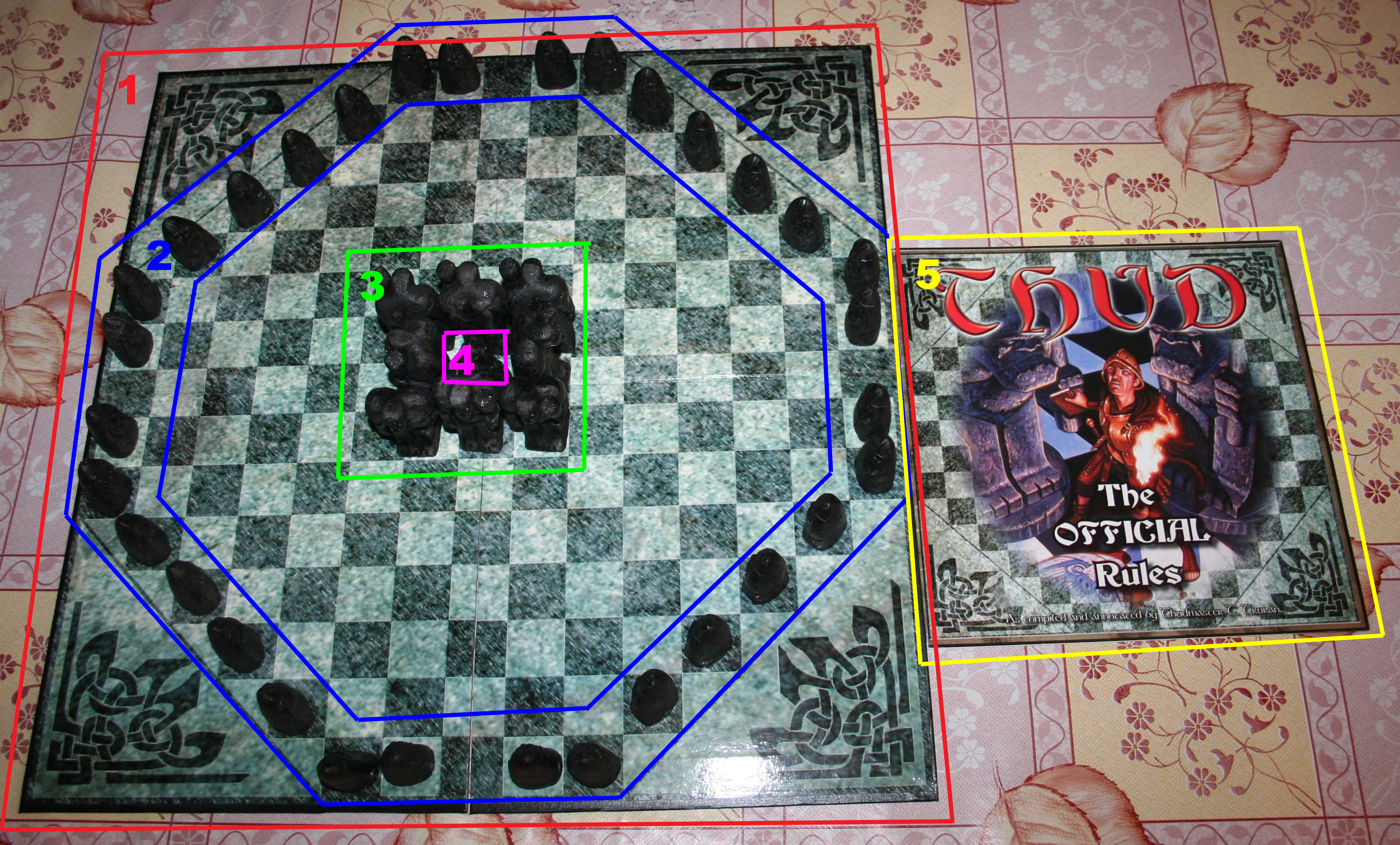
  1. A game board. With an Octagon of squares on it.
  2. 32 Dwarf pieces.
  3. 8 Troll pieces.
  4. 2 different thud stones.
  5. An instruction booklet.

Playing the Game:

The objective of the game is to capture as many of the other players pieces, while losing as few of your own pieces as possible.

To see the rules in full, look here, but I’m going to give a brief overview anyway:

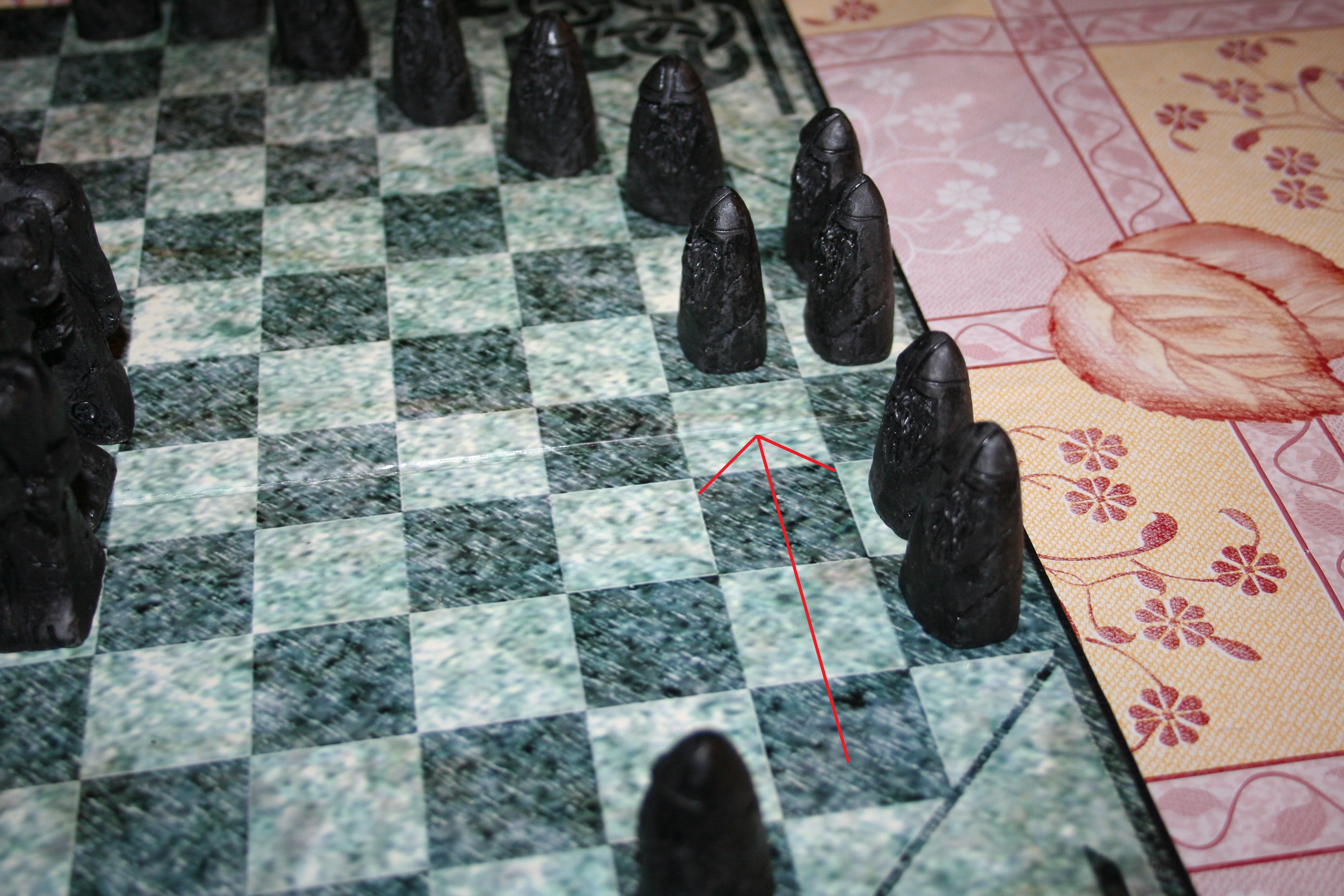
Dwarfs move first; they can move any amount they like, in any direction, so long as it’s in a straight line and there’s nothing in the way, like this:

IMG_0459
The first Dwarf move.

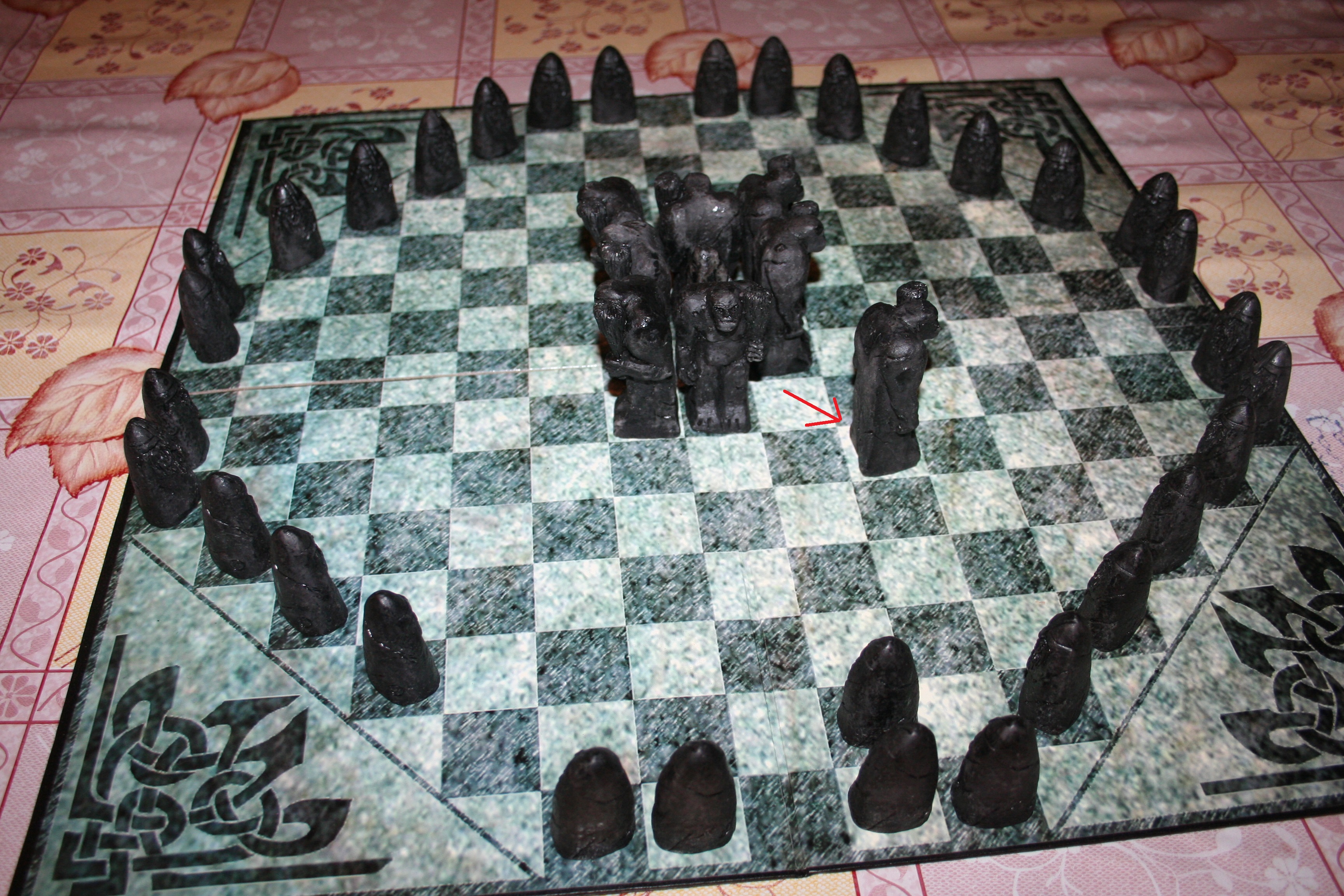
Then the trolls move; they may only move one square at a time in any direction, as they are large and slow. Like this:

First Troll move.
First Troll move.

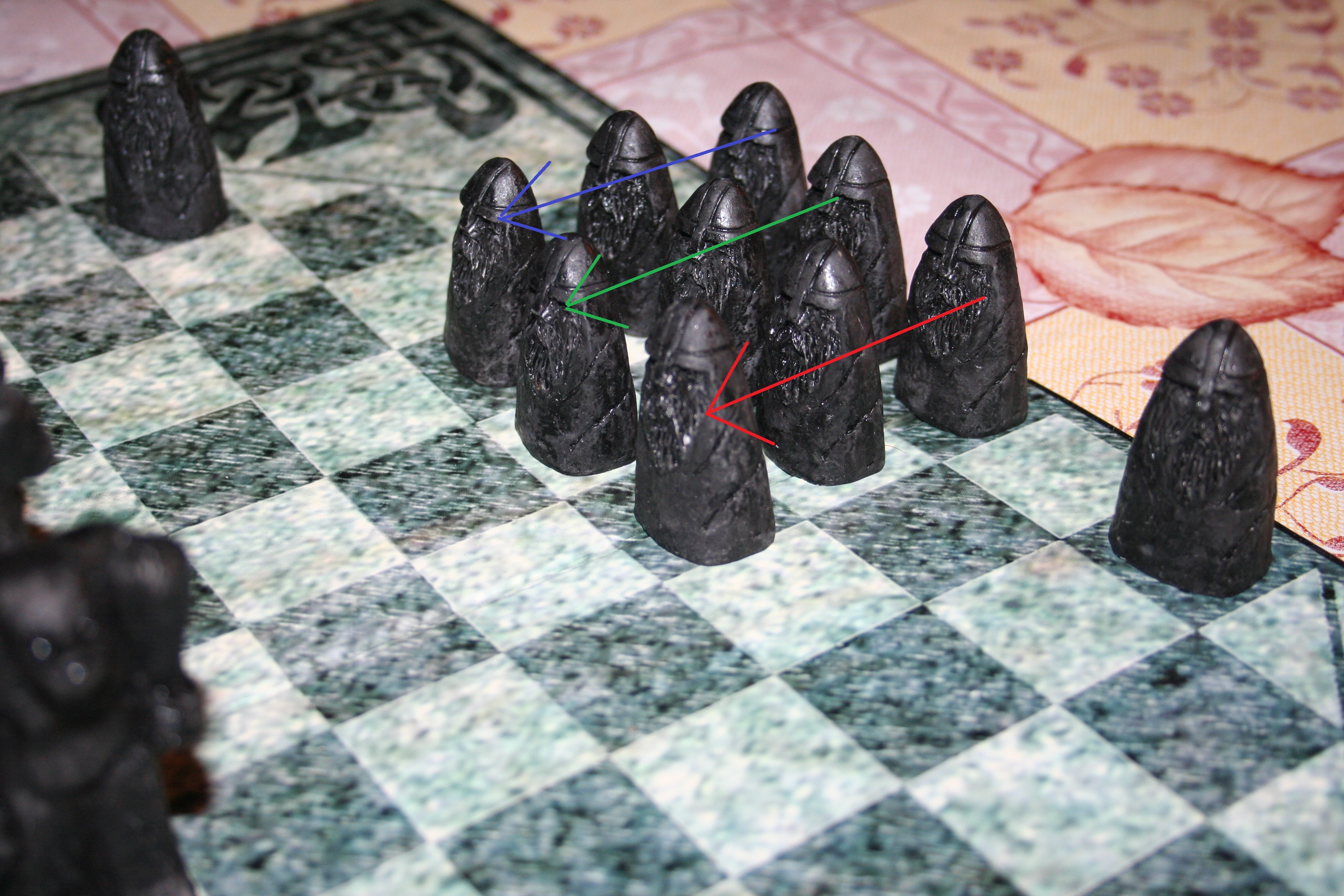
To take another piece a dwarf cannot just go to the same space as a Troll, he must be thrown at the Troll by a line of Dwarfs behind him. Like this:

Each arrow shows formed lines ready to throw the front Dwarf. The lines also apply on the diagonals and horizontals but it just looked like a mess if I drew that many lines.

The number of Dwarfs in the line determines how far the front Dwarf may be thrown.

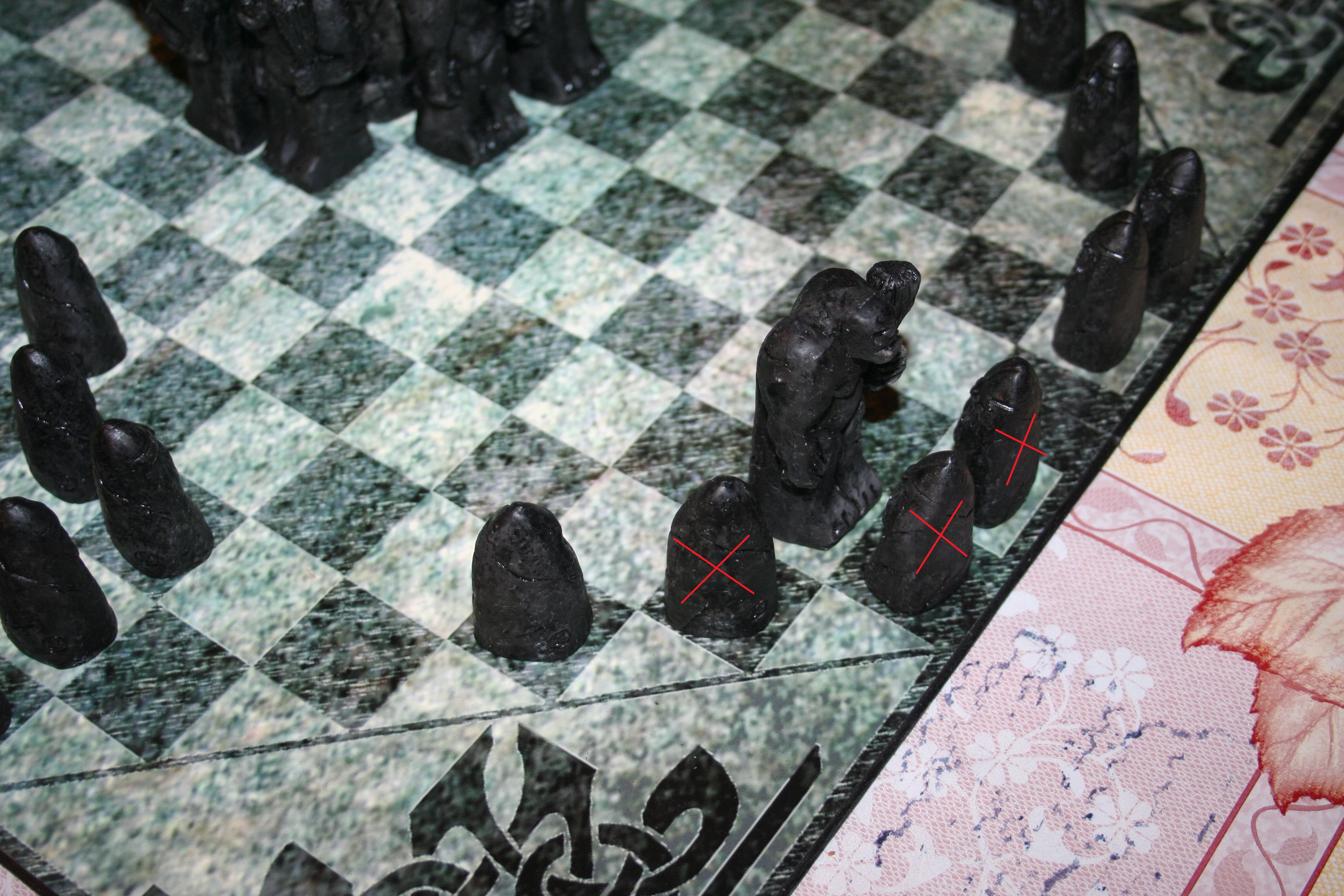
Trolls take by moving next to Dwarfs, any Dwarfs adjacent to it are taken.

So all of the Dwarves marked with red crosses would be taken.
So all of the Dwarfs marked with red crosses would be taken.

Trolls can also form lines like the Dwarfs and shove the front one of their line, depending on how many Trolls are lined up behind it.

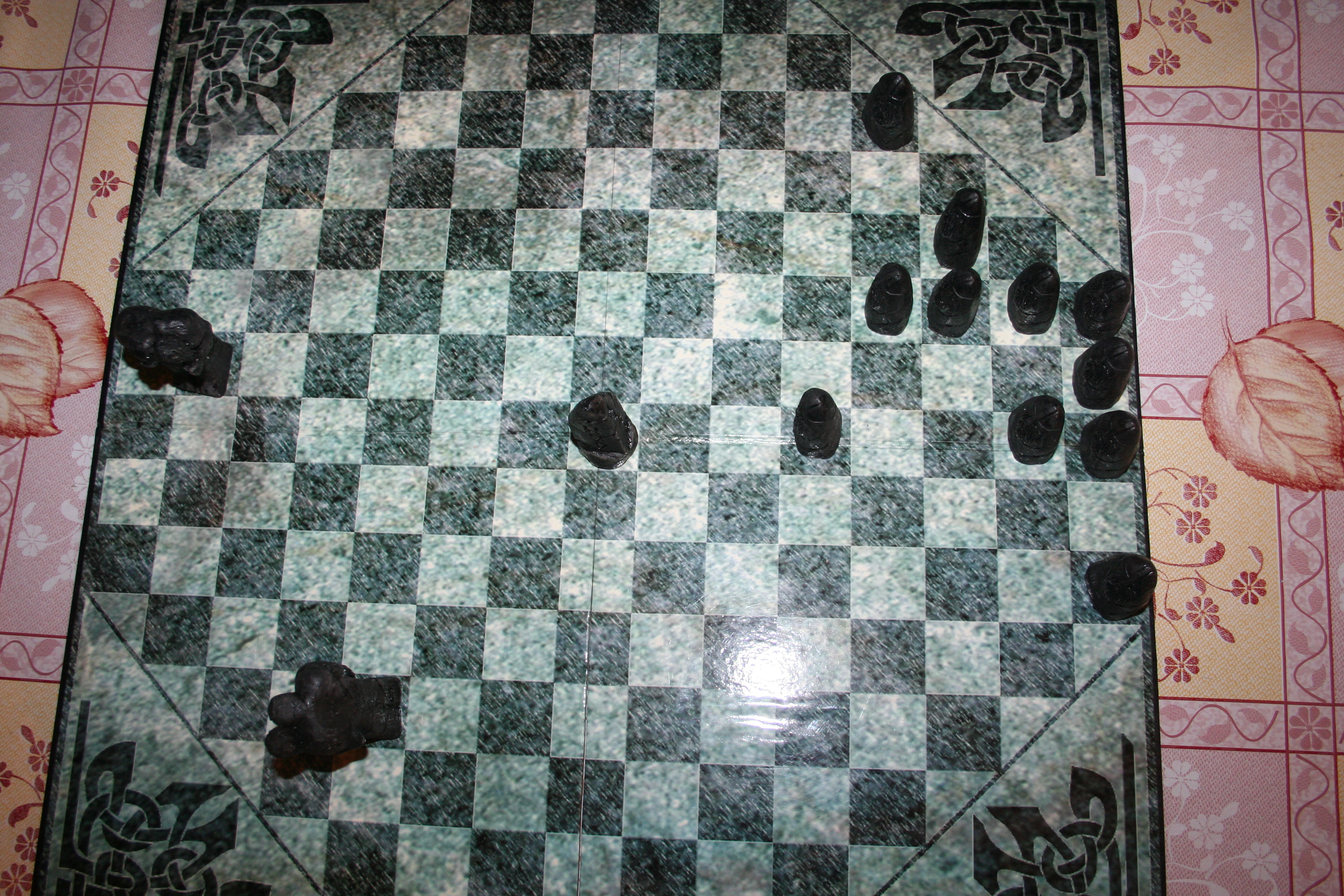
The game is over either when one person loses all their pieces, or (much more likely) when you communally decide there’s no point continuing play because the trolls will never capture their Dwarfs and/or the Dwarfs don’t have enough pieces to form a line to take any Trolls.

Like this.
Like this.

Then you add up the amount of points that each player has left on the board; a Dwarf being worth 1 and Troll being worth 4 for their respective players. You then switch sides and play again, the total of both games determining the winner.

Strategy:

Now the strategy of the game is very interesting and also potentially very complex. Not being a master of it I’m just going to focus on one aspect we noticed to be rather crucial if you want to win as Dwarfs.

This is… FORMING A SQUARE… Like this:

IMG_0466This is super useful and basically the most practical (and likely) way to win as Dwarfs! By forming a square like this you make it very hard for the Trolls to approach you without being taken. Because any angle they approach you from is going to be on a line that you can throw on, and therefore take them.

To break your square they then have to sacrifice a Troll OR form a shoving line, which is easy to disrupt by adding additional dwarfs to your square to make the distances you can throw greater.

History and Interesting Facts:

  1. Thud was first mention in Terry Pratchett’s book Going Postal it then became the focus of the following book Thud
  2. The origin of the game is the Battle of Koom Valley, which it supposedly represents.
  3. If I’m understanding this correctly Trevor Truran created the game and it was published in 2002. Terry Pratchett, approving of the game, then worked the complete version of it into the Discworld universe, talking about it in Going Postal, published in 2004.
  4. In Dwarfish it is called “Hnaflbaflwhiflsnifltafl“.
  5. Which the beginning of the word bears an interesting, and ridiculous resemblances to the name of the Norse game Hnefatafl on which the game is based.
  6. The release of the book Thud! lead to a special edition of the board game being released, the Koom Valley Edition, where the pieces were produced to look more like the cover art from the book.
  7. The fictional creator of the game is Morose Stronginthearm who created the game for the Low King of the Dwarfs.
  8. There is another way of playing the game which we have not covered in this post (and also I have to admit I haven’t played). This is Koom Valley Thud and is played with the same amount of pieces and the same board shape as normal Thud but the starting up is different, as are the rules.
  9. Fictitiously the game of Thud was devised as an alternative to the fighting.
  10. Fictitiously the game is supposed to be played once from each side to make up one match in order to teach the merit of seeing things from both sides. This also has real world application.

Also there are ways you can play online on the official site, to do that see here!

To Conclude:

I like Thud, it’s a good game, it has a good concept and is quite well balanced once you’ve got the hang of being each side. However it just doesn’t grab me in the same way some of the other Discworld board games do. I don’t find it half as playable/re-playable. I’m not exactly sure why, because you would imagine it would appeal to someone who likes Chess… And it does… For maybe one game every 6 months.

Update – February 2014

This month is going to be themed Terry Pratchett month (or more like, board games inspired by works of Terry Pratchett) but that’s somewhat long winded! If anyone reading this is unaware of Terry Pratchett and his works, you must be educated now! Start by clicking THIS hyper link and picking a book, then buy it, then start reading. You could start at the beginning (a very good place to start) with The Colour of Magic. Then watch at least a couple of the films made from his books (I would suggest Hogfather followed by Going Postal) then even perhaps find the stop motion version of Truckers (which you can watch on YouTube HERE) and watch that (its not half bad) and then watch the animated TV series of Wyrd Sisters and of Soul Music. And after all that perhaps even listen to the Steeleye Span album Wintersmith inspired by the book of the same name. Then after you’re familiar with all that come and finish reading this post and then play the board games!

We’ve reviewed the games in publication order going from oldest to youngest and the last one will be the newest game we have looked at so far, having only been published in 2013.

Games for February: – Terry Pratchett

Monday the 3rd – Thud

Monday the 10th – Ankh-Morpork

Monday the 17th – Guards! Guards!

Monday the 24th – The Witches

Other Things to Note:

To my infinite disgust we now have a Twitter page. It took us a while, but we finally came to terms with the thought that it might be a good idea. Check it out HERE! Follow it etc.

The Twelve Games of Christmas – 2013 page is GONE! Having finally let go of the Christmas magic we took the stand alone page down. However the individual posts can still be found and brought together if you click on the category for them.

We have some very exciting ideas for future video blogs but are fundamentally stumped by our lack of a decent camera, but good ideas are in the works and will hopefully be a reality in a few months or less. SO, for now you’ll have to live with videos like the one we made of the game play of OSKA – which you can see HERE!

Along with Breach The Keep we have two other games in the works. One is a card game called Crush the Crown! Which we will be posting the rules for soon and hoping for (but not expecting) some feedback! There is another, far cooler, project in the works which will be posted about soon, so definitely look out for that.

This may be a premature announcement but we are having a website built to host internet versions of games we design starting with Breach The Keep. However, it’s in early stages, but is coming along nicely so expect it, but not for half a year or so.

And don’t forget to like us on facebook HERE!

Go!

3 - 5

Number of Players: 2

Year of Publication: Unknown

Creator: Unknown

Strategist? Don’t Plan Wars, Play Go!

Go is a strategic two player game which dates back some 3-4,000 years in age. It’s got initially very simple rules, but will probably take me the rest of my life to get anywhere close to good at it as it requires a dimension of thought I don’t believe I currently possess. I was introduced to it by a friend back in September, she tried to teach me the basics in a pub one evening, using a Chess Board and Draughts pieces. Needless to say, the outcome was a little interesting and involved me losing spectacularly and being completely confused for quite a while.

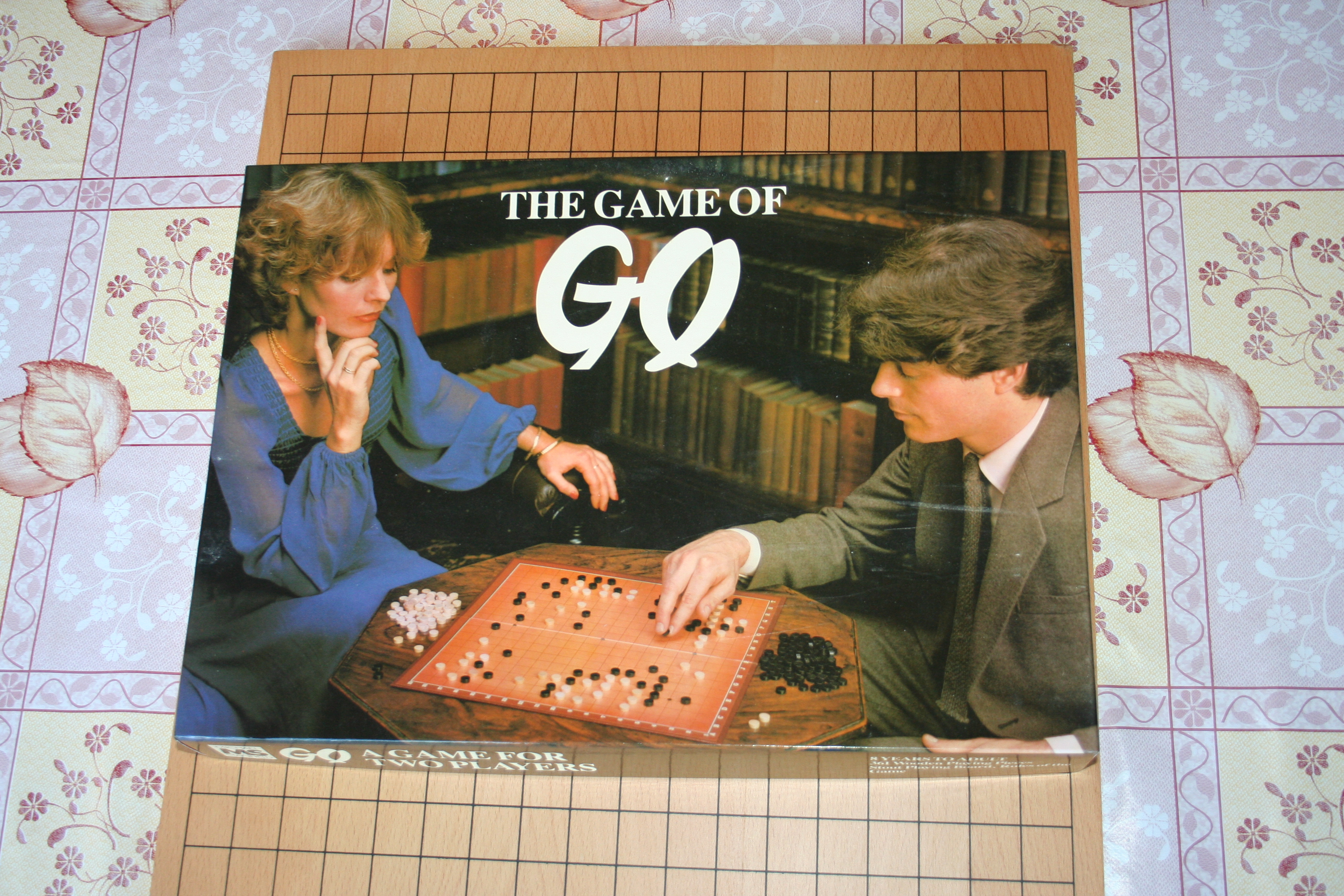
My copy of Go, the box is very 80's...
Our copy of Go, the box is very 80’s…

What’s in the Box:

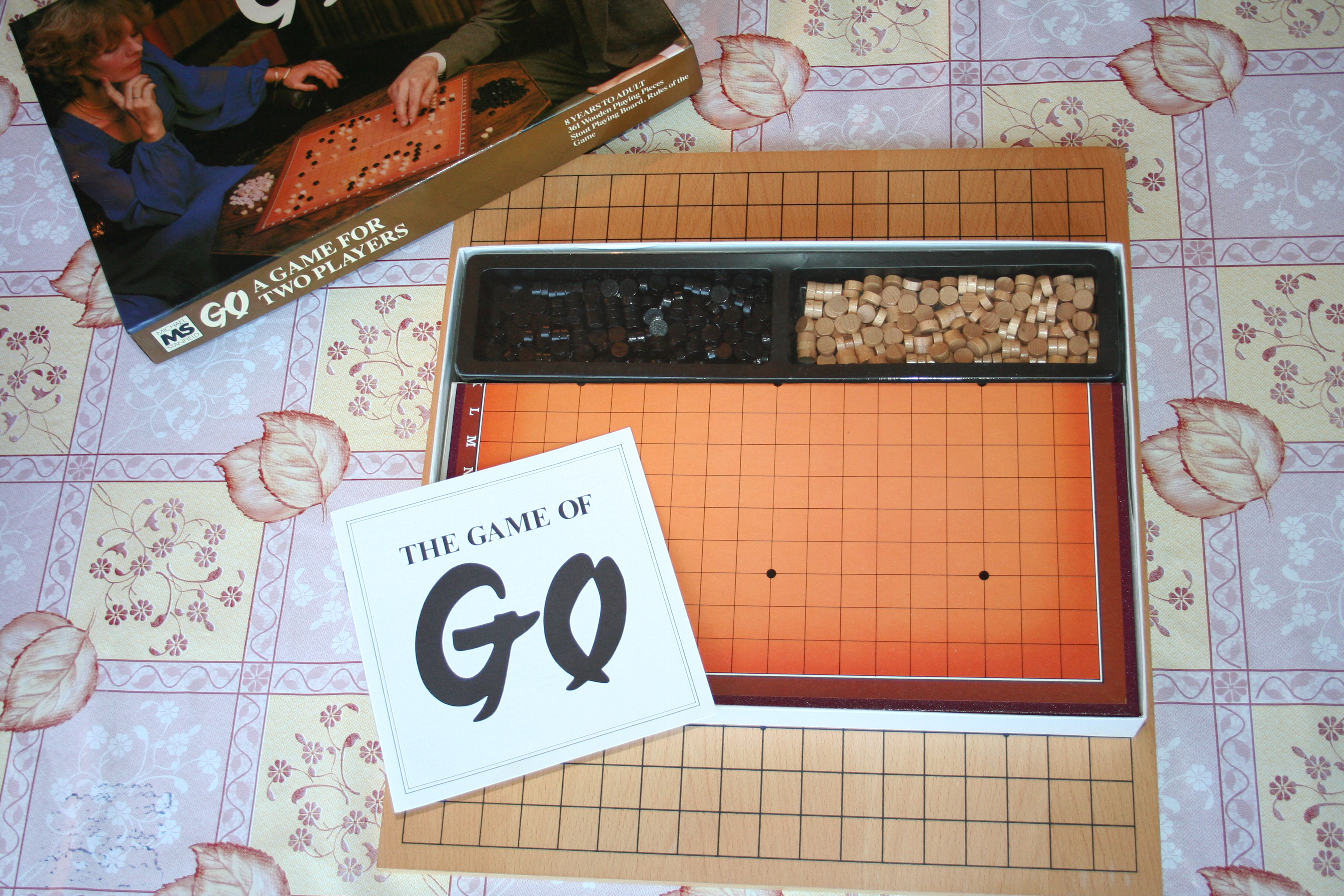
As you can see, the contents of the box, is thoroughly unexciting.
As you can see, the contents of the box is thoroughly unexciting.

Inside the box you’ll usually find:

  1. A board (I have acquired two boards for the game, as the one in the box is bent, and therefore, given the size of the pieces, fundamentally useless).
  2. The instructions, very handy for the point when you realize you’ve been playing one of the rules wrong for the entire game.
  3. 180 white playing pieces.
  4. 181 black playing pieces.

Playing the Game:

Objective: To surround empty areas of the board and capture your opponents pieces.

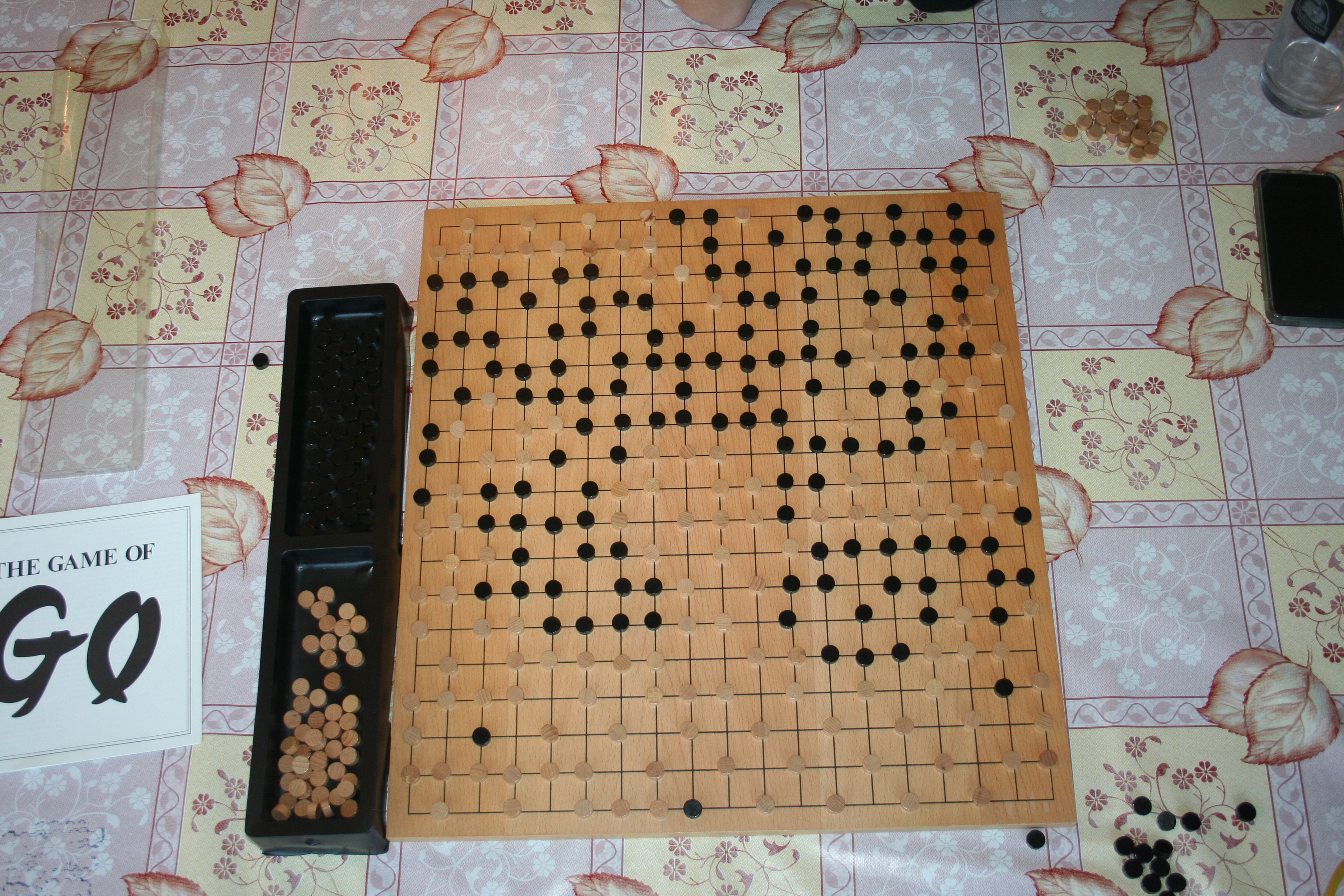
This is what our board looked like at the end of the game, for anyone who plays Go properly, it probably looks horrendous as this is only the third time i've played this game
This is what our board looked like at the end of the game, (you can’t really see the white pieces, but they are there) for anyone who plays Go properly, it probably looks horrendous as this is only the third time i’ve played this game

The Rules:

  • Players move by playing stones on the intersections on the board with Black playing first.
  • Once a stone has been played on the board it cannot then be moved unless it is captured – captured stones are removed from the board.
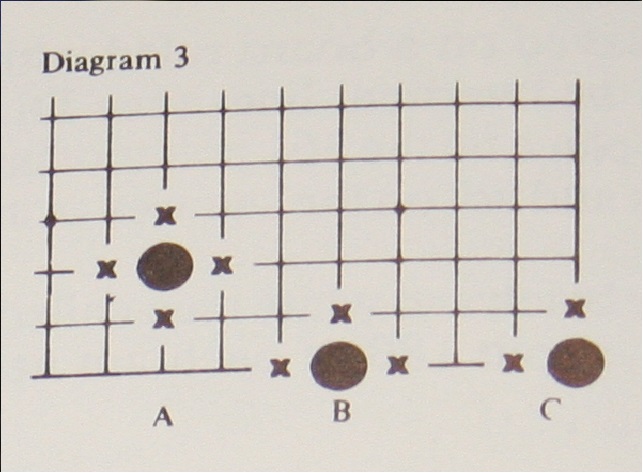
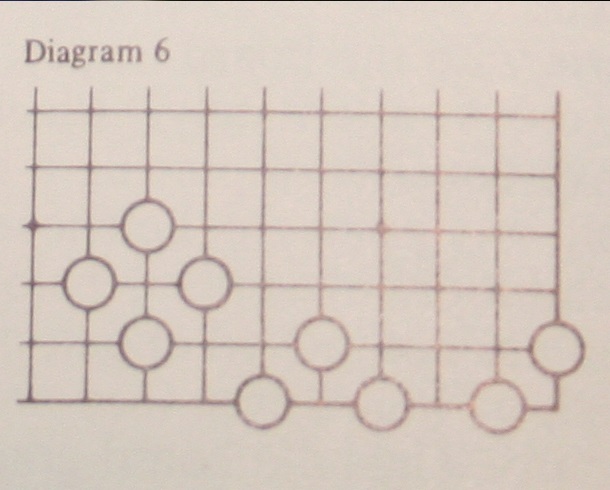
  • To capture a stone the opposing player must closely surround it, cutting of all its “liberties”. Liberties are the four lines extending out from the intersection a piece is played on. If all four of these are blocked on the next closest intersection, that piece is captured.
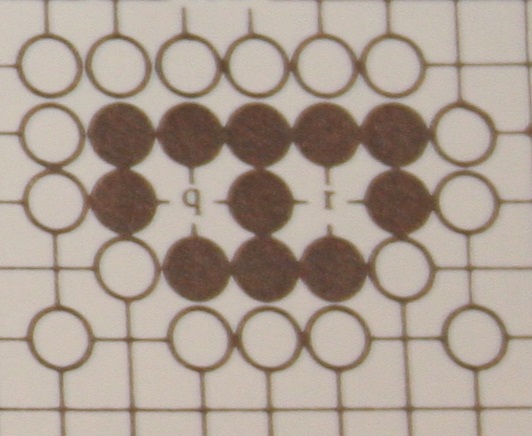
Three pieces placed in different locations on the board. Their Liberties are marked with small X's. This shows which lines must be blocked to capture a piece.
Three pieces placed in different locations on the board. Their Liberties are marked with small X’s. This shows which lines must be blocked to capture a piece.
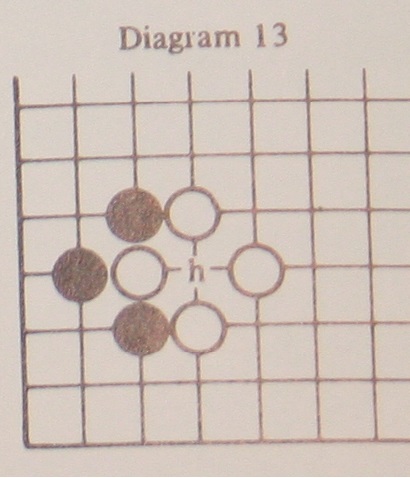
  • Once a space like this has been created it is called an Eye, the space in the middle of the Eye cannot be played on by the other colour player, as this move is suicidal – your piece would be captured as soon as it had been placed – however, in the event that playing this piece caused one of your opponents pieces to be captured, thus freeing up one of the Liberties for the piece in the centre of the Eye this move becomes legal.
Here white has made three successful Eyes, the spaces in the middle cannot now be played in by black.
Here White has made three successful Eyes, the spaces in the middle cannot now be played in by Black.
Now black can play inside whites Eye because the move would result in capturing the left hand white piece, thus creating a new Liberty for the played piece
Now Black can play inside Whites Eye because the move would result in capturing the left hand white piece, thus creating a new Liberty for the played piece
  • Stones played on the edge of the board only have three Liberties and can be captured in the same way as other pieces.
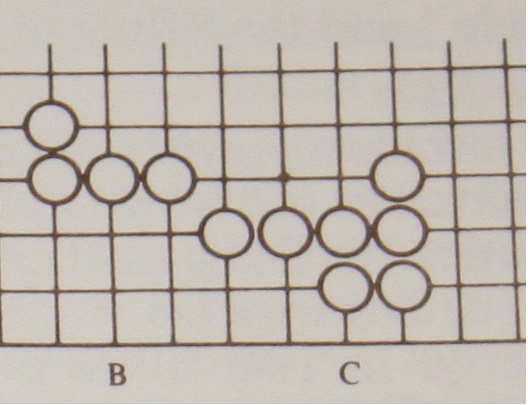
  • A player can create an Army by playing one of their stones on the Liberty of another of their pieces, these are now connected and to capture them you must block all of their combined Liberties.
  • Armies can be continually extended by connecting Liberties but it’s important to note that diagonal connections do not count.
Here white has created two armies, although they are next to each other, the diagonal on which they are connected doesn't count
Here White has created two armies, although they are next to each other, the diagonal on which they are connected doesn’t count.
  • Once a player has created an Army, their opponent cannot take individual pieces, the Army must be captured as an entire unit, or not at all.
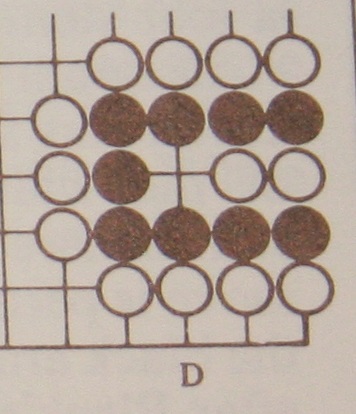
  • Any Army that encloses an empty space on the board must also be captured from the inside, once all external Liberties have been surrounded the capturing player must play a stone on the available intersection(s) inside the Army to remove it from the board.
White has completely surrounded Blacks army, all they need now do is play one piece in the remaining space inside the army.
  • If a position is reached where one player acknowledges that there are some stones on the board that cannot avoid being captured, their opponent can remove these stones as prisoners at the end of the game without needing to further occupy their Liberties, this can only happen if both players agree.
  • Ending the Game: Theoretically a player can pass a turn, by handing over one piece from their unplayed stock to their opponent as a prisoner. Once both player pass in succession, the game is over. However, in practice, the game usually reaches a point where all available territory has been securely surrounded by one player or the other and there can be no dispute about whether or not any groups of stones can still be captured. Now the game ends by mutual agreement, and points are scored to determine who wins.
  • Scoring Points: points are scored by counting up the number of empty intersections left on the board surrounded by each colour. Captured pieces also give a bonus of one point each and these two scores added together determine the winner.
  • Illegal Moves: There are only two illegal moves in Go; The “Suicide Rule” and the “Rule of Ko”. The Suicide Rule forbids a player to place a piece in a location that would cause it to immediately be captured, as I said before. The Rule of Ko is much more interesting, “Ko” is a Japanese word meaning “eternity”, this rule was invented to prevent the game reaching stalemate. This rule forbids a player to move in a way that leaves the board in exactly the same position as his or her previous move.

Strategy:

Go is essentially a tactical game, and therefore probably not one i’m going to excel at any time soon, but it is very interesting to consider the different angles of play. Interestingly, games like this (and also Chess) can reveal a lot about a person. Whether you play defensively, aggressively or recklessly, it can be a challenge to restrain your natural instinct towards your chosen method of going about things in the interest of actually winning the game.
Having played the game so few times there’s not much I can give in the way of tactics, but there is one type of play that’s so well-known and used that it’s more or less become a standing play, something that features in every game.

INVULNERABLE ARMIES:
If one player has managed to create an Army, and there is an empty space inside this Army, they may intentionally place pieces inside the Army to create Eyes there. If a player manages to create an Army with two or more Eyes in the centre, this Army cannot be taken, as placing any piece here would be suicide and there is no way to simultaneously cut off all its Liberties.

Because Blacks army has two Eyes, there are now no circumstances under which it can be captured.

History and Interesting Things:

  1. Although the game is thought to have originated in China it became really popular in Japan, where, in the early 17th Century, stipends were awarded to the four strongest Go players, by the Shogun. These were then later extended to their heirs, and so the four Go schools; Honinbo, Hayashi, Inoue and Yasue were founded.
  2. Over the following 250 years the four Go schools encouraged such rivalry that a ranking system was set up with nine grades of Go player, the highest of which is Meijin, meaning “expert”. This title was only held by one person, and only achieved if one player managed to out-class all their contemporaries.
  3. Meijin Dosaku is considered the best Go player in history, and was the fourth head of the Honinbo school, which was easily the most successful of the four, producing more Meijins than the other three schools put together.
  4. In 1868 professional Go was undermined in Japan as the Shogunate collapsed and the Emperor was returned to power.
  5. A game of Go once decided the future of Tibet when the Buddhist ruler at the time refused to engage in a battle and instead challenged the aggressor to a game of Go.
  6. Go is followed as avidly in the Far East as sporting competitions are in the West, professional players from Japan, Korea, China and Taiwan become national heroes in their home countries.
  7. By 500 BC in China, Go was already one of the “Four Accomplishments” that had to be mastered by a Chinese gentleman.
  8. In Europe the game was not played at all, despite having been described and written about by European travellers going to the Far East, until 1880.
  9. Britain has been playing Go for at least 100 years now, and currently our top ranking player is Matthew Macfayden (not to be confused with actor Matthew Macfadyen)
  10. Prior to the last 20 years, games of Go  were rarely played between Go masters of different nationalities, the game has been advancing hugely in recent years, in part thanks to the internet, there are many servers for Go players of all levels now, encouraging the continued growth of the game worldwide.

For the Super-Interested…

So that’s the end of this somewhat lengthy post about Go. It currently rates 3/5, not because it’s anything less than a brilliantly concieved game, but because the tactical development involved in learning to play the game is complicated, and I think that to play well, one would actually have to study the game. So learning it is quite an undertaking, for the willing individual.

If anyone’s interested enough to actually want to learn how to play this game properly (something that i’m now trying to achieve), you could watch this video:

Further Reading:

Here’s where you’ll find all my history points, and more!

And HERE is where i’m trying to improve my limited ability to play this game!

OSKA


4 - 5 Strike Thro

3 - 5

Number of Players: 2

Year of Publication: 1995

Creator(s): Bryn Jones and Michael Woodward Creations (Designers), artists are unknown

Steven…Sorry, I Mean OSKA:

While this months theme is “Old (usually) Wooden Games” OSKA doesn’t exactly fit that theme. It really all comes down to your idea of old, if you’re ten years old and 1995 seems like “FOREVER AGO” and “BEFORE I WAS EVEN BORN!” then OSKA is old, but if this is not the case then there’s every chance you remember 1995 and so it doesn’t seem that old. It does have an earlier history than its publication but that still only dates back to the 1950s, which some of you also may possibly be able to remember. See the history section for more information.

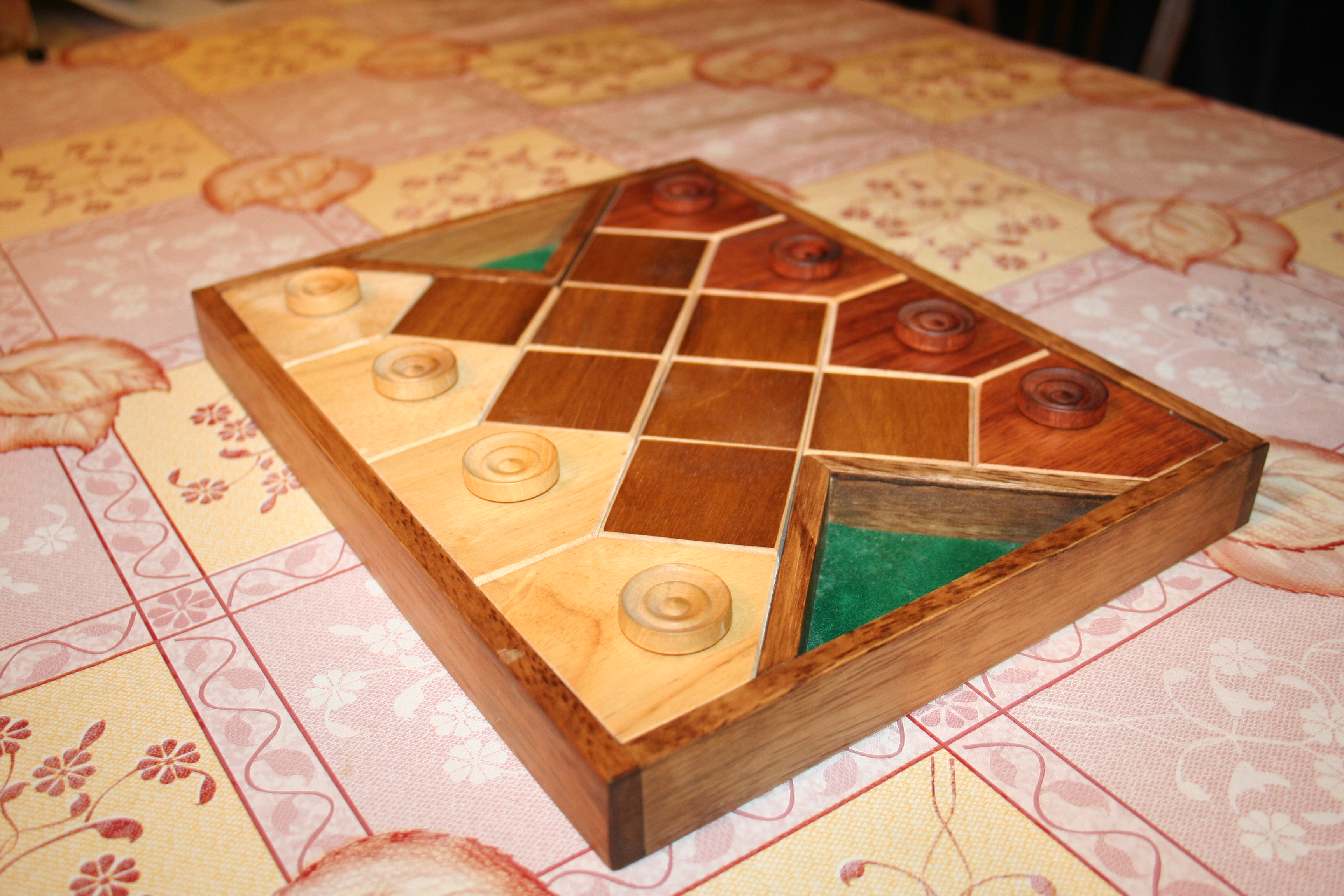
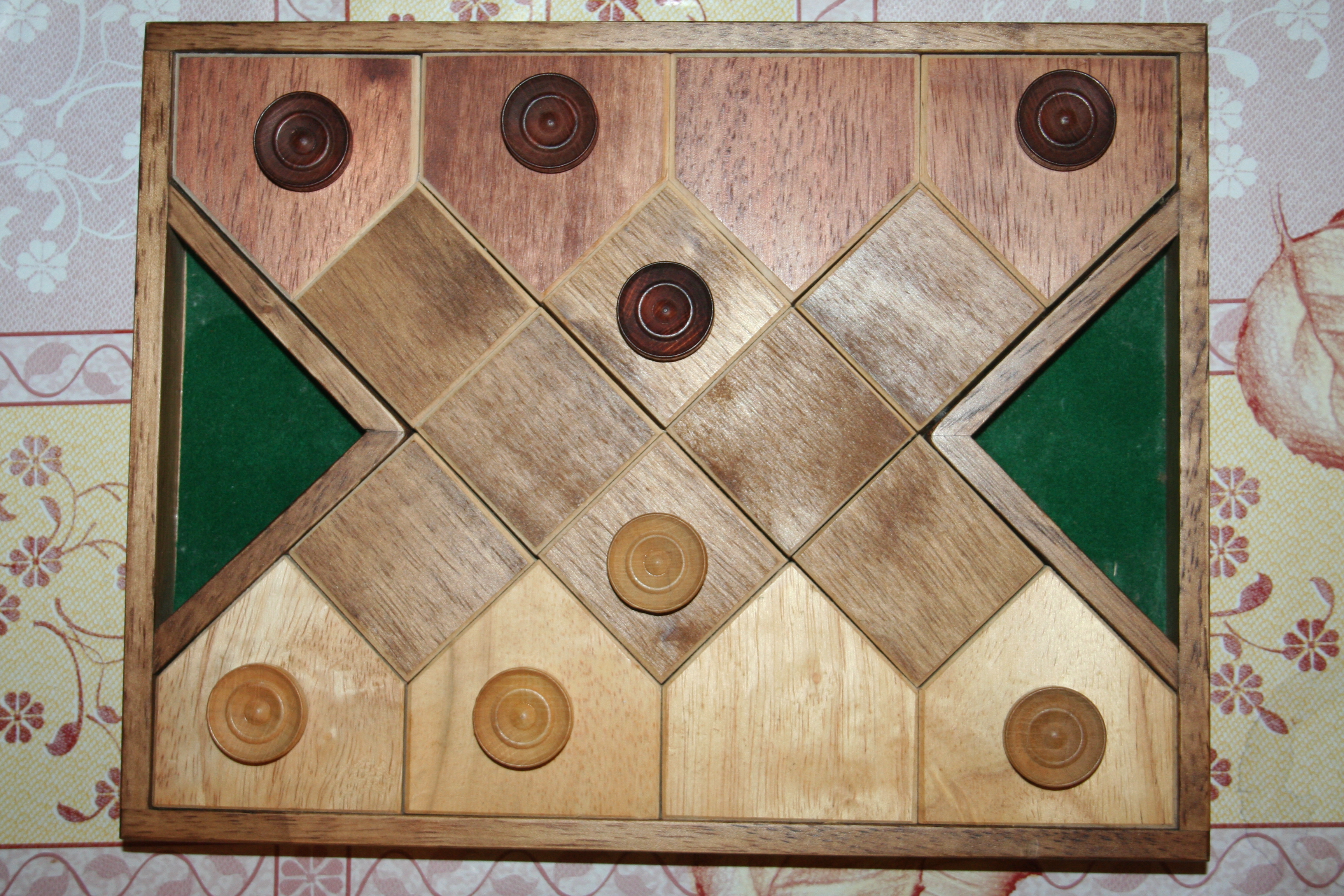
Our copy of OSKA with borrowed Pieces.
Our copy of OSKA using borrowed pieces.

What’s in the Box:

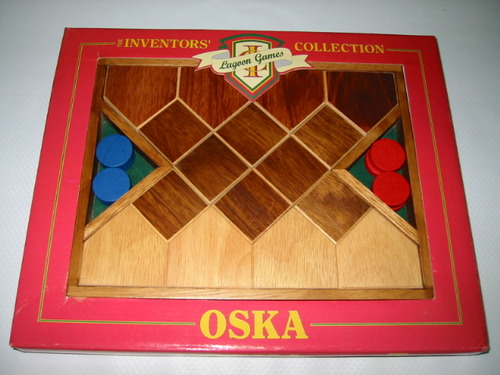
A picture lovingly borrowed from www.boardgamegeek.com just to show you what a real complete copy would look like.

In a normal OSKA box you find:

  1. One wooden board
  2. Eight pieces. Four red and four blue.
  3. And it should have an instruction booklet to remove any ambiguity about the brief instructions on the back of the box, (see section “Playing the Game) but there isn’t one.

However our copy came from a charity shop (one of the best places to buy games if you were unaware of this). So in the box there was just the board with no pieces! So we borrowed four white and four brown pieces from a game of  Draughts!

Playing the Game:

Normally here I would give a brief outline of the rules but as the rules to OSKA are already brief I have copied exactly what it says on the back of the box:

OSKA is a speedy game for 2 players which is deceptively simple, using the Draughts (checkers) principle of diagonal movement and capture. BUT – keep well in mind the quirk that gives OSKA its bite. The winner is the player whose remaining pieces first reach the far side – the less pieces you have left, the easier this will be. The skill lies in when, or if, to capture, and when to force your opponent to capture you.”

The big problem with this set of rules is that there are more than one set of rules to Draughts. For example in English Draughts you can only take diagonally forwards (unless you are using a king) but in International Draughts it allows you to take diagonally backward. I have assumed that it meant the English Draughts; firstly because it initially refers to it as Draughts rather than Checkers and secondly, because OSKA was invented in England.

So let’s just clarify the rules:
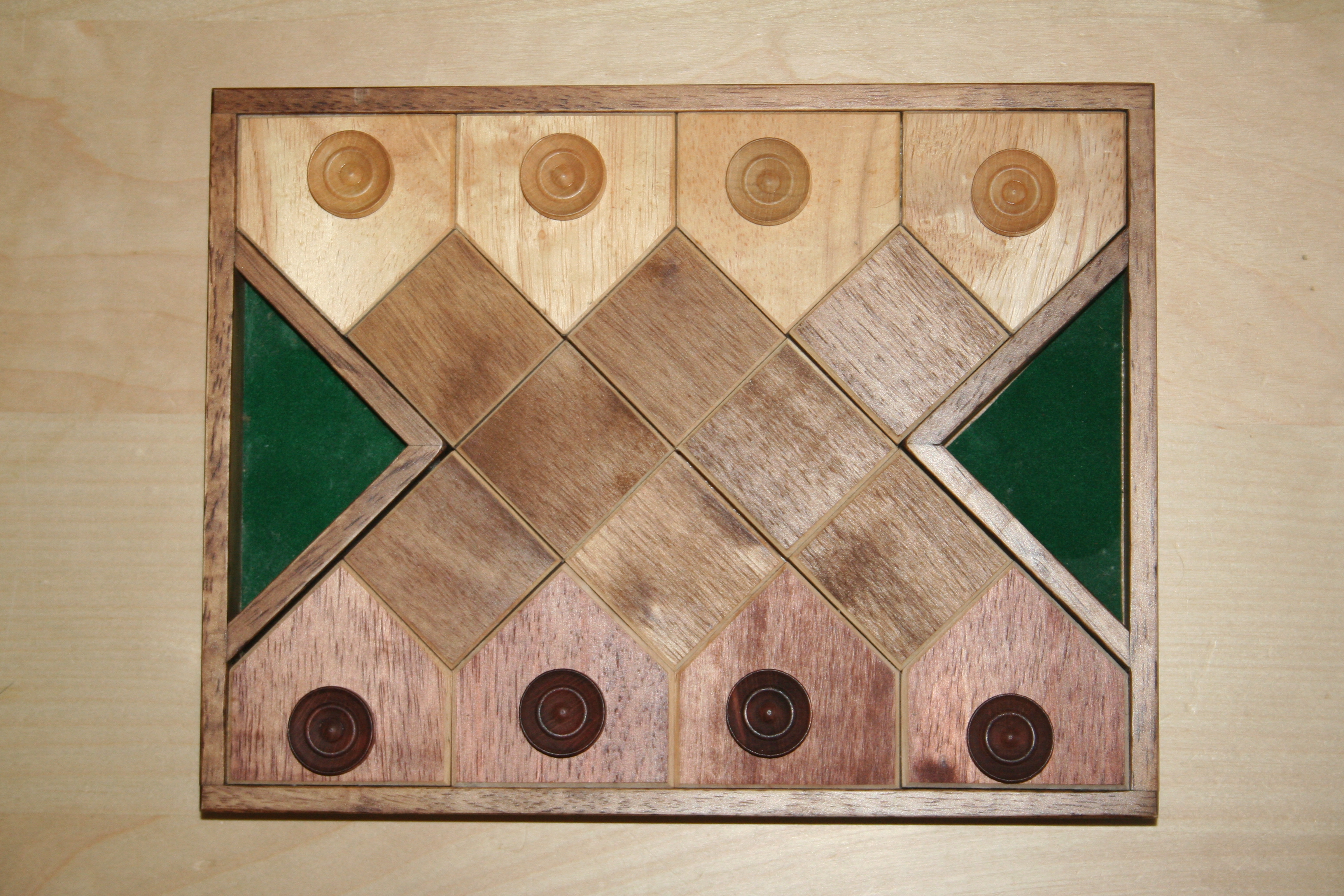
  1. You set up your four pieces on the back row like this:

    Start Positions!
    Start Positions!
  2. We played white moves first but you could play either way, and if you’re playing with red and blue pieces you could play whoever is set up on the white section moves first.
  3. You move one pieces diagonally, the the other player does the same.

    The Game after one move each.
    The Game after one move each.
  4. You take a piece by jumping it, so this can only be done forwards and so long as the space the other side of it is empty. You do not HAVE to take as the rules state “when, or if, to capture”.
  5. The winner is the first one to have ALL of their REMAINING pieces to the other side, so if all of their pieces are taken except one and they get that one to the other side before the other player gets all four of their pieces across, they win.

    Winning!
    Winning!
Rules We Assumed:
  1. We rationally assumed that in the scenario that all your pieces are taken you’ve lost.
  2. We also assumed that if you both ended up with the same number of pieces in the end zone at the same time it was a draw. This CAN occur if one player while moving its last (or only piece) into the end zone takes the other players only piece that’s not in the end zone. However this is unlikely to occur, as in that scenario you can choose to move into the end zone without taking.
  3. We also assumed that if a similar scenario occurred and one person had more pieces than the other in the end zone they won.
A Little Help:

Just to help we filmed a video of the game play of OSKA to help clarify. Here it is! Our very first video blog… Sort of. Our real video blogs will happen when we get a much better camera but it’s a start!

Strategy:

Now while the game is simple (once you’ve clarified the rules) and fast, there’s a lot that could be said about the strategy. For starters you cannot afford to make mistakes, I know this can be said for almost all games but one mistake in OSKA and the other person most often enters a state where they can’t be beaten because all series of moves that follow result in their victory!

The key to the game, I believe, lies in forcing the other person to take you. You can create a series of plays where they have no option but to take you because they have no other available moves. And once you start to lose pieces you have an easier job than they do as you have less pieces to get across the board.

I could go on about strategy and start drawing diagrams and things of this nature (as that how “into” this game I have got, a game that less than a month ago I was unaware existed). But I will spare you all, however, in the future I may write a specific post on the dynamics and maths of the game, which everyone can feel free not to read.

History and Interesting Facts:

Unfortunately due to the obscurity of this game the history and fasts that are about to follow are mostly off the back of the box as there’s not much more information on the game out there. Which is a shame as it’s a good game.

  1.  The game was originally devised by Bryn Jones in the 1950s.
  2. Bryn Jones was a miner so the game was originally played scratched into the dust on the floor of a mine at Lancashire Coalfields to pass time at breaks.
  3. In the early 1990s Bryn brought the game to Michael Woodward Creations.
  4. Woodward Creations annotated the rules and refined it into the more presentable format you find it in now.
  5. It can now be found as part of The Inventors Collection which is a gathering of games and puzzles from the worlds top game inventors.
  6. The game is made of eco-friendly wood.
  7. It can be considered as part of the Draughts family of games.
  8. Not really a surprise if you’ve read the post above, but the rules are ambiguous which unfortunately takes away from a very good and very fast game.

To Conclude:

This may come as little surprise to you (if you have read the above), I like this game! I’m a huge fan of Chess (as most sane people are) and similarly simplistic but complex at the same time strategy games make me happy. However as far as I’m aware there is no game as perfect as Chess and probably never will be. But OSKA falls into the category of games that are in the right ball park when it comes to your basic strategy game. I would even proclaim that it has a one up on Draughts as I maintain Draughts is too large and long a game to have such simplicity, in short it can become boring, which is why to every 100 Chess matches I have played I’ve probably only played half a Draughts game. This is where OSKA hits the nail on the head, its taken the same idea as Draughts and made it small, fast and above all FUN!

The biggest flaw I find with this game is the ambiguity of the rules and their phrasing. I am slightly ashamed to admit that we played the game wrong in two different ways before finally re-re-re-reading the paragraph on the back of the box and breaking it down to create clarity. First time round we missed the word “remainder” so we where playing first one to get one piece across…This version of the game is ridiculously flawed because the person who moves first (providing they’re not an idiot) will ALWAYS win! We also played that you HAVE to capture if you can capture and even after we started paying attention to the “remaining pieces” section of the rules we still failed to notice the “when, or if, to capture” phrase that implies you do not HAVE to capture. Anyway once we had figured it all out this game is a 4 out of 5 however the amount of time we wasted playing it wrong reduces it to a 3 out 5 (hence the top scoring). It could be argued that us playing it wrong is our own fault but I maintain the rules are needlessly ambiguous and if you don’t know what Draughts is they’re impossible to follow!

Additionally if anyone would like to buy the game check out HERE! – keep in mind this link is to an eBay sale so it won’t always be valid but it’s valid at the time of publication and will hopefully either be updated or removed when it stops being valid.

Shove Ha’penny/ Rebound

Shove Ha’penny:
3 - 5
Number of Players: 2/4
Year of Publication: Unknown

Rebound:
4 - 5
Number of Players: 2/4
Year of Publication: 1971

Sliding on down – Shove Ha’penny/Rebound:

Both Shove Ha’penny and Rebound are easy to learn, quick games. Rebound is included in this post, despite the fact that it’s not a wooden game, because it’s the game Shove Ha’penny developed into in the late 20th century.

What’s in the Box:

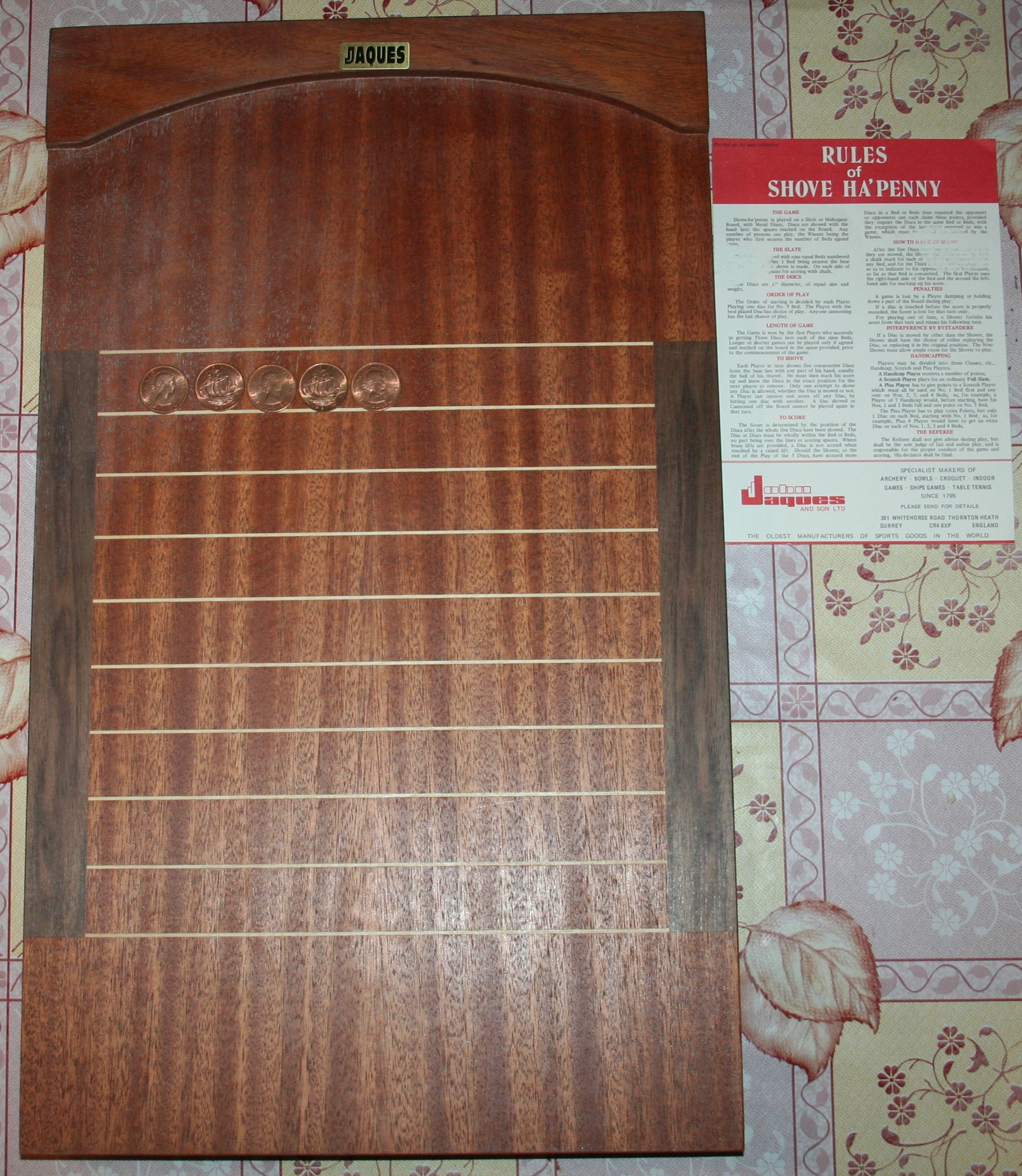
Well, in the box for Shove Ha’penny there’s a large-ish wooden board, an instructions card, and five half penny coins.
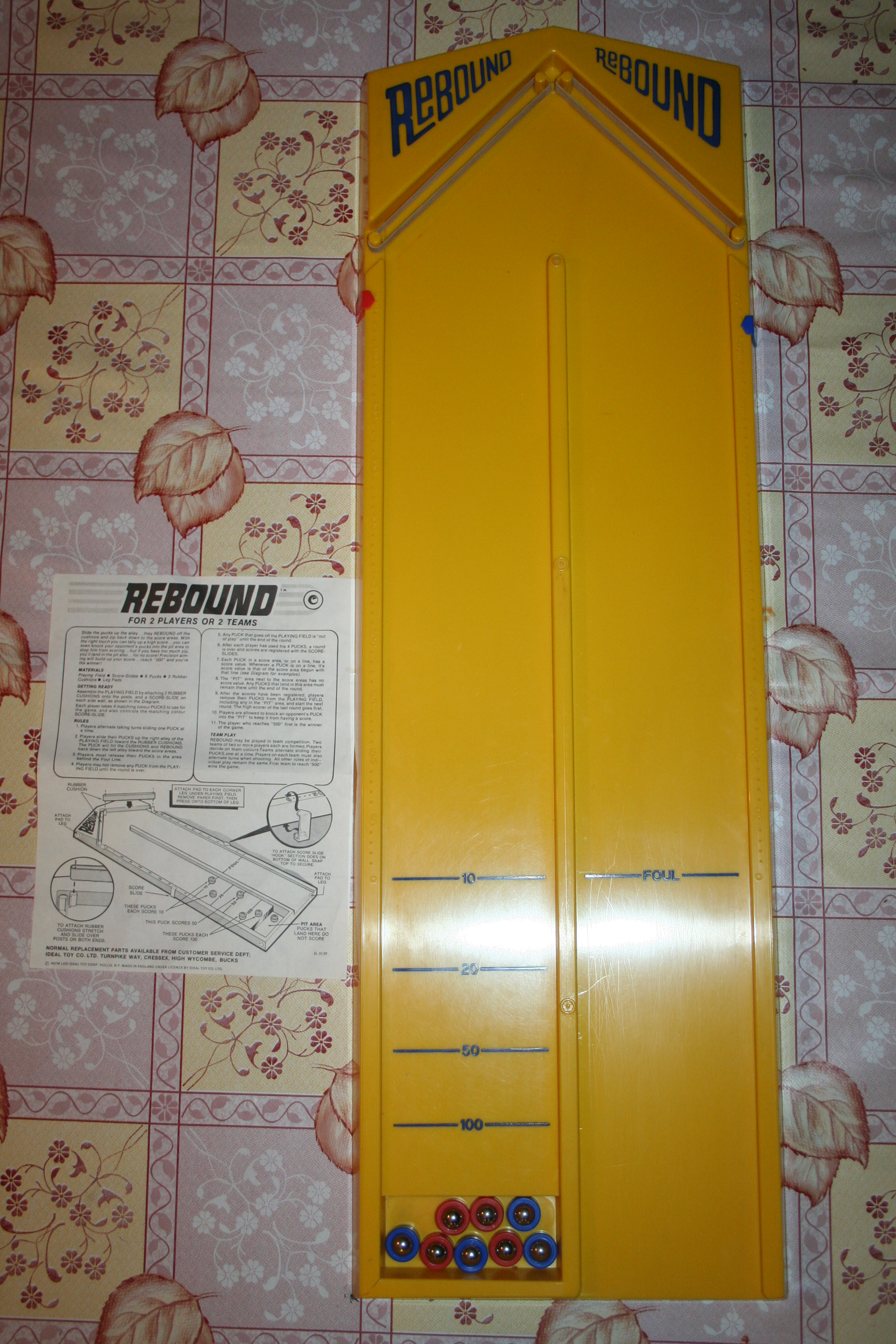
In the box for Rebound there’s a large plastic board, two elastic bands and eight (or sixteen in our case) ball bearings with coloured rings around them.

Shove Ha'penny
Shove Ha’penny
Rebound
Rebound

Playing the Game:

The objective of Shove Ha’penny is to be the first player to shove three coins into the same scoring area. In Rebound it’s to be the first player to score 500 points.

The Rules:

Shove Ha’penny:

  1. Players take it in turns to shove all five coins into the scoring areas.
  2. You must not touch the board with the hand you aren’t using to move the coins, if you do, you score zero for that round.
  3. At the end of your turn you must let the other player remove the coins from the board, if you take them, your score for that round isn’t counted.
  4. If a coin ends up off the board for any reason during your turn, that coin cannot be replayed and doesn’t count towards your score.
  5. Any coin that finishes outside the scoring area in any way is not counted and cannot be replayed.
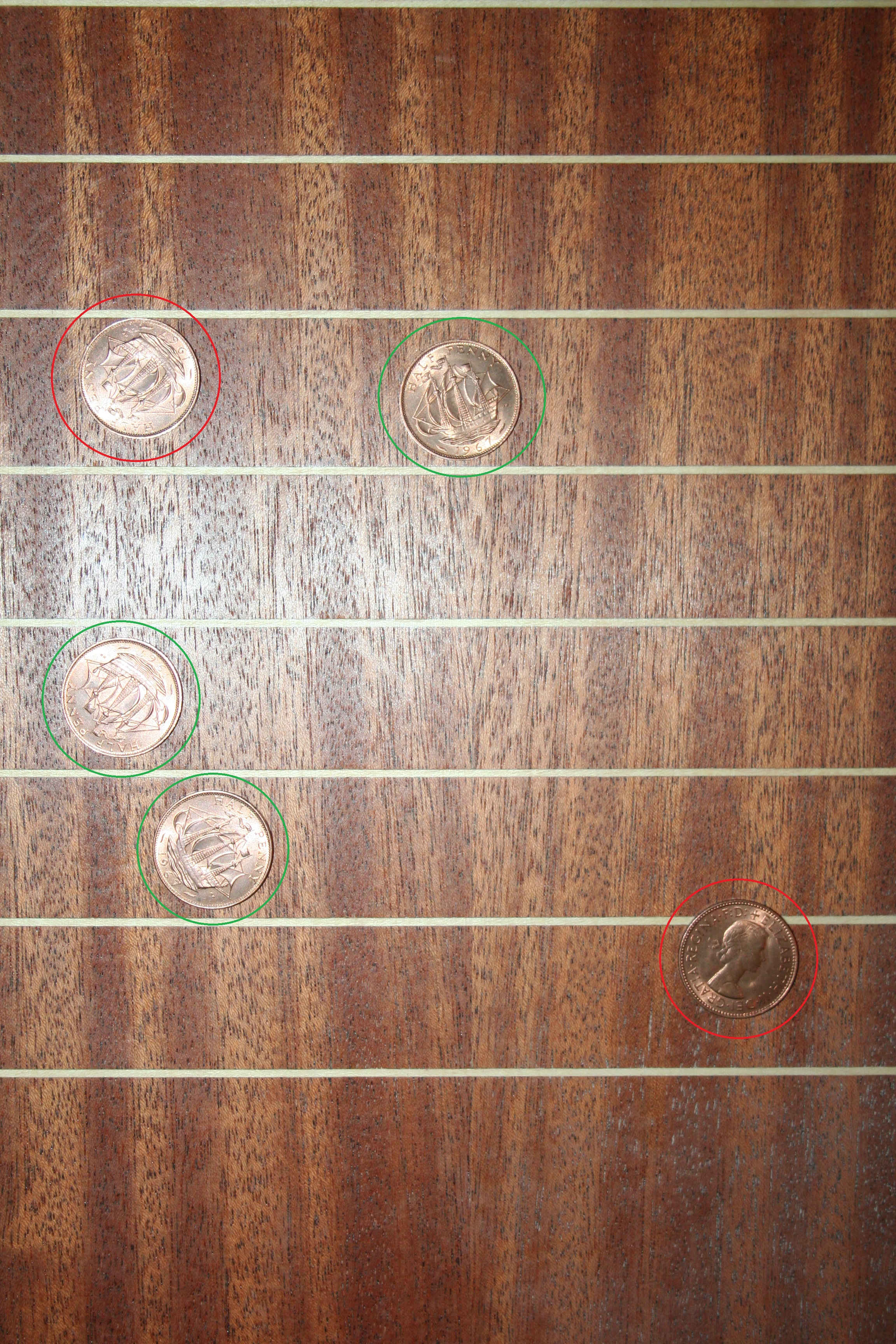
  6. Coins on the line (even the tiniest bit) don’t count only coins between the two area lines count.
So the coins circled in Red don not count as score where as the coins circled in green are acceptable scores.

Rebound: 

  1. Players choose a colour and take the four ball bearings with their colour ring around them.
  2. The game progresses in rounds, players take it in turns to play one of their ball bearings, they do this until they’ve played all four of them, then the round is over, and the points are scored.
  3. Any ball bearing that leaves the board is not counted and cannot be replayed, the same applies to a ball that passes out the other side of the scoring area into the trench space at the end of the board.
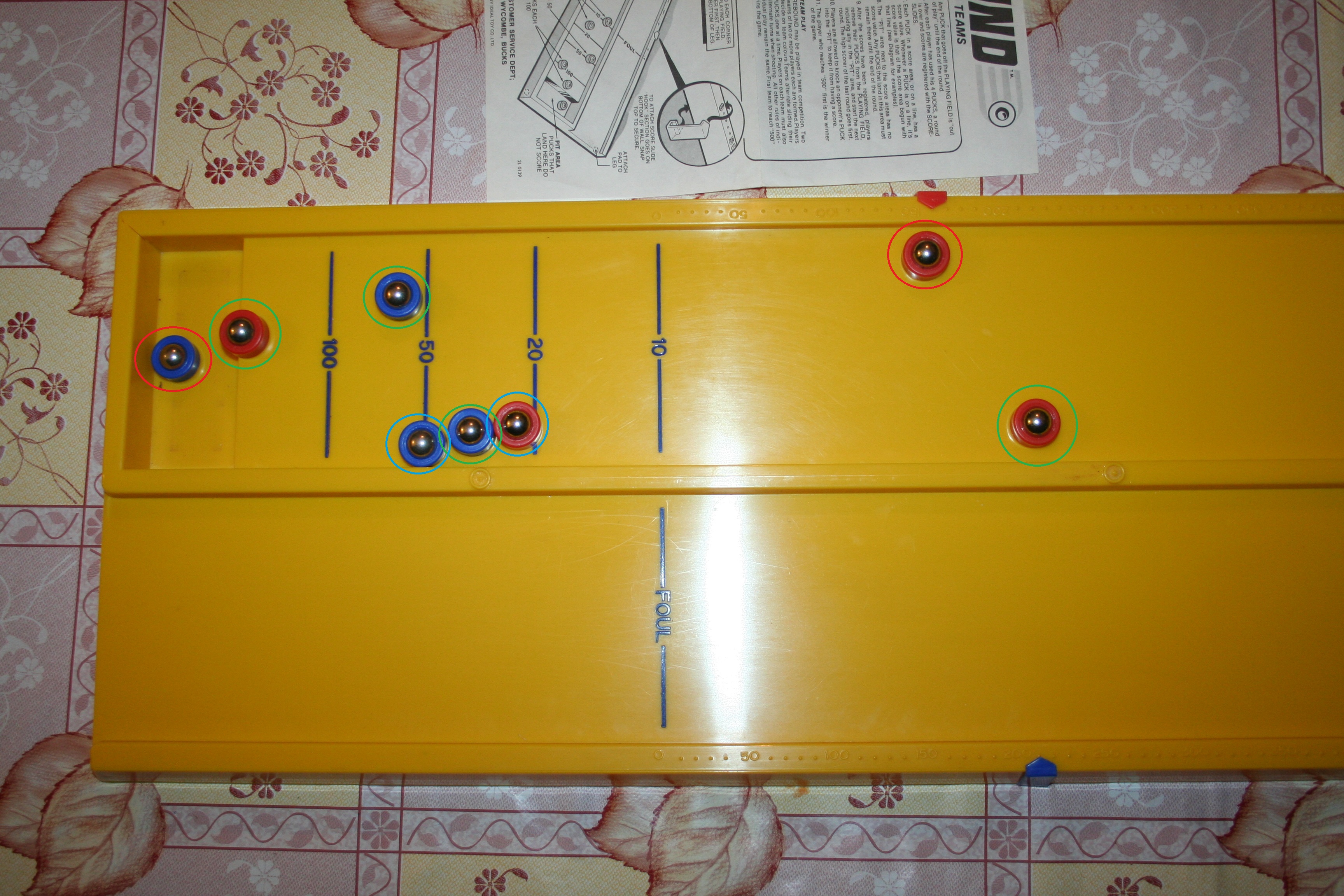
  4. Points are only scored when a ball is entirely in a zone if any part of it is in a lower zone it scores the lower (or no, if its hanging into the no score zone) points. If ball is still physically on the board and not in the pit is accepted as 100 point score.
The ones circled in Red don't score as either they fall short of the scoring zone or they fell into the pit. The ones circled in Green score, even if they over hang the end and the ones circled in orange score the lower points of the two zones they cover.
The ones circled in Red don’t score as either they fall short of the scoring zone or they fell into the pit. The ones circled in Green score, even if they over hang the end and the ones circled in orange score the lower points of the two zones they cover.
Strategy:

As far as strategy goes, there isn’t much that can be applied for these games, apart from being able to gauge well how much force is needed to get your pieces into their optimum positions. So basically having steady hands and a good gauge of force. It takes a few play of the game to get the idea of how much force you need and even after that some how your mind just keep forgetting.

History and Interesting Facts:

  1. It’s the smaller offspring of a game called Shovel Board and was played in taverns as far back as the 15th century.
  2. If a player managed to shove three coins into one “bed” or scoring area in a turn, he has scored a “sergeant”, if he manages to get all five coins into one bed, he has scored a “sergeant-major” or a “gold-watch”.
  3. Substances can be added to the board to lubricate it, any of the following have been commonly used; French chalk, black lead, beer, paraffin and petrol (although the latter two of these do make the game rather more combustible).
  4. Officially, one side of the coins used are supposed to be smoothed flat, this should be tails side, as, in England, it’s illegal to deface a picture of monarch.
  5. Because a coin only scores if it’s clearly between two of the scoring lines, the more expensive Shove Ha’penny boards had rails in the grooves of the lines that could be lifted out to determine if a coin scored or not. If the coin moved when the rail was removed, it scored nothing.
  6. Around Oxford, a variation of the game called “Progressive” is played, in which, a player is allowed to retrieve and replay any coins that score. Apparently with more skilled players this can result in the game ending before the second player’s had a chance to shove at all. I imagine this to be a depressing state of things if you lose the toss and are playing second.
  7. In Stamford, locals organize a “world championship” for the game Push-Penny which is much the same as Shove Ha’penny and this takes place during the Stamford Festival, at the end of June/start of July every year.
  8. We’ve posted these games together because they’re very similar, Rebound just appears to a be a more modern version of Shove Ha’penny, however, I can’t (although my search wasn’t very in-depth or long) actually find any documents that link the two games. So there you go. 🙂

To Conclude:

Both these games are good fun for two people, and are very easy to learn and play. however, of the two, I would say that I enjoy Rebound more, although Shove Ha’penny may well require more actual skill, as you’ve less space to push down, and are playing with pieces that’re less naturally inclined to slide. I recommend both, especially as games suitable for playing with children of any age!

For further reading, and a little more detail on my history points, go here.

Solitaire

3 - 5

Number of Players: 1

Year publication: 1697

Creator(s): Unknown

How to Play With Yourself – Solitaire:

Solitaire is an interesting game and the first game to be officially reviewed in 2014! Solitaire is an old (usually wooden) game, so it fits our theme for this month. This is the first post with our new standardized format so any feed back would be appreciated, let us know if there’s anything we are missing or if anything is too much.

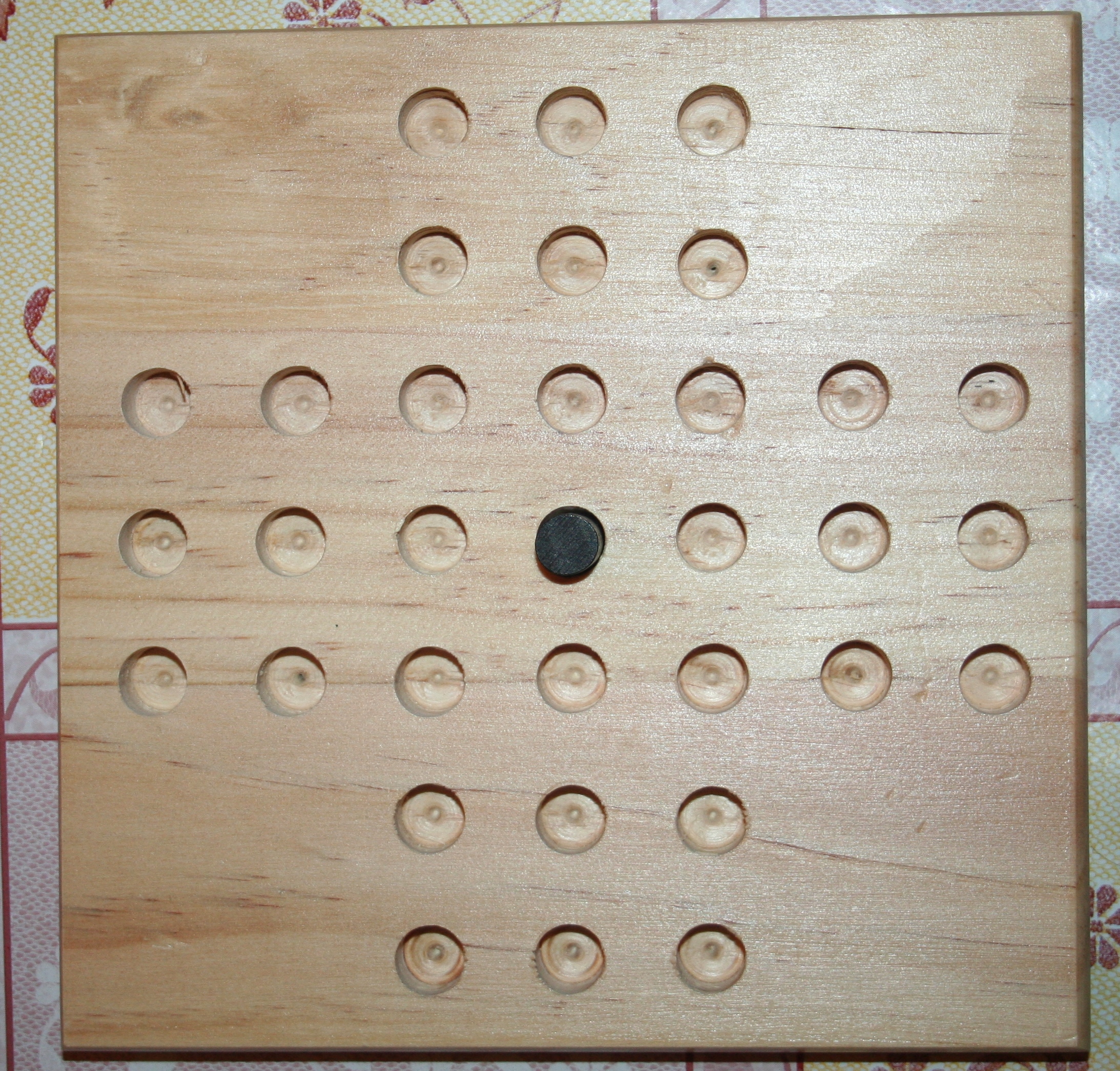
The game.
The game.

What’s in the Box:

the board and peices
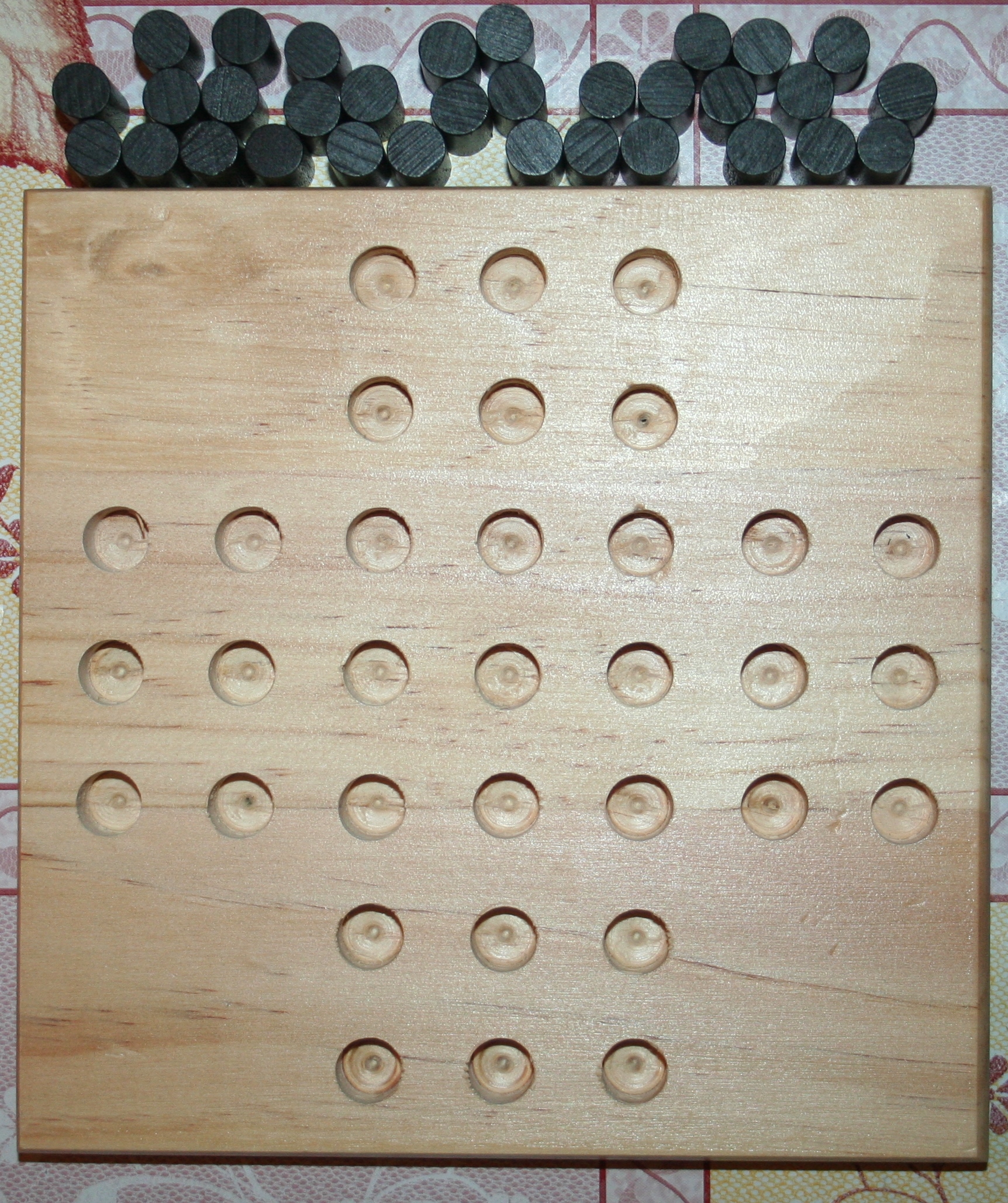
The board and pieces separately.

Solitaire only consists of two things:

1) A board with 33 holes or groves in it.

2) 32 pieces – sometimes pegs and sometime marbles – sometimes 33 pieces are included so you remove one before playing.

Playing the Game:

The aim of the game is to remove all of the other pieces leaving just one in the central hole that is originally left empty.

The Rules:
  1. The board is set out with 32 pieces leaving a gap in the middle.
  2. You move to take pieces by jumping over them.
  3. Taking can only be done horizontally or vertically NOT diagonally.
  4. You win if you manage to remove all pieces and are left with one pieces in the central slot.
  5. You lose if you are left with one or more pieces not in the central slot and you cannot make any more moves.
Win
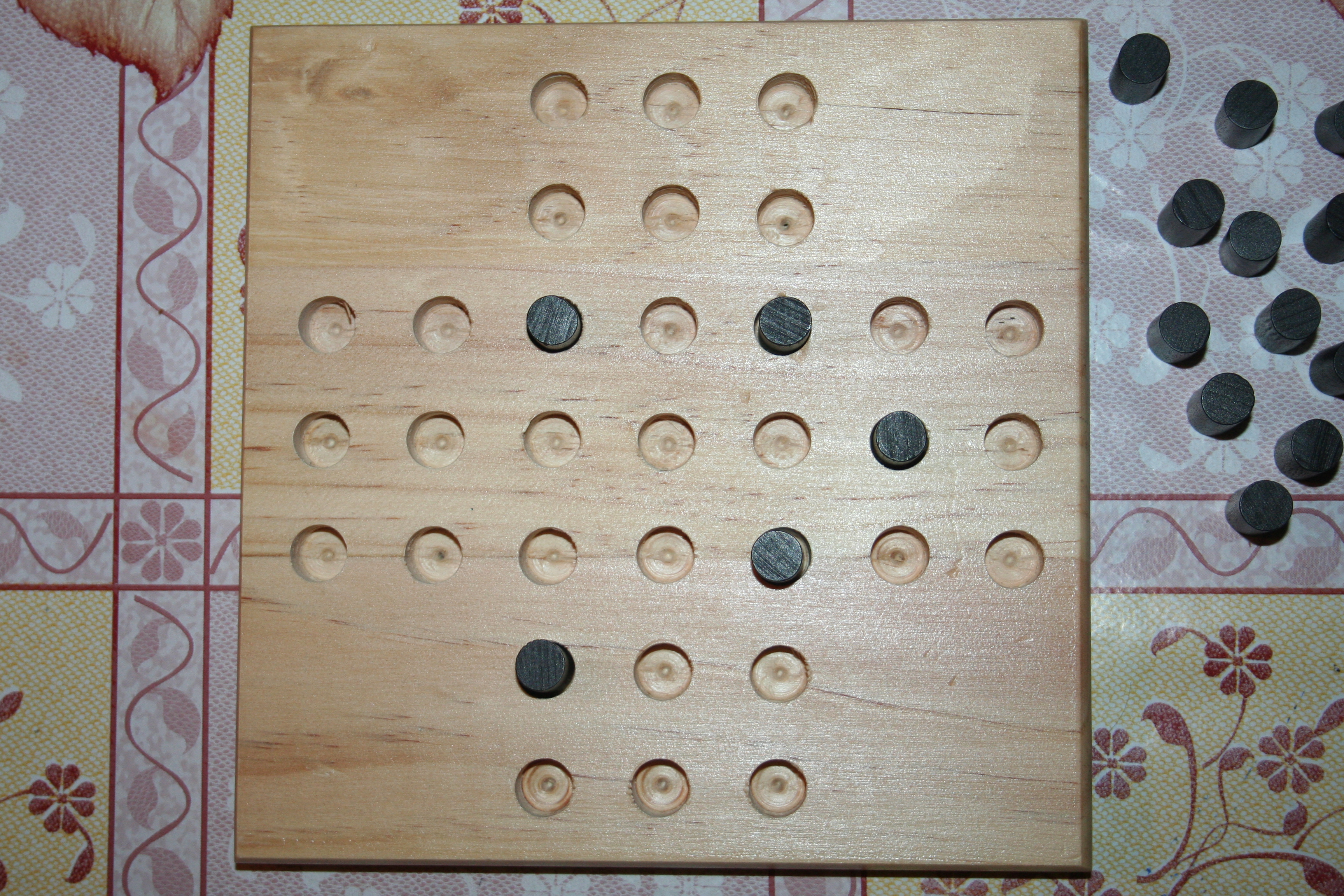
WINNING! (I did not actually win this I just set the board up like this to take this picture)
Strategy:

While this game has a very simple set of rules and is fairly easy to understand mastering it is a whole other matter! While I consider myself somewhat intelligent (and also modest) I have played this game through 30 or so times and still failed to win! I always end up in situations like this:

fail
FAIL!

I’m getting closer but I still feel quite far way. As far as I can see it makes sense to clear the board systematically and try very hard to not leave any pieces out on the edges by themselves. Of course you could always cheat and watch this video:

I have refused to watch it as I want to solve the game myself and will not be helped by Youtube! Additionally, once you’ve committed to memory how to beat the game it’s a bit of a one trick wonder as it has no replay-ability because you will always be able to beat it!

History and Interesting Facts:

The aim of this is not to give you a full history lesson on the game – that would be long and boring! But just a quick ten bullets to give you a rough idea of the games history and cultural relevance as well as some interesting facts about it.

  1. The earliest known reference to the game is a French engraving of Anne de Rohan-Chabot, pictured with the game, made in 1697. As seen here:

    Borrowed lovingly from Wikipedia!
    Borrowed lovingly from Wikipedia!
  2. The first literary reference made to it is in a French magazine from the same year.
  3. The Solitaire featured in these references, however, is not the same as the Solitaire featured in this post. There are two common/traditional versions of the game. The one featured in this post is the English version (which is fitting as we are in England) the one originally featured in the engraving is know as the European version. If you look at the engraving shown above you will see the board has four more holes that occur in the inside corners of the board to give it a more rounded shape. Additionally you do not traditionally start this game by leaving the middle hole empty but rather one offset towards the top of the board.
  4. There are also a fair few other versions of the game including a version made by J. C. Wiegleb in 1779 in German that has 47 holes and is effectively an extended version of the English version.
  5. There are also other ways of playing it on the same board, whether you’re using the English board, European board or any other. Including a version where your starting and finishing slot is in the bottom right corner.  To take a look at some of these different versions and play them (and even see solutions to them) see HERE!
  6. The shortest solution to the English version of the game was found by  Ernest Bergholt in 1912 and was proven to be the shortest by John Beasley in 1964. This solution in full detail can be viewed HERE, but I challenge you to find it yourself first, in fact I will give £100 to the person who can irrefutably prove that they found the shortest solution to the game without any assistance!
  7. While there is only one shortest solution to the English version of the game there are three shortest solutions to the European version of the game that are all very different from each other but result in the same amount of moves made. To read about them in detail see HERE!
  8. A much thorougher analysis of the mathematics of the game(s)  is provided in the book Winning Ways for Your Mathematical Plays – Volume 1 which on the extreme off chance anyone is interested in can be bought HERE and viewed as a pdf HERE (it’s discussed in chapter 23 under the name Peg Solitaire).
  9. The game is historically called Solo Noble or Peg Solitaire, however in the UK it is usually just referred to as Solitaire as the card game of the same name(s) is commonly known as Patience.
  10. Very interestingly there are 577,116,156,815,309,849,672 different sequences to the English version of the game (being how many different orders of things that can happen). From this set of sequences there are 40,861,647,040,079,968 different solutions (some are simply reflection and rotations of others). To see this maths in more detail see HERE!

To Conclude:

The thing I find most interesting about this game is your could vary it almost indefinitely and it would still be a playable and difficult problem, it is rare that you find a board game that is so interchangeable but still maintains its fundamental characteristics. It also stands as a classic mathematical/logic problem that is quite challenging to initially complete.

While it is fun and simple it is also quite limited in the sense that is is simple. You can furiously try for 40 minutes to try and figure out a solution and then lose interest completely because you feel like you’re just repeating the same thing again and again and never getting closer to your goal. So it might be a steer clear for those of you who are more OCD about things as you may never be able to put it down until you find the solution. However if you’re not OCD then definitely give it and play! I challenge you to find the solution without help!

Update – January 2014

A Happy New Year to you all and I hope it’s been a good year so far! This is something we’re going to start doing monthly; an update post! … Everyone’s favorite type of post (heavy amounts of sarcasm implied upon that, in-case anyone didn’t get it). In these update posts we will tell you the four games we’re doing for the coming month and the dates they’ll go up, along with any other developments of interest, of which there will hopefully be a fair few in this coming year, so keep your eyes open because otherwise you may miss an opportunity to gain something awesome!

Additionally we will be theming the months, for example this month is Old (usually) Wooden Games. And with any luck the last post of each month (or the second to last post) will be accompanied by a video blog… But don’t hold me to that.

Games for January: – Old (usually) Wooden Games

Monday the 6th – Solitaire

Monday the 13th – Shove Ha’penny/Rebound

Monday the 20th – Oska

Monday the 27th – Go

Other Things to Note:

In case you haven’t noticed, we’ve upgraded to our own domain name, we are now just www.tametheboardgame.com!

We’ve also started a facebook page so come give it a like HERE!

AND we’ve updated our About page so go check it out!

Also also! Banner change! We’ve changed our banner so the backdrop of it is some games we’re going to review this year, in the same way that last years one was all games we reviewed last year (excluding Thud, which is still in this banner backdrop as we will be reviewing it this year).

The Boards to Breach The Keep have finally arrived! So sometime this month a post about the ever developing-ness of that will go up and the progress that has been made is rather note worthy but I’ll leave all the to the actual post!

On the Twelfth Day of Christmas My True Love Gave To Me…

…A Twelve-Player Game and I Introduced Him to Some Men in White Coats! – Boggle…A Million Points if You can Score a Twelve Letter Word in It.

Twelve Booglers Boogling!
Twelve Bogglers Boggling!

The Rules:

Boggle is a brilliant quick game for any number of players, all you need is a piece of paper and pencil to play. Before you start players must decide on the number of rounds that are going to be played, and the time allowance for each round. The timer that comes with the game is two minutes, and, although the timer for our copy doesn’t work properly any more, we still play to that, using someone’s phone as a timer. However, if you also have to do this, having the vibrate function on when you set the timer is a bad idea, as we found out when playing with Aunt Jean. The first time the timer went off and started vibrating on the table, it made such a strange sound that I was almost responsible for giving her a heart attack!
To play, one player shakes up the cube containing the dice, until they’re all flat, showing one face up. Then another player flips (or starts) the timer, and you have two minutes to make as many words as possible from the letters you can see. These words must be at least three letters long, and the letters must be connected either horizontally, vertically or diagonally. You cannot use the same letter twice in one word. When the timer goes off, one player reads out their list of words, any word that any of the other players has also written down is crossed off and doesn’t get you any points. When everyone’s checked their lists, you score. Three and four letter words are worth 1 point each, any word with more letters is given one extra point for each subsequent letter, i.e. 5 letters = 2 points etc.
After you’ve played through the appointed number of rounds the player with the most points overall wins.

For Christmas?

A great game for fans of Scrabble or similar games, not so much fun for dyslexics (like Dave) who get overexcited when they score two points in a round, mostly with three letter words. However, it’s a fantastic game because it can be played super-quickly with any number of people, you could challenge yourself and whoever you’re playing with to find the longest or silliest words possible, making it a superb game for any occasion!

Happy Twelfth and last day of Christmas and a Happy Epiphany too … For those who celebrate that kind of thing!

On the Eleventh Day of Christmas My True Love Gave To Me…

…An Eleven-Player Game and The Suggestion That I Make More Friends – Eleven Pictionarys Drawing!

Eleven Pipers...Playing Pictionary!
Eleven Pipers…Playing Pictionary!

The Rules:

Pictionary is supposed to be played on teams of two (or four), but eleven is an incredibly hard number to find a game for, I mean, Aunt Jean may be willing to make up your 12th player, but given her tendency to shout things out in a slightly turrets-y way you may want to direct her to some other occupation whilst you’re playing. For her own good . So, just pretend that eleven is the optimum number for this game, and all will be well! The objective of the game is to advance round the board by guessing the words that the other teams are drawing out on their turns. At the start of the game, each team is given a pad of paper, a pencil, a category card and a playing piece. Each playing piece is placed on the start square on the board. Each team then elects one player to be their picturist. It’s this player who will draw out clues for the other teams for the rest of the game.  Then each team rolls the die, highest roll selects the first first card. The first word sketched is an All Play sketch, meaning that all teams can guess. At the start of the game, the die is not rolled to advance. There are five different categories, as follows; All Play – this can be any word or expression and all teams participate, Difficult – challenging words, Action – verb, things that can be performed, Person/Place/Animal – self explanatory, proper names can be included and Object – noun, things that can be touched or seen.
To play, the starting picturist selects a word card from the front of the deck the word that matching the coloured square that the playing pieces is on is the one being described. The picturist is allowed five seconds to examine the word, then the timer is turned and the picturist begins sketching. The other team(s) can then begin guessing, this continues until the word is guessed or the time runs out. If the word is guessed the team then continues by rolling the die and advancing the appropriate number of squares, they then select the next card and picturist. If the word is not guessed, play then continues clockwise, the next team then begins by drawing a new card not rolling the die.
The first team to land on the Finish square and guess the word correctly, wins.

For Christmas?

So describing the rules may have been a little lengthy, but it’s actually a very simple game. It’s good fun with a small or large group of people, and a fantastic family game, whether being played for a challenge, or just for a few laughs as we all enjoy our different (and sometimes dubious in my case) artistic abilities. This game can be a fantastically relaxed way to end an evening, or it can be a creative challenge for younger kids! it’s good for everyone old enough to talk (well, possibly not quite) and is a timeless classic for family time. Appropriate for this time of year, no?

Happy Penultimate Day of Christmas!