Saboteur – back with a quick card game!

Number of Players: 3-10

Year of Publication: 2004

Creators: Frederic Moyersoen, (designer), Andrea Boekhoff, Alexander Jung, Frederic Moyersoen (artists)

Are you a dedicated miner, searching for the gold with your crew? Or a sneaky saboteur, trying to bring down the tunnels on the heads of your compatriots!?

Saboteur is a silly, easy, quick-to-play (average play time for one round is only 30 minutes, but can easily be less with experienced players) card game where each player randomly draws either a regular Dwarf card, or a Saboteur Dwarf card at the start of the game. These cards provide you with your goal. The objective is simple; Dwarves are mining, and, as you might expect, are searching for the gold; Saboteurs are trying to thwart their comrades, and prevent them from striking gold!

Nothing makes the heart of a dwarf race quite like a nice shiny gold nugget. As one of these intrepid folk, you naturally want to collect as much of the yellow stuff as you can. But are you a gold digger… or a saboteur? – excerpt from the game rulebook

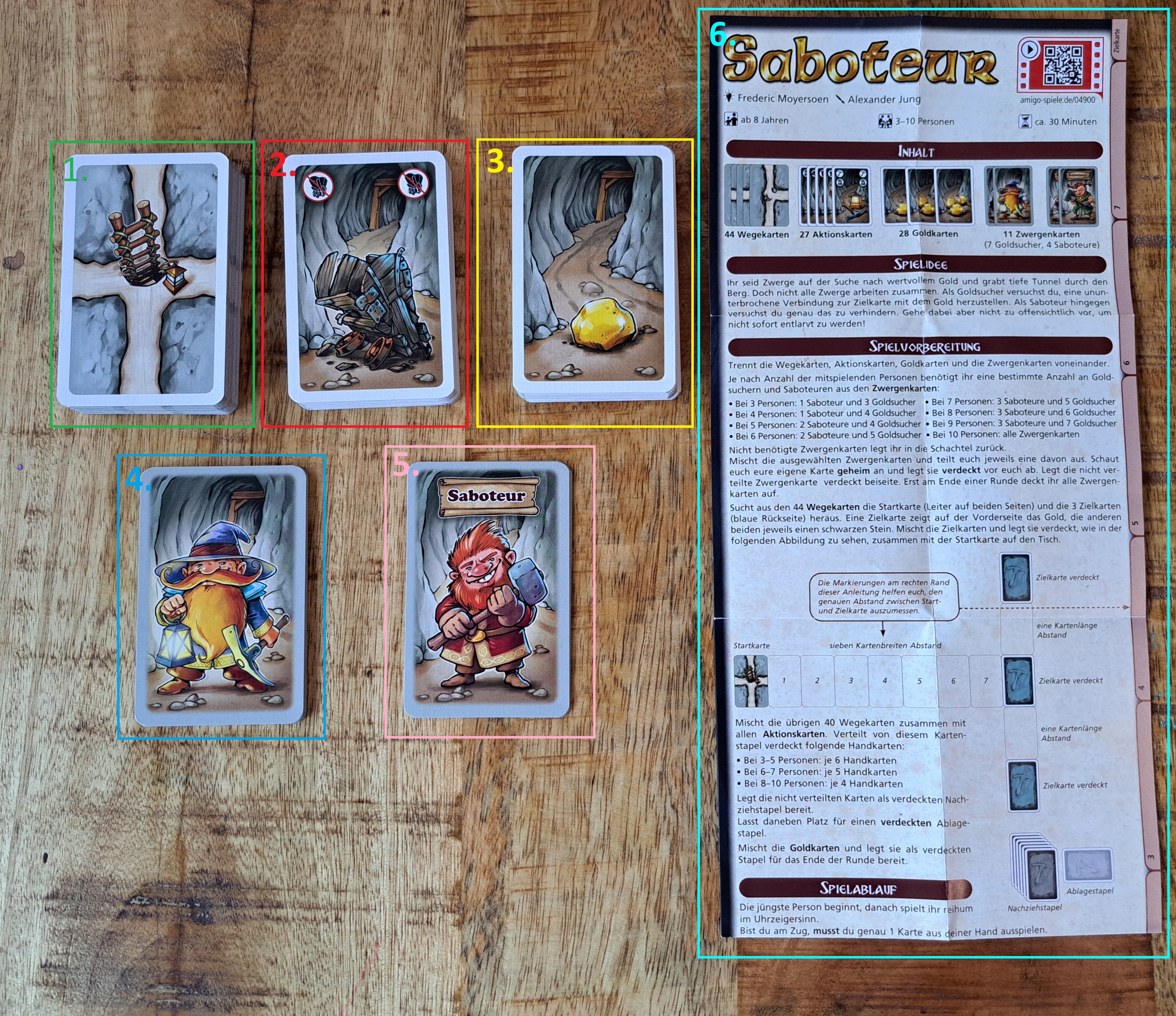
What’s In The Box:

  1. 44 Path Cards
  2. 27 Action Cards
  3. 28 Gold Nugget Cards
  4. 7 Gold Miners
  5. 4 Saboteurs
  6. 1 Game Instructions sheet

Setting Up The Game:
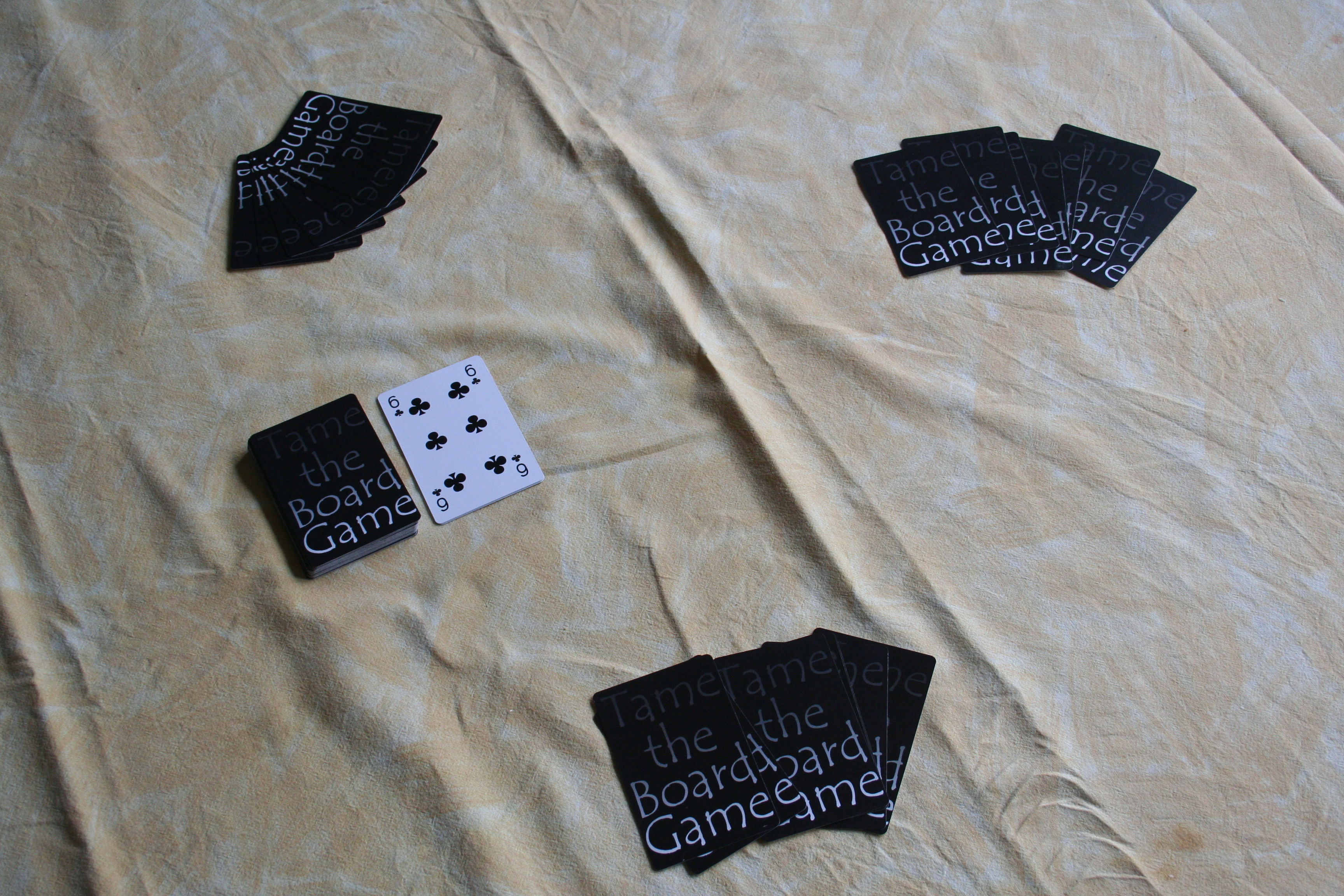
Before the game begins there is a very small amount of setup required. You’ll need a reasonable sized table in order to lay out the cards that form the “mine map”. Cards must be separated into the above shown decks to begin, though regular Dwarf and Saboteur cards can remain in one pile. The number of Dwarfs and Saboteurs required for a round depends on the number of players, and is indicated clearly in the rulebook. The needed number are separated, and any unneeded player cards are returned to the box before the pile is shuffled. Each player then randomly receives a card which they should look at without showing the other players. Now you know if you’re a miner, or a saboteur. There will always be one Dwarf or Saboteur card leftover once all have been dealt; this is placed, face-down, to the side until the end of the round.

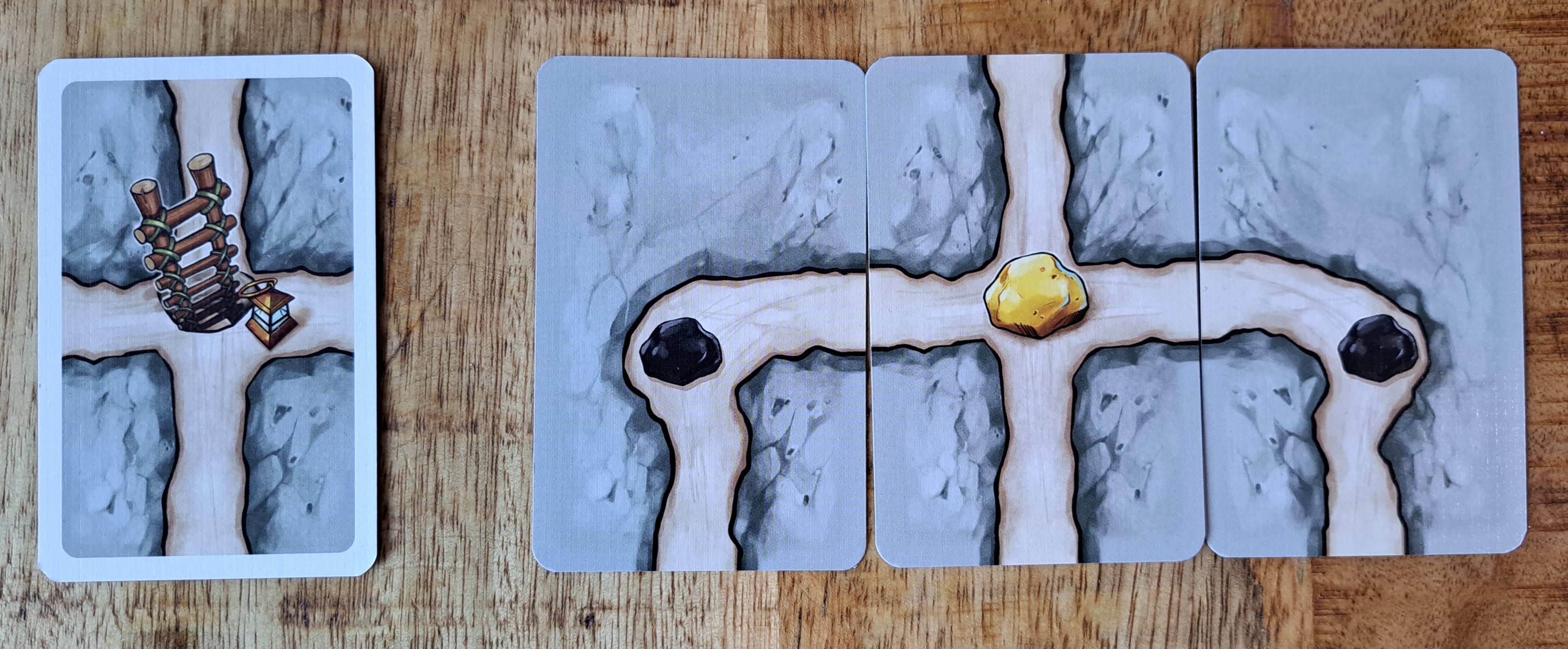
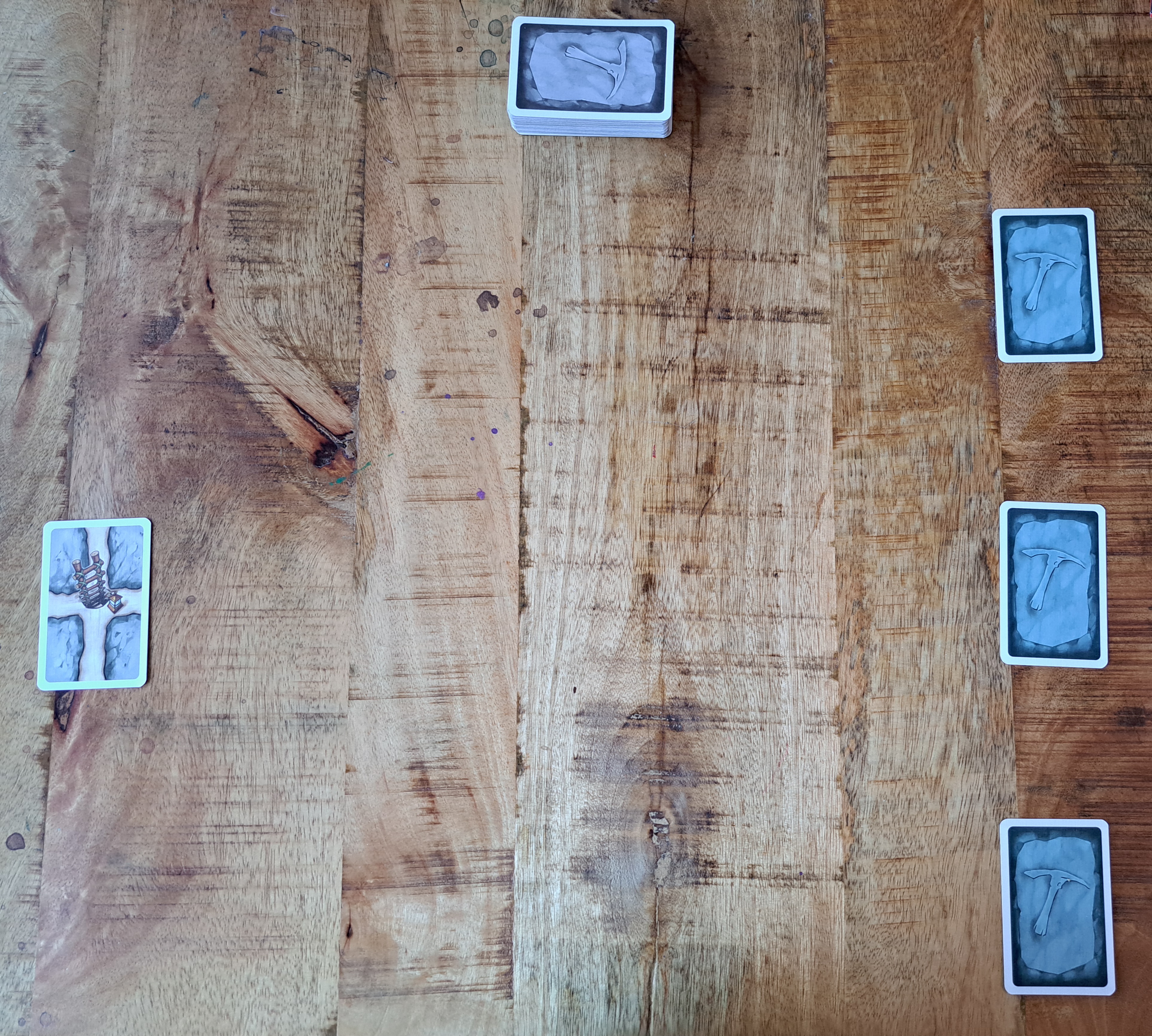
Next, you need to locate the Start Card, which is the only Path Card with a ladder on it, and the three Goal Cards, easy to spot, as one has a large gold nugget on it, and the other two a lump of coal each.

As shown here!

The three Goal Cards are then shuffled and placed face-down upon the table with one cards-length of space between the bottom of the top card and the next, making the width of the defined playing space five cards high. You then need to measure seven cards width across before placing the Start Card on the same row as the middle Goal Card. This represents the “edges” of the mine map. In total your map area will be nine playing cards wide, and five high, like this:

Now you’re ready to start the game, all that’s left to do is to shuffle together the remaining 40 Path Cards with the Action Cards, and deal a starting hand to each player. The number of cards each player receives is determined in the rulebook by the number of players present. Once each player has their hand the youngest player begins the round.

Playing The Game:

A players turn is very straightforward; you use the cards in your hand to further your goals. Each player must play a card on their turn. This means one of three things:

  1. add a Path Card to the maze,
  2. place an Action Card in front of yourself or another player,
  3. pass your turn by putting a card face down on the discard pile (this means the discard pile will have cards both face up and face down in it, this is completely okay)

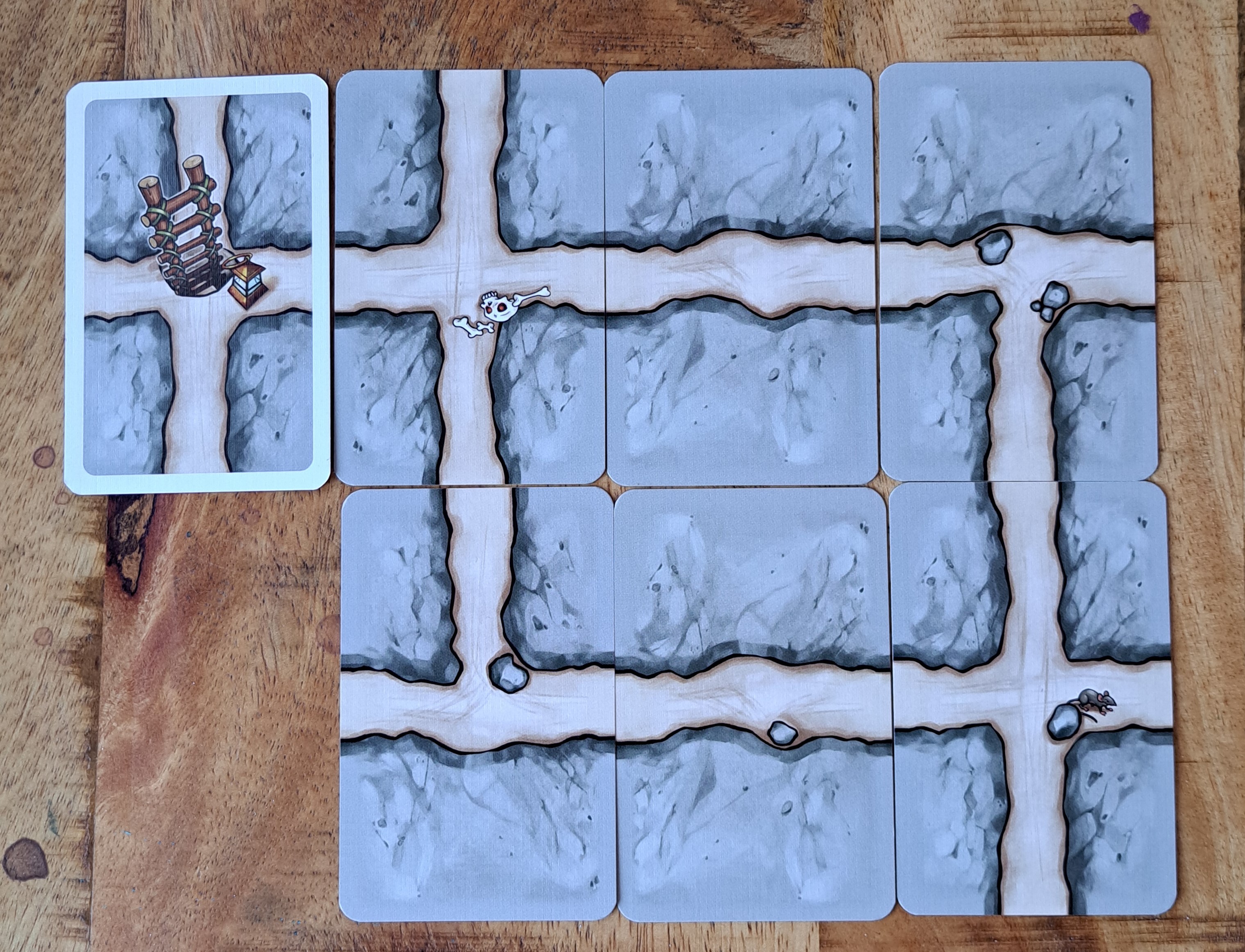
When playing a Path Card you must connect it to the Start Card in a logical way, meaning, the tunnels shown must connect, and, if connecting to more than one card (either above, below or on either side) must connect properly to all adjoining tunnels. Like this:

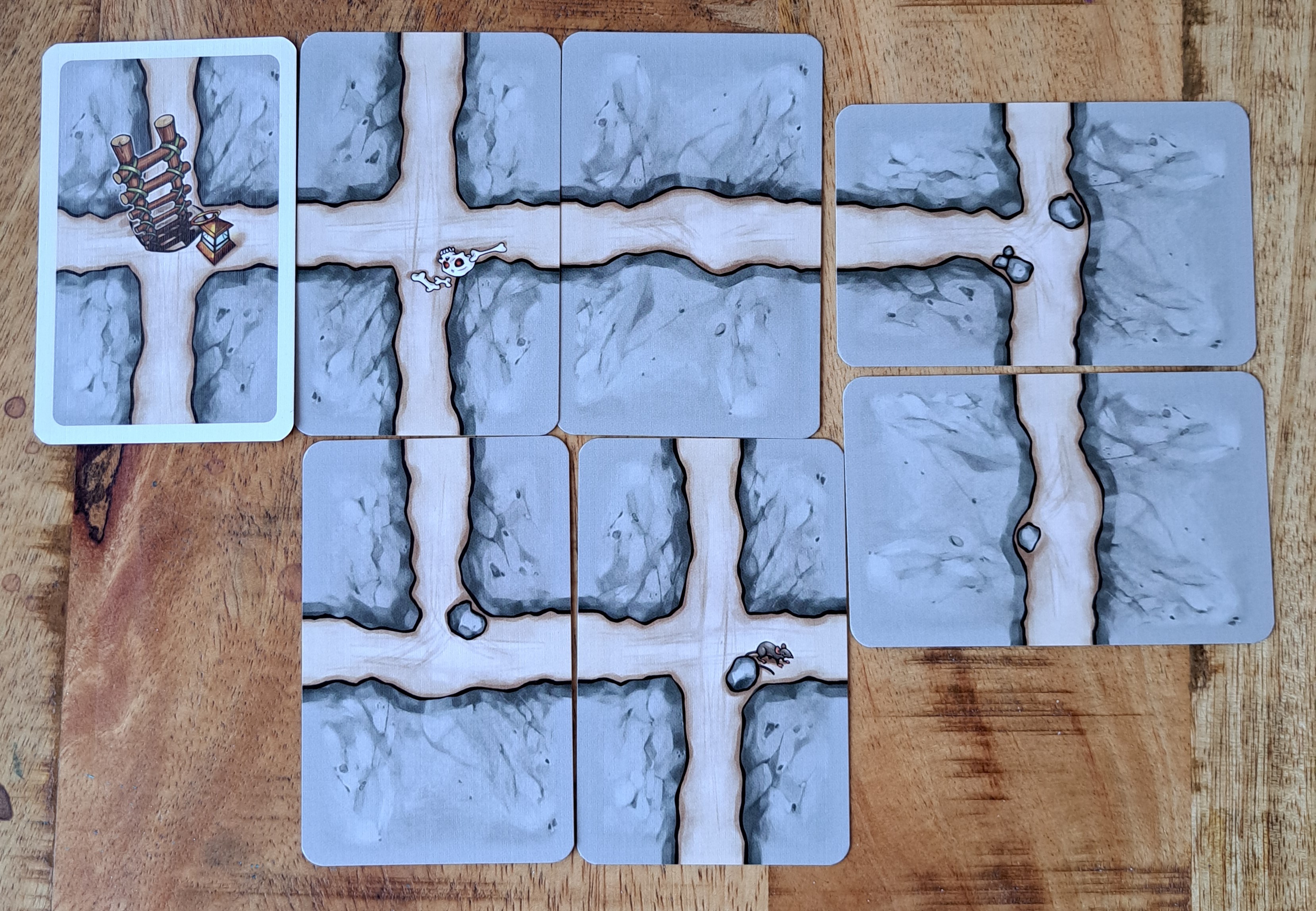
NOT LIKE THIS:

Path Cards must also be played long side to long side or short side to short side. It is not permitted to connect the long side of one tunnel card to the short side of another.

Playing An Action Card:

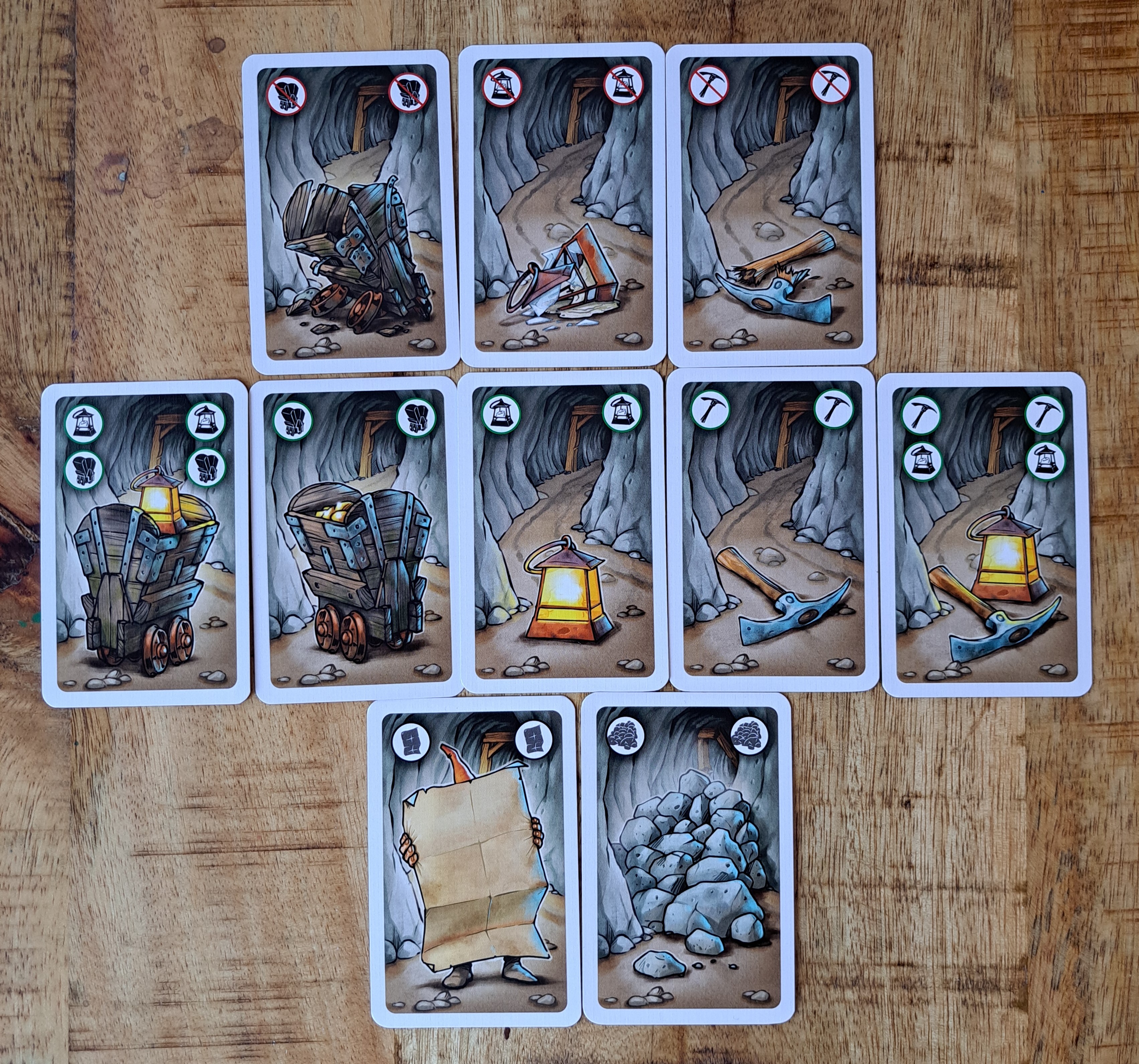
There are four types of Action Cards; Broken Tools, Fix Tools, Rockfall and Map

Broken Tools are useful cards both for Saboteurs and Miners; you can play them on another player by placing them in front of that player, and a player with Broken Tools is unable to build tunnels until they, or a different player, have been able to play the appropriate Fix Tools card.

Broken Tools do not completely hinder a player though, as Rockfall and Map can still be used until such time as your tools can be repaired. Rockfall is an excellent tool for a Saboteur, as it allows a player to remove one section of tunnel, effectively setting the Miners back one turn. As some Path Cards allow Saboteurs to build dead ends into the map the Rockfall can be a useful tool for the Miners too, as it will enable them to remove problem sections of the map created by nefarious Saboteurs and build functional tunnels. Map allows a player to chose one of the Goal Cards and look at it, without showing the other players, giving them an edge on potentially knowing where the chunk of gold is.

Ending A Round:

If a route is completed to a Goal Card, one of two things happens. Firstly the Goal Card is flipped over; if it’s revealed that the Goal Card reached was only a lump of coal, then the round continues as before. If, however, the Miners have struck gold, the round ends. At this point all Miner/Saboteur cards are flipped, revealing who was who all along.

If the draw pile is exhausted the round continues with each player continuing to play or discard cards as necessary until either a route to a Goal Card is achieved or no player remains able to play a card. At this point, if no route has been completed to gold, the Saboteurs win! At the end of a round, no matter who won, gold must be divided up between the victors.

When the Miners win the round the player who laid the last card to complete the path draws Gold Nugget cards equal in number to the number of Miners, looks at them secretly, chooses one to keep (not all Gold Nugget cards have the same value), then passes the remaining cards to the next player, going anti-clockwise, until all Miners have a Gold Nugget card to keep.

When the Saboteurs win the gold is divided up slightly differently. If only one Saboteur was playing they take Gold Nugget cards from the deck equaling four Gold Nuggets, if two or three are playing they each get three Gold Nuggets, and if four are playing each receives two Gold Nuggets.

Note: It is possible for a round to be played (in a game with only three or four players) in which no one is a Saboteur. If this happens and the gold is not reached before the round ends due to lack of cards, none of the Dwarfs receive any gold.

At the end of a round each player keeps their Gold Nuggets. The Miner and Saboteur cards are returned to one pile, including the one that was put aside at the beginning of the round, they are then shuffled and redealt, for the start of the new round. All Path and Action Cards are returned to the deck, and everything is shuffled together, for new hands to be drawn. Likewise the Goal Cards are shuffled and laid on the table again. The next round is played the same as the first.

At the end of three rounds the game is over and each player counts their Gold Nuggets. The player with the most wins! In the event of a tie, the players share the win.

Strategy:

This is not really a game in which a whole lot of strategy is required. Obviously you’re on the lookout for who might be Saboteur, and aiming to hinder them if you’re one of the Miners. Likewise, as a Saboteur you’re aiming to hinder the Miners without being immediately obvious, and also hoping not to accidentally hinder other Saboteurs if there are any playing. Other than that you mostly have to go with which cards are in your hand, available to play.

To Conclude:

I like this game a lot. It’s quick, easy to learn, easy to set up/put away and all-around good fun. It’s also good for kids, as there’s not any reading required, once the rules have been looked through, and the high player limit make it an excellent choice for a family game. The only slightly irritating thing is that the game is not playable with only two people, however, Saboteur 2, which we also have, and will be reviewing, expands on the base game, and gives new depth with teams added and new roles introduced.

This game is a solid 4.5 on our rating, as it’s interesting enough in structure to be fun, easy enough to learn quickly, and a good game for casual gamers, who might not be invested in the kind of games that require 1-2 hours of set up and rule reading before you even get to gameplay. The last .5 that would bring it to a 5 rating is that we wish it would be playable with just two people.

Games You Can Make At Home – Snakes and Ladders


Where Did The Game Come From?

Well, we’re going to make a version of Snakes and Ladders. For anyone who doesn’t know, Snakes and Ladders is originally an Ancient Indian game, played entirely by luck. Historically it had its roots in morality; your progress up the board represented a life journey with the complications of virtue (ladders) and vice (snakes). Nowadays it is most commonly played as a simple race and counting game for younger children.

What Will You Need?

  • A large A3 or similar sized pad of paper (in which you can store all the games you make)
  • A ruler, at least 30cm in length
  • A pencil (I recommend a mechanical one)
  • Coloured pens/pencils (optional)
  • Time – about half an hour
  • Plenty of space – either a clear table or big wooden floor

The Process:

  1. The very important first step is deciding what size you want your squares to be, and how many squares there will be on the board. I made two boards; one with 100 squares, and one with only 25, these were, respectively, 10×10 and 5×5 grids. For my 100 square board I settled on a size of 5x5cm squares.
  2. Once you’ve chose the number of squares you want, and the size they will be, you simply lay down your ruler and (in pencil) measure out the total length of all the squares; i.e. 5 x 10 = 50cm x 50cm for the 100 square grid. Once you’ve measured out the length, go back down the ruler and mark off each 5cm (or whatever your chosen size of square is) to get the intervals for where your squares will be. Repeat this on all four sides trying to keep your lines as square to each other as possible.
  3. When completed you should have a square with 5cm marks down all four sides. Next you just join them up, go along either horizontally or vertically joining the top and bottom, or left and right lines together. Then repeat the way you didn’t go first to end up with a nice grid.
  4. At this point you should have a nice, neat pencil grid in front of you. My next step would be to number the squares, in the top right hand corner, reasonably small, but big enough to be easily read.

We’re now almost finished with the first stage of the game! The last thing to do is to draw on your snakes and your ladders, you should aim to have these fairly evenly distributed across the board, their lengths are totally up to you, but I would advise making all of them different lengths, and including at least one pretty long ladder, as well as a nasty snake quite close to the end of the game, if you’re feeling mean.

*NOTE! Everything up to this point should be done in pencil, as mistakes are easy to make, but hard to correct if the work was done in pen.*

Making It Colourful!

Here’s where your coloured pens/pencils come in. When I did it I went over all the grid lines and numbers with my black pen and then proceeded to colour in the ladders and snakes giving them black outlines, but more colourful insides. You should also feel totally free to doodle on the blank paper outside of the grid, this is your project and you’re completely free to make it complicated or simple – as you choose!

If you’ve got little kids you could also draw and number the grids yourself, going over them in black pen, and then give it to your kid (or make multiple copies if you have more than one child) and let them draw on their own snakes and ladders.

Finishing Up:

My last action was to go over the grid with a rubber in the places where I could still see the pencil marks – this is totally optional, if it doesn’t bother you to see the pencil marks, then by all means, leave them there.

The Finished Product:

As you can see, my final products were pretty simple, but you can do whatever you want with yours! All you need now is a standard 6-sided die and a few generic coloured playing pieces and you’re ready to roll!

One Last Note…

These posts are entirely non-profit, the idea behind them being to suggest creative ways that bring assorted games into the house if you don’t have the money/space to buy beautiful wooden, or printed copies. The games I intend to write about are all old and in public domain.

On The Seventh Day Of Christmas, My True Love Gave To Me…

Uno, and said in hushed tones that it’s the only child-friendly way of playing Blackjack early in the day…

The Rules:

The deck of cards is shuffled, and seven cards are dealt to each player, the remaining cards are placed face-down in the middle of the table and the top one turned over and placed next to it. Generally the youngest player begins and they start by putting a card on top of the face-up one that matches either the colour or the number of the card. If they aren’t able to do this, but they hold a wild card, they can play that instead and change the colour of the cards that are being played. There are a few other cards that change the direction of play and similar things, but those can mostly only be played when they match the colour. The objective of the game is to play all of your cards. If you are unable to play a card on your turn you must pick one up from the face-down pile and add it to your hand. When you only have one card left you have to say “UNO!!” as loudly as possible before you can put it down. If you play your last card without proclaiming Uno, you must draw new cards and continue playing as a punishment.

For Christmas?

Yes! Definitely! This game is great for large or small groups of players, and is all-ages inclusive. Aunt Jean could almost definitely grasp this one without too much trouble, and she might not even complain about it! On top of that, it’s a speedy play, so a good time filler.

Happy Seventh Day of Christmas! Keep the cheer and food flowing!

Lotti Karotti or Funny Bunny!

5 - 5

Number of Players: 2-4

Year of Publication: 1999

Creator: Ian Steven (artist)

Go back to whichever hole you jumped out of and leave us alone!

What do you call a happy rabbit? A hop-timist! (Not the place for bad rabbit jokes? Okay…)

Lotti Karotti (the German name for the game, the English is Funny Bunny) is a simple and fun game in which you race against the other players’ rabbits, and hop that little bit faster than everyone else!

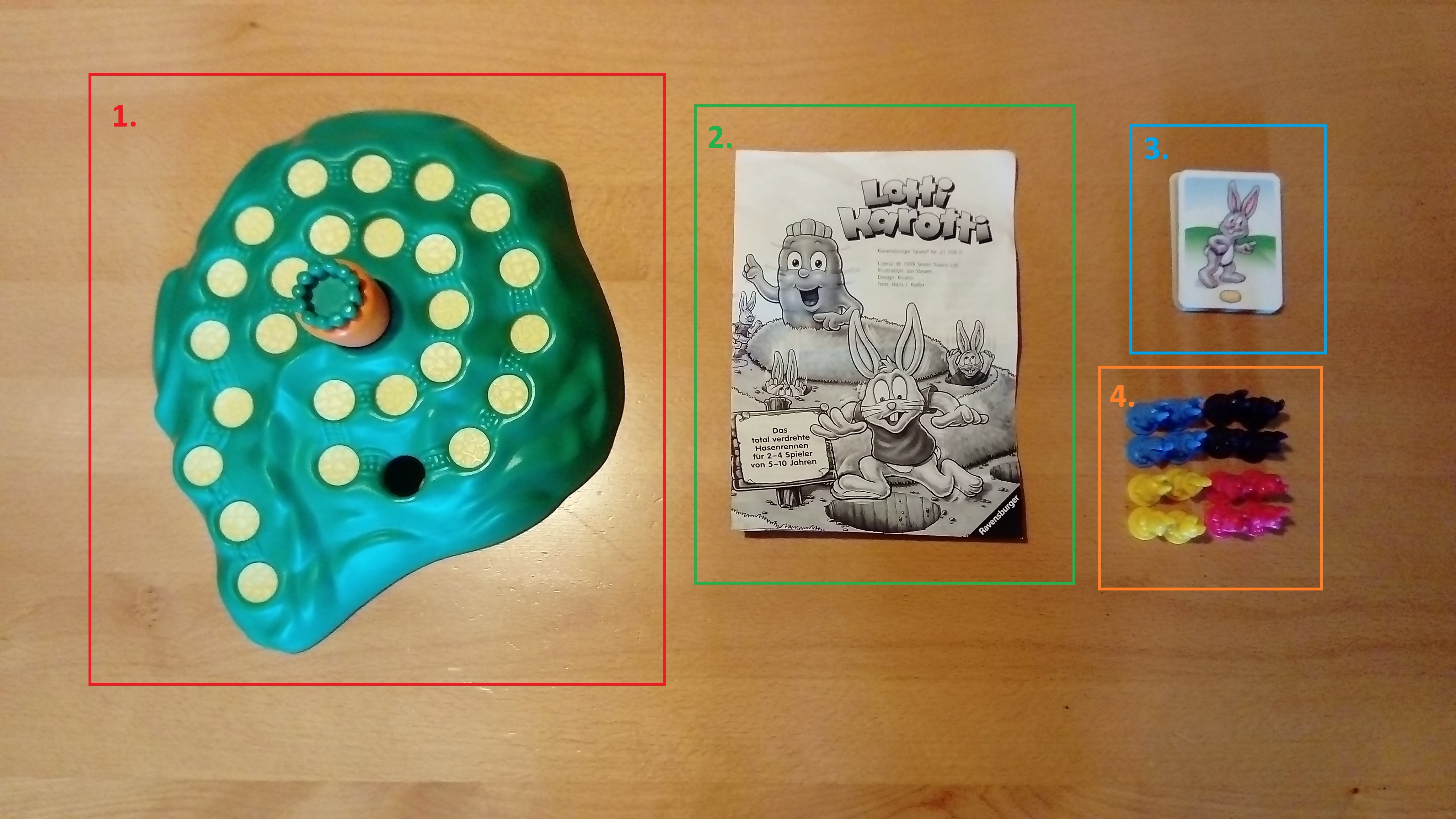
What’s In The Box:

dsc_0142

  1. Three-dimensional playing board
  2. Game rules
  3. Deck of action cards
  4. 4 x 4 coloured rabbits

Playing The Game:

Objective: To get one of your rabbits to the big carrot faster than anyone else.

To begin the game the deck of action cards should be shuffled and placed face-down at the side of the board and the carrot should be twisted until there are no holes showing in the board. Next each player should choose a colour of rabbit to be from the four available. As it doesn’t say in the rules who plays first we just did Rock, Paper, Scissors for it. Once a first player has been determined they draw the first card from the deck and turn it face up on the table. They then perform the action on the card which will be either, hop 1, 2 or 3 spaces, or twist the carrot.

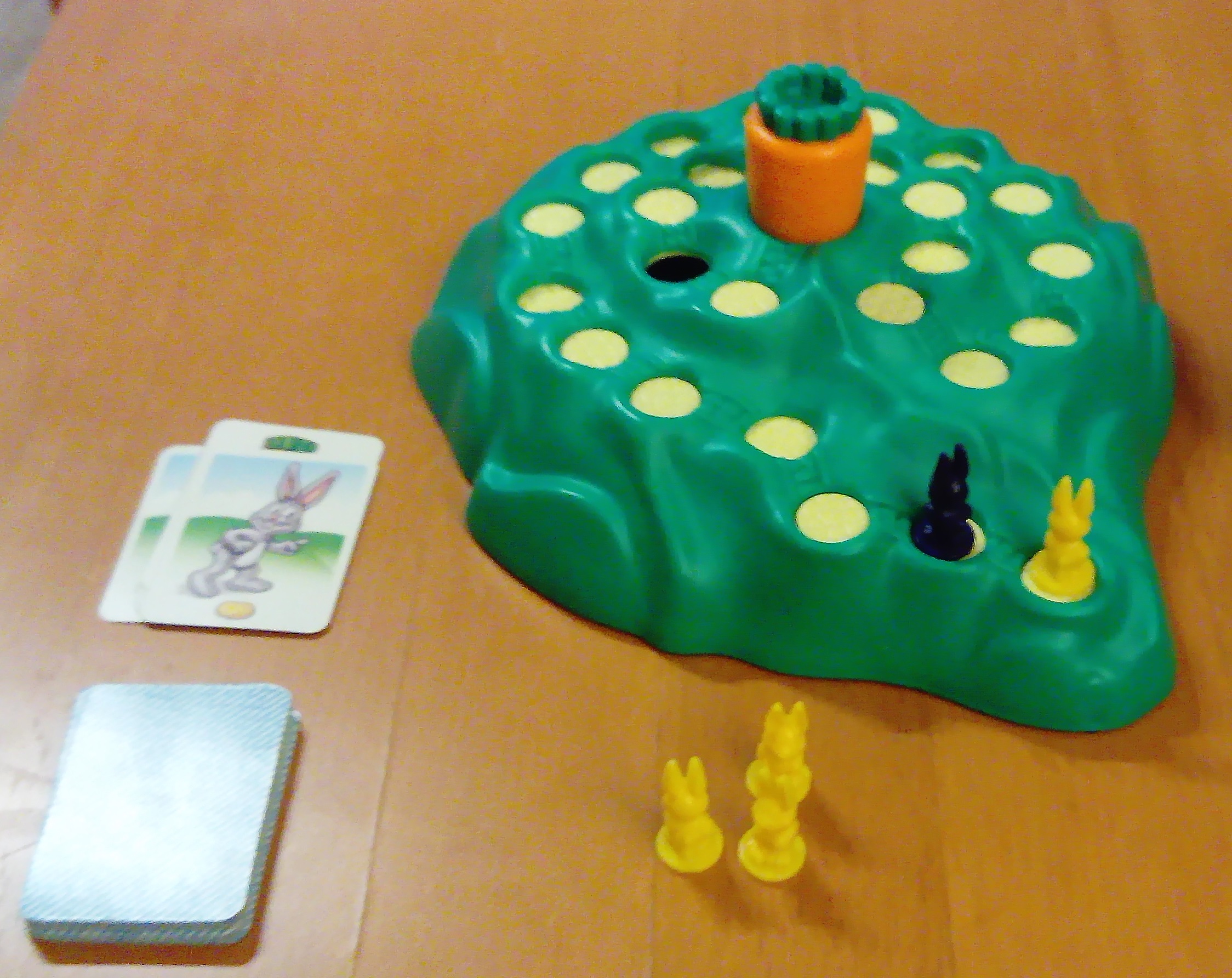
Normally players will place a rabbit onto the first, second or third spot on the board on their first turn. This normally creates a que of rabbits, like this:

dsc_0188
Here two rabbits are adjacent to each other.

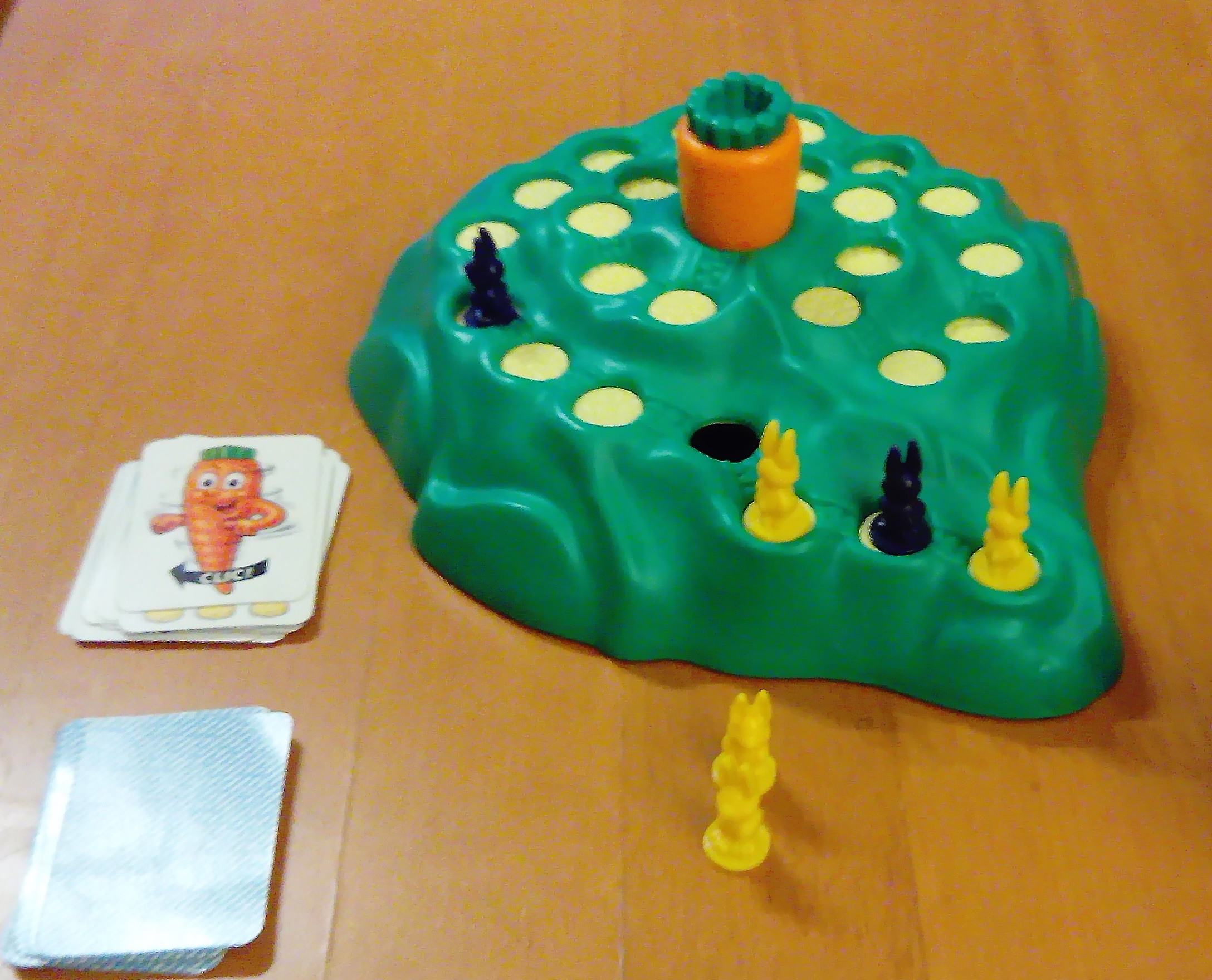
If this happens and the player in the middle or the back turns over a card that tells them to hop they are allowed to jump over any number of rabbits that are adjacent to them to get to the next empty space. Like this:

dsc_0189
The second yellow rabbit has hopped over the first yellow rabbit and the purple one to reach the third space on the board.

When the carrot is turned it causes holes to open up at different points on the board. If one of your rabbits is on a hole when it is opened by another player (or yourself) it falls underneath the board and is immediately out of the game. Likewise if a hole is opened next to where one of your rabbits is and you turn up a card saying to hop one space you also have to hop into the hole, you cannot hop over it.

Winning The Game:

The first player to get a rabbit to the top of the carrot is the winner.

Strategy:

It’s not really possible to have a strategy for this game. This time round that we played it all my rabbits ended up in underneath the board and there was absolutely nothing I could have done about it. I would say just try and get your first rabbit as far along the board as possible. But otherwise don’t think it through too much, because it’s a game of chance with the cards really.

History and Interesting Things:

  1. Between 2001 – 2002 this game was recommended for two awards and won 1.
  2. I have absolutely nothing else interesting to write here.

To Conclude:

As kids games go this is pretty great. It doesn’t involve any complicated thinking but also, because of the nature of the ‘carrot’ cards, doesn’t get boring either. It’s a good quick play for children of all ages with a cute theme.

Sphinx!

5 - 5

Number of Players: 2-4

Year of Publication: 1999

Creator(s): Gunter Baars (designer) and Chris Mitchell (artist)

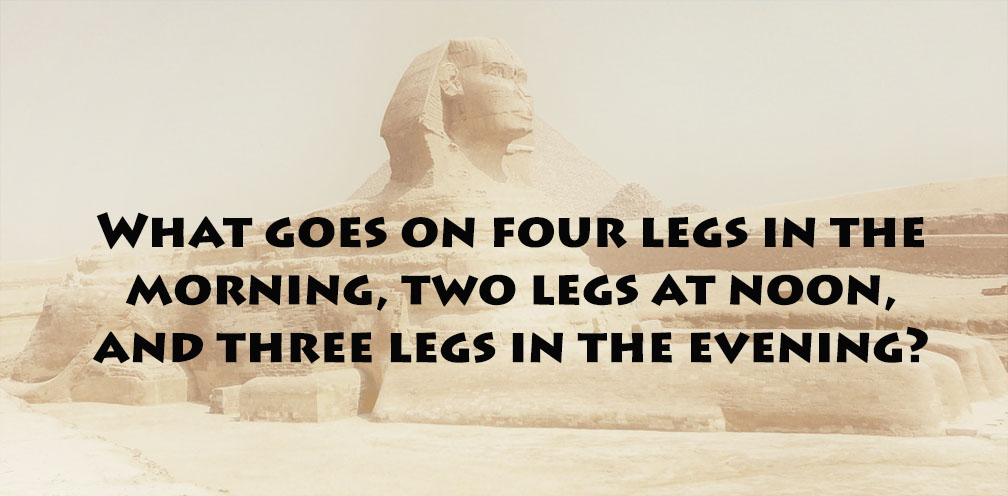
Can you fathom the riddle of the Sphinx?

sphinx-riddle
Image courtesy of awesomejelly.com

Sphinx  is a simple game for kids which incorporates the popular mythological creature. The Sphinx is a widely recognize creature; a lion with the head of a man. The most famous Sphinx in the world is the Great Sphinx of Giza in Egypt, which stands near the Great Pyramids of Giza on the west bank of the Nile. In popular mythology the Sphinx is a wise being which often demands the answer to a riddle. when this answer is given incorrectly the Sphinx eats the unfortunate person who couldn’t answer. However, the mini Sphinxes in this game are much less vicious.

What’s In The Box:

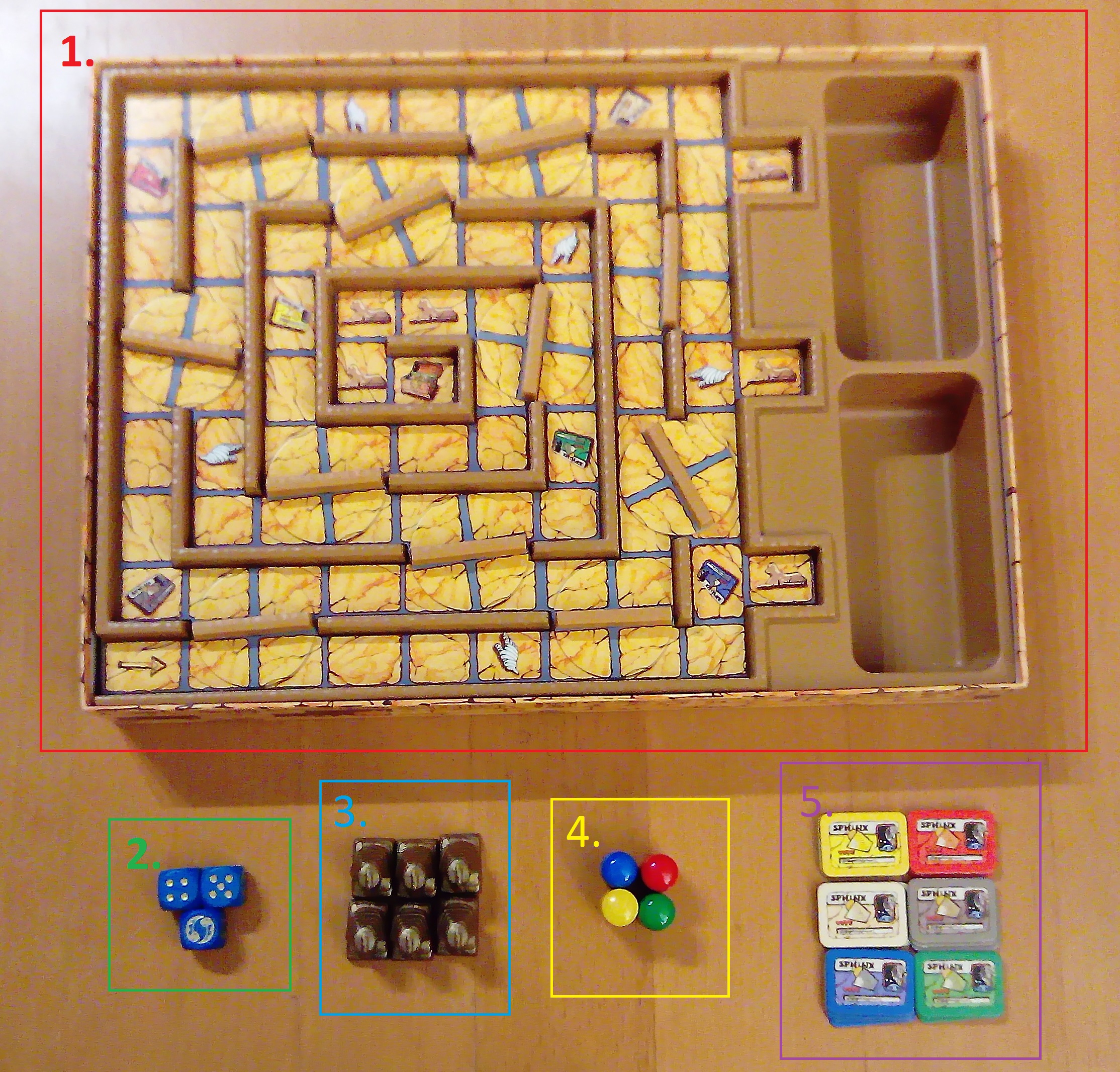
dsc_0182

  1. Game board
  2. 3 6-sided dice, one with a double snake image on one side
  3. 6 Sphinxes with different coloured bases
  4. 4 player tokens
  5. 6 coloured Sphinx cards
  6. 1 Rule book (not in the picture as someone was reading it at the time)

Playing the Game:

Objective: To collect the right coloured Sphinx cards and present them before the Sphinxes to collect the treasure.

Okay, that’s not a hugely clear way of writing the objective, but that’s why we write the rest of the post!

To begin the game each player chooses a token and places it on the square on the board with an arrow on it. The six Sphinxes are then randomly placed on each of the six squares with a Sphinx image on it. If you’re playing with less than four players you should remove the appropriate number of Sphinx cards from the stack by the side of the board so that there is one for each player. In this game the youngest player starts, and play then continues clockwise round the board.

To begin your turn you roll all three dice. In this game you do not total the number shown on the dice, instead you take each die as an independent section of your turn, in whichever order you choose. If you pass another player you can take a Sphinx card that you need from them. However you cannot take a card that you already have, if a player has Sphinx cards, but you already have all of them, they have to return one to the stack and recollect it.

An interesting thing about this game is the flexibility with which you can take each turn, when you move forward with the number on one die, you can then move backwards using the number on the next die.

Note: you cannot move forward an backward on the same number. For example I couldn’t split a five on one die into two three squares forward, one square back, I would have to move either five squares forward or backwards.


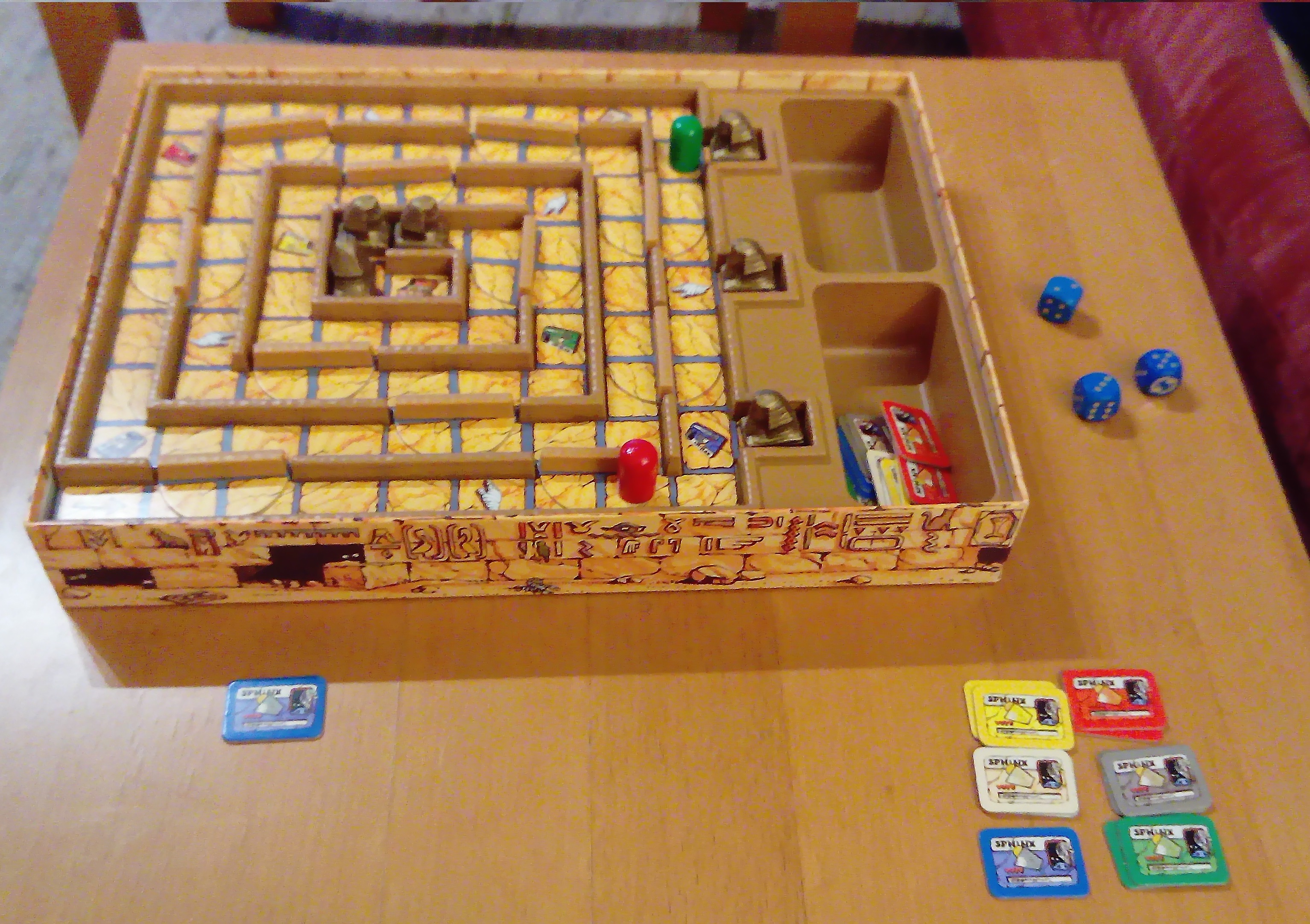
dsc_0184

Okay, take this picture as an example of how I might take my turn. Say I’m green and I’ve just rolled a 2, 3 and 5. I could then proceed as follows: I could go forward two squares and collect the beige Sphinx card (to collect a card you can either land on, or pass over the correct square), I could then proceed a further five squares along in the same direction as I was previously going. This would pass me over a mummy hand, doing this means that I can look at the base of any one of the six Sphinxes on the board to know which colour it is. In addition to that, I also have to spin the section of board that I’ve landed on. It’s not clear in this picture, but some of the sections of wall in the maze are small 2×2 square turntables. If a player ends one of their moves on one of theses, they have to rotate it 180 degrees; if another player is on the next square, or the other side of the same wall section, they are also rotated. Lastly I have a 3 to use up, I can then go in whichever direction I choose, three either direction takes me to another turntable.

Oaky, so that’s how you would play a turn. Lastly, there’s a double-snake symbol on one of the sides of one of the dice. When this is rolled the player who rolls it has to swap one of the Sphinx from the center of the board with one of those situated down the right-hand side.  When doing this they are not allowed to look at the base of either of the Sphinxes; that can only be done when a player passes over, or lands on a mummy hand.

Winning The Game!

To win the game a player must correctly discover (or guess) the colours and order of the three Sphinxes in the center of the board and proceed to the first Sphinx and present the correctly coloured Sphinx cards.

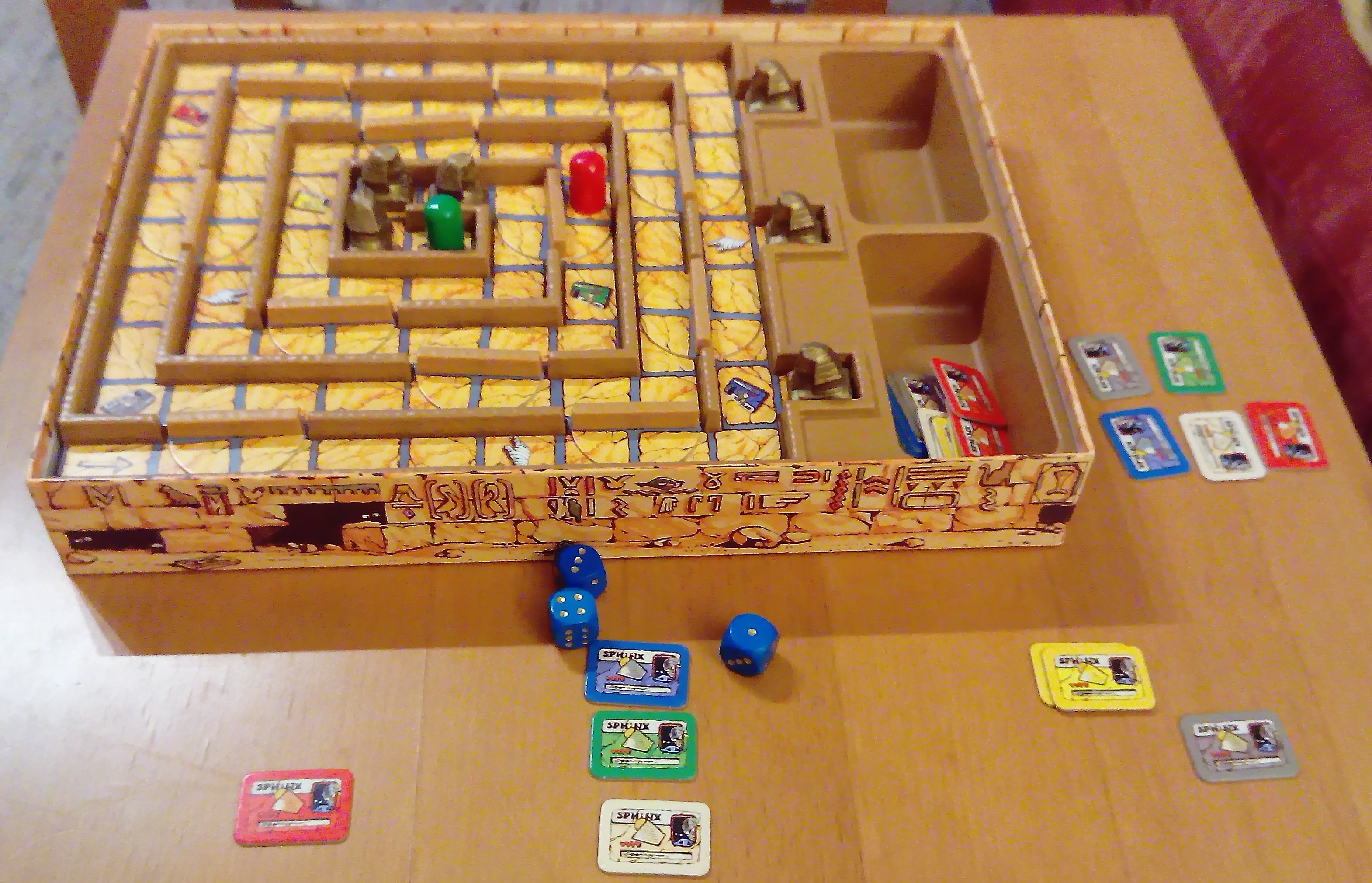
dsc_0186
The Green player (me) is going for the win. I announced the first Sphinx to be blue, the second green and the third beige. I won. 😀

The optimistic player must then announce to all other players which Sphinx they think has each colour. They then look, without showing any other player what the colours are and announce whether they are right or wrong. If they are right they then show the Sphinx bases to all the other players. If they are wrong they remove their playing piece from the board, and stay quiet whilst everyone else keeps playing. The first player to get to the middle with the right Sphinx cards in the right order wins.

Strategy:

This is a pretty simple game, aimed at kids aged 8+. The only thing I really want to say in terms of strategy is that if you roll a double snake, the best thing to do on that turn is to try and pass over a mummy hand with your other two numbers, before swapping any of the Sphinxes. If you do this then you can look at one of the Sphinxes from the edge of the board, and then move that one into a space in the middle. When you do this you’re actually making it easier for you to win the game as you’ve played a Sphinx that you already know the colour of. Don’t forget that you have to collect Sphinx cards though, I generally try and pass over as many Sphinx cards as possible on my way around the board, as I can then proceed very quickly to the treasure in the middle once I’ve worked out the colours of the Sphinxes.

History and Interesting Things:

  1. The word Sphinx was derived from the Greek word spingein, meaning to bind or squeeze, by Greek grammarians . However, the etymology of the word is unrelated to the legends that surround the creature, and therefore dubious.
  2. The earliest Greek author to mention the creature was Hesiod, and he called it Phix.
  3. The most famous Sphinx legend features the Winged Sphinx of Boeotian Thebes. This Sphinx was said to have terrorized people by demanding the answer to the following riddle, “What has one voice, but becomes four-footed, two-footed and three-footed?” and devouring anyone who answered incorrectly. Upon being given the correct answer: a man who crawls on four legs as an infant, walks on two when grown and leans on a staff in old age, she kills herself. Talk about a drama queen.
  4. It is from this legend that the belief that Sphinxes are omniscient apparently arose.
  5. The Great Sphinx of Giza is known by the Arabs as “Father of Terror”.
  6. Although most images of the Sphinx don’t have enough information with them for their function or symbolism to be known it is generally believed that the Sphinx served a protective function.
  7. Sphinxes were commonly carved with the heads of pharaohs on them.

Okay, I know this is only seven points, but there’s actually so much that can be read about Sphinxes in different parts of the world, in legend and in artistic representation and interpretation that I can’t go through more of it without my brain turning into jelly!

To Conclude:

This game is great. It’s complicated enough to be a challenge; the three-section turn means you have to think a little more tactically that if you simply moved the entire dice roll in one go. But simple enough that you can’t really get into any arguments about the rules or anything like that. It’s also a good memory game for children as in discovering the pattern of colours of the central Sphinxes they have to remember which Sphinx had which colour, and they have to be aware when Sphinxes are moved. This is challenging for children (and some adults) and encourages the development of focus, concentration and the short-term memory.

I rated this five because, in addition to the well-structured nature of the game, the box is also great. Every piece has a place and it’s tidy and efficient.


Connect 4!

5 - 5 - Strike Thro

4.5 - 5

Number of Players: 2

Year of Publication: 1974

Creator(s): Milton Bradley designers, artists etc are uncredited.

The simplest and yet often the most frustrating of games!

Connect 4 is a popular game played most often by children of primary school age (7-11). It has a very simple your-turn-my-turn game play and can be quite frustrating if your opponent keeps winning.

What’s In The Box:

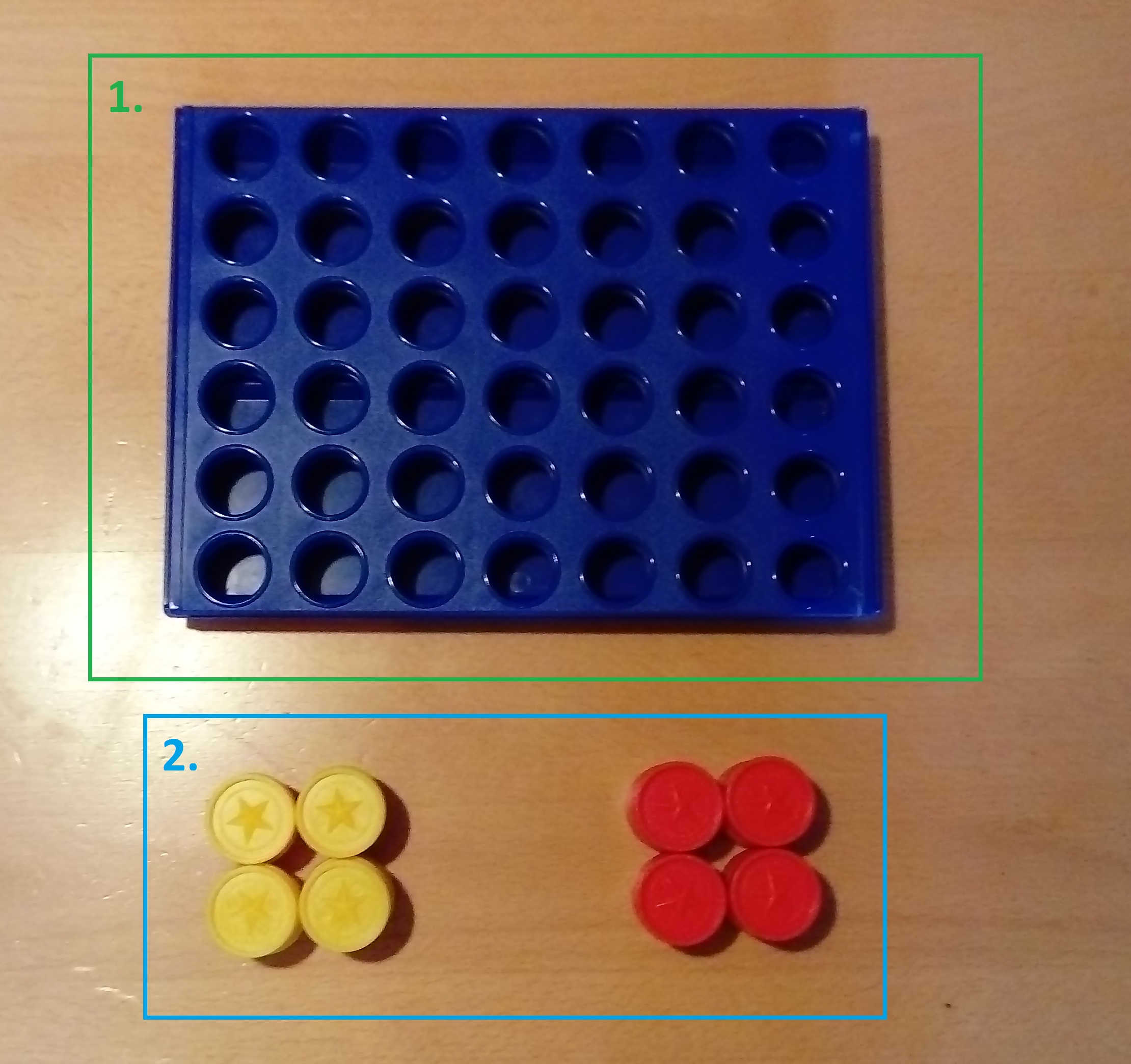
whats-in-the-box

  1. 1 Fold-out game grid
  2. 21 yellow and red counters

Playing The Game:

Objective: To create a line of four of your counters either horizontally, vertically or diagonally, before your opponent.

This game is incredibly simple in its original form. The yellow player takes the first turn, and places one of their counters into the top of any column on the grid, this then falls to the bottom, taking a position on the lowest line on the grid. The red player then follows suit.

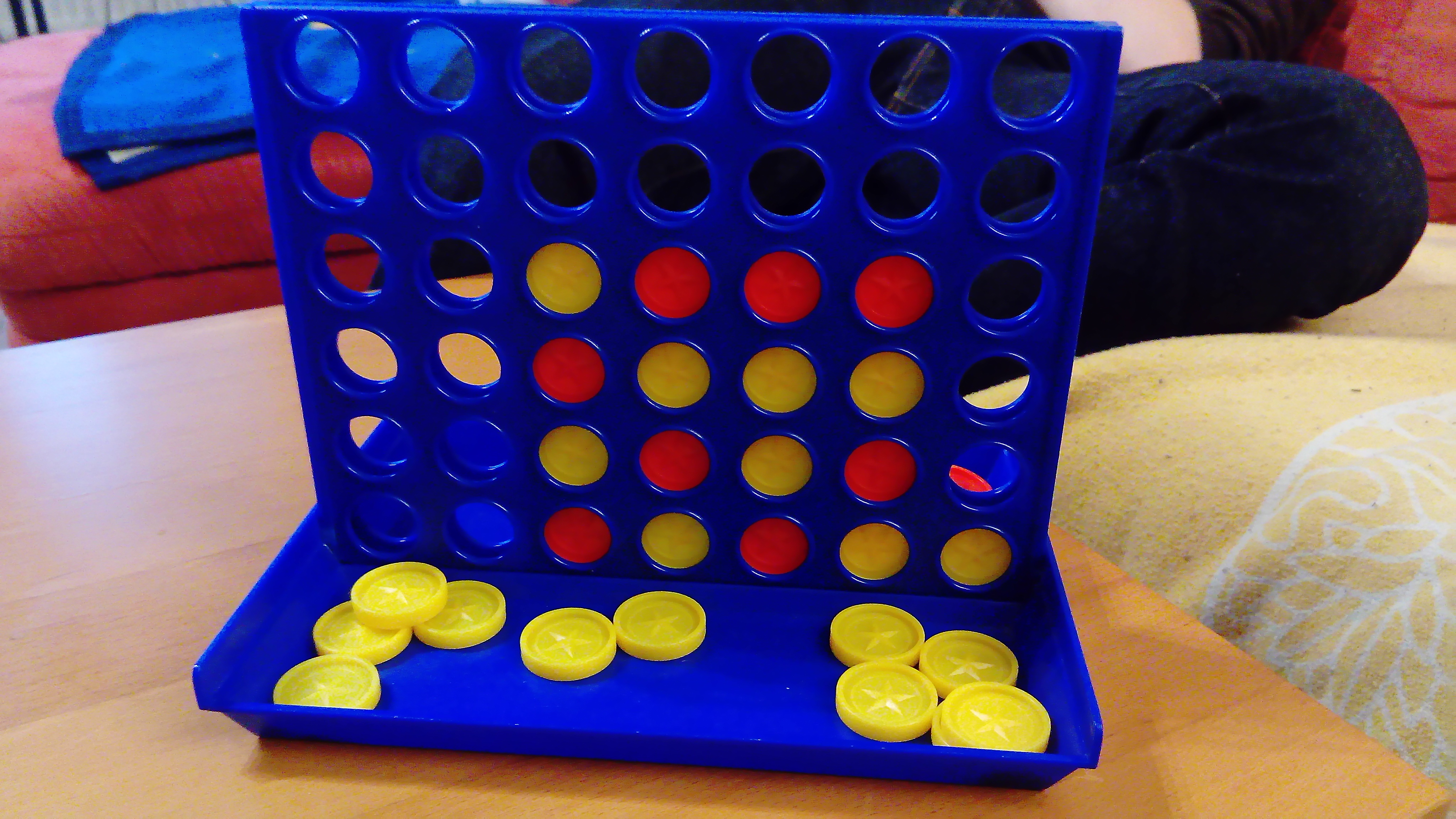
dsc_0150
This is what a game that is about halfway through might look like.

The game continues in this manner, with players each dropping counters into whichever column they like, until either one player has succeeded in creating a line of four, or both players have run out of counters.

Winning The Game!

Winning the game is simple, and would look like this:

dsc_0153
Yellow player (me) has successfully created a diagonal line through the red players attempt to create a line of four!

Strategy:

This game is one of a group of games that can always be won by the first player, provided they play correctly. Strategically the best starting position for the first player is the central column, as from there they can choose to play on either side of grid whilst knowing that they’ll be connected to their other counters. I generally play to block off my opponent at every turn, whilst simultaneously trying to create a position in which I can create two lines of four, meaning that my opponent, at that point, cannot stop me from winning.

History and Interesting Things:

  1. The game was first sold under this name by Milton Bradley in February of 1974, but is also known by these names: Captain’s Mistress, Four Up, Plot Four, Find Four, Four in a Row, Four in a Line and Gravitaps (Soviet Union)
  2. The game is a Solved game, meaning that its outcome can be correctly predicted from any position, assuming that both player play perfectly.
  3. The game has been mathematically solved by several different people, the first of whom was James Dow Allen on October 1st, 1988.
  4. There are several different variations of the game; Pop Out, Pop 10, 5-in-a-Row and Power Up. They can be read about in more detail here.
  5. Hasbro produces various sized outdoor versions of the game, the largest of which is built from weather-resistant wood, and measures 120cm in width and height.
  6. A rumor that the game was created by David Bowie was started by NME broadcaster and reporter Stuart Maconie which then became an urban myth.
  7. Another version of the game, Connect 4 Twist & Turn was published by Winning Moves in 2015. This version features a game tower instead of a grid, with five rings that twist independently. The objective, to create a row of four of your colour disc, is the same, however as a player can choose to twist a ring after they’ve played a disc a new level of strategy is added to the game.

Look at that! I managed to find quite a few interesting things about this game!

To Conclude:

This game is great, as a child I loved it (and am still good at it). I rated it 4.5 instead of 5 because of the problem where the first player can always win. Although there’s not much that can be done about it in the original form of the game it doesn’t still make the game technically unfair. Aside from that though, I have nothing to complain about, the game is great for kids as it makes them think a little tactically, plus, it’s simple enough that it can be learnt in a few minutes. I’d say that this a game to have in the house if you’ve got children, especially as it’s easy to tidy up due to not having lots of tiny pieces.

Kids Games – Teddy Memory

5 - 5

Number of Players: 2-4

Year of Publication: Unknown

Creator(s): Ravensburger

How’s Your Memory?

In this classic variation of Pairs, the simple memory game Teddy Memory is a cute and child-appealing version of the game, with adorable teddy cards.

What’s In The Box?

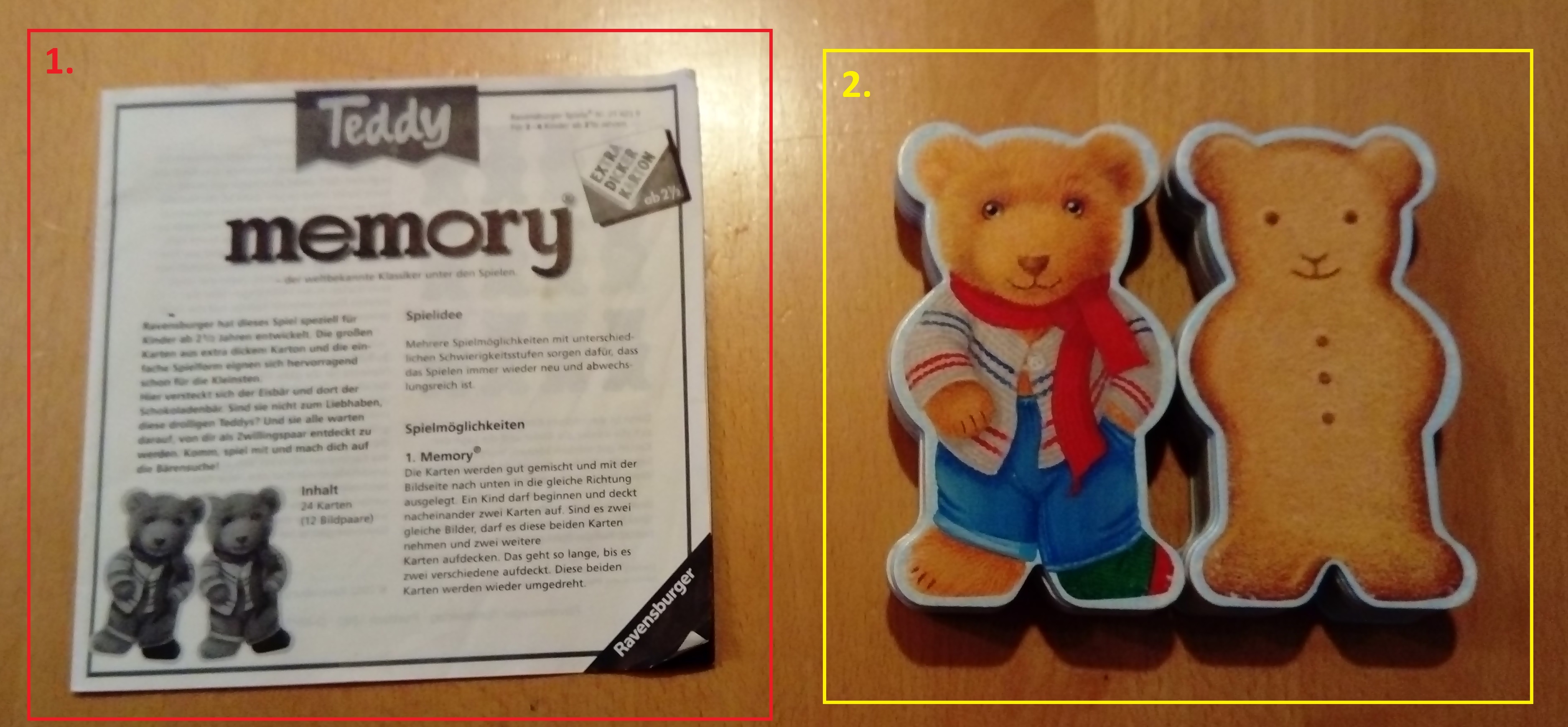
dsc_0138

  1. Multi-lingual rulebook
  2. 24 Teddy cards (12 pairs)

Playing The Game:

Objective: To have the best memory and so collect the most pairs before the end of the game.

In normal Pairs there is only one way to play the game: you shuffle the cards and lay them all out face-down on the table. You then take it in turns to flip over two cards. If they match you can keep them and take another turn. If they don’t match you have to turn them over again and it is the next players turn. In Teddy Memory Ravensburger have suggested two additional ways to play this game, which are both interesting.

The first is this: Reaction Memory
I’m going to write here exactly what they wrote in the rulebook. “Shuffle all of the cards and place them face down in the same direction. The first player turns over one of the cards and leaves it face up. The next player then does the same, and the game continues in this manner until two matching cards are revealed. Then it’s up to the players to react – the first one to call out what the picture on these cards is takes them as his or her own. The game then carries on as before. The game is over when only two cards are left on the table. The player with the highest number of pairs is the winner.”

The second variation is: Describing Pictures
“The Memory cards are shuffled well and placed face up on the table. One player chooses a card, describes it and then passes it on to the next player. The second player chooses the matching card from the table and keeps the pair. This player then chooses a new card and describes it before passing it on to the next player. The game is over when all the cards have been collected. There is no winner in this game.”

These are all simple and I don’t think they really need any extra explanation, so I’m going to go straight to the next part of the post.

Strategy!

Well, this is a game for children aged 2 and a half – 5 so there’s not much in the way of strategy. For the classic version of the game the best way to play is really to concentrate on what other people are turning over. I find that to collect a lot of pairs you should first turn over a card that you haven’t seen the other side of, and then try and remember if its pair has already been turned over somewhere. If it has, pick that one out, and if it hasn’t, turn over another random one to see if you can get lucky.
That’s basically it. Concentrate hard and you might be able to win. But also maybe not, that’s the beauty of simple games.

History and Other Interesting Things:

To be totally honest, this game is really old but it’s almost impossible to date it or to know anything interesting about it except that there’s hundreds of variations of it, with Bears, Disney Princesses, Barbie, Happy Families, Farm Animals… The list goes on.

Further Reading and Other Editions of the Game:

This is possibly the easiest game to find variations of ever. Online there are regular memory games, number memory games, letter memory games… Some more challenging and obviously educational than others, but fundamentally all the same.

Conclusion:

This game is great for kids, and for adults. It’s so simple that the rules have no ambiguity to them, and you can even make your own version of this game at home using paper and pens if you don’t have a properly published version. It’s also quick and straightforward, so although it’s always possible to get frustrated at a game I believe that this one generally remains fun and light-hearted. If you’ve got kids and you haven’t played this game with them you should get a copy, especially as it really helps them focus, therefore improving their concentration and memory skills from an early age.

Quarto!

4.5 - 5

Number of Players: 2

Year of Publication: 1991

Creator(s): Blaise Muller

 Video:

Quarto! is complicated Connect Four and for this review we’ve done a video, our first real video review! The video covers all our normal sections except ‘History and Interesting Things’ so check it out below:

History and Interesting Things:

There are only a couple of notable things about this game and they are:

  1. The game was invented in 1991 by Swiss mathematician Blaise Müller.
  2. It has won the following awards:

To Conclude:

Like we say in the video, we like this game a lot! My only issue with it is retaining enough concentration to keep in check all of the eight different piece attributes that could create a line. However I would highly recommend this game and if you like games that range from Connect Four to Chess then you will most probably love this game.

Switch (Blackjack)

4 - 5

Number of Players: 2-lots

Year of Publication: Unknown

Creator(s): Unknown

Appreciate Our Custom Made Cards!

Switch is one of the many versions of Black Jack around, we aim to cover them all between now and eternity, but that could take years, so don’t hold your breath for any exciting Blackjack posts any time soon. I think this game is good because it’s simple, can be played anywhere, and is very quick.

What’s In The Box:

Well, as it would transpire…. Nothing! All you need to play this game is a standard deck of cards, and at least two willing people.

Playing The Game:

Objective: To be the first to play all the cards in your hand.

So to start the game each player is dealt a hand, usually of seven cards. The remaining cards are placed face down in the middle of the table, and the top card is drawn to determine how play starts. If the top card is a Power Card, then another card is drawn until a card is revealed that has no other purpose in the game. The starting player (typically left of the dealer) should then find in their hand a card that matches either the suit or the rank of the face up card. If a player cannot play a card from their hand they must draw cards from the deck until they can.

The starting set up for Switch.
The starting set up for Switch. Appreciate our custom made cards!

Power Cards:

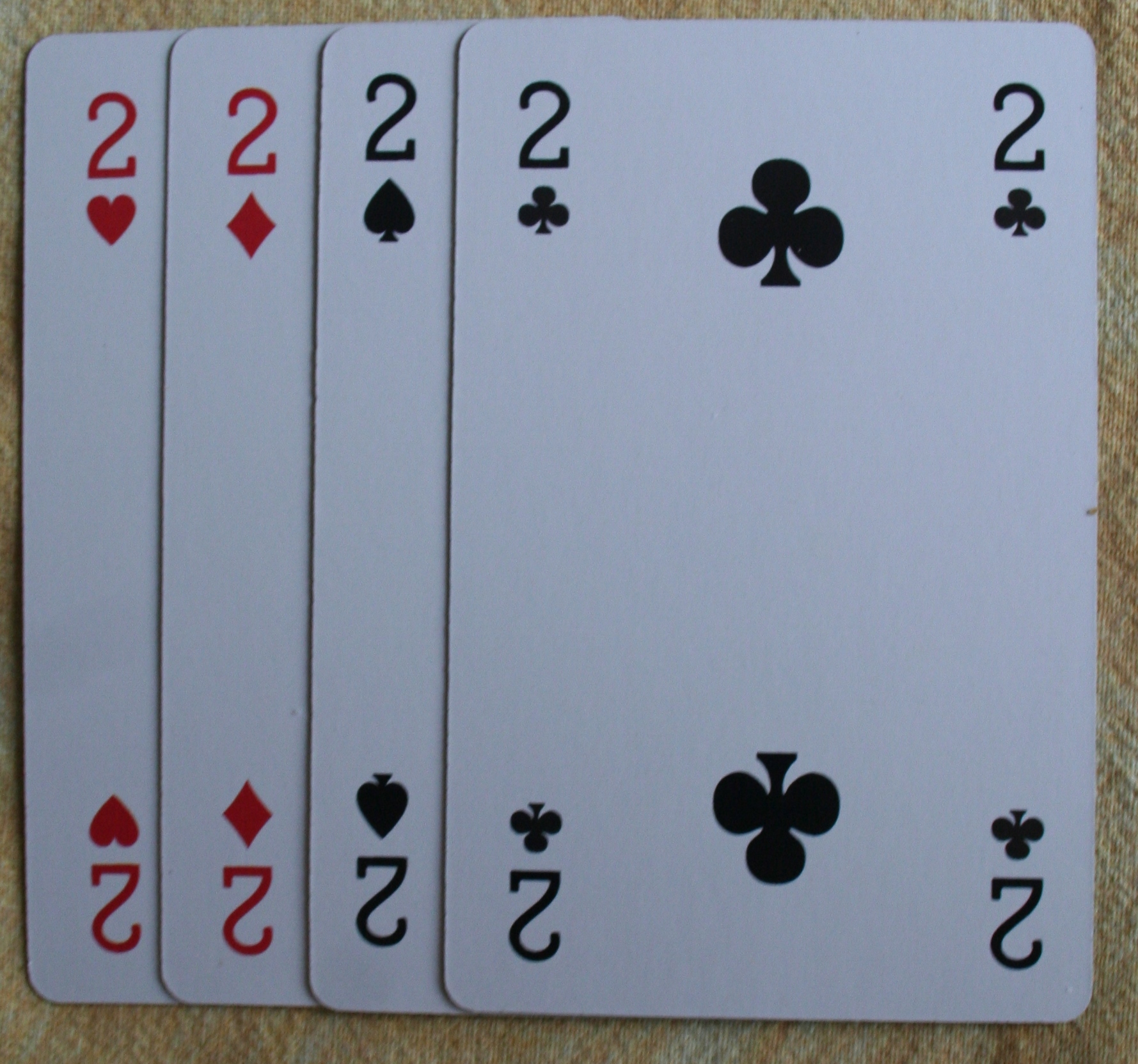
  • 2 – if a player places a two in their turn the player next to them then has to draw two cards, unless they have a two in their hand, they can then play this and make the player next to them pick up four cards. This can continue round players until all four twos are played if possible, forcing the last player to pick up eight cards. The player that has to draw cards also forfeits the right to play any cards that turn.

Twos!
Twos!

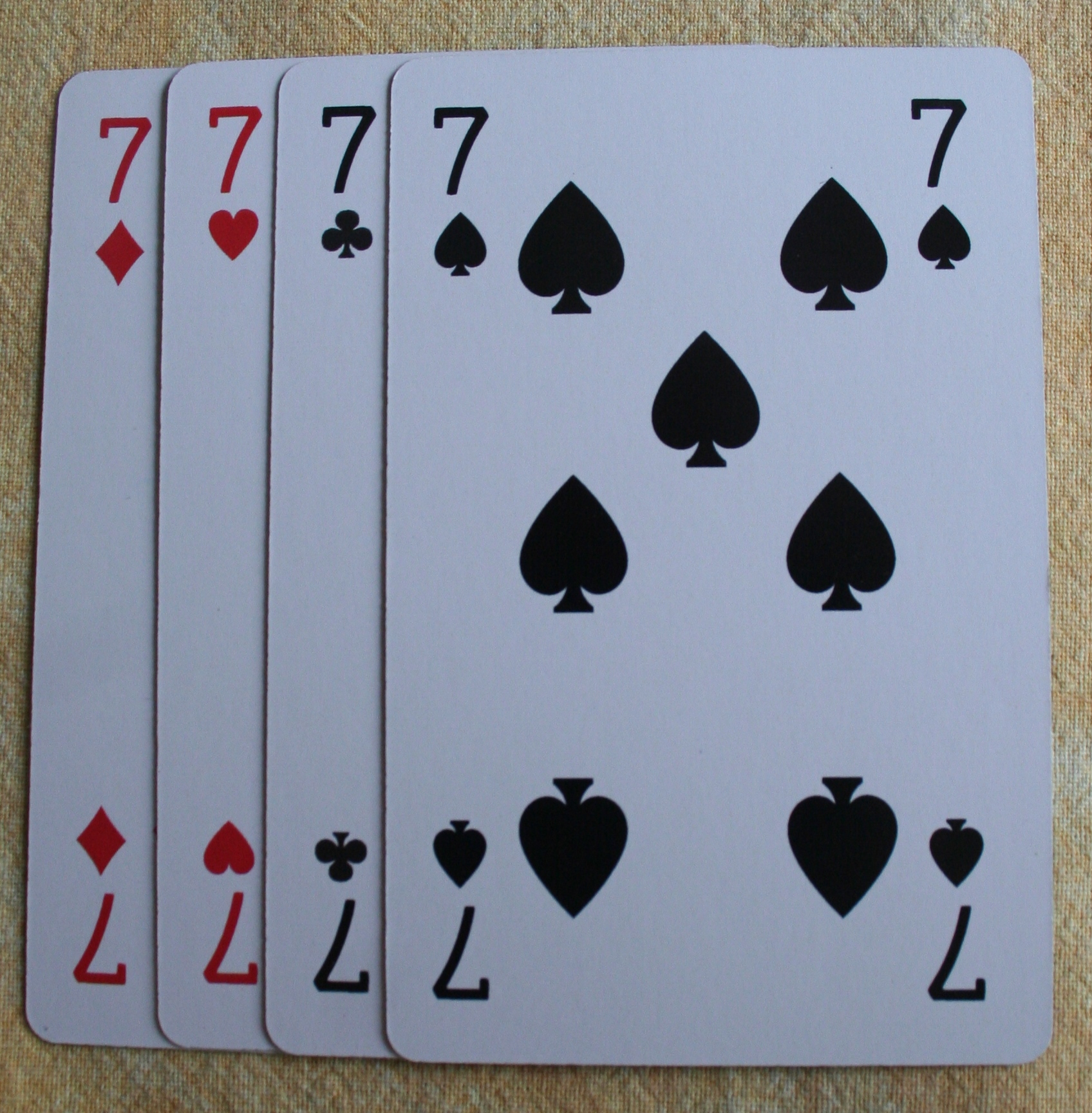
  • 7 – a seven must be covered, so the person who played it must put another card of the same suit over it, or pick up a card if they cannot. If they pick up the next player must then cover the seven, or draw a card, this continues until someone has managed to cover the card.

Sevens!
Sevens!

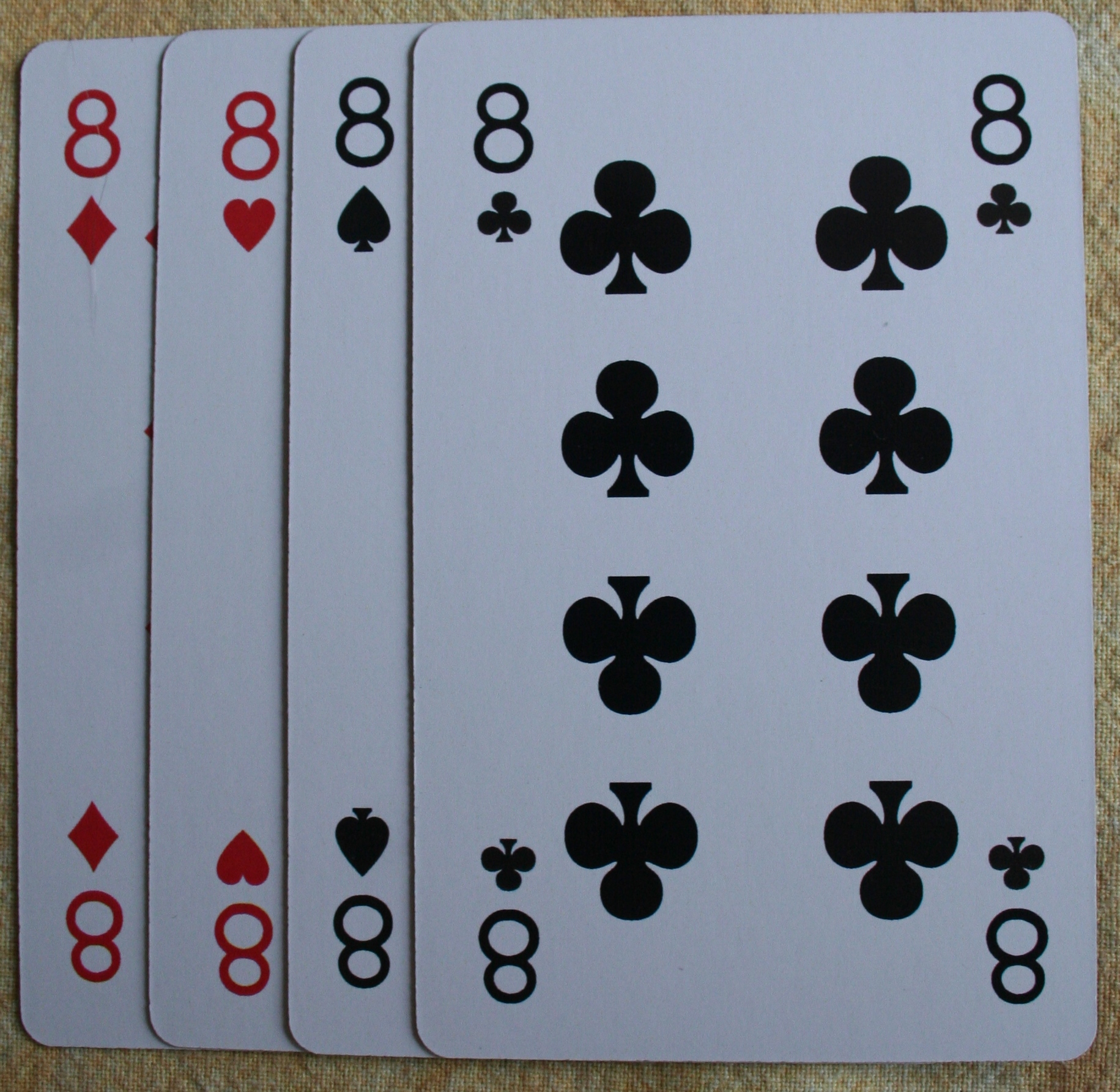
  • 8 – when played eights make the next player miss their turn. There is an optional rule that allows that player to also play an eight, passing the missed turn on in the same way stacking two’s works, with the last player who cannot play an eight missing the same number of turns as there are eights in play.

Eights!
Eights!

  • 10 – reverses the direction of play.

Tens!
Tens!

  • Black Jacks – a black jack is similar to a two, when it’s played the next player must pick up five cards or play the other black jack, which would then make the next player pick up 10 cards.

BLACKJACKS!
BLACKJACKS!

  • Red Jacks – a red jack can be used to cancel out a black jack, if two black jack’s are in play then to cancel them both you must play both red jacks.

Redjacks!
Redjacks!

  • Ace – an ace can be played onto any card, irrespective of suit or value, whoever played the ace then chooses which suit play will continue in, and the game carries on, but with the new suit instead of whatever was being played before.

Aces!
Aces!

Winning The Game!

The first player to play their last card immediately wins the game. However, to win you must call LAST CARDS as soon as you are able to go out, this must  be noticed by other players. If you fail to do this and then play your last card you must pick up another card. Play also cannot end on an  Ace, if you finish with an Ace you must pick up another card.

History and Interesting Things:

There’s not a lot of history going on for this game, but there are a few entertaining things I can tell you:

  • There’s a variation of the game called Peanuckle in which player with only two cards left in their hand must say “peanuckle”, and a player with only one card left must say “supper-peanuckle”. I have no idea why this is, but this is the way of it.
  • There are loads of variations of Black Jack, most of which are played in Casinos around the world, like 21 Blackjack, also known as Pontoon.
  • We were familiar with this game before we decided to write about it, but the variation we’d previously played had slightly different rules and Power Cards.
  • Three points is two more than I thought I’d write, so I’m doing well!

To Conclude:

A good game, I like it a lot because it’s easy to learn and you can play it anywhere with anyone. I also like that there are so many variations of it, makes it always interesting to play. Although, because there are so many variations of the game it can lead to interesting disputes over Power Cards and rules regarding winning the game. We played with a bunch of people when we were in Brazil and we had three different ideas of what the rules should be. There had to be a little bit of universal rule deciding before we could start playing.

The most comprehensive information I found on this game was on Wikipedia, but most of it’s in this blog post. Annnnnnnd, yeah, that’d be about it, have fun playing cards!


OSKA


4 - 5 Strike Thro

3 - 5

Number of Players: 2

Year of Publication: 1995

Creator(s): Bryn Jones and Michael Woodward Creations (Designers), artists are unknown

Steven…Sorry, I Mean OSKA:

While this months theme is “Old (usually) Wooden Games” OSKA doesn’t exactly fit that theme. It really all comes down to your idea of old, if you’re ten years old and 1995 seems like “FOREVER AGO” and “BEFORE I WAS EVEN BORN!” then OSKA is old, but if this is not the case then there’s every chance you remember 1995 and so it doesn’t seem that old. It does have an earlier history than its publication but that still only dates back to the 1950s, which some of you also may possibly be able to remember. See the history section for more information.

Our copy of OSKA with borrowed Pieces.
Our copy of OSKA using borrowed pieces.

What’s in the Box:

A picture lovingly borrowed from www.boardgamegeek.com just to show you what a real complete copy would look like.

In a normal OSKA box you find:

  1. One wooden board
  2. Eight pieces. Four red and four blue.
  3. And it should have an instruction booklet to remove any ambiguity about the brief instructions on the back of the box, (see section “Playing the Game) but there isn’t one.

However our copy came from a charity shop (one of the best places to buy games if you were unaware of this). So in the box there was just the board with no pieces! So we borrowed four white and four brown pieces from a game of  Draughts!

Playing the Game:

Normally here I would give a brief outline of the rules but as the rules to OSKA are already brief I have copied exactly what it says on the back of the box:

OSKA is a speedy game for 2 players which is deceptively simple, using the Draughts (checkers) principle of diagonal movement and capture. BUT – keep well in mind the quirk that gives OSKA its bite. The winner is the player whose remaining pieces first reach the far side – the less pieces you have left, the easier this will be. The skill lies in when, or if, to capture, and when to force your opponent to capture you.”

The big problem with this set of rules is that there are more than one set of rules to Draughts. For example in English Draughts you can only take diagonally forwards (unless you are using a king) but in International Draughts it allows you to take diagonally backward. I have assumed that it meant the English Draughts; firstly because it initially refers to it as Draughts rather than Checkers and secondly, because OSKA was invented in England.

So let’s just clarify the rules:
  1. You set up your four pieces on the back row like this:

    Start Positions!
    Start Positions!
  2. We played white moves first but you could play either way, and if you’re playing with red and blue pieces you could play whoever is set up on the white section moves first.
  3. You move one pieces diagonally, the the other player does the same.

    The Game after one move each.
    The Game after one move each.
  4. You take a piece by jumping it, so this can only be done forwards and so long as the space the other side of it is empty. You do not HAVE to take as the rules state “when, or if, to capture”.
  5. The winner is the first one to have ALL of their REMAINING pieces to the other side, so if all of their pieces are taken except one and they get that one to the other side before the other player gets all four of their pieces across, they win.

    Winning!
    Winning!
Rules We Assumed:
  1. We rationally assumed that in the scenario that all your pieces are taken you’ve lost.
  2. We also assumed that if you both ended up with the same number of pieces in the end zone at the same time it was a draw. This CAN occur if one player while moving its last (or only piece) into the end zone takes the other players only piece that’s not in the end zone. However this is unlikely to occur, as in that scenario you can choose to move into the end zone without taking.
  3. We also assumed that if a similar scenario occurred and one person had more pieces than the other in the end zone they won.
A Little Help:

Just to help we filmed a video of the game play of OSKA to help clarify. Here it is! Our very first video blog… Sort of. Our real video blogs will happen when we get a much better camera but it’s a start!

Strategy:

Now while the game is simple (once you’ve clarified the rules) and fast, there’s a lot that could be said about the strategy. For starters you cannot afford to make mistakes, I know this can be said for almost all games but one mistake in OSKA and the other person most often enters a state where they can’t be beaten because all series of moves that follow result in their victory!

The key to the game, I believe, lies in forcing the other person to take you. You can create a series of plays where they have no option but to take you because they have no other available moves. And once you start to lose pieces you have an easier job than they do as you have less pieces to get across the board.

I could go on about strategy and start drawing diagrams and things of this nature (as that how “into” this game I have got, a game that less than a month ago I was unaware existed). But I will spare you all, however, in the future I may write a specific post on the dynamics and maths of the game, which everyone can feel free not to read.

History and Interesting Facts:

Unfortunately due to the obscurity of this game the history and fasts that are about to follow are mostly off the back of the box as there’s not much more information on the game out there. Which is a shame as it’s a good game.

  1.  The game was originally devised by Bryn Jones in the 1950s.
  2. Bryn Jones was a miner so the game was originally played scratched into the dust on the floor of a mine at Lancashire Coalfields to pass time at breaks.
  3. In the early 1990s Bryn brought the game to Michael Woodward Creations.
  4. Woodward Creations annotated the rules and refined it into the more presentable format you find it in now.
  5. It can now be found as part of The Inventors Collection which is a gathering of games and puzzles from the worlds top game inventors.
  6. The game is made of eco-friendly wood.
  7. It can be considered as part of the Draughts family of games.
  8. Not really a surprise if you’ve read the post above, but the rules are ambiguous which unfortunately takes away from a very good and very fast game.

To Conclude:

This may come as little surprise to you (if you have read the above), I like this game! I’m a huge fan of Chess (as most sane people are) and similarly simplistic but complex at the same time strategy games make me happy. However as far as I’m aware there is no game as perfect as Chess and probably never will be. But OSKA falls into the category of games that are in the right ball park when it comes to your basic strategy game. I would even proclaim that it has a one up on Draughts as I maintain Draughts is too large and long a game to have such simplicity, in short it can become boring, which is why to every 100 Chess matches I have played I’ve probably only played half a Draughts game. This is where OSKA hits the nail on the head, its taken the same idea as Draughts and made it small, fast and above all FUN!

The biggest flaw I find with this game is the ambiguity of the rules and their phrasing. I am slightly ashamed to admit that we played the game wrong in two different ways before finally re-re-re-reading the paragraph on the back of the box and breaking it down to create clarity. First time round we missed the word “remainder” so we where playing first one to get one piece across…This version of the game is ridiculously flawed because the person who moves first (providing they’re not an idiot) will ALWAYS win! We also played that you HAVE to capture if you can capture and even after we started paying attention to the “remaining pieces” section of the rules we still failed to notice the “when, or if, to capture” phrase that implies you do not HAVE to capture. Anyway once we had figured it all out this game is a 4 out of 5 however the amount of time we wasted playing it wrong reduces it to a 3 out 5 (hence the top scoring). It could be argued that us playing it wrong is our own fault but I maintain the rules are needlessly ambiguous and if you don’t know what Draughts is they’re impossible to follow!

Additionally if anyone would like to buy the game check out HERE! – keep in mind this link is to an eBay sale so it won’t always be valid but it’s valid at the time of publication and will hopefully either be updated or removed when it stops being valid.