Spartacus: A Game of Blood and Treachery

NOW SELLING THIS GAME HERE: https://www.ebay.co.uk/itm/Spartacus-A-Game-of-Blood-and-Treachery-Gale-Force-9-Board-Game-Good-Condition/283678724813

4 - 5

Number of Players: 3 – 4

Year of Publication: 2012

Creator: Aaron DillJohn KovaleskiSean Sweigart (Designers) and Charles Woods (Artist)

NO! I’m Spartacus:

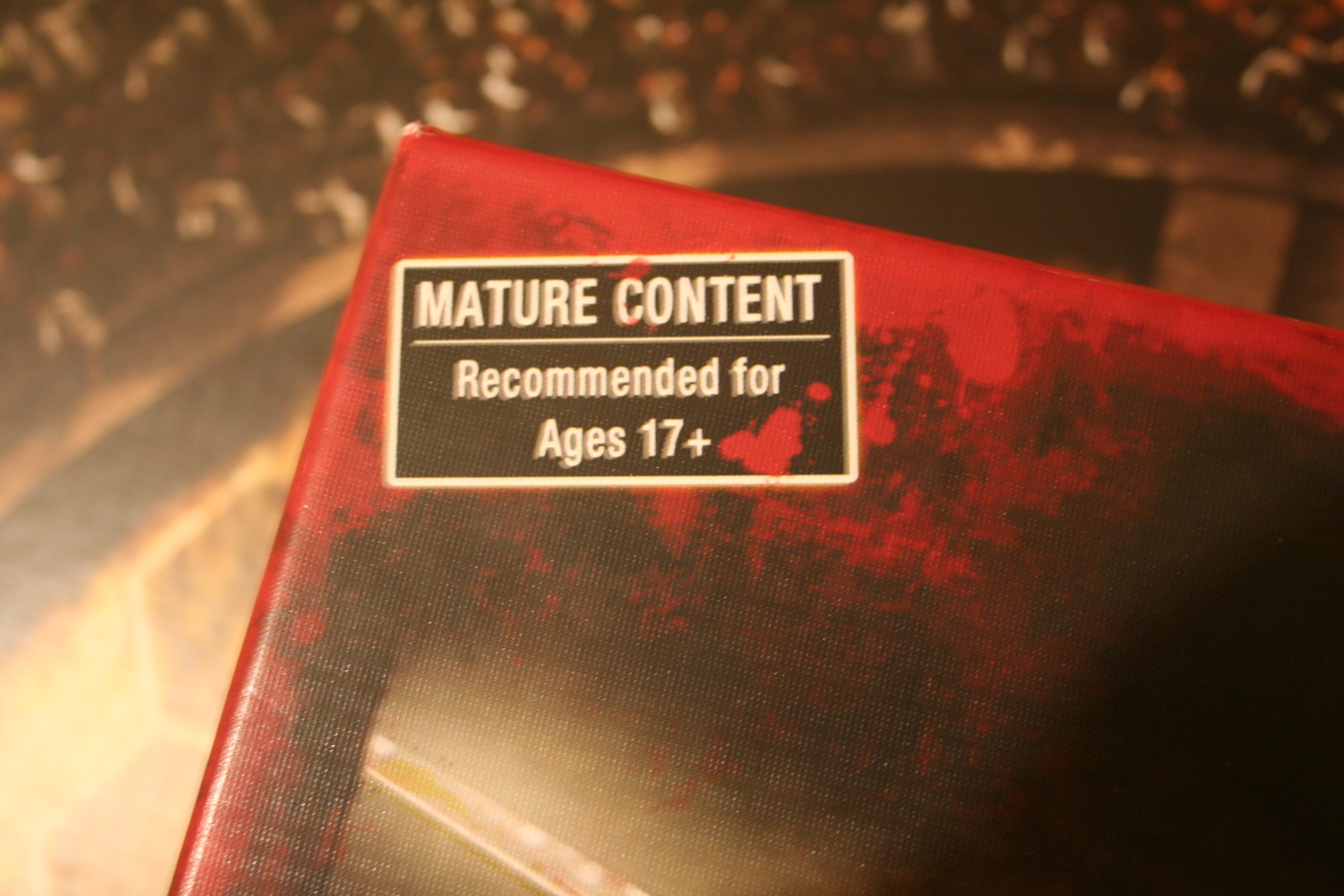
Spartacus: A Game of Blood and Treachery is a board game based on the TV series Spartacus: Blood and Sand ( which has a mini series prequel and is followed by Spartacus: Vengeance and Spartacus: War of the Damned and proceeded by a not so good Spartacus: Gods of the Arena). To reflect the style of the TV series this is the only game I’ve come across, to date, that has an age rating on it:

The age rating at the top corner of the box lid.

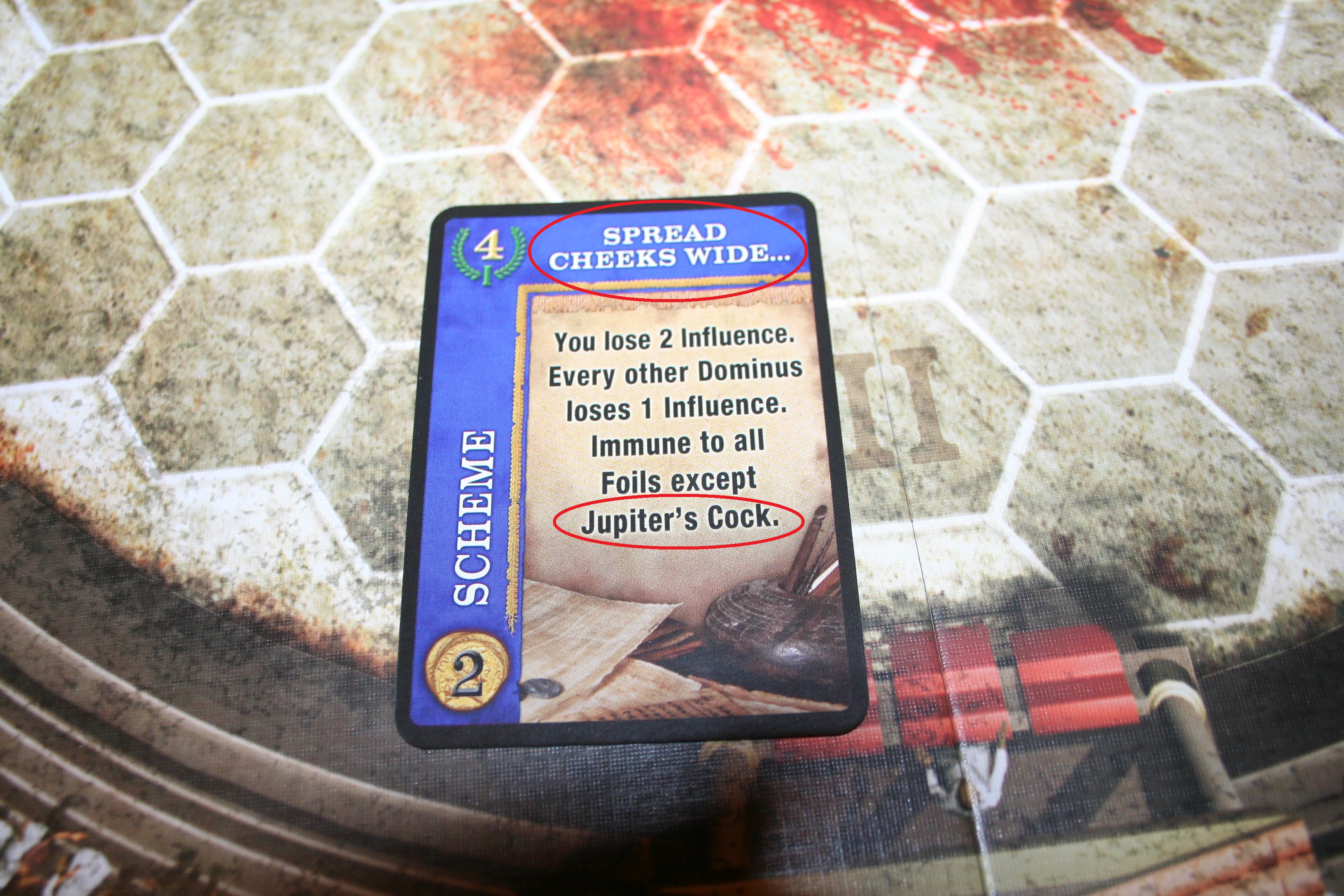
And because of this you get cards with things like this written on them:

This did make us laugh...a lot.
This did make us laugh… A lot.

Now unfortunately, being a big fan of the TV series this review is unlikely to be completely non- biased, I will however do my best to stay objective.

What’s In The Box:

The Stuff!
The Stuff!
  1. Game board
  2. Rules Book
  3. 4 x House cards
  4. 62 x Market Cards
  5. 104 x Intrigue Cards
  6. 10 x Favor/Injured tokens
  7. 4 x Champion tokens
  8. 3 x House betting tokens (per house) and 1 x House marker (per house)
  9. 1 x Host marker
  10. 117 x Gold
  11. 4 x Gladiator figures
  12. 4 x Turn summary cards
  13. A lot of Dice (9 x Red, 9 x Black and 8 x Blue)

Playing The Game:

Objective: Be the first to raise your house influence to 12!

Depending on whether you want to play a Quick, Standard or Advanced game you set the starting amount of influence each house has to a different number:

  • Quick = 7
  • Standard = 4
  • Advanced = 1
Starting favor set to 7 for a quick game and the starting amount of things dealt out.
Starting influence is set to 7 for a quick game and the starting amount of things dealt out.

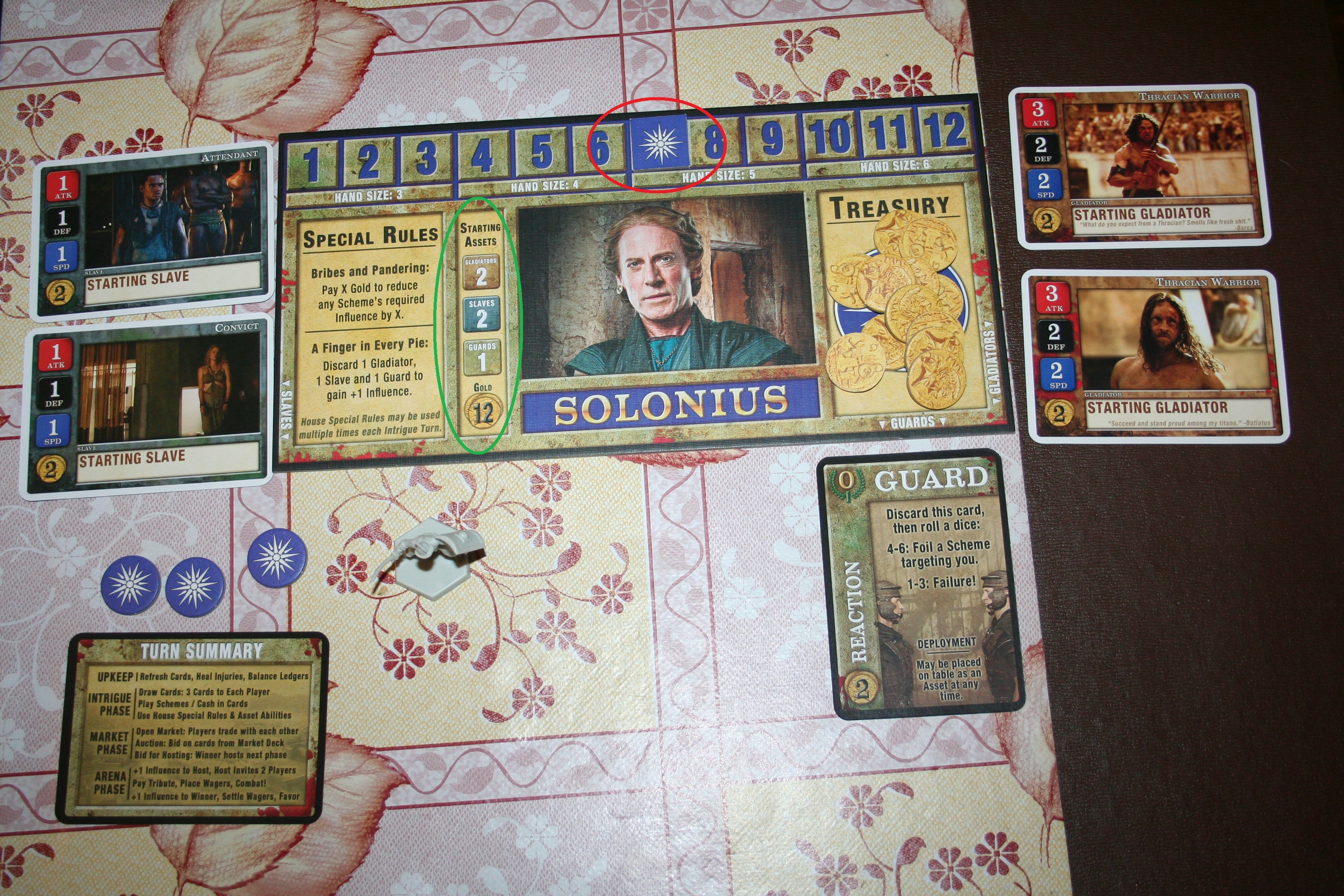
You then get dealt the starting number of items as dictated by your house card (circled green). So for Solonius that’s 2 Gladiators, 2 Slaves, 1 Guard and 12 Gold. Additionally each player gets one gladiator figure, their 3 house betting tokens and a turn summary card.

Now, every turn of play is made up of four sections:

  1. Up Keep
  2. Intrigue Phase
  3. Market Phase
  4. Arena Phase
Up Keep:

Up keep consists of three parts:

  1. Refreshing Cards – Any cards that have been exhausted in the previous round (so are face down) get turn back up so their abilities can be used again.
  2. Healing Injuries – Attempt to heal any injured gladiators or slaves by performing a healing role – on a role of 4 – 6 they are healed anything less and they stay inured.
  3. Balancing the Ledgers – You gain one gold for every ready slave you have and you must pay one gold to the bank for every ready gladiator you have – if you cannot pay (or don’t want to) you must discard the card that’s making you pay.
Intrigue Phase:

Intrigue consists of two parts:

  1. Drawing Cards – At the start of each intrigue phase each player draws three intrigue cards (players all receive three cards simultaneously).

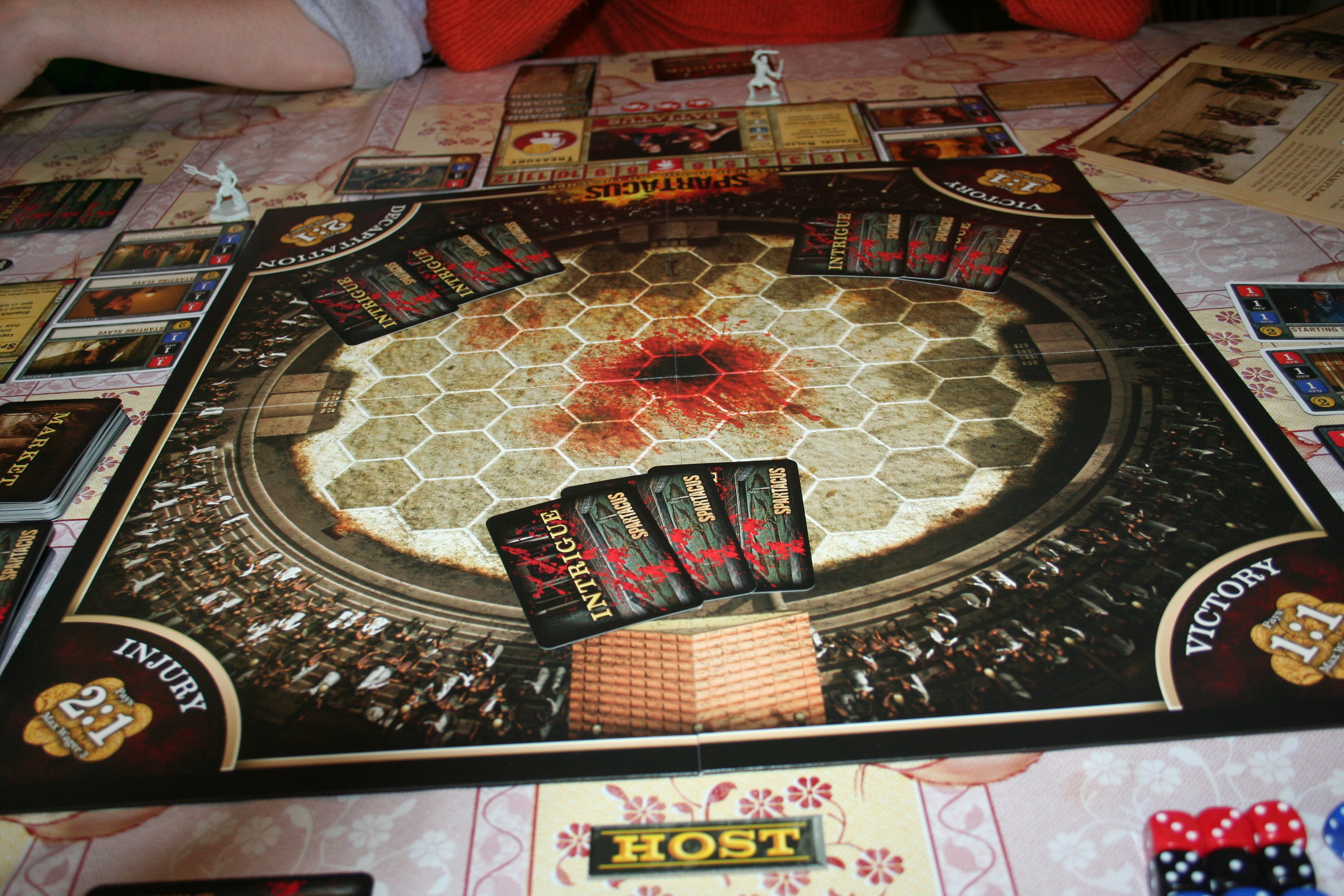
    All Intrigue cards dealt.
    All Intrigue cards dealt.
  2. Playing Schemes/ Foiling Schemes/ Cashing in Cards – Some of the intrigue cards are schemes you can play against another Dominus (Latin word for master), cards that allow you to foil other schemes or get rid of an opponents guards. To play a Scheme you must have the right amount of influence  to play it (as listed on the card), if you don’t you can pair with another Dominus to play it by adding your influence together but beware; deals that are made can be easily broken. If someone plays a scheme against you you can foil it by using your guards and performing a dice role or you can play a scheme foiling card that are reactions to schemes and also require that you have the right amount of influence to play it. Finally if you don’t want some of you cards or can’t keep them (as your had size is dictated by the amount of influence you have) you can cash in cards for the amount written on them from the bank.
Market Phase:

This phase is made up of three parts:

  1. Open Market – At this point anything can be traded for anything for anything else. Except Intrigue cards, which cannot be sold.
  2. Auction – After open market is over each player conceals their gold in their hand and cards equal to the amount of players playing are drawn face down on to the board. The first card is flipped up; each player decides how much they want to bid for that card and hide it in their hand and hold it out over the board, then together they revel how much they have bid, highest bidder wins. Someone who bids nothing is ignored, but if everyone bids nothing the card is discarded. If there is a tie the two players who are tied place the amount they have already bid on the board and repeat the procedure until one player is victorious. This is then repeated with each card until all cards are sold or discarded.
  3. Bid for Hosting – This is done in the same way as the bidding for the cards. The person who wins the host bidding gets the Host token and it marks that they control the next phase of the game and choose who will fight who.
Arena Phase:

This phase is made up of six parts:

  1. Honour to the Host – The player that won the hosting rights in the auction gets +1 influence.
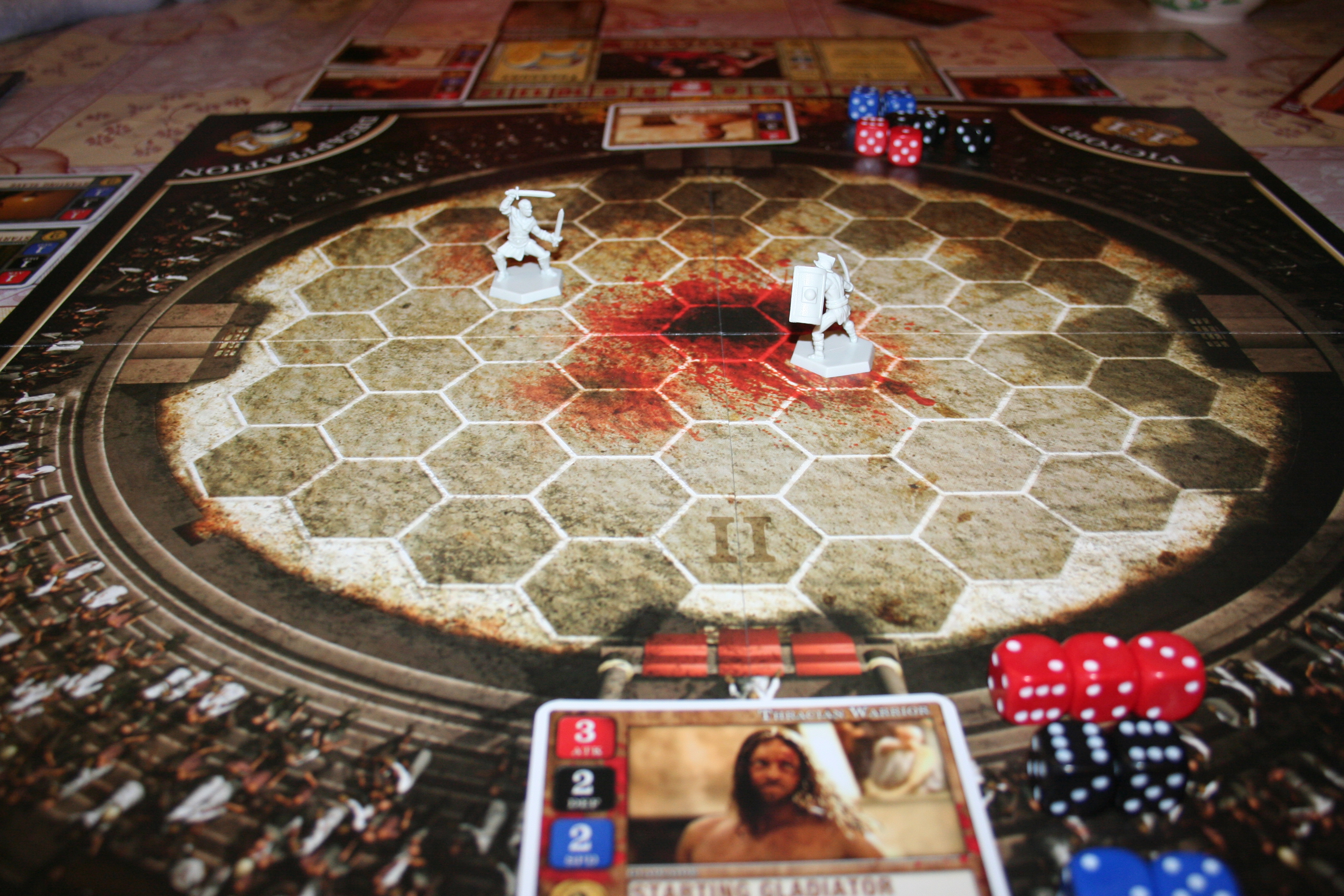
  2. Hosting the Event – The host then invites two players to take part in the games (they can invite themselves).  If a player declines they lose one influence. If they accept they place their gladiator figure in the arena in the starting position then place the card of the gladiator they are fighting, along with any Weapons or Armour they are also using.

    IMG_0564
    A starting gladiator ready to battle.
  3. Tribute – The owners of the gladiators are then paid tribute if their gladiators have favour or are champions – +2 gold for each favour token and +6 gold if they are a champion. If they don’t have any favour and are not champions they get nothing.
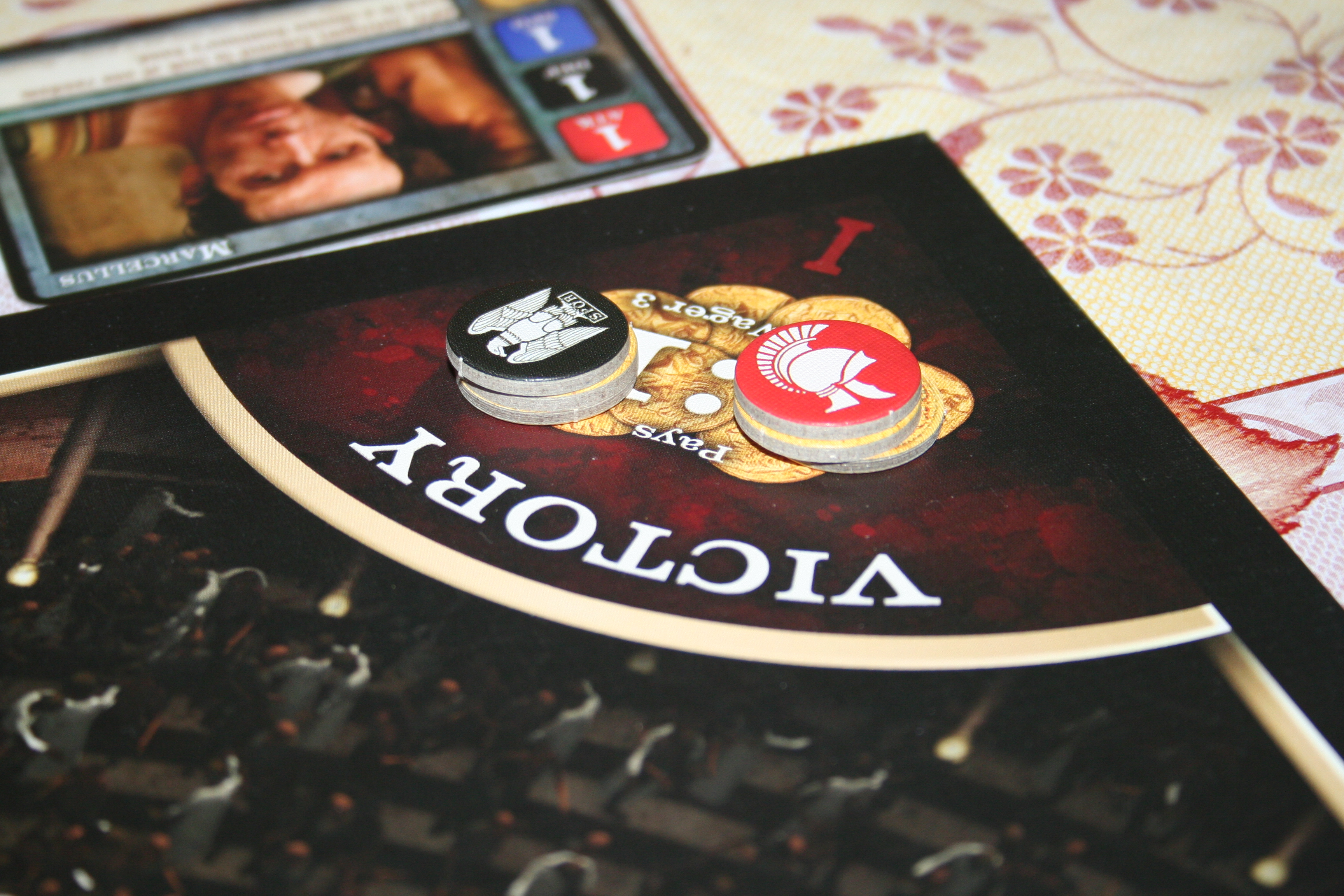
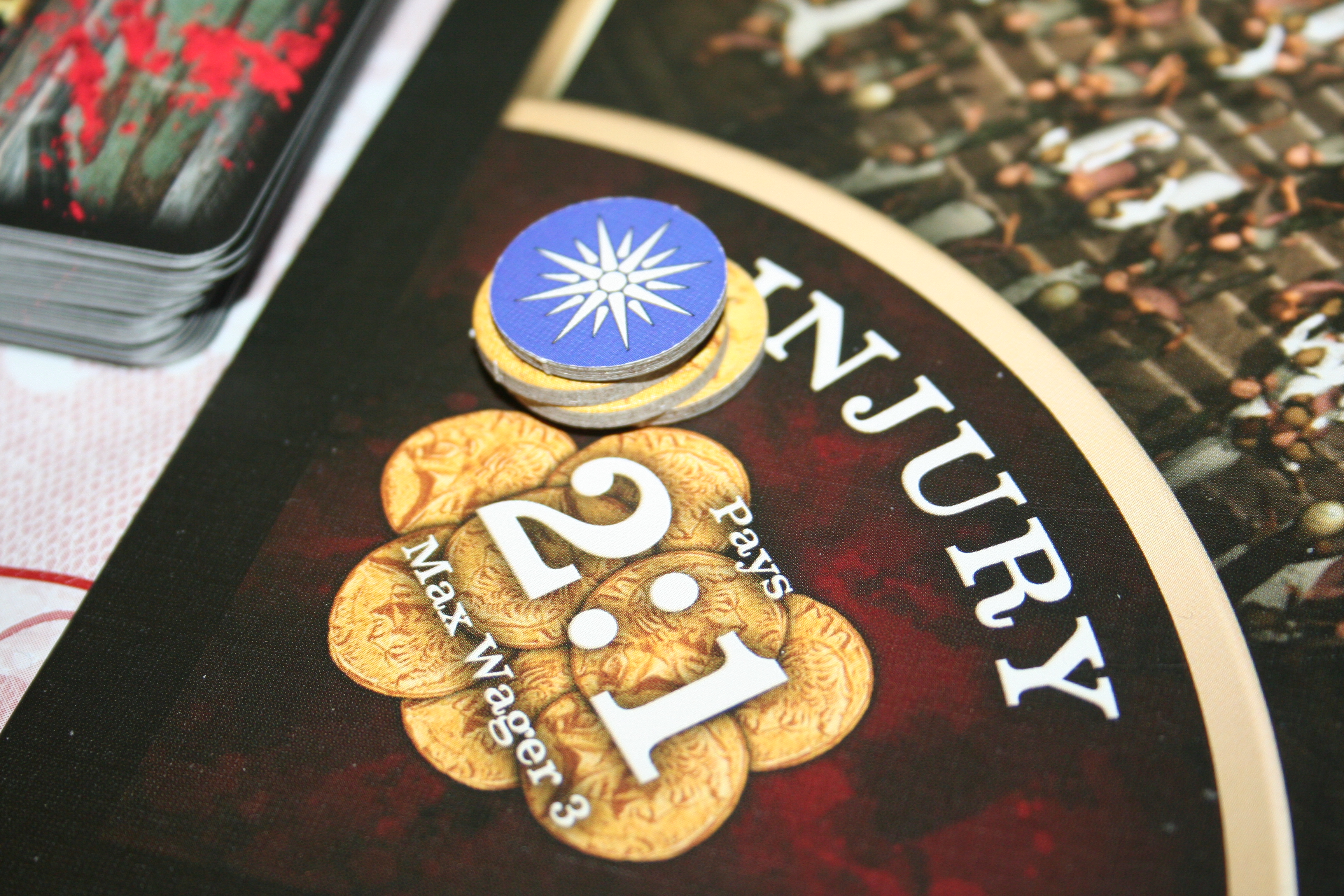
  4. Place Wagers – It’s then time to place wagers, you can wager on who will win (competing players can’t wager against themselves) and how they will win (injury or decapitation). Three is the maximum wager on any one wager and the wagers you place are marked by putting you house wager tokens on top of your pile of gold on the wager you have made.
    So a bet on players combatant one to win returns 1:1 odds so you can double your money.
    So a bet on combatant one to win returns 1:1 odds so you can double your money.

    A bet on the fight ending in injury returns 2:1 odd so you triple your money.
    A bet on the fight ending in injury returns 2:1 odds so you triple your money.
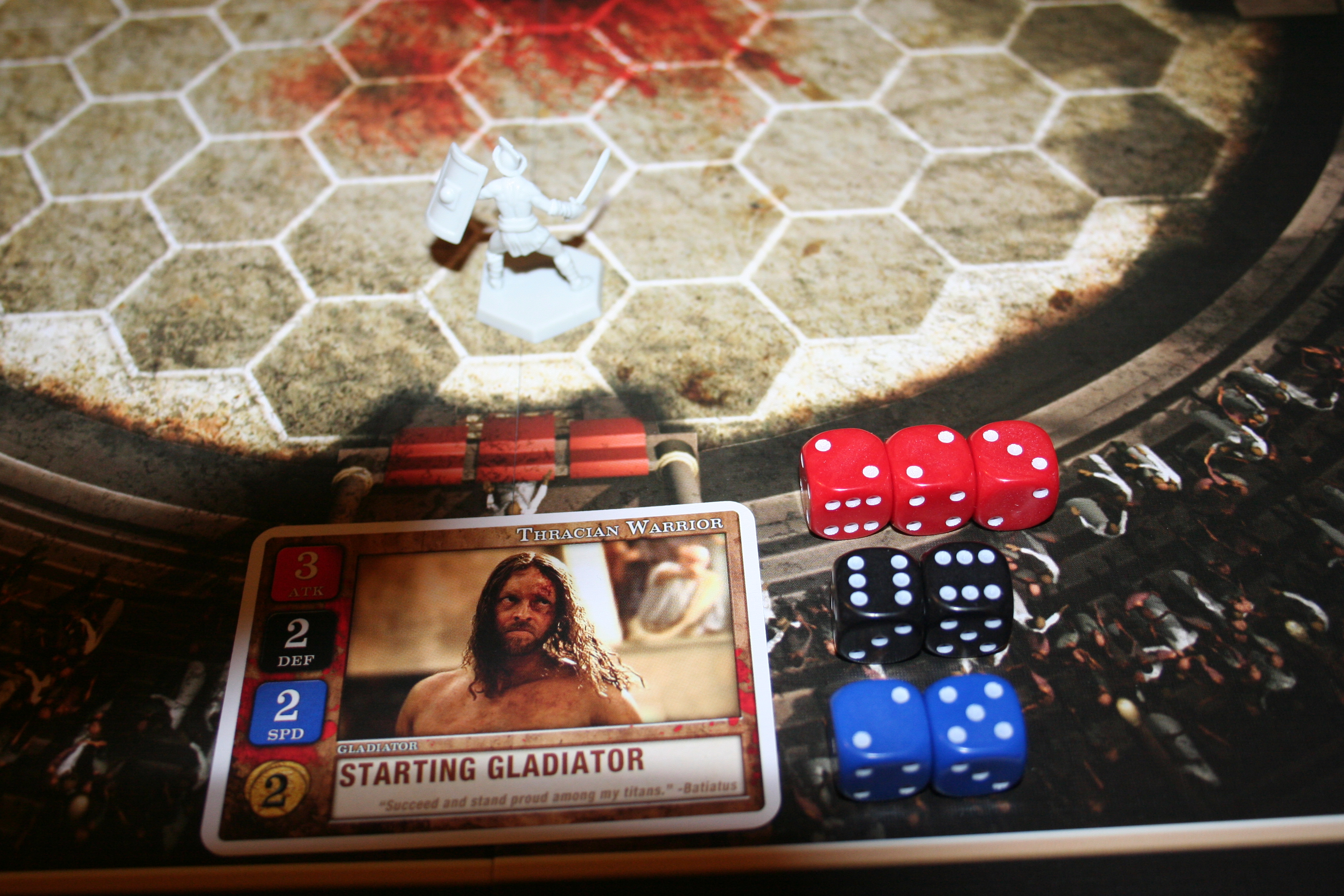
  5. Combat! – Now the fight begins. Each fighting gladiator has statistics for Attack, Defence and Speed. They are given as many red dice as their attack statistic, as many black dice as their defence statistic and as many blue dice as their speed statistic:
    IMG_0564
    3 Attack = 3 red dice, 2 Defence = 2 black dice and 2 Speed = 2 blue dice.

    Each player then roles their total amount of speed dice to determine who moves first, the player with the highest total wins and decides who moves first. Your total number of speed dice dictates how many spaces you can move; so if you have two dice you can move two spaces. You can chose to move and then attack or if you’re already adjacent to your enemy you can attack and then move away. Once adjacent you attack by rolling your attack dice while the defender roles their defence dice. You then line the dice up from highest to lowest, opposite each other. Any place where one attack dice is a higher number than the defence dice is a hit and any place where a defence dice is higher than the attack dice is successfully defended. If they’re equal it’s also a successful defence. Where attack die outnumber defence dice any additional roles that have no matching dice count as a hit so long as they are three or above.

    Two warriors ready for combat.
    Two warriors ready for combat.

    The dice are your health; so for each hit that is obtained the taker of the hit decides which dice to get rid of, lowering their attack, defence or speed for the next move. All attributes must be reduced to 1 before any can be completely removed. If one is completely removed then the player has yielded, if two are reduced to zero in one attack the player is wounded and if all three are reduced to zero in one attack the player is decapitated.

  6. Victory and Defeat – The winning Dominus gains one influence. The winning gladiator revives one favour token, if it’s his third favour token he becomes a Champion. Wagers are then settled with the bank. If the loser was not decapitated the host of the games decides if he lives or dies with the thumbs up or down signal. To kill a loser who has favour will cost the hosting Dominus 1 influence per favour token and champions cannot be killed.

After all this the turn phases are repeated unless one player has a full 12 influence at this point, then they’re the winner! If they have reached 12 influence before this point they are not yet the winner as they can still lose influence before the turn of play is over.

Strategy:

  1. MONEY IS POWER! Like in real life. If you are a broke Lanista (trainer of Gladiators) then you are a rather useless Lanista.
  2. UNDERSTAND WORTH! Linked to the first point, knowing what/how much to bid for something in this game is everything. Knowing what you need and what’s not worth buying (at that time) will be the key to winning and losing.
  3. HOST THE MOST! Bidding to be the host is always worth it, not only does it automatically give you influence you then have control too.
  4. KNOW YOUR FRIENDS! While this is a rather back stab-y game it’s important to know the people you’re playing with and understand when they’re likely to stick with you and at what point they will abandon you and leave you to be eaten by dogs.
  5. KEEP THINGS IN PERSPECTIVE! With such a large turn phase to the game it’s very easy to get caught up in just one round or one arena match and forget about the bigger picture and larger aim. Everything you do should be in aid of the bigger picture not just to get back at another player or just because you want to see a fight between two cool Gladiators.

History and Interesting Things:

While the board game itself does not have much notable history (at least nothing I can find) the historical events it’s based (very loosely around) do so that’s more what this section is going to contain.

  1. The board game was published in 2012, before the airing of the final season of the TV show, by A1 GamesBattlefront Miniatures LtdGale Force Nine, LLCHeidelberger SpieleverlagMarabunta and Zvezda.
  2. The board game is only based on the first season of the TV show Spartacus: Blood and Sand, it being the only season in which Spartacus is a Gladiator rather than a rebel.
  3. The TV series is a re-imagining of the 1960 film Spartacus directed by Stanley Kubrick and starring Kirk Douglas.
  4. However both the TV show and the film are based (loosely) around the historical Third Servile War of the Roman Republic.
  5. While historical facts on the war are highly debated it is often interpreted as a rebellion of oppressed people rising up against a slave owning oligarchy.
  6. Historically Spartacus (the man) is supposed to have lived from 109 BC – 71 BC. The characters Crixus,OenomausCastus and Gannicus, are also historically verified people who assisted in the uprising.
  7. He was born a Thracian and supposedly died on the Battlefield near to Petelia (modern-day StrongoliCalabria, Italy) as depicted in the TV show and film (probably without the “I’m Spartacus” fiasco).
  8. This being Appian also that his body was never found.
  9. 6000 survivors of the battle where crucified alongside the Appian Way from Rome to Capua as depicted in the final episode of the TV show with the crucifixion of Gannicus.
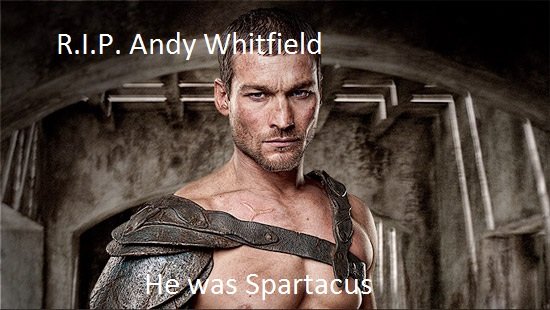
  10. Andy Whitfield who played Spartacus in the first season Spartacus: Blood and Sand (who’s face should be on the front of the game box rather than his replacements Liam McIntyre) sadly died on September the 11 2011 of on-Hodgkin lymphoma and the series was literally less than half as good without him.
picture lovingly borrowed from http://www.funnyjunk.com/funny_pictures/2600925/RIP.
Picture lovingly borrowed from: http://www.funnyjunk.com/funny_pictures/2600925/RIP.

To Conclude:

While my obvious like for the TV show has made this review at least slightly biased I would still maintain this game is a good game by anyone’s standards. It is, however perhaps a touch complex and drawn out. For example; cancelled down version of just the gladiator battles would have made quite a good game just in itself. So this game is primarily for the patient and those who are naturally enthusiastic about games not for those who think monopoly is the epitome of (board) gaming.

Further more it’s always nice to see a box that’s well designed unlike the Pirate of the Caribbean edition of Buccaneer! and Conquest of the Empire:

I rate this box design 4.5/5! The only thing that would have made it better is a slot for the host marker to sit in.

Yes I do think rate the box is going to have to become a permanent part of our posts.

The Settlers of Catan

5 - 5

Number of Players: 3-4

Year of Publication: 1995

Creator(s): Volkan Baga, Tanja Donner, Pete Fenlon, Jason Hawkins (Artists) and Klaus Teuber (Designer)

Create the Best Civilisation and become King of Catan!

Okay, you don’t actually win the title “King of Catan” if you win the game, but it’d be cool if you did. Instead, you just win the sheer joy of winning, which is almost as good. Settlers of Catan is a brilliant game, primarily for its simplicity and versatility. Because of the way the board gets set up, no two games are ever going to be the same and it’s got so few rules that anyone can learn to play!

What’s In The Box:

The stuff!
The stuff!
  1. 19 Terrain Hexes and 6 Sea Frame pieces – set up in one possible arrangement for play.
  2. 9 Harbour Pieces
  3. 18 Circular Number Tokens (chits)
  4. 95 Resource Cards (19 each of Stone, Sheep, Clay, Wood and Grain)
  5. 25 Development Cards
  6. 4 “Building Costs” Cards
  7. 2 Special Cards
  8. 16 Cities (4 each in Orange, White, Red and Blue)
  9. 25 Settlements (5 each in Orange, White, Red and Blue)
  10. 60 Roads (15 each in Orange, White, Red and Blue)
  11. 2 Dice (one Yellow, one Red)
  12. 1 Robber
  13. 1 Game Rules and Almanac Book

Playing The Game:

Objective: To develop your civilization fastest in order to gain 10 Victory Points and win the game!

Setting up the Board:

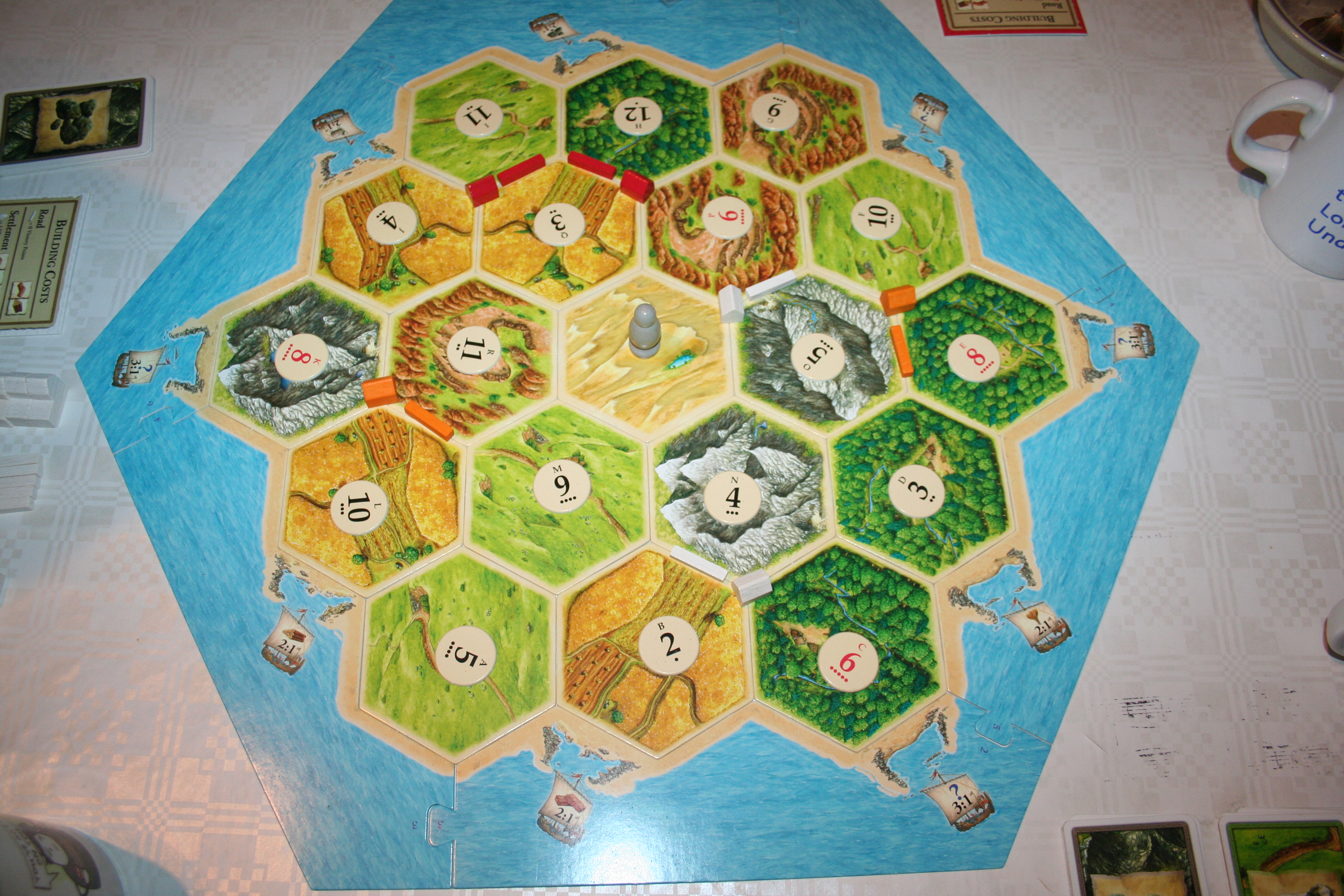
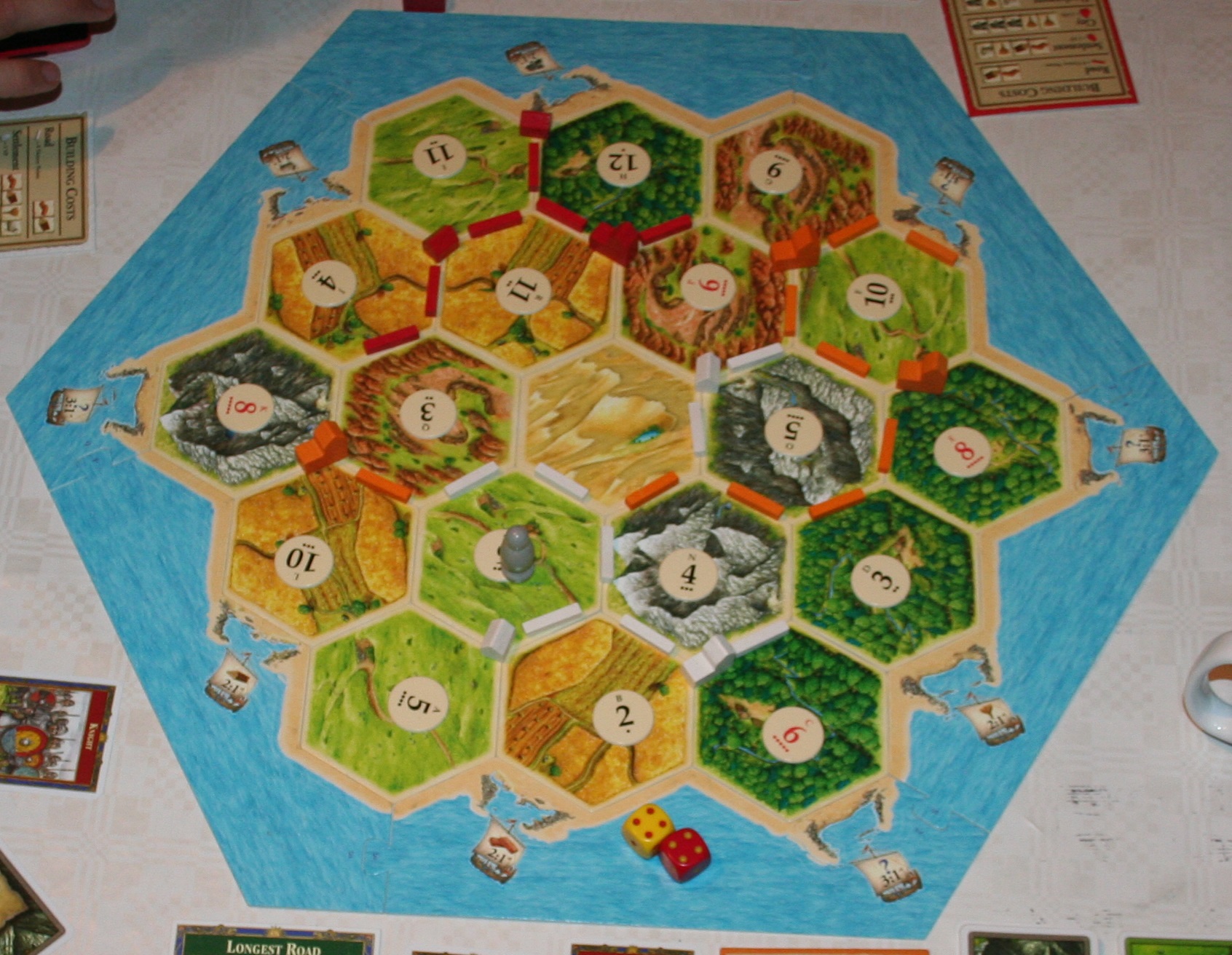
To start the game you set up the board so it looks more or less like the photo below. You give a few of the Terrain Hexes to each player. They’re then laid out in that honeycomb kind of pattern, and edged with the Sea Frame pieces. There’s no set layout for the beginning of the game, so the hexes you get given can be placed anywhere. Once the board is set up each player chooses a colour and takes all the Cities, Settlements and Roads for that colour. They also take the Building Costs card of that colour. Then the Circular Number Tokens are placed on the board. These tokens all have both a number and a letter on them, numbering from 2-12, missing only 7, and having the respective letters A-R. One player then chooses a starting tile, and places the Token with A on it. The other tokens are then laid out in alphabetical order moving clockwise around the board. One of the Terrain Hexes is the desert, this is the only Hex which doesn’t have a token placed on it.

Starting set up for the game.

Once that’s been done, the grey Robber figure is placed on the desert Hex, and each player can then place two of their Settlements, and two Roads on the board. Settlements (and later Cities) are always placed on the corners of the Hexes, so your Settlement will be on the point on a Hex where two or three Hexes meet. Roads must be placed on the edges of Hexes and connected to a Settlement or City of their colour. To start, your Settlements can be placed anywhere on the board, but following this they must always be connected to a previously existing Settlement by a road. To start each player collects one Resource card for the tiles they have Settlements on, for example, at the start of the game above, White would receive two Stone cards, one Clay, one Wood and one Crops.

Turns:

A players turn is divided up into the following phases:

  1. Rolling the dice, moving the Robber and collecting Resources
  2. Trading Resources with other players or the bank
  3. Building Roads or Settlements, upgrading to Cities and buying Development Cards

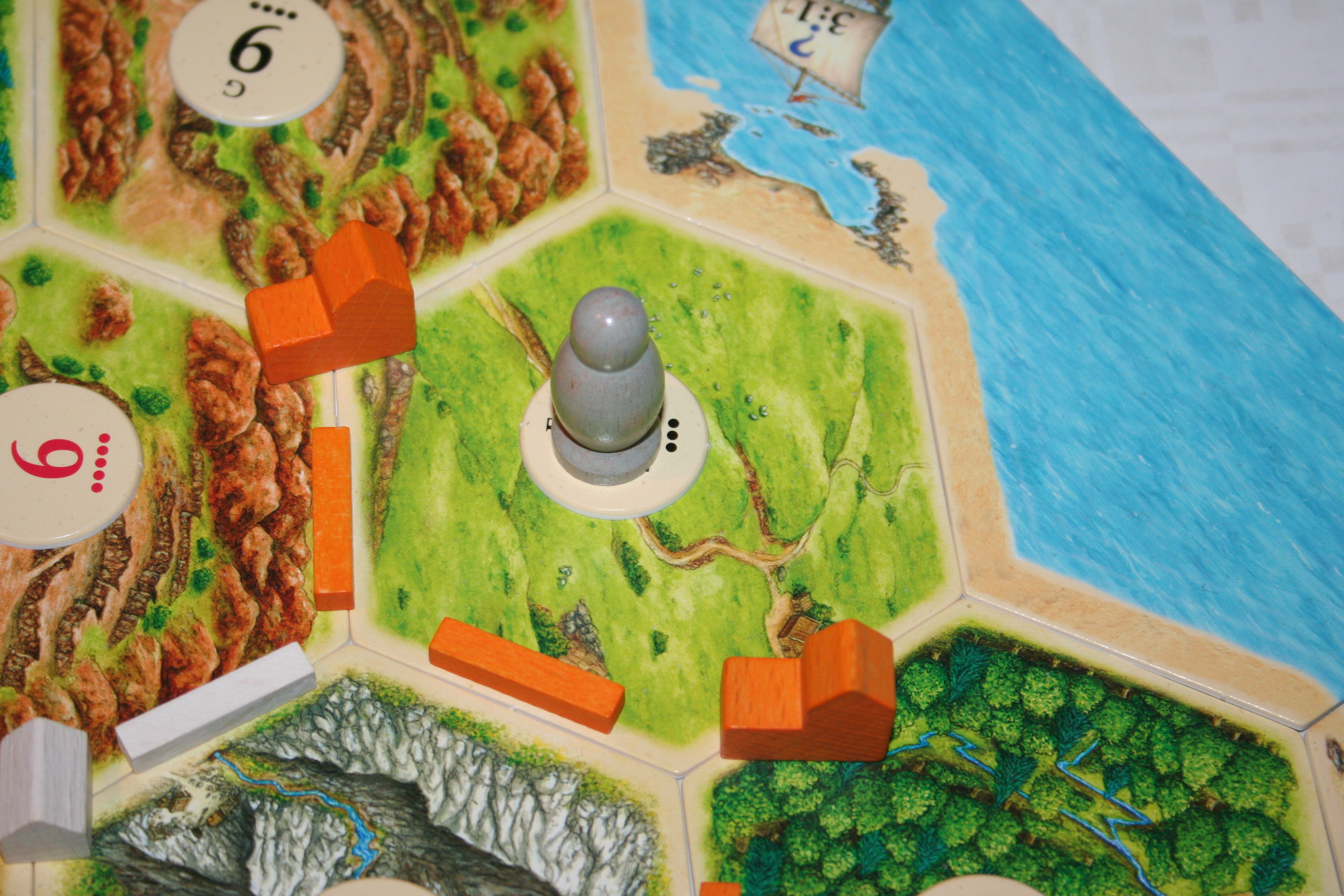
Rolling the dice always happens first, and the number rolled reflects which Resources will be produced on that turn. There are two Number Tokens for each number that can be rolled, apart from 12, once the dice are rolled, find these, and anyone with a Settlement on the corner of the corresponding piece receives one Resource card for that tile. On a roll of 7 no Resources are produced, and the Robber’s moved. The player that rolled the dice can now put the Robber wherever they like. If placed on a tile, the Robber prevents any Resources being produced for this tile until someone else rolls a 7 and moves him, so he can be a huge inconvenience to your opponents.

Like this:

Here the Robber was preventing me from receiving any Sheep Resources

Next you can trade Resources. This is done verbally and with the exchange of cards. One player simply states which Resources they need, and what they’re prepared to offer for them, and other players may accept or decline. Or haggle, if they feel so inclined. if a player has a lot of one Resource they can trade five of one Resource in to the bank, in exchange for one different Resource of their choice. If a player rolls a 7 all players must also count how many cards are in their hand, if they’ve got more than 7 Resource cards in their hand they must discard half of them, in the case of an odd number, for example, 9, you round down, so you would only discard 4, not 5.

It’s also possible to use the Sea Ports to trade resources, but you have to have a Settlement or City built on one of the three points adjacent to a port to use it.

Finally you can build things, your Building Costs card tells you how much each thing will cost you in Resources, and you discard Resources into the Resource bank to build on the board or buy Development Cards. Settlements or Cities must be connected by at least two roads, so they cannot be on the points next to each other, meaning that only three Settlements can ever be on one Hex. You must also have a connecting road before you can build a Settlement.

Play continues like this until one player has gained 10 Victory Points!

Winning the Game!

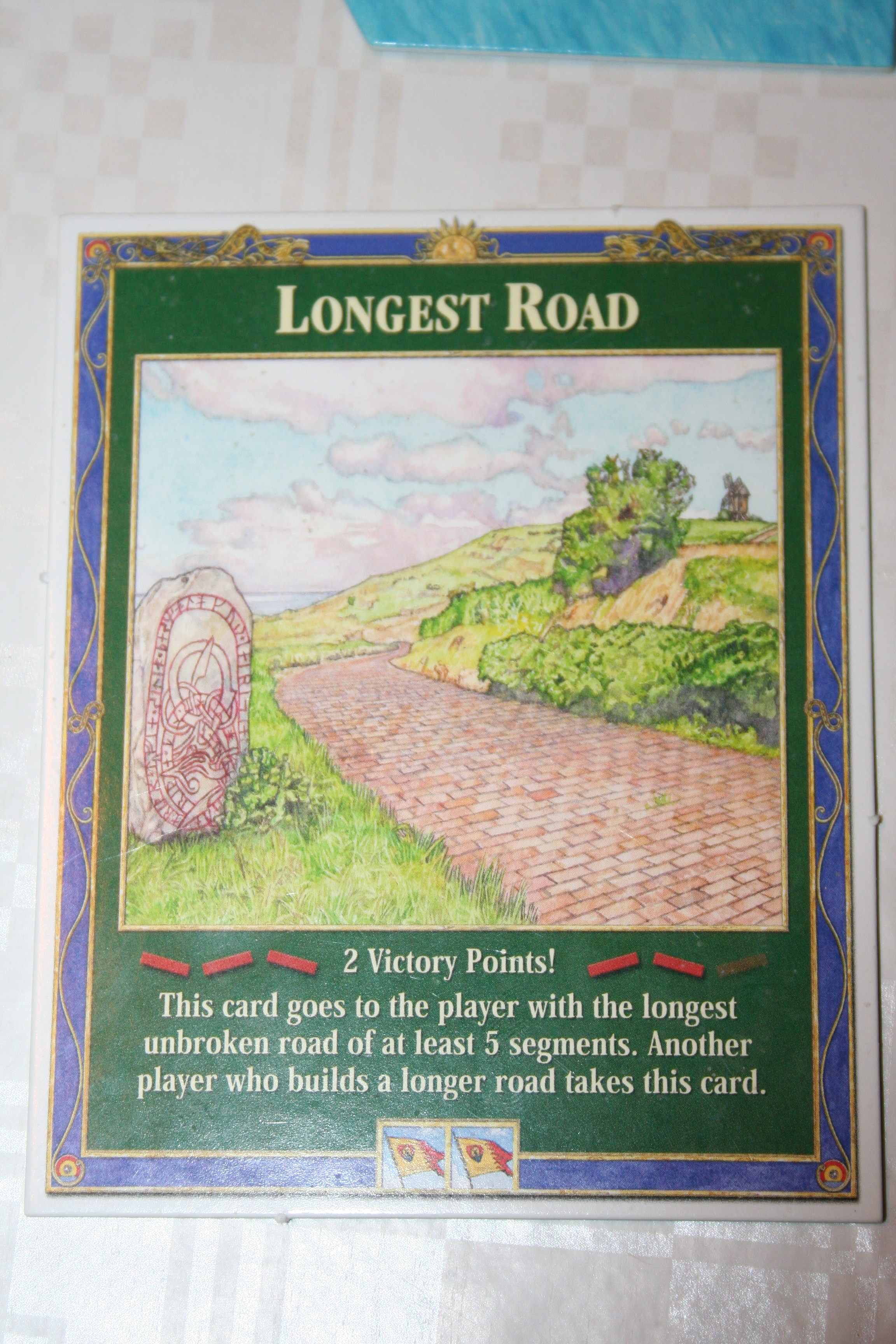
Winning the game actually isn’t very difficult, each Settlement you build is worth 1 Victory point and each City is worth 2. So you start the game with 2 Victory points, for your two Settlements placed before game play starts. You can also gain an extra 2 Victory points for having the longest unbroken road, this is one of the Special Cards, and is awarded once a player has a road at least five segments long. However, this card can get passed around a bit, as other players build longer roads. In the game we played, I had the longest road:

I was Orange, my road was 8 segments long

So I got the extra Victory points on the Special Card:

Longest road!
Longest road!

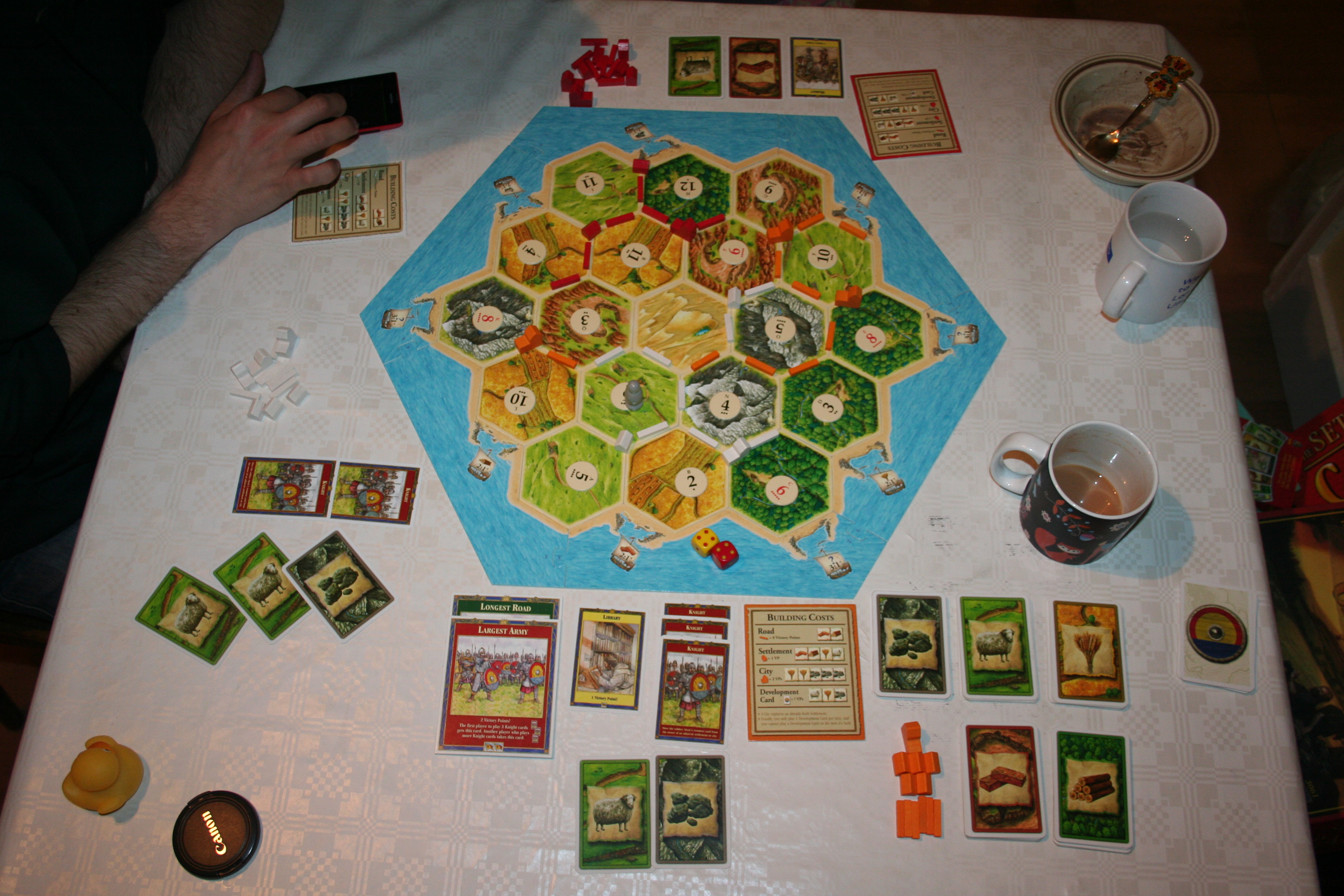
So, the end of our game looked like this:

I win!
I win!

So, ignoring the tea, ice cream and small rubber duck, this is what the game looked like at the end, I had acquired here, Longest Road, Largest Army (which is the other Special Card, Knights can be acquired by buying Development Cards and you get Largest Army once you’ve got three) and then also some Cities and Settlements.

Strategy!

This game can be played strategically, at the start of the game, when the board is being arranged, look for areas where a lot of one resource are concentrated, if you build both your starting Settlements on these and then quickly expand your Roads you can create a monopoly on one resource, forcing other players to trade with you for whatever you demand. Alternatively, try and build you Settlements so that you get as many different resources as possible. Both these are acceptable ways to start the game. One thing I would say to not do is this: unless you’re going for monopoly on something DO NOT BUILD YOU SETTLEMENTS CLOSE TOGETHER TO START. Doing this is going to severely inconvenience you later in the game. It makes getting Longest Road, or heading out to resources on the other side of the board much harder. Also, don’t be too harsh with trading, if you have something another player desperately needs, don’t ask too much for it, as they might get annoyed, and refuse to trade something you really need later in the game. It’s all a question of balance, getting as much as possible out of the trade without being unreasonable.

History and Interesting Things:

  1. One of the first European games to achieve real popularity outside of Europe – it’d sold over 15 million copies by 2009.
  2. There are over 50 Scenarios and Variants now available for this series of games.
  3. There are only four base expansions to this game, which are: Catan: Seafarers, Catan: Cities & Knights, Catan: Traders & Barbarians and Catan: Explorers & Pirates.
  4. Die Siedler von Catan is a novel, set on the island of Catan, written by Rebecca Gablé following the popularity of the initial release of the game.
  5. Settlers has been created and recreated online over the years – it used to be playable over MSN, for everyone out there who remembers when MSN was the going thing!
  6. A series of mini stuffed animals based on the resources produced in the game was released by Mayfair, call Catanimals.
  7. A version of the game to be played on Nintendo DS was announced in 2008, but has yet to be released.

To Conclude:

This game has a rating of 5 because of how versatile it is, and how easy it is to play, the rules have little to no ambiguity in them, the storage space in the box is well laid out and therefore not annoying, and it’s a really, really fun game to play, which takes between an hour and an hour and 40 minutes, more or less. Which I think is an almost perfect running time for a game, long enough to be interesting, without becoming boring! It’s a brilliant family game too, as the simplicity of the rules allows for younger players!

Battle Cry!

4 - 5


Number of Players: 2

Year of Publication: 1999/2010 (Anniversary Edition)

Creator: Richard Borg

Picture lovingly borrowed from http://www.sonofthesouth.net/uncle-sam/uncle-sam-posters.htm

As is self-evident from the name of the game Battle Cry is a strategy war game. It recreates the American Civil War. Players play as the Union or the Confederates, in other words, North or South America and can play through each of 30 scenarios from the war. The board is set up using Terrain Tiles with different images on them to create different parts of the country. Each scenario is defined in the Rule Book and has a pictorial representation of the starting layout of the board. My favourite thing about these descriptions is that there’s a little historical information provided about each scenario, but at the bottom, right after it tells you who originally won that battle it says: “The stage is set, the battle lines are drawn, and you are in command. The rest is history.” And it leaves you to find out who the best strategist is!

Dave and I did initially play the game slightly wrong, because we were in a rush. But this just reinforces our firm belief that you should thoroughly read the rules before starting any game.

Our first attempt at playing this game - we set up the board wrong.
Our first attempt at playing this game – we set up the board wrong.

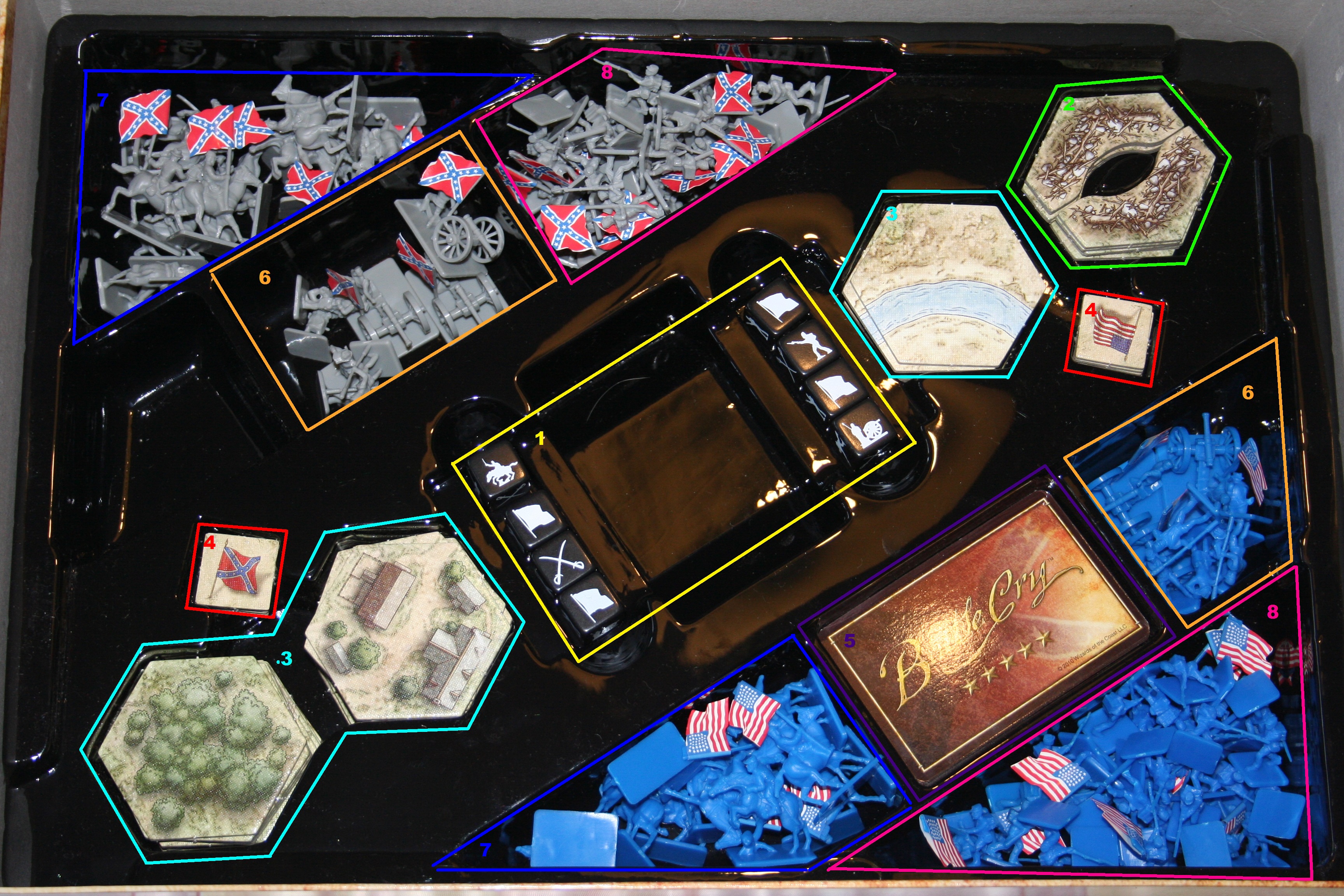
What’s In The Box:

The stuff. I know the layout of the box looks weird, I have since changed it, but taking another photo was a lot of effort...
The stuff. I know the layout of the box looks weird, I have since changed it, but taking another photo was a lot of effort…
  1. 8 Battle Dice
  2. 9 Double-sided Entrenchment/Fieldwork Tokens
  3. 46 Double-sided Terrain Tiles
  4. 14 Double-sided Flag Tokens
  5. 60 Command Cards
  6. 3 Artillery with Flags and 6 Artillery Crewmembers
  7. 3 Generals with Flags, 3 Cavalry with Flags and 6 Cavalry
  8. 10 Infantry with Flags and 30 Infantry

Plus also (and in a different picture just for fun):

The other stuff.
The other stuff. The stuff that didn’t fit in the first photo.

The Game Board, Terrain Reference Sheet and Game Rule Book.

Playing The Game:

Objective: To capture a given number of your opponents flags before they do yours and win the match!

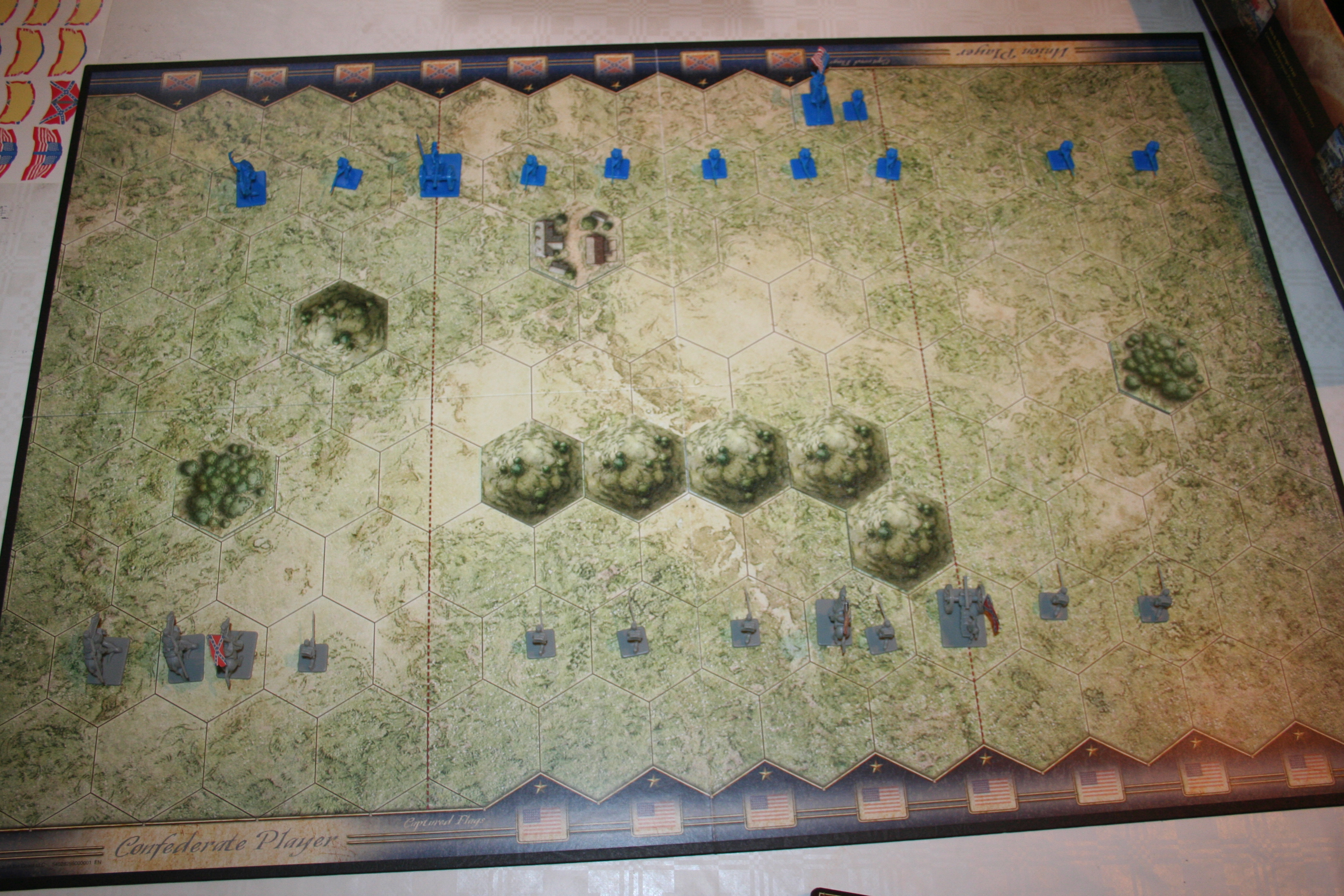
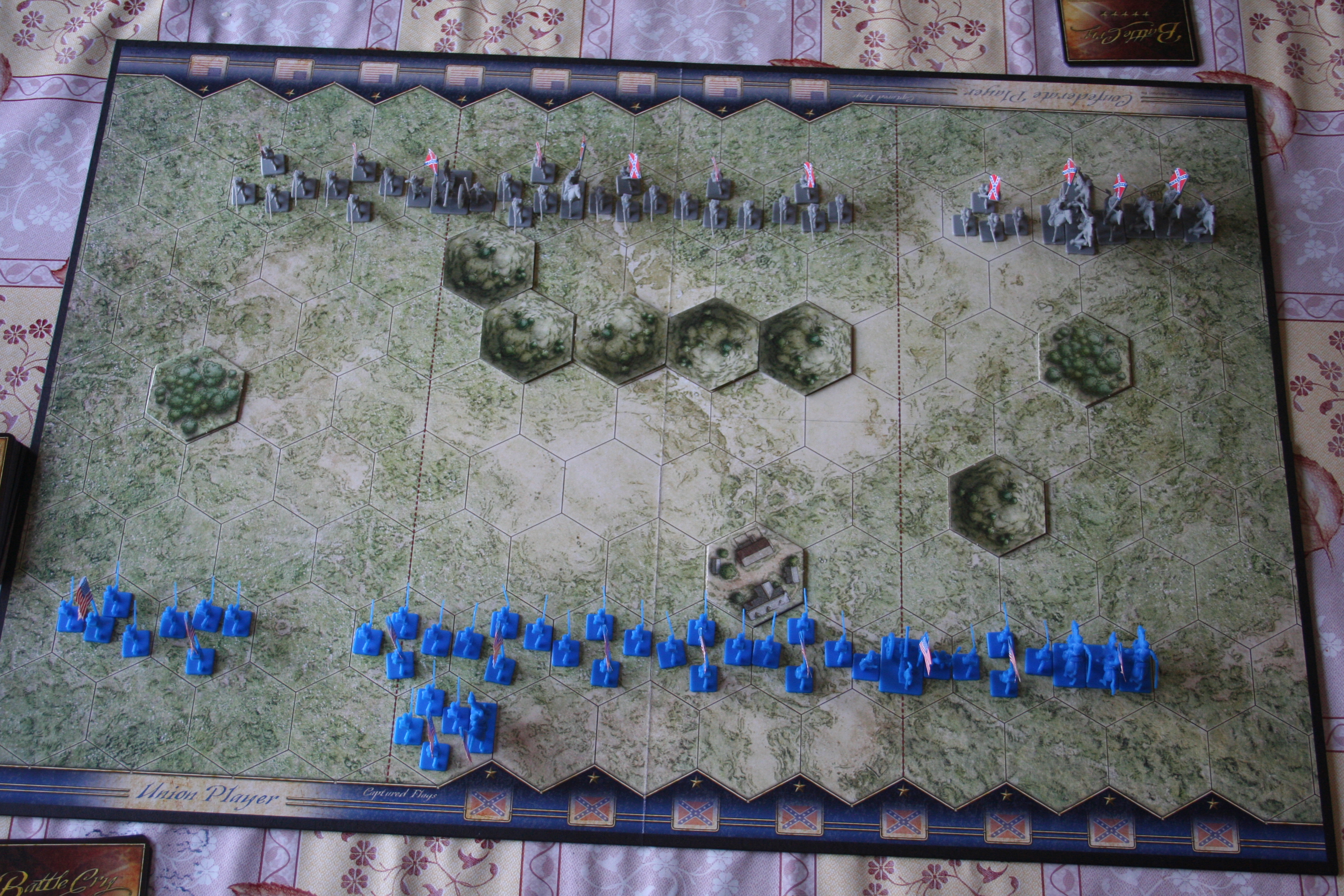
Although this game has a few scenarios that’re a little time-consuming to set up, it’s actually not all that complicated. Turns consist of five parts: playing a Command Card, giving orders, moving, battling and drawing a new card. I’ve only played two of the available scenarios so far, but both have been really good. The starting set up for the board on the simplest set up is this:

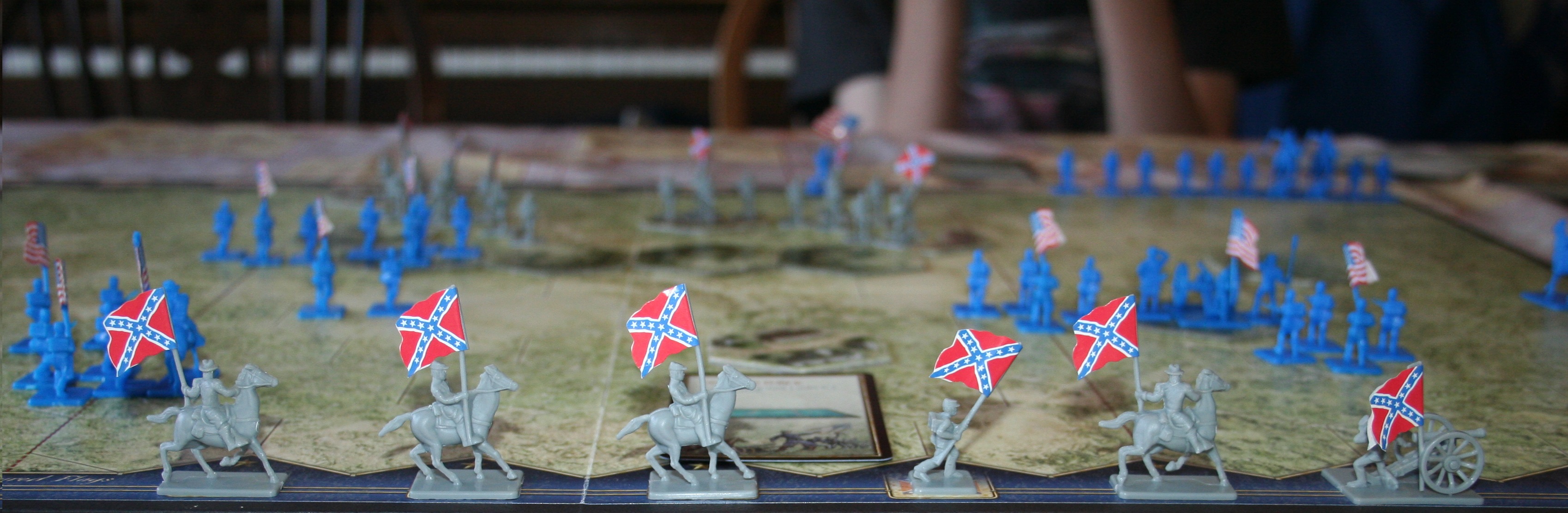
The starting set up for the simplest scenario, called First Bull Run. Blue is Union, Grey is Confederate.

To give you an idea of how simple this set-up is comparatively, here’s a photo of the next one on in the Rule Book:

A slightly more complex (and time consuming) set up.

There’re a fair few men on the board here, but it’s a lot simpler than it appears – the occupants of one hex on the board are a unit and all move together. Infantry can only move 1 hex at a time, Cavalry moves 3 hexes, Artillery moves 1 hex, and a General can move 3 by itself or if it’s in a unit with Cavalry, but can only move one when in a unit with Infantry.

Command Cards:

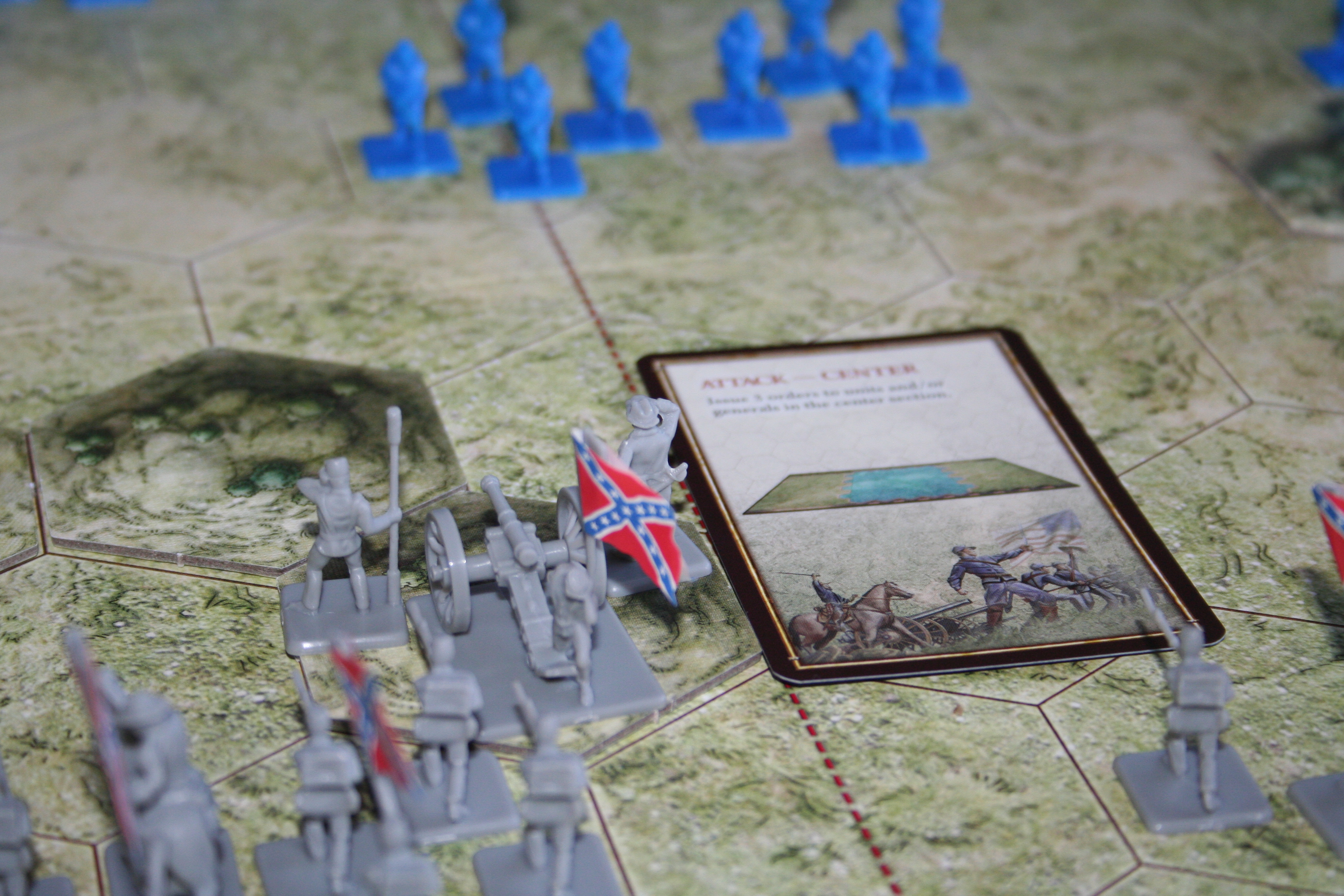
There are two different kinds of Command Cards; the Section Cards and the Tactic Cards and Dave and I have ranked the Section Cards in terms of usefulness. The least useful are the Scout cards, these allow you to order one of your units in one section of the board, then draw two cards instead of one, and choose which one to keep, discarding the other. Next are Probe cards, you can now give two orders to two of your units in one section of the board. Yet more useful is Attack, you guessed it already, you can now give three orders to three units in one section of the board. But the most useful of these cards are the Assault cards, these allow you to give one order per card you have including the one you’re playing, to units in one section of the board. The section of the board you give orders in is always specified on these cards and can be either Centre, Left Flank, or Right Flank.

A Section Command Card in play.

The Tactic Cards are very different, they allow you to do a whole host of things that the Section Cards don’t, such as placing Fieldwork Tokens on the board, which changes the terrain, and impacts on sight lines, amongst other things. There are, however, a lot of Tactic Cards, so I’m not going to go into any detail about them. But you can have a photo of one!

An example of a Tactic Command Card in play.
Giving Orders and Moving Units:

Once you’ve read out the Command Card you’ve chosen to play you put it face up on the board and announce which units you intend to move. You must order all units before moving any of them. Next you move your units, taking into consideration terrain restrictions and remembering that a unit cannot battle unless it’s been ordered, even if it does not move.

Battling and Retreating:

Now you can battle! Any unit that’s close enough to an enemy unit (or an Artillery unit that was ordered but not moved) can now try to eliminate some of the opposing soldiers. This is done by rolling Battle Dice. Terrain restrictions, distance from target and type of soldier all effect how many dice you roll, and therefore how likely you are to succeed in doing any damage.

For example; if you’re attacking an enemy unit that’s on a hill hex, you roll one less Battle Dice than normal depending on how far away from the target you are, because you’re attacking uphill, which puts you at a disadvantage.

All units have one member that has a flag in them, when fighting an enemy unit, you always remove the flag bearer last. 

I won’t go through how each unit attacks, but I’ll use Cavalry as an example. Every unit has a different range to the others, Infantry can attack enemy units up to four hexes away, Artillery up to five hexes away, and Cavalry must be adjacent to the unit they wish to attack.

Depending on where you are in relation to the unit you’re targeting you roll a certain number of Battle Dice. Cavalry always roll three, unless terrain battle restrictions state otherwise.

Of the three Battle Dice rolled here two were hits. As you can see, the small image on the dice is of a Cavalry figure. When rolling to eliminate opponents you must roll the correct symbols.

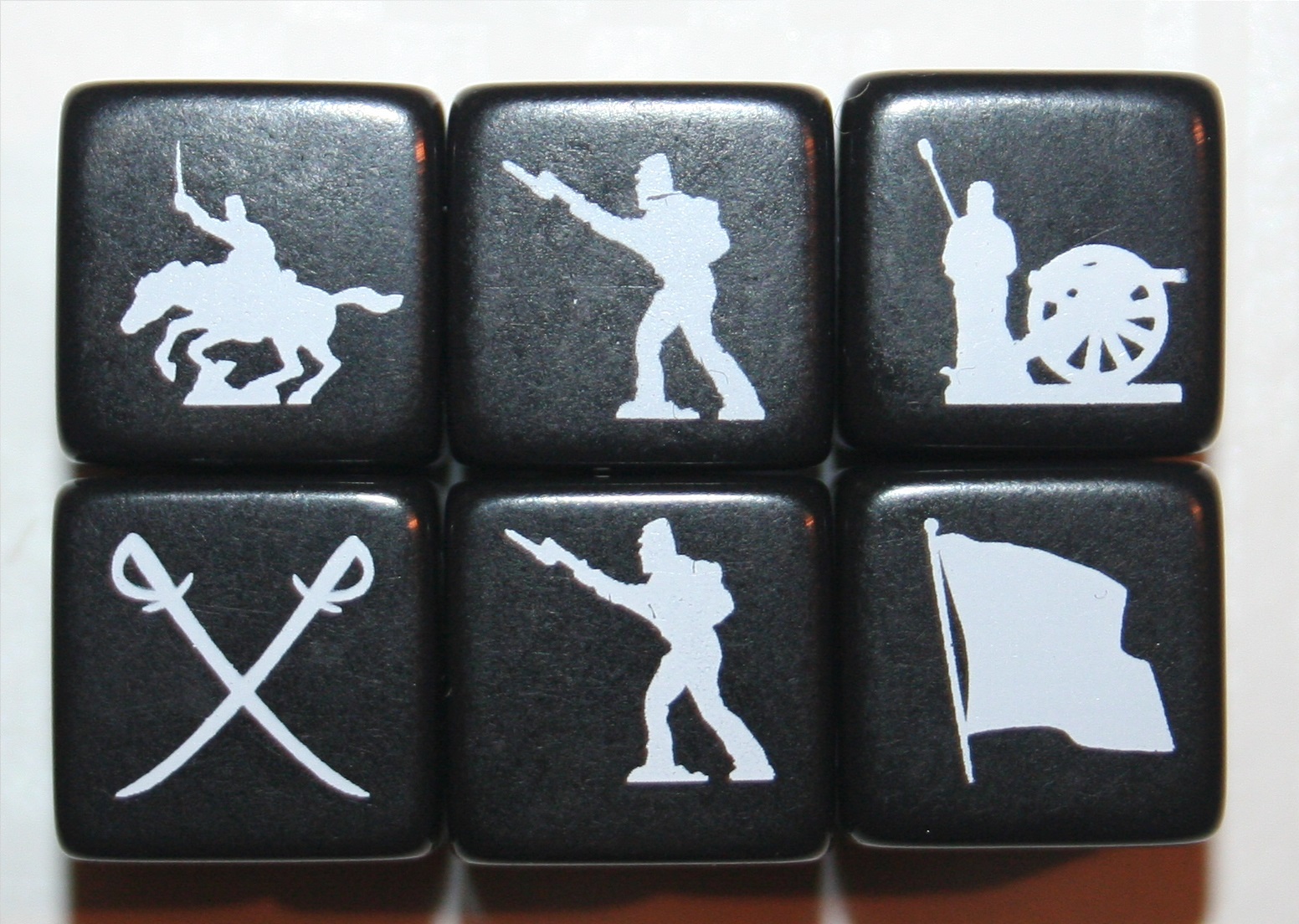
These are all six of the sides of the Battle Dice, and each symbol means something different. Infantry, Cavalry and Artillery are fairly self-explanatory – for every one of those symbols rolled, you can capture one of the equivalent enemy pieces if there is one in the unit you’re attacking. The cross sabres are the only symbol that can remove a General from the board, however, if there’s no General in the unit, sabres also remove anything else. The flag is a retreat:

The Battle Dice. As you can see, there are two Infantry symbols showing. This is because there are two sides of each die with the Infantry symbol on them. Making them the easiest units to capture.

A flag rolled means that the unit you’re attacking must retreat one hex, however, it can’t retreat onto an occupied hex, unless that hex has a General on it that’s not attached to a unit, the General then become attached to the unit and must move with it.

Different Kinds of Terrain:

There are hexes on top of the board, these are the Terrain Tiles. In both the scenarios I’ve played so far there are only three kinds on the board: Woods, Hills and Homestead hexes. These alter the course of the game in that they place restrictions on movement, line of sight and accuracy. So can be used to your advantage, or to severely disadvantage your opponent. All of these act as blocks in the line of sight when you want to attack a unit, but the Woods and the Hills can be incredibly useful. From the top of a hill the range of an Artillery unit is increased by 1, whilst the accuracy of an attacking unit is decreased by 1. Likewise, on a Woods hex the attacking units accuracy is decreased by 1, but the unit inside the Woods has no such impediment.

Winning the Game!

One the page in the Rule Book assigned to whichever scenario you’ve chosen to play there will be a small amount of information underneath the picture of the starting set up. This will include the historical background to that particular battle, which General both sides are commanding as, who moves first, and most importantly, how many flags you need to capture to win. The first player to achieve having this number of their opponents flags, immediately wins the match. However, to play a complete match, you’re supposed to reset the board and change sides, and the winner is determined after both matches are complete. This probably often ends with a draw, but I haven’t yet played a complete match in this way. The game we played the first player to capture six flags won:

My victory stand at the end of the game!

Strategy:

This game is tactical, it requires strategic thinking and a little bit of foresight. I’ve found that on the First Bull Run the best way to play is just to push forward in more or less a straight line, going up hills wherever you can, or into woods. If you’ve got possession of the hills and woods you’ve got the advantage, because your enemy is less likely to be able to capture you when they attack.

This isn’t a huge amount of help, as it’s things that’re mostly just common sense, but I’m not particularly strategically minded, so although I’m not bad at this kind of game, I also don’t make plans when I play them. Just take each turn as it comes, kinda thing.

History and Interesting Things:

  1. The first game to be published under this name was published in 1961. The concept of this game was the same as the version we’ve got, but much much simpler. Each side only has 22 pieces, the grid is square, not hexagonal, and there’s only one battle scenario available to play.
  2. An online version of this game was released in November 2008, to GameTableOnline.com and can be played player vs player or player vs computer.
  3. It won the International Gamers Award in 2001 for the General Strategy: 2-Player category.
  4. I don’t have anything else to write about the history of the game, so have some points about the Civil War instead: Before William Tecumseh Sherman became a famous Union General he was demoted for apparent insanity.
  5. More men died in the Civil War than in any other American conflict, and two-thirds of them died of disease.
  6. During the war Robert E. Lee’s Virginia estate was confiscated and turned into a cemetery by the Union.
  7. Robert E. Lee was the bloodiest General of the war.
  8. President Lincoln was shot at, and almost killed, nearly two years before his assassination riding to the Soldiers’ Home (his summer residence) from the White house on an August evening in 1863.
  9. On the Union side, black soldiers refused their pay for 18 months because they were being paid less than their white comrades.
  10. Harriet Tubman led a raid to free slaves during the war, this one raid freed more than 720 slaves – more than 10 times the number she had freed in 10 years on the Underground Railroad.

I read about the history of the war here, and got my game info off of Wikipedia.

To Conclude:

So  this game is great for a few reasons; it’s easy to understand, it’s easy (though time-consuming) to set up, and there are so many different scenarios that it’s going to be a long time before it stops being interesting!

I recommend it to anyone who enjoys a proper sit-down game. It takes about an hour to play a scenario, with around 15 minutes set up time (this’ll probably become less as we get more familiar with the board and different layouts). For anyone with a son or daughter who’s an up-and-coming tactician, this would be a fantastic game to play with them.

If this is a game that’s up your street, go out and get a copy, and have lots of fun re-writing the course of history!

Escape From Atlantis

4.5 - 5

Number of Players: 2 – 4

Year of Publication: 1986

Creator(s): Julian Courtland-Smith

Escape This:

You have to imagine the Jaws music

So I thought I’d open with that just to get your attention. Escape from Atlantis is a game that’s really up there for me, it’s just really good fun. I remember if from when I was a child; I can’t remember exactly where we used to play it, either my Grandma or my Godmother had a copy, but I used to love it. Now, my sister being the wonderful person she is, bought me an original copy of the 1986 publication, complete and in very good condition, off the internet for my birthday. Naturally since then we’ve played it more times than any other game we’ve played recently.

What’s In The Box:

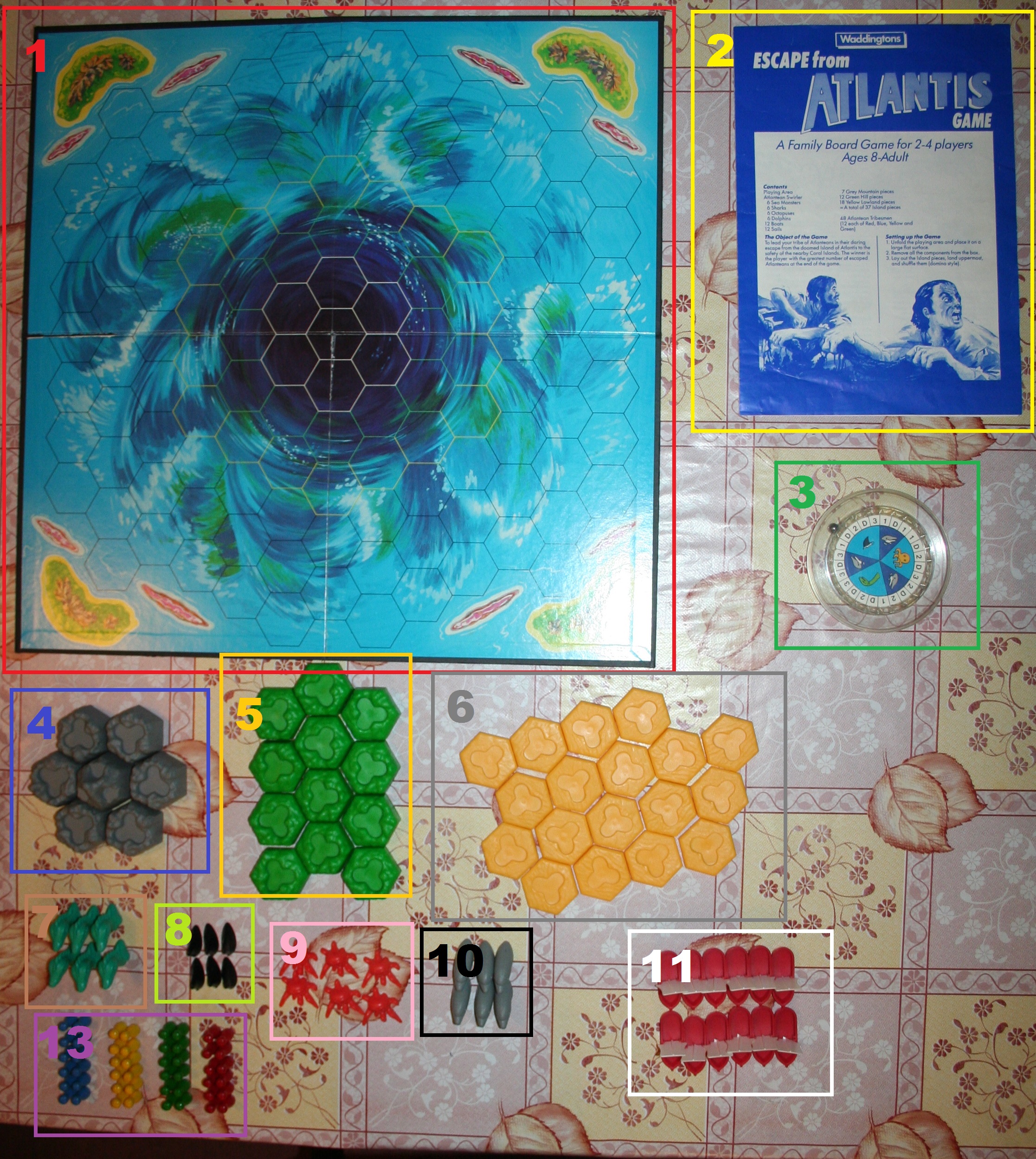
The Stuff.
The Stuff.
  1. A playing board.
  2. A instruction booklet
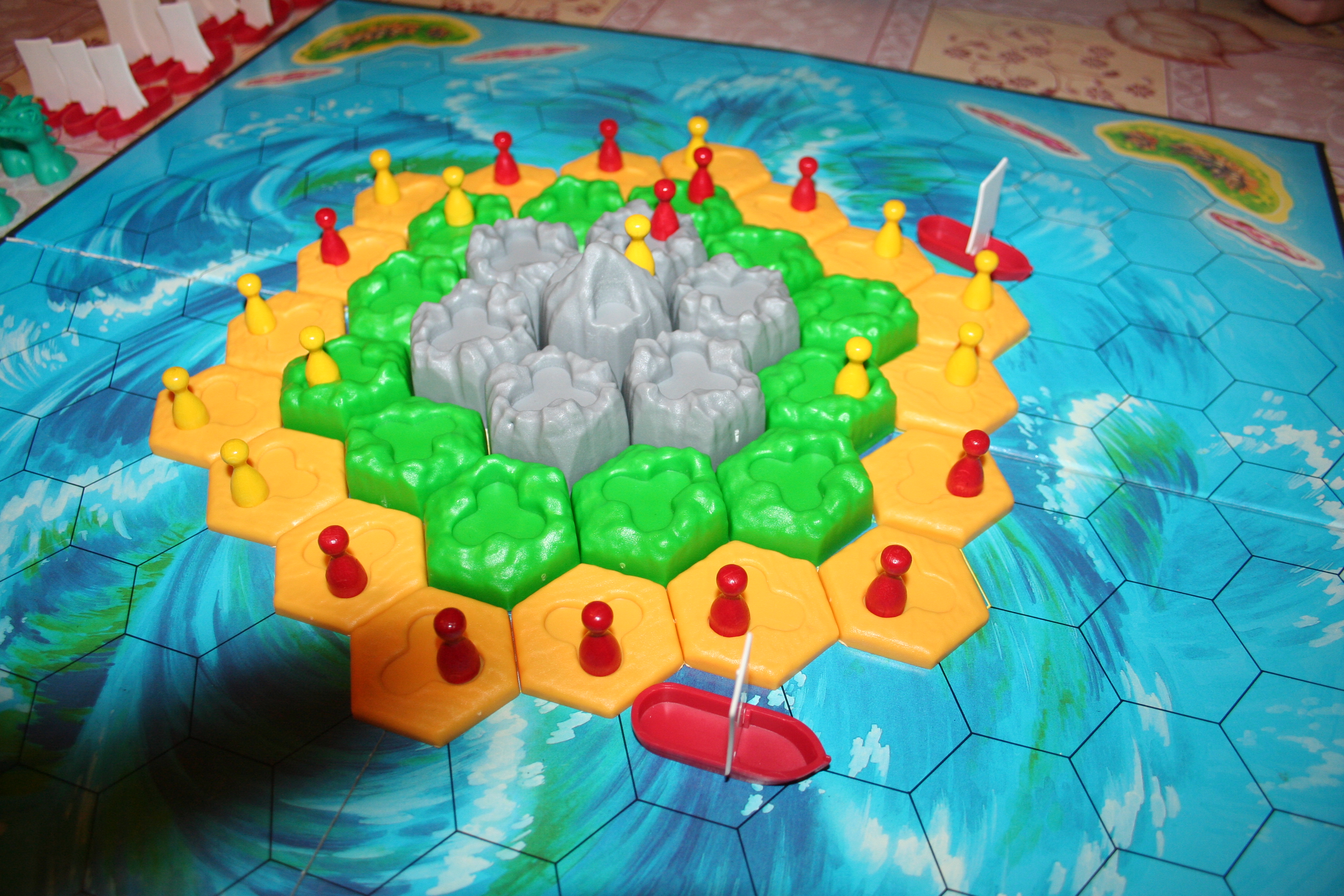
  3. An Atlantean Swirler
  4. 7 Grey (rock) land tiles
  5. 12 Green (hills) land tiles
  6. 18 Yellow (sand) land tiles
  7. 6 Sea Monster Pieces
  8. 6 Shark Pieces
  9. 6 Octopus Pieces
  10. 6 Dolphin Pieces
  11. 12 Boats
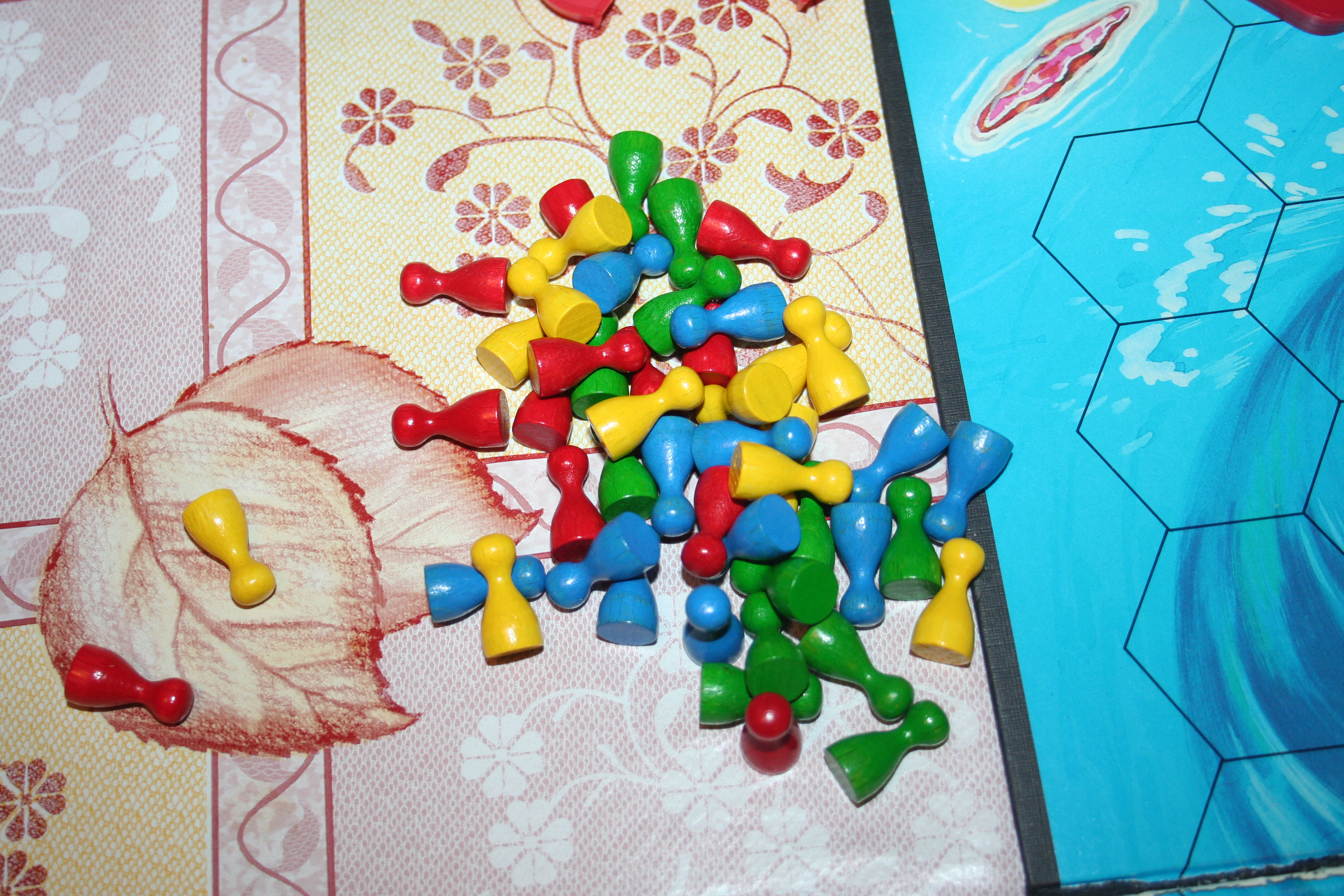
  12. 48 wooded play pieces divided in two twelve set of four colours (Blue, Yellow, Green and Red)

Playing The Game:

Objective: To save more of your Atlanteans than any of the other players by the time one player saves their last surviving piece.

The board at the start of the game.

You start the game by setting up the island in the middle and then taking turns placing your pieces on it. You can only have one piece occupying each yellow space at the beginning of the game. You then each place a boat on a space adjacent to the island.

IMG_0555
The board after all pieces are placed.

Then you start movement, each player can move three spaces per turn. These three spaces can be used on one man, or split across any combination. They can also be used to move un-manned boats or boats you have control of. You have control of a boat if there are more of your men in the boat than any other players, you share control if you both have one piece in it; meaning you both can move it. If you only have one piece to another players two you cannot then move the boat. Men who’re in the water (not in a boat) can only move one space per turn but three moves still apply so you can use the other two to move something else.

Yellow has control as there's only one red piece in the boat.
Yellow has control as there’s only one red piece in the boat.

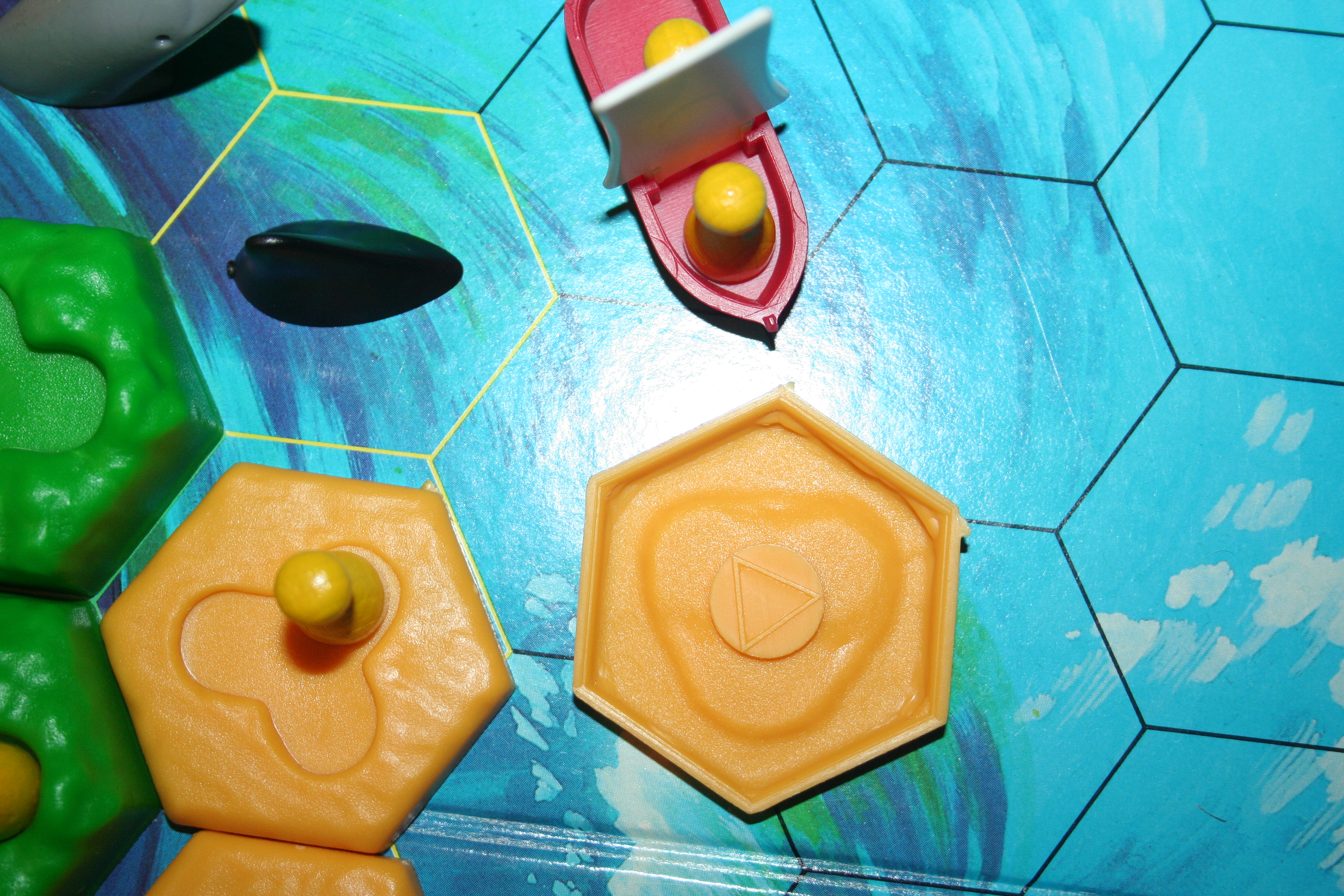
The next phase of your go after movement is to take a piece of the island away. Each piece of island has a symbol on the underside representing one of the following; A whirlpool which sucks everything on adjacent spaces (that aren’t land pieces or on land pieces) in and destroys them, a sea monster, a shark, an octopus, a dolphin or a boat; these are all created on the uncovered sea space. Any men that were on the removed land tile are moved to the closest available space on the island – unless it’s the last piece, then they’re cast into the sea. The yellow land tiles are removed first followed by the green then the grey.

The symbol is a triangle which means shark, so a shark has been placed in the space the land tile was on.

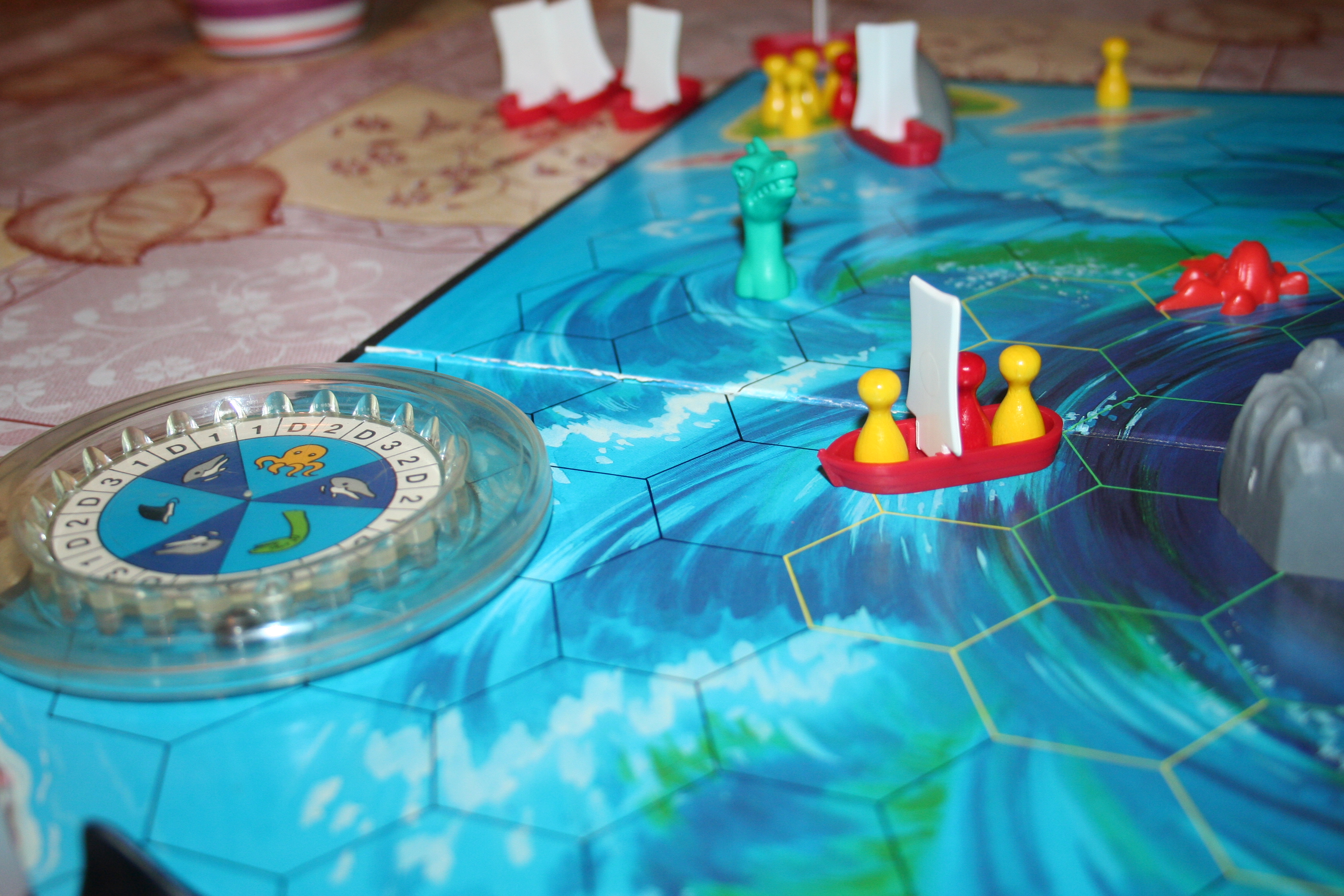
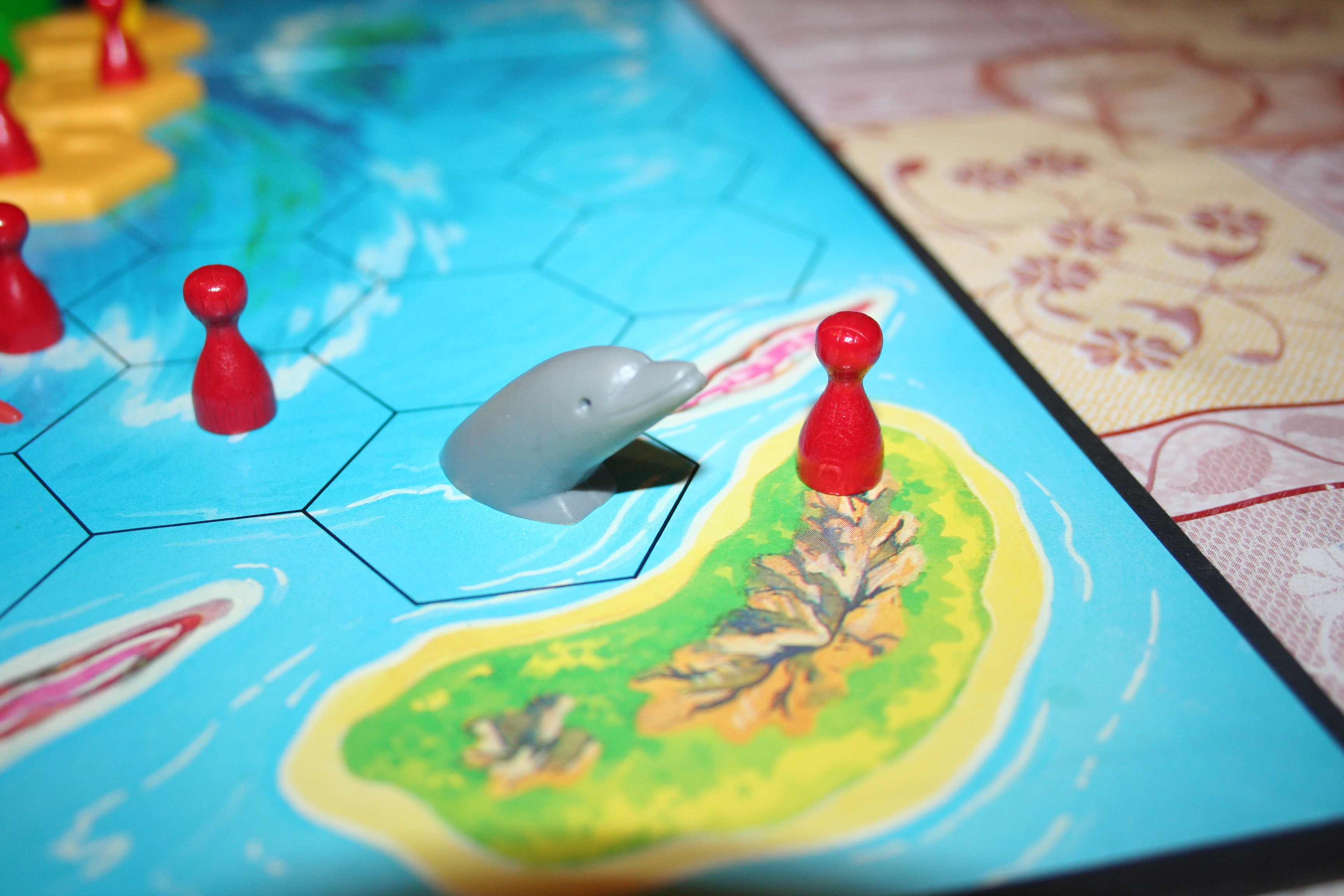
The last phase of a players move is to spin the Atlantean swirler. This shows either a; sea monster, octopus, shark or dolphin and the numbers 1 -3 and the letter D. This indicates that you can move the relevant sea creature the relevant number of spaces or if it says D (meaning dive) you can move the creature to any unoccupied space on the board. The sea creatures are the fun part of the game, if you move a sea monster onto a space with a boat or swimmers in it will eat the lot, if you move a shark onto a space with swimmers it will eat them but it will not eat boats, octopuses will only destroy boats and make everyone in them swimmers but will let them live and dolphins are friendly and will carry a swimmer to safety at the cost of the player next three moves.

Dolphins save lives!

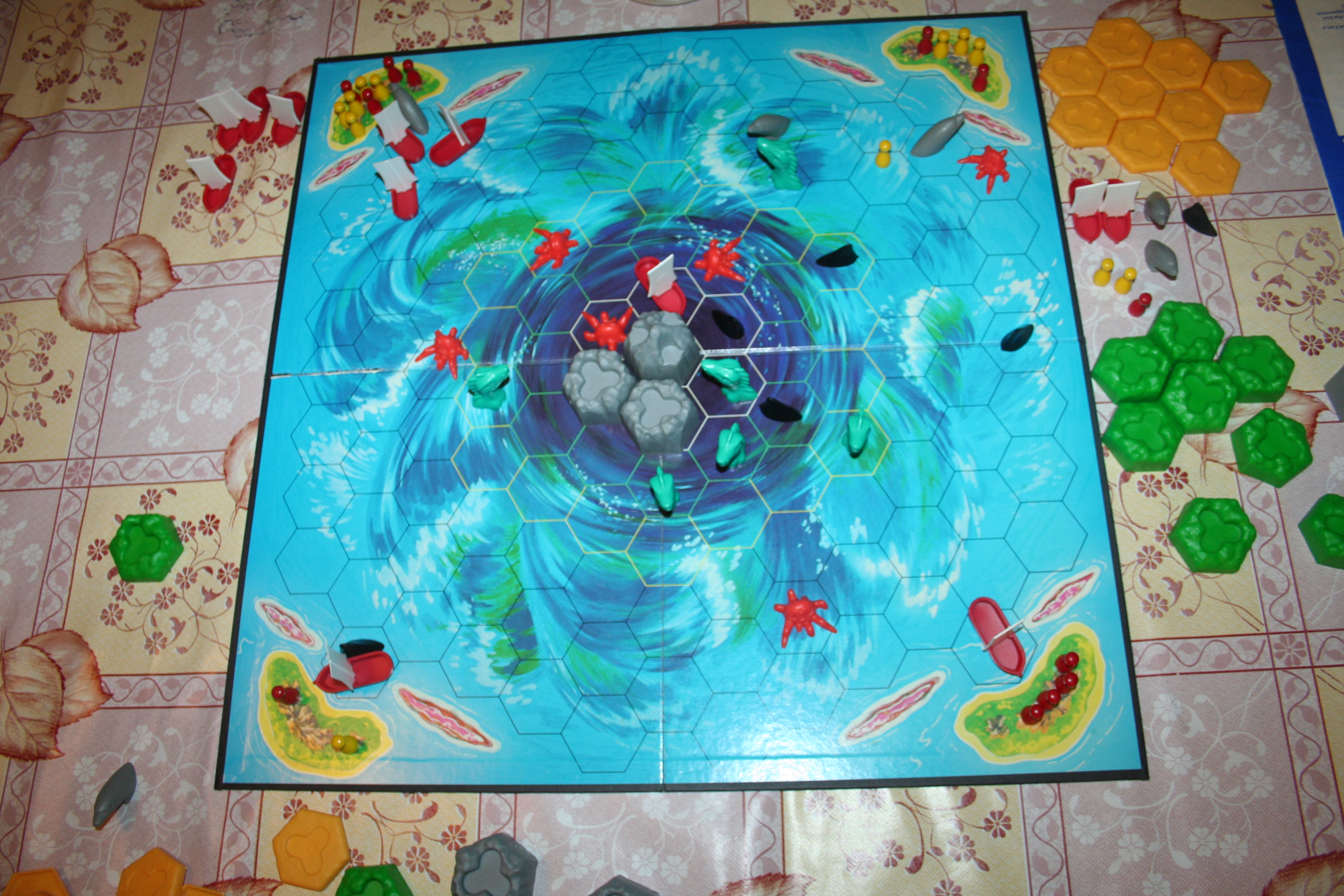
As the island disintegrates and more monsters appear, more pieces end up in the water and so the game becomes much more fun! The winner is the person with the  MOST pieces on the coral islands in the corners when the first player runs out of pieces either by saving them or having them eaten. Now, while the rules don’t specifically state this, we decided this meant no suicides as it could be beneficial to kill your own men off (by swimming them into sea monster/sharks or the other way around) when you have the most men on the islands. We decided this was not in the spirit of survival and should not be allowed.

The end of the game.

Strategy:

The primary strategy to this game is… DON’T GET EATEN! But there are a few other things to consider; like it’s always useful to make someone else save your pieces by putting it is as a tag along/third man in a boat controlled by someone else. Also dolphins are your friends. The best tactic I think is to remember to move not just to aid your escape but to move to hinder the other persons; move empty boats away from the island, block the escape island entrances with sea creatures (preferably sea monsters) and destroy land pieces that hinder the other players as much as possible.

History and Interesting Things:

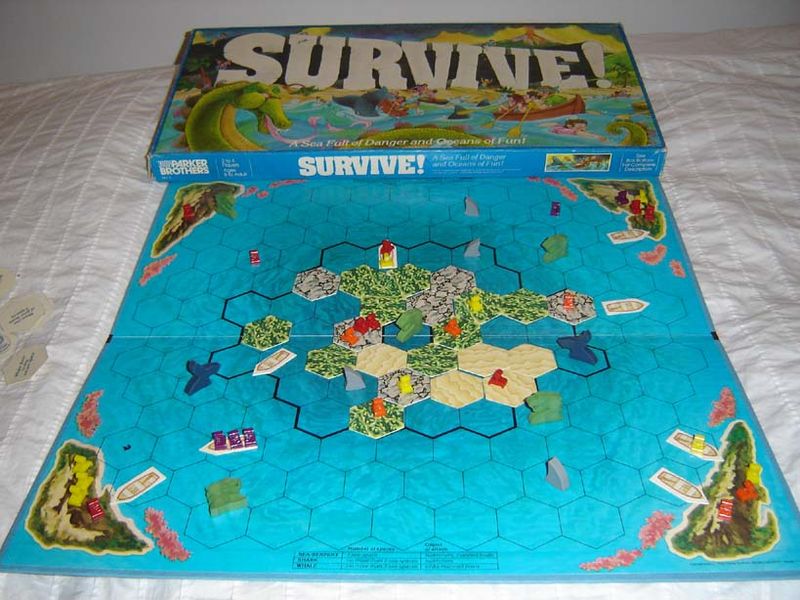
  1. The game was originally released under the title Survive! in the USA.

    Original Survive! Picture lovingly borrowed from Wikipedia.
    Original Survive! Picture lovingly borrowed from Wikipedia.
  2. It was released like this in 1982 but was remade with 3D pieces to the addition we own and released in the UK with revised rules in 1986.
  3. In the original game the island was built at random in the middle and pieces where removed at random (as you might be able to see from the picture) which resulted in the island sinking in an less-uniform manor.
  4. From 1987 the game sold in many countries, in many languages including Finnish, Dutch, Spanish, Italian, French and German.
  5. In 2010 Stronghold Games announced they where going to reprint Escape from Atlantis and title it Survive! Escape from Atlantis. Which they did in February 2011.
  6. In June 2012 they then released Survive! Escape from Atlantis – 30th anniversary Edition with revised rules and a slightly altered theme involving the explorers actually finding Atlantis and then having to escape from it.
  7. French publisher Asmodee released the game under the title The Island in 2012.
  8. Stronghold Games released three expansions for the Survive: Escape from Atlantis! – 30th Anniversary Edition in 2013 called: 5-6 Player Mini Expansion Kit plus Dolphins & Dive Dice Expansion Kit and The Giant Squid Expansion Kit and because of these this version of the game and the expansions must be added to our Game we Want page.
  9. The game has won boardgame.ru best family game of the year 2012 as well as “2012 Juego del Ano Finalist” (what ever that means exactly… Some sort of finalist for something)
  10. World sales of Escape from Atlantis now exceed 1.25 million units.

To Conclude:

This game is up there with my favourites, it’s a classic that’s just really, really good fun. I will have to get the new one to compare it, so expect a post on that when I do. However never forget the fallen:

To quote a terrible Star Wars film: "the death toll is catastrophic".
To quote a terrible Star Wars film: “the death toll is catastrophic”.

Stealth Chess

That Time I almost Lost at Chess…To a GIRL!…Who’s Younger than Me!

Luckily for me she backed herself into a stalemate and my pride was slightly less destroyed than it could have been. Like our Cripple Mr. Onion post this post is a bit of a bonus this month. Being a game invented by Terry Pratchett (well, more an adaptation of a classic game) we decided it needed a mention.

Being Stealthy at Chess:

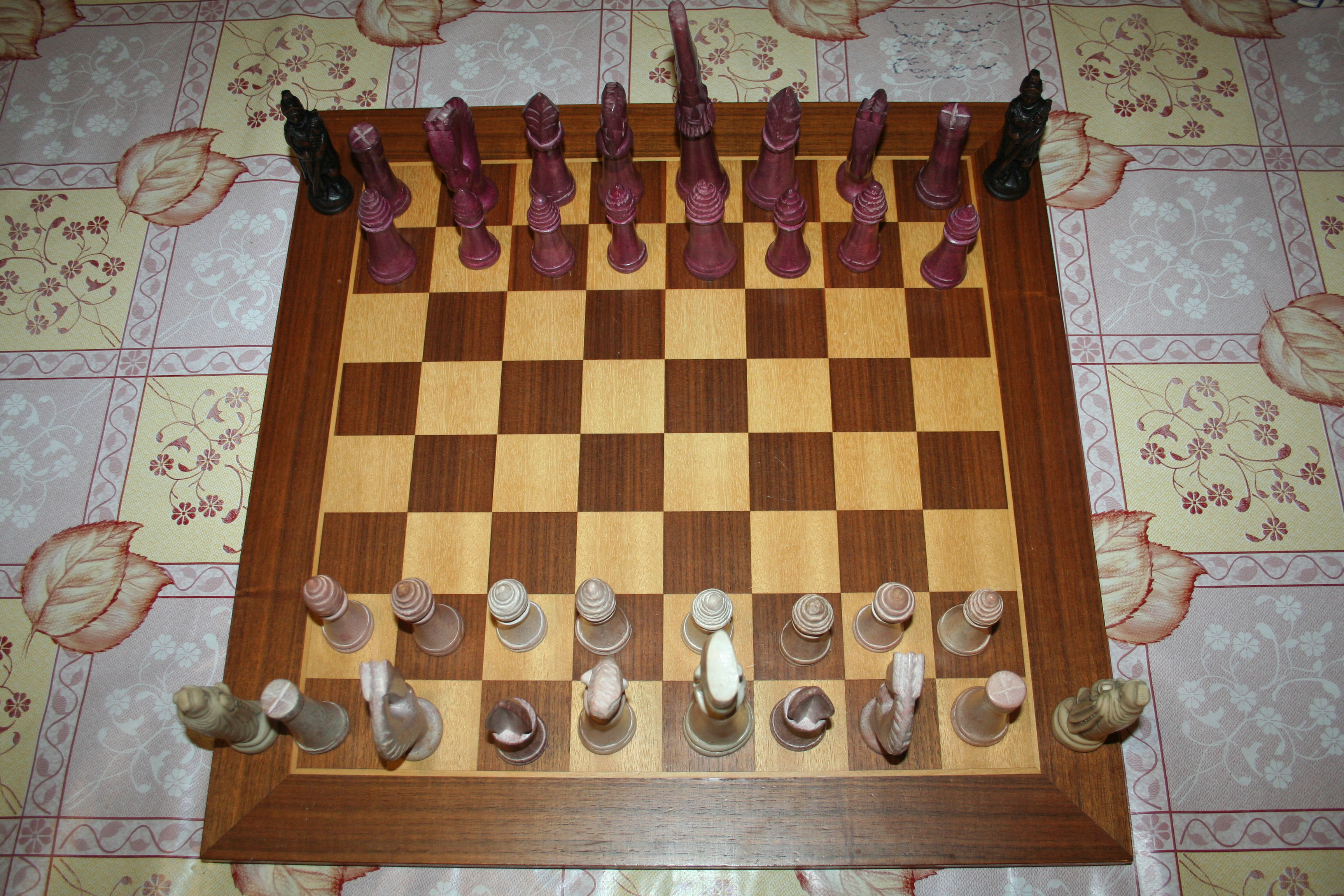
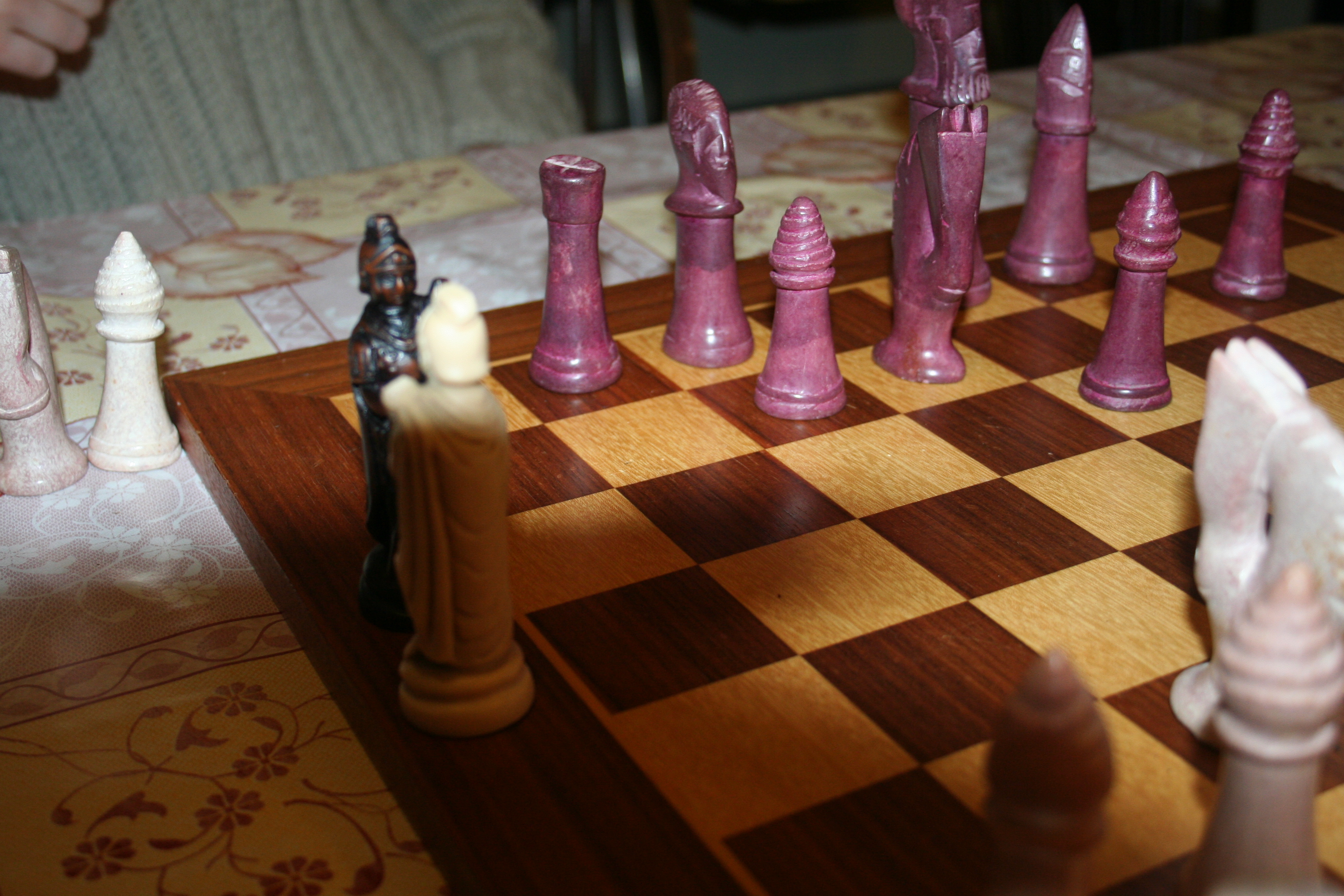
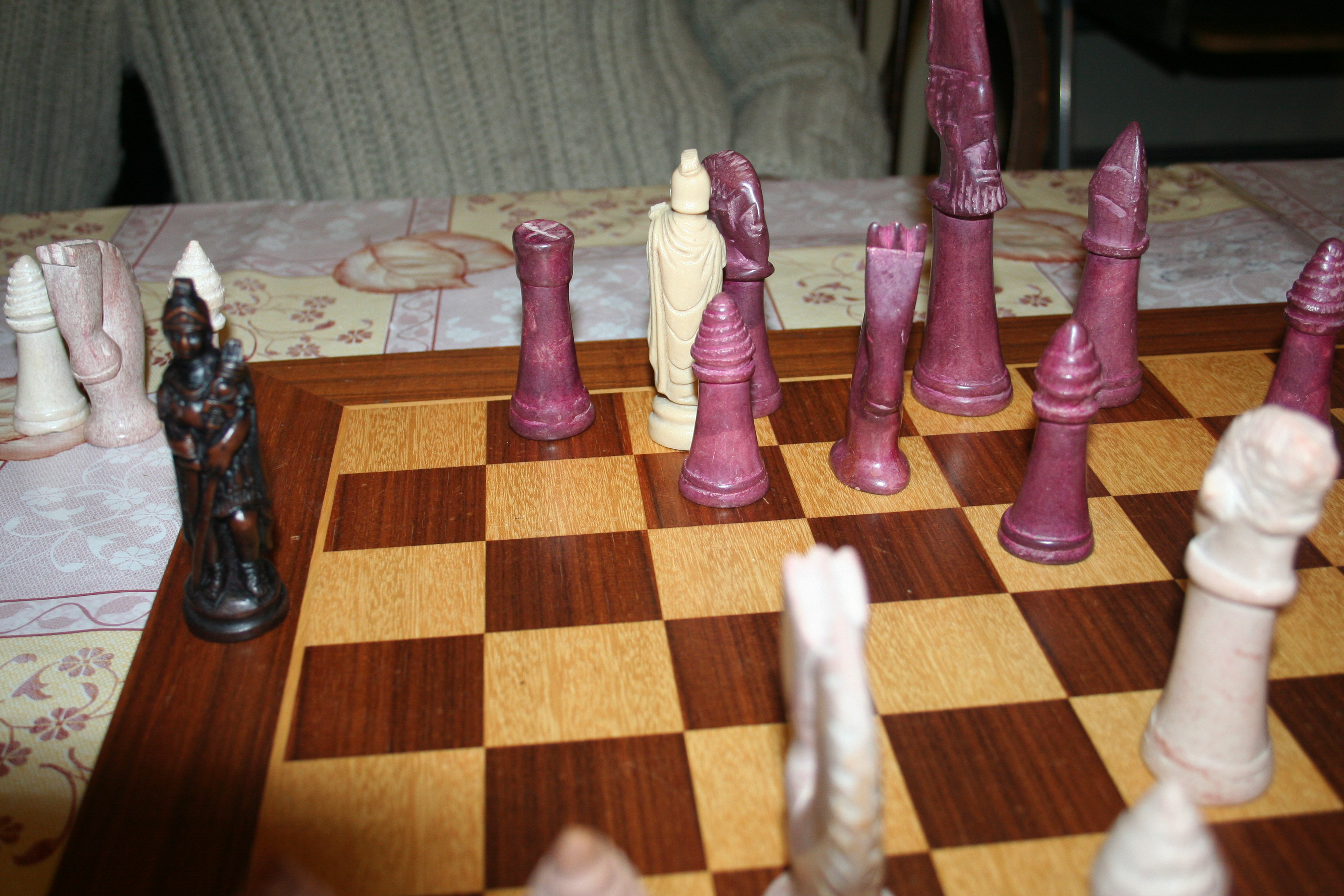
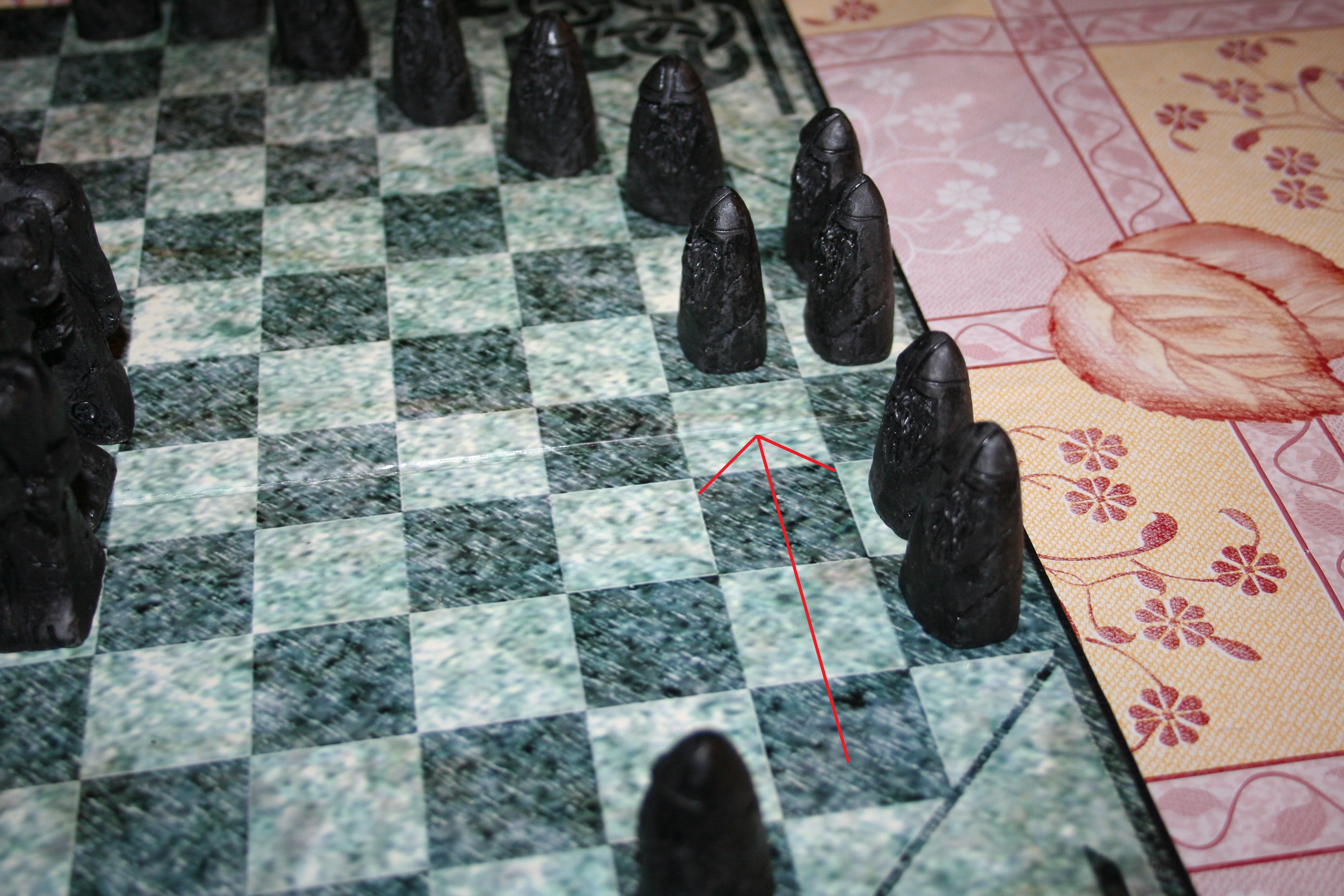
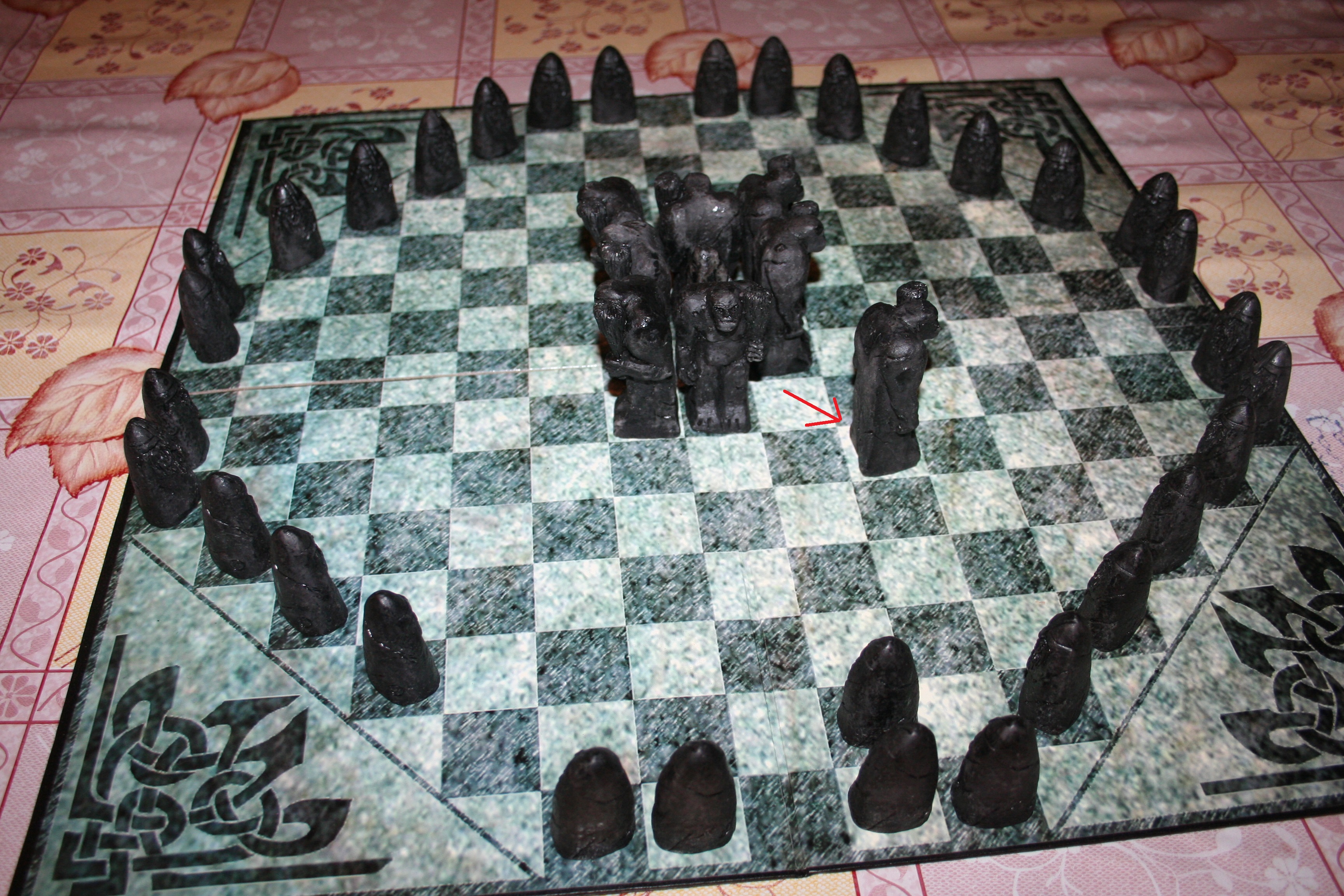
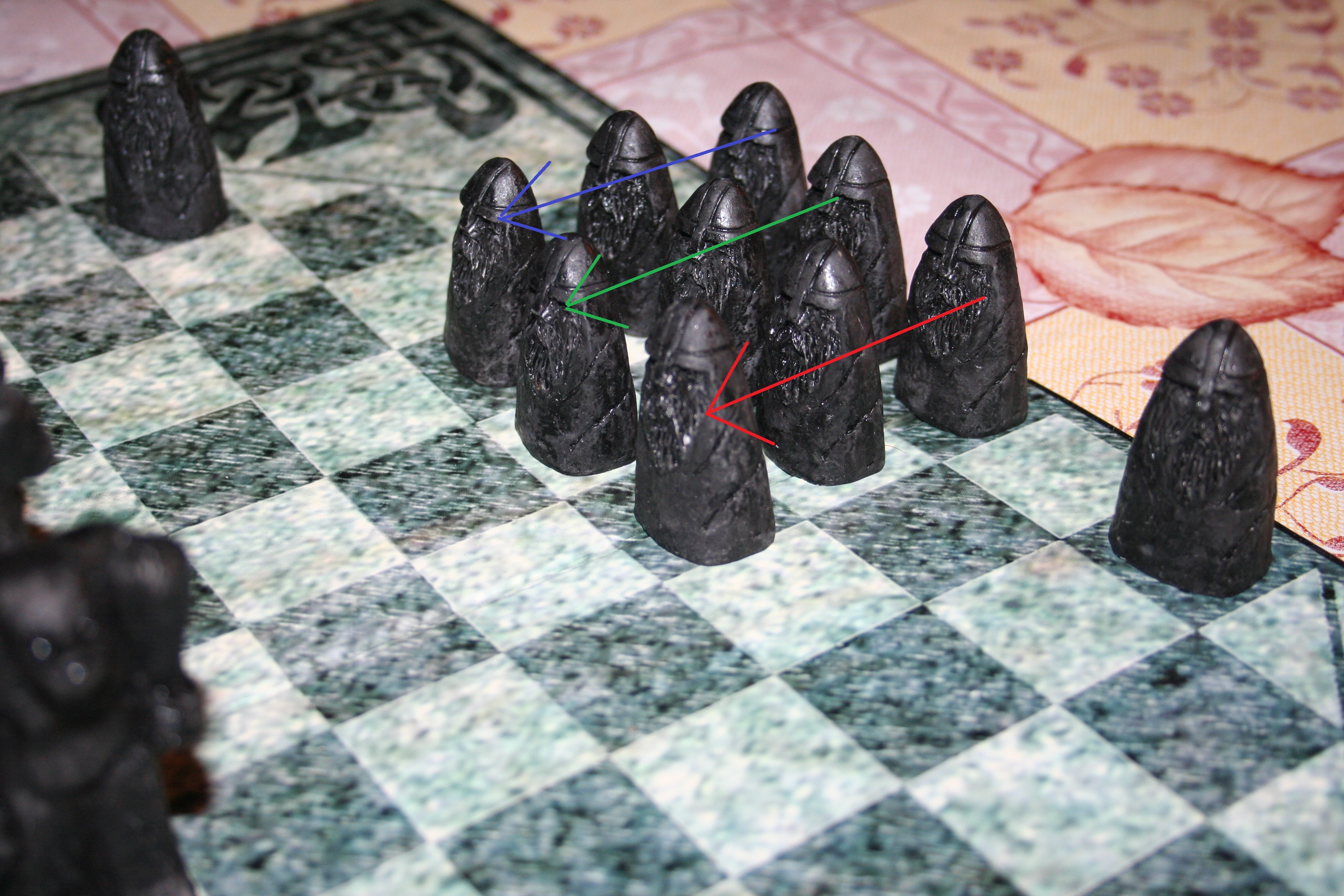
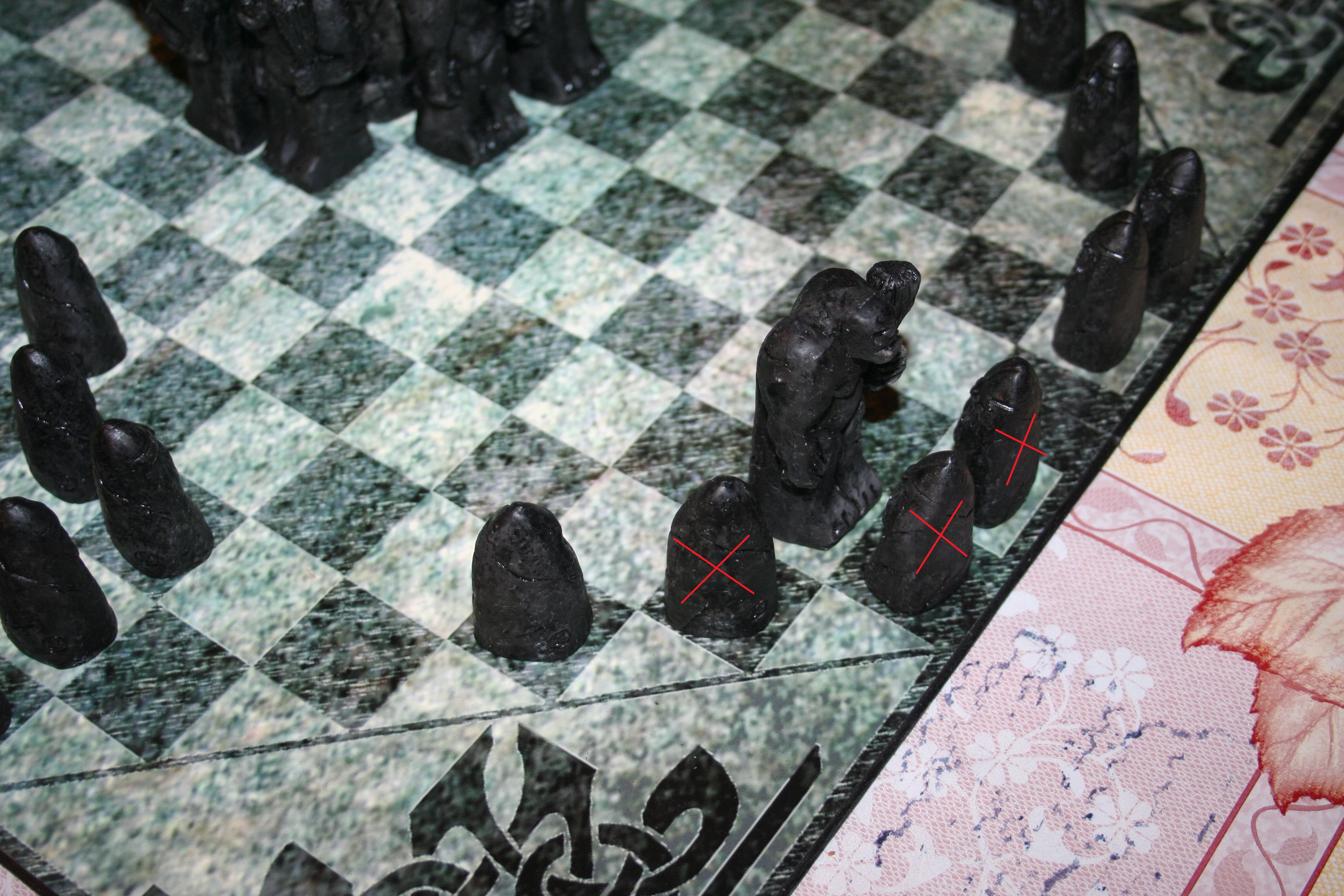
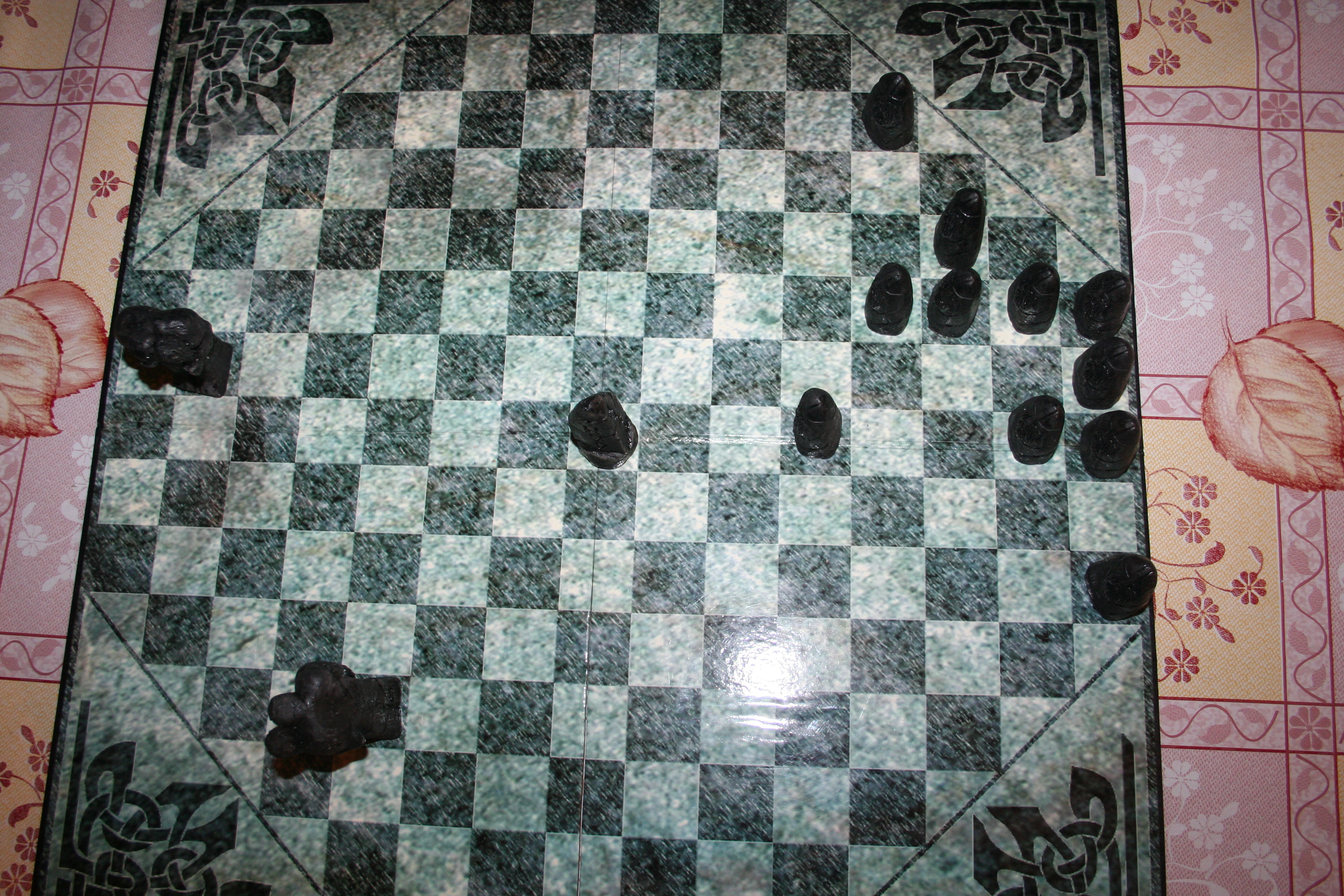
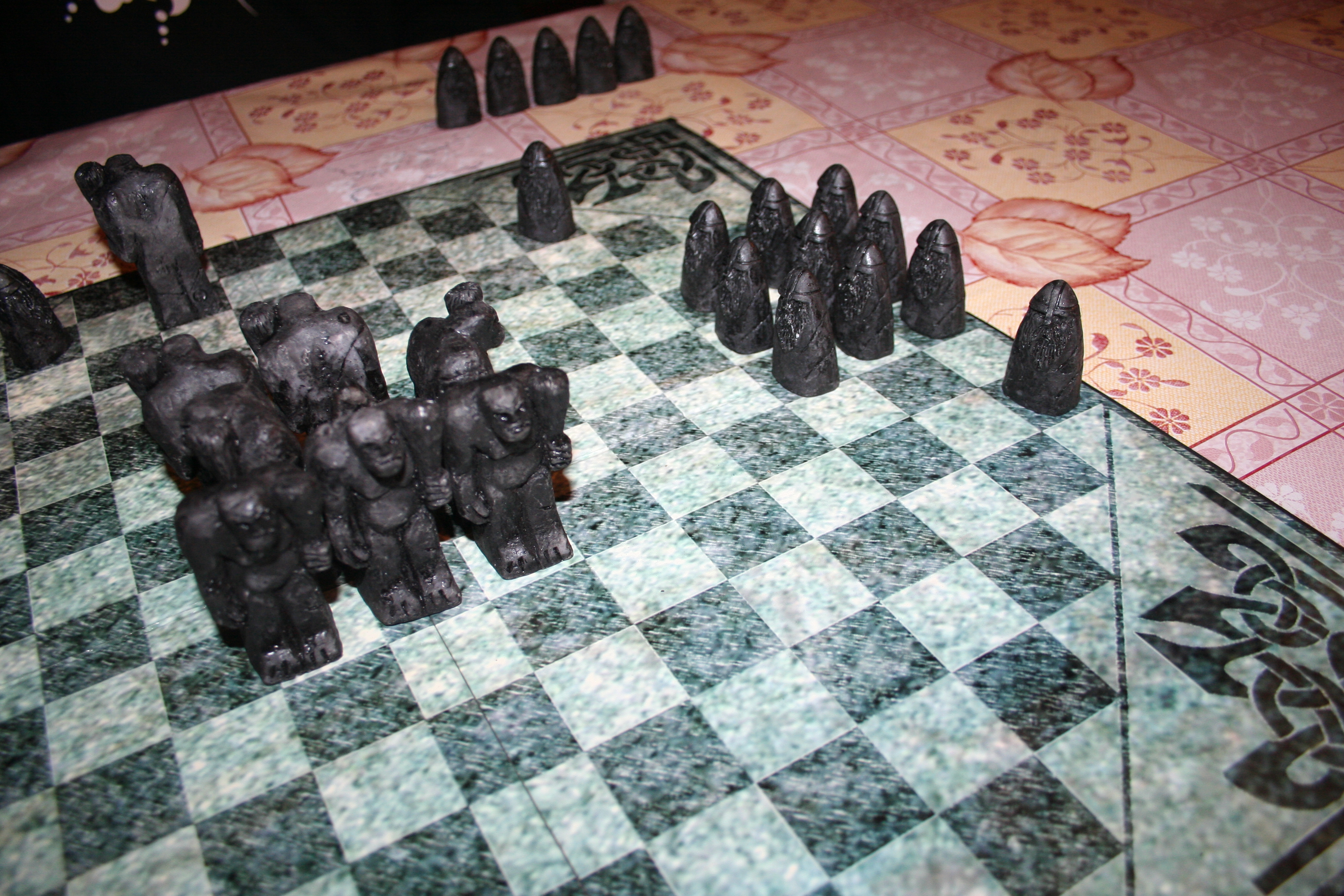
Stealth Chess is much like normal Chess in the sense that all the regular rules of Chess apply and all the normal pieces are present and used. The game is altered by the widening of the board by one row on each side; these rows are called Slurks, and the addition of two pieces to each side which are Assassins. The Assassins start in the Slurks next to the Rooks, and only the Assassins can move in the Slurks. Unfortunately we did not have a Stealth Chess board lying around so we had to make do with a normal Chess board and imagine the additional rows, additionally the pieces that look very different to the others are pieces we borrowed from a different set to act as the Assassins.

Stealth Chess staring positions.
Stealth Chess starting positions.

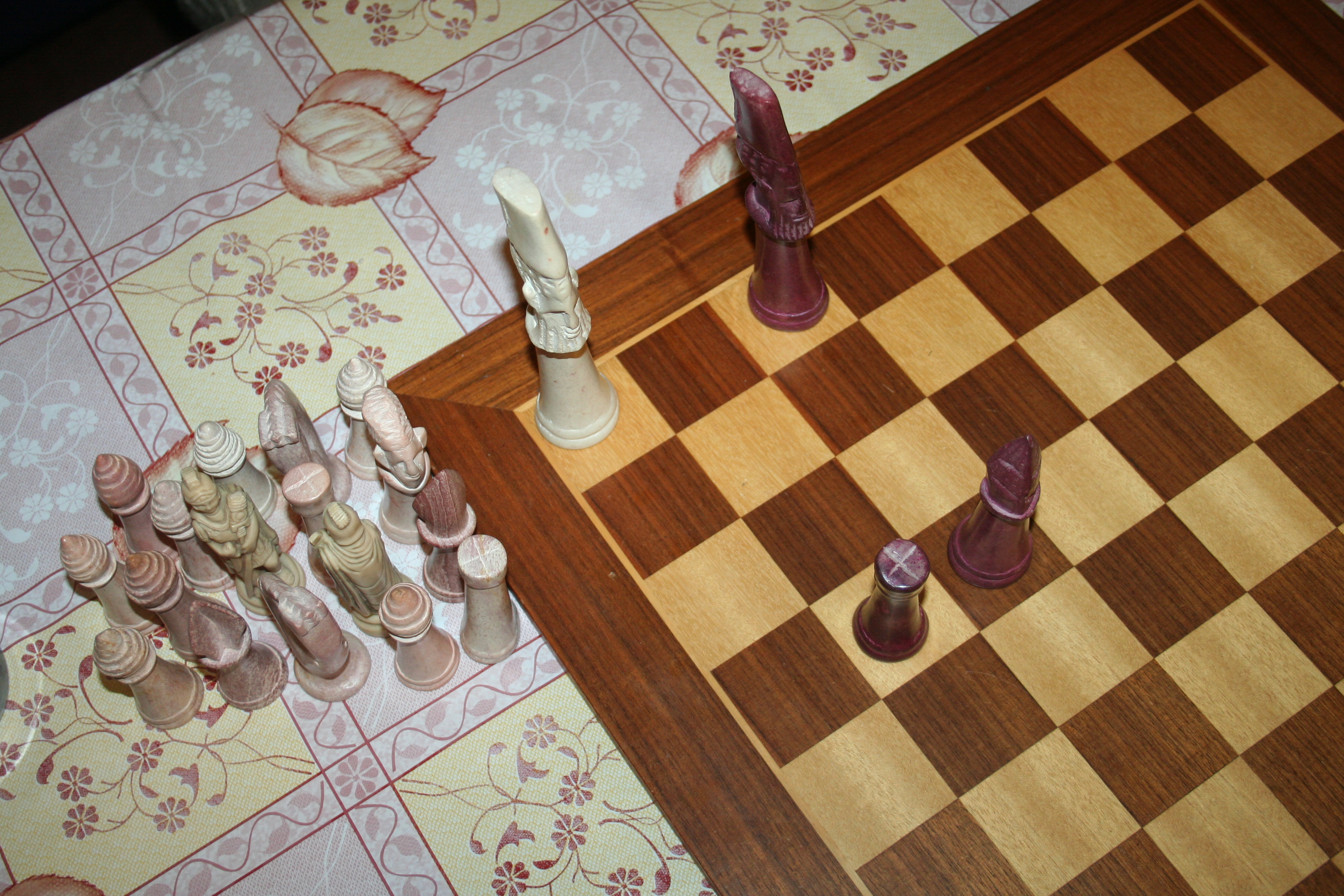
Like in normal Chess all normal rules apply with the addition of the rules concerning the Assassins and Slurks. Assassins move one space in any direction but can move two to capture. Only they can move in the Slurks, and now you get the complicated bit; the Assassin can move as many spaces out of the Slurks as he has in the Slurks. To clarify, if over the course of 6 moves the Assassin has moved six spaces in the Slurks (including just backwards and forwards) the Assassin may move up to six space out of the Slurks, when exiting it, in one move and then an additional space to capture. So:

This white Assassin has moved three spaces in the Slurks:

So its in range of the Black (purple) Queen.
So it’s in range of the Black (purple) Queen.

So on exiting the Slurks it can capture the Queen like so:

So the Queen gets taken.

Now the only point of ambiguity we have in this is “can the Assassin move through other pieces in this way?” Our answer was yes as, if you read the rules as laid out on Wikipedia here or the Discworld Wiki here, it describes the Slurks as another board under the existing board. So rather than moving down the side of the board it represents a space under the board which the Assassins move through and pop up to capture things. Additionally to all of this Assassins cannot take each other, out of professional courtesy.

The End and Other Things:

Normally I destroy my sister at Chess and our game of Stealth Chess was going the same way until I made one massive error and then it nearly all ended in tears. Except after a long time she managed to fight me into this position:

How it all ended.
How it all ended.

Which of course is Stalemate. However I think by the fifty-move rule it may have already been stalemate but that’s neither here nor there.

Anyway that’s the last time I lose concentration.

So a few last comments about Stealth Chess:

  • It’s given me an awesome idea for a two tiered version of Chess… Literally building two Chess boards that sit over each other.
  • Also to build an actual Stealth Chess board with the Slurks and proper Assassin pieces.

A couple of interesting “facts” about the game are:

  • On the Discworld it’s thought to actually be the original version of the game – “this belief is corroborated by the in-world discovery, in a tomb in Muntab, of a preserved corpse with an 8×10 board embedded in its skull and a pawn hammered up each nostril”
  • The master of the game in the Discworld is – ” Lord Havelock Vetinari, provost of Assassins and Patrician of Ankh-Morpork.”

All in all it’s an interesting adaptation of Chess and a bit difficult to get your head around if you’re so used to thinking about Chess in the standard way. It’s well worth a play, and you don’t even have to buy anything if you already have a Chess set and a bit of imagination!

Guards! Guards!

NOW SELLING THIS GAME HERE: https://www.ebay.co.uk/itm/283678712760

3.5 - 5

Number of Players: 2 – 6

Year of Publication: 2011

Creator(s): Leonard Boyd & David Brashaw – Inspired by the books of Terry Pratchett

“Noble dragons don’t have friends. The nearest they can get to the idea is an enemy who is still alive.” – Guards! Guards!

Guards! Guards! is a board game based on the book of the same name from the genius mind of Terry Pratchett (if you are unaware of Terry Pratchett read our update post for this month here).

Whats In The Box:

jgfuhbjk
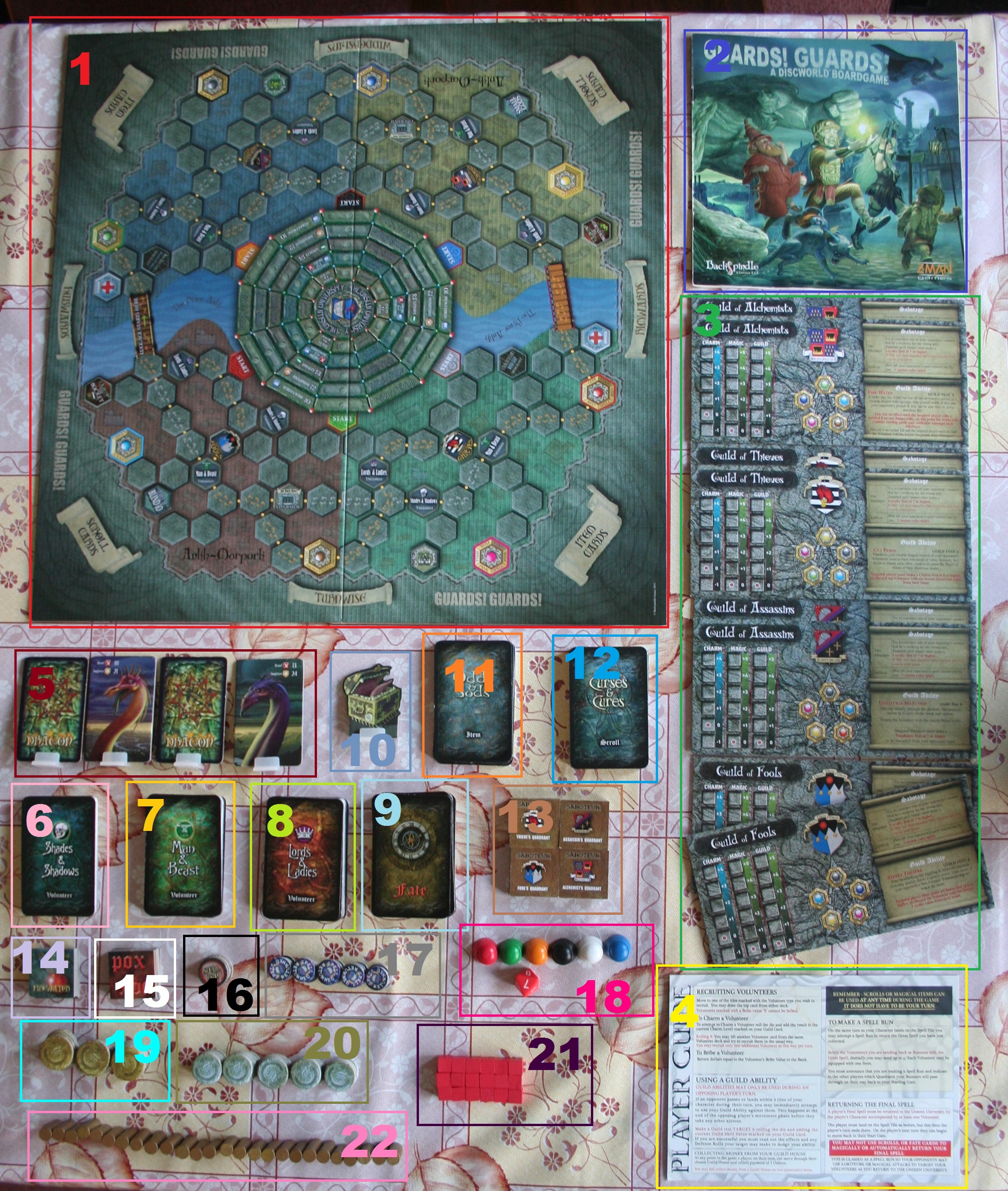
The Stuff.
  1. Playing Board
  2. Rule book
  3. 8 Guild Cards
  4. Player’s Guide
  5. 4 Dragon Cards
  6. 30 Shades & Shadows Volunteer Cards
  7. 30 Man & Beast Volunteer Cards
  8. 30 Lords & Ladies Volunteer Cards
  9. 36 Fate Cards
  10. 1 Luggage Piece
  11. 20 Odds & Sods Item cards
  12. 20 Curses & Cures Scroll Cards
  13. 6 Saboteur Tokens – Fools Quadrant
    6 Saboteur Tokens – Thieves Quadrant
    6 Saboteur Tokens – Assassins Quadrant
    6 Saboteur Tokens – Alchemists Quadrant
  14. 6 Alchemists Fire Water markers
  15. 6 Pox Markers
  16. 6 Spell Run Tokens
  17. 36 Spell Returned Tokens
  18. 1 8 sided die
    6 Coloured Playing Pieces
  19. 39 Gold 5 Ankh-Morpork $ coins
  20. 56 Silver 1 Ankh-Morpork $ coins
  21. 18 Attribute Markers (red cubes)
  22. 25 Great Spell Markers (gold cylinders)

This is by far the game with the most individual pieces we’ve played so far.

Playing The Game:

Objective: To return five of the eight Great Spells marked on your Guild card to the Unseen University before anyone else.

Now, this game is very complicated and also not very all at the same time. It has a LOT of rules, and took us a good hour to read through them all, but once you get the hang of it it’s actually all quite simple and is effectively just a slightly complicated race. So because of the complexity of the rules I will only outline in rough what happens.

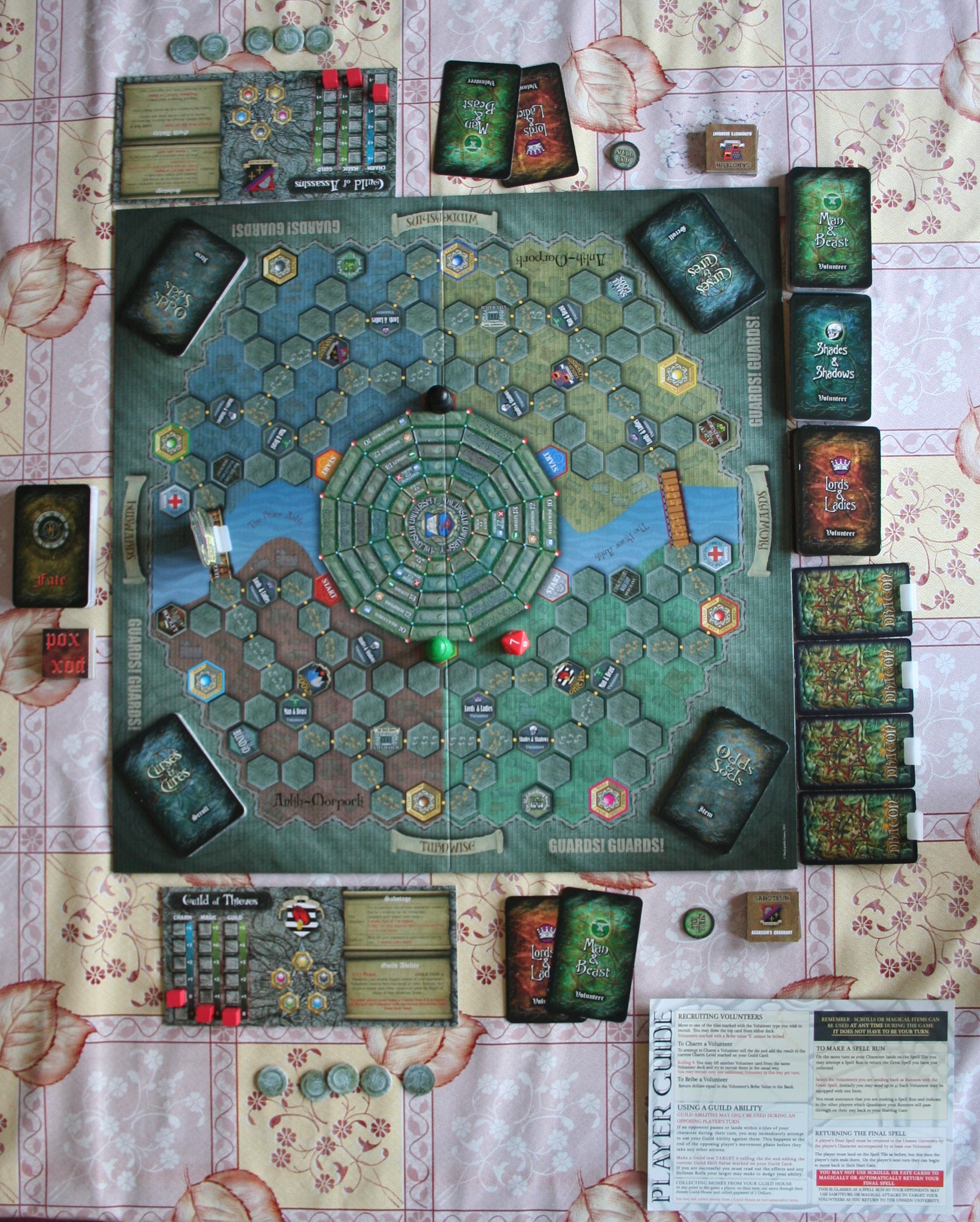
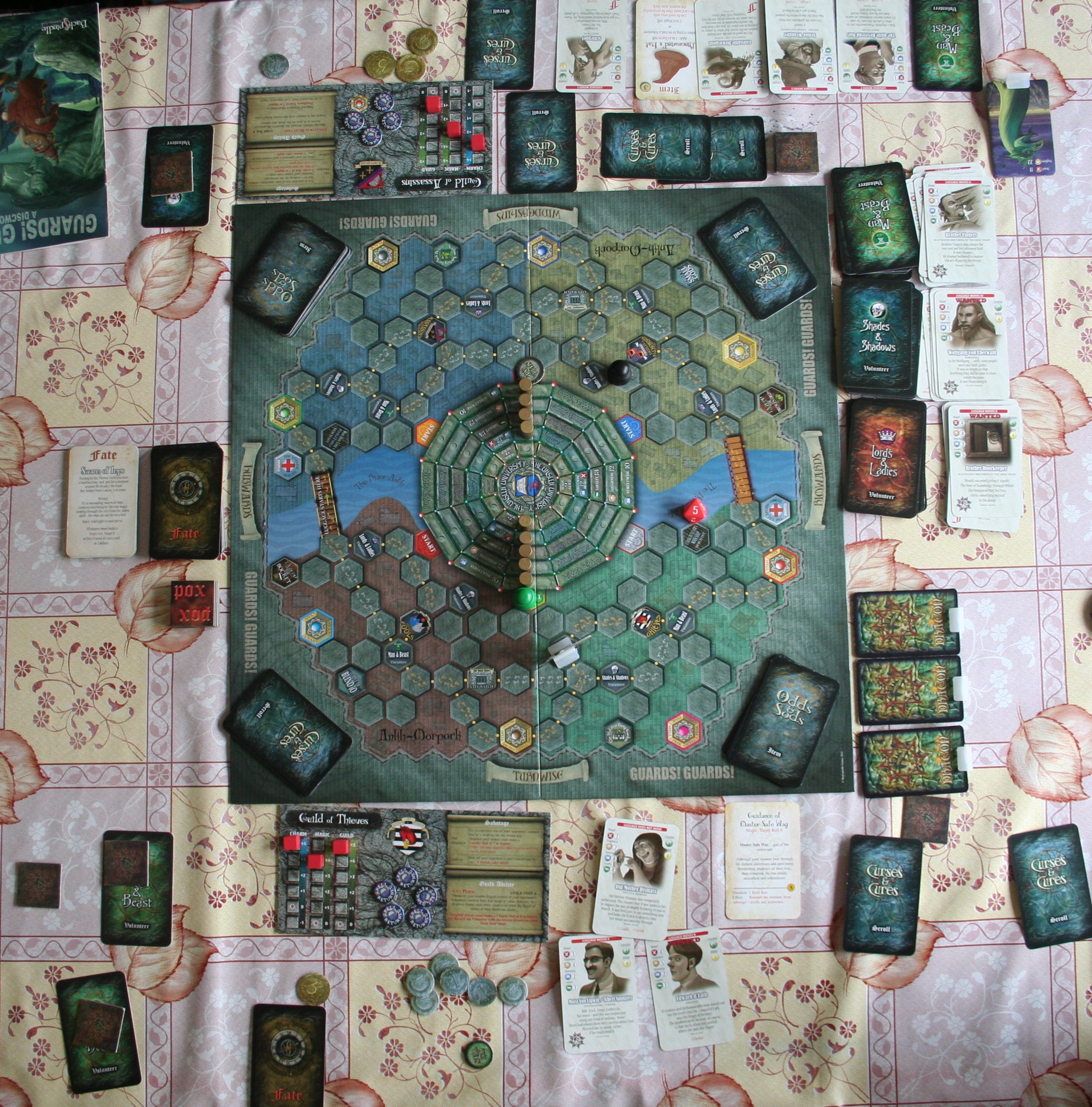
You set up the board like this:

Board set up
Board set up

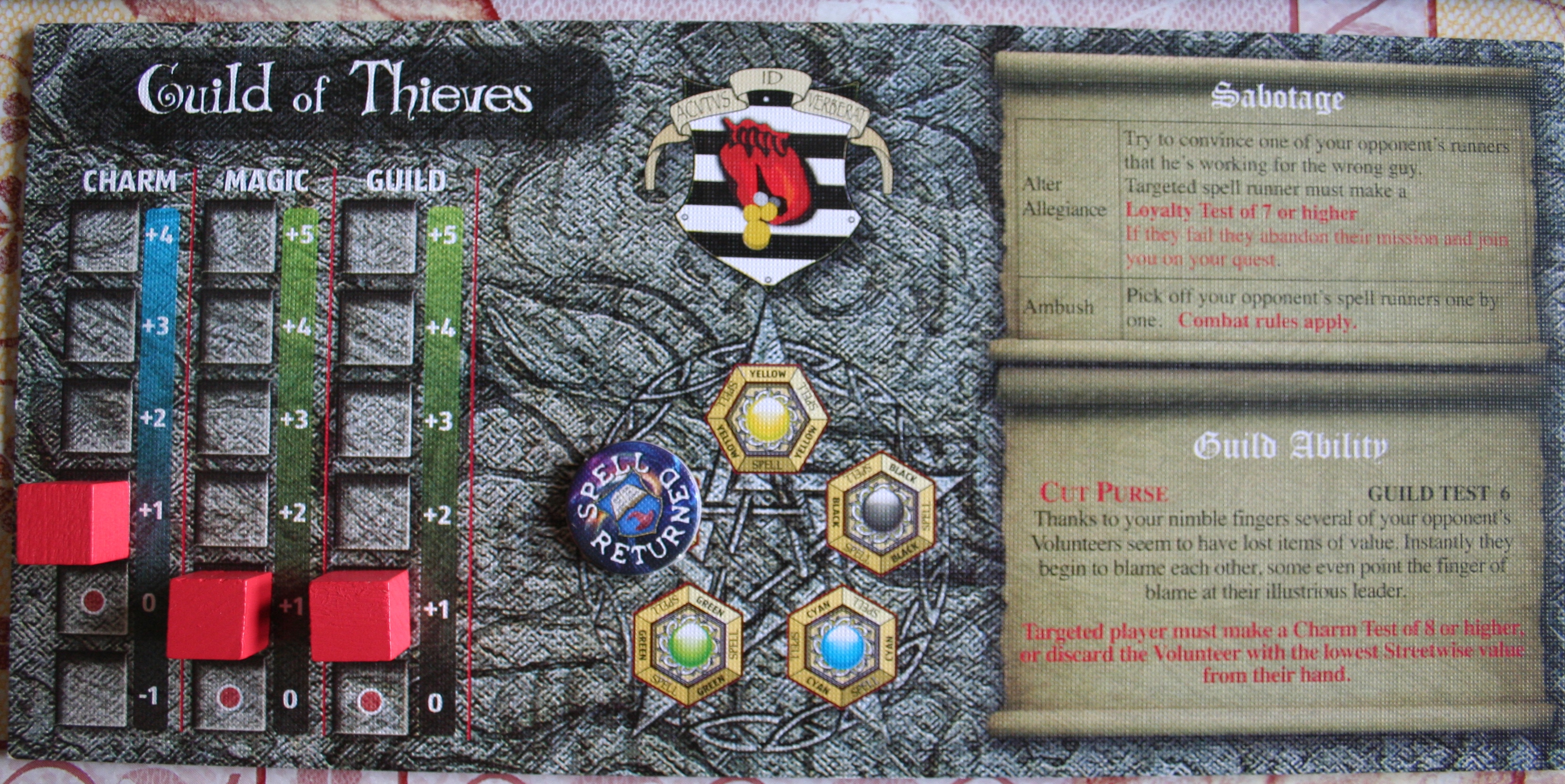
Each player starts at their start marker in the relevant guild quadrant, the board is divided into for quadrants, Assassins, Thieves, Fools and Alchemists quadrants. You start the game by picking a guild, for which you get a guild card for which has stats on it for Charm, Magic and Guild. You can increase these stats throughout the game by various methods and you blocks go up as shown bellow.

Not that all of my stats (marked by the red blocks) have increased by one.

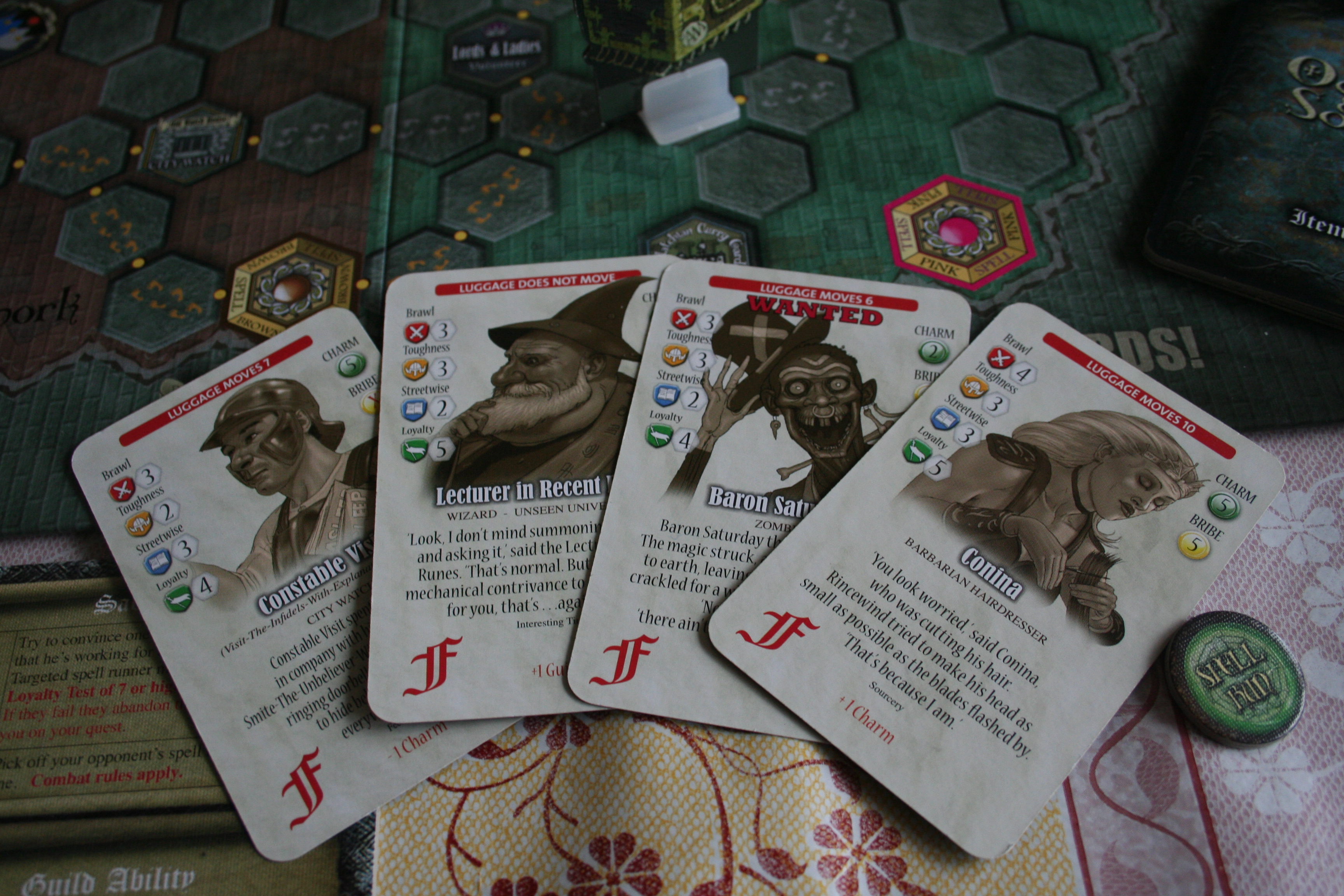
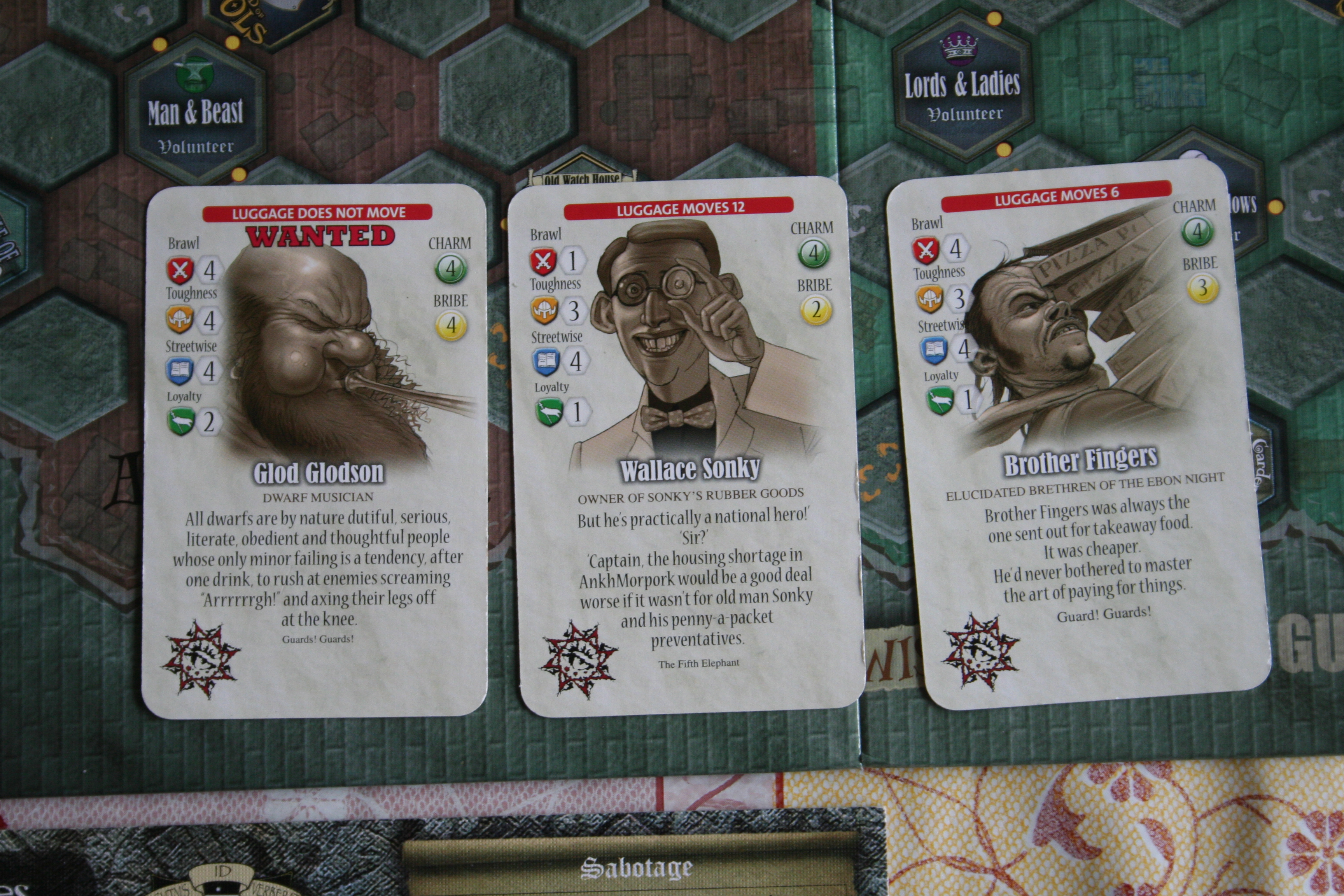
Your stats are mostly increased by the recruitment of volunteers which is done by charming or bribing. To bribe a volunteer you simply pay the amount marked in the bribe section on the card, to charm it you must roll the dice and achieve a number higher than its charm value, for this you also add you charm value from your stats to that number.

A selection of volunteer cards.

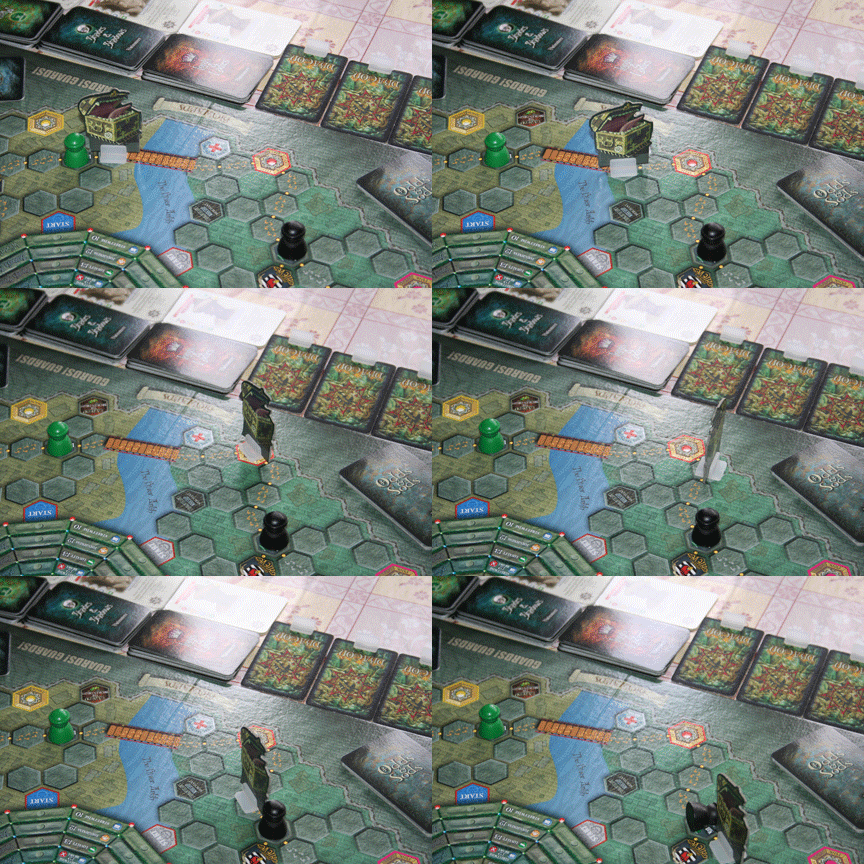
These cards also determine the movement of the coolest function of the game…THE LUGGAGE! At the top of each card it says “Luggage Moves” and then a number or instruction. The player who drew the card then has to move the luggage around the set track marked on the board, at splits in the track they get to chose which way it goes. If it collides with a player, even if it’s the piece of the person moving it, the player is sent straight to the nearest hospital, as shown bellow:

Nom, Nom, Nom!
Nom, Nom, Nom!

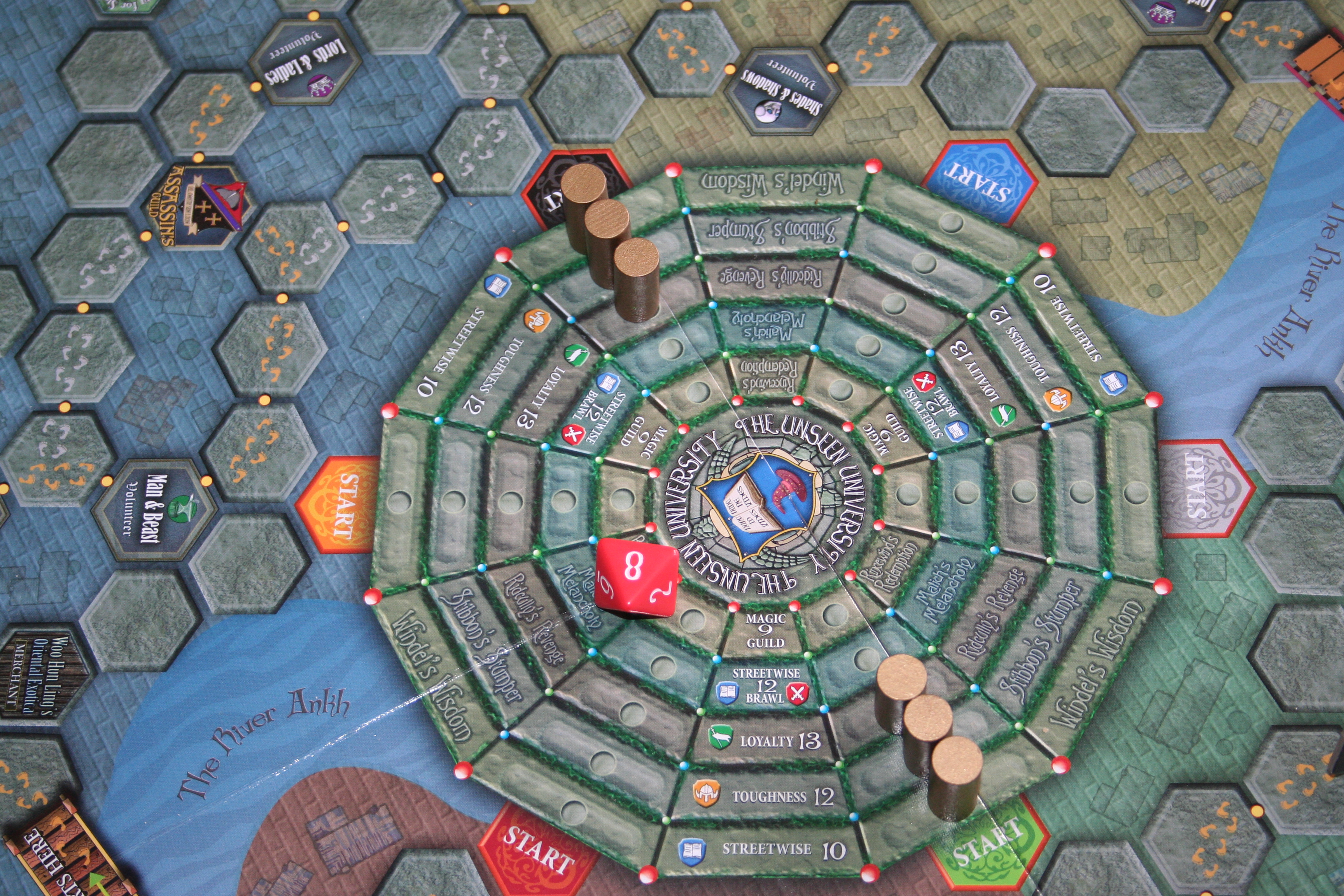
All of this is with the aim of returning spells to the Unseen University; you do this by getting to a spell you require and starting a spell run. This is where the volunteers you have collected are needed; you send them with the spell back to the University where you have to complete different levels of the wizards challenge to get the spells back in. I won’t go into the full mechanics of this as that would make this post very long. But as you return more and more spells the wizards challenges get harder and harder and you add more gold cylinders to you section of the Unseen University to mark the spells you have returned:

At this point we had both completed three levels of the wizards challenge and therefore returned 3 spells each.

These spell runs can be sabotaged and you can use your volunteers to fight with each other, there are also items and scrolls that can be very helpful but I won’t go into these as, again, we would be here forever.

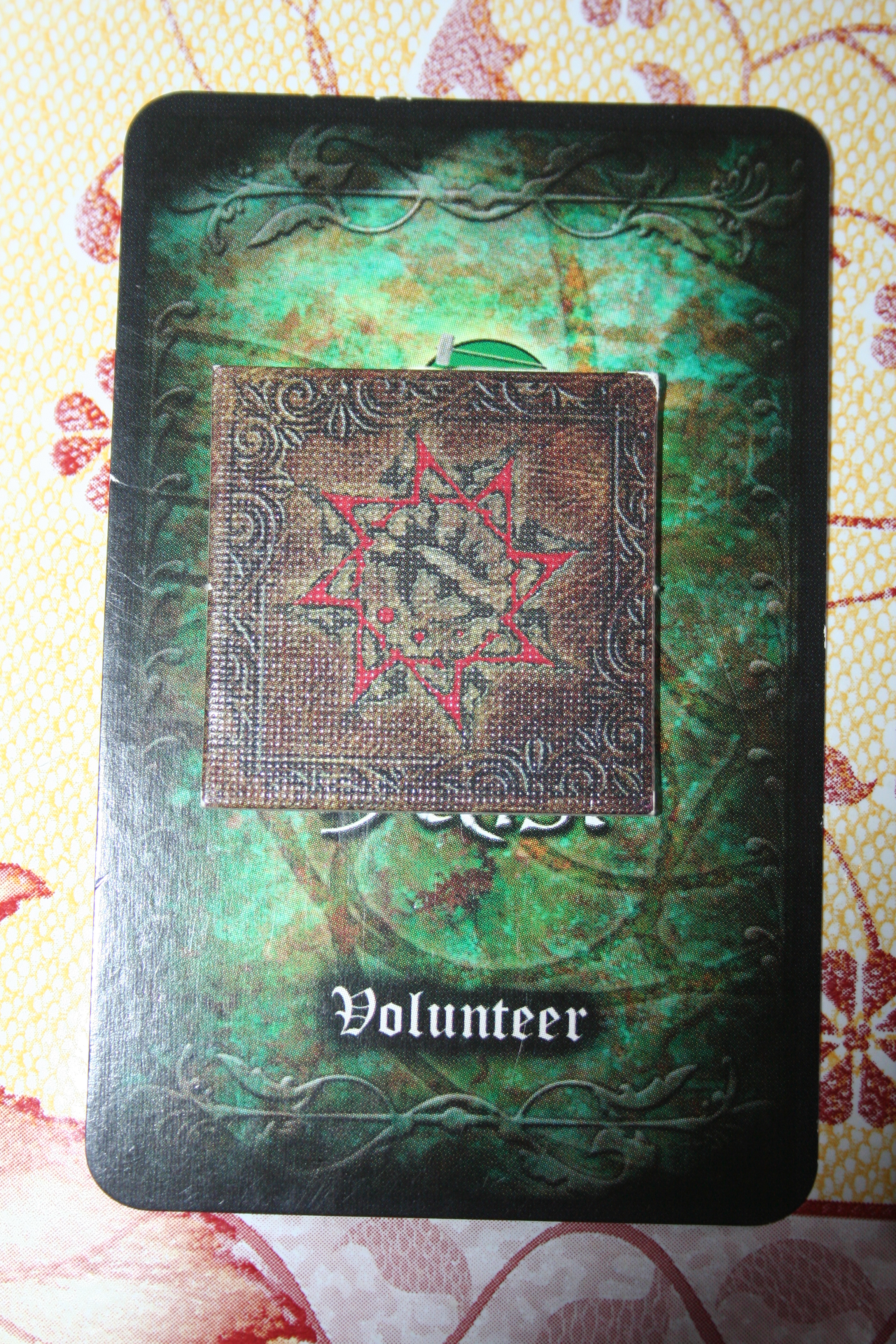
The other cool thing is that dragons can be summoned onto the board if three members of the Brotherhood, when called, are in play:

The symbols in the bottom left mark them as members of the brotherhood.
The symbols in the bottom left mark them as members of the Brotherhood.

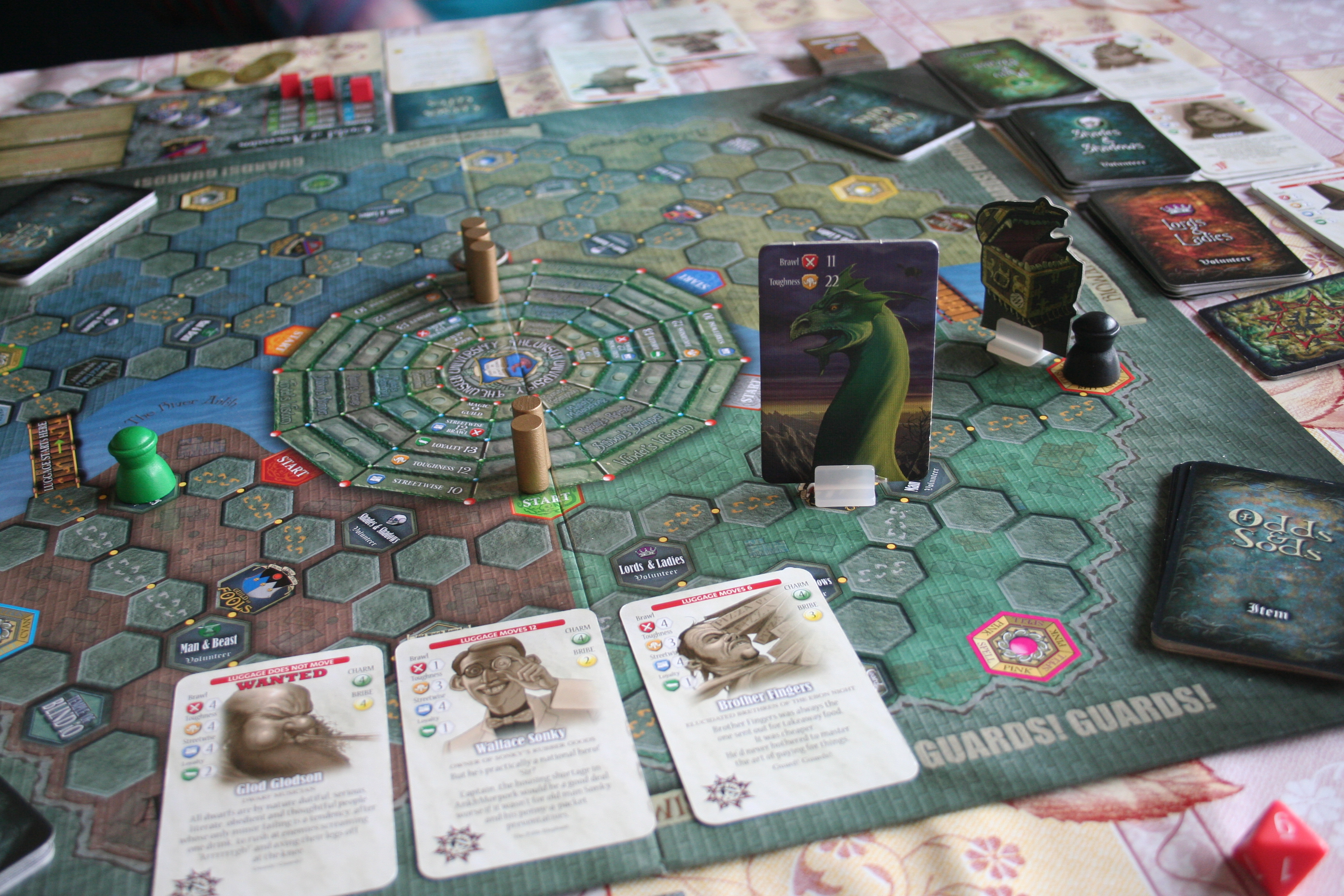
When this happens a dragon is summoned like this:

A summoned dragon in play.

The dragon mechanics are complicated and in many respects kind of irrelevant, as once the dragon is summon and the threat initially met it’s very easy to just ignore it and carry on with the game regardless. However, one fun aspect is that if all four dragons come into play the game ends and nobody wins, this is a bit of a reoccurring theme in Terry Pratchett’s game as there is a similar mechanic in the Ankh-Morpork (read our post on it here) game as well as The Witches. Although this can have the downside of  being rather anti-climactic and making you feel like you just wasted a few hours.

The game is won by the first person to return all the spells:

The game finished...and won by me!
The game finished… And won by me!

There are plenty of other rules about playing the game and other things and if you want you can read the revised rules here. We were following the unrevised rules, having an original edition of the game, so there was some ambiguity at points as to whether you actually could sabotage like that, amongst other things, but we worked through it.

Strategy:

Having only played this game twice I have a limited idea of the best strategy. But one thing I did notice was that the person who collects as many volunteers as possible rather than going straight for the spells seems to have an advantage. Also NEVER forget about the scrolls and items as they can get you out of some tight binds, the first time we played I basically ignored them, to my own peril. Also PLACE SABOTEURS! It is the difference between winning and losing, if you can sabotage the other persons spell run you have the edge!

A saboteur ready to pounce.

History and Interesting Facts:

  1. Although the board game was published in 2011 it was originally conceived in 1991.
  2. Leonard Boyd Originally conceived the idea and played it with friends until in 1995 he showed it to Terry Pratchett.
  3. Terry Pratchett liked the game but said they needed the backing of a major games company to make it all happen.
  4. In 1999 Colin Smythe (currently Terry Pratchett’s agent) suggest that the game never be published…I’m quite happy that he was wrong and they didn’t give up on it.
  5. In 2006 Gary Wyatt (of the Green Games Company) advised that they tried again with the publication of it as the board games market had picked up significantly since 1995.
  6. So in Junes 2008 it was taken to the Speil Toy fair in Essen, Germany where it was shown to many companies, a couple of companies requested copies for play testing.
  7. In 2008 Wolfgang Ludtke of TM-Spiele/Kosmos Games in Germany asked about developing a game based on the books of Terry Pratchett so they go sent a prototype too.
  8. All three companies that had play tested the game felt that it needed a redesign to be aimed more at the hobby market.
  9. So after FIVE redesigns it was sent for testing by the same three companies, it was also test played by Terry Pratchett fans, it got the backing of Z-Man Games and a license from Terry Pratchett.
  10. The game was finally published in September of 2011! Showing that the road to getting a board game published can be long and very hard but if you end up with a great game its worth it in the end. Also while Thud is the oldest of the Terry Pratchett board games by publication date this one is probably the oldest in concept.

To read the full history of the game go to the official website here.
To Conclude:

Guards! Guards! is a good game however it has it’s flaws, for example it took us over an hour to read the rules…We’re patient but there’s a limit. Also for all its rules it manages still to be quite simple in the sense that it’s a race and the person with the best luck tends to win. However it is a fun way to spend a couple of hours with some friends and the artwork and layout of the game are well conceived. I would recommend it, especially if you are a fan of the Discworld universe as each volunteer card has a unique quote on it that is taken from one of the books and are mostly quite amusing, as well as passages in the rule book being quoted and funny. For another overview of the game watch this video review here:

Ankh-Morpork

5 - 5

Number of Players: 2-4

Year of Publication: 2011

Creator(s): Martin Wallace (designer), Peter Dennis, Paul Kidby (artist) – Based on the books of Terry Pratchett

Could You Be The Next Lord Vetinari?

Well, actually, in this game, yes!
The Ankh-Morpork board game is an amazing, detailed game that completely encapsulates Sir Terry Pratchett’s brilliant city from the Discworld Universe (if you’re unfamiliar with Terry Pratchett, read our update post about how awesome he is, here). I want to write a bit about the game, but I feel that the opening paragraph from the rule book will tell you everything you initially need to know, and do it far better than I could:

“Welcome to Ankh-Morpork, the largest, smelliest, and most ‘interesting’ city on Discworld. The city’s patrician, Lord Vetinari, has disappeared, and the citizens are calling out for firm leadership. Will one of the noble families take control of the city, or will the people welcome the return of the king to restore peace? Then again, Vetinari’s absence may have been temporary and his spies could be spreading around the city, ready to start pulling the levers of power for their master.”

What’s in the Box:

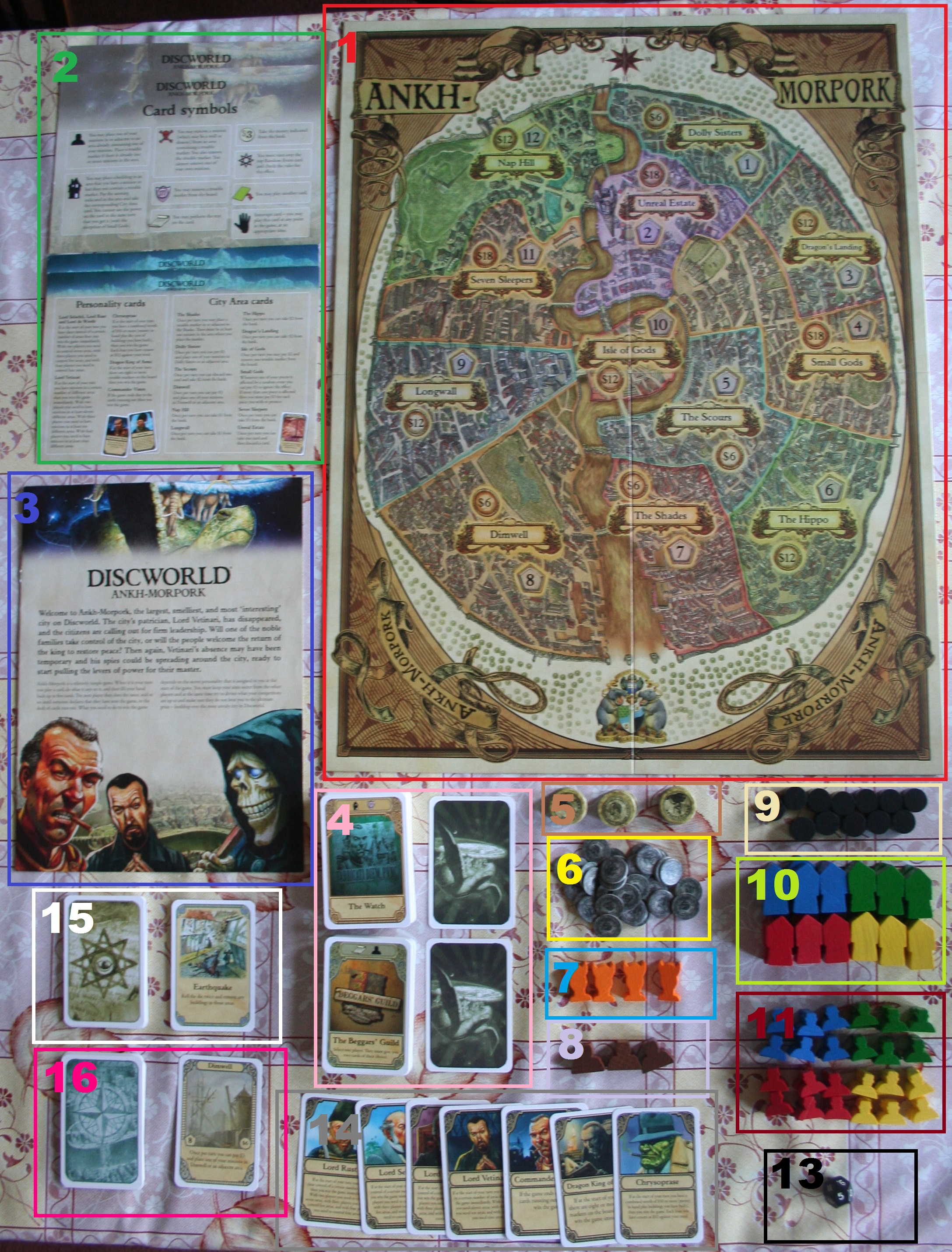
IMG_0016
The Stuff.

Well, there’s a lot of exciting things in this box:

  1. One Playing Board.
  2. Four Player Aid Cards. These are reference cards for the players and have different important aspects of the game explained on them.
  3. One Rule Book.
  4. Two decks of Player Cards; 48 with a green border, and 53 with a brown border.
  5. 17 gold coins, worth $5.
  6. 35 silver coins, each worth $1.
  7. Four orange Demon pieces.
  8. Three brown Troll pieces.
  9. Twelve black Trouble Markers.
  10. Four sets of six Building pieces in Blue, Green, Red and Yellow.
  11. Four sets of twelve Minion pieces, in Blue, Green, Red and Yellow.
  12. One 12-sided die.
  13. Seven Personality Cards. These are given randomly, one to each player, at the start of the game, they are kept secret and have on them your objective for the game.
  14. Twelve Random Event Cards, some, or all of these, will be played throughout the game.
  15. Twelve City Area Cards, these match the areas that the board is divided up into, you may be familiar with them from the books.

Playing the Game:

Objective: To achieve the aim on your Personality Card and win the game before anyone else!

To start the game each player chooses a colour and takes all of the Minion and House pieces of that colour. Then they are dealt a Personality Card, because the maximum number of players for the game is four and there are seven Personalities available, they can never all be in play at once. This adds an extra element to the game as part of winning is to figure out what your opponent(s) objective is, and prevent it.

Personality Cards:

There are seven Personalities available in the game, each of which represent well-known characters from the Discworld series (these Personality descriptions are copied straight from the rule book) :

  • Lord Vetinari – You win if at the beginning of your turn you have a certain number of minions in different areas on the board (think of them as your spies). With two players you need to have minions in at least eleven different areas. With three players you need to have minions in at least ten different areas. With four players you need to have minions in at least nine different areas. Areas must be free of demons.
  • Lord Selachii, Lord Rust, Lord de Worde – you win if at the beginning of your turn you control a certain number of areas. If there are only two of you playing then you need to control seven areas, if there are three of you then you need to control five areas, and if there are four of you then you need to control four areas. You control an area if you have more playing pieces in it than any single other player (a playing piece being a minion or a building). You would also have to have more pieces there than the total number of trolls in the area. You cannot control an area that contains one or more demons. The presence of a trouble marker does not affect the control of an area.
  • Dragon King of Arms – If at the beginning of your turn there are eight trouble markers on the board then you win. The rationale is that the city has fallen into more chaos than normal and people want the king back (who would be controlled by you).
  • Chrysoprase – If at the beginning of your turn your net worth (your cash plus the monetary cost of each building you have) is $50 or more then you win the game. Please note that any loans you have taken out count as $12 against your total worth (certain cards allow you to take out loans).
  • Commander Vimes – you win if nobody else wins by the time the draw pile has been exhausted.
Setting Up The Board:

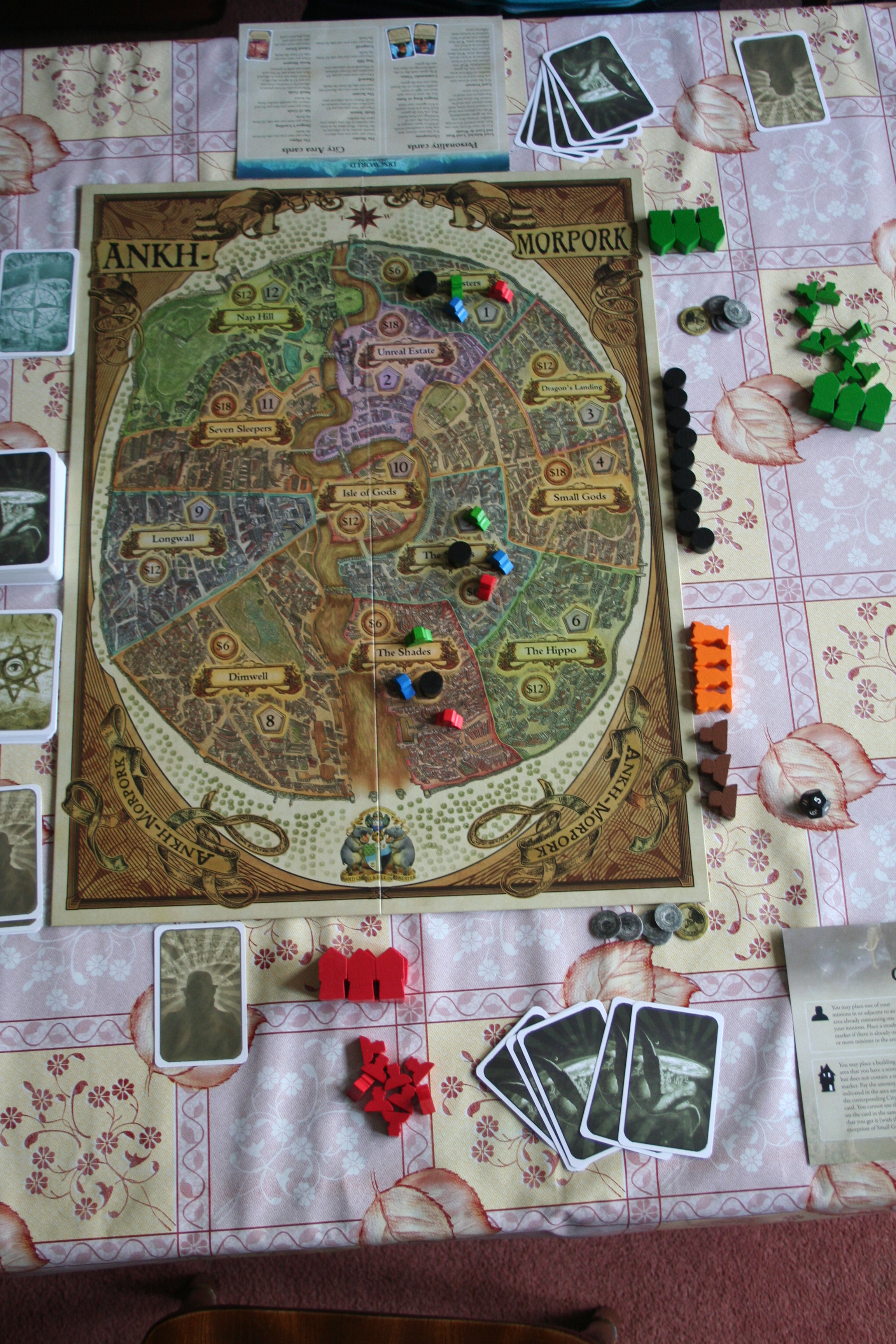
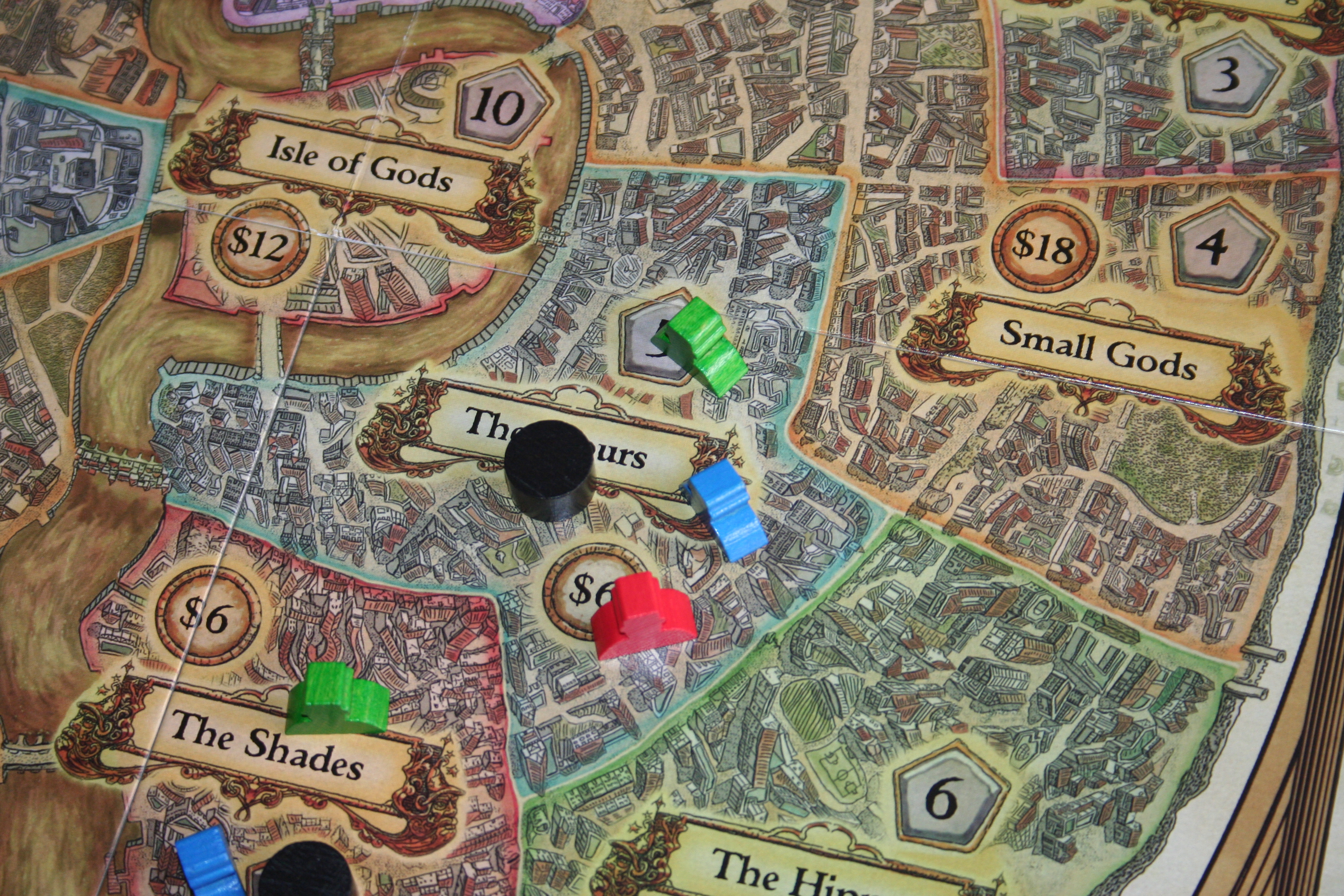
Now that you’ve got your Personality for the game and have chosen which colour you’re going to play as, you need to place your first Minions. Each player starts the game with three Minions on the board, one in each of The Shades, The Scours and Dolly Sisters. Now, because there’s more than one Minion in each of these areas, a Trouble Marker must be placed there. Trouble Markers are important in game play, as they determine how and when Minions can be removed from the board, and are also relevant to one of the Personalities objectives.
You can't see the actual numbers or names of the areas the board's divided into in this picture, but you can see the minions we  had on the board to start, and that there's a trouble marker in each area with them. Which is good enough for now.
You can’t see the actual numbers or names of the areas the board’s divided into in this picture, but you get the idea of what the board looks like to start the game.

As soon as a Minion is placed into an area with one or more Minions already existing there, a Trouble Marker must be placed there too. However, as soon as a Minion is moved out of an area, or removed from the board, the Trouble Marker is also removed, even if more than one Minion remains in the area.

There are three Minions in The Scours, and so a trouble marker has been placed there too.
There are three Minions in The Scours, and so a Trouble Marker has been placed there too.
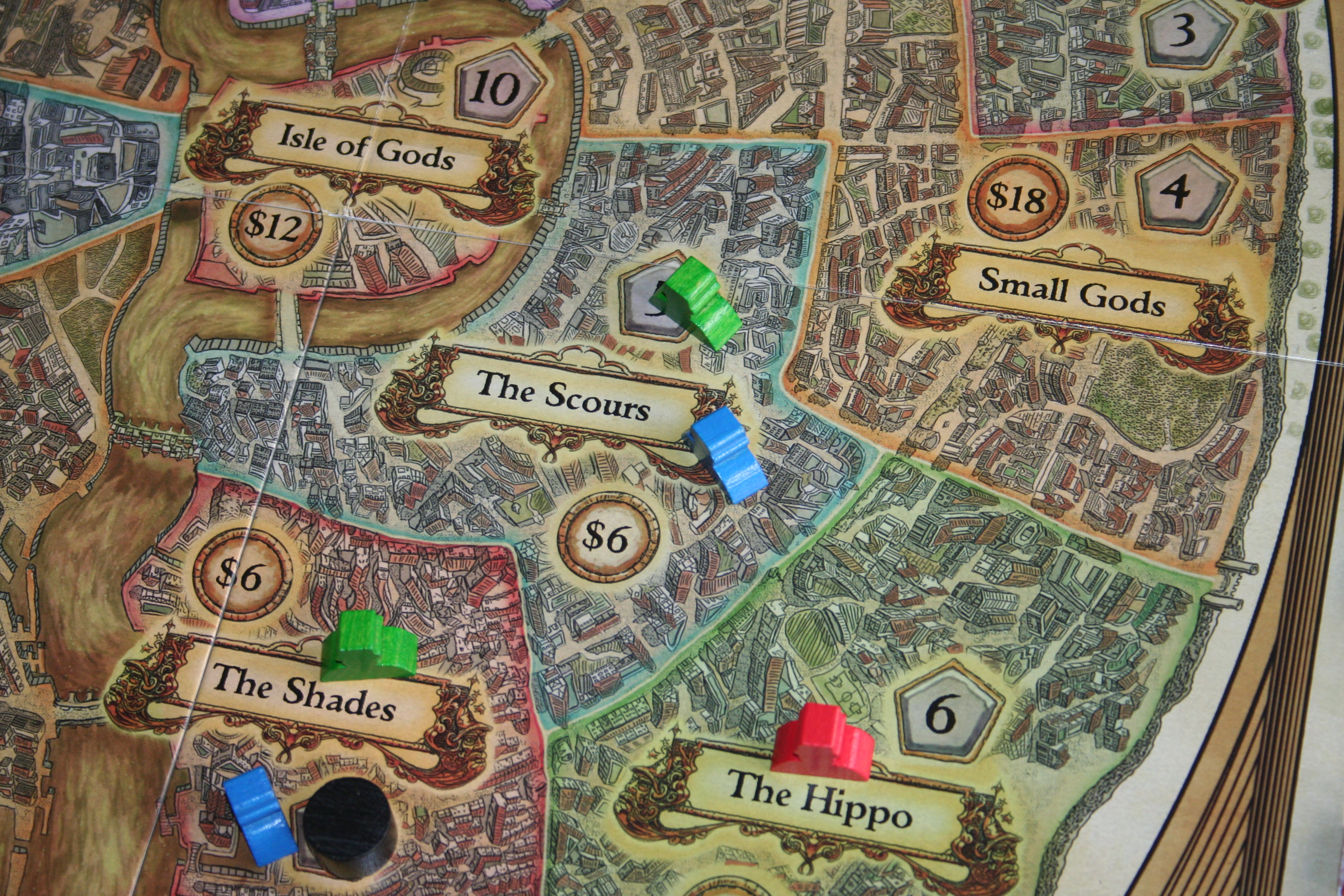
Now the red Minion has been moved to The Hippo, and so the Trouble Marker has been removed. Because red is the only player in The Hippo, no Trouble Marker is placed there.
NOTE: There cannot be more than one Trouble Marker in an area at a time. 
Each player is then dealt five cards from the top of the deck, which they are allowed to look at. The dice is rolled to determine who plays first and play then proceeds clockwise around the board. You’re now ready to start the game!

The Rules:

Essentially, the first rule of this game (and of all board games) is, if in doubt, DO NOT HESITATE TO CONSULT THE RULE BOOK. I don’t know how much we say this, (we should probably get it on t-shirts or something) but it’ll never cease to be the first, and most important, thing you should do, especially if you’re confused about something.

Ankh-Morpork is essentially a card game, played with a board, so you don’t have to hold lots of information in your head all at once. In your turn you play cards, the card(s) you play from your hand dictate how the game progresses. When you set up the board, you split out the green deck from the brown deck and you play through the green deck first. This is important because, as the game progresses and you move from the green deck to the brown deck, different things start to happen.

The Cards:

The cards all have symbols across the top of them, which are played in order from left to right, and it’s these that determine what’s going to happen in your turn. A player may choose to not play some of the symbols on their cards if they wish, with the exception of Random Events, these must be played.
The symbols are each explained on your Player Aid cards and breakdown as follows:

  • Minion – this symbol allows you to place one of your minions in or adjacent to an area you already have a minion.
  • House – this allows you to build a house in an area that you have at least one minion in, providing there are no trouble markers there, and you have the right amount of money, which will be shown on the board in the area you wish to build.
  • Skull and Crossbone – this allows you assassinate one minion of another player, from any area with a trouble marker in it.
  • City Watch Badge – this allows you to remove a trouble marker from any area.
  • Money – the coin symbol will have a number inside it, you can then take this much from the bank.
  • Random Events! – these are represented by an eight-point start. A card is then drawn from the top of the Random Events deck and read out, consequences are dependent on each card.
  • Play Another Card – this is what it says, you can play any other card from your hand.
  • Scroll – you then play the text on the card.
  • Interrupt – a hand sign, this card can be played at any time, even if it’s not your turn, and they usually protect you from something; i.e. they can stop someone who’s trying to assassinate one of your minions.

As with all games with cards, there are good cards and bad cards, useful cards and cards that’re generally a bit naff. Some of the cards can also be considered a bit of a two-edged sword, for example, loan cards. A loan card, when played, allows you to take a loan of $10 from the bank, which can be very useful if you want to build houses, or just want money. However! At the end of the game, if you come to score up, you must pay $12 back to the bank, before you  count your points. Also there are two cards in the deck that, if you play the text, allow you to give them to another player and they must pay you $5, if they refuse they keep that card face up in front of them for the rest of the game, and their hand size is reduced to four. This, ultimately, isn’t the end of the world, but it can become a real nuisance as the game progresses. In my experience, people usually just pay, unless they don’t have enough money, in which case, they’re screwed.

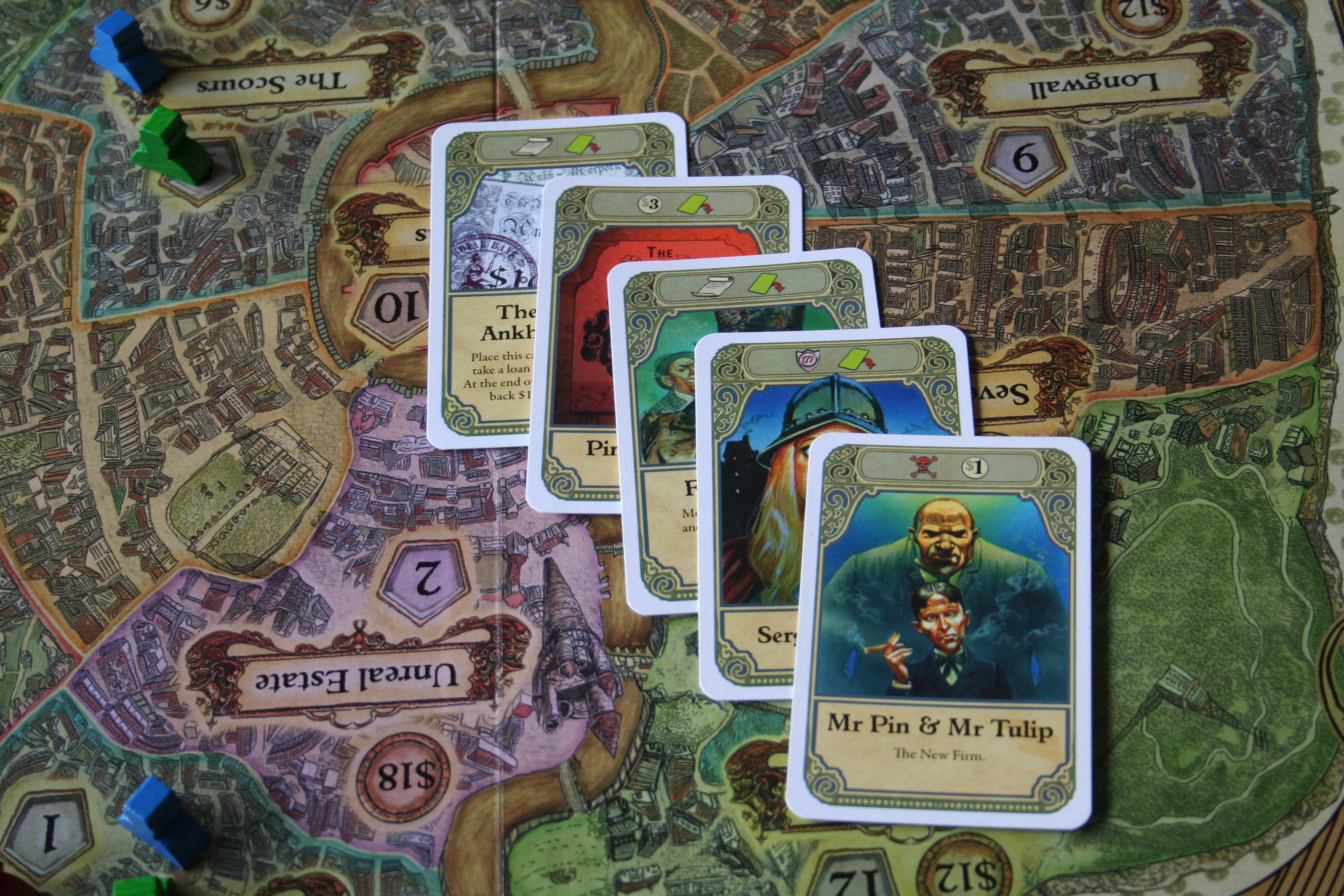
If you have multiple cards with the “Play Another Card” symbol on them in your hand, you can link them to create chains of cards like this:

So, in this chain, (from top to bottom) I was able to take a loan of $10 from the bank, play another card, take $3, play another card, do something I can't read, play another card, remove a trouble marker, play another card, assassinate someone, and finally, take one dollar, for my services to the game.
So, in this chain, (from top to bottom) I was able to take a loan of $10 from the bank, play another card, take $3, play another card, do something I can’t read, play another card, remove a trouble marker, play another card, assassinate someone, and finally, take one dollar, for my services to the game.

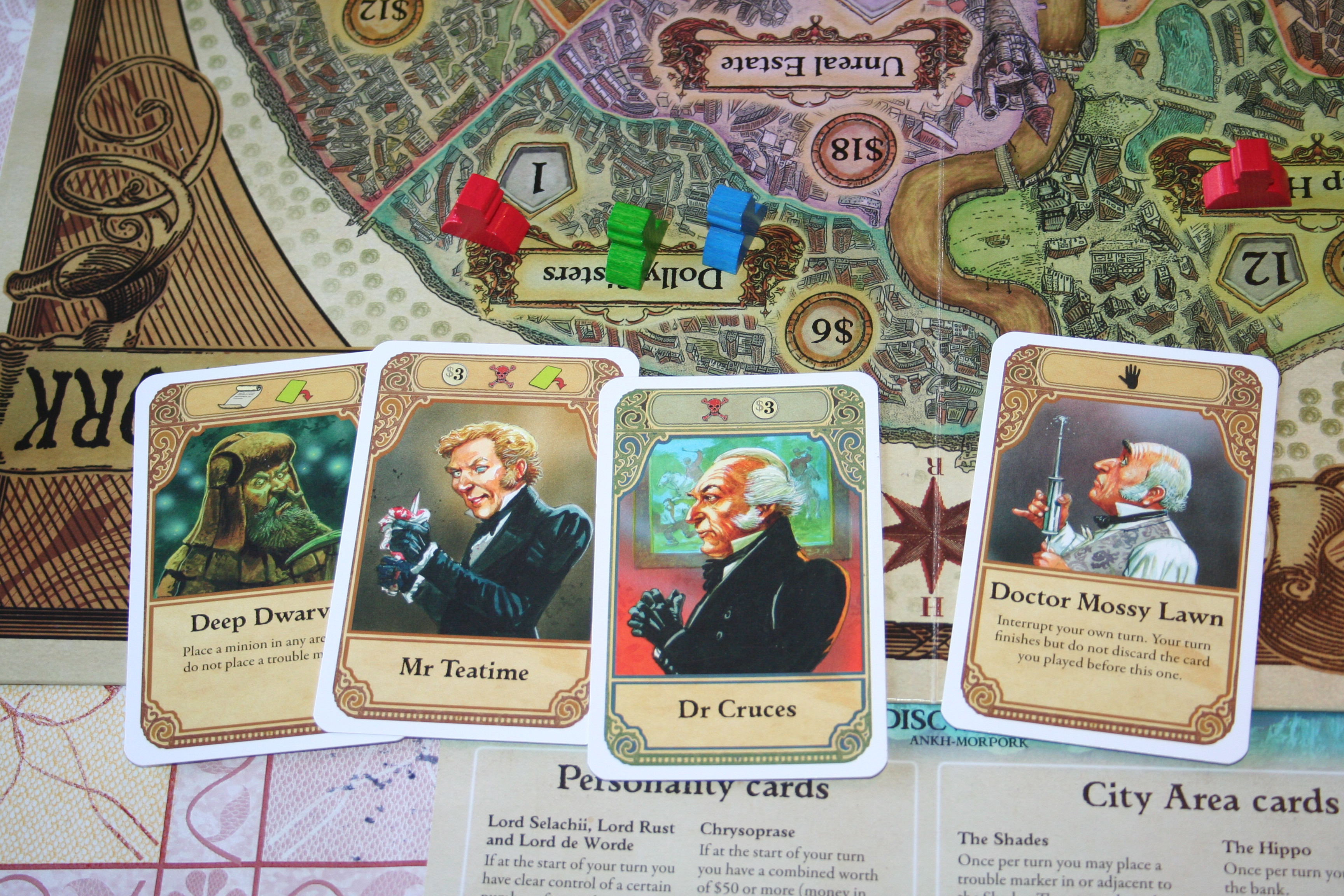
Or this:

Here I was able (from left to right) the place a minion without placing a trouble marker, which can be very a useful at some points in the game, play another card, take $3, assassinate someone, play another card, assassinate someone else, take $3, and I then played Doctor Mossy, to interrupt my own turn and not have to discard Dr Cruces. in this way I was then able to assassinate more people on my next turn!
Here I was able (from left to right) to place a minion without placing a trouble marker; which can be very useful at some points in the game, play another card, take $3, assassinate someone, play another card, assassinate someone else, take $3, and I then played Doctor Mossy, to interrupt my own turn and not have to discard Dr Cruces. in this way I was then able to assassinate more people on my next turn!

There is one card in the deck, called The Peeled Nuts, which is completely useless. All it does, is sit in your hand doing nothing. It has no text on it, and no symbols, and therefore, cannot be played. However, it can be discarded using the text on other cards, or it can be passed to a different player to infuriate them, if they play a card that requires you to give them one of your cards.

 Random Events:

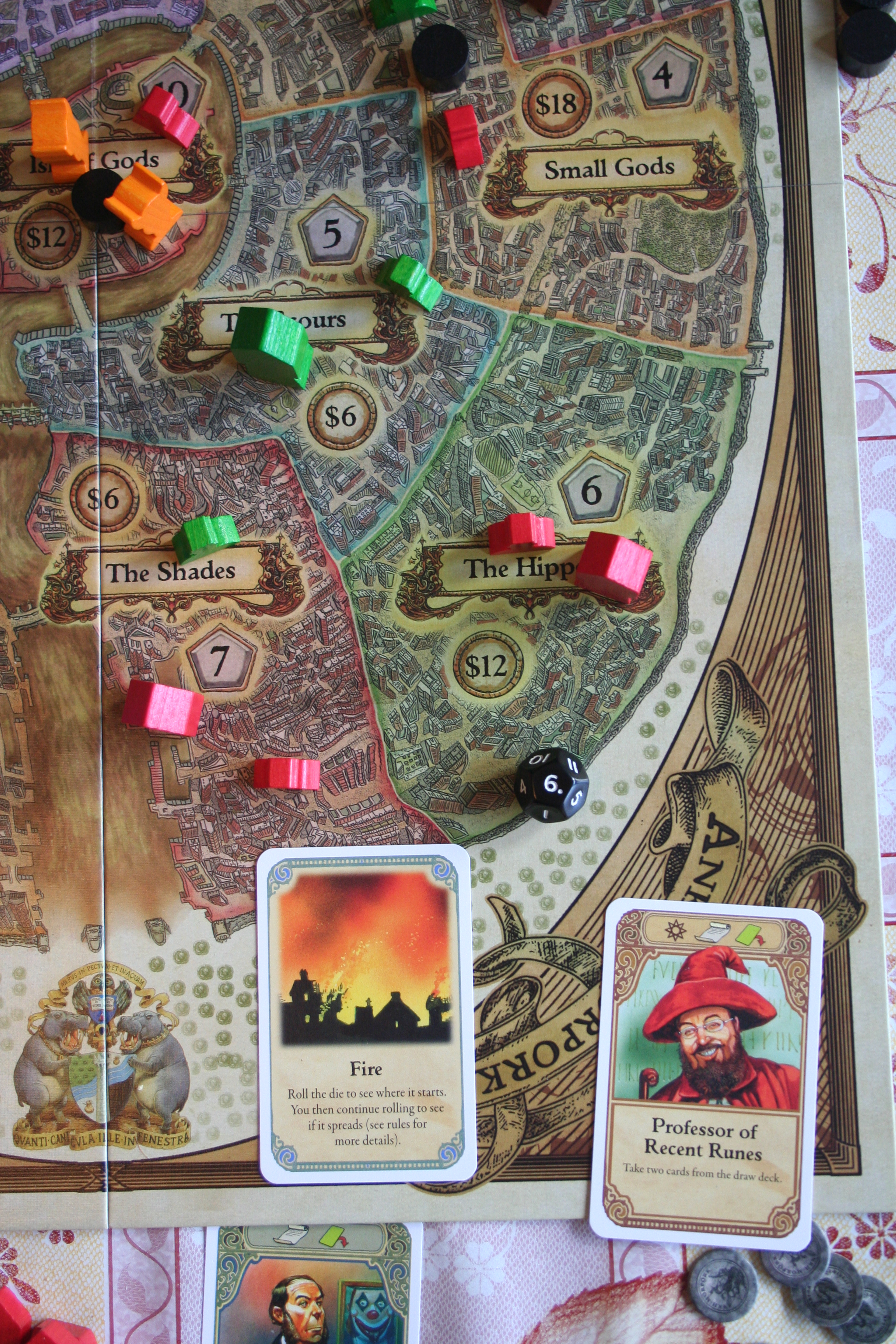
The Random Event are an interesting addition to the game, and represent, for anyone familiar with the Discworld series, real events from the books, such as a dragon lading in the city. There are twelve Random Event cards and they can have drastic effects on the game, or no effect whatsoever, it’s mostly down to the roll of the die and the current set up of the board. Each card will say on it how the consequences of drawing this card should be played, and I’m not going to go through all of them, but as an example of one that can have uncool consequences I’ll tell you about the Fire card.

You can see here, the card that was played that caused the Random Event, and what the actual card looks like, the text on these cards is brief, and tells you our favourite thing - to refer back to the rules!
You can see here, the card that was played that caused the Random Event, and what the actual card looks like, the text on these cards is brief, and tells you our favourite thing – to refer back to the rules! You can also see the City Area rolled, number 6, which means the red house in The Hippo, would now have to removed.

When this card’s drawn, the person that played the Random Event rolls the die to see where the fire starts and, if there are any buildings in the area that corresponds to the number rolled, they’re removed. The player then continues to roll the die to see if the fire spreads, if the next number they roll is adjacent to the area previously rolled, and there’s a building there, this too, is removed. Rolling continues in this way until a number is rolled where there’s no building. If there are no buildings in the areas adjacent to the first area rolled, there’s no need to roll the die again, as the fire cannot spread.

City Area Cards:

The board is divided up into twelve sections, each with a number in it, and a price, shown in dollars. These correspond to the City Area cards available for when a player builds a house. When a player builds a house in an area, they get the card that goes with it, that gives them certain benefits that they can use during their turn, as well as having their house count as one minion in an area, which can be very handy. only one house can exist in an area at one time.

The benefits gained from building houses are as follows (copied directly from the rules):

  1. Dolly Sisters – Once per turn you can pay $3 and place one of your minions in Dolly Sisters or an adjacent area.
  2. Unreal Estate – Once per turn you can draw one card and then discard a card.
  3. Dragon’s Landing – Once per turn you can take $2 from the bank.
  4. Small Gods – Whenever one of your minions or buildings is affected by a Random Event you can pay $3 to ignore the effect. If more than one piece is affected then you must pay $3 for each piece you wish to protect.
  5. The Scours – Once per turn you can discard one card and take $2 from the bank.
  6. The Hippo – Once per turn you can take $2 from the bank.
  7. The Shades – At any point in your turn you can place one Trouble Marker in The Shades or an adjacent area (area must contain at least one minion).
  8. Dimwell – Once per turn you can pay $3 and place one of your minions in Dimwell or an adjacent area.
  9. Longwall – Once per turn you can take $1 from the bank.
  10. Isle of Gods – Once per turn you can pay $2 to remove one Trouble Marker from the board.
  11. Seven Sleepers – Once per turn you can take $3 from the bank.
  12. Nap Hill – Once per turn you can take $1 from the bank.

My favourite place to have a house is The Scours, simply because it’s useful both for drawing more interesting cards, if you don’t have a very good hand, and for giving you money. With the added bonus that, to build in The Scours, it only costs you $6, whereas other areas of the board, such as The Hippo or Small Gods, cost $12 or $18, respectively.

Winning the Game!

Your Personality Card will tell you the different conditions under which a player wins the game, however, there are two other ways to end the game, either a player draws the ‘Riot’ Random Event card,  or the last card is drawn from the deck, and Commander Vimes is not in play. In the event that this happens, all players score up. This is done by adding the amount of money you have at the end of the game, to the total value of any properties held (minus any loans you may have taken from the bank at any point in the game) to the amount of Minions you have on the board. Each Minion is worth five points. If you’ve taken a loan and cannot pay it back, you lose fifteen points from your total score. Then the player with the most points wins.

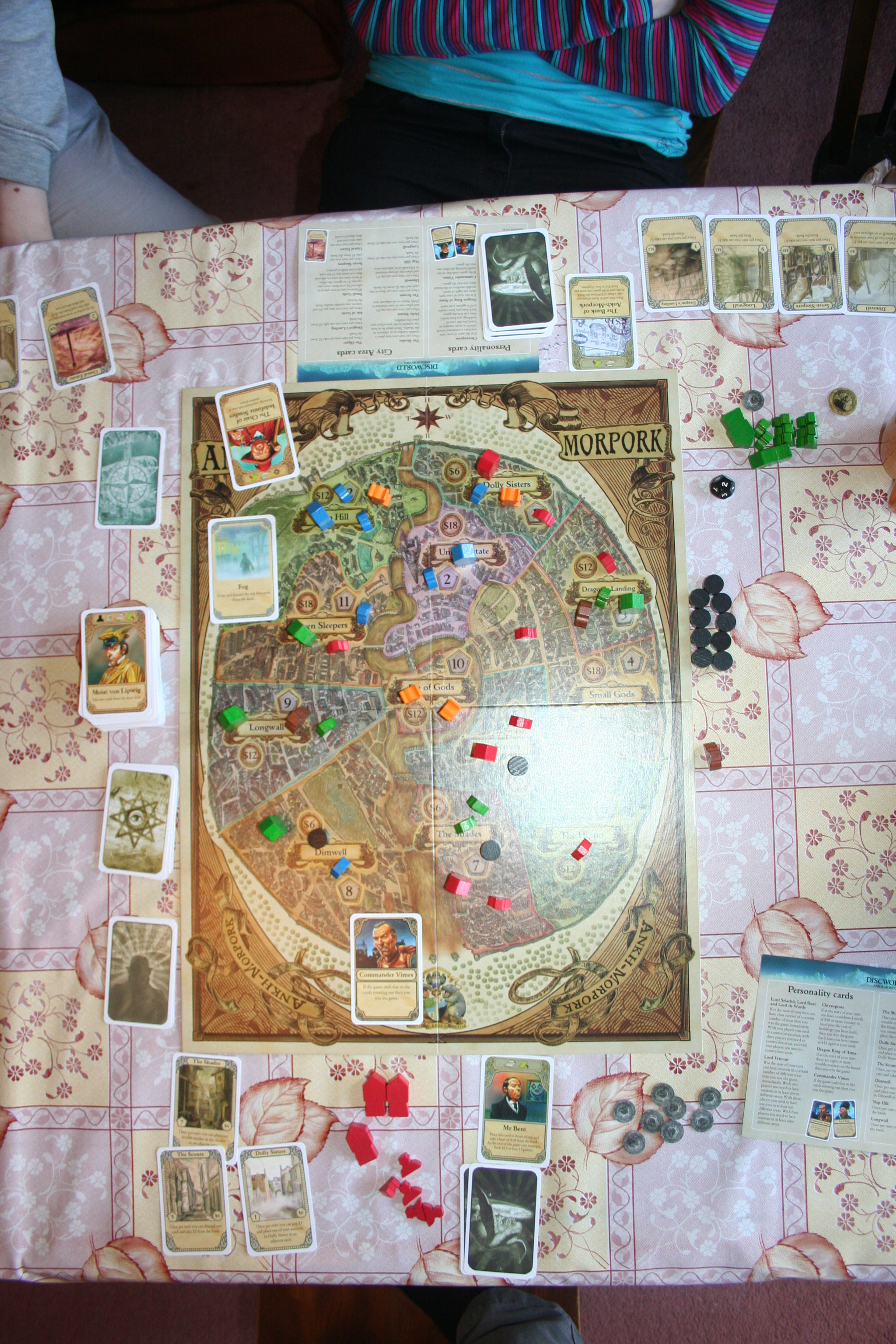
The board at the end of the game. All the Demon and Troll pieces are in play, although I haven't explained them to you - play the game to find out what they're all about!
The board at the end of the game. Commander Vimes has won. All the Demon and Troll pieces are in play, although I haven’t explained them to you – play the game to find out what they’re all about!

Strategy:

Because you want to try and make it as difficult as possible for anyone else to win, whilst secretly carrying out your own objective, double-bluffing plays an important part in this game. One of the sneakiest ways to win (and one that Dave has employed on a few occasions) is to play very well as a personality you’re not to convince everyone that that’s what you’re going for, whilst simultaneously building up to your real objective. I am terrible at this aspect of the game; I once managed to successfully confuse my sister by not actually playing my objective at all. For the whole game she thought I was playing as a personality I wasn’t, simply because I decided I wasn’t going to be able to achieve it, and therefore didn’t try.

Whilst keeping your personality for the game a secret from everyone else plays an important part in how easy it is for you to win, luck of the draw is also a key feature. If you get dealt useless cards, and as a result cannot either advance your own objective, or hinder someone else’s, you just have to keep playing cards hoping that you’ll pick up something much more useful.

History and Things:

There’s not a lot of history around on the game, because it was published so recently, so instead I’m going to provide you with fun facts about the historic city of Ankh-Morpork (you may begin to see parallels between some of these facts and some old stories from our universe):

  • Legend tells us that the city of Ankh-Morpork was founded thousands of years ago by twin brothers, raised by a hippopotamus.
  • The original city was a walled keep, built to protect the Tower of Art. The origins of the Tower are unknown and may well pre-date the Disc itself.
  • At one point it had an Empire that spanned half the Disc, largely the creation of General Tacticus, who later, in his role as King of Genua, declared war on it.
  • There was a Golden Age of Kings in Ankh-Morpork, whom legend recalls to be wise and noble and fair, this line died out around 2000 years before present day, and was then replaced by more realistically corrupt and (occasionally mad) rulers, as referenced in Men at Arms.
  • The Age of Kings ended completely in Ankh-Morpork when “Old Stoneface”, Commander of the City Watch at the time (and ancestor of the current Commander, Sir Samuel Vimes, the Blackboard Monitor), executed the last king, Lorenzo the Kind, who, amongst other things, reputedly was “very fond of children”.
  • From this point forward the Patrician has ruled the city. But like the kings, there have been many who were mad and oppressive.
  • Lord Vetinari replaced Mad Lord Snapcase as Patrician at some point following the revolt in Treacle Mine Road in Night Watch.
  • Under Vetinari the city became multi-cultural as he opened the city to immigration, gradually inviting in all other nationalities as well as species. His pragmatic view on multiculturalism being “Alloys are stronger”
  • Although Vetinari is the tyrant of the city, the only real sign of his tyranny is the banning of Mime Artists. Anyone caught practising Mime is hung upside-down in a scorpion pit with “Learn the words” written on the walls.
  • Lastly, over the course of the Discworld series, the avid reader will see Ankh-Morpork develop from a crumbling, ruinous city, to a well-greased(ish), organized (sometimes), thriving (definitely) city, the second most developed nation on the Disc – after the Agatean Empire.

Further Reading and Other Editions of the Game:

Although the game is pretty new – only three years old – there are two other editions of the game that we don’t have. We own the standard edition of the game, but Treefrog (who publish the game) have also released The Collectors Edition; which comes with wooden coins, a larger board, and a custom twelve-sided die, and the Deluxe Edition, which is the same as The Collectors Edition, but also comes with resin Minions, Buildings, Trolls and Demons.

For further reading I would just recommend you go and read all the collective works of Pratchett. Which should keep you out of trouble for a while!

Conclusions:

3800 words too much? I don’t think so! I actually wanted to write a lot more about this game than I have, if I’d continued as I wanted, I’d have explained every possible Random Event, and given an in-depth consideration to the best way to win as each personality… But in the interest of not making this post any longer than it already is (which is fairly long), I’ve stopped.

I’ve rated this game a five at the top of this post, and Dave agrees with me. It’s possibly one of the best games I’ve ever played, brilliant in conception, design and execution. The rules have little to no ambiguity about them, the cards and personalities are interesting and accurate to the books; providing a few jokes for those that know the series, or just an interesting time for anyone that doesn’t, and the actual pace of game play is excellent. As with most games it’s best played with the full four players, but three’s also a good game, and it’s only with two that the game starts to drag a little, and I think that’s only because it’s much easier to work out what your opponents objective is, and therefore thwart them.

In all, a game that everyone should now go away and play; play it with your brothers, sisters, parents, cousins, friends, dog, neighbours, people you meet in the super market… The possibilities are endless, just play this game!

Special thanks to Wikipedia for all the additional information! I spent far too much time reading it, instead of writing the post, but anything else you wish to know about Ankh-Morpork can be found here.

The Games We Have – Update

We decided, in our infinite genius, to get all the game we have together for a photo…we under estimated a bit how many game we actually had. This is what happened after A LOT of arranging:

All the games we have as of Febuary 2014.
All the games we have as of February 2014.

A Tad Excessive?

Don’t be ridiculous, of course it’s not. There’s no such thing as too many games! Now not all of them are ours. The ones on the left at the top are mine and the ones on the left at the bottom are my sister’s, but the rest are communal family games… Our love of games had to come from somewhere!

A Bit of a Thought:

So from this picture of the collection of our games we decided we were going to make a “Games We Have” page as well the the “Games We Want” page to keep a catalogue of all the games we have and to mark the ones we’ve played, the ones we’ve reviewed, and how we rate them. So up the top now you should see “Games We Have” and “Games We Want“. Check them out and feel free to recommend games by commenting on the “Games We Want” page and see what our favourite games are on the games we have page and how many of these 100+ games we still have to play!

Thud

2.5 - 5

Number of Players: 2

Year of Publication: 2002

Creator(s): Trevor Truran – Inspired by the books of Terry Pratchett

Thump…Sorry I mean Thud!

Thud is the first Discworld board game! The first of four (true at time of publication) to be precise. It’s a product, initially, of the genius mind of Terry Pratchett (if you are unaware of Terry Pratchett check out this months update post for more details on him HERE!)

What’s in the Box:

This is the Terry Pratchett game with the fewest pieces.

The Stuff.
The Stuff.
  1. A game board. With an Octagon of squares on it.
  2. 32 Dwarf pieces.
  3. 8 Troll pieces.
  4. 2 different thud stones.
  5. An instruction booklet.

Playing the Game:

The objective of the game is to capture as many of the other players pieces, while losing as few of your own pieces as possible.

To see the rules in full, look here, but I’m going to give a brief overview anyway:

Dwarfs move first; they can move any amount they like, in any direction, so long as it’s in a straight line and there’s nothing in the way, like this:

IMG_0459
The first Dwarf move.

Then the trolls move; they may only move one square at a time in any direction, as they are large and slow. Like this:

First Troll move.
First Troll move.

To take another piece a dwarf cannot just go to the same space as a Troll, he must be thrown at the Troll by a line of Dwarfs behind him. Like this:

Each arrow shows formed lines ready to throw the front Dwarf. The lines also apply on the diagonals and horizontals but it just looked like a mess if I drew that many lines.

The number of Dwarfs in the line determines how far the front Dwarf may be thrown.

Trolls take by moving next to Dwarfs, any Dwarfs adjacent to it are taken.

So all of the Dwarves marked with red crosses would be taken.
So all of the Dwarfs marked with red crosses would be taken.

Trolls can also form lines like the Dwarfs and shove the front one of their line, depending on how many Trolls are lined up behind it.

The game is over either when one person loses all their pieces, or (much more likely) when you communally decide there’s no point continuing play because the trolls will never capture their Dwarfs and/or the Dwarfs don’t have enough pieces to form a line to take any Trolls.

Like this.
Like this.

Then you add up the amount of points that each player has left on the board; a Dwarf being worth 1 and Troll being worth 4 for their respective players. You then switch sides and play again, the total of both games determining the winner.

Strategy:

Now the strategy of the game is very interesting and also potentially very complex. Not being a master of it I’m just going to focus on one aspect we noticed to be rather crucial if you want to win as Dwarfs.

This is… FORMING A SQUARE… Like this:

IMG_0466This is super useful and basically the most practical (and likely) way to win as Dwarfs! By forming a square like this you make it very hard for the Trolls to approach you without being taken. Because any angle they approach you from is going to be on a line that you can throw on, and therefore take them.

To break your square they then have to sacrifice a Troll OR form a shoving line, which is easy to disrupt by adding additional dwarfs to your square to make the distances you can throw greater.

History and Interesting Facts:

  1. Thud was first mention in Terry Pratchett’s book Going Postal it then became the focus of the following book Thud
  2. The origin of the game is the Battle of Koom Valley, which it supposedly represents.
  3. If I’m understanding this correctly Trevor Truran created the game and it was published in 2002. Terry Pratchett, approving of the game, then worked the complete version of it into the Discworld universe, talking about it in Going Postal, published in 2004.
  4. In Dwarfish it is called “Hnaflbaflwhiflsnifltafl“.
  5. Which the beginning of the word bears an interesting, and ridiculous resemblances to the name of the Norse game Hnefatafl on which the game is based.
  6. The release of the book Thud! lead to a special edition of the board game being released, the Koom Valley Edition, where the pieces were produced to look more like the cover art from the book.
  7. The fictional creator of the game is Morose Stronginthearm who created the game for the Low King of the Dwarfs.
  8. There is another way of playing the game which we have not covered in this post (and also I have to admit I haven’t played). This is Koom Valley Thud and is played with the same amount of pieces and the same board shape as normal Thud but the starting up is different, as are the rules.
  9. Fictitiously the game of Thud was devised as an alternative to the fighting.
  10. Fictitiously the game is supposed to be played once from each side to make up one match in order to teach the merit of seeing things from both sides. This also has real world application.

Also there are ways you can play online on the official site, to do that see here!

To Conclude:

I like Thud, it’s a good game, it has a good concept and is quite well balanced once you’ve got the hang of being each side. However it just doesn’t grab me in the same way some of the other Discworld board games do. I don’t find it half as playable/re-playable. I’m not exactly sure why, because you would imagine it would appeal to someone who likes Chess… And it does… For maybe one game every 6 months.

Go!

3 - 5

Number of Players: 2

Year of Publication: Unknown

Creator: Unknown

Strategist? Don’t Plan Wars, Play Go!

Go is a strategic two player game which dates back some 3-4,000 years in age. It’s got initially very simple rules, but will probably take me the rest of my life to get anywhere close to good at it as it requires a dimension of thought I don’t believe I currently possess. I was introduced to it by a friend back in September, she tried to teach me the basics in a pub one evening, using a Chess Board and Draughts pieces. Needless to say, the outcome was a little interesting and involved me losing spectacularly and being completely confused for quite a while.

My copy of Go, the box is very 80's...
Our copy of Go, the box is very 80’s…

What’s in the Box:

As you can see, the contents of the box, is thoroughly unexciting.
As you can see, the contents of the box is thoroughly unexciting.

Inside the box you’ll usually find:

  1. A board (I have acquired two boards for the game, as the one in the box is bent, and therefore, given the size of the pieces, fundamentally useless).
  2. The instructions, very handy for the point when you realize you’ve been playing one of the rules wrong for the entire game.
  3. 180 white playing pieces.
  4. 181 black playing pieces.

Playing the Game:

Objective: To surround empty areas of the board and capture your opponents pieces.

This is what our board looked like at the end of the game, for anyone who plays Go properly, it probably looks horrendous as this is only the third time i've played this game
This is what our board looked like at the end of the game, (you can’t really see the white pieces, but they are there) for anyone who plays Go properly, it probably looks horrendous as this is only the third time i’ve played this game

The Rules:

  • Players move by playing stones on the intersections on the board with Black playing first.
  • Once a stone has been played on the board it cannot then be moved unless it is captured – captured stones are removed from the board.
  • To capture a stone the opposing player must closely surround it, cutting of all its “liberties”. Liberties are the four lines extending out from the intersection a piece is played on. If all four of these are blocked on the next closest intersection, that piece is captured.
Three pieces placed in different locations on the board. Their Liberties are marked with small X's. This shows which lines must be blocked to capture a piece.
Three pieces placed in different locations on the board. Their Liberties are marked with small X’s. This shows which lines must be blocked to capture a piece.
  • Once a space like this has been created it is called an Eye, the space in the middle of the Eye cannot be played on by the other colour player, as this move is suicidal – your piece would be captured as soon as it had been placed – however, in the event that playing this piece caused one of your opponents pieces to be captured, thus freeing up one of the Liberties for the piece in the centre of the Eye this move becomes legal.
Here white has made three successful Eyes, the spaces in the middle cannot now be played in by black.
Here White has made three successful Eyes, the spaces in the middle cannot now be played in by Black.
Now black can play inside whites Eye because the move would result in capturing the left hand white piece, thus creating a new Liberty for the played piece
Now Black can play inside Whites Eye because the move would result in capturing the left hand white piece, thus creating a new Liberty for the played piece
  • Stones played on the edge of the board only have three Liberties and can be captured in the same way as other pieces.
  • A player can create an Army by playing one of their stones on the Liberty of another of their pieces, these are now connected and to capture them you must block all of their combined Liberties.
  • Armies can be continually extended by connecting Liberties but it’s important to note that diagonal connections do not count.
Here white has created two armies, although they are next to each other, the diagonal on which they are connected doesn't count
Here White has created two armies, although they are next to each other, the diagonal on which they are connected doesn’t count.
  • Once a player has created an Army, their opponent cannot take individual pieces, the Army must be captured as an entire unit, or not at all.
  • Any Army that encloses an empty space on the board must also be captured from the inside, once all external Liberties have been surrounded the capturing player must play a stone on the available intersection(s) inside the Army to remove it from the board.
White has completely surrounded Blacks army, all they need now do is play one piece in the remaining space inside the army.
  • If a position is reached where one player acknowledges that there are some stones on the board that cannot avoid being captured, their opponent can remove these stones as prisoners at the end of the game without needing to further occupy their Liberties, this can only happen if both players agree.
  • Ending the Game: Theoretically a player can pass a turn, by handing over one piece from their unplayed stock to their opponent as a prisoner. Once both player pass in succession, the game is over. However, in practice, the game usually reaches a point where all available territory has been securely surrounded by one player or the other and there can be no dispute about whether or not any groups of stones can still be captured. Now the game ends by mutual agreement, and points are scored to determine who wins.
  • Scoring Points: points are scored by counting up the number of empty intersections left on the board surrounded by each colour. Captured pieces also give a bonus of one point each and these two scores added together determine the winner.
  • Illegal Moves: There are only two illegal moves in Go; The “Suicide Rule” and the “Rule of Ko”. The Suicide Rule forbids a player to place a piece in a location that would cause it to immediately be captured, as I said before. The Rule of Ko is much more interesting, “Ko” is a Japanese word meaning “eternity”, this rule was invented to prevent the game reaching stalemate. This rule forbids a player to move in a way that leaves the board in exactly the same position as his or her previous move.

Strategy:

Go is essentially a tactical game, and therefore probably not one i’m going to excel at any time soon, but it is very interesting to consider the different angles of play. Interestingly, games like this (and also Chess) can reveal a lot about a person. Whether you play defensively, aggressively or recklessly, it can be a challenge to restrain your natural instinct towards your chosen method of going about things in the interest of actually winning the game.
Having played the game so few times there’s not much I can give in the way of tactics, but there is one type of play that’s so well-known and used that it’s more or less become a standing play, something that features in every game.

INVULNERABLE ARMIES:
If one player has managed to create an Army, and there is an empty space inside this Army, they may intentionally place pieces inside the Army to create Eyes there. If a player manages to create an Army with two or more Eyes in the centre, this Army cannot be taken, as placing any piece here would be suicide and there is no way to simultaneously cut off all its Liberties.

Because Blacks army has two Eyes, there are now no circumstances under which it can be captured.

History and Interesting Things:

  1. Although the game is thought to have originated in China it became really popular in Japan, where, in the early 17th Century, stipends were awarded to the four strongest Go players, by the Shogun. These were then later extended to their heirs, and so the four Go schools; Honinbo, Hayashi, Inoue and Yasue were founded.
  2. Over the following 250 years the four Go schools encouraged such rivalry that a ranking system was set up with nine grades of Go player, the highest of which is Meijin, meaning “expert”. This title was only held by one person, and only achieved if one player managed to out-class all their contemporaries.
  3. Meijin Dosaku is considered the best Go player in history, and was the fourth head of the Honinbo school, which was easily the most successful of the four, producing more Meijins than the other three schools put together.
  4. In 1868 professional Go was undermined in Japan as the Shogunate collapsed and the Emperor was returned to power.
  5. A game of Go once decided the future of Tibet when the Buddhist ruler at the time refused to engage in a battle and instead challenged the aggressor to a game of Go.
  6. Go is followed as avidly in the Far East as sporting competitions are in the West, professional players from Japan, Korea, China and Taiwan become national heroes in their home countries.
  7. By 500 BC in China, Go was already one of the “Four Accomplishments” that had to be mastered by a Chinese gentleman.
  8. In Europe the game was not played at all, despite having been described and written about by European travellers going to the Far East, until 1880.
  9. Britain has been playing Go for at least 100 years now, and currently our top ranking player is Matthew Macfayden (not to be confused with actor Matthew Macfadyen)
  10. Prior to the last 20 years, games of Go  were rarely played between Go masters of different nationalities, the game has been advancing hugely in recent years, in part thanks to the internet, there are many servers for Go players of all levels now, encouraging the continued growth of the game worldwide.

For the Super-Interested…

So that’s the end of this somewhat lengthy post about Go. It currently rates 3/5, not because it’s anything less than a brilliantly concieved game, but because the tactical development involved in learning to play the game is complicated, and I think that to play well, one would actually have to study the game. So learning it is quite an undertaking, for the willing individual.

If anyone’s interested enough to actually want to learn how to play this game properly (something that i’m now trying to achieve), you could watch this video:

Further Reading:

Here’s where you’ll find all my history points, and more!

And HERE is where i’m trying to improve my limited ability to play this game!