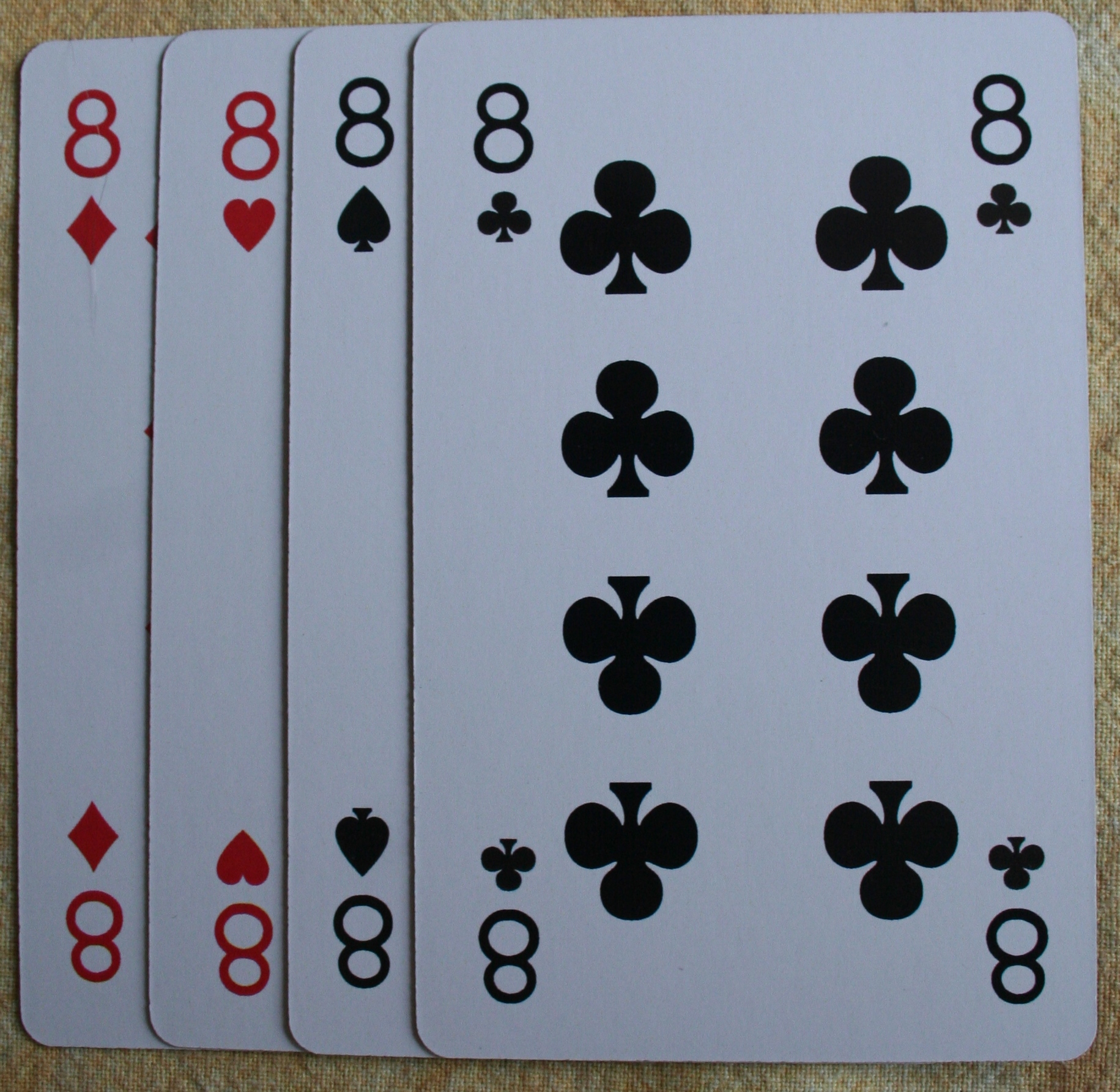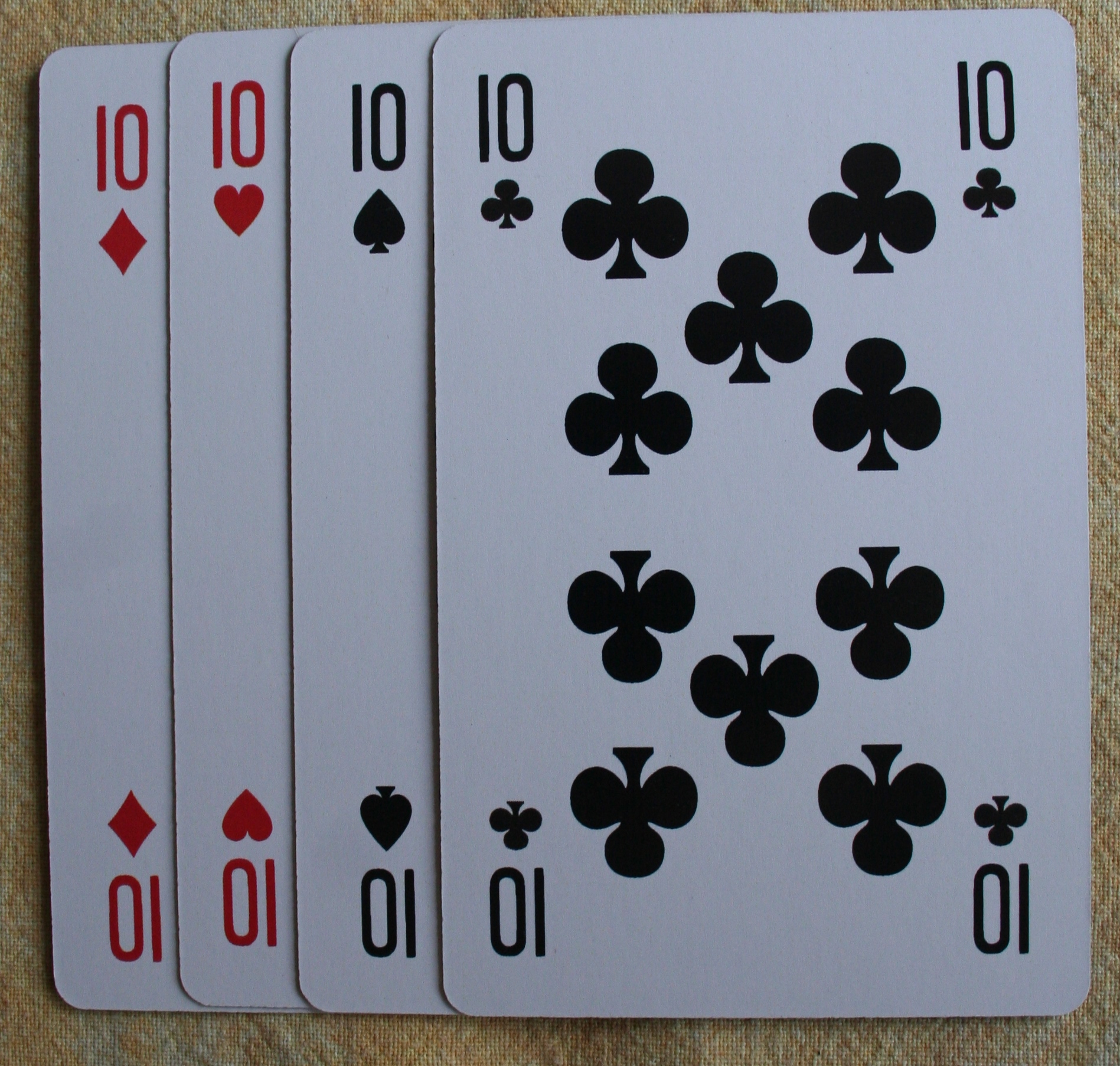
Scrabble

3 - 5

Number of Players: 2 – 4

Year of Publication: 1948

Creator(s): Alfred Mosher Butts (designer) and C. Leslie Crandall and Michael Graves (artists)
Mostly just because.

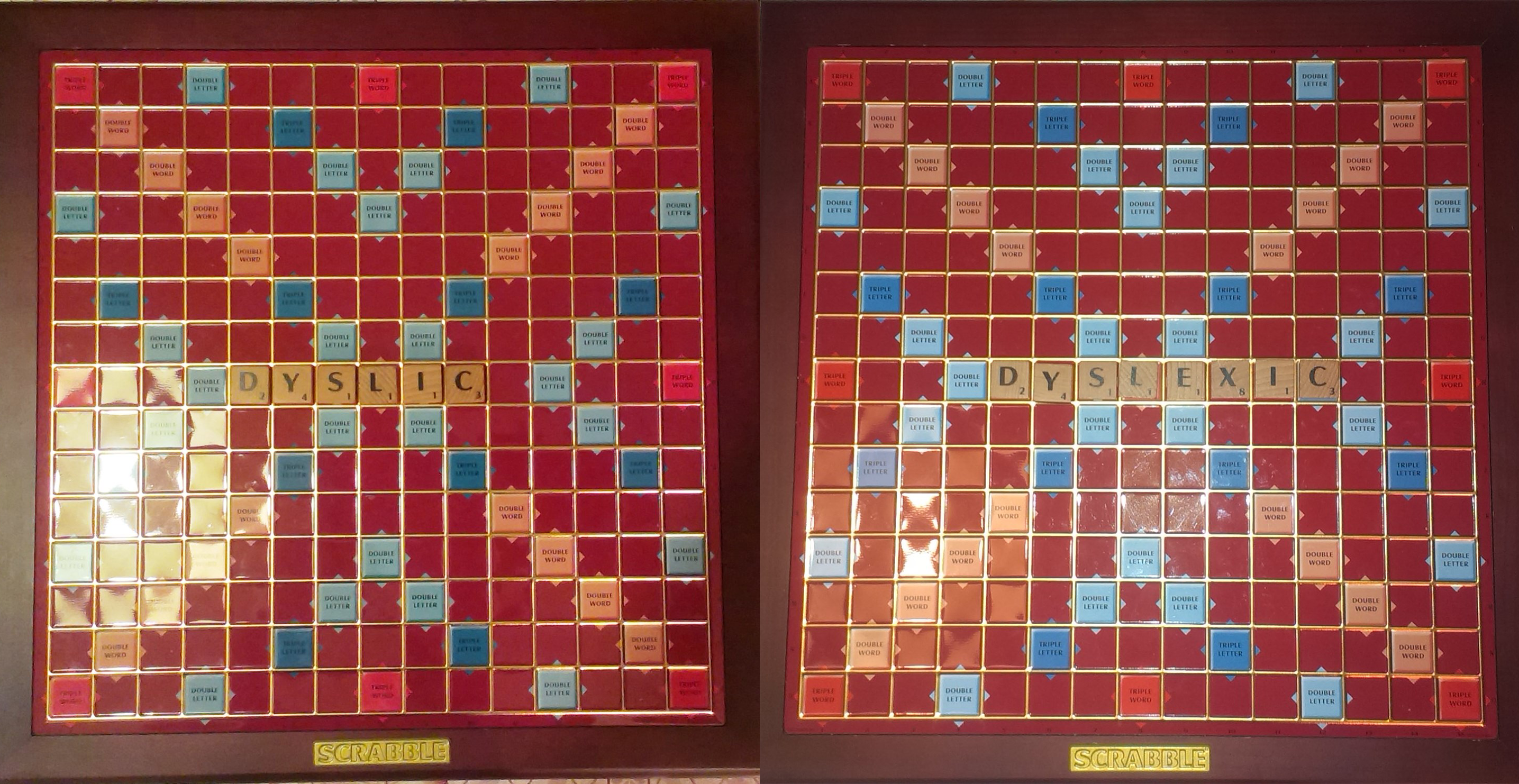
 Scrabble With A Dyslexic!

The word "dyslexic" is hard for dyslexics...
The word “dyslexic” is hard for dyslexics…

Scrabble is one of the classics of classics. There’s a high chance that you’ve played this game at some point in your life, or, failing that, have seen a copy floating around in your grandparents house that they like to get out at Christmas and encourage everyone to play together. Either way, it’s a fun game to play, especially on teams, and especially especially if there are dyslexics around.

What’s In The Box:
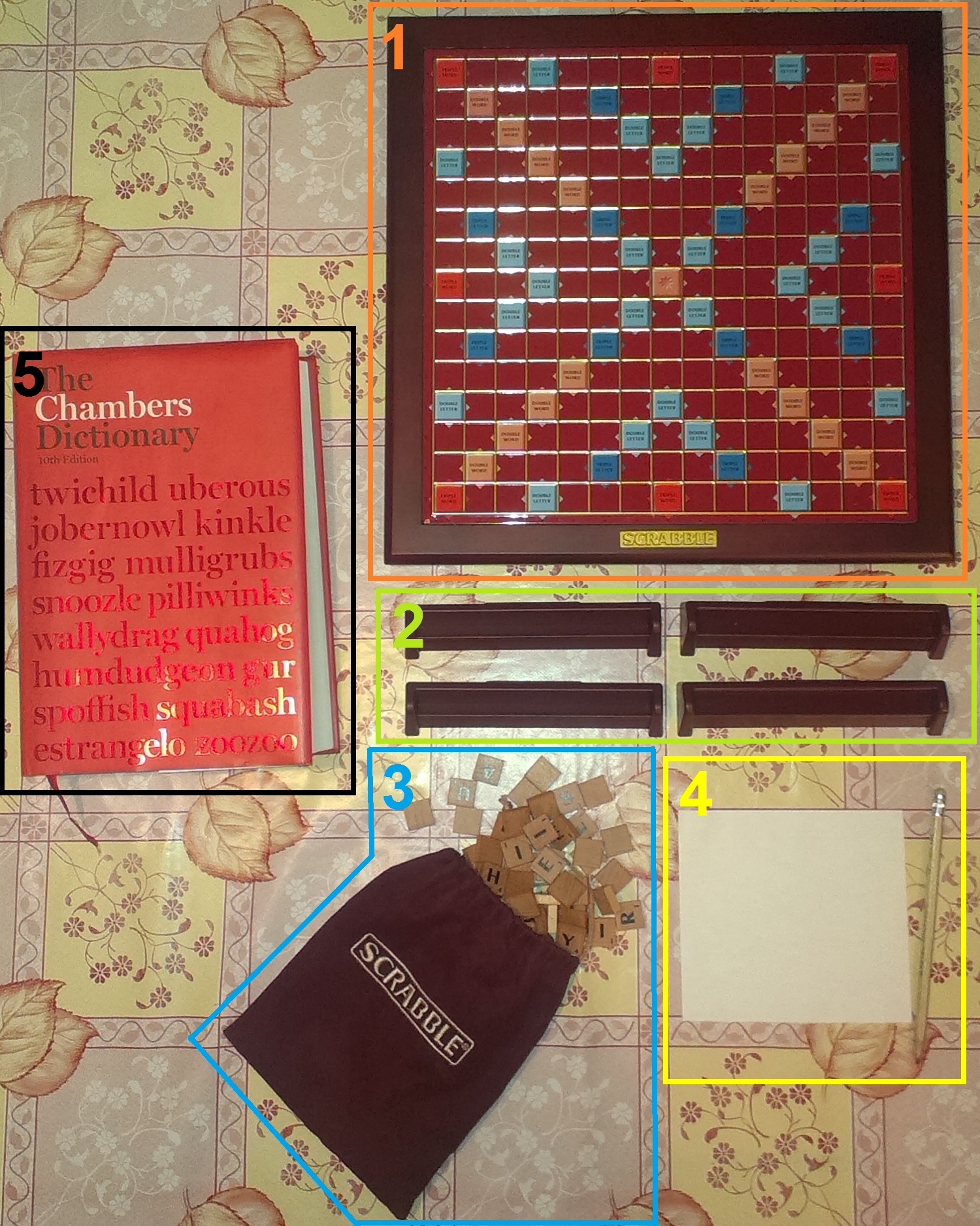
The stuff.
The stuff.
  1. 1 Game Board
  2. 4 Tile Racks
  3. 1 Bag containing 100 Letter Tiles
  4. 1 Pencil and Score Sheet
  5. The Chambers Dictionary (not actually included in the box, or used by anyone I’ve ever met when playing this game)

Playing The Game:

Objective: To have scored the most points by the time one player plays their last tile and there are none remaining in the draw bag.

To determine who plays first each player takes one tile at random from the draw bag, the player with the letter closest to the start of the alphabet is the starting player. From them play proceeds clockwise around the board. All of these tiles are then returned to the bag, and new tiles are drawn. In play order players draw 7 tiles and place them on their tile rack, keeping them out of the sight of the other players.

Once all players have their tiles, player one places a word on the board. All words must be at least two letters long and the first player places their first word across the red Double Word space in the middle of the board. After the first word has been played other players can lay words; new words must either be played through other words, crossword style, or be added on to the end of a word already on the board, for instance by adding an “S”. All words played must be real words, and names (of both places and people) and foreign languages are not considered legitimate words.
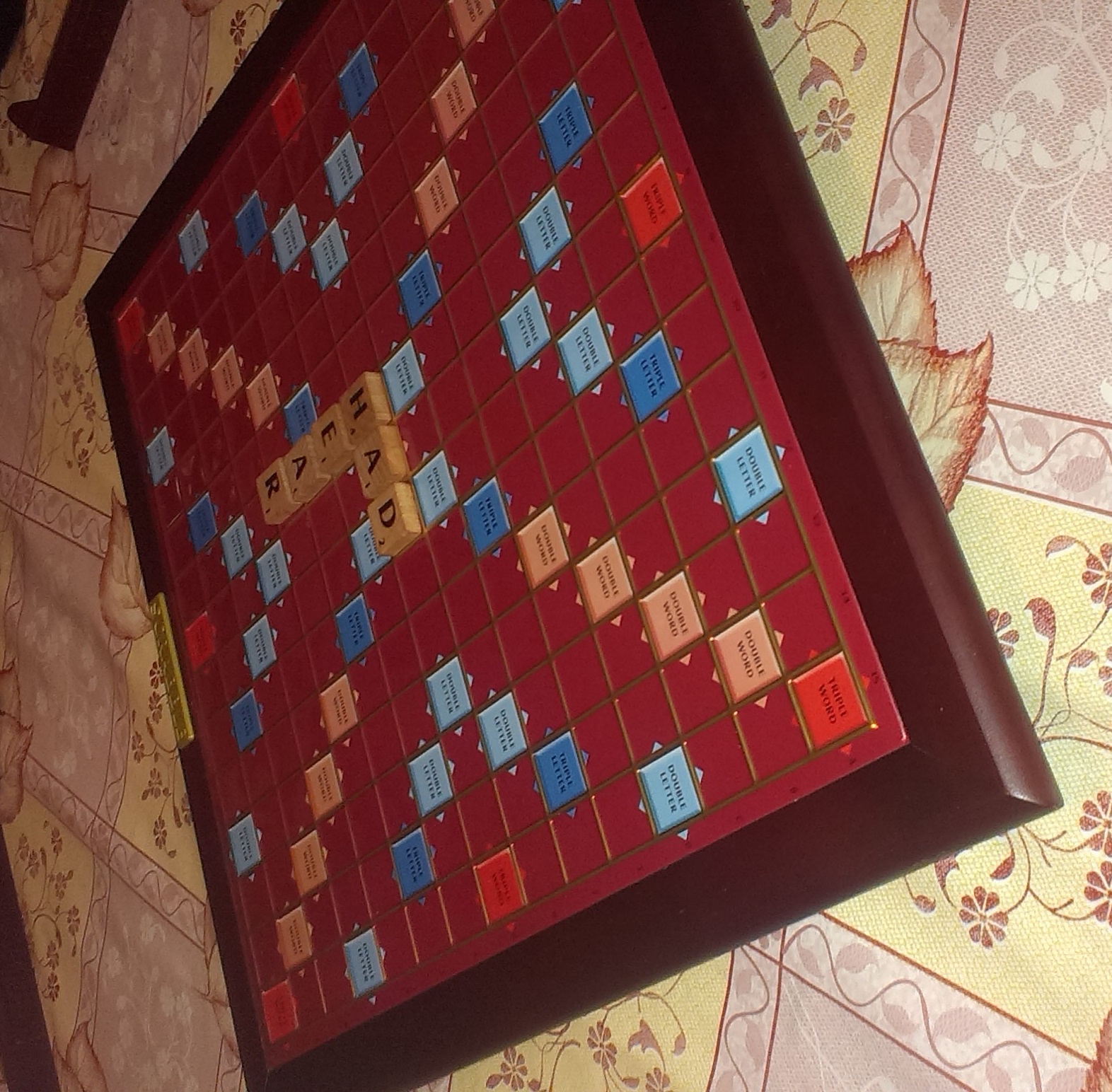
Dave was being artistic. Or something.
I don’t really know what was going on with this picture. I assume artistic license has something to do with it…

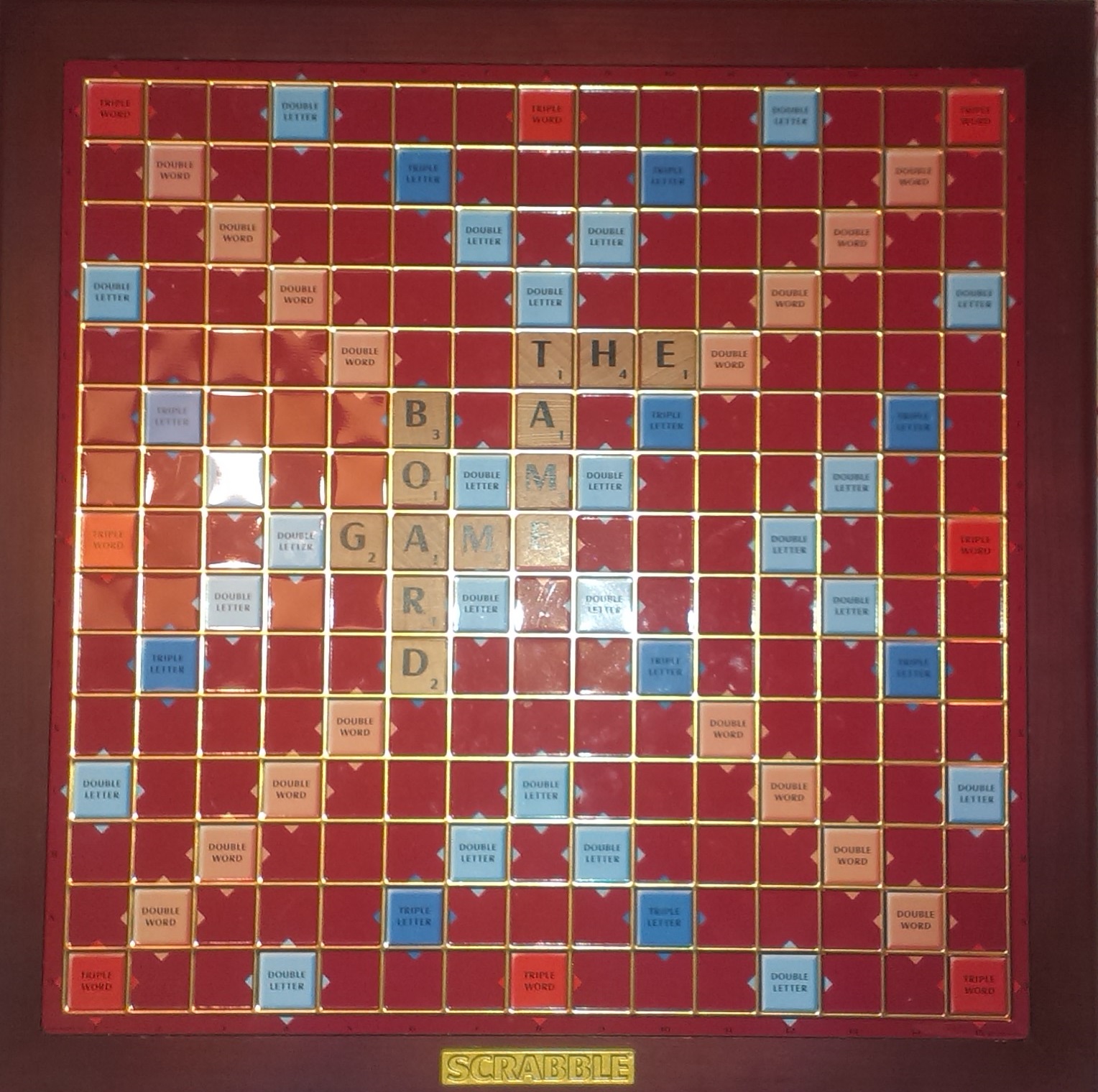
So you can kind of see what the opening words of a game might look like, even though the angle of that photo is weird as. Once a player has played a word, they then draw the same number of new tiles at random from the Draw Bag as they placed on the board. This can be interesting, because there’s no knowing which letters you’re going to be blessed with next. You can end up with a rack that only contains vowels, or consonants. Which is often not a huge amount of use.

However, there is a rule that allows a player to forfeit a turn to change all of their tiles, to do this the player must wait until it’s their turn, and then exchange their whole rack for fresh tiles from the Draw Bag. Play then immediately passes to  the next player. This is a good rule that can allow you do something about getting rid of a rack that looks like this:
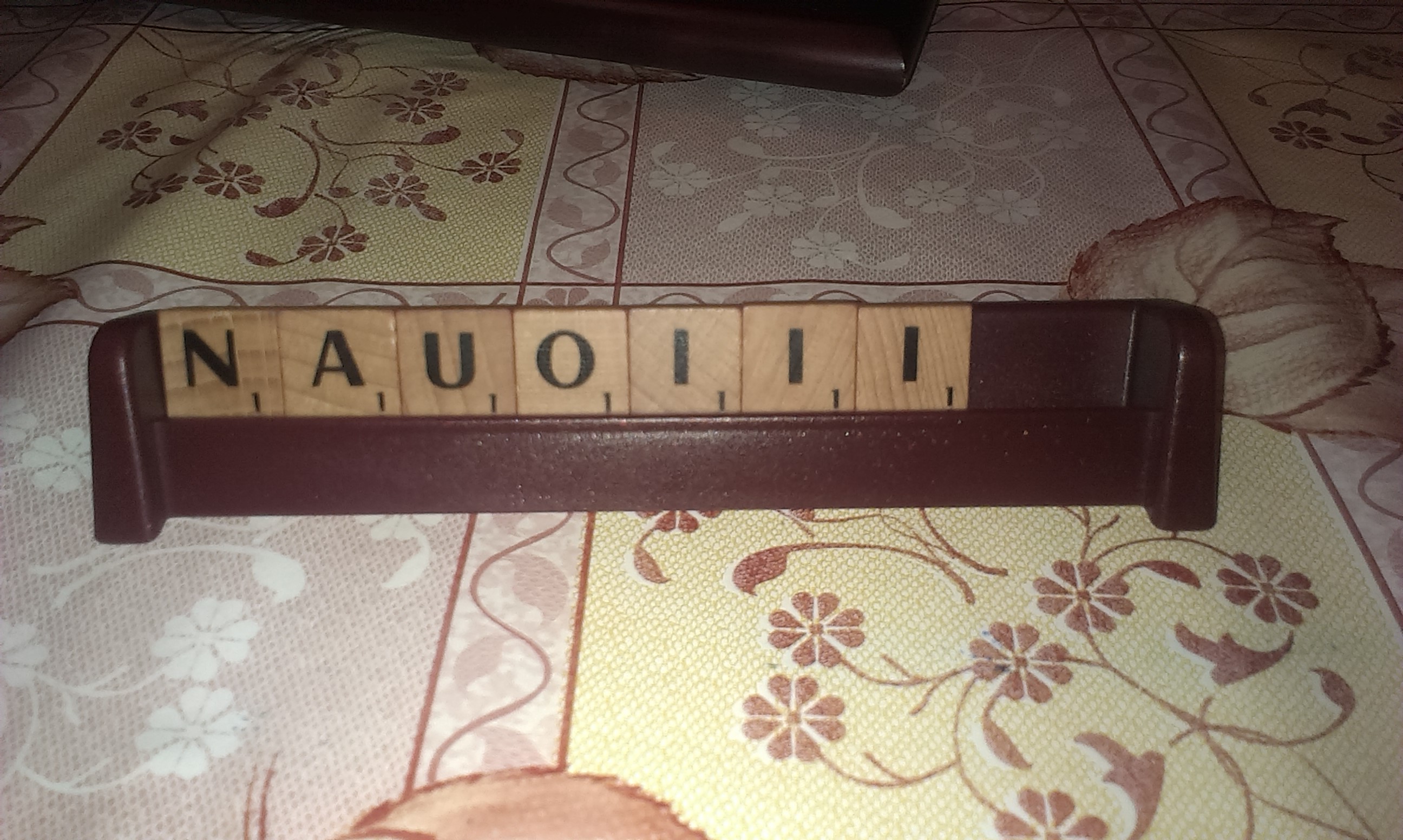
Had I chosen to do so, that rule would've allowed me to replace these tiles with new ones from the Draw Bag
Had I chosen to do so, that rule would’ve allowed me to replace these tiles with new ones from the Draw Bag

Play continues in this way, with one player keeping track of score until one player plays their last tile after the Draw Bag has been emptied. To score a player has to take into account both the value of the letter tiles played (the number on the bottom right hand corner of the tile), and whether or not the word has been played over any double/triple word/letter score tiles on the board. If it has then you must increase the score of that word for that player accordingly. If a player plays a word that changes a word already on the board, for example playing a word that starts with “S” and adding the required S onto the end of a word already existing on the board, the player adds up to total for the word they have changed, as well as the word they played, to be the score for that turn.

A generally accepted method of keeping score is to draw out columns on your score sheet with the initial or name of each player at the top of a column, you then keep a running total going in the columns so you can see exactly where each player’s at throughout the game, like this:
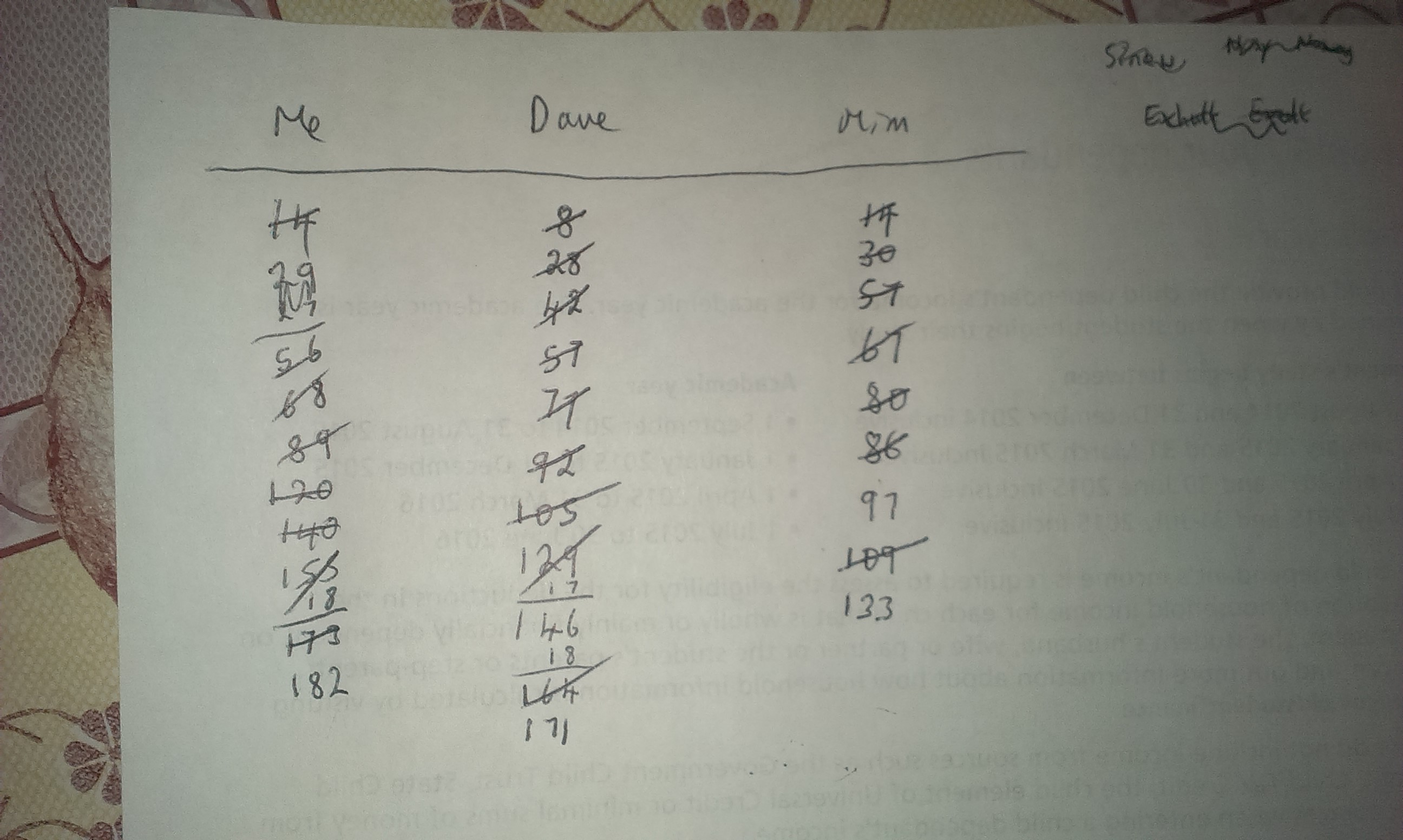
Our score sheet.
Our score sheet. As per the norm, I lost.

Strategy:

The best kind of strategy for this game is to look out for the bonus point spaces on the board, because there’s no point in making an absolutely fantastic word that lets you play lots of your letters but doesn’t get you any extra points if it then creates easy access to a double/triple word/letter tile that another player can use to score some ridiculous amount of points. Other than that this is really a “be as imaginative as possible” kind of game, where the weirder the words you play are, the better the game gets.

History and Interesting Things:

  1. The game was invented by an American out-of-work architect called Alfred Mosher Butts in 1938. He created the game by combining features of anagrams and crosswords.
  2. It was originally called LEXIKO and then CRISS CROSS WORDS before becoming Scrabble.
  3. Although everyone thinks of this game as a word game, it’s actually fundamentally a number game, to create the game a series of painstaking letter-frequency calculations were needed to determine how many times each letter should appear in the game.
  4. The game was rejected by many games manufacturers, until Butts met James Brunot who loved the game.
  5. Between Butts and Brunot they refined the rules of the game and came up with the name Scrabble which means “to grope frantically”.
  6. The game was trade marked in 1948.
  7. To produce the game the Brunot’s rented an abandoned schoolhouse in Dodgington, Connecticut, where, asissted by friends, they turned out 12 games an hour, stamping letters onto the wooden tiles one by one.
  8. As with many games the game lost money in its first year, but, over a few years, the game steadily grew in popularity, until the president of MACYS came across the game on holiday and ordered some for his store. Soon after this it became a must-have, and Brunot realized that they could no longer produce the games fast enough to meet demand. They licensed Selchow & Righter to produce the game until, in 1972, they purchased the trademark from Brunot.
  9. Selchow & Righter were bought by COLECO in 1986, but when they declared bankruptcy in 1989 the trademark was bought by Hasbro, the largest games manufacturer in America.
  10. The game is now found in one in every three American houses.

To Conclude:

A very good game, although only rated 3 out of 5, this isn’t a reflection on how much I like the game, more of a reflection on how accessible it is for everyone. For instance, although it’s a great game for everyone in that it can be very fun and silly, it’s an unbelievably challenging game for anyone with literacy difficulties, as well as occasionally being very frustrating due to the random selection of tiles. That said, it’s a game everyone should play a few times, even if it’s just to discover that your friends know words that they didn’t know they knew so you can argue over whether or not they’re allowed on the board.

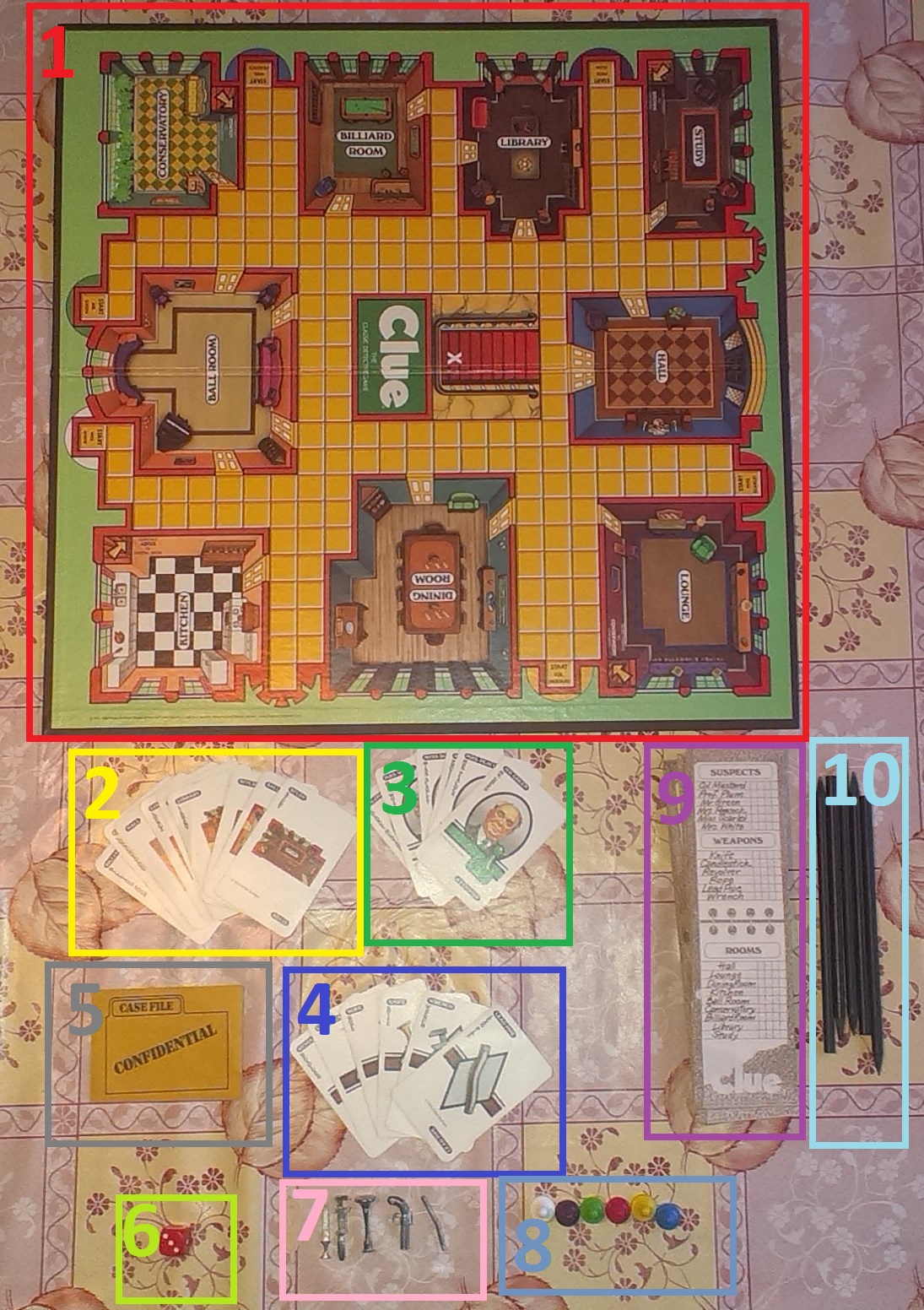
 

Clue (Cluedo)

3.5 - 5

Number of players: 2 – 6

Year of publication: 1949

Creator(s): Anthony E. Pratt (designer), René GoscinnyMatt Groening and Albert Uderzo (Artists)

I Have No Clue…Do:

Clue is probably one of the most popular board games of all time after MonopolyFor those of you living in the UK and a few other places your know this game by the name Cluedo. While it’s a classic its far less boring (and infinitely continuous) than Monopoly and even has a slightly role playing feel to it without directly inviting you to step into a character at all (you may choose to anyway due to physiological imbalances… Like my self).

What’s In The Box:

The Stuff!
The Stuff!
  1. Game Board (with 9 Rooms)
  2. 9 Room Cards
  3. 6 People Cards
  4. 6 Weapon Cards
  5. 1 Confidential Case File
  6. 1 Die (2 dice in later editions of the game)
  7. 6 Miniature Weapons:
    • Lead Pipe (Lead Piping in Cluedo)
    • Rope
    • Knife (Dagger in Cluedo)
    • Wrench (Spanner in Cluedo)
    • Candlestick
    • Revolver
  8. 6 Character Pawns:
    • Miss Scarlet (spelled Scarlett in Cluedo)
    • Professor Plum
    • Colonel Mustard
    • Mr. Green (Reverend Green in Cluedo)
    • Mrs. White
    • Mrs. Peacock
  9. Pad of Detective Notebooks
  10. Confidential Case File
  11. Instructions – found printed on the box of our copy (not pictured)

 Playing The Game:

Objective: To be the first player to correctly accuse the right person of the murder in the right room with the right weapon.

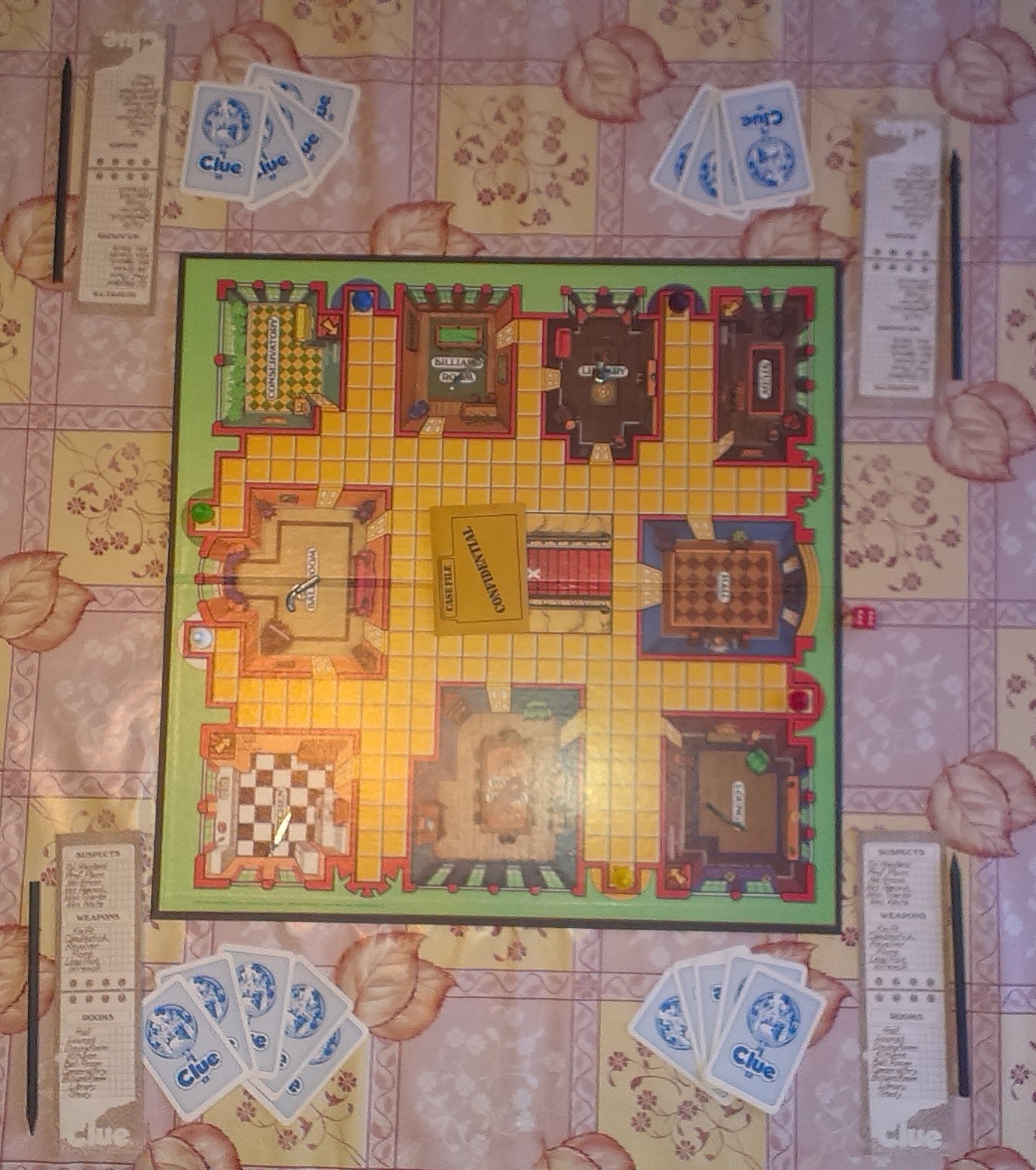
The game starts by the three decks of card being shuffled separately and the top card of each deck being placed into the case file (without anyone knowing what they are). The rest of the cards are shuffled together and dealt between the remaining players. Each player also has a detective notebook and a pencil. The weapons are randomly distributed between the rooms (only one per-room).

The starting set up.

Each player may then look at the cards in their hand and mark them off on their detective notebook so they know they’re not the cards in the case file. Make sure your notebook and cards are kept out of the sight of other players. Play then starts with Miss Scarlet who roles the dice and moves accordingly (you cannot move diagonally). Play then proceeds clockwise around the board.

Suggesting:

When a player enters a room he/she may make a suggestion of who committed the murder. They can suggest any character (even themselves or one not controlled by a player), on doing so they move the character to the room they are in and then they also choose the weapon they think they may have used and move that into the room.

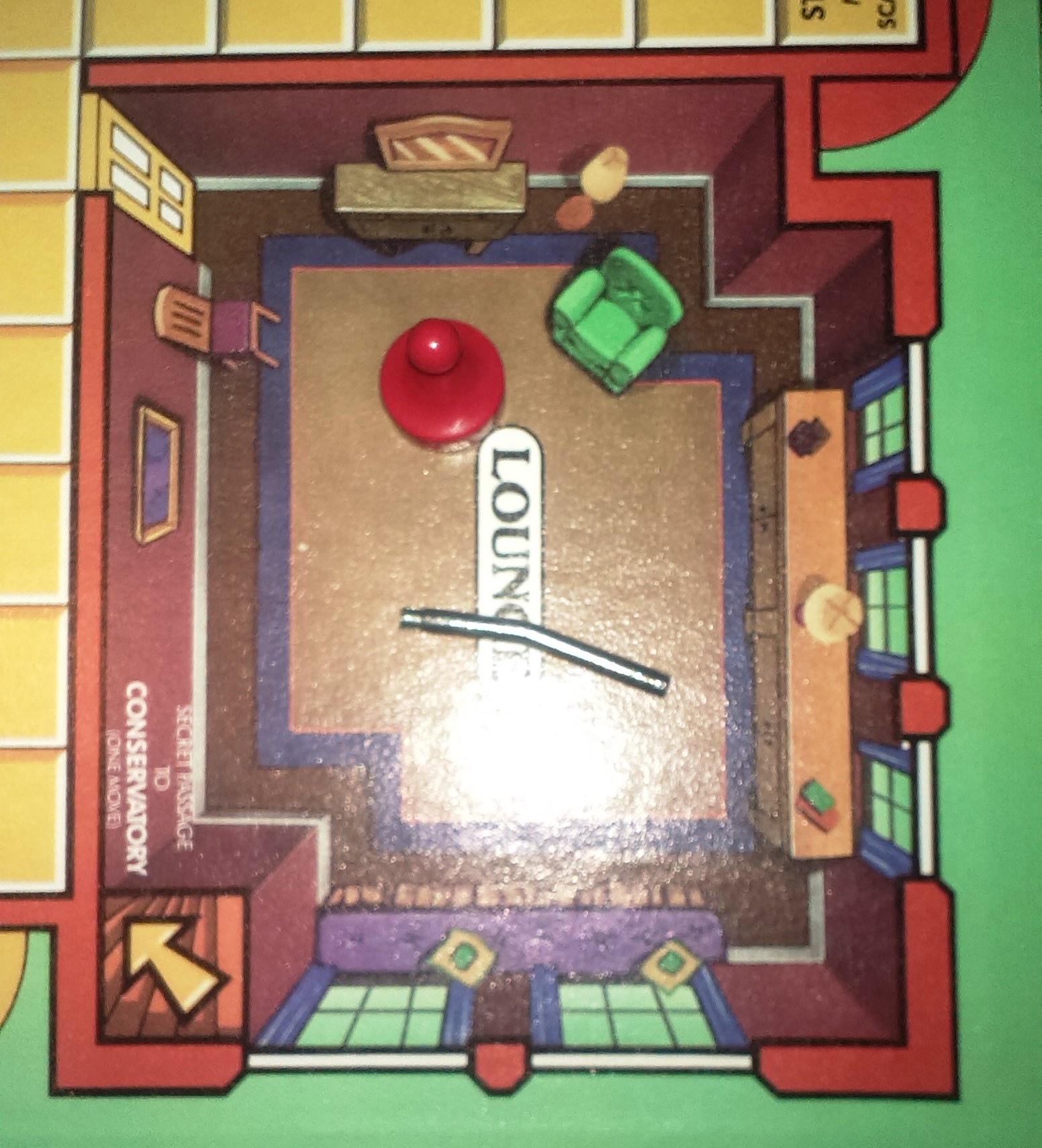
IMAG2493
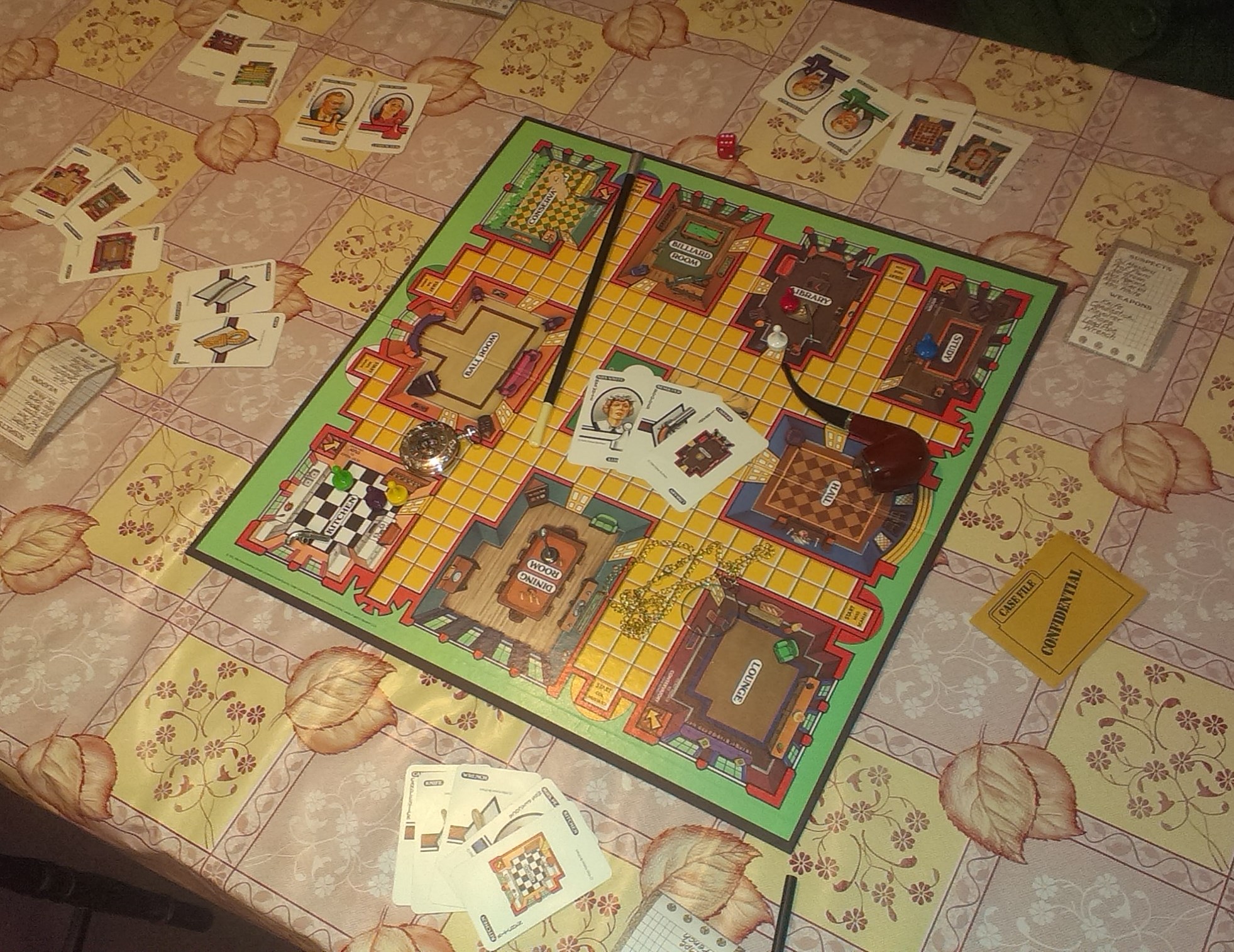
So this is a suggestion of Miss Scarlet in the Lounge with the Lead Pipe.

The player to the left of the person making the suggestion must then show one of the cards relevant to the suggestion if they have one, if they do not then the next person must show one relevant card and so on. They must only show the player making the suggestion and none of the other players. If the player to the left of the one that made the suggestion has more than one of the relevant cards they may choose which one to show, and as the game progresses this can be used to your advantage to throw the other players off by making them believe you don’t have a a card that you’re actually holding.

Accusations:

Once you have done this enough and someone is confident they know which three cards are in the confidential case file (and therefore not in play) they may make an accusation. To do this they say “I am accusing, <a person>, in <a place> with <a weapon>”. They do not move the relevant pieces, nor do they need to be in the correct room. They then look in the case file to see if they are correct; if so they are the winner, if not they are out of active play and only stay to show their cards upon the suggestions of other players.

At the end of the game, all prop pieces down.

Strategy:

  1. Like in real life DON’T BE TO QUICK TO ACCUSE – While you might be eager to win the game and are being hasty to attempt to beat the other players to it, be sure of your facts before you go yelling accusations – otherwise it’s game over for you!
  2. BE AWARE OF WHO’S SHOWING CARDS ON SUGGESTIONS –  Always take mental notes of who’s showing cards with regards to certain things. If a suggestion gets all the way round the board with no one showing any cards then the only person who might have any of the components of the suggestion is the person who made the suggestion themselves.
  3. PLAY YOUR CARDS CLOSE TO YOUR CHEST – An easy game to accidentally cheat on, especially if someone’s stretching at the right time or “just leaning back”. So keep your cards and your detective notebook well covered.

History and Interesting Things:

  1. The game was initially patented in 1944 by Anthony E. Pratt under the name Murder!
  2. The game was originally created to be played in air raid shelters during the War.
  3. Anthony E. Pratt’s wife then presented it to Waddingtons‘ executive, Norman Watson, who purchased it.
  4. It was then given the name Cluedo which was a play on the words Clue and Ludo (which means ‘I play’ in latin).
  5. Whilst the game was created in 1944 and the patent granted in 1947 the game was not launched ’till 1949 due to war shortages.
  6. The game was also licensed to Parker Brothers and renamed Clue to be distributed in the United States at the same time as it was launched in the UK.
  7. The game that was launched in 1949 differed in a few ways from the original concept. The games original design had been to have ten characters one of which was randomly assigned as the victim at the beginning of the game, leaving eight playable characters and nine suspects. Mr. Brown, Mr. Gold, Miss Grey, and Mrs. Silver where eliminated from the game and Nurse White was renamed Mrs. White and Colonel Yellow was renamed Colonel Mustard. Originally there were also eleven rooms, this was canceled down to nine, eliminating the gun room and the cellar. There was also supposed to be nine weapons, some of the  eliminated or replaced weapons were the bomb, syringe, shillelagh (walking stick), fireplace poker and the (later used) axe and poison. Some of these weapons and characters were used in later spin-offs of the game.
  8. Additionally, the game play was different from the published version. The cards were distributed into the rooms for the players to collect. Players also had to land on other players to make suggestions about them through the use of tokens that, once exhausted, prevented you from making any more suggestions.
  9. Both Parker Brothers and Waddingtons‘ produced a number of unique editions between 1949 and 1992 when they were both purchased by Hasbro in the early 1990s. Hasbro continued to produce unique editions for each market until 2002/2003 when it produced the modern version of Clue/Cluedo which was unified for all markets with only localised spelling and regional changes made to each edition.
  10. The version we own (appearing in this post) is a 1989 Parker Brothers North American copy (even though we live in the UK) and we also own the modern UK version.

To Conclude:

Clue (Cluedo) is a good game… It’s easy to see why it’s been such a commercial success. However, in my opinion, it suffers from the same thing Monopoly does… It’s boring. Now this isn’t because it’s inherently boring, it’s just because most people most places have played it LOADS since they were children and therefore have no interest in it. In a sense it’s a victim of its own success when it comes to catching my interest. Like when you’re sitting there with some people and you go “Hey guys, let’s play some Monopoly” and everyone groans and goes “PLEASE NOOOO!” it’s a similar response with Clue just not quite to the same extreme. This being said, it’s still a good and well developed game, and its easy to understand why it’s been around and been popular for over half a century.

Monopoly

3 - 5

Number of Players: 2-8

Year of Publication: 1933

Creator(s): Charles Darrow (Designer) and Frantz Rey (Artist)

If I Can Just Get Past Your Hotel, I’ll Be Fi- NOOOOOOOOOOOOOOOOOOOOOOOOOOOOO

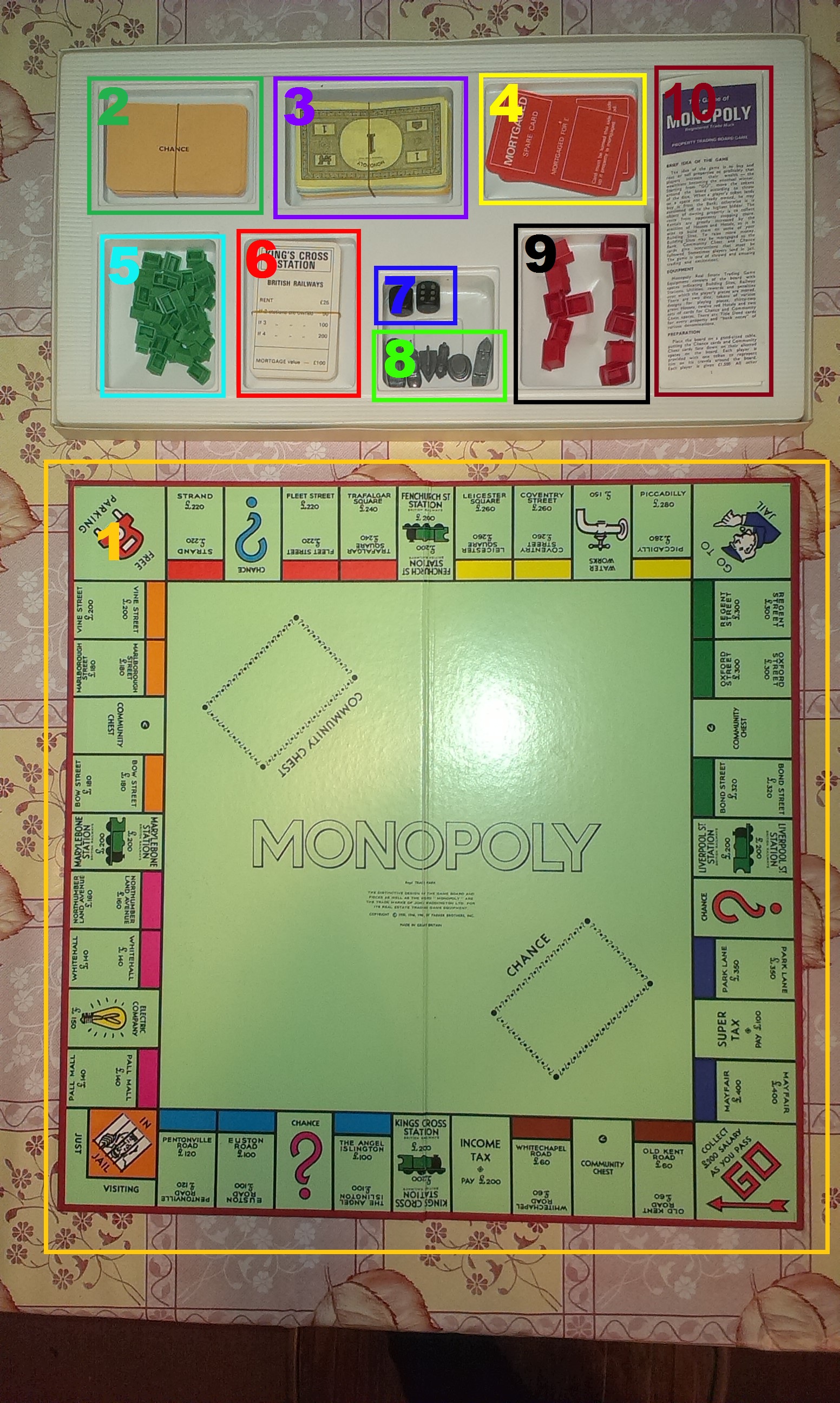
Monopoly is probably the first game that comes to mind when someone says to you “What’s a really old board game?” either that or Clue. I’m fairly sure that most of the world is familiar with the concept of Monopoly even if they’ve never played it, it’s just one of those games you know about. Now, in our house we have a slightly different approach to Monopoly. We collect it. I think the list is currently at Star Wars Original Trilogy Collectors Edition, Star Wars Episode I, The Simpsons, Lord of the Rings Trilogy Edition and Travel Monopoly. The copy of original Monopoly featuring in this post actually belongs to our sister and brother-in-law, and before them, our Grandma.

What’s In The Box:

The Stuff.
The Stuff.
  1. Game Board
  2. 16 Chance cards and 16 Community Chest cards
  3. Game Money in denominations of 1, 5, 10, 20, 50, 100 and 500
  4. 2 Spare (blank) Title Deed cards
  5. 32 Houses
  6. 28 Title Deed cards
  7. Two standard 6-sided dice
  8. 6 Playing Tokens
  9. 12 Hotels
  10. Rule book

 Playing The Game:

Objective: Buy and develop the most properties to either achieve Monopoly or bankrupt all your opponents.

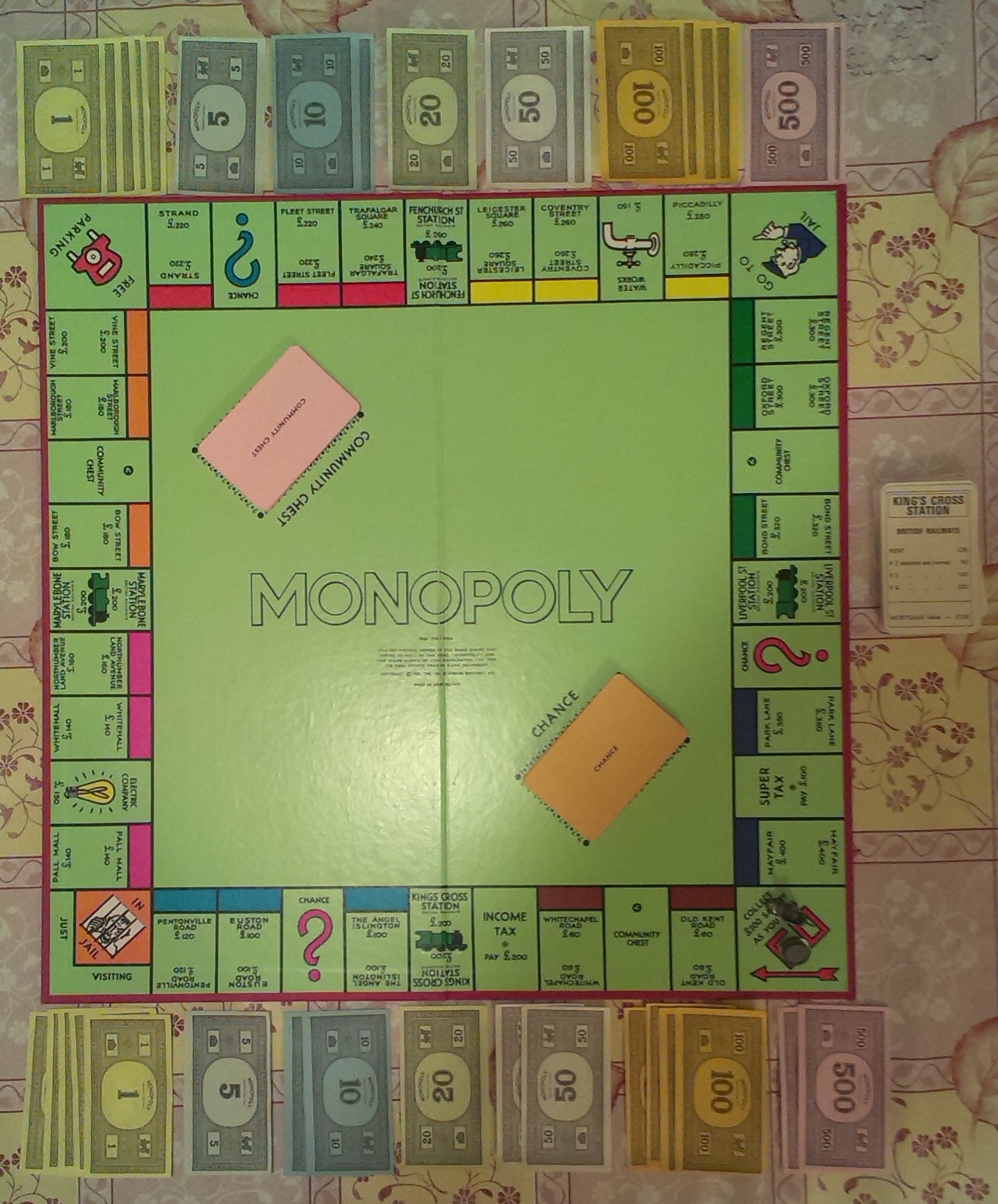
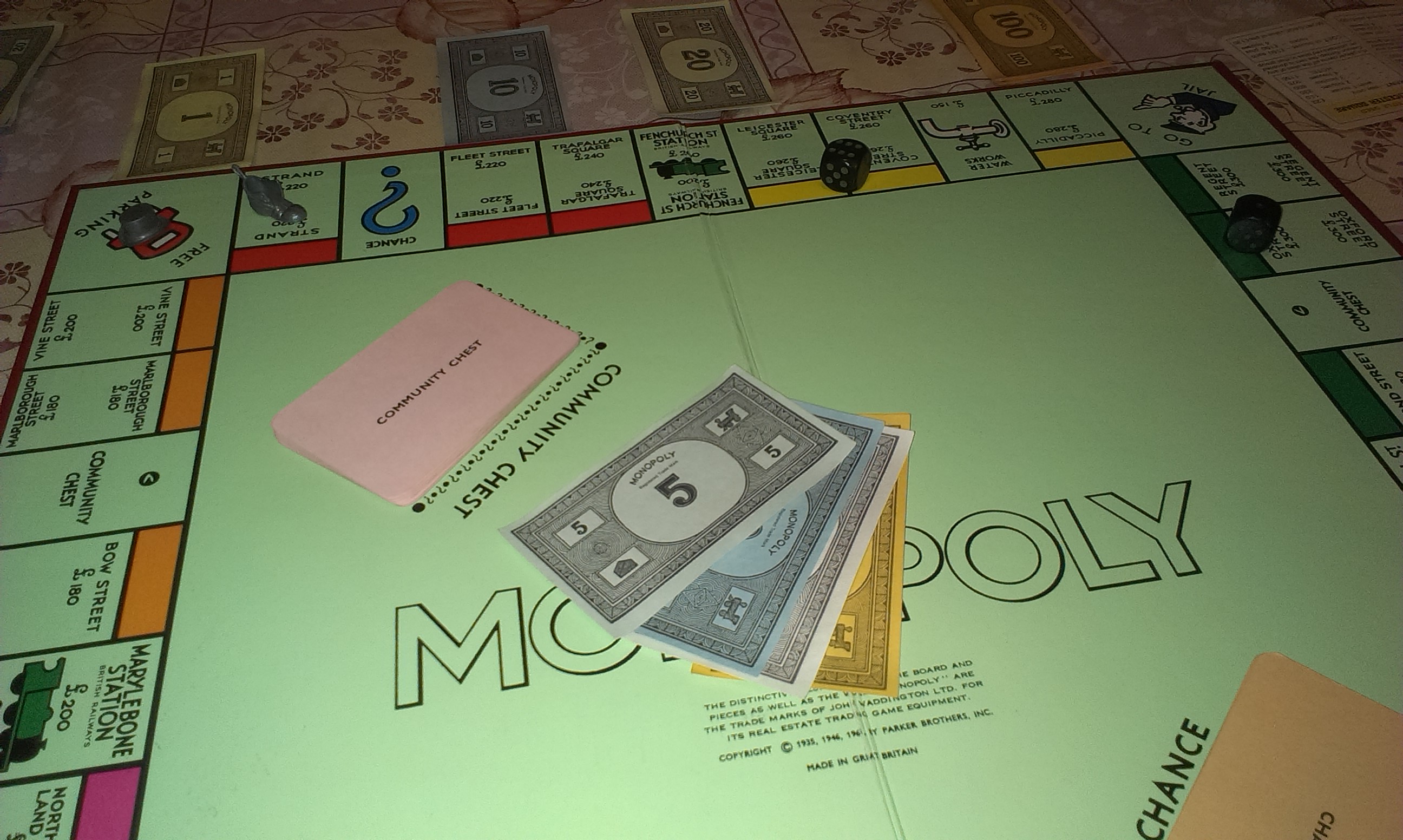
Because the world is generally so familiar with Monopoly I’m going to try and keep this section brief. Essentially, to start the game you need to separate the Chance and Community Chest cards, shuffle them, and put them in their allotted spaces on the board. Then elect one player to be Banker, they’re in charge of making sure the correct amount of money goes in and out of the bank for the rest of the game. To start they deal out 2 x 500, 4 x 100, 2 x 50, 1 x 20, 2 x 10, 1 x5 and 5 x 1 to every player. Lastly you choose Tokens, put them on GO and then roll the dice to see who plays first. Highest roll starts.

Starting set up for a game with two players

Moving and Rolling Doubles:

Starting with the player who rolled the highest number players take it in turns to roll the dice and move the shown number of spaces around the board, moving clockwise. If a player rolls a double they may move, complete all actions associated with that move (buying property, collecting money on Chance cards, etc) and then roll again, and move again. However, if a player rolls three doubles in a row, they must go to jail. There are several options for things it’s possible to land on, the most common of which is a Property space.

Landing on a Property:

If you land on an unowned property you may buy it by exchanging the amount of money shown on the space with the Banker for the Title Deed for the property you landed on. However, if another player has already bought the property you land on you must pay them rent for stopping there. The amount of rent paid varies from card to card, increasing as you go further round the board. It also changes when a player owns all of a set of one colour of property, or develops the property by buying Houses or Hotels for it.

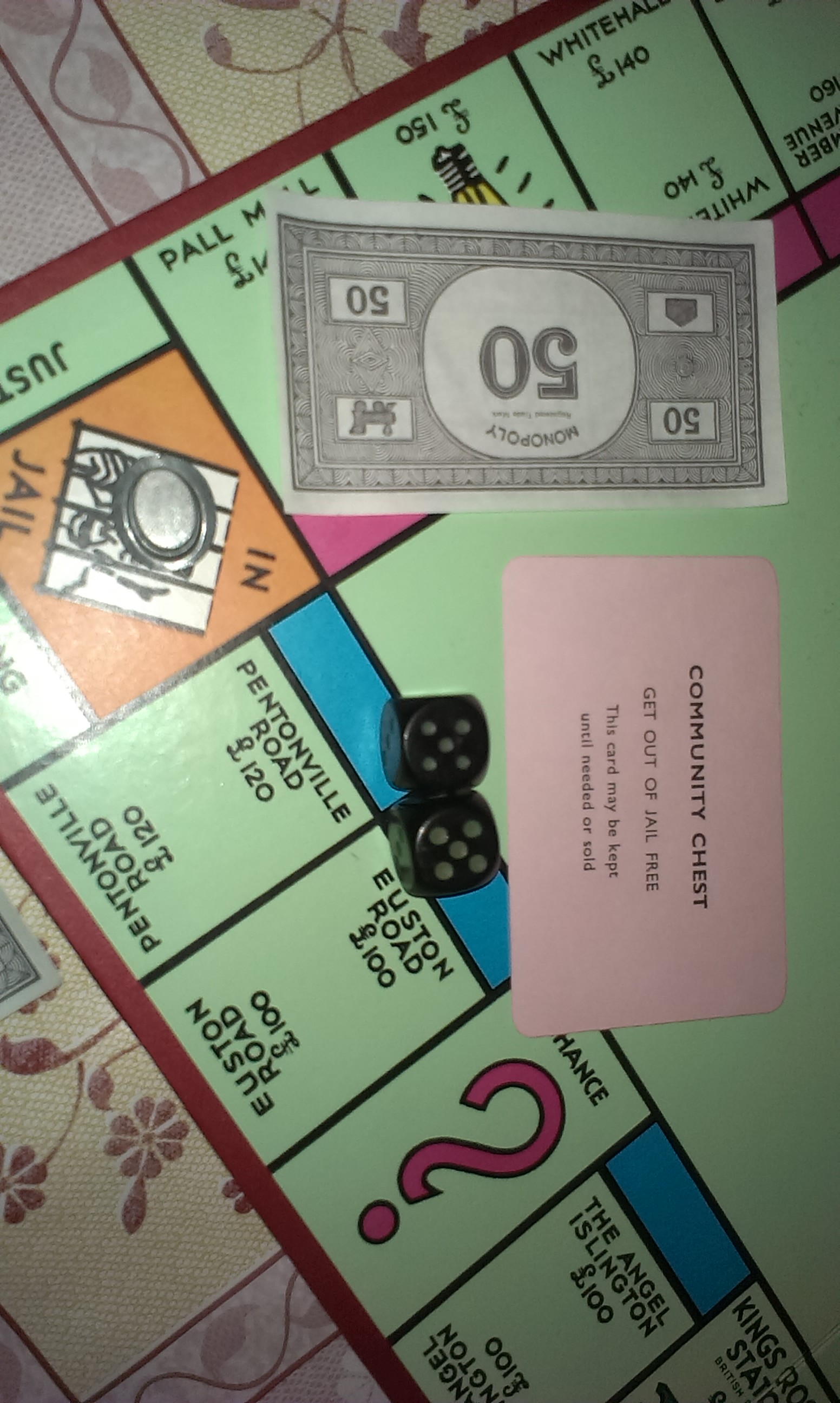
Chance or Community Chest:

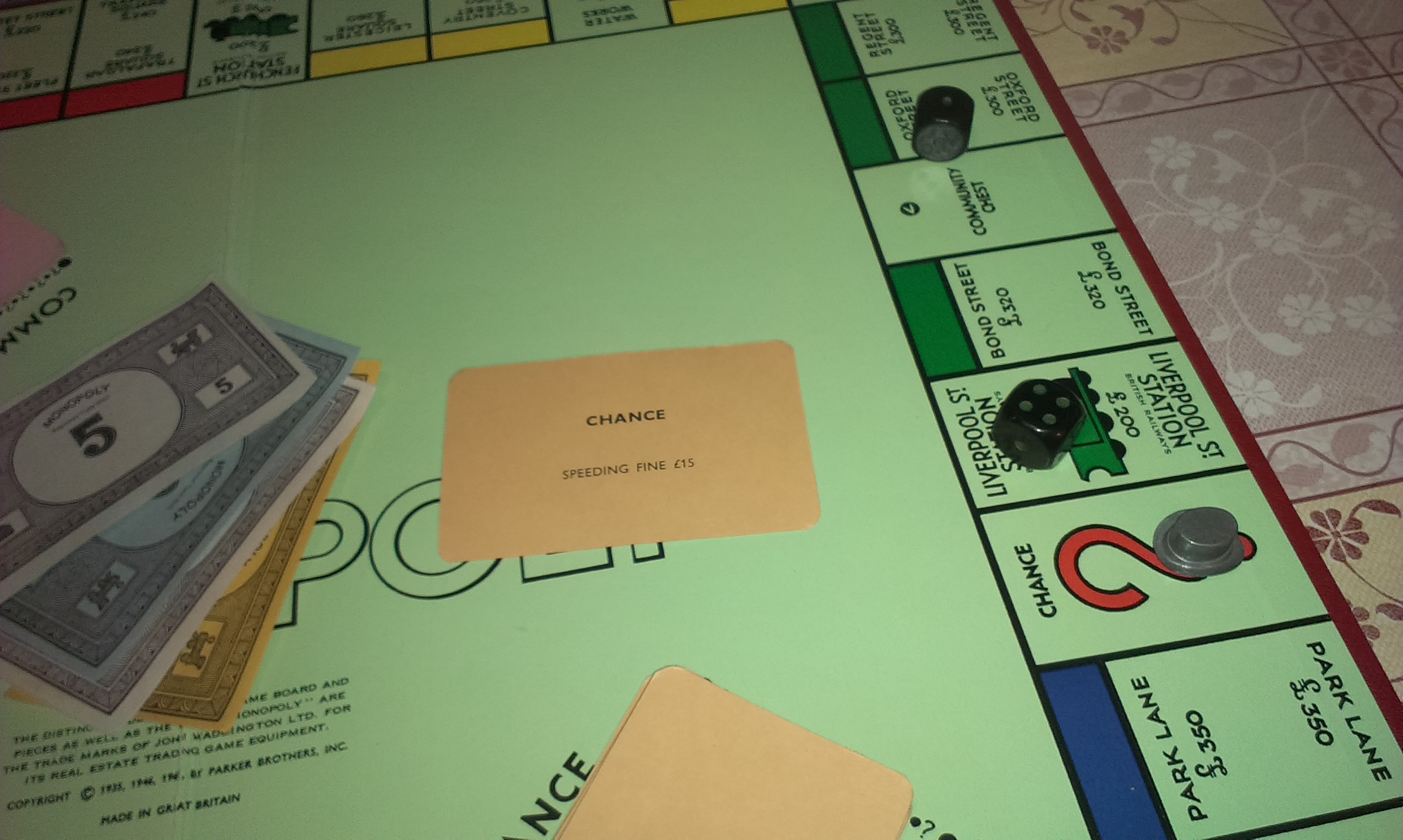
There are three Chance and three Community Chest spaces around the board. If you land on one of these you must draw the top card from the relevant deck and follow all instructions on the back. Once completed you return the card to the bottom of the deck you took it from, unless the card specifies that it make be kept and used later, the only one of these in the decks is the Get Out Of Jail Free card. Once this has been used it is also returned to the bottom of the deck. Chance and Community Chest are a mixture of good and bad cards, they can be helpful things, like cards that allow you to roll again, or take some money from the bank. But they can also be bad, forcing you to pay taxes or go to jail, so landing on one is always a bit of a gamble. Unless the cards specifies money to be paid either to the bank or to another player, all money lost to these cards in placed in the middle of the board and can be claimed by landing on Free Parking.

I landed on Chance and had to pay a speeding fine to the middle of the board.

Income Tax and Super Tax:

These are the only two spaces on the board that can force you to pay money, and this money is paid straight to the bank.

Jail and Go To Jail:

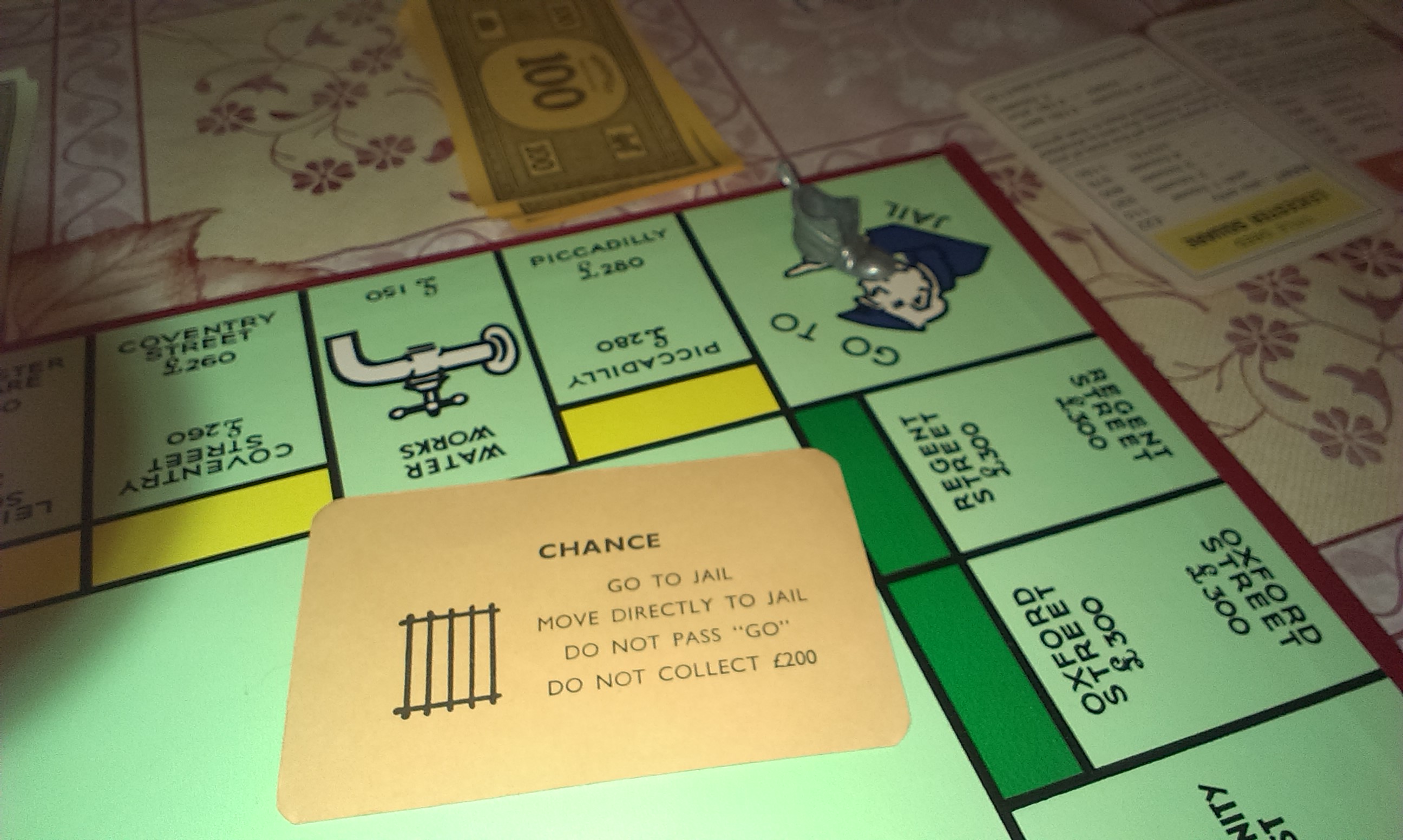
These two spaces are diagonally opposite to each other on the board. The jail space itself is most irrelevant to game play – acting as a space where nothing happens – unless you get a Chance or Community Chest card that sends you to jail, you land on the Go To Jail space, or you roll three doubles in a row. These are the only three actions that can send a player to jail.

GO TO JAIL.
GO TO JAIL.

Getting out of jail is slightly harder than getting in, you can get out of jail by doing one of the following: throwing a double on any one of the three turns following you being sent to jail, playing a Get Out of Jail Free card, either by already having it in your possession before you went to jail, or by buying it off another player for an agreed price, or, paying a fine of £50. If you choose to try and roll your way out of jail, but on your third roll do not succeed in throwing a double, you must then pay the fine.

All the various ways of getting out of jail.

After this is paid a players turn may continue as normal, moving and buying property. Whilst in jail a player may also collect rent, buy or sell properties and build Houses or Hotels. The only thing they really miss out on is moving and passing GO.

GO:

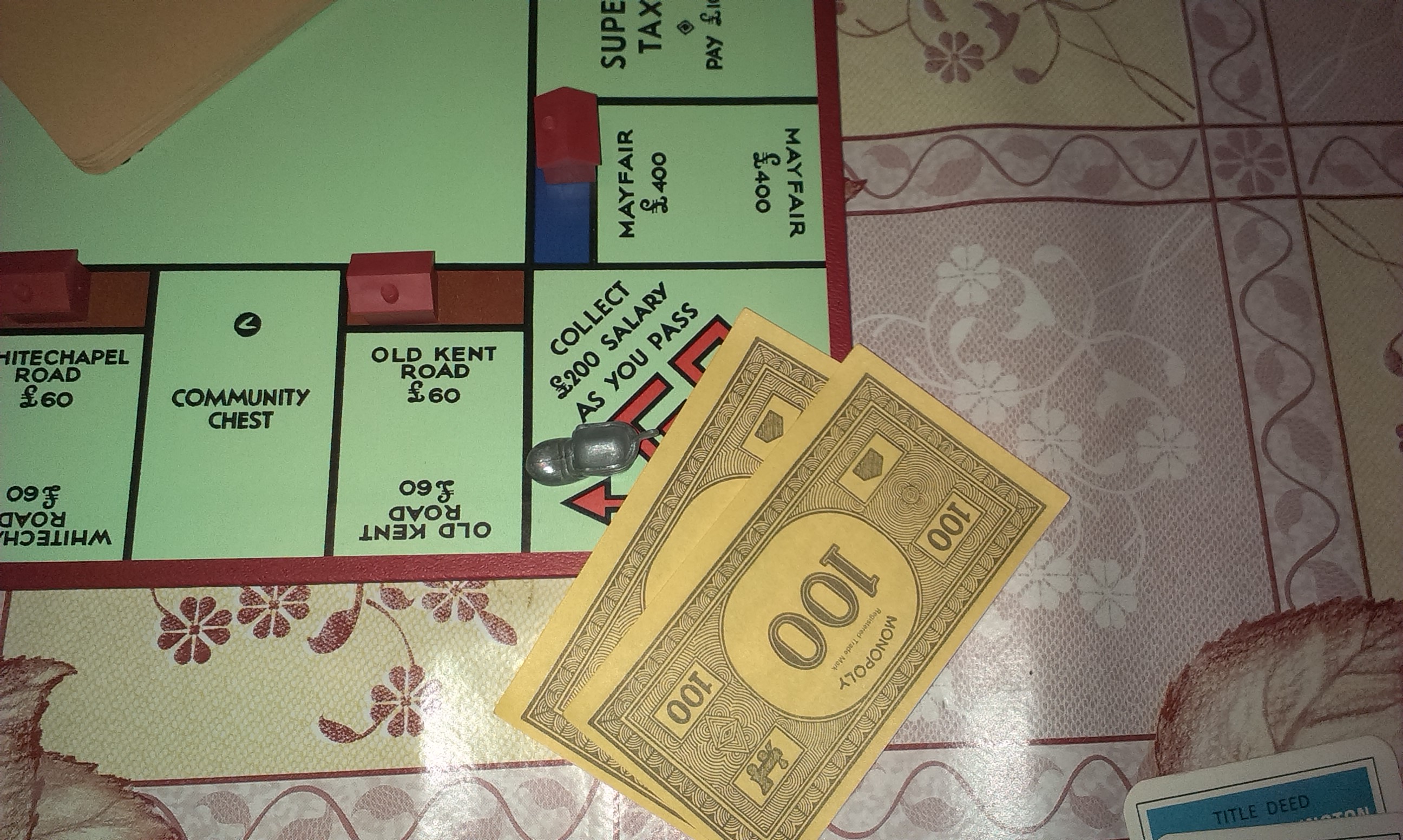
When a player passes or lands on GO at any point after the start of the game (with the exception of if they’re being sent to jail) they collect £200 from the bank.

Landing on GO!
Landing on GO!

Houses and Hotels:

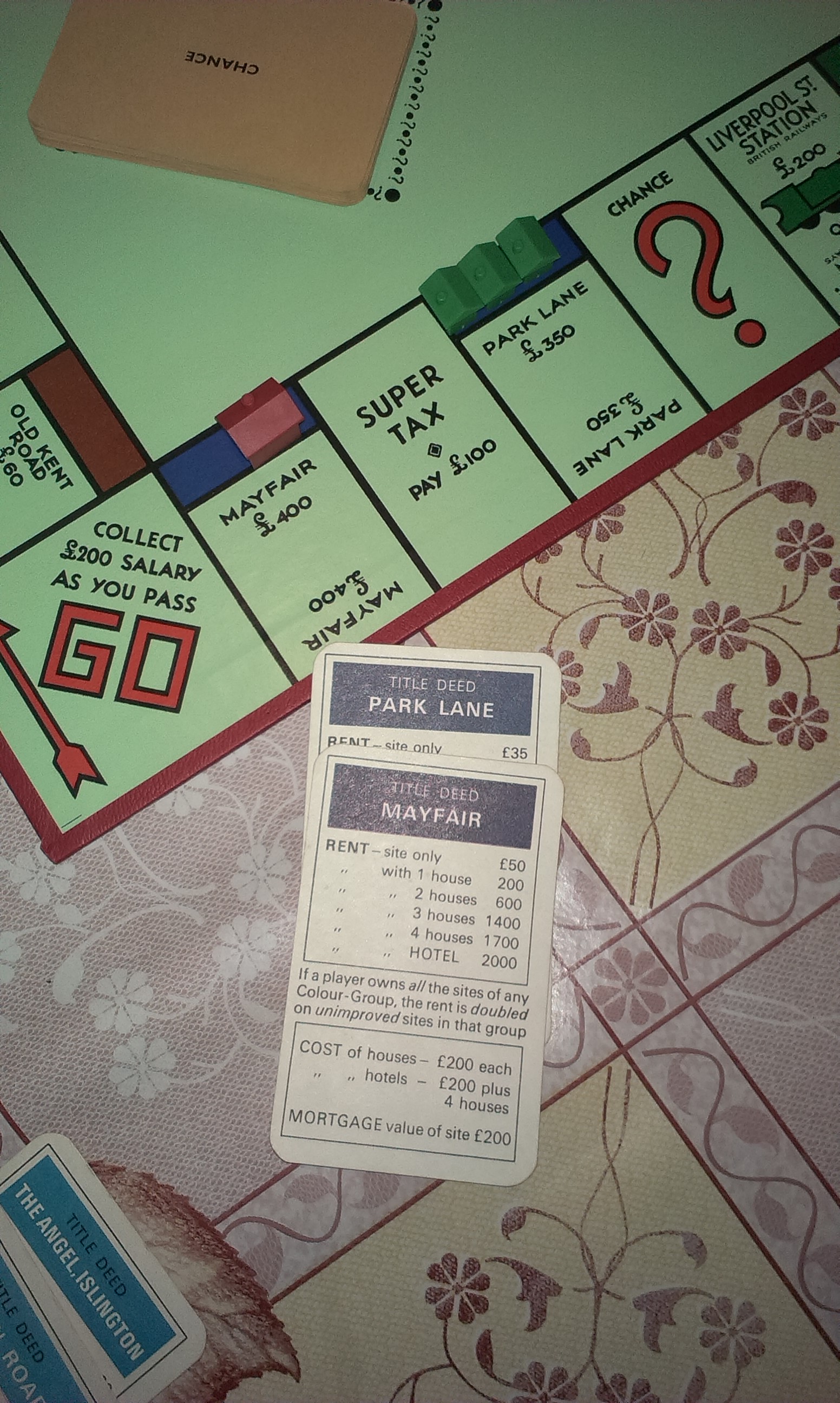
A player can purchase these when they own all of one set of a property. For example, they own both Park Lane and Mayfair they would be able to purchase Houses, and then Hotels for them, like this:

Mayfair has a Hotel, Park Lane has three houses. The long and the short of it is that I'm screwed.
Mayfair has a Hotel, Park Lane has three houses. The long and the short of it is that I’m screwed.


Before buying a Hotel for a property a player must first buy four Houses. They cannot jump ahead a put a Hotel straight onto the most expensive property they own.

Free Parking:

When a player lands on Free Parking they can collect any money that’s currently in the middle of the board, this is a nice bonus, especially if it was mostly your money to begin with.

I landed on Free Parking, so I got to reclaim my money from the middle of the board.

Winning The Game!

A player wins the game when they have either bankrupted all their opponents, or they’ve achieved Monopoly by buying every single property on the board. This is a simple objective that’s actually pretty hard to achieve. When we play we usually end up ascertaining a winner by cashing up at the point that everyone agrees they’re bored. The person with the most money (inclusive of property value) is then proclaimed the winner.

Players in debt to other players can mortgage their properties to the bank to try and pay off their debts, these properties are place face down in front of their owner, and can be bought back from the bank at a later stage of the game. Properties can also be given to a player as part of paying off a debt if you don’t have enough money.

Strategy:

  1. Buy as many properties as possible! I am deadly serious about this, if you don’t buy anything because you’re holding out for one particular property (which you may or may not land on, depending on the roll of the dice) and end up hoarding your money, it’s not going to do you any good. You’ll be able to just pay rent and taxes and such for a while, but then, as there are more and more spaces on the board that you have to pay to stop on, you’ll find that you fast run out of money. Buying up lots of properties also prevents your opponents from being able to complete sets of properties and therefore stops them buying Houses or Hotels. This gives you good trading leverage later in the game.
  2. Don’t be rash. If an opponent wants to trade a property with you, don’t accept whatever they offer first, see if they’ll give more, and if they won’t, keep it until they desperately need it. When this happens, you should be able to name your price.
  3. If you’re playing with someone who’s irritatingly good at this game, team up against them! Rope in all the other players and support each other with loans and stuff to try and bankrupt this one player. Once that’s done and they’re out of the game you can then turn on each other. Not very sportsman-like, I know, but hey, it’s a dog-eat-dog world out there.
  4. Other than that, don’t be too open about which properties you really want, if you’re trying to get a specific set for some reason, this only drives up the price if you want to buy or trade one off another player.

History and Interesting Things:

  1. The first version of the game was designed by an American, Elizabeth Magie, and patented in 1904 under the name The Landlord’s Game.
  2. It was originally intended to show the consequences of Ricardo’s Law of Economic rent and Georgist concept of a single tax on land value.
  3. The game went through so many changes and revisions between its original publication and the Monopoly that we’re all familiar with now that by the 1970’s it had become popular folklore that Charles Darrow was the sole creator of the game.
  4. This was so much believed that it was printed in the rules for a fair few years as well as in a book about Monopoly printed in 1974, and was cited in a book about toys as recently as 2007.
  5. No family I’ve played this game with has ever played it the same way, or followed all the rules, for example, in our house we have a rule that if you pass GO you collect £200, but if you land on GO you can collect £400. I  believe this rule was invented by our mother as a way of getting her more money when she was losing to her various children.
  6. When playing the long version of the game it can literally go on for days. Our record was 5 days, a game left out on the living room floor for almost the whole of a rainy half term.
  7. I don’t think I’ve ever played a game where someone’s managed to achieve Monopoly. We’ve all gotten bored and gone away before that happens.
  8. When Ralph Anspach created Anti-Monopoly in 1973, Parker Brothers tried to sue him for copyright infringement, the case went to trial in 1976, but in 1979 Anspach won on appeals, the ruling being that the Monopoly trademark was generic, and therefore unenforceable.
  9. There have been several video game versions of Monopoly. I remember that we used to have a PC game of Monopoly, which was one of the only things we were allowed to do on the computer when we were small.
  10. http://http://www.youtube.com/watch?v=nif68iBR3LA

To Conclude:

One of the most classic of classic games, really good fun for all ages, but can be the cause of a vast number of arguments. If you haven’t played it, you should, at least once. There’s a reason this game’s sold so many copies and been reproduced in so many countries and versions – because it’s awesome. Having said that, I have only rated it 3 out of a possible five on our ratings at the top of the posts, this is mostly because the game can take days, and games that have definite ends tend to be more desirable, and less overwhelming when you sit down the play them.

I read about the history of the game on Wikipedia (and we all know that it’s super-trustworthy information) here.

Irish Snap

3 - 5 Strike Thro

5 - 5

Number of Players: 2 – as many drunk people you can fit round a deck of cards (wouldn’t recommend with less than 3 people)

Year of Publication: Who knows?

Creator: The Irish

I Guarantee You Will Laugh More Than Any Other Game:

So this has to go down as one of my favourite card games of all time. It’s very simple, huge amounts of fun and anyone can play it (they might just be bad at it, which will make it funnier).

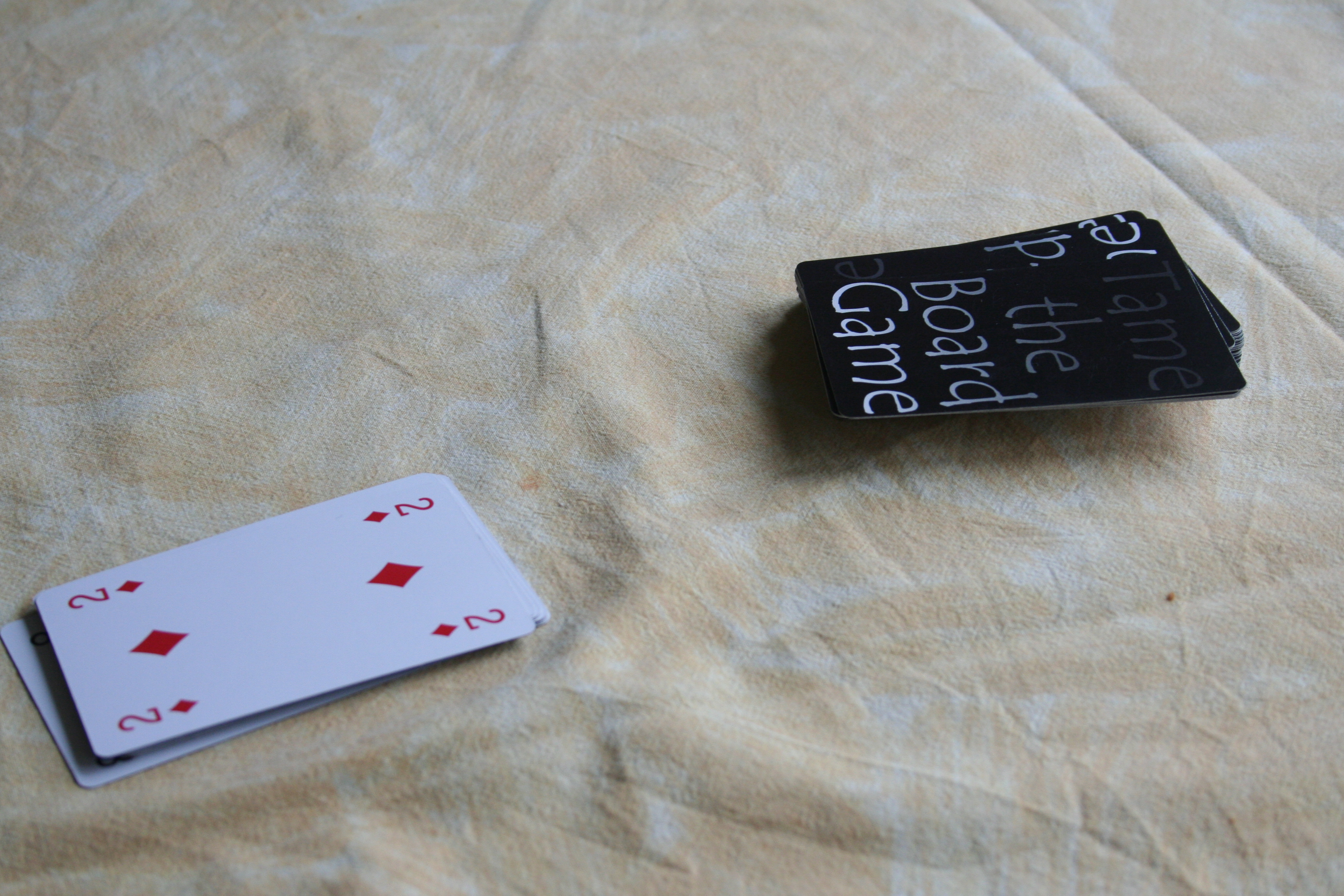
Appreciate our custom cards!

What’s In The Box:

Unlike most of the games we review this game only needs one thing:

1 x Standard 52 deck of cards

Playing The Game:

Objective: Don’t be the person holding all the cards at the end of the game!

Now there are quite a few variations of this game what with it being quite ambiguous and not actually having an official publication or official set of rules, so it’s up to the people playing it to decide what to play by. But here’s how we play it:

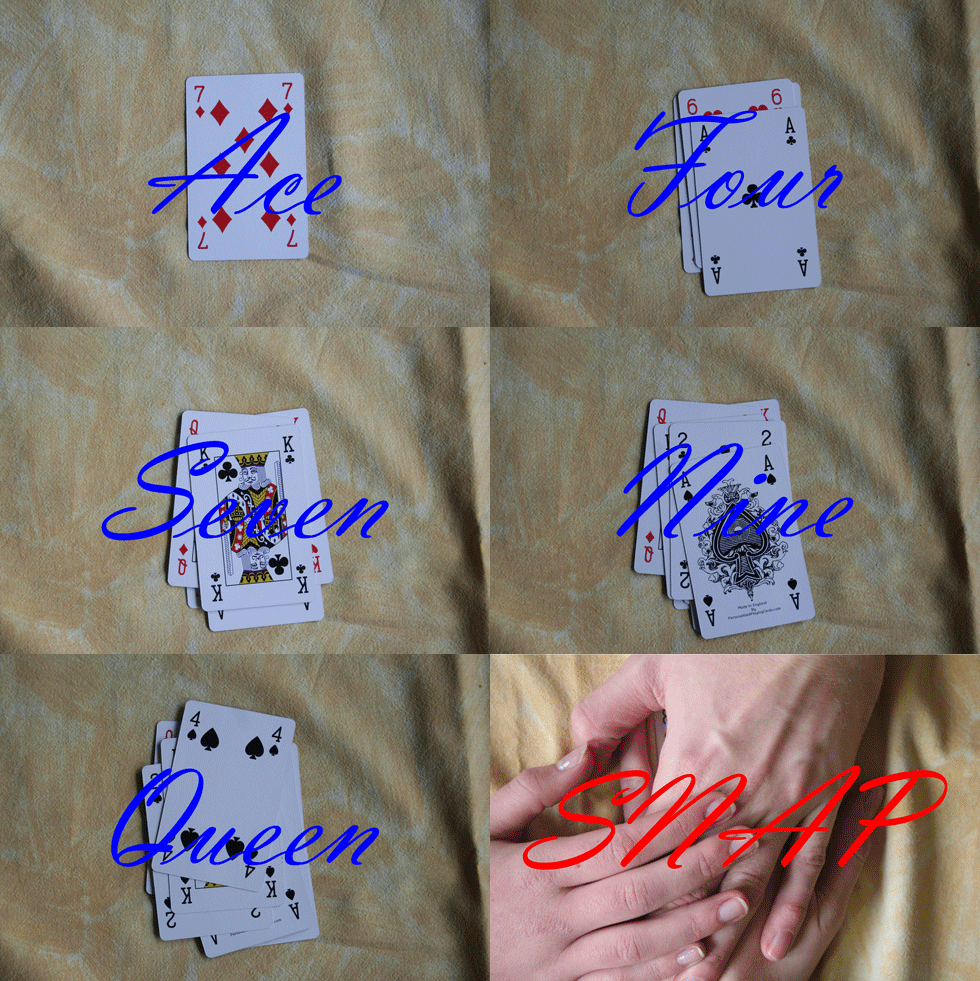
The basic principle is the same as Snap (I hope you are all familiar with the concept of Snap – although its real name is Slapjack). The difference between it and snap is that it’s the card that matches what the person is saying rather than the card under it. So the cards are split, face down, equally between players. The first player puts a card in the centre and says Ace, now if the card is an Ace hands go in, the last hand in is the loser and picks up the cards. If its not an Ace the next person puts a card down face up and says Two, if it’s a two hands go in, if not play continues to Three, Four etc. all the way to King and then back to Ace. The picture below should demonstrate what I mean:

You only snap when the card put down meets the card said.
You only snap when the card played is the same as what was said

Now in addition to this you can also choose to snap on actual snap cards, say someone puts a ten down and the next card is also a ten. The game gets interesting when people start to lose all the cards. The person who loses all their cards is NOT the winner, in fact they’re not even out of the game, they still have to say the right card when it comes round to them and their hand still has to go in when snap happens. This way a player can go through phases of having and not having cards multiple times in a game. The game is only over when only one person is left with all the cards in their hand. So even when there’s only one person, or even in a rare case where no one is playing any cards the game is not over until the final snap and one person is left with the whole deck.

For a more concise and directly playable version of the rules see here.

Additional Rules:

These rules you may only want to introduce after playing it a few times:

  1. Flinching – if a person flinches they have to pick up all the cards.
  2. Pace – You have to keep a steady fast rhythm to the game and if you break it by forgetting what you’re supposed to be saying or by not noticing it’s your turn you have to pick up.
  3. Queens – Some rules state that you snap on a Queen too, but this is really up to you.
  4. Change of direction – When Jacks are played (or a card of the players choosing) the direction of play changes.
  5. Word confusion – Changing the word for some of the cards to something obscure and if a player forgets this when saying it they have to pick up.
  6. DRINKING! – This is the most obvious additional rule (it being called Irish Snap and all) but the player who picks up has to drink.

Variations:

  1. Winning – The first and most major variant is that players to lose all their cards are actually out of the game and win… I personally believe this version is for losers with no real commitment.
  2. No speaking – Numbers are counted in your head and you snap in the same way you would if they were said. Makes it much harder as you have to pay even more attention. I tried an interesting variation of this rule (sort of) where half the people playing were Polish and they said the cards in Polish and the English people said them in English… It got very interesting.

Strategy:

  1. HAVE QUICK HANDS! – There is very little strategy that can actually be applied to this game except having quick hands and not getting distracted!
  2. DRUG THE OTHER PLAYERS! – We don’t actually suggest this… But it would help. Also keep in mind you just want to make them a bit slow, not knock them out.

To Conclude:

Ok, the loss of life may be a bit extreme.

First of all take heed of the picture above, this is why the drinking version is good… After a while you start to not feel the pain – but this also how hands are lost.

Note I have not put a “History and Interesting Things” section in this post; that’s because this game doesn’t seem to have a history. Well it probably does, but not a documented one, so if anyone knows anything interesting about it or finds anything beyond my lazy research capacity then please let me know in the comments. I would strongly advise playing this game, it’s only a 2 or 3 out of 5 on a purely objective level but is also a 5 out of 5  because of the huge amount of fun and endless hours of entertainment it has given me.


Pit

3 - 5


Number of Players: 3-8

Year of Publication: 1903

Creator(s): Edgar CayceHarry GavittGeorge S. Parker (Designers) and Randy AsherPaul CoutureOlivier FagnèreNick the Rat (Artists)

Corner the Market!

Pit is an interesting trading game. It’s got very few rules and can be played in any amount of time as the winner is the first person to reach a pre-determined amount of points. So games can be very very quick. Although the game is 3-8 players you should definitely opt for 8 if you can get the people, the more people, the better with this game.

What’s In The Box:

The stuff!
The stuff!
  1. One Pit “Corner” card
  2. One 72 card deck (8 suits of 9 cards)
  3. One “Bull” card and one “Bear” card

Playing The Game:

Objective: To be the first player to score 500 points by cornering the market on a specific commodity.

There are two ways of playing this game, basic, and slightly less basic. The only difference between them being that in the basic version the Bull and Bear cards are removed from the deck before play starts.

Setting Up:

  • Place the Pit Corner board in the middle of the table.
  • Prepare a score sheet.
  • Select a dealer and prepare the deck. The dealer takes one complete suit for every person playing (it’s not in the rules to do this, but we usually play with the highest-scoring suits) and shuffles them, together with the Bear and the Bull if they’re in play.
  • Deal 9 cards, face-down, to each player.

Once all this is done players can then look at their cards and choose which commodity they’re going to collect. It’s best to go for whatever you currently have most of in your hand. Once everyone’s had a chance to look at their cards the dealer announces “The Exchange is open!” It’s not compulsory, but you can do this with as much bravado as you like, just for fun.

Now the Pit is open players can trade cards. You can choose any number of cards from your hand and hold them face down in the centre of the table, you then announce the number of cards you want to exchange this is generally very noisy. You can then trade with any other player offering the same number of cards. If no one’s offering the same number you may want to higher or lower the number of cards you’re exchanging.

This continues until one player has all nine of one commodity in their hand. They then hit the Pit board in the center and announce “Corner on (insert commodity here)!” When playing without the Bear and Bull, the only player who scores is the one to hit the board. They score the amount of points shown on the cards of the commodity they collected, for instance, a corner on Corn would give that player 75 points. The winner of the hand then reshuffles the deck and deals the next hand.

Playing with the Bull and Bear:

When you add these cards in two players will receive 10 cards instead of 9 in the initial dealing. They can then call corner if they have all nine of one commodity and one of another, simply discarding the extra card when they lay down their hand to show the corner. The game is played as normal, but with these two difference:

The Bear is always a bad card, and you should try and get rid of it as soon as possible if you’re dealt it or traded it. If you hold the Bear, but have all nine of one commodity in your hand, you cannot lay it down whilst you hold the Bear, and if another player goes out whilst you have it you receive a penalty of -20 points, even if your current score is 0.

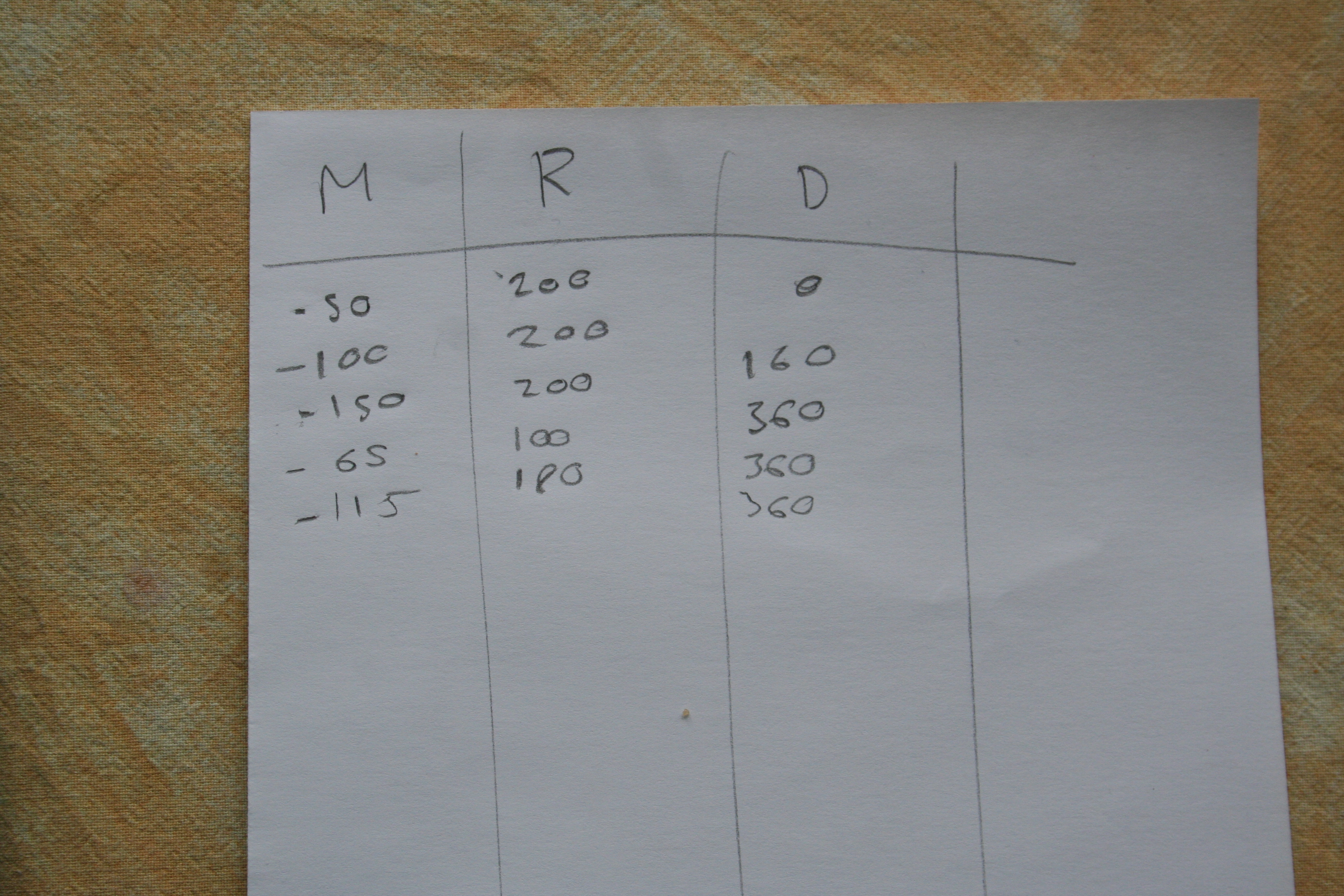
Our score sheet halfway through the game.
Our score sheet halfway through the game. I was spectacularly losing.

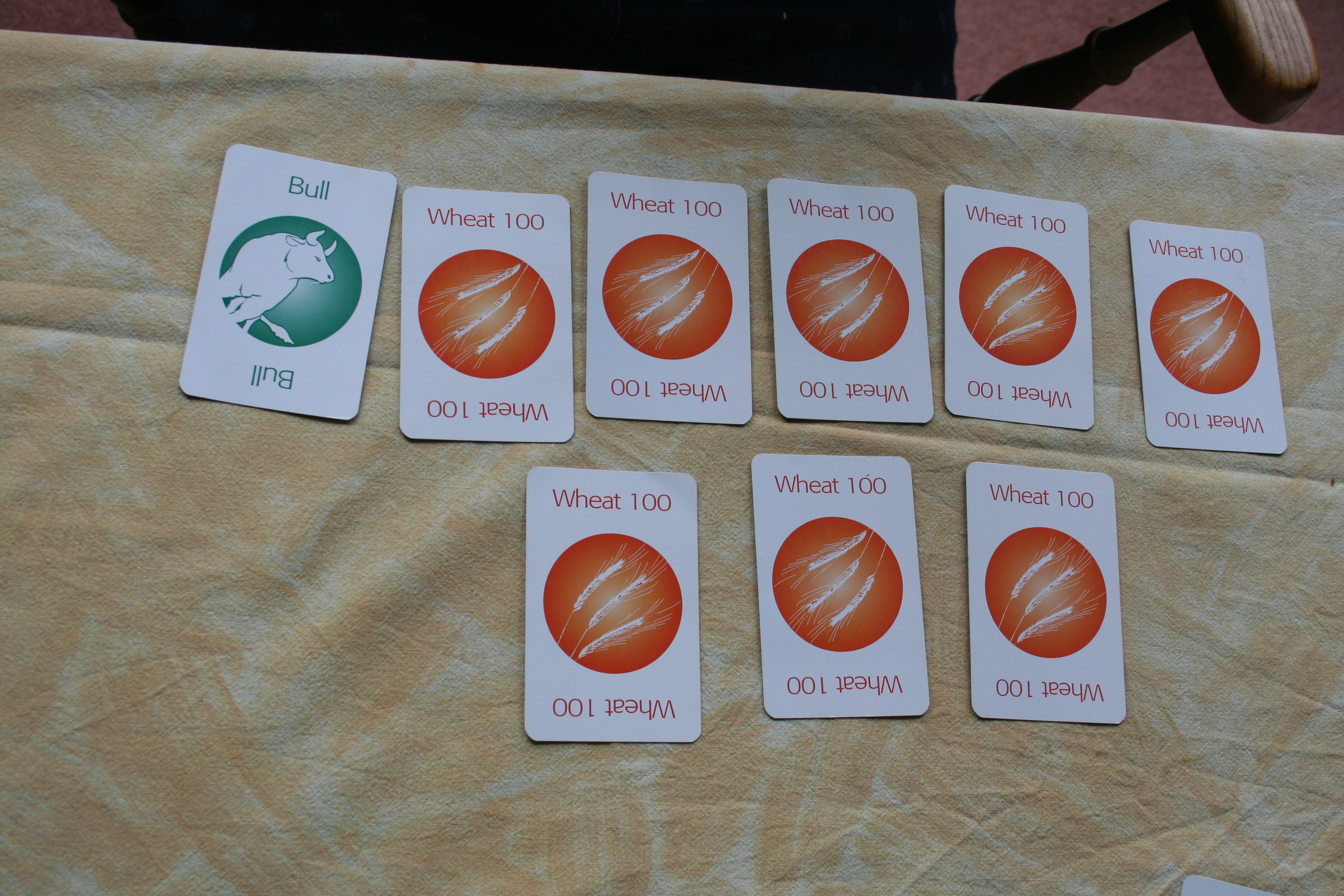
The Bull is a wild card and can be good or bad. If you’re holding the Bull and you call corner, your score is then doubled. However, if you’re holding the Bull and someone else calls corner, you minus 20 points, as if you were holding the Bear. With the Bull you can go out if you only have eight of the commodities you were collecting and the Bull, as only two players would be able to collect the full nine.

A winning corner on Wheat, with the Bull. Whoever laid this down scored 200 points.

If someone calls corner and you’re holding the Bull and the Bear, your penalty is -40 points. If you’re unlucky, you can end up getting to fairly high minus numbers when playing with the Bear and Bull. You can trade the Bull and the Bear individually, or in combination. But you can never trade more than four cards at a time.

Strategy:

There’s no strategy to this game. Get rid of the Bear fast, and try and trade the Bull if you suspect the round might be about to end by someone else calling the corner. Other than that, try and trade as fast as possible and hope no one else is trying to collect the commodity you want!

History and Interesting Things:

  1. It was first sold in 1904.
  2. The inspiration was the Chicago Board of Trade.
  3. The game has been marketed under all of the following names: Billionaire, Business, Cambio, Dulux pit, Quick 7 and Zaster.
  4. Versions of the game published, starting in 1970, included a bell to start trading.

To Conclude:

This game’s fun, quick and easy, and you can teach it to anyone! It’s a fantastic family game, or just a quick one for playing with a bunch of friends.


Poker – Five Card Draw

4 - 5

Number of Players: 2 – 10

Year of Publication: 1810

Creator: Unknown

Poke-Her:

So the time has come to review the almighty Poker. Now I must admit to not actually being able to play poker before learning it to write this review. This is not to say I hadn’t played it before, I had a couple of times, but always while being guided like a baby by people who were already in the know. I find this is a bad way to learn games because as well as learning the rules you tend to learn things that aren’t the rules and are just made up by these people, but they’ve convinced themselves they are the rules, and also things that are part of the rules get forgotten. As I’m sure some of you are aware there are like a million different versions of poker, but this is a review specifically of the five card draw version. We will endeavour to play and review all versions of poker in the future (over the next 20 – 60 years) but we thought this was a good starting point.

What’s In The Box:

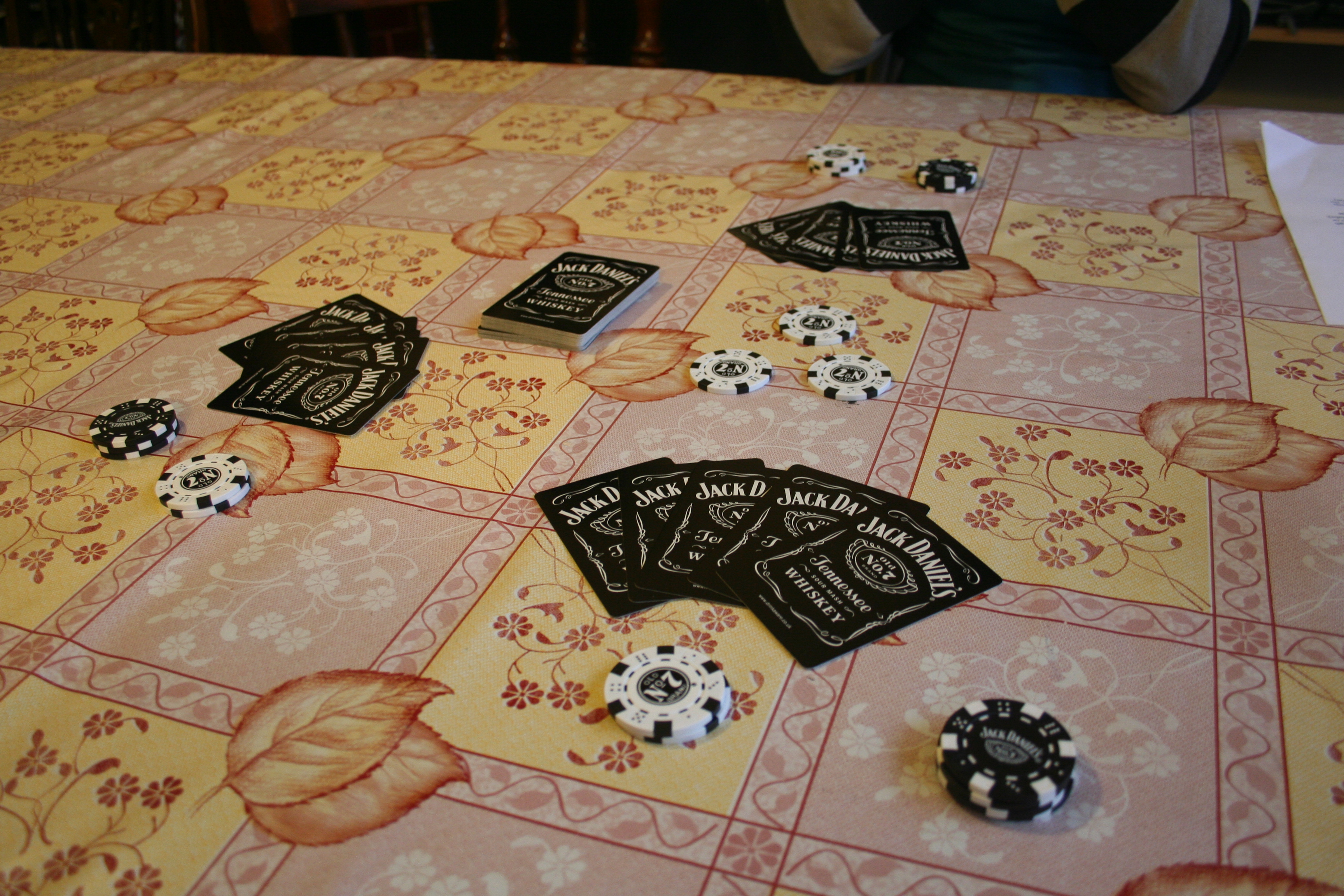
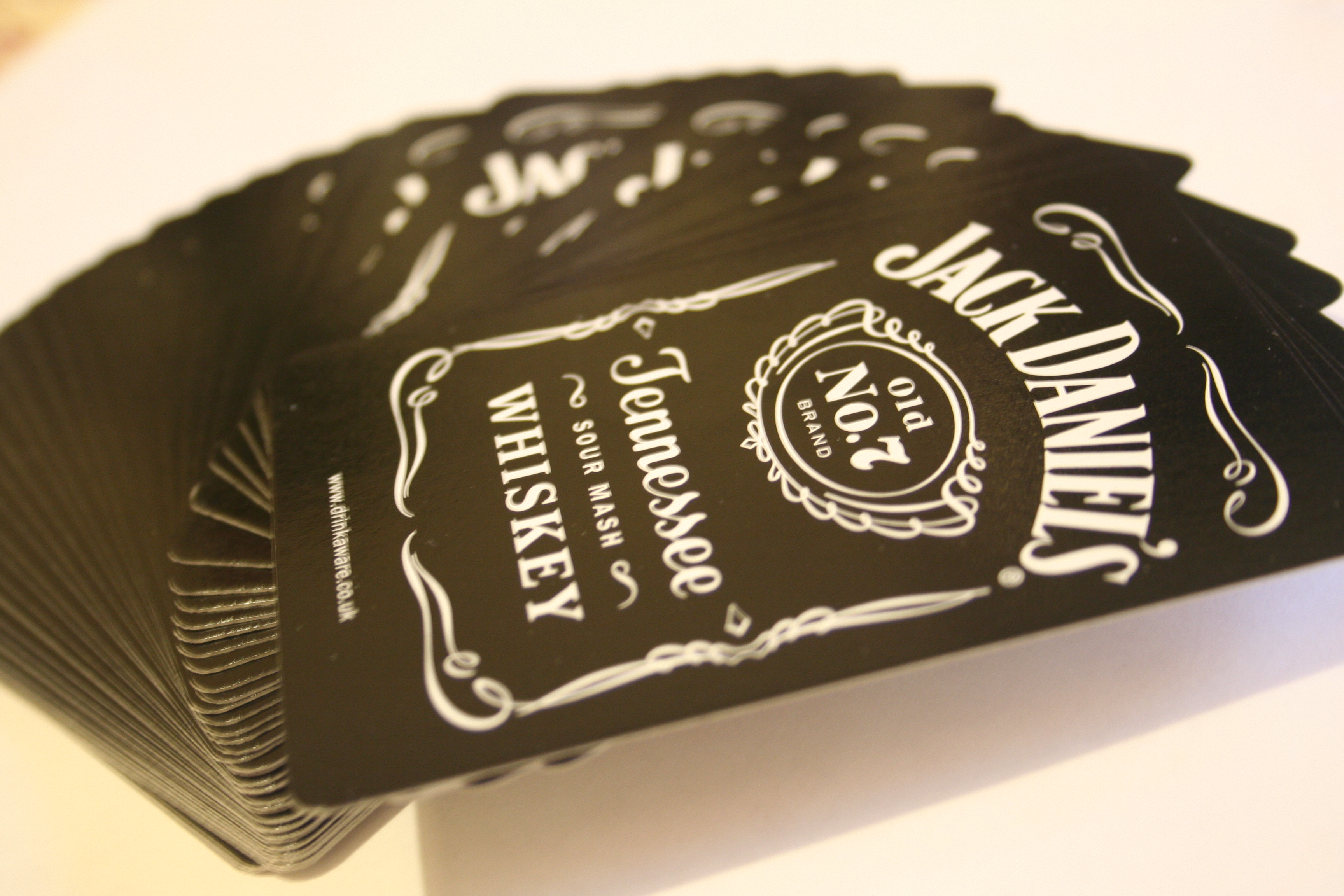
Card from our amazing Jack Daniel's poker cards.
Cards from our Jack Daniel’s poker set.

To play poker all you really need is a standard 52 card deck. However, we used our Jack Daniels Poker Set which contained:

  1. 1 52 deck of Jack Daniels Cards.
  2. 10 x Black Chips.
  3. 10 x White Chips.
  4. 1 x Small Bottle of Jack Daniels Old No.7.

Playing The Game:

Objective: To have the highest ranking hand after two rounds of betting. Also to take all the other peoples money, until everyone else goes bust.

Now for a good and clear set of exact rules to this game see here (these are the rules we learnt from).

To start choose to play the game either with or without betting. It’s far more fun with betting:

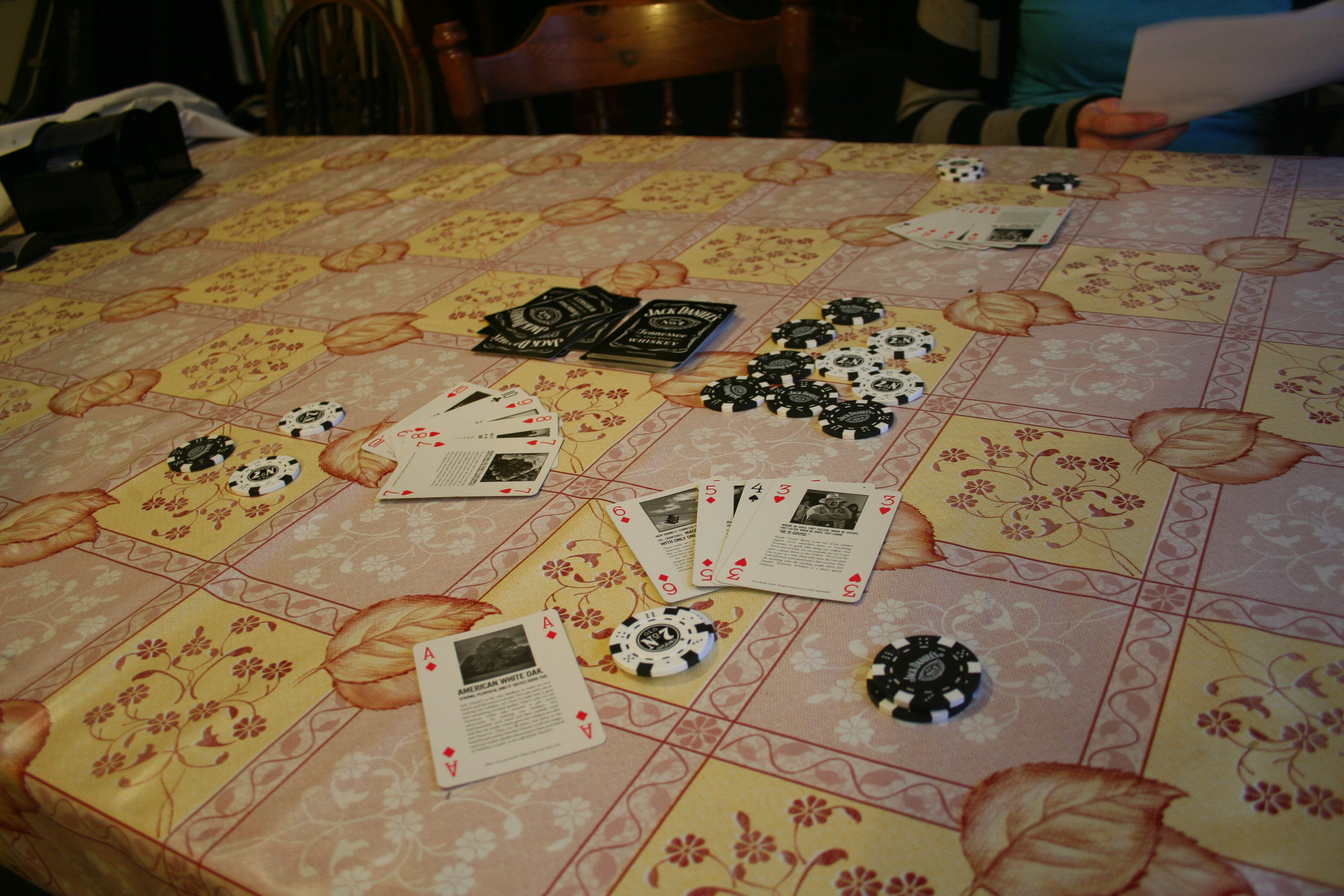
The Stuff.
The starting set up.

With betting you set a starting bet, which is the bet everyone has to put down just to be dealt cards. We set it as one white chip and we decided black chips where worth two white chips. Once the starting bet is placed by everyone five cards are dealt to each player by the dealer. The players then look at those cards and, from the left of the dealer, choose to either:

  • CALL – The player decides to match whatever’s already in the pot. If no one has put anything extra in the pot this means they put nothing in.
  • RAISE – The player decides to raise the pot (normally you set a maximum raise, we set it as one black chip). They do this by adding more money to it. Any player who then wants to stay in the round has to match the amount they’ve added.
  • FOLD – The player decides there’s no point continuing with the round and folds by not matching the raise in the pot and puts their cards face down on the table, taking care not to show any of the other players their cards.

After that round of betting anyone who owes the pot anything (because it was raised after their turn to bet) decides whether to call it or to fold. Then each player, from the left of the dealer, then has the chance to switch up to three cards in their hand. Once each player has done this another round of betting is done, exactly like the first, and then cards are revealed.

The Reveal.
The Reveal.

The person with the highest hand wins the round and claims the pot. The hands are (listed from highest to lowest):

Five of a Kind –  A five of a kind (which is only possible when using wild cards) is the highest possible hand. If more than one hand has five of a kind, the higher card wins (Five Aces beats five kings, which beat five queens, and so on).

Straight Flush – A straight flush is the best natural hand. A straight flush is a straight (5 cards in order, such as 5-6-7-8-9) that are all of the same suit. As in a regular straight, you can have an ace either high (A-K-Q-J-T) or low (5-4-3-2-1). However, a straight may not ‘wraparound’. (Such as K-A-2-3-4, which is not a straight). An Ace high straight-flush is called a Royal Flush and is the highest natural hand.

Four of a Kind –  Four of a kind is simply four cards of the same rank. If there are two or more hands that qualify, the hand with the higher-rank four of a kind wins. If, in some bizarre game with many wild cards, there are two four of a kinds with the same rank, then the one with the higher card outside the four wins. General Rule: When hands tie on the rank of a pair, three of a kind, etc, the cards outside break ties following the High Card rules.

Full House –  A full house is a three of a kind and a pair, such as K-K-K-5-5. Ties are broken first by the three of a kind, then the pair. So K-K-K-2-2 beats Q-Q-Q-A-A, which beats Q-Q-Q-J-J. (Obviously, the three of a kind can only be similar if wild cards are used.)

Flush –  A flush is a hand where all of the cards are the same suit, such as J-8-5-3-2, all of spades. When flushes tie, follow the rules for High Card.

Straight – A straight is 5 cards in order, such as 4-5-6-7-8. An ace may either be high (A-K-Q-J-T) or low (5-4-3-2-1). However, a straight may not ‘wraparound’. (Such as Q-K-A-2-3, which is not a straight). When straights tie, the highest straight wins. (A-K-Q-J-T beats K-Q-J-T-9 down to 5-4-3-2-A). If two straights have the same value (A-K-Q-J-T vs A-K-Q-J-T) they split the pot.

Three of a Kind – Three cards of any rank, matched with two cards that are not a pair (otherwise it would be a Full House). Again, highest three of a kind wins. If both are the same rank, then compare High Cards.

Two Pair –  This is two distinct pairs of cards, and a 5th card. The highest pair wins ties. If both hands have the same high pair, the second pair wins. If both hands have the same pairs, the high card wins.

Pair – One pair with three distinct cards. High card breaks ties.

High Card – This is any hand which doesn’t qualify as any one of the above hands. If nobody has a pair or better, then the highest card wins. If multiple people tie for the highest card, they look at the second highest, then the third highest etc. High card is also used to break ties when the high hands both have the same type of hand (pair, flush, straight, etc).

Hand descriptions loving borrowed from: http://www.contrib.andrew.cmu.edu/~gc00/reviews/pokerrules

As you may have gathered from those descriptions you can play with the jacks as well, these are wild cards and allow the Five of a Kind had to be played. Also you can play Aces high or low depending on how you’re feeling.

Strategy:

Now there are whole books on poker strategy and the art of reading a persons tell, etc. But I’m not even going to pretend to know even 0.001% of that information. HOWEVER, this is a list of things you should keep in mind when playing with very low level amateurs:

  1. THEY’RE PROBABLY BLUFFING – The other player is probably bluffing because it’s far more fun than not bluffing, especially if you’re not betting anything of real worth. They’re almost definitely going to bluff rather than go out.
  2. KNOW WHICH HANDS ARE WORTH WHAT – This is hardly a strategy comment more a comment of common sense, but having just learnt the game I made quite a few mistakes by not knowing what was worth more that what.
  3. DON’T BET ANYTHING OF WORTH – If you’re learning the game don’t go straight into high stakes betting, it’ll just make you hate each other and give the person who wins false confidence is their poker skills.

History and Interesting Things:

Again there’s whole books full of history and interesting things on poker so I’ll just cover a few:

  1.  One of the earliest recorded uses of the game is by Joseph Cowell who wrote that it was played in New Orleans in 1829 with a 20 deck of cards.
  2. The exact origins of the game are uncertain.
  3. While there are a LOT of different versions of poker there are only four main categories of poker and these are; Straight poker, Draw poker (what this is, as the name might tell you), Stud poker and Community Card poker.
  4. It is possible the most popular card game of all time.
  5. It is probably the most popular gambling game of all time.
  6. It has featured as plot devices in many films and books including the James Bond film/book Casino Royale and in many other Bond films. It has also been shown as a common recreational activity in films and TV shows alike. For example in Star Trek: The Next Generation and the film How to Lose a Guy in Tew Days.
  7. The example of poker in film and TV mirrors the spike in interest in it that happened in the 21st century. With the introduction of online poker and hole-card cameras it became a spectator sport and something you could do from the comfort of your own home.
  8. With this spike and the ability to make it a spectator sport many poker tours emerged, including World Poker Tour and European Poker Tour, both of which were televised.
  9. In 2009 the International Federation of Poker was founded to be its governing body and to promote it.
  10. They then launched two new events; The Nations Cup which was held on the  London Eye and The Table which featured 130 of the best poker players in the world.

To Conclude:

Poker is an interesting game and I can see why it has mass appeal. However, can someone please explain to me the appeal of online poker? Apart from the fact you don’t have to get out of the chair by your computer or off your bed with your laptop why would you gamble with people whose faces you can’t see? Does that not defeat the whole point of trying to read peoples tells and take away a large part of the whole psychology of the game? Correct me if I’m wrong.

Also, we all know Casinos fix games in their favour (and who can blame them? It would’t make a very good business if they didn’t) but to gamble online in any form is surly to leave yourself open to an even larger con? I could write a fixed version of any gambling game as a computer program in like a day and I’m a bad programmer. With poker there’s less of a fear of this because everyone playing is supposed to be a real person and there is no “house” to take the money… Eccept how do you know all these people are real and one of then isn’t the “house” and the game isn’t fixed in their favour? I’m half tempted to write a fixed version of poker, put it online, and see how many people I could convince to play it… Except then I could be arrested for all kinds of things… But it would make for a rather interesting experiment/business… But anyway, I have digressed.

Back to the point, poker is a good game, if you don’t know how to play it, learn as undoubtedly you’ll be somewhere with some people and they’ll be like “lets play poker” and you’ll be that one person who doesn’t know how to play and they’ll “teach you” but in that way where you only ever really pick up half of it.


Switch (Blackjack)

4 - 5

Number of Players: 2-lots

Year of Publication: Unknown

Creator(s): Unknown

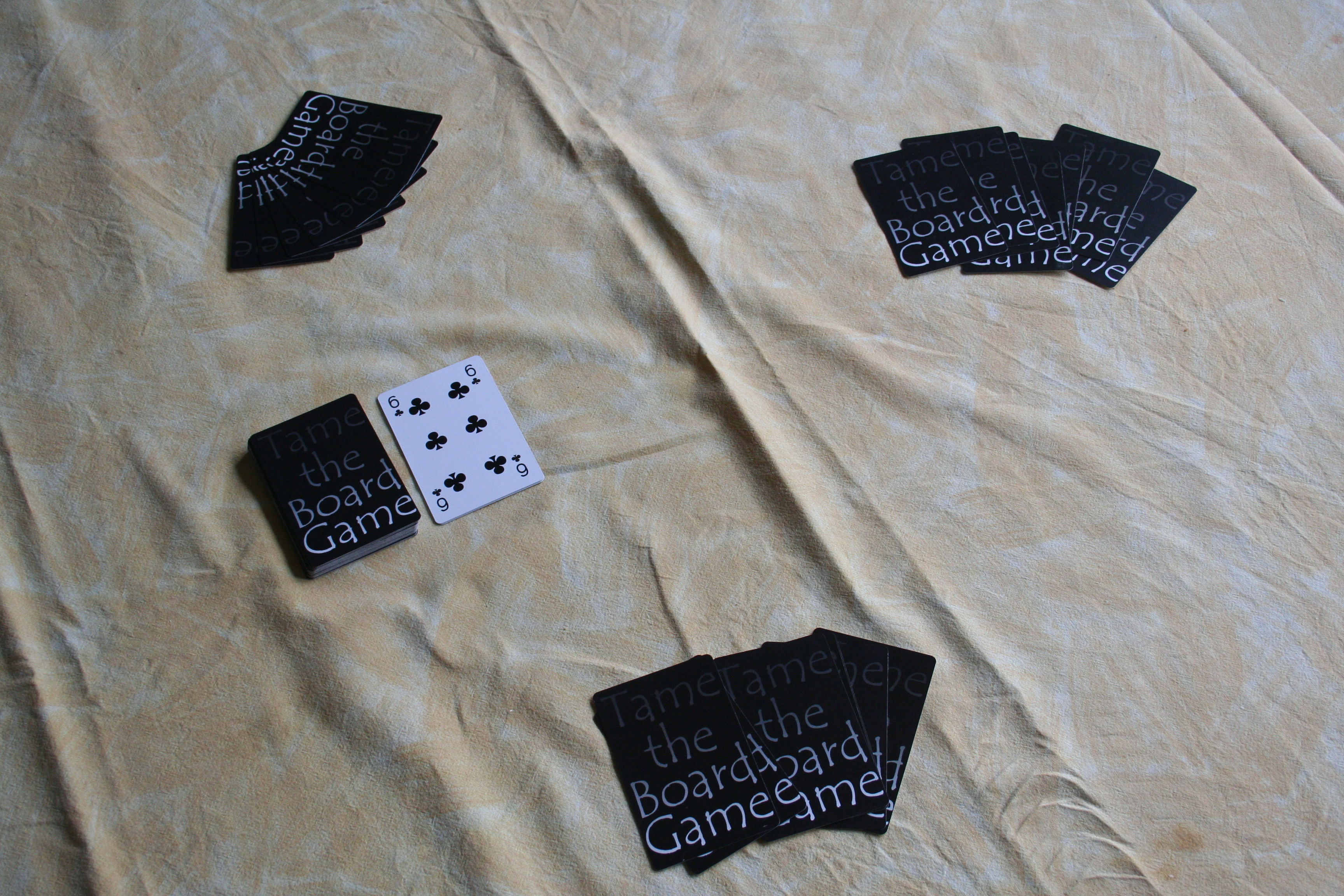
Appreciate Our Custom Made Cards!

Switch is one of the many versions of Black Jack around, we aim to cover them all between now and eternity, but that could take years, so don’t hold your breath for any exciting Blackjack posts any time soon. I think this game is good because it’s simple, can be played anywhere, and is very quick.

What’s In The Box:

Well, as it would transpire…. Nothing! All you need to play this game is a standard deck of cards, and at least two willing people.

Playing The Game:

Objective: To be the first to play all the cards in your hand.

So to start the game each player is dealt a hand, usually of seven cards. The remaining cards are placed face down in the middle of the table, and the top card is drawn to determine how play starts. If the top card is a Power Card, then another card is drawn until a card is revealed that has no other purpose in the game. The starting player (typically left of the dealer) should then find in their hand a card that matches either the suit or the rank of the face up card. If a player cannot play a card from their hand they must draw cards from the deck until they can.

The starting set up for Switch.
The starting set up for Switch. Appreciate our custom made cards!

Power Cards:

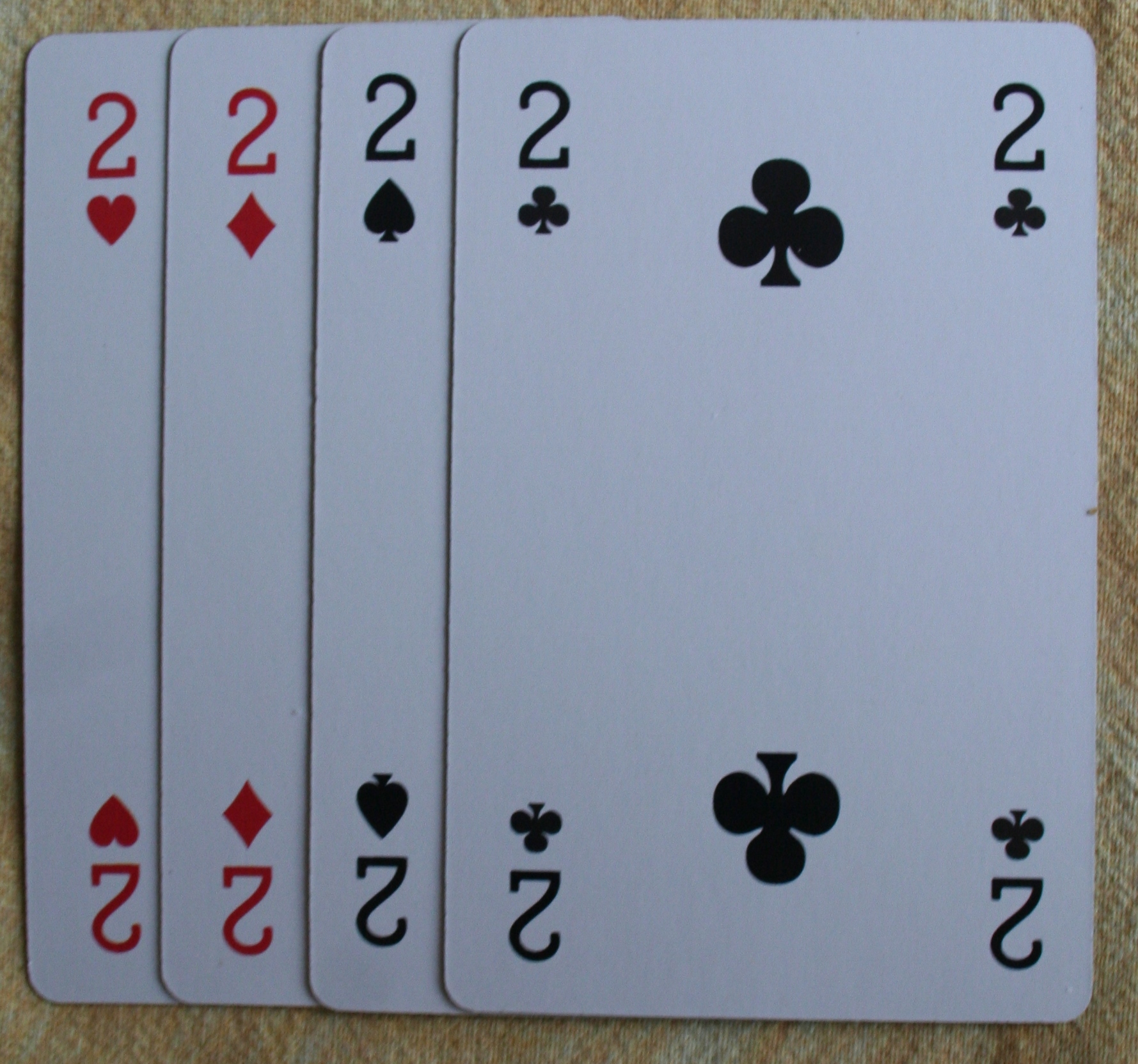
  • 2 – if a player places a two in their turn the player next to them then has to draw two cards, unless they have a two in their hand, they can then play this and make the player next to them pick up four cards. This can continue round players until all four twos are played if possible, forcing the last player to pick up eight cards. The player that has to draw cards also forfeits the right to play any cards that turn.
Twos!
Twos!
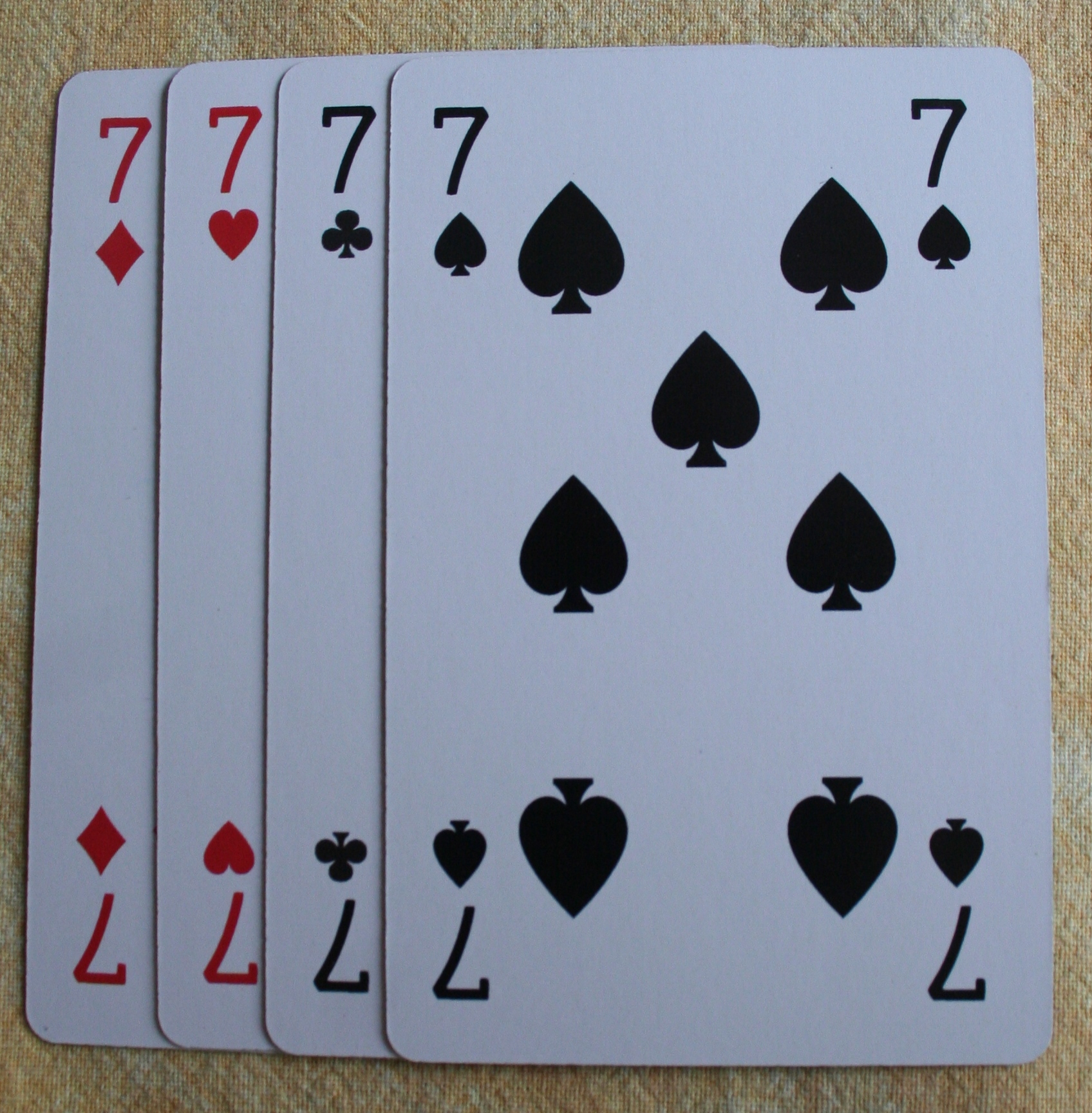
  • 7 – a seven must be covered, so the person who played it must put another card of the same suit over it, or pick up a card if they cannot. If they pick up the next player must then cover the seven, or draw a card, this continues until someone has managed to cover the card.
Sevens!
Sevens!
  • 8 – when played eights make the next player miss their turn. There is an optional rule that allows that player to also play an eight, passing the missed turn on in the same way stacking two’s works, with the last player who cannot play an eight missing the same number of turns as there are eights in play.
Eights!
Eights!
  • 10 – reverses the direction of play.
Tens!
Tens!
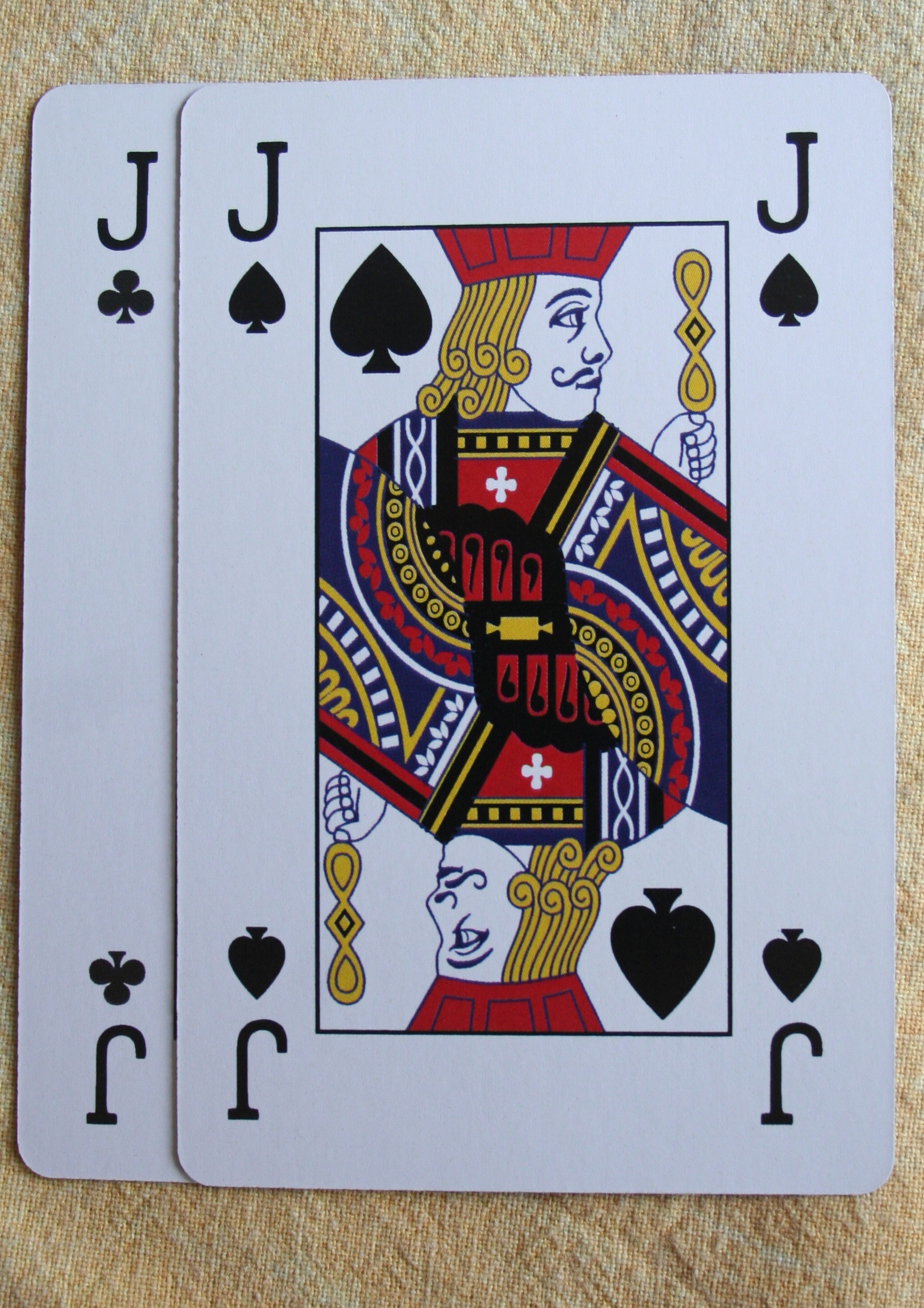
  • Black Jacks – a black jack is similar to a two, when it’s played the next player must pick up five cards or play the other black jack, which would then make the next player pick up 10 cards.
BLACKJACKS!
BLACKJACKS!
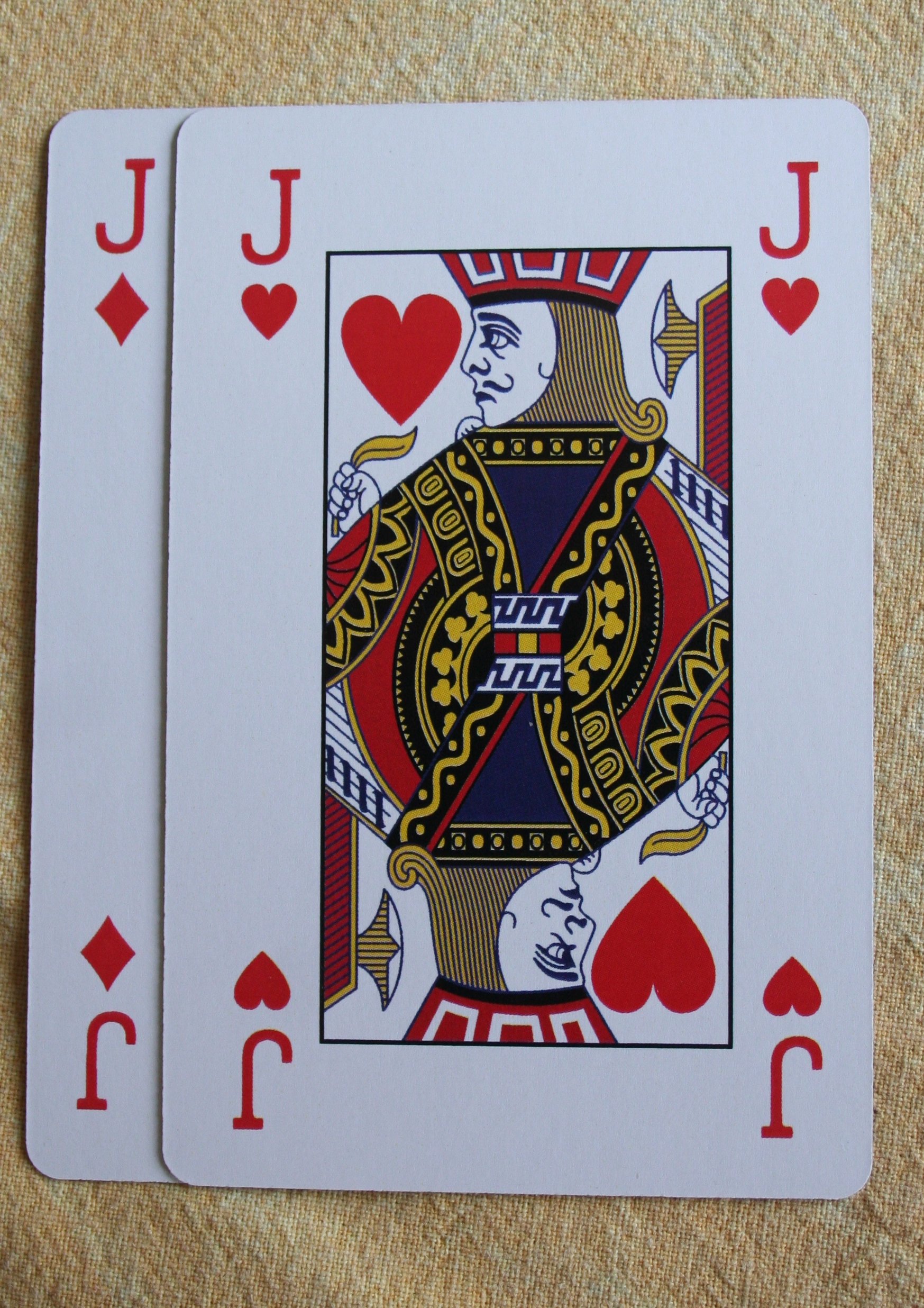
  • Red Jacks – a red jack can be used to cancel out a black jack, if two black jack’s are in play then to cancel them both you must play both red jacks.
Redjacks!
Redjacks!
  • Ace – an ace can be played onto any card, irrespective of suit or value, whoever played the ace then chooses which suit play will continue in, and the game carries on, but with the new suit instead of whatever was being played before.
Aces!
Aces!

Winning The Game!

The first player to play their last card immediately wins the game. However, to win you must call LAST CARDS as soon as you are able to go out, this must  be noticed by other players. If you fail to do this and then play your last card you must pick up another card. Play also cannot end on an  Ace, if you finish with an Ace you must pick up another card.

History and Interesting Things:

There’s not a lot of history going on for this game, but there are a few entertaining things I can tell you:

  • There’s a variation of the game called Peanuckle in which player with only two cards left in their hand must say “peanuckle”, and a player with only one card left must say “supper-peanuckle”. I have no idea why this is, but this is the way of it.
  • There are loads of variations of Black Jack, most of which are played in Casinos around the world, like 21 Blackjack, also known as Pontoon.
  • We were familiar with this game before we decided to write about it, but the variation we’d previously played had slightly different rules and Power Cards.
  • Three points is two more than I thought I’d write, so I’m doing well!

To Conclude:

A good game, I like it a lot because it’s easy to learn and you can play it anywhere with anyone. I also like that there are so many variations of it, makes it always interesting to play. Although, because there are so many variations of the game it can lead to interesting disputes over Power Cards and rules regarding winning the game. We played with a bunch of people when we were in Brazil and we had three different ideas of what the rules should be. There had to be a little bit of universal rule deciding before we could start playing.

The most comprehensive information I found on this game was on Wikipedia, but most of it’s in this blog post. Annnnnnnd, yeah, that’d be about it, have fun playing cards!


Spartacus: A Game of Blood and Treachery

NOW SELLING THIS GAME HERE: https://www.ebay.co.uk/itm/Spartacus-A-Game-of-Blood-and-Treachery-Gale-Force-9-Board-Game-Good-Condition/283678724813

4 - 5

Number of Players: 3 – 4

Year of Publication: 2012

Creator: Aaron DillJohn KovaleskiSean Sweigart (Designers) and Charles Woods (Artist)

NO! I’m Spartacus:

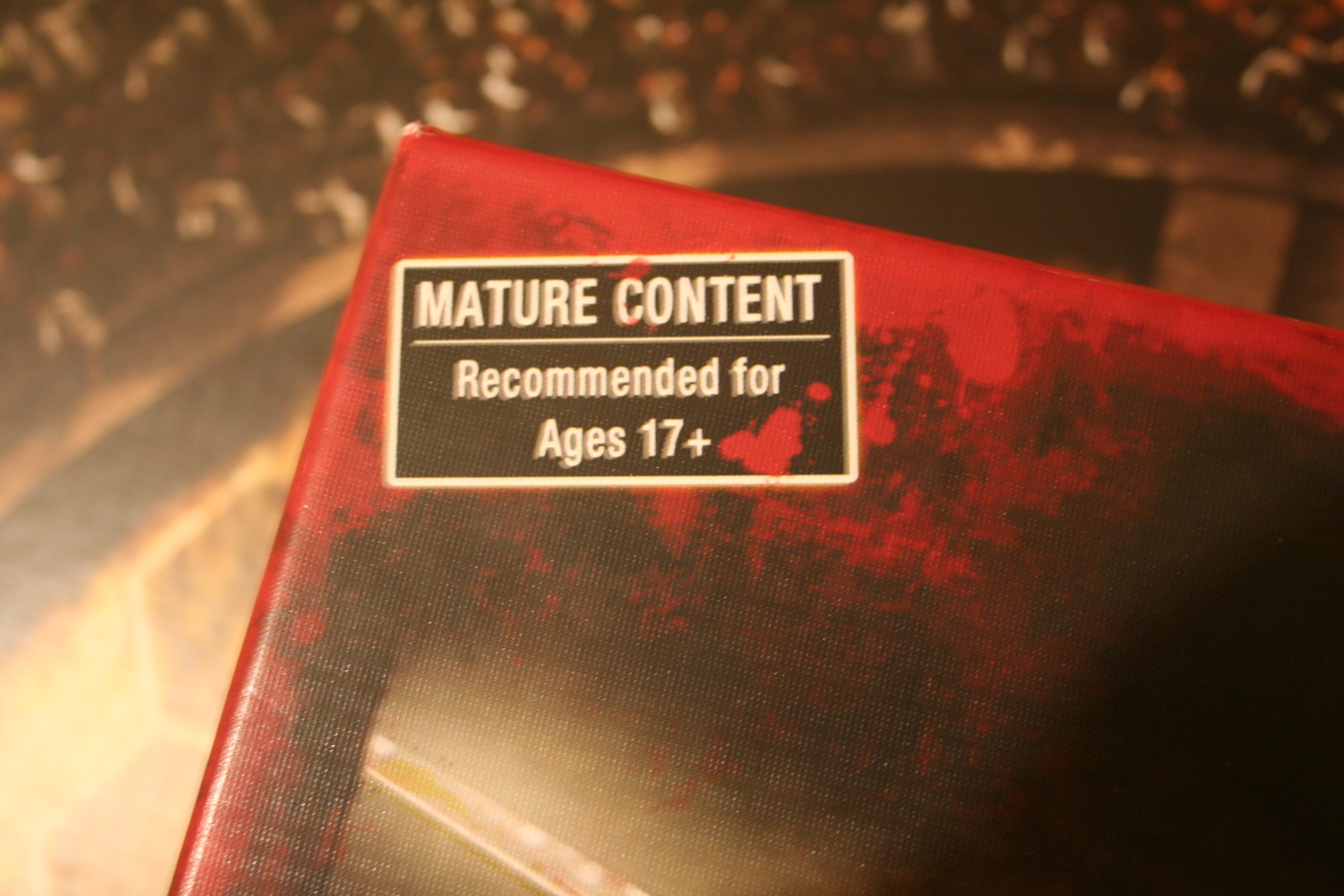
Spartacus: A Game of Blood and Treachery is a board game based on the TV series Spartacus: Blood and Sand ( which has a mini series prequel and is followed by Spartacus: Vengeance and Spartacus: War of the Damned and proceeded by a not so good Spartacus: Gods of the Arena). To reflect the style of the TV series this is the only game I’ve come across, to date, that has an age rating on it:

The age rating at the top corner of the box lid.

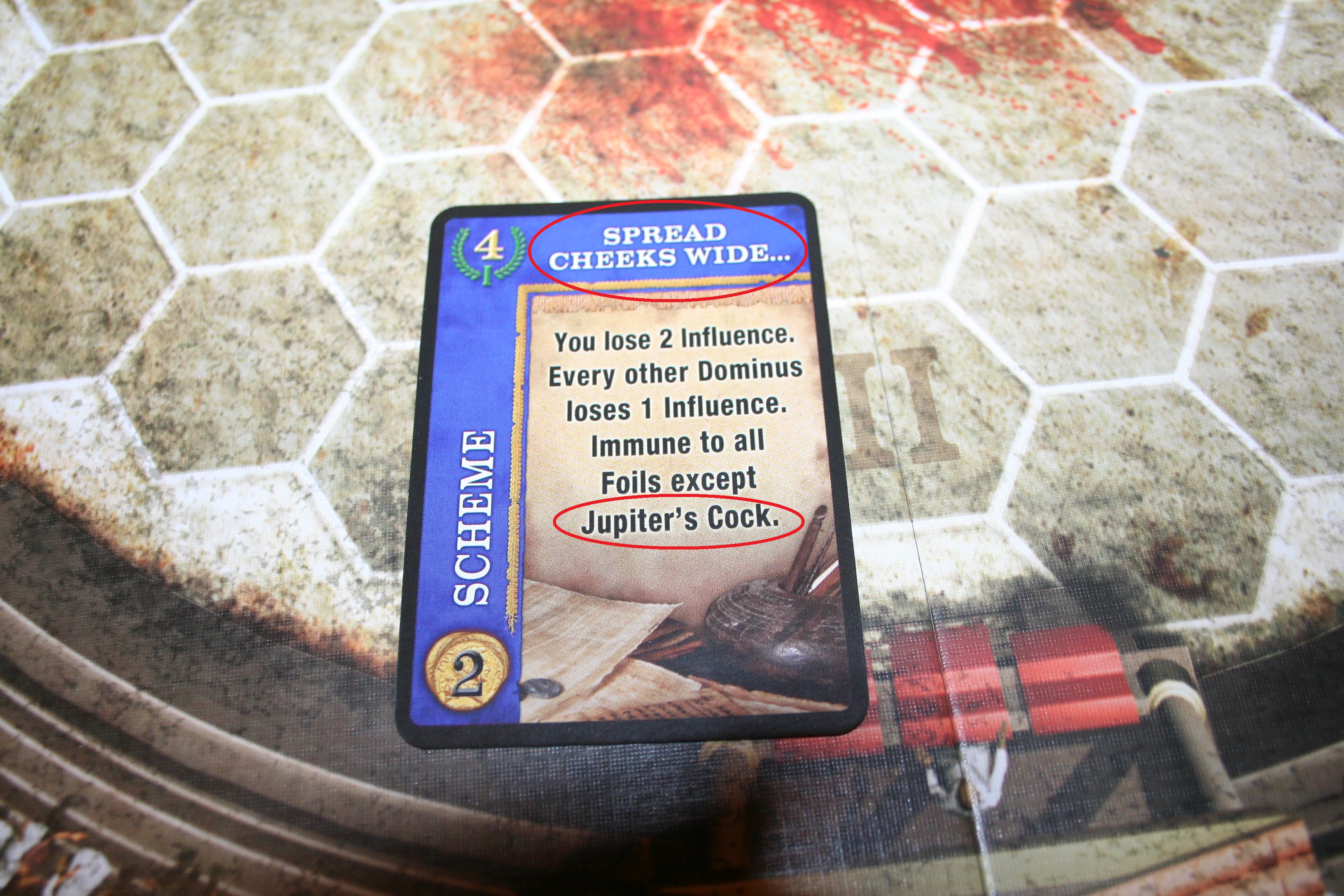
And because of this you get cards with things like this written on them:

This did make us laugh...a lot.
This did make us laugh… A lot.

Now unfortunately, being a big fan of the TV series this review is unlikely to be completely non- biased, I will however do my best to stay objective.

What’s In The Box:

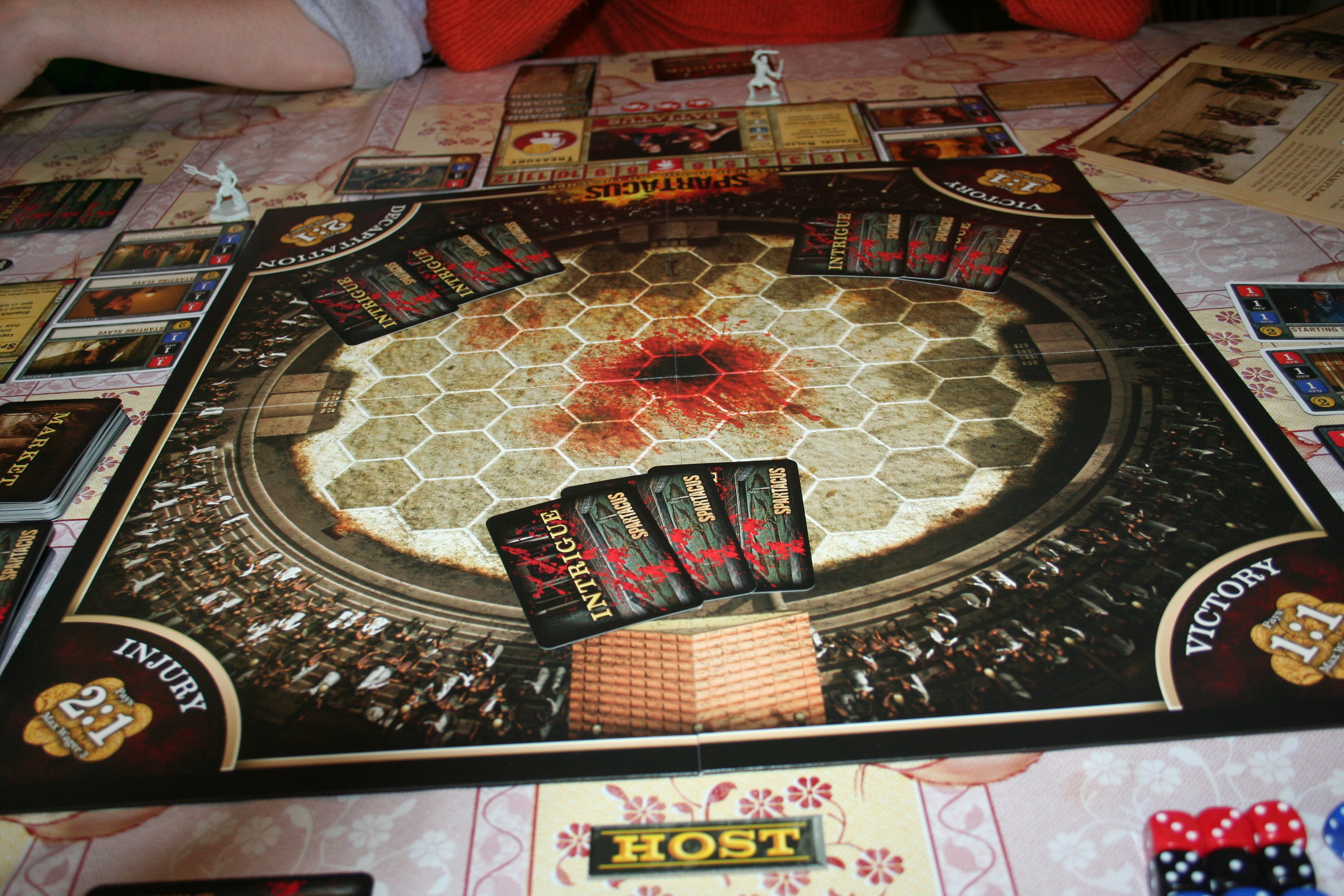
The Stuff!
The Stuff!
  1. Game board
  2. Rules Book
  3. 4 x House cards
  4. 62 x Market Cards
  5. 104 x Intrigue Cards
  6. 10 x Favor/Injured tokens
  7. 4 x Champion tokens
  8. 3 x House betting tokens (per house) and 1 x House marker (per house)
  9. 1 x Host marker
  10. 117 x Gold
  11. 4 x Gladiator figures
  12. 4 x Turn summary cards
  13. A lot of Dice (9 x Red, 9 x Black and 8 x Blue)

Playing The Game:

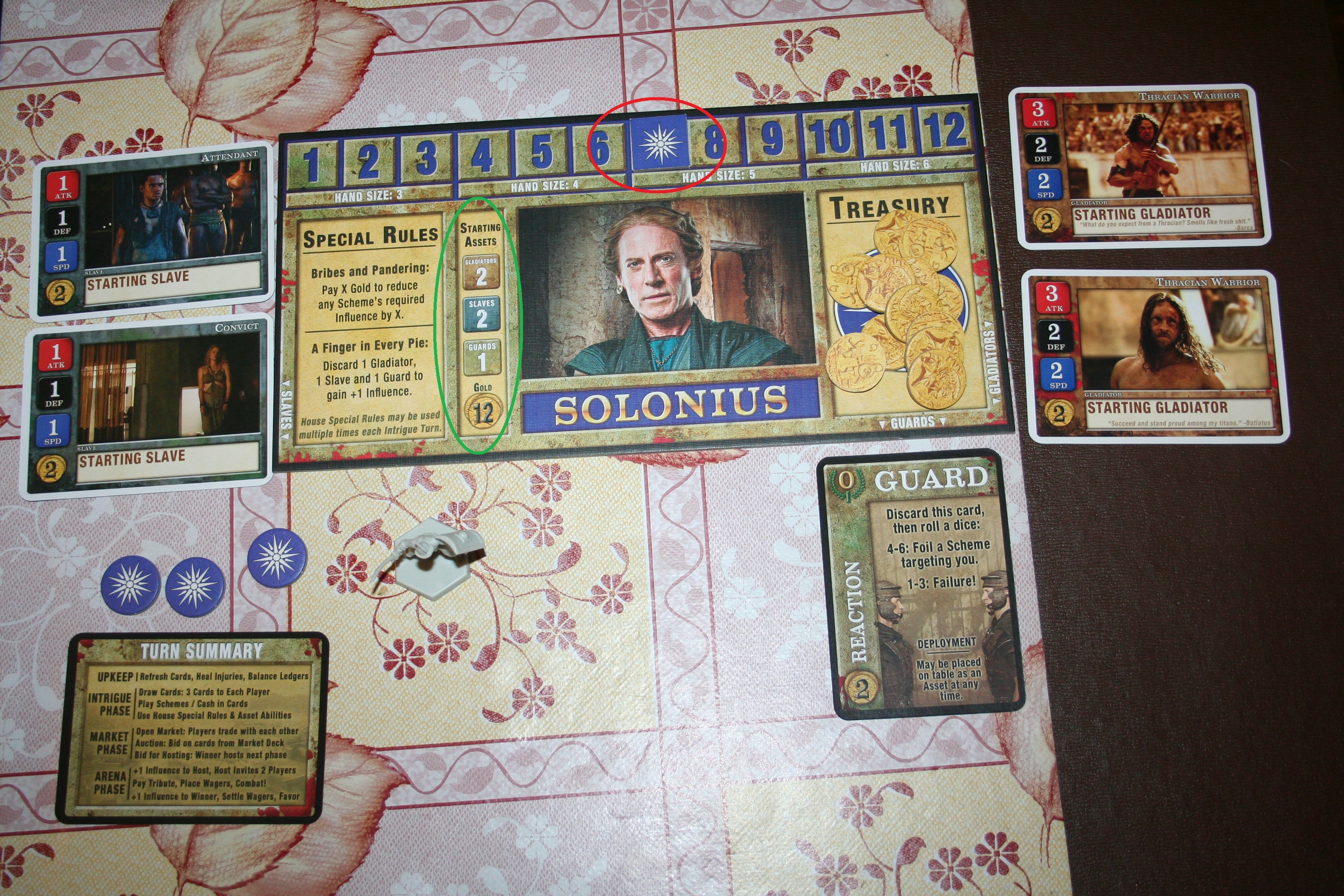
Objective: Be the first to raise your house influence to 12!

Depending on whether you want to play a Quick, Standard or Advanced game you set the starting amount of influence each house has to a different number:

  • Quick = 7
  • Standard = 4
  • Advanced = 1
Starting favor set to 7 for a quick game and the starting amount of things dealt out.
Starting influence is set to 7 for a quick game and the starting amount of things dealt out.

You then get dealt the starting number of items as dictated by your house card (circled green). So for Solonius that’s 2 Gladiators, 2 Slaves, 1 Guard and 12 Gold. Additionally each player gets one gladiator figure, their 3 house betting tokens and a turn summary card.

Now, every turn of play is made up of four sections:

  1. Up Keep
  2. Intrigue Phase
  3. Market Phase
  4. Arena Phase
Up Keep:

Up keep consists of three parts:

  1. Refreshing Cards – Any cards that have been exhausted in the previous round (so are face down) get turn back up so their abilities can be used again.
  2. Healing Injuries – Attempt to heal any injured gladiators or slaves by performing a healing role – on a role of 4 – 6 they are healed anything less and they stay inured.
  3. Balancing the Ledgers – You gain one gold for every ready slave you have and you must pay one gold to the bank for every ready gladiator you have – if you cannot pay (or don’t want to) you must discard the card that’s making you pay.
Intrigue Phase:

Intrigue consists of two parts:

  1. Drawing Cards – At the start of each intrigue phase each player draws three intrigue cards (players all receive three cards simultaneously).

    All Intrigue cards dealt.
    All Intrigue cards dealt.
  2. Playing Schemes/ Foiling Schemes/ Cashing in Cards – Some of the intrigue cards are schemes you can play against another Dominus (Latin word for master), cards that allow you to foil other schemes or get rid of an opponents guards. To play a Scheme you must have the right amount of influence  to play it (as listed on the card), if you don’t you can pair with another Dominus to play it by adding your influence together but beware; deals that are made can be easily broken. If someone plays a scheme against you you can foil it by using your guards and performing a dice role or you can play a scheme foiling card that are reactions to schemes and also require that you have the right amount of influence to play it. Finally if you don’t want some of you cards or can’t keep them (as your had size is dictated by the amount of influence you have) you can cash in cards for the amount written on them from the bank.
Market Phase:

This phase is made up of three parts:

  1. Open Market – At this point anything can be traded for anything for anything else. Except Intrigue cards, which cannot be sold.
  2. Auction – After open market is over each player conceals their gold in their hand and cards equal to the amount of players playing are drawn face down on to the board. The first card is flipped up; each player decides how much they want to bid for that card and hide it in their hand and hold it out over the board, then together they revel how much they have bid, highest bidder wins. Someone who bids nothing is ignored, but if everyone bids nothing the card is discarded. If there is a tie the two players who are tied place the amount they have already bid on the board and repeat the procedure until one player is victorious. This is then repeated with each card until all cards are sold or discarded.
  3. Bid for Hosting – This is done in the same way as the bidding for the cards. The person who wins the host bidding gets the Host token and it marks that they control the next phase of the game and choose who will fight who.
Arena Phase:

This phase is made up of six parts:

  1. Honour to the Host – The player that won the hosting rights in the auction gets +1 influence.
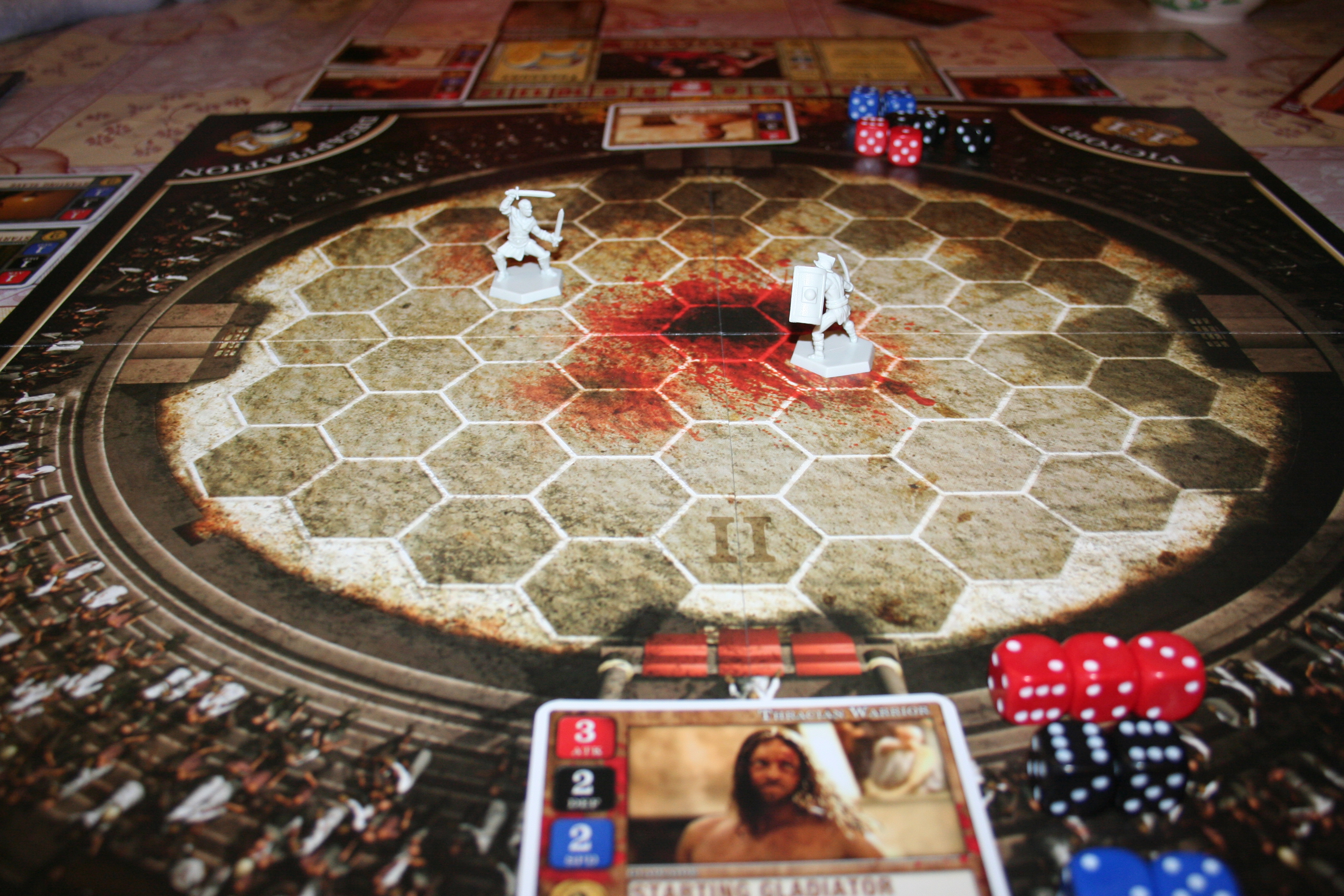
  2. Hosting the Event – The host then invites two players to take part in the games (they can invite themselves).  If a player declines they lose one influence. If they accept they place their gladiator figure in the arena in the starting position then place the card of the gladiator they are fighting, along with any Weapons or Armour they are also using.

    IMG_0564
    A starting gladiator ready to battle.
  3. Tribute – The owners of the gladiators are then paid tribute if their gladiators have favour or are champions – +2 gold for each favour token and +6 gold if they are a champion. If they don’t have any favour and are not champions they get nothing.
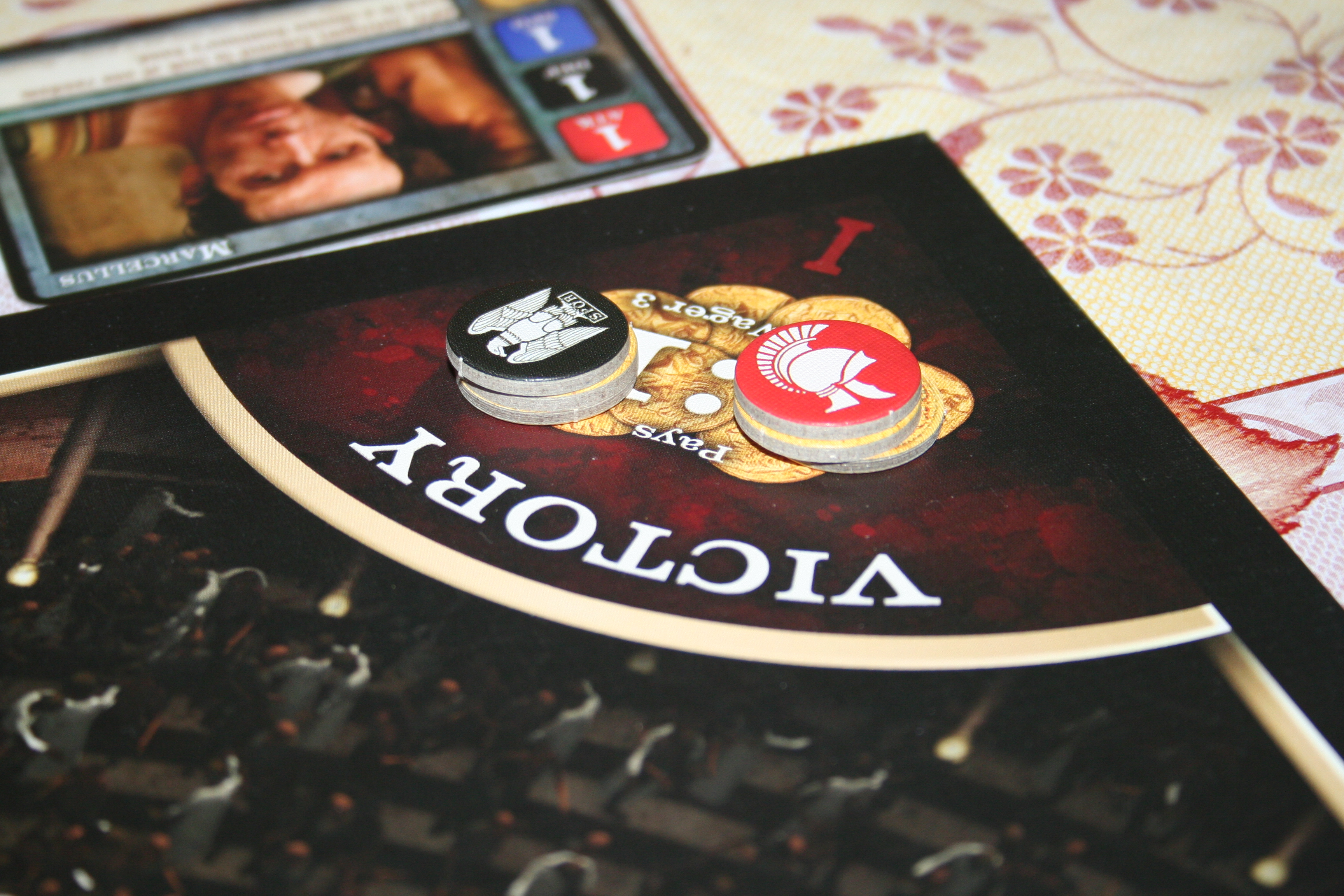
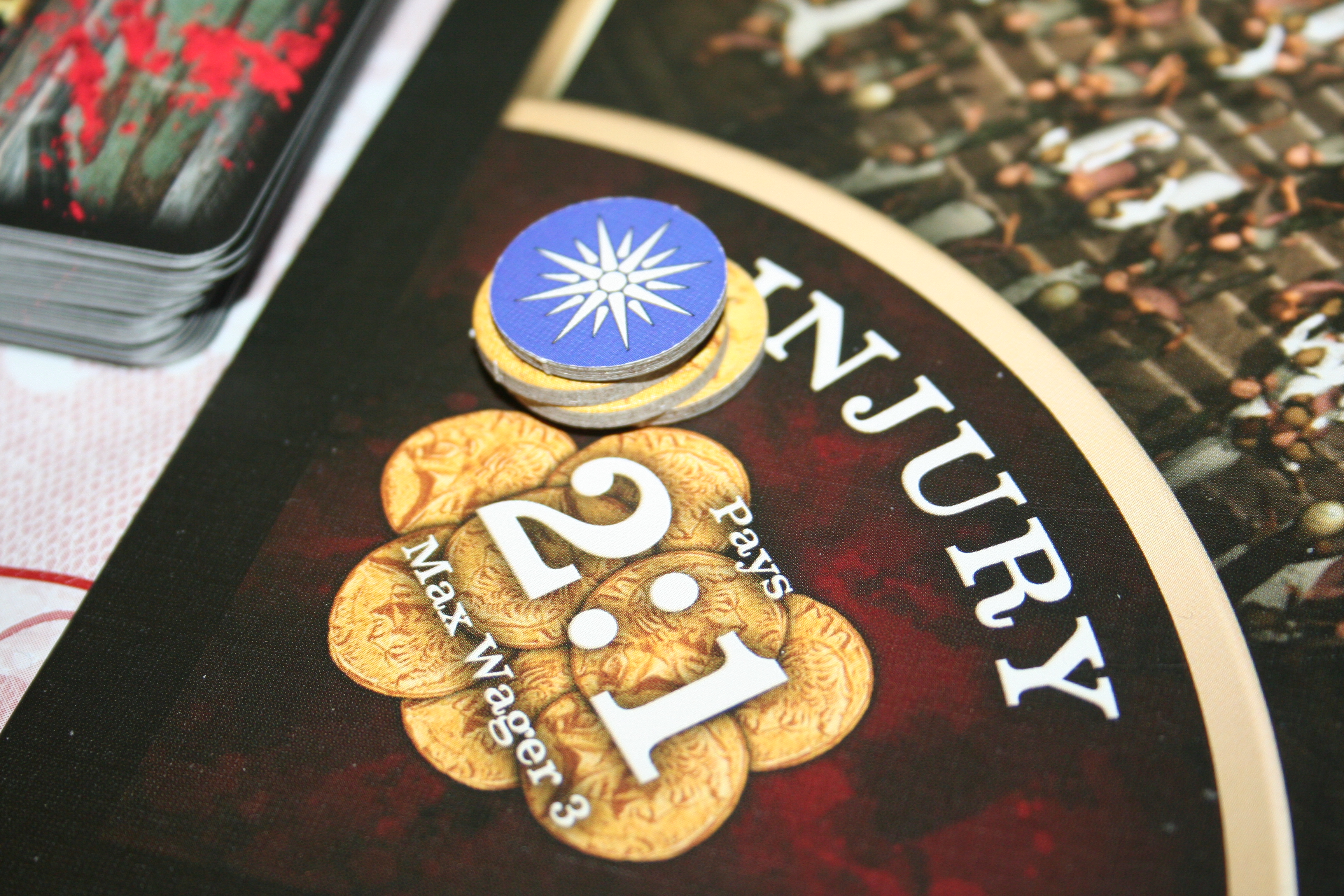
  4. Place Wagers – It’s then time to place wagers, you can wager on who will win (competing players can’t wager against themselves) and how they will win (injury or decapitation). Three is the maximum wager on any one wager and the wagers you place are marked by putting you house wager tokens on top of your pile of gold on the wager you have made.
    So a bet on players combatant one to win returns 1:1 odds so you can double your money.
    So a bet on combatant one to win returns 1:1 odds so you can double your money.

    A bet on the fight ending in injury returns 2:1 odd so you triple your money.
    A bet on the fight ending in injury returns 2:1 odds so you triple your money.
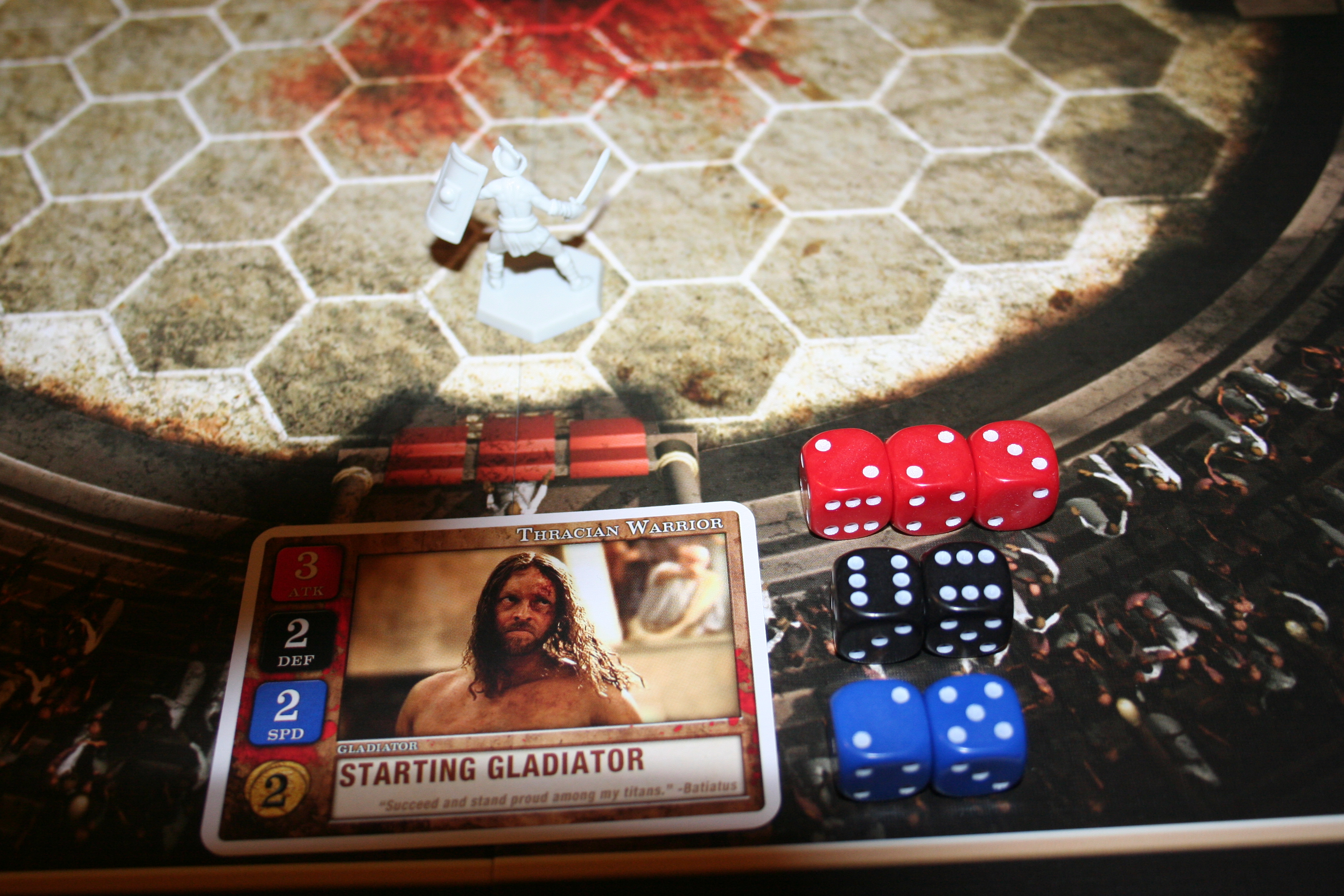
  5. Combat! – Now the fight begins. Each fighting gladiator has statistics for Attack, Defence and Speed. They are given as many red dice as their attack statistic, as many black dice as their defence statistic and as many blue dice as their speed statistic:
    IMG_0564
    3 Attack = 3 red dice, 2 Defence = 2 black dice and 2 Speed = 2 blue dice.

    Each player then roles their total amount of speed dice to determine who moves first, the player with the highest total wins and decides who moves first. Your total number of speed dice dictates how many spaces you can move; so if you have two dice you can move two spaces. You can chose to move and then attack or if you’re already adjacent to your enemy you can attack and then move away. Once adjacent you attack by rolling your attack dice while the defender roles their defence dice. You then line the dice up from highest to lowest, opposite each other. Any place where one attack dice is a higher number than the defence dice is a hit and any place where a defence dice is higher than the attack dice is successfully defended. If they’re equal it’s also a successful defence. Where attack die outnumber defence dice any additional roles that have no matching dice count as a hit so long as they are three or above.

    Two warriors ready for combat.
    Two warriors ready for combat.

    The dice are your health; so for each hit that is obtained the taker of the hit decides which dice to get rid of, lowering their attack, defence or speed for the next move. All attributes must be reduced to 1 before any can be completely removed. If one is completely removed then the player has yielded, if two are reduced to zero in one attack the player is wounded and if all three are reduced to zero in one attack the player is decapitated.

  6. Victory and Defeat – The winning Dominus gains one influence. The winning gladiator revives one favour token, if it’s his third favour token he becomes a Champion. Wagers are then settled with the bank. If the loser was not decapitated the host of the games decides if he lives or dies with the thumbs up or down signal. To kill a loser who has favour will cost the hosting Dominus 1 influence per favour token and champions cannot be killed.

After all this the turn phases are repeated unless one player has a full 12 influence at this point, then they’re the winner! If they have reached 12 influence before this point they are not yet the winner as they can still lose influence before the turn of play is over.

Strategy:

  1. MONEY IS POWER! Like in real life. If you are a broke Lanista (trainer of Gladiators) then you are a rather useless Lanista.
  2. UNDERSTAND WORTH! Linked to the first point, knowing what/how much to bid for something in this game is everything. Knowing what you need and what’s not worth buying (at that time) will be the key to winning and losing.
  3. HOST THE MOST! Bidding to be the host is always worth it, not only does it automatically give you influence you then have control too.
  4. KNOW YOUR FRIENDS! While this is a rather back stab-y game it’s important to know the people you’re playing with and understand when they’re likely to stick with you and at what point they will abandon you and leave you to be eaten by dogs.
  5. KEEP THINGS IN PERSPECTIVE! With such a large turn phase to the game it’s very easy to get caught up in just one round or one arena match and forget about the bigger picture and larger aim. Everything you do should be in aid of the bigger picture not just to get back at another player or just because you want to see a fight between two cool Gladiators.

History and Interesting Things:

While the board game itself does not have much notable history (at least nothing I can find) the historical events it’s based (very loosely around) do so that’s more what this section is going to contain.

  1. The board game was published in 2012, before the airing of the final season of the TV show, by A1 GamesBattlefront Miniatures LtdGale Force Nine, LLCHeidelberger SpieleverlagMarabunta and Zvezda.
  2. The board game is only based on the first season of the TV show Spartacus: Blood and Sand, it being the only season in which Spartacus is a Gladiator rather than a rebel.
  3. The TV series is a re-imagining of the 1960 film Spartacus directed by Stanley Kubrick and starring Kirk Douglas.
  4. However both the TV show and the film are based (loosely) around the historical Third Servile War of the Roman Republic.
  5. While historical facts on the war are highly debated it is often interpreted as a rebellion of oppressed people rising up against a slave owning oligarchy.
  6. Historically Spartacus (the man) is supposed to have lived from 109 BC – 71 BC. The characters Crixus,OenomausCastus and Gannicus, are also historically verified people who assisted in the uprising.
  7. He was born a Thracian and supposedly died on the Battlefield near to Petelia (modern-day StrongoliCalabria, Italy) as depicted in the TV show and film (probably without the “I’m Spartacus” fiasco).
  8. This being Appian also that his body was never found.
  9. 6000 survivors of the battle where crucified alongside the Appian Way from Rome to Capua as depicted in the final episode of the TV show with the crucifixion of Gannicus.
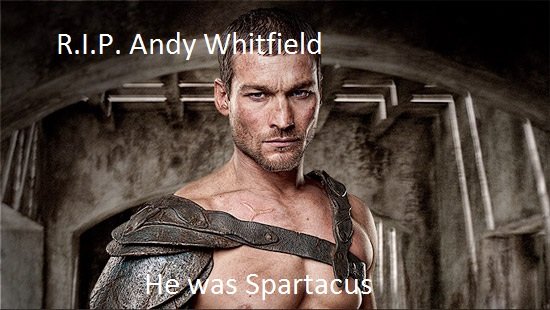
  10. Andy Whitfield who played Spartacus in the first season Spartacus: Blood and Sand (who’s face should be on the front of the game box rather than his replacements Liam McIntyre) sadly died on September the 11 2011 of on-Hodgkin lymphoma and the series was literally less than half as good without him.
picture lovingly borrowed from http://www.funnyjunk.com/funny_pictures/2600925/RIP.
Picture lovingly borrowed from: http://www.funnyjunk.com/funny_pictures/2600925/RIP.

To Conclude:

While my obvious like for the TV show has made this review at least slightly biased I would still maintain this game is a good game by anyone’s standards. It is, however perhaps a touch complex and drawn out. For example; cancelled down version of just the gladiator battles would have made quite a good game just in itself. So this game is primarily for the patient and those who are naturally enthusiastic about games not for those who think monopoly is the epitome of (board) gaming.

Further more it’s always nice to see a box that’s well designed unlike the Pirate of the Caribbean edition of Buccaneer! and Conquest of the Empire:

I rate this box design 4.5/5! The only thing that would have made it better is a slot for the host marker to sit in.

Yes I do think rate the box is going to have to become a permanent part of our posts.

The Settlers of Catan

5 - 5

Number of Players: 3-4

Year of Publication: 1995

Creator(s): Volkan Baga, Tanja Donner, Pete Fenlon, Jason Hawkins (Artists) and Klaus Teuber (Designer)

Create the Best Civilisation and become King of Catan!

Okay, you don’t actually win the title “King of Catan” if you win the game, but it’d be cool if you did. Instead, you just win the sheer joy of winning, which is almost as good. Settlers of Catan is a brilliant game, primarily for its simplicity and versatility. Because of the way the board gets set up, no two games are ever going to be the same and it’s got so few rules that anyone can learn to play!

What’s In The Box:

The stuff!
The stuff!
  1. 19 Terrain Hexes and 6 Sea Frame pieces – set up in one possible arrangement for play.
  2. 9 Harbour Pieces
  3. 18 Circular Number Tokens (chits)
  4. 95 Resource Cards (19 each of Stone, Sheep, Clay, Wood and Grain)
  5. 25 Development Cards
  6. 4 “Building Costs” Cards
  7. 2 Special Cards
  8. 16 Cities (4 each in Orange, White, Red and Blue)
  9. 25 Settlements (5 each in Orange, White, Red and Blue)
  10. 60 Roads (15 each in Orange, White, Red and Blue)
  11. 2 Dice (one Yellow, one Red)
  12. 1 Robber
  13. 1 Game Rules and Almanac Book

Playing The Game:

Objective: To develop your civilization fastest in order to gain 10 Victory Points and win the game!

Setting up the Board:

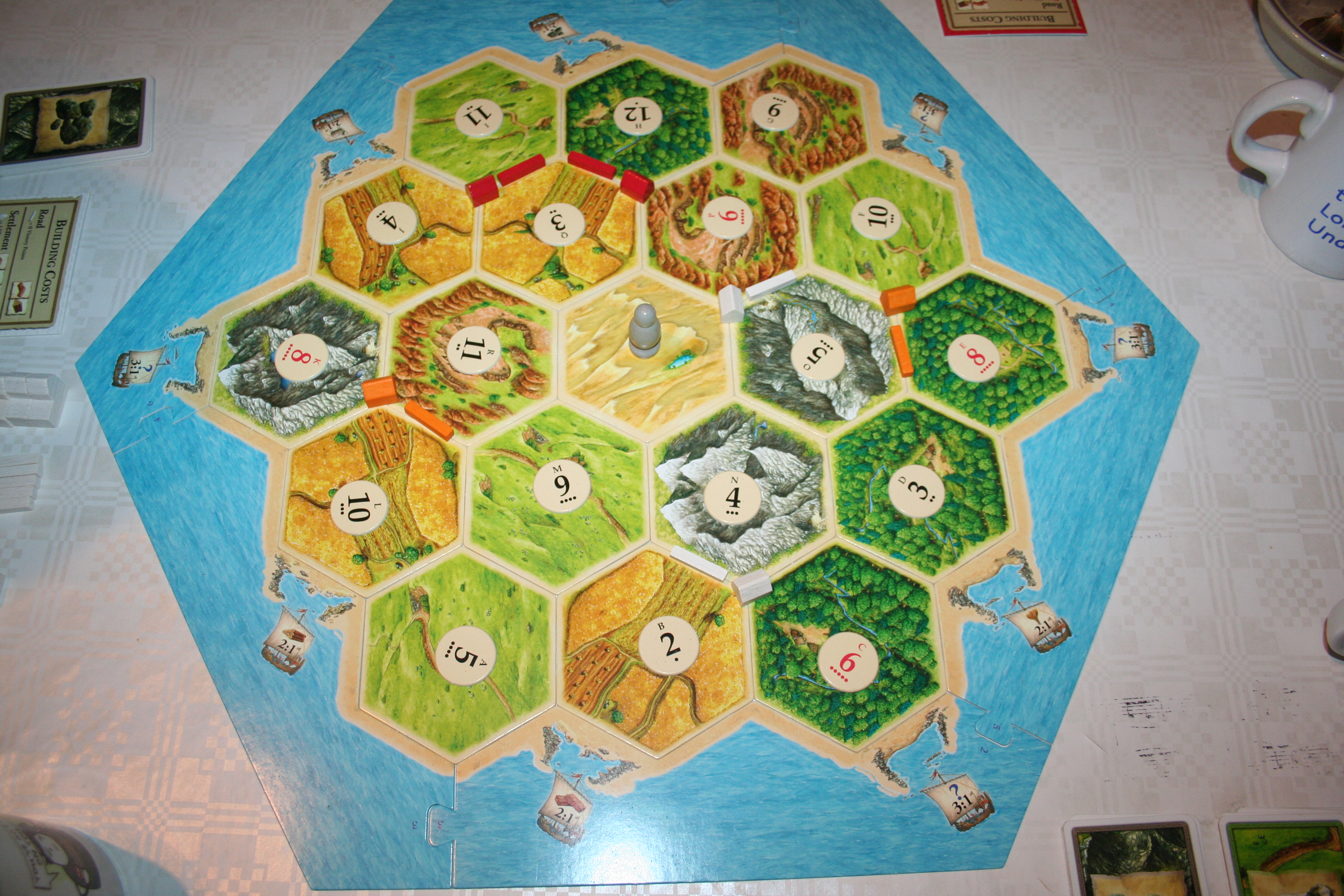
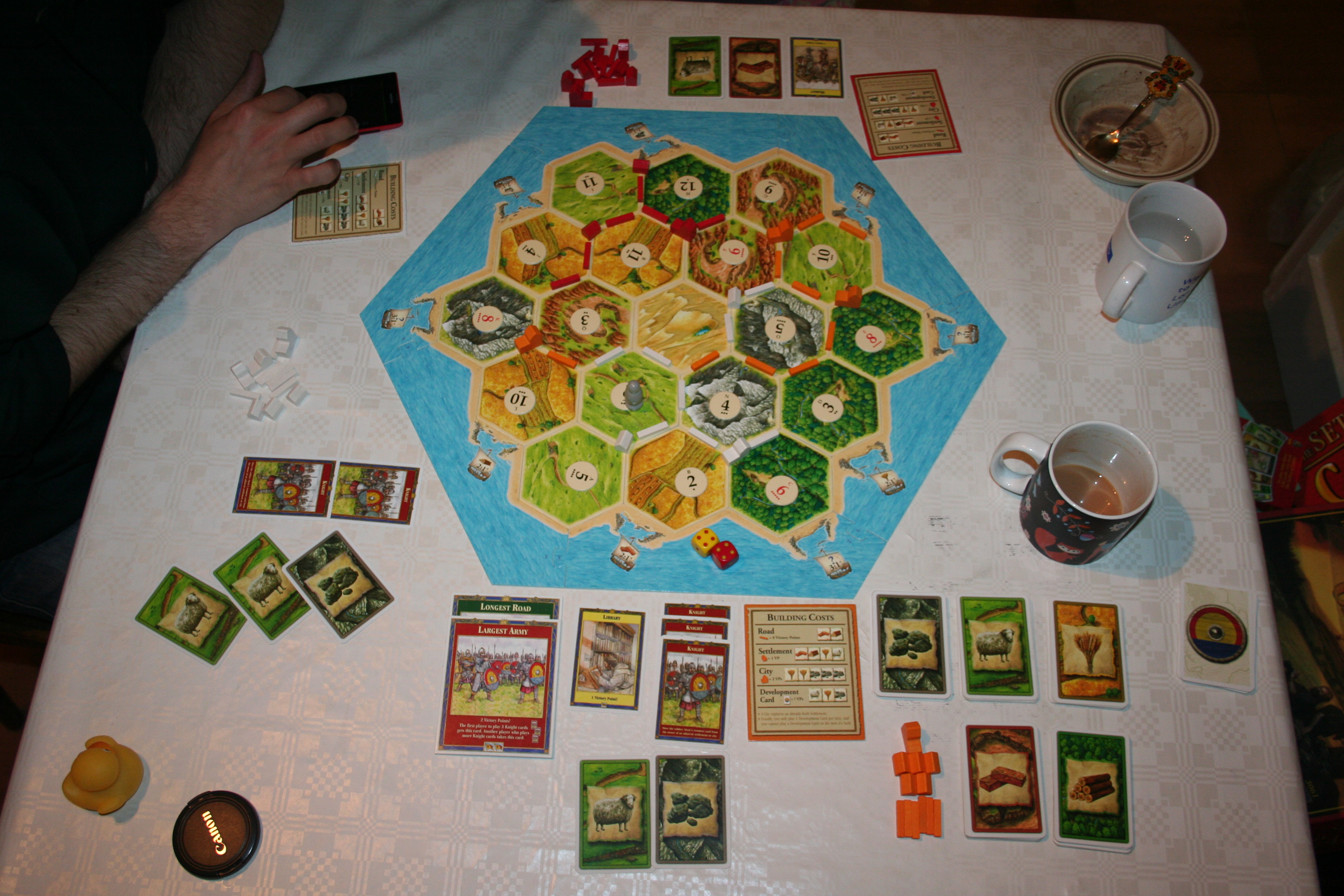
To start the game you set up the board so it looks more or less like the photo below. You give a few of the Terrain Hexes to each player. They’re then laid out in that honeycomb kind of pattern, and edged with the Sea Frame pieces. There’s no set layout for the beginning of the game, so the hexes you get given can be placed anywhere. Once the board is set up each player chooses a colour and takes all the Cities, Settlements and Roads for that colour. They also take the Building Costs card of that colour. Then the Circular Number Tokens are placed on the board. These tokens all have both a number and a letter on them, numbering from 2-12, missing only 7, and having the respective letters A-R. One player then chooses a starting tile, and places the Token with A on it. The other tokens are then laid out in alphabetical order moving clockwise around the board. One of the Terrain Hexes is the desert, this is the only Hex which doesn’t have a token placed on it.
Starting set up for the game.

Once that’s been done, the grey Robber figure is placed on the desert Hex, and each player can then place two of their Settlements, and two Roads on the board. Settlements (and later Cities) are always placed on the corners of the Hexes, so your Settlement will be on the point on a Hex where two or three Hexes meet. Roads must be placed on the edges of Hexes and connected to a Settlement or City of their colour. To start, your Settlements can be placed anywhere on the board, but following this they must always be connected to a previously existing Settlement by a road. To start each player collects one Resource card for the tiles they have Settlements on, for example, at the start of the game above, White would receive two Stone cards, one Clay, one Wood and one Crops.
Turns:

A players turn is divided up into the following phases:

  1. Rolling the dice, moving the Robber and collecting Resources
  2. Trading Resources with other players or the bank
  3. Building Roads or Settlements, upgrading to Cities and buying Development Cards

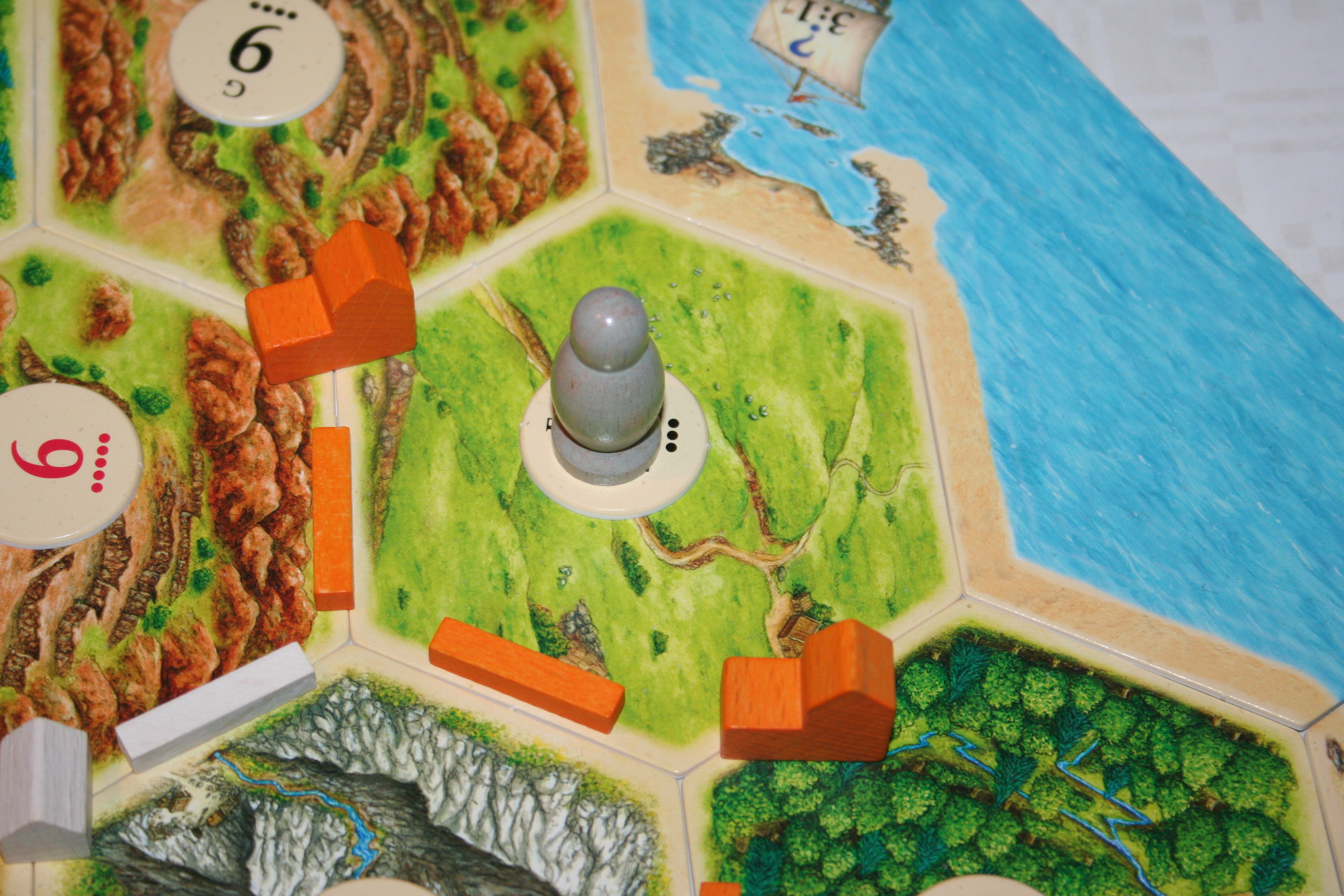
Rolling the dice always happens first, and the number rolled reflects which Resources will be produced on that turn. There are two Number Tokens for each number that can be rolled, apart from 12, once the dice are rolled, find these, and anyone with a Settlement on the corner of the corresponding piece receives one Resource card for that tile. On a roll of 7 no Resources are produced, and the Robber’s moved. The player that rolled the dice can now put the Robber wherever they like. If placed on a tile, the Robber prevents any Resources being produced for this tile until someone else rolls a 7 and moves him, so he can be a huge inconvenience to your opponents.

Like this:

Here the Robber was preventing me from receiving any Sheep Resources

Next you can trade Resources. This is done verbally and with the exchange of cards. One player simply states which Resources they need, and what they’re prepared to offer for them, and other players may accept or decline. Or haggle, if they feel so inclined. if a player has a lot of one Resource they can trade five of one Resource in to the bank, in exchange for one different Resource of their choice. If a player rolls a 7 all players must also count how many cards are in their hand, if they’ve got more than 7 Resource cards in their hand they must discard half of them, in the case of an odd number, for example, 9, you round down, so you would only discard 4, not 5.

It’s also possible to use the Sea Ports to trade resources, but you have to have a Settlement or City built on one of the three points adjacent to a port to use it.

Finally you can build things, your Building Costs card tells you how much each thing will cost you in Resources, and you discard Resources into the Resource bank to build on the board or buy Development Cards. Settlements or Cities must be connected by at least two roads, so they cannot be on the points next to each other, meaning that only three Settlements can ever be on one Hex. You must also have a connecting road before you can build a Settlement.

Play continues like this until one player has gained 10 Victory Points!

Winning the Game!

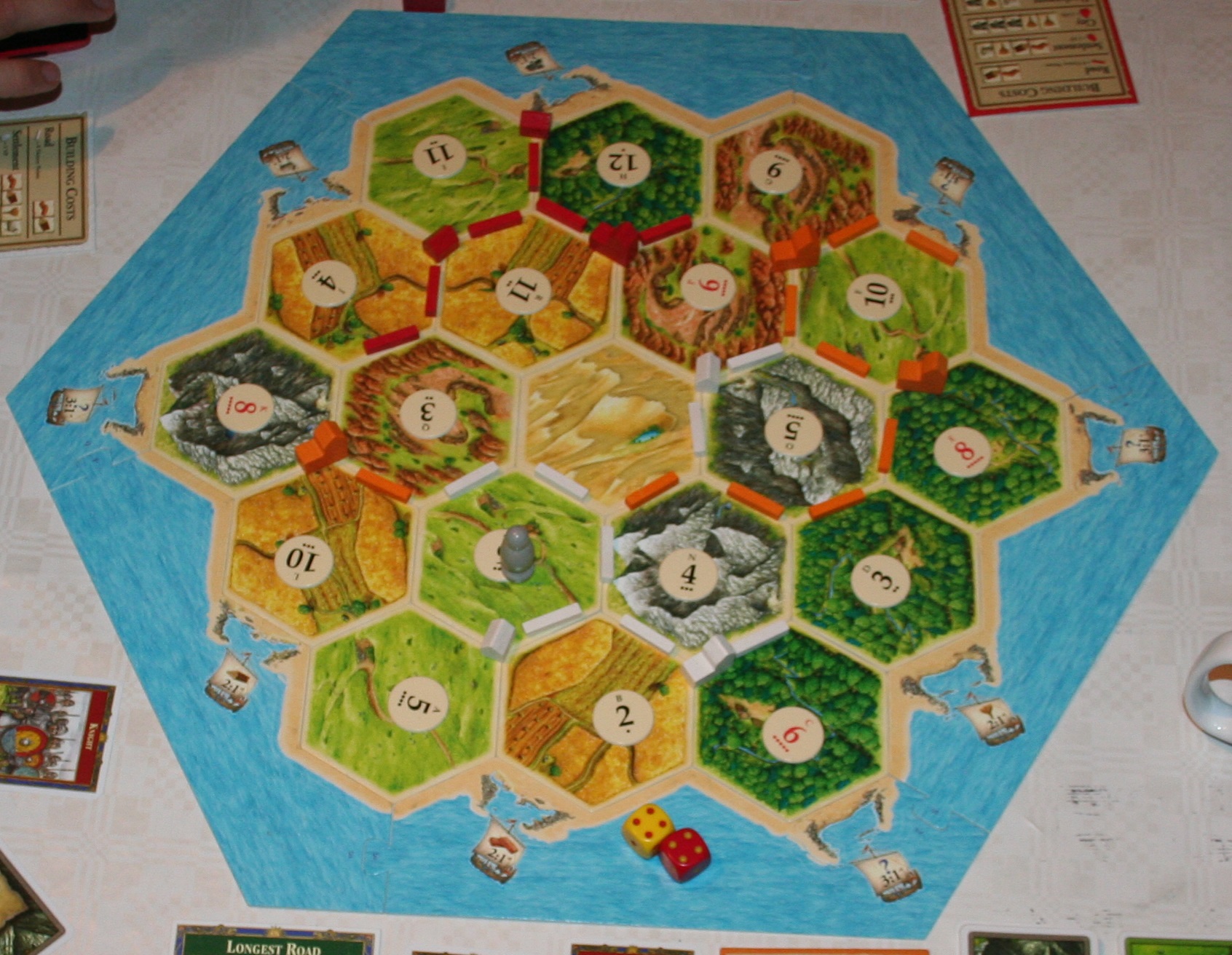
Winning the game actually isn’t very difficult, each Settlement you build is worth 1 Victory point and each City is worth 2. So you start the game with 2 Victory points, for your two Settlements placed before game play starts. You can also gain an extra 2 Victory points for having the longest unbroken road, this is one of the Special Cards, and is awarded once a player has a road at least five segments long. However, this card can get passed around a bit, as other players build longer roads. In the game we played, I had the longest road:

I was Orange, my road was 8 segments long

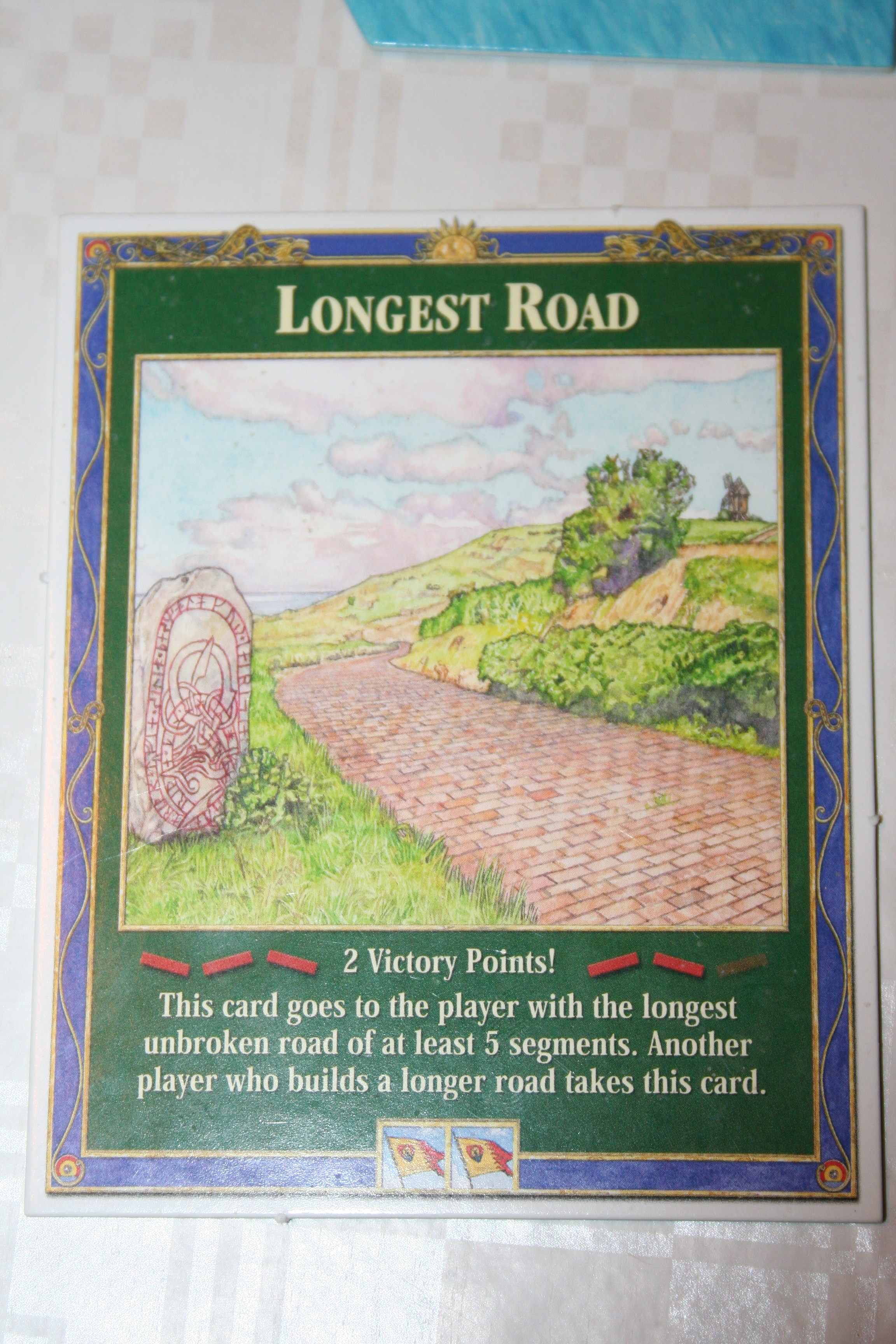
So I got the extra Victory points on the Special Card:

Longest road!
Longest road!

So, the end of our game looked like this:

I win!
I win!

So, ignoring the tea, ice cream and small rubber duck, this is what the game looked like at the end, I had acquired here, Longest Road, Largest Army (which is the other Special Card, Knights can be acquired by buying Development Cards and you get Largest Army once you’ve got three) and then also some Cities and Settlements.

Strategy!

This game can be played strategically, at the start of the game, when the board is being arranged, look for areas where a lot of one resource are concentrated, if you build both your starting Settlements on these and then quickly expand your Roads you can create a monopoly on one resource, forcing other players to trade with you for whatever you demand. Alternatively, try and build you Settlements so that you get as many different resources as possible. Both these are acceptable ways to start the game. One thing I would say to not do is this: unless you’re going for monopoly on something DO NOT BUILD YOU SETTLEMENTS CLOSE TOGETHER TO START. Doing this is going to severely inconvenience you later in the game. It makes getting Longest Road, or heading out to resources on the other side of the board much harder. Also, don’t be too harsh with trading, if you have something another player desperately needs, don’t ask too much for it, as they might get annoyed, and refuse to trade something you really need later in the game. It’s all a question of balance, getting as much as possible out of the trade without being unreasonable.

History and Interesting Things:

  1. One of the first European games to achieve real popularity outside of Europe – it’d sold over 15 million copies by 2009.
  2. There are over 50 Scenarios and Variants now available for this series of games.
  3. There are only four base expansions to this game, which are: Catan: Seafarers, Catan: Cities & Knights, Catan: Traders & Barbarians and Catan: Explorers & Pirates.
  4. Die Siedler von Catan is a novel, set on the island of Catan, written by Rebecca Gablé following the popularity of the initial release of the game.
  5. Settlers has been created and recreated online over the years – it used to be playable over MSN, for everyone out there who remembers when MSN was the going thing!
  6. A series of mini stuffed animals based on the resources produced in the game was released by Mayfair, call Catanimals.
  7. A version of the game to be played on Nintendo DS was announced in 2008, but has yet to be released.

To Conclude:

This game has a rating of 5 because of how versatile it is, and how easy it is to play, the rules have little to no ambiguity in them, the storage space in the box is well laid out and therefore not annoying, and it’s a really, really fun game to play, which takes between an hour and an hour and 40 minutes, more or less. Which I think is an almost perfect running time for a game, long enough to be interesting, without becoming boring! It’s a brilliant family game too, as the simplicity of the rules allows for younger players!

Conquest of the Empire – Classic Rules

3.5 - 5

Number of Players: 2 – 6

Year of Publication: 2005

Creator: Glenn DroverLarry Harris, Jr.Martin Wallace (Designers) and Paul Niemeyer (Artists)

Julius Caesar, The Roman Geezer, Squashed his Wife with a Lemon Squeezer:

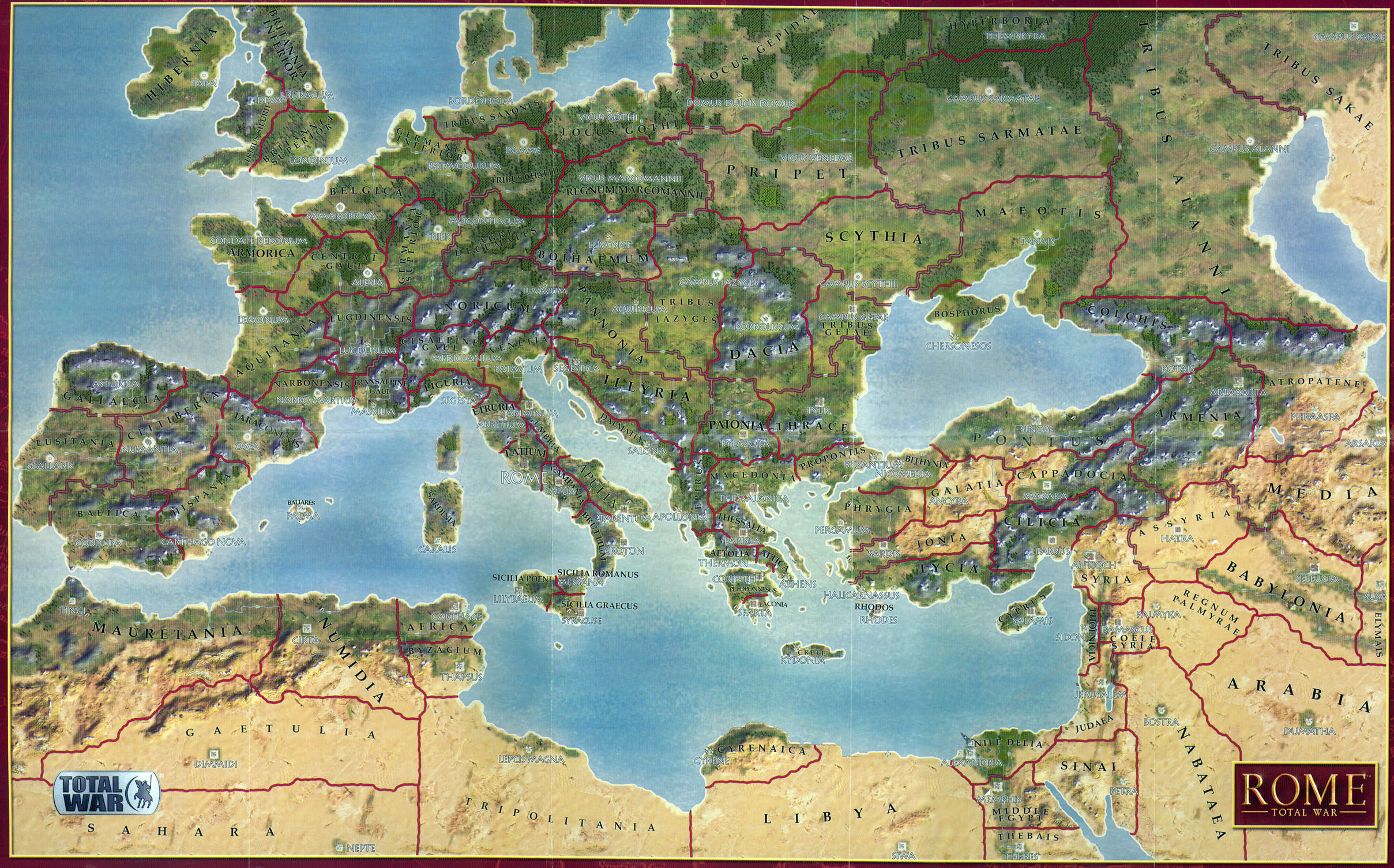
So as far I can figure Conquest of the Empire is just a table top version of Rome: Total War and being a huge fan of that game I’m also a huge fan of this game. In many respects it’s cooler; because you’re playing real people you actually feel some sense of victory when you crush them! But on the other hand, it’s obviously far more limited than Rome: Total War. To illustrate my point this is a picture of the Rome: Total War map:

Lovingly borrowed from http://ru.wikipedia.org/wiki/%D0%A4%D0%B0%D0%B9%D0%BB:Rome_total_war_map.jpg

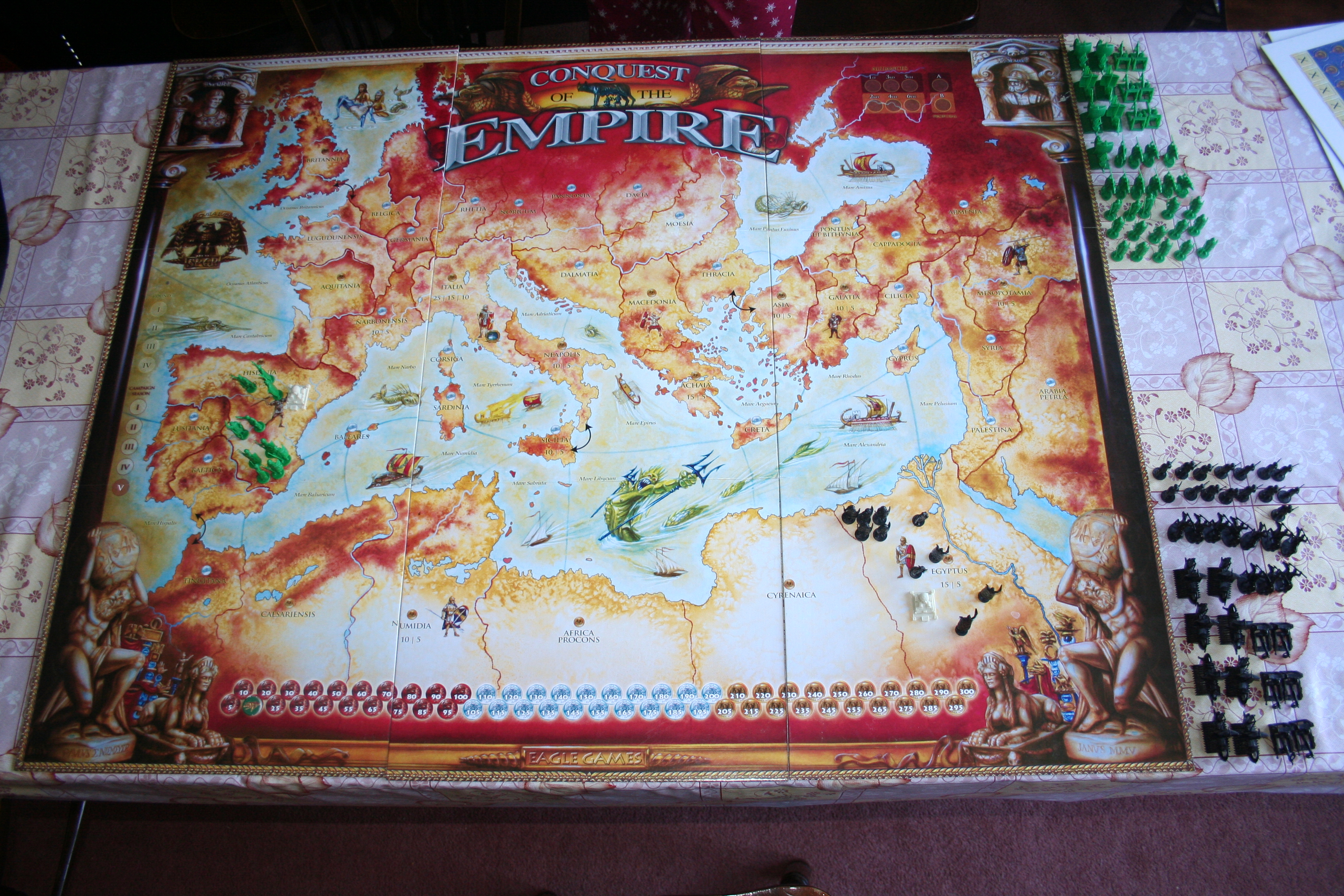
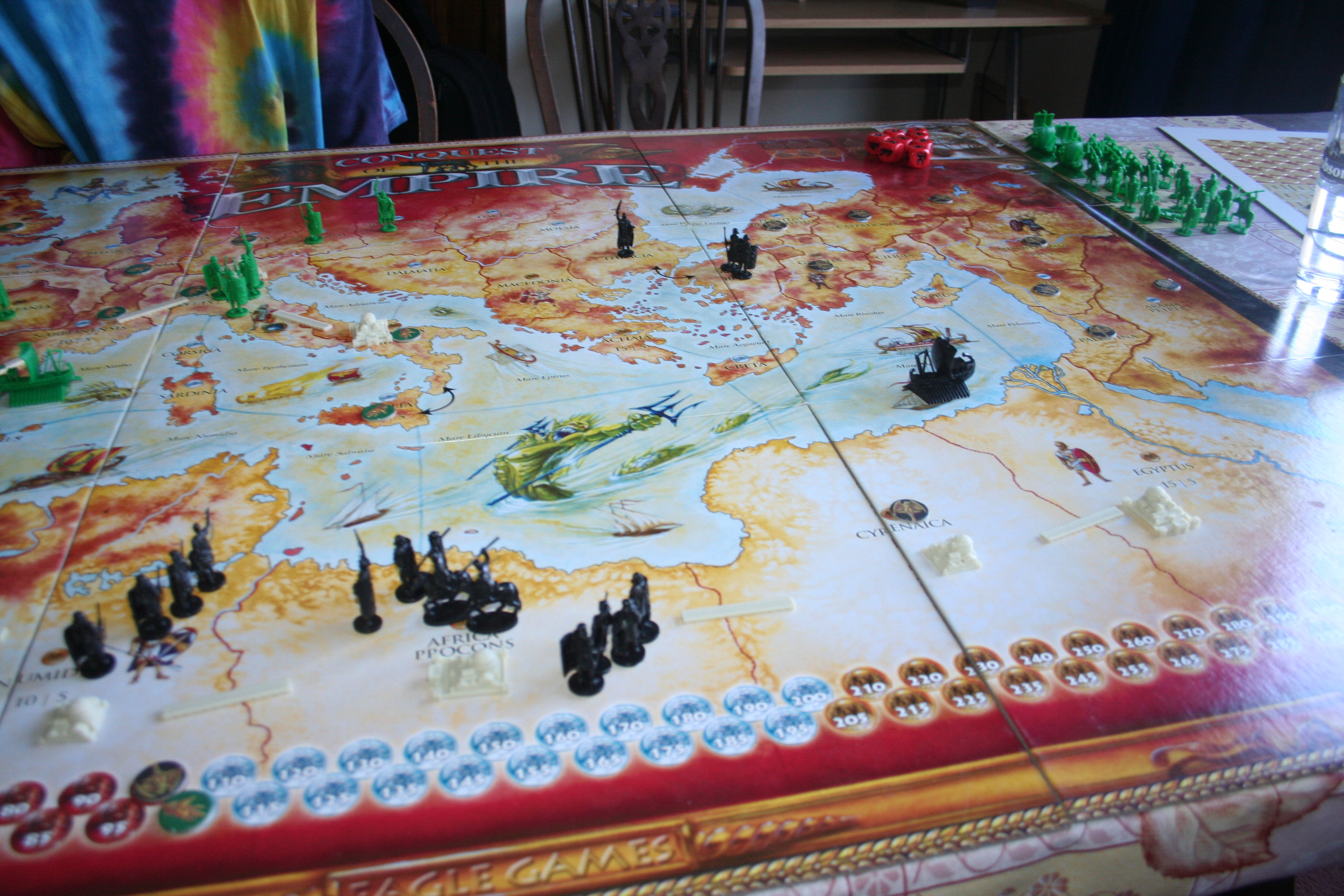
And this is a picture of the Conquest of the Empire board:

IMG_0515
Can you see the similarities?

Now, there are two sets of rules to this game, as I explain in the History and Interesting Facts part of the post but this post is only covering the Classic rules, as we haven’t had the time to play the other rules. Hopefully there will be another post covering the other set of rules before the month is over, so keep an eye out for that.

What’s In The Box:

IMG_0505

IMG_0509

  1. 1  Game board (see picture in introduction of it laid out)
  2. Province tokens
  3. Some of the Chaos tokens (the ‘X’s at the bottom of the other sheet are also Chaos tokens)
  4. Influence/control tokens for each colour (except the bottom row)
  5. 2 Instructions Booklets:
    1. 1 for the Classic rules
    2. 1 for the new Conquest of the Empire 2 rules
  6. Black game pieces consisting of:
    1. 1 Caesar
    2. 4 Generals
    3. 20 Infantry
    4. 10 Cavalry
    5. 6 Catapults
    6. 8 Galleys
  7. Yellow game pieces, the same as black
  8. Blue game pieces, the same as black
  9. Purple game pieces, the same as black
  10. 25 five-talent coins (Silver) 50 ten-talent coins (Gold)
  11. Red game pieces, the same as black
  12. Green game pieces, the same as black
  13. 8 Dice (for some reason ours has 12 but it did come from a charity shop)
  14. 16 Fortifications
  15. 16 Cities
  16. 1 deck of cards
  17. Cards
  18. 20 Roads

Playing The Game:

Objective: To capture the other player(s) Caesar

The aim of the game is ultimately just to capture the other player(s) Caesar, which can lead to a fairly short game if you get lucky and the other person is careless; or if the other person is careful it can be a long complex game of strategy and well thought-out battling.

The board right at the beginning.

You start in one of the six starting provinces, these are shown on the board and the instruction book denotes which are available relative to how many players there are. The tribute scale at the bottom of the board is used to mark your income per-turn and increases if you capture provinces and decreases if you lose them depending on the worth of the province (marked on the board). you start on 15, as you home province is worth 10 but it also has a city in it which adds an additional 5.

The tokens for each player show the amount of money they get each turn.

Each turn is broken up into 6 sections:

  1. Movement
  2. Combat
  3. Collect Tribute
  4. Destroy Cities
  5. Purchase New Pieces
  6. Place New Pieces

So first up is movement, normal pieces can only move when attached to a General/Caesar. When they’re attached they form a legion; a legion may be up to 5 pieces (of any type) and then the General/Caesar to make a legion of six pieces overall. Without roads normal pieces may only move one space (being from one province to another) in a turn, however General/Caesar may move two, so they may move with a legion and then one further turn on their own. However they cannot fight by themselves – but are useful for conquering unoccupied provinces. The exception to this is roads; once on a road a player may move as far along that road as he/she likes. Galleys are the only units that can move without a General/Caesar, they can move up to two sea provinces even with no units in them.

The first move of the game.

The second part of a players turn is combat. Combat occurs when you move your pieces into a province occupied by an enemy and once you have finished all of your moving.

Just before combat.
Just before combat.

Combat is somewhat similar to Battle Cry! (as reviewed here) in that it uses dice with symbols that show which piece have to be removed. You role as many dice as there are piece in your legion (up to 6) and the defender does the same. the relevant pieces are then removed according to the symbols on the dice, and either you fight again or one player retreats. Generals/Caesar are the last pieces to be removed from any legion and can only be captured when the rest of the legion has been destroyed. Captured Generals are kept by the winner and can be bartered with later in the move, if Caesar is captured the person who loses their Caesar has lost the game and is out.

A captured Cesar.
A captured Caesar.

The next phase of a move is to collect tribute, that’s as simple as it sounds, you look at the tribute scale at the bottom of the board and collect the amount of tribute you are due.

A pile of gold!
A pile of gold!

The next phase is to destroy cites, you can do this in provinces you own if they are about to be captured to stop the other player gaining any benefits from them. This phase doesn’t have to be done as you may not be in a situation where its required.

The next phase is to buy pieces. You use your tribute to to buy pieces to build a bigger army. Pieces initially cost:

  1. Infantry – 10
  2. Cavalry – 20
  3. Galleys – 20
  4. Catapult – 30
  5. Fortified City – 50
  6. City – 30
  7. Fortification – 20
  8. Road – 10

However when inflation is trigger the first time (marked by the change in the tribute scale at the bottom of the board) cost doubles, when its triggered again (by the second change in the scale) the cost triples from the original prices.

A newly bought army.

The very last phase of a players move is to places his newly brought pieces. All new combat units must be placed in the home province of the player buying them, ships are placed on the coast of that province, or on the closest coast if you are landlocked. Cities are placed in the relevant province that you want a city in, only one city per-province and only one fortification per-city. Roads can only be built between two cities in adjacent provinces but multiple road sections between multiple cities can be used to make one long road.

Roads!
Roads!

This process is then repeated until there is only one players Caesar remaining.

Strategy:

Now, like most games on this blog I don’t claim to be a master ,but here are a few things I picked up that are important:

  1. DON’T FOR GET ABOUT YOUR CAESAR! That’s how I won the game we played, he was left in a province by himself. Always know where he is and always have him protected away from the action (unless you have no choice but t0 have him in the action.)
  2. MONEY IS POWER!  Conquering provinces is important to generate more tribute so you can buy more units so you can have more power.
  3. DON’T FORGET ABOUT SHIPS! Ships look like they can be a very useful tool to attack your enemy where he/she is not expecting.
  4. DON’T FORGET YOU CAN DESTROY YOUR OWN CITIES! Also destroying a city will destroy a road that runs between it and another city as roads can only exist between two cities. This could help slow a fast enemy advance.
  5. BRUTE FORCE IS KING! Due to the luck/probability of the dice actually being 100% tactical is difficult, so just out manning the other player in all conflicts is advised.

History and Interesting Things:

      1. While I have stated the publication date of the game as 2005, and hyper linked the 2005 game on BoardGameGeek, the original version of the game was released in 1984 by Milton Bradley and it’s sole designer was Larry Harris, Jr.
      2. However the original version of the game’s catapult rules were considered to be “broken” so the 2005 version of the game was issued with two sets of rules, one that was similar to the original rules but with fixed catapult rules (the classic rules, the ones played in this article) and another completely new set that were based on Martin Wallace’s Struggle of Empires (these are Conquest of the Empire II rules).
      3. The original version of the game also had different combat rules and the rules in the 2005 version were changed along with the dice that have images that correspond to the different units.
      4. The game is thought to be very similar to the game Axis & Alliesthis may be because it’s also designed by Larry Harris, Jr. (and because of this Axis & Allies is obviously going on our Games We Want page).
      5. It was a 2006 Golden Geek Best Wargame Nominee
      6. The original version of the game is now completely out of print and therefore a prized collectors piece.
      7. However, that’s what Wikipedia says but you can buy a 1984 original copy from America for around £55 on Ebay here (eBay listing was active at time of publication).
      8. The game is set in the Roman Empire after the death of Marcus Aurelius. So just after this happened:

(This may be from the film Gladiator and therefore may not be historically accurate).

      1. Like I said in my introduction, the game really is a physical version of Rome: Total War, just less complex and in some ways more fun.
      2. It is also the largest game we have played to date, which makes it just a little bit more awesome.


To Conclude:

I like this game, I like it a lot, but I was always going to – as I said in my introduction, it’s just table top RTW. However this version of the rules has quite a lot of ambiguity but with careful reading and a  bit of logic you can think your way through this. There are a few thing I think should be done differently, for example you should be able to build units in places other than your home provinces, other cities would have had barracks and been able to train men etc. Also it just feels wrong to collect your money half way through your turn, everyone knows turns begin with collecting money, it’s true of so many games, both table top and computerized. However I understand the building units one turn and not being able to move the till the next because it represents a training time.

The biggest issue with this game though is this:

Everything thrown in the box!

POOR BOX DESIGN! Now you may say that this is irrelevant to the game in the sense that it doesn’t affect game play. But it does, if you’ve had to spend 20 minutes sorting out pieces because there in a mixed mess you’re not going to have the same amount of fun playing the game as if they were all sorted already in a vacuum-formed tray in the box like 90% of games I’ve played (like Battle Cry!.) The only other game I’ve come across to rival this is the Pirate of the Caribbean edition of Buccaneer! Which you can read my rant about at the end of the post on it here.

But all in all Conquest of the Empire is a good and fun game (perhaps not quite as good/well thought out as Battle Cry! and definitely not as versatile). It’s also very large which for some unknown reason makes it more exciting…

We’ll have to wait and see if the other way of playing it is as good or perhaps better.

P.S. I (Miriam) wouldn’t usually add on to a post like this, but it was more like 2 hours sorting time than 20 minutes which makes this, in my opinion, an epic design flaw… Especially when trying to determine if all the pieces were still there.

They weren’t.