Ticket To Ride

Number of Players: 2-5

Year of Publication: 2004

Creators: Alan R Moon (designer), Cyrille Daujean (artist) and Julien Delval (artist)

She’s Got A Ticket To Ri-iiide, She’s Got A Ticket To Ri-i-iiide, She’s Got A Ticket To RIDE, And She Don’t Care!!

Ticket To Ride is a straightforward route-building game featuring a lovely map of North America with major cities marked on them as route destinations, all the way from Miami, down in the South-East, to Vancouver, up in the North-West, and many in between. The objective is simple: score as many points as possible before the game ends. You play as an industrial railroad builder, who is trying to forge routes across North America, each hoping to build the most lucrative routes before their rivals.

“On a blustery autumn evening five old friends met in the backroom of one of the city’s oldest and most private clubs. Each had traveled a long distance – from all corners of the world – to meet on this very specific day… October 2, 1900 – 28 years to the day that the London eccentric, Phileas Fogg accepted and then won a £20,000 bet that he could travel Around the World in 80 Days.

When the story of Fogg’s triumphant journey filled all the newspapers of the day, the five attended University together. Inspired by his impetuous gamble, and a few pints from the local pub, the group commemorated his circumnavigation with a more modest excursion and wager – a bottle of good claret to the first to make it to Le Procope in Paris.

Each succeeding year, they met to celebrate the anniversary and pay tribute to Fogg. And each year a new expedition (always more difficult) with a new wager (always more expensive) was proposed. Now at the dawn of the century it was time of a new impossible journey. The stakes $1 Million in a winner-takes-all competition. The objective: to see which of them could travel by rail to the most cities in North America – in just 7 days. The journey would begin immediately…” – excerpt from the Rulebook

What’s In The Box:
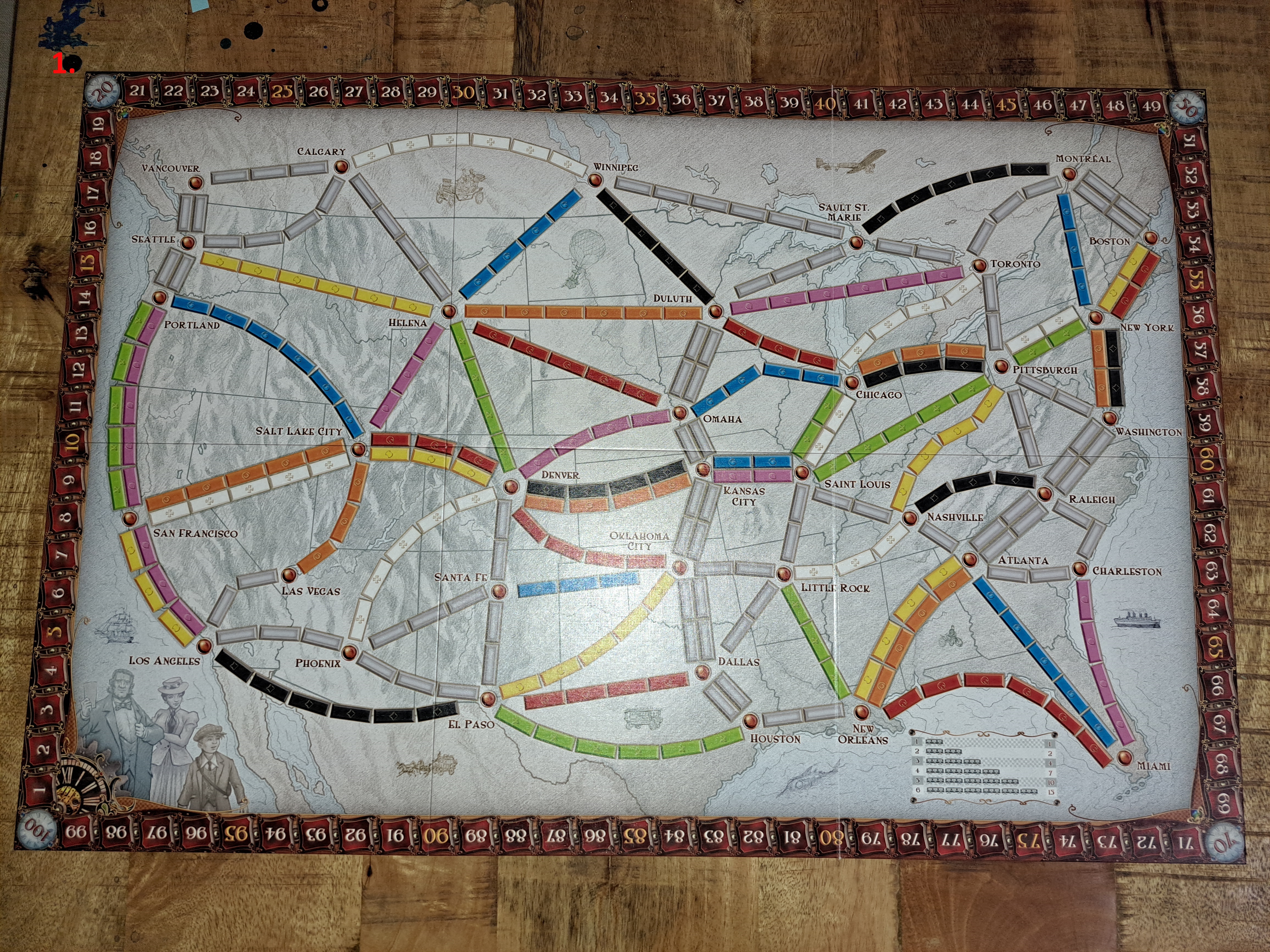
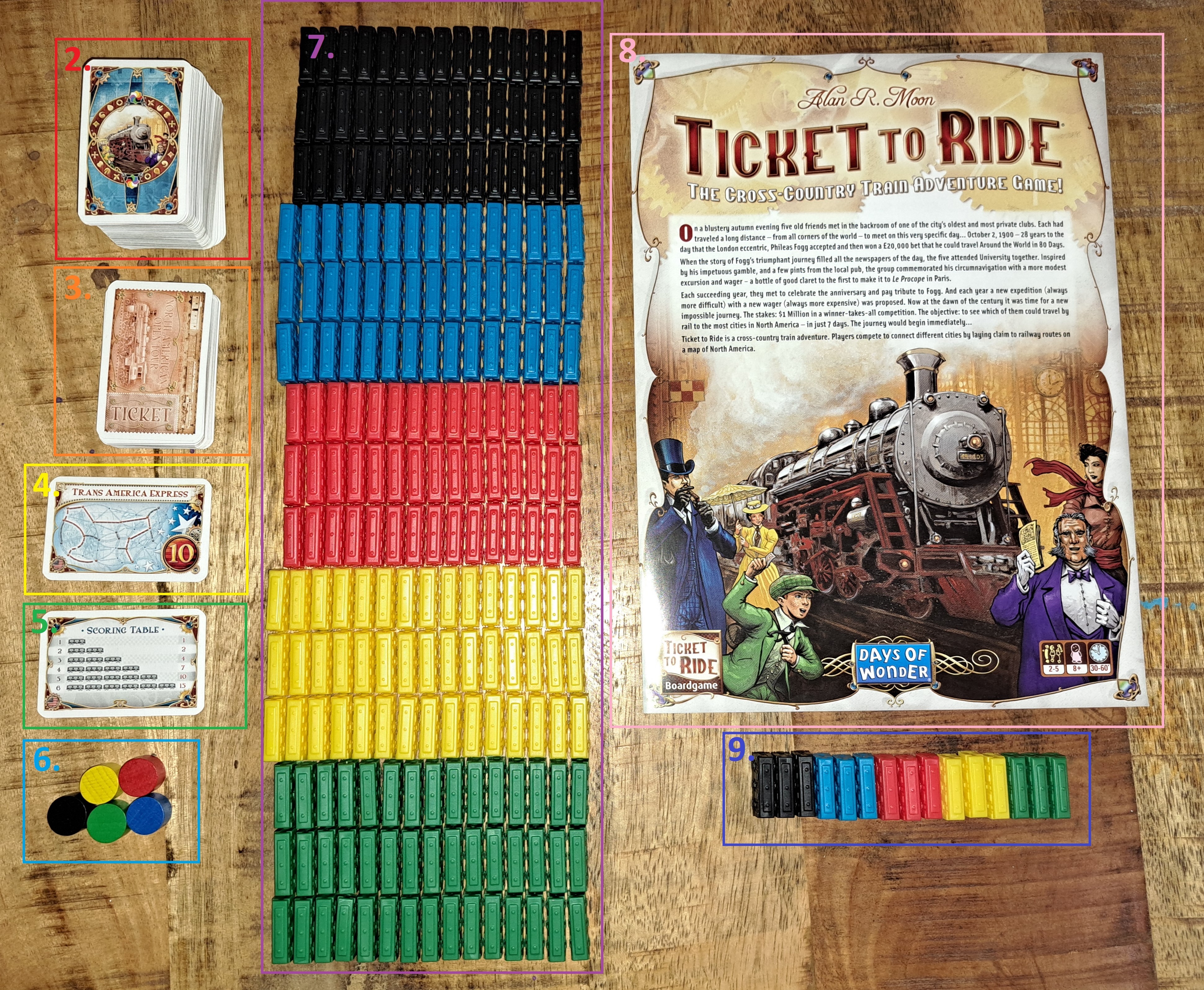
  1. Game Board
  2. 110 Train Car Cards
  3. 30 Destination Ticket Cards
  4. 1 Longest Continuous Path Bonus Card
  5. 1 Summary Card
  6. 5 Wooden Scoring Markers
  7. 225 Coloured Train Cars (45 of each colour)
  8. 1 Rules Booklet
  9. 15 Replacement Train Cars (3 of each colour)

Setting Up The Game:

To begin place the board in the middle of a decently large table. A largish table is necessary as the board itself is pretty big and you need space for all your train cars, as well as the Train Car and Destination Ticket Cards. Each player should choose a colour and take all the appropriate Train Cars, as well as the Wooden Scoring Marker that matches. The Scoring Marker should be placed on the 100 on the scoring track, which goes around the edge of the board. The 100 also doubles as 0 for the start of the game. The Train Car Cards are shuffled, and a starting hand of four cards is dealt to each player. The remaining cards are then placed, face-down, on one of the long edges of the board and the top five are turned face up, and laid out down the edge of the board, for all players to see. Place the Longest Path Card next to the board as well. Now shuffle the Destination Ticket Cards and deal three to each player. The players may now look at them, and decide which they want to keep. All three may be kept if a player wishes, or a maximum of one can be discarded. Discarded Destination Ticket cards are placed on the bottom of the pile, which is then put at the side of the board, once each player has finished deciding. You are now ready to begin and the most experienced traveller plays first, with play continuing clockwise after they have taken their turn.
Playing The Game:

On each players turn, they may perform one of the following three actions:

  • Draw Train Cards – a player may draw two cards; one either from the face-up cards lying on the table, or one from the top of the face-down pile of Train Car Cards. If they draw from the face-up cards a new card is immediately taken from the top of the face-down pile to replace it. There should always be five Train Car Cards face-up on the table. Once the first card has been drawn the player can then decide where they want to draw their second card from, as before. *See below for special rules applying to Locomotive Train Car Cards
    There is no limit on hand size in this game; a player may hold as many cards as they wish and continue to draw new cards. Only if the draw deck runs out will they be forced into one of the other two permitted actions.
  • Claim A Route – various routes are indicated across the board by small coloured rectangles connecting two cities. In order for a player to claim one they must lay down the appropriate number of cards for the route they wish to claim. Additionally, the rectangles are coloured, indicating which type of Train Car Card must be used to claim that particular route. A route can only be claimed if a player has the required number of cards all in the correct colour. If a route is comprised of grey rectangles then any colour of Train Car Cards may be used, as long as they are all the same. Once a route has been successfully claimed the player lays their Train Cars onto the route, discards the cards they used to claim it, and moves their Scoring Marker up the scoring track the appropriate number of spaces. How much each route is worth is indicated both on the board itself and on the small Summary Card. Special note regarding routes: on some sections of the board there are routes that show a double line of rectangles. This means that that route may be claimed twice during play. HOWEVER, in a two-player game, each double route may only be claimed once, in order to increase the challenge of the game a little, as there is less overall competition for routes. *Special Locomotive rules apply here too
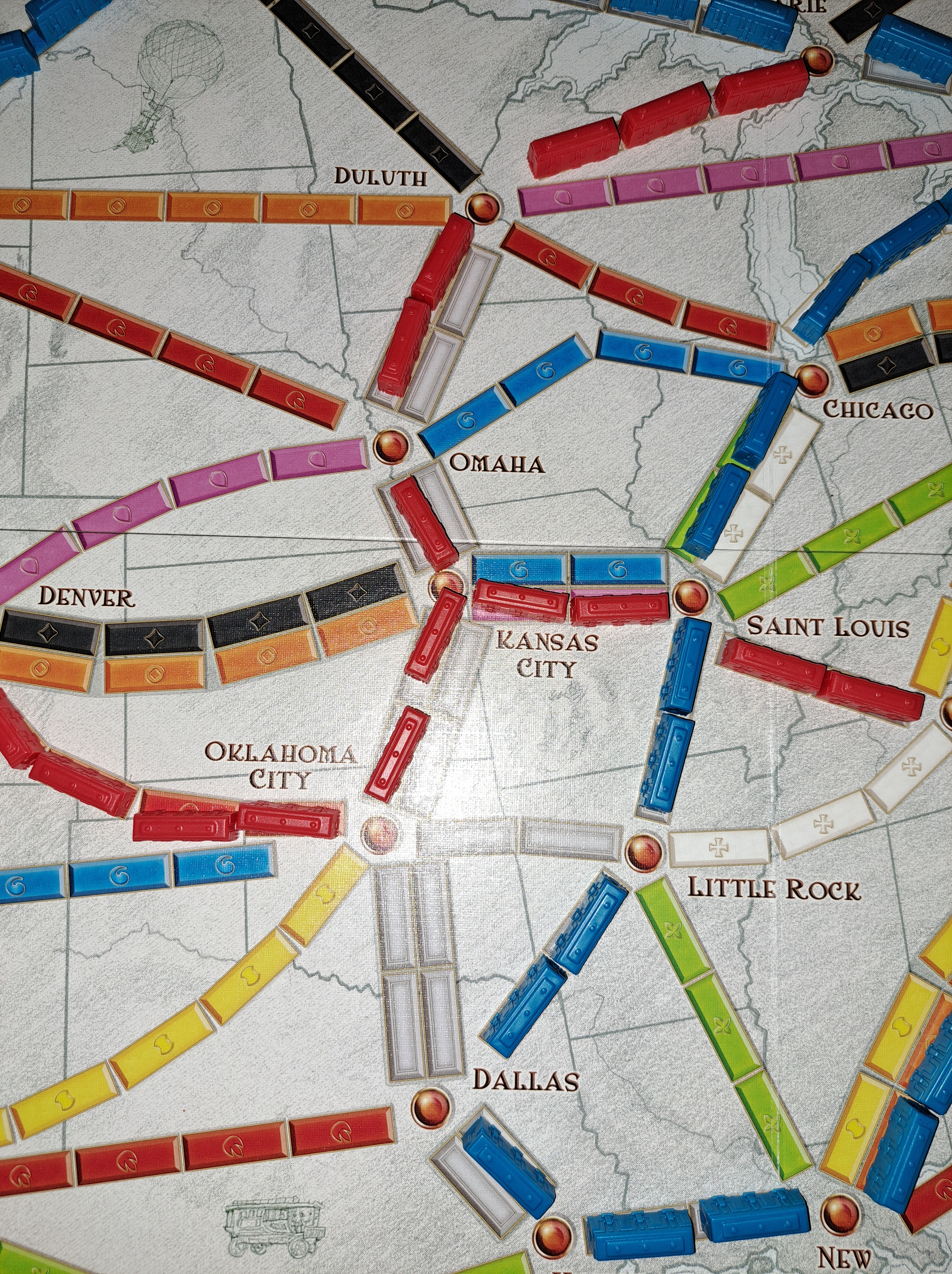
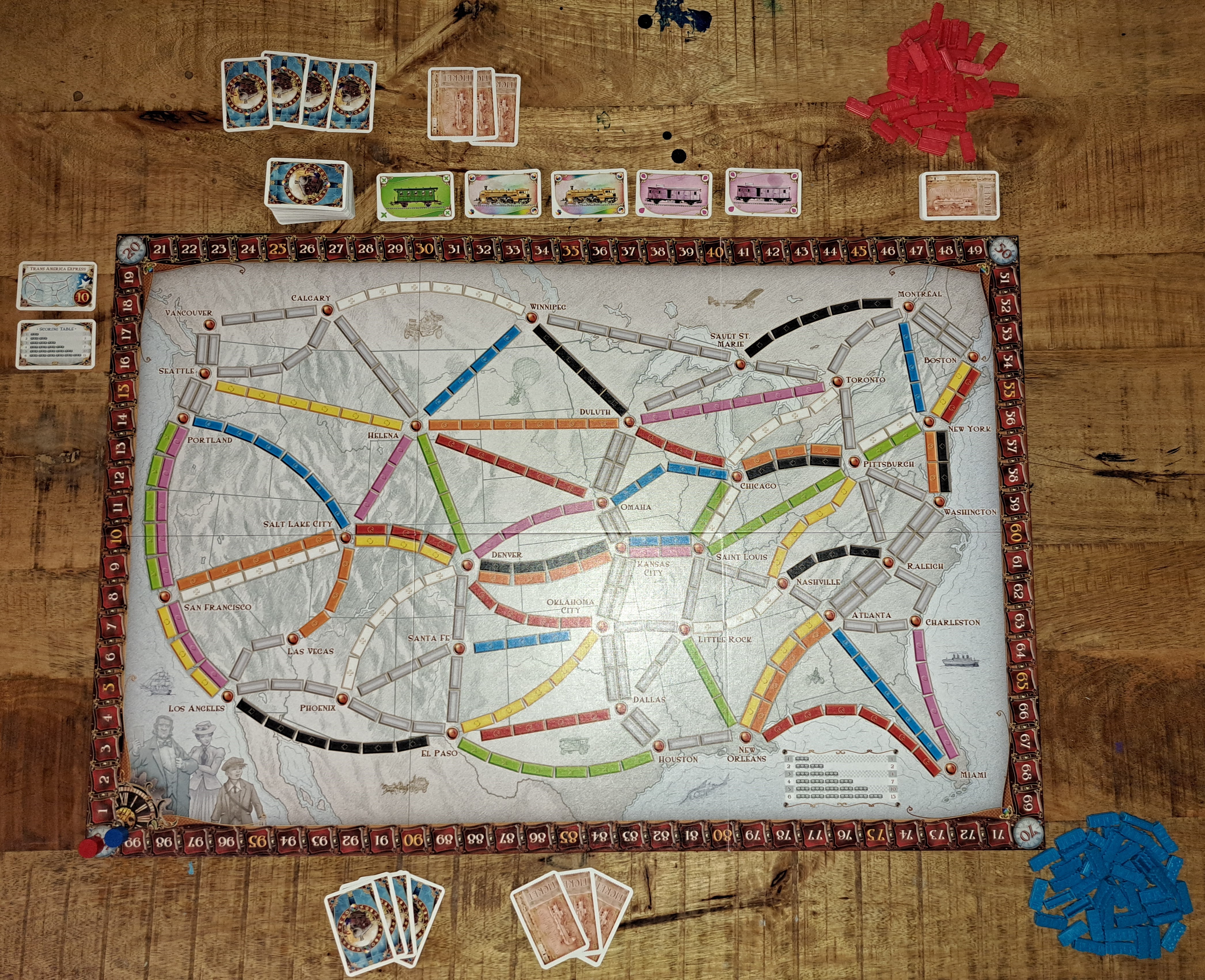
Here you can see a selection of short, double-grey routes. In a game with more than two players both sets of grey would be useable all the way from Duluth to Houston, however, as this was a two player game, once red had claimed most of them, they became inaccessible for blue.
  • Draw Destination Tickets – the player draws three new Destination Tickets from the top of the deck, looks at them, and decides which they want to keep. A minimum of one must be kept, but the player may keep two or all three if they so wish. Any discarded Destination Tickets are returned to the bottom of the deck.
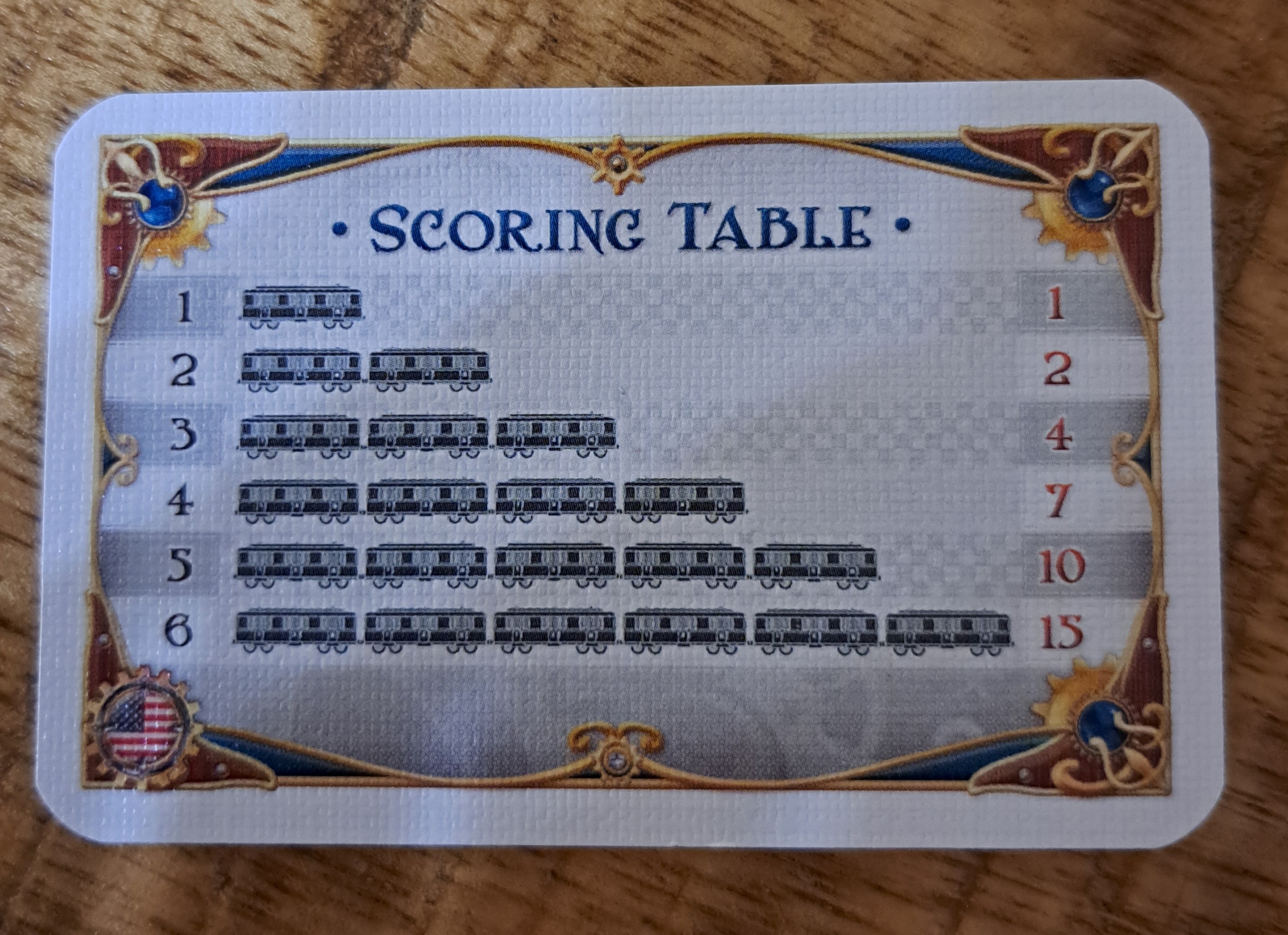
This card indicates how many points a player gains when claiming new routes. As you can see, a long route can be quite lucrative, if you have the right cards to claim one!

Special Locomotive Train Car Rules!

Locomotive Train Car Cards are easy to spot as they are multi-coloured. They act as a wild card and can be used in place of one regular Train Car Card of any colour when claiming a route. When drawing cards, if a Locomotive is one of the face-up cards on the table you may take it, HOWEVER if you do, you may NOT draw a second card. Additionally, if you draw a regular Train Car Card from the face-up five and the replacement card is a Locomotive, you MAY NOT take that card. If, however, a Locomotive is drawn blind as the first card taken from the draw deck, the player is lucky, and may still draw a second card either from the deck, or from the face-up cards.

IMPORTANT NOTE: IF AT ANY TIME THREE OF THE FIVE FACE-UP TRAIN CAR CARDS ON THE TABLE ARE LOCOMOTIVES ALL FIVE CARDS MUST IMMEDIATELY BE DISCARDED AND NEW ONES DRAWN TO REPLACE THEM.

An important thing to know regarding Destination Tickets is that they each have a point value. If the route indicated is completed by the player holding the card before the game ends, those points are added to their final score when the game has ended. If the route HAS NOT BEEN COMPLETED the player loses those points at the end instead. Destination Tickets are kept secret until the end of the game and the points from them are added only once play has finished, no matter when a player completed the route. As with hand size, there is no limit to the number of Destination Tickets a player may hold.

Ending The Game:

The game ends when one players supply of trains is either 0,1 or 2 at the end of their turn. After this each player, including the player who triggered the end of the game, may take one more turn before final scoring is done.
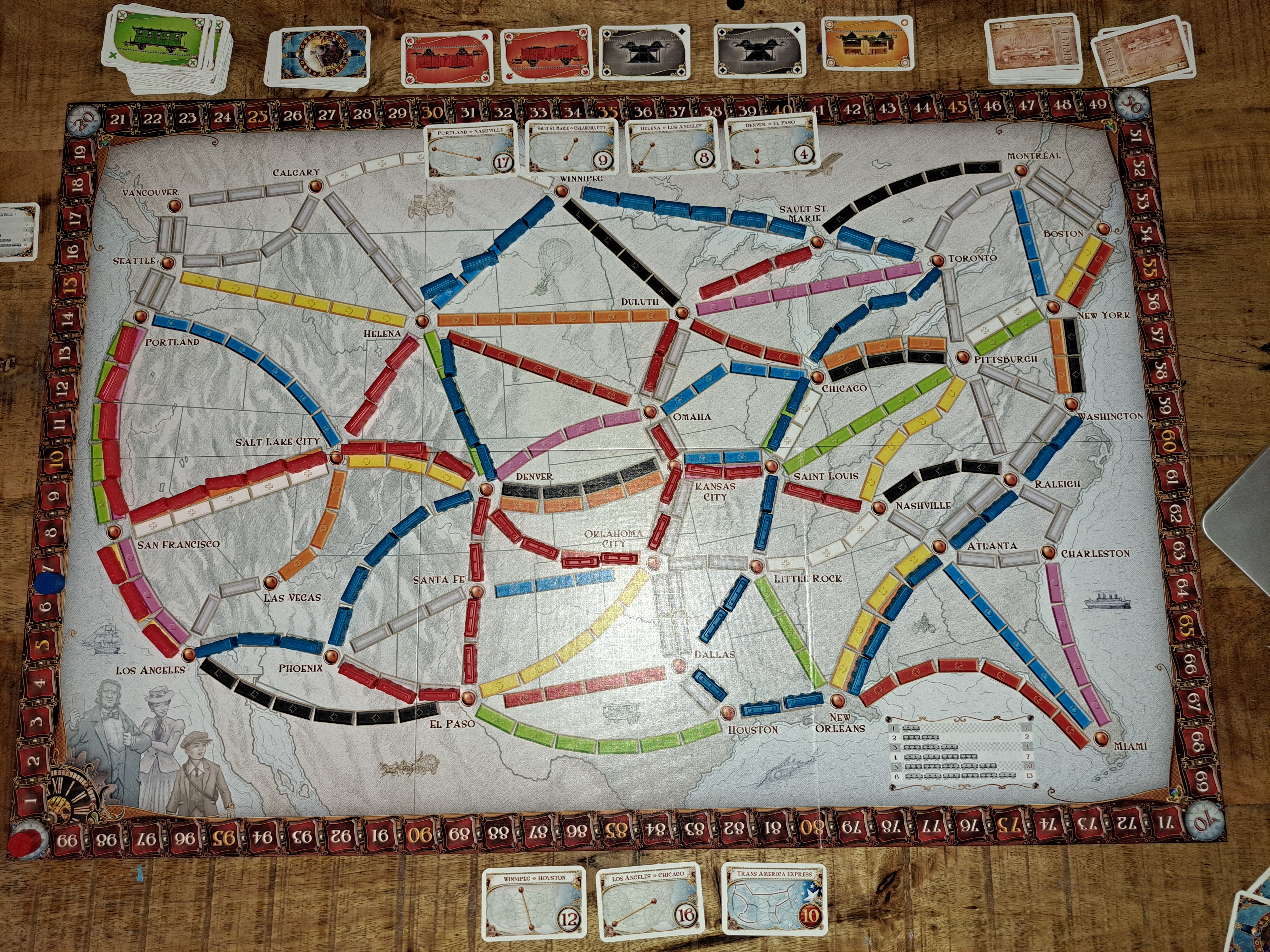
This was how our two-player game ended. Below you can see the routes that Blue (me) had claimed, plus the 10 point bonus for the Trans America Express. Total I had 107 points this time round. Above you can see the routes that Red (my husband) has claimed. Although he had more routes than me, he was unable to catch up points-wise, as they each (bar the Portland-Nashville route) only gave him a small number of points, and they did not connect well to form a long route. This is the first time I’ve ever beaten my husband at this game, and I am rather smug.

Strategy:

There is a limited amount of strategy that can be employed in a game as simple (relatively speaking) as this. We have found that completing routes, and often going for the Longest Continuous Path Bonus makes a large difference in final scoring. No matter how many individual routes a player has claimed they will most likely always be bested by someone who has one or two Destination Ticket routes completed. Especially as a few of these are rather high-scoring. It’s also worthwhile to claim routes as soon as you have the cards rather than waiting to hoard up more cards, as whilst you’re collecting cards there’s always a chance another player will steal away the route you had your eye on. If you’re approaching the end of the game and you’ve completed all your Destination Ticket routes and aren’t feeling brave enough to draw new ones, it’s worth it to try and extend your existing routes in order to claim the Longest Continuous Path Bonus, which gives you 10 extra points at final scoring. It is likewise worthwhile to lay claim to long routes, even if they do not connect you to anything particular, as these give you a good point-boost too.

To Conclude:

This is a lovely game. It’s good for a wide range of ages, so appropriate for families, and straightforward enough for both beginner and advanced board-gamers. The limited amount of reading required is very handy if younger children wish to play, though if you want to keep to the rules extremely strictly then children under the age of 6 probably cannot play alone, as they won’t be able to read the city names on their Destination Tickets. When we play with children we usually play open hand with all Destination Tickets face up on the table, in order to be able to help them plan their routes. It’s also a very nice choice if you want a relatively quick round of something, as each players’ turn doesn’t usually take more than a minute or two, and the game naturally progresses and ends quite speedily.

I personally like this game for several reasons:

  • Aesthetics – the board map is really nice to look at. City names are easy to read and the colours are bright, but not garish. The design is good. Playing pieces are also sturdy and simple, therefore unlikely to break.
  • Simplicity – the rulebook is a mere four sides, with plenty of pictures to explain, making it extremely easy to understand, and leaving little room for ambiguity or misunderstandings during gameplay.
  • Speed – my children often like to play board games, but their current ages mean that committing to a game can be a big deal, due to short attention spans. This game is fast enough that we can usually get through a round before anarchy descends.

I have rated this only a 3.5 though because, although the game is well thought-out, attractive and easy, I like a bit more challenge to my games. However, we have a later version of the game, Ticket To Ride: Europe too, and that version expands beautifully on the originally, introducing some new rules and one new game piece, which will likely, when we come to reviewing it, bump up the rating to a 4 or 5.

Saboteur – back with a quick card game!

Number of Players: 3-10

Year of Publication: 2004

Creators: Frederic Moyersoen, (designer), Andrea Boekhoff, Alexander Jung, Frederic Moyersoen (artists)

Are you a dedicated miner, searching for the gold with your crew? Or a sneaky saboteur, trying to bring down the tunnels on the heads of your compatriots!?

Saboteur is a silly, easy, quick-to-play (average play time for one round is only 30 minutes, but can easily be less with experienced players) card game where each player randomly draws either a regular Dwarf card, or a Saboteur Dwarf card at the start of the game. These cards provide you with your goal. The objective is simple; Dwarves are mining, and, as you might expect, are searching for the gold; Saboteurs are trying to thwart their comrades, and prevent them from striking gold!

Nothing makes the heart of a dwarf race quite like a nice shiny gold nugget. As one of these intrepid folk, you naturally want to collect as much of the yellow stuff as you can. But are you a gold digger… or a saboteur? – excerpt from the game rulebook

What’s In The Box:

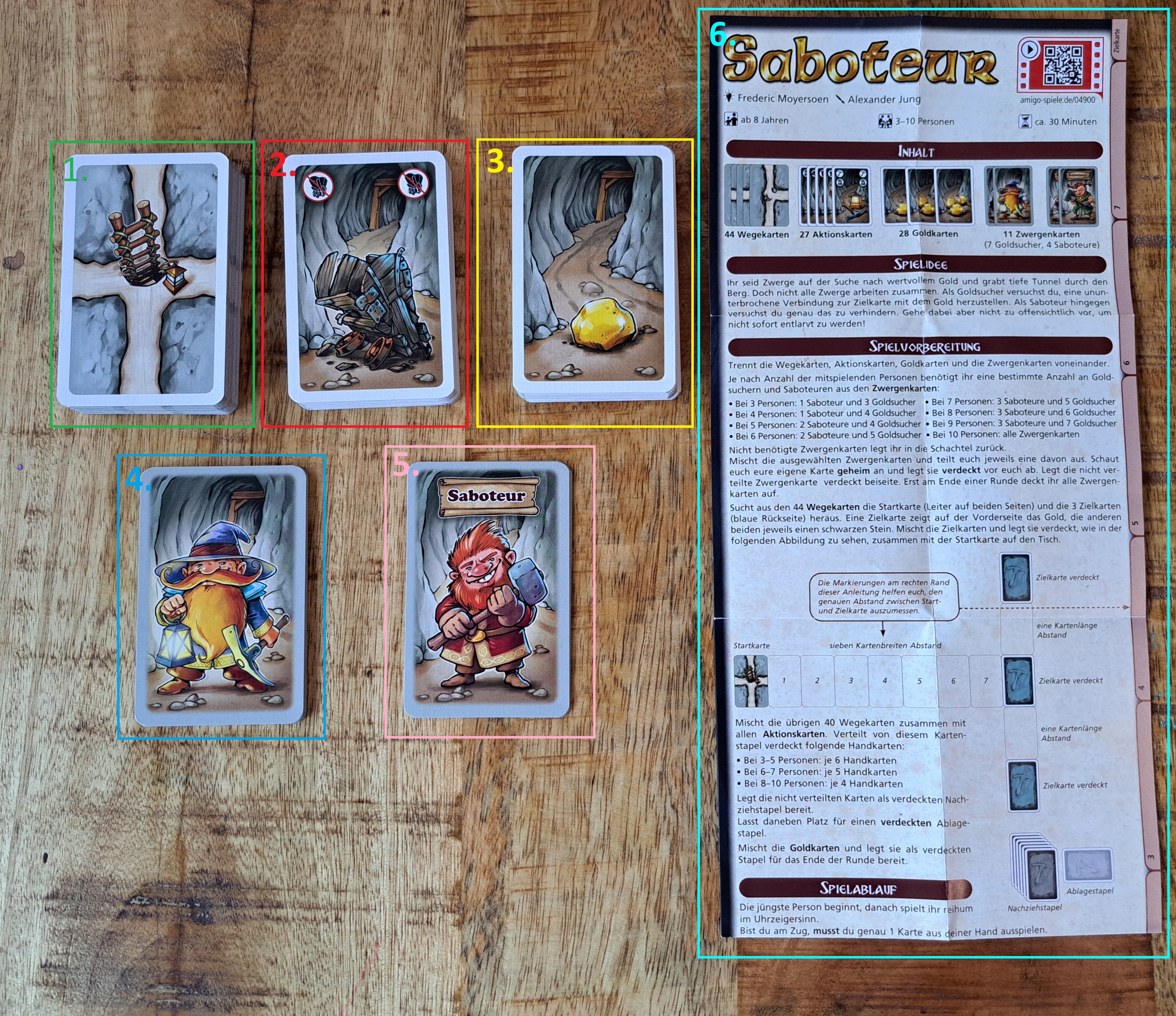
  1. 44 Path Cards
  2. 27 Action Cards
  3. 28 Gold Nugget Cards
  4. 7 Gold Miners
  5. 4 Saboteurs
  6. 1 Game Instructions sheet

Setting Up The Game:
Before the game begins there is a very small amount of setup required. You’ll need a reasonable sized table in order to lay out the cards that form the “mine map”. Cards must be separated into the above shown decks to begin, though regular Dwarf and Saboteur cards can remain in one pile. The number of Dwarfs and Saboteurs required for a round depends on the number of players, and is indicated clearly in the rulebook. The needed number are separated, and any unneeded player cards are returned to the box before the pile is shuffled. Each player then randomly receives a card which they should look at without showing the other players. Now you know if you’re a miner, or a saboteur. There will always be one Dwarf or Saboteur card leftover once all have been dealt; this is placed, face-down, to the side until the end of the round.

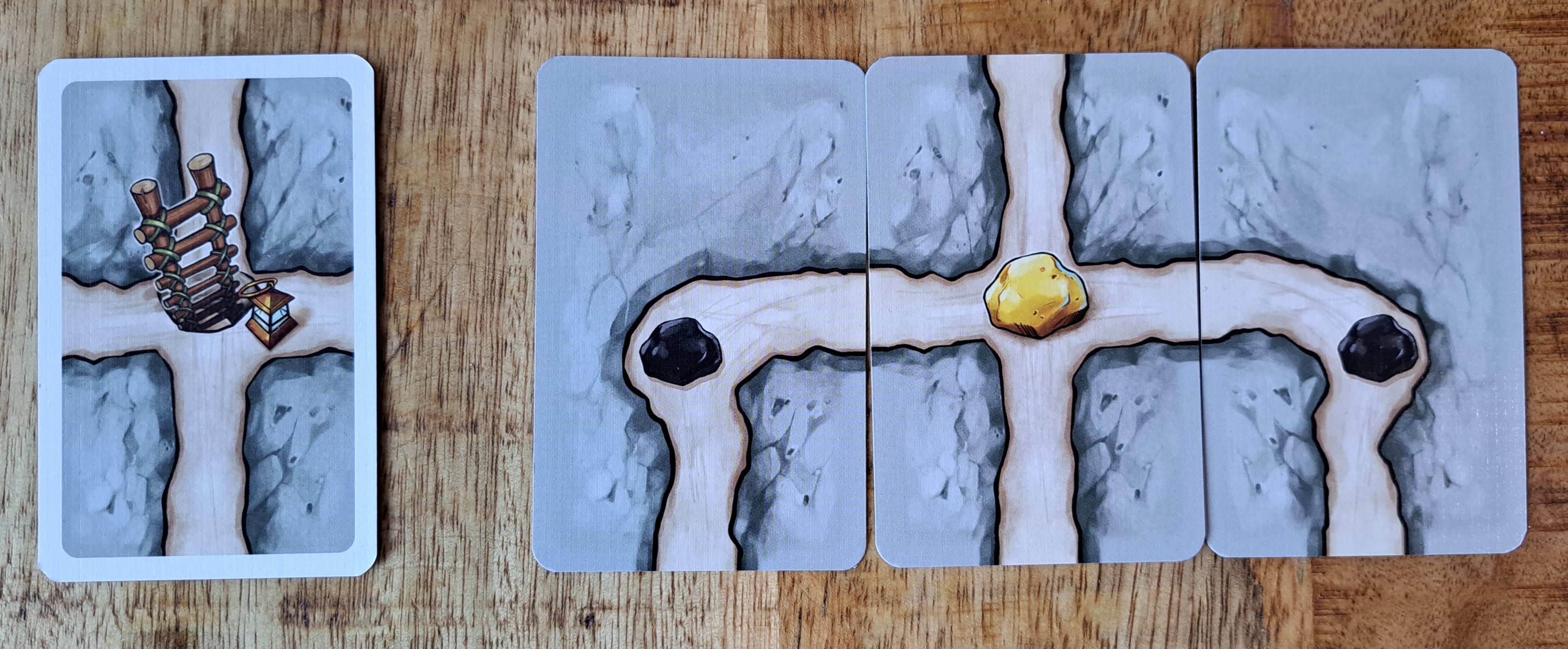
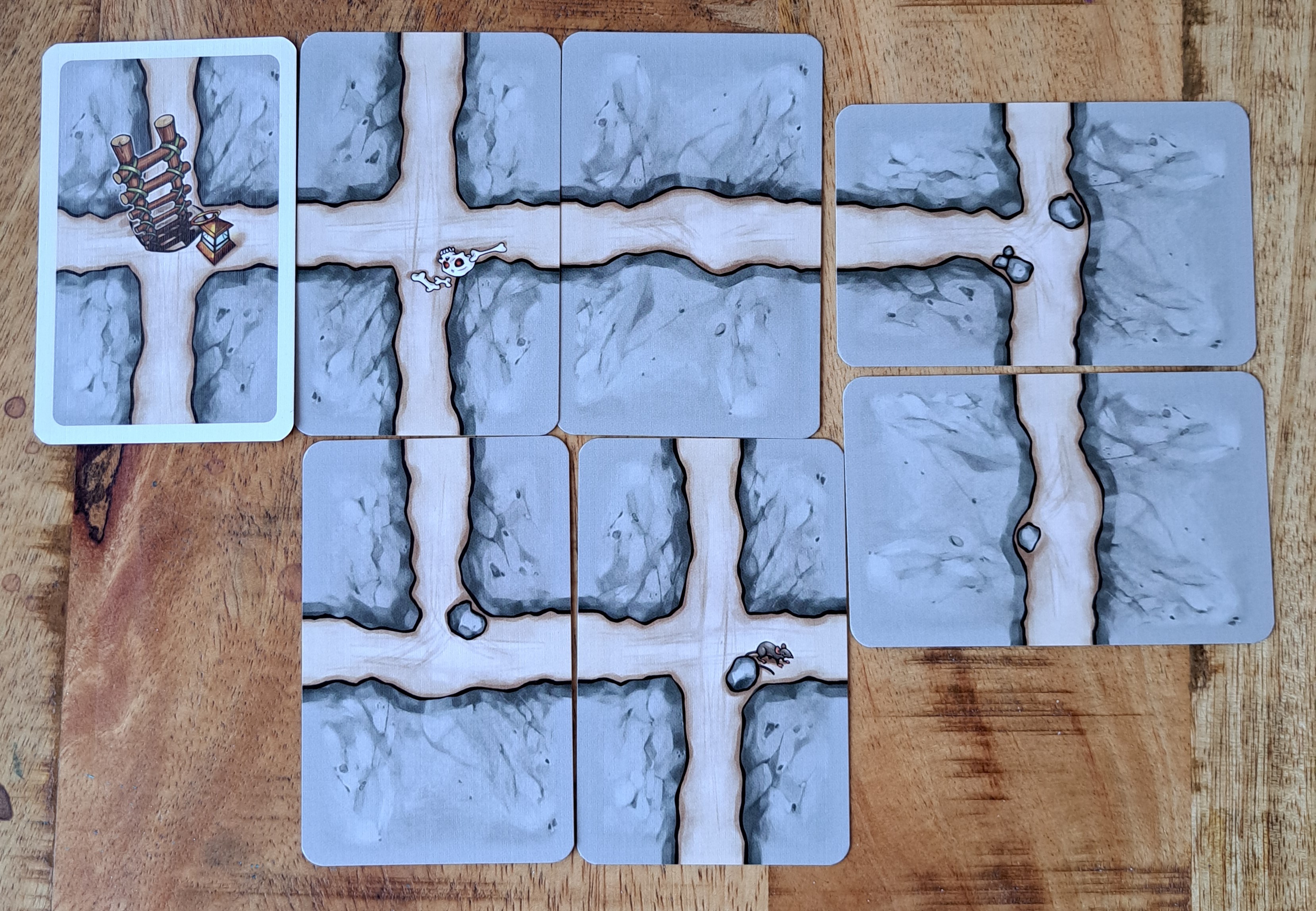
Next, you need to locate the Start Card, which is the only Path Card with a ladder on it, and the three Goal Cards, easy to spot, as one has a large gold nugget on it, and the other two a lump of coal each.

As shown here!

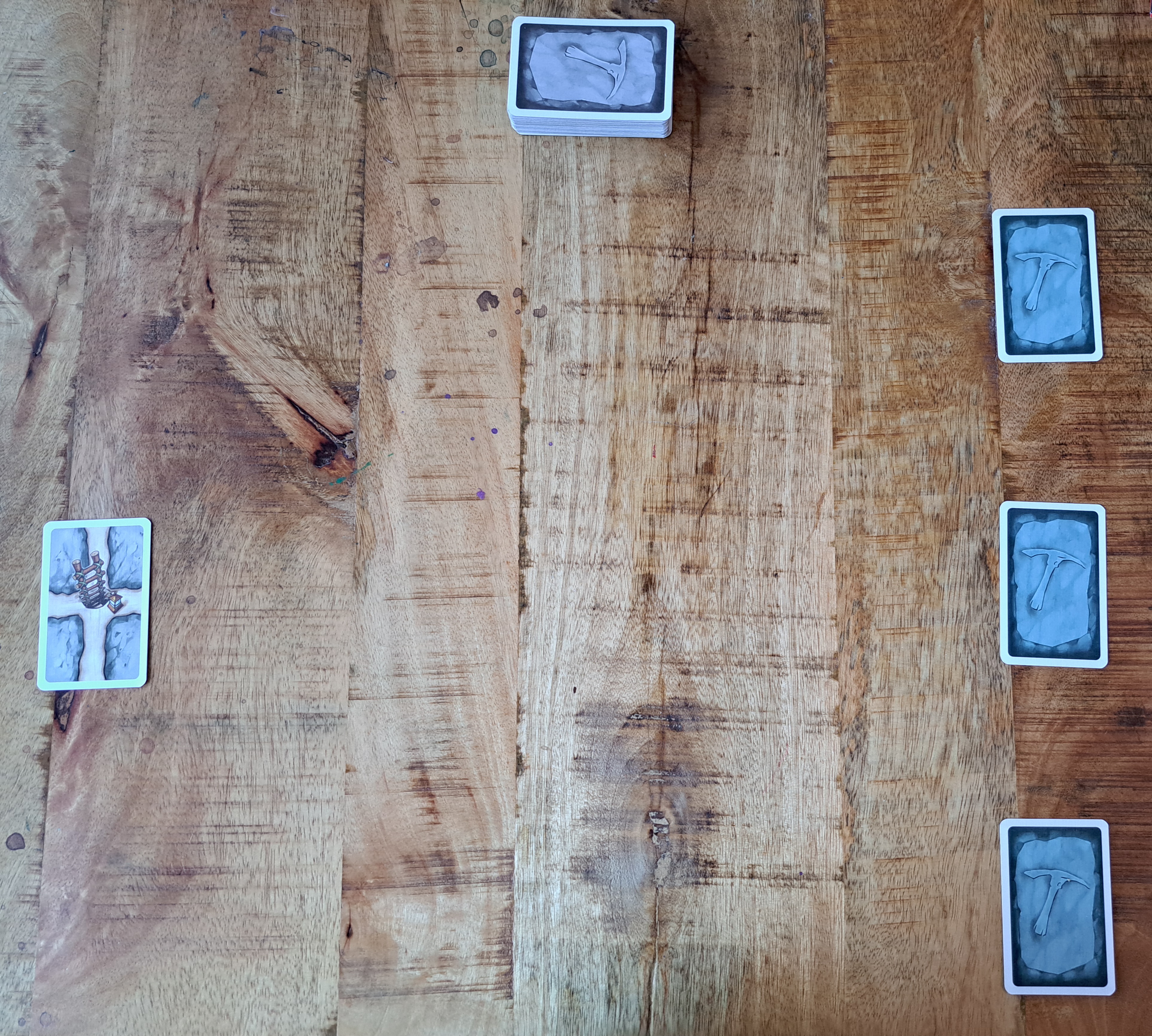
The three Goal Cards are then shuffled and placed face-down upon the table with one cards-length of space between the bottom of the top card and the next, making the width of the defined playing space five cards high. You then need to measure seven cards width across before placing the Start Card on the same row as the middle Goal Card. This represents the “edges” of the mine map. In total your map area will be nine playing cards wide, and five high, like this:

Now you’re ready to start the game, all that’s left to do is to shuffle together the remaining 40 Path Cards with the Action Cards, and deal a starting hand to each player. The number of cards each player receives is determined in the rulebook by the number of players present. Once each player has their hand the youngest player begins the round.

Playing The Game:

A players turn is very straightforward; you use the cards in your hand to further your goals. Each player must play a card on their turn. This means one of three things:

  1. add a Path Card to the maze,
  2. place an Action Card in front of yourself or another player,
  3. pass your turn by putting a card face down on the discard pile (this means the discard pile will have cards both face up and face down in it, this is completely okay)

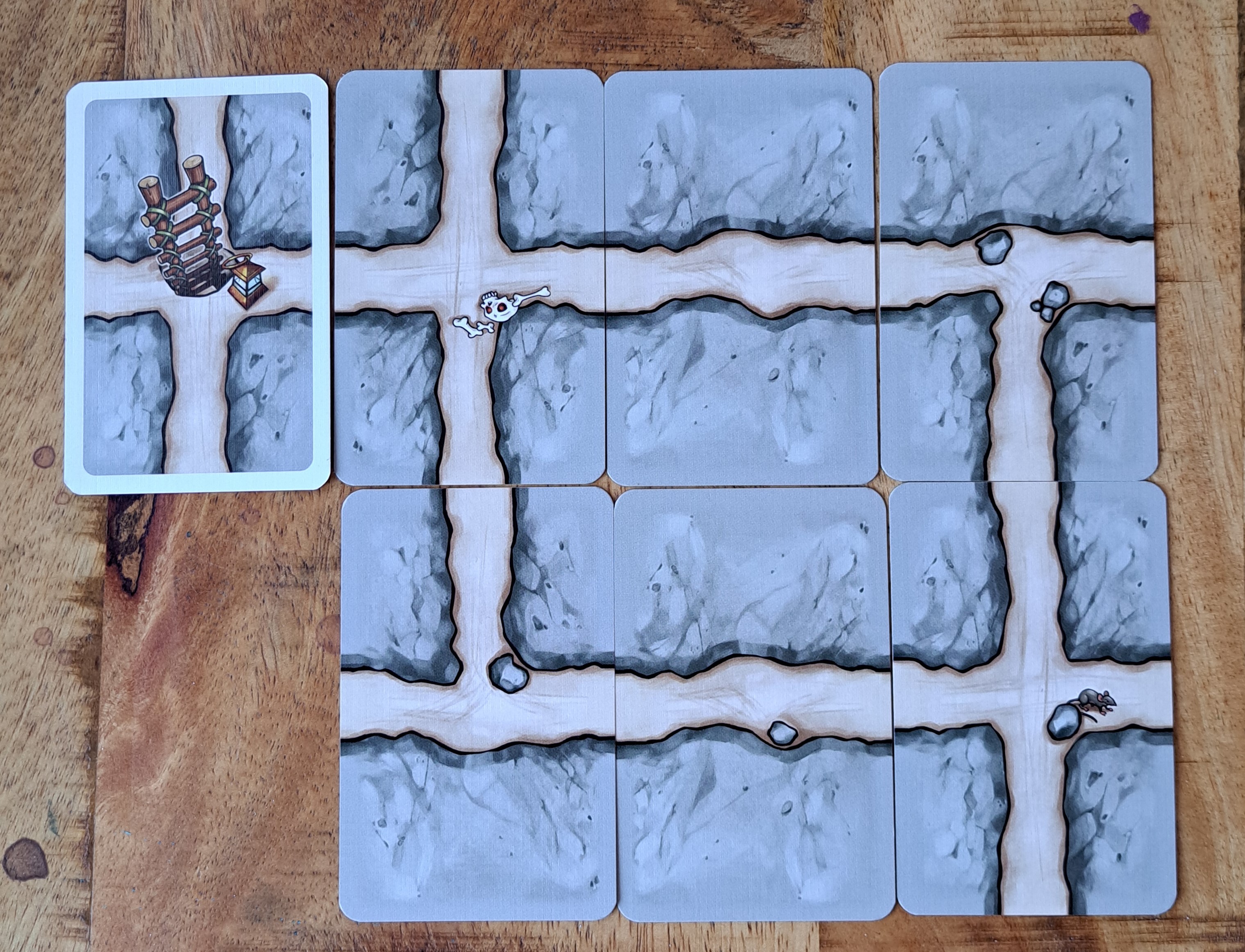
When playing a Path Card you must connect it to the Start Card in a logical way, meaning, the tunnels shown must connect, and, if connecting to more than one card (either above, below or on either side) must connect properly to all adjoining tunnels. Like this:

NOT LIKE THIS:

Path Cards must also be played long side to long side or short side to short side. It is not permitted to connect the long side of one tunnel card to the short side of another.

Playing An Action Card:

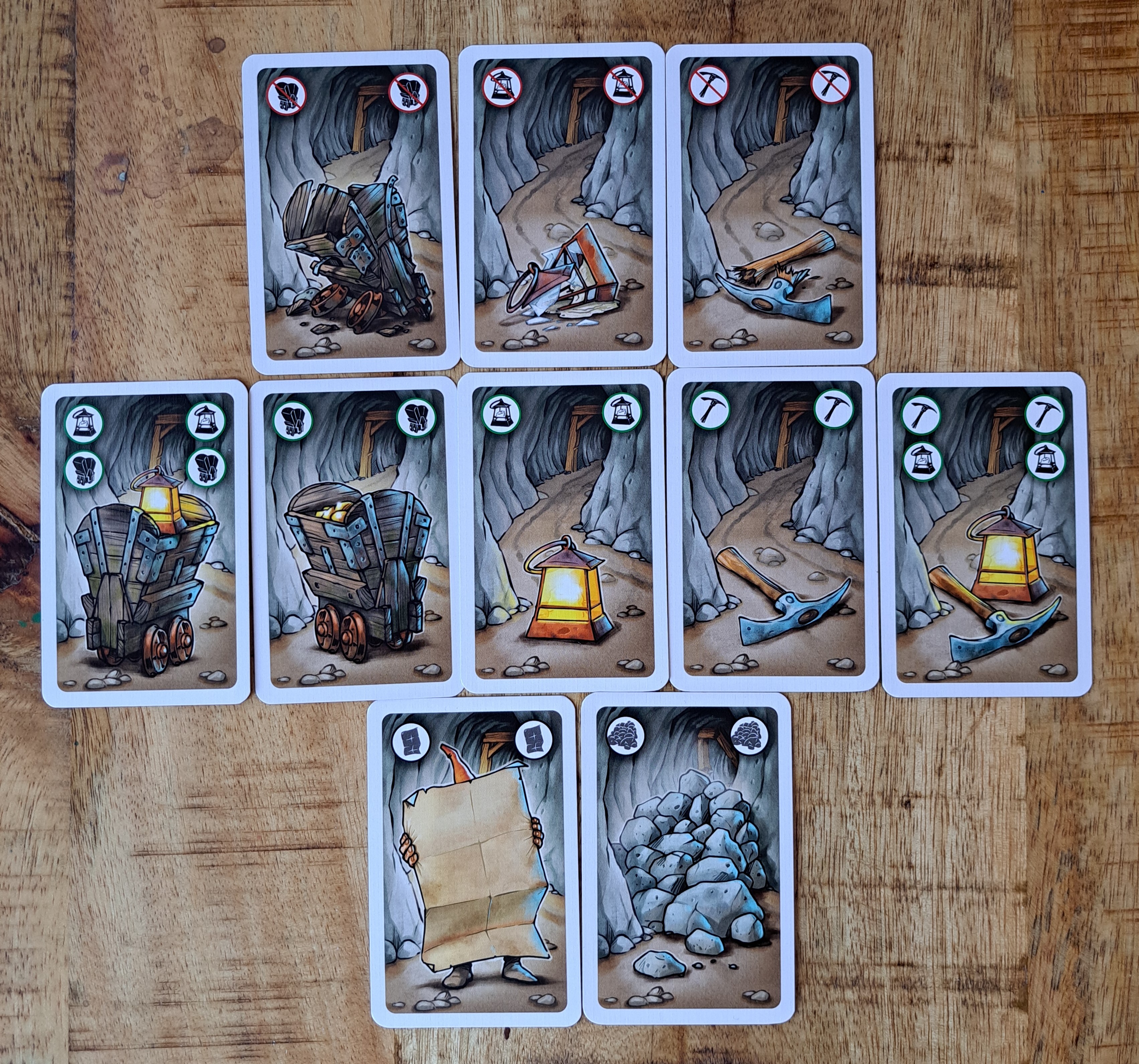
There are four types of Action Cards; Broken Tools, Fix Tools, Rockfall and Map

Broken Tools are useful cards both for Saboteurs and Miners; you can play them on another player by placing them in front of that player, and a player with Broken Tools is unable to build tunnels until they, or a different player, have been able to play the appropriate Fix Tools card.

Broken Tools do not completely hinder a player though, as Rockfall and Map can still be used until such time as your tools can be repaired. Rockfall is an excellent tool for a Saboteur, as it allows a player to remove one section of tunnel, effectively setting the Miners back one turn. As some Path Cards allow Saboteurs to build dead ends into the map the Rockfall can be a useful tool for the Miners too, as it will enable them to remove problem sections of the map created by nefarious Saboteurs and build functional tunnels. Map allows a player to chose one of the Goal Cards and look at it, without showing the other players, giving them an edge on potentially knowing where the chunk of gold is.

Ending A Round:

If a route is completed to a Goal Card, one of two things happens. Firstly the Goal Card is flipped over; if it’s revealed that the Goal Card reached was only a lump of coal, then the round continues as before. If, however, the Miners have struck gold, the round ends. At this point all Miner/Saboteur cards are flipped, revealing who was who all along.

If the draw pile is exhausted the round continues with each player continuing to play or discard cards as necessary until either a route to a Goal Card is achieved or no player remains able to play a card. At this point, if no route has been completed to gold, the Saboteurs win! At the end of a round, no matter who won, gold must be divided up between the victors.

When the Miners win the round the player who laid the last card to complete the path draws Gold Nugget cards equal in number to the number of Miners, looks at them secretly, chooses one to keep (not all Gold Nugget cards have the same value), then passes the remaining cards to the next player, going anti-clockwise, until all Miners have a Gold Nugget card to keep.

When the Saboteurs win the gold is divided up slightly differently. If only one Saboteur was playing they take Gold Nugget cards from the deck equaling four Gold Nuggets, if two or three are playing they each get three Gold Nuggets, and if four are playing each receives two Gold Nuggets.

Note: It is possible for a round to be played (in a game with only three or four players) in which no one is a Saboteur. If this happens and the gold is not reached before the round ends due to lack of cards, none of the Dwarfs receive any gold.

At the end of a round each player keeps their Gold Nuggets. The Miner and Saboteur cards are returned to one pile, including the one that was put aside at the beginning of the round, they are then shuffled and redealt, for the start of the new round. All Path and Action Cards are returned to the deck, and everything is shuffled together, for new hands to be drawn. Likewise the Goal Cards are shuffled and laid on the table again. The next round is played the same as the first.

At the end of three rounds the game is over and each player counts their Gold Nuggets. The player with the most wins! In the event of a tie, the players share the win.

Strategy:

This is not really a game in which a whole lot of strategy is required. Obviously you’re on the lookout for who might be Saboteur, and aiming to hinder them if you’re one of the Miners. Likewise, as a Saboteur you’re aiming to hinder the Miners without being immediately obvious, and also hoping not to accidentally hinder other Saboteurs if there are any playing. Other than that you mostly have to go with which cards are in your hand, available to play.

To Conclude:

I like this game a lot. It’s quick, easy to learn, easy to set up/put away and all-around good fun. It’s also good for kids, as there’s not any reading required, once the rules have been looked through, and the high player limit make it an excellent choice for a family game. The only slightly irritating thing is that the game is not playable with only two people, however, Saboteur 2, which we also have, and will be reviewing, expands on the base game, and gives new depth with teams added and new roles introduced.

This game is a solid 4.5 on our rating, as it’s interesting enough in structure to be fun, easy enough to learn quickly, and a good game for casual gamers, who might not be invested in the kind of games that require 1-2 hours of set up and rule reading before you even get to gameplay. The last .5 that would bring it to a 5 rating is that we wish it would be playable with just two people.

On The Twelfth Day Of Christmas, My True Love Gave To Me…

Mastermind! And acted very suspiciously all day….

The Rules:

This game is very simple. One player makes a code using the coloured pegs provided and then hides it whilst the other player looks away/puts their face in a cushion. The second player then has to use the remaining coloured pegs to try and guess the code. The first player indicates when they are right or wrong using white and red pegs. The second player has to crack the code before they run out of lines. We already wrote a full review post of this game here if you want to read more about it.

For Christmas?

Definitely! This game is a fun quickie for two players, and fantastic for keeping the most rambunctious children occupied for a little while if you’re a family that been blessed with children with boundless energy! Although a two player game doesn’t sound the best for Christmas, when there’s usually vastly more than two people around it’s actually fantastic. Both for smaller families and big ones. It’s easy to make a Mastermind tournament if you have lots of interested people or, if there’s only a few of you it’s ideal for having a few quiet moments. It’ll also keep Aunt Jean happy – she’s not strong with tactical games, but if only two people are playing it at least there should be someone left to hear about her newest animal acquisition!

Happy Twelfth Day of Christmas! This brings us to the end of the Christmas period, and the end of this series of posts – at least until next year!

On The Eleventh Day Of Christmas, My True Love Gave To Me…

Blokus – and after spending the day with my father told me I was a chip off the ol’ block!

The Rules:

Blokus is a great game that relies on simple rules. Each player chooses a colour and takes all the tiles of that colour. Then, starting with the oldest player they place one tile, starting from the corner nearest where they’re sitting. You can place whichever tile you like but your tiles must all be connected by the points of the corners.

For Christmas?

Yes! I first played this game at Christmas and it’s good fun. It’s not particularly competitive, which makes for a relaxed game. On top of that it’s also very easy to grasp how to play. It’s such a straightforward game that Aunt Jean might even win at it, if she can stop talking about her dogs long enough to focus.

Happy Eleventh Day of Christmas! We’re nearly at the end of the Twelve Games of Christmas now and hopefully you’re  all !

On The Tenth Day Of Christmas, My True Love Gave To Me…

Sphinx! And asked if I knew the answer to the riddle…

The Rules:

Sphinx is a great kids game which takes half an hour or less to play. Each player starts on the same square in the maze and moves around by rolling three dice. There are two symbols on the board, one is a little coloured card, called a Sphinx card, the other is a mummy hand. The Sphinx card allows you to collect a card of that colour from the stack next to the board, you need these to win the game. The mummy hand allows you to look at the colour of the base of one of the six Sphinxes on the board. There are three Sphinxes in the center of the board, guarding the treasure, there are also three Sphinxes down the right-hand side of the board. Each of these has a different colour on their base. To win the game a player must advance to the middle of the maze and present the correct coloured Sphinx cards in the correct order to reach the treasure. There is a double snake symbol on one of the dice. this means that the player who rolled that symbol must swap one of the Sphinxes in the center of the board with one on the side. In doing this the pattern of colours in the center also changes. The game is won when a player correctly guesses the colour pattern of the center of the board with the correct Sphinx cards.

For Christmas?

Yup! It’s a slightly more challenging game for kids who are a little older. It’s a great introduction to strategy and memory games and can be used as a learning point for the myth and history of the Sphinx (if you’re into that kind of stuff). It could also be an excellent opportunity for the kids to teach Aunt Jean something, as we all know that her interest into history doesn’t extend further than the pedigree of her favourite dog!

Happy Tenth Day of Christmas, if you’re being bored by these posts, just hang on for two more days, and then everything goes back to normal on the blog!

On The Ninth Day Of Christmas, My True Love Gave To Me…

Connect 4, and proceeded to bore me, explaining how if he started first he could always win…

The Rules:

Connect 4 is a simple tactical game; two players take it in turns to drop their coloured counters down columns on an empty grid in an attempt to make a line of four of their colour, either vertically, horizontally or diagonally, whilst preventing their opponent from making one first. The first player to make a line immediately wins. If both players run out of counters and no one has a line the game is a draw.

For Christmas?

I think it’s a good quick game for when you need five minutes to chill away from the masses, or for when you need your kids to stop running around for a few minutes so that you can get food out of the oven without falling over them. You could also get Aunt Jean to play it, which would keep her out of the way for a few minutes when you’re busy, because she’s really not as helpful in the kitchen as she thinks she is!

Happy Ninth Day of Christmas everyone! If you haven’t played any games yet, you’re not doing Christmas right!

On The Eighth Day Of Christmas, My True Love Gave To Me…

Labyrinth – and asked me to get lost in one when I won.

The Rules:

The board is laid out randomly with movable square pieces. One piece is left over on the side and the youngest player takes the first turn. Before the game begins you have to shuffle the Treasure Cards and put the pile face down by the side of the board. Then flip over the top card. The first player then pushes one row either vertically or horizontally down/up or left/right so that the spare piece is now on the board, and a different piece has fallen off. Next they move their coloured token to try and claim whichever treasure is shown on the face up card. A player can move any number spaces in any direction on their turn so long as there’s a path. If they succeed in claiming the treasure they take the card and the next one is turned over. Play then passes to the next player. The game continues like this until all the cards are claimed. The player with the most treasure wins.

For Christmas?

Yes and no, this game is good, fun and easy to play, so excellent for families of mixed ages. My only reservation is that it can drag on a little. So I would say, yes for Christmas, but put some kind of time limit on it so everyone doesn’t get bored – otherwise you’ll just give Aunt Jean something new to complain about. On the other hand, yesterday was New Years Eve and all the adults may be slightly hungover, so for that this is a good game – it’s got next to no rules, so isn’t difficult to think about, and it doesn’t make any noises!

Happy Eighth Day of Christmas and Happy New Year! Drink lots of water and try not to throw up if you were out partying last night!

On The Seventh Day Of Christmas, My True Love Gave To Me…

Uno, and said in hushed tones that it’s the only child-friendly way of playing Blackjack early in the day…

The Rules:

The deck of cards is shuffled, and seven cards are dealt to each player, the remaining cards are placed face-down in the middle of the table and the top one turned over and placed next to it. Generally the youngest player begins and they start by putting a card on top of the face-up one that matches either the colour or the number of the card. If they aren’t able to do this, but they hold a wild card, they can play that instead and change the colour of the cards that are being played. There are a few other cards that change the direction of play and similar things, but those can mostly only be played when they match the colour. The objective of the game is to play all of your cards. If you are unable to play a card on your turn you must pick one up from the face-down pile and add it to your hand. When you only have one card left you have to say “UNO!!” as loudly as possible before you can put it down. If you play your last card without proclaiming Uno, you must draw new cards and continue playing as a punishment.

For Christmas?

Yes! Definitely! This game is great for large or small groups of players, and is all-ages inclusive. Aunt Jean could almost definitely grasp this one without too much trouble, and she might not even complain about it! On top of that, it’s a speedy play, so a good time filler.

Happy Seventh Day of Christmas! Keep the cheer and food flowing!

On The Sixth Day Of Christmas, My True Love Gave To Me…

Das Kasperlspiel, and walked around like a puppet for the rest of the day.

The Rules:

This game is pretty straightforward; to play you just claim one Harlequin movable card and arrange its arms and legs into a starting position. Then shuffle the Harlequin cards and deal them out into three piles, which should then be turned face up. The youngest player begins and tries to make their Harlequin match one of the cards they can see by moving only one arm or leg one position. If you succeed in matching one of the images on your turn you get to claim that card from the top of the pile. If you don’t manage to match one of the cards it is the next players turn. The highest number of cards that any player can in one turn is two, and this is only possible if a players Harlequin matches a card that’s already face-up when their turn begins. They are then allowed to claim that card before moving their Harlequin to try and claim another. The game ends when all the cards have been claimed and the player with the most cards wins. If two players are tied for the most cards then the points (shown in a small coloured circle on each card) are added up and the player with the highest number of points wins.

For Christmas?

Maybe… To be honest, although I like this game, I also struggle with it a bit. It requires quite a lot more concentration than games from our previous posts of this years Twelve Games series to consider the most logical/efficient way of moving your Harlequin. On top of that, Aunt Jean definitely wouldn’t be able to cope with it, it’s likely she’d find it boring and too fiddly. I would recommend it to families who like serious, logical games. Not because it’s difficult, but simply because you have to concentrate that little bit harder on it.

Happy Sixth Day of Christmas! It’s around this time that people are starting to have to go back to work and there’s less time for games, but if you’ve got kids, or lots of holiday days, keep the games flowing!

On The Fifth Day Of Christmas, My True Love Gave To Me…

  Märchenland, and told me that I really needed to work on my storytelling skills!

The Rules:

The aim of the game is to collect all four story tiles from three different fairy tales before any other player. To do this you roll the die and move around the board turning over the number of story tiles indicated on the space you land on. A player who rolls a magic wand must switch places with another player, the same applies for a player who lands on the magic wand space. If a player rolls a number that would mean they land exactly on the same space as another player before the gingerbread house they have to remain one space behind the other player, but if they roll this after passing the gingerbread house they are able to force their opponent to go back to the start.

For Christmas?

This game is a good opportunity to tell a few stories, but you might not want to invite Aunt Jean to play if there are little kids around – she’s likely to tell the slightly more gory versions of the stories written by the Brothers Grimm, rather than the lovely, romantic Disney versions of each story. It’s a good memory game, and is relatively quick, with very few rules so can be easily learnt and played by players of mixed ages. I would recommend it.

Happy Fifth Day of Christmas! We hope no one in your house is bored of their presents yet!