Teddy Memory – and suggested that I work on my memory before buying him another present…
The Rules:
This game is just Pairs, but under a cuter name. Very simple and straightforward. You shuffle all the cards and lay them face-down on the table/floor/whatever surface you’re playing on. Then the first player picks two cards and turns them face up. If they’re the same that player gets to keep them and takes another turn. If they’re different they have to be turned over again and play passes to the next player on the left. The winner is the person with the most pairs when all the cards have been picked up.
For Christmas?
Well, why not? It’s a nice easy game that can be played by any number of people (provided you have enough cards and a big enough table or floor). It’s also fantastic for all ages because it forces you to exercise your memory muscles! Brain-active games have been shown to help prevent Alzheimer’s, so get all the oldies playing with the kids and then everyone can have healthier brains! It’s definitely a social game too, so Aunt Jean (see Twelve Games of Christmas – 2013) won’t be able to complain that no one wants to spend any time with her! (Unless of course she doesn’t want to play the game and then, well, what can you do?)
Anyone who was reading this blog as far back as 2013 will already have a feel for how these posts go. The only difference really is that this year they’re all kids/family games rather than just any game we really liked during the year.
Merry Christmas everyone! Play many games and bring joy and game-related arguments to all your family and friends!
Go back to whichever hole you jumped out of and leave us alone!
What do you call a happy rabbit? A hop-timist! (Not the place for bad rabbit jokes? Okay…)
Lotti Karotti(the German name for the game, the English is Funny Bunny) is a simple and fun game in which you race against the other players’ rabbits, and hop that little bit faster than everyone else!
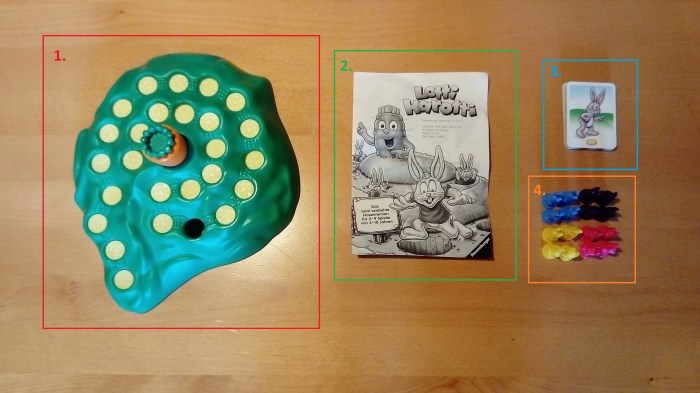
What’s In The Box:
Three-dimensional playing board
Game rules
Deck of action cards
4 x 4 coloured rabbits
Playing The Game:
Objective: To get one of your rabbits to the big carrot faster than anyone else.
To begin the game the deck of action cards should be shuffled and placed face-down at the side of the board and the carrot should be twisted until there are no holes showing in the board. Next each player should choose a colour of rabbit to be from the four available. As it doesn’t say in the rules who plays first we just did Rock, Paper, Scissors for it. Once a first player has been determined they draw the first card from the deck and turn it face up on the table. They then perform the action on the card which will be either, hop 1, 2 or 3 spaces, or twist the carrot.
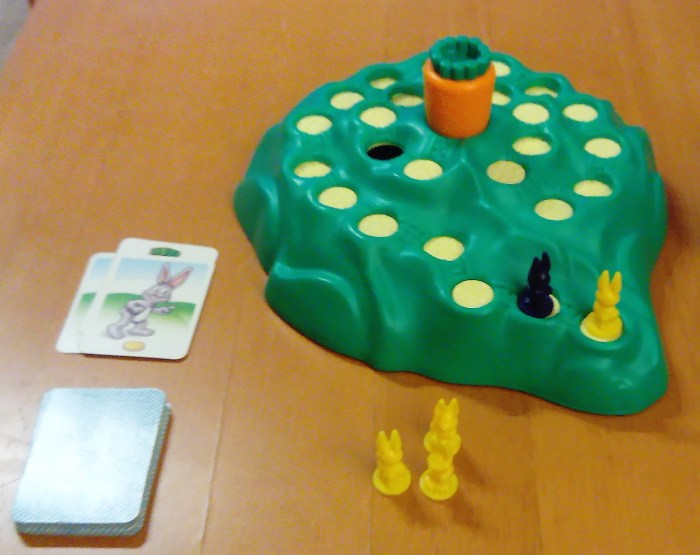
Normally players will place a rabbit onto the first, second or third spot on the board on their first turn. This normally creates a que of rabbits, like this:
Here two rabbits are adjacent to each other.
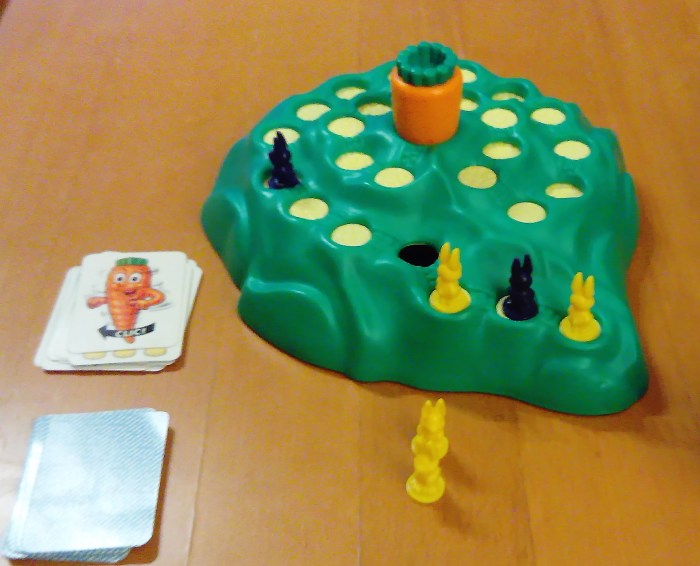
If this happens and the player in the middle or the back turns over a card that tells them to hop they are allowed to jump over any number of rabbits that are adjacent to them to get to the next empty space. Like this:
The second yellow rabbit has hopped over the first yellow rabbit and the purple one to reach the third space on the board.
When the carrot is turned it causes holes to open up at different points on the board. If one of your rabbits is on a hole when it is opened by another player (or yourself) it falls underneath the board and is immediately out of the game. Likewise if a hole is opened next to where one of your rabbits is and you turn up a card saying to hop one space you also have to hop into the hole, you cannot hop over it.
Winning The Game:
The first player to get a rabbit to the top of the carrot is the winner.
Strategy:
It’s not really possible to have a strategy for this game. This time round that we played it all my rabbits ended up in underneath the board and there was absolutely nothing I could have done about it. I would say just try and get your first rabbit as far along the board as possible. But otherwise don’t think it through too much, because it’s a game of chance with the cards really.
History and Interesting Things:
Between 2001 – 2002 this game was recommended for two awards and won 1.
I have absolutely nothing else interesting to write here.
To Conclude:
As kids games go this is pretty great. It doesn’t involve any complicated thinking but also, because of the nature of the ‘carrot’ cards, doesn’t get boring either. It’s a good quick play for children of all ages with a cute theme.
This a favorite to say to children when they’re obviously making something up instead of telling the truth, but this game is all about fairy tales!
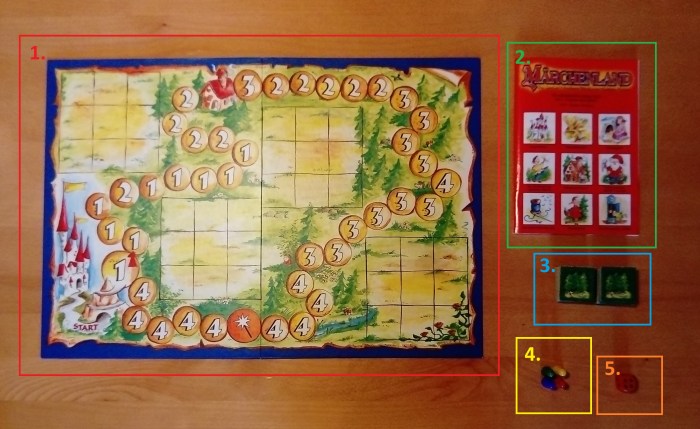
What’s In The Box:
Game Board
Rules
36 Story Tiles
4 Player Pawns
6-Sided Die
Playing The Game:
Objective: To collect all four parts of the as many fairy tales as possible.
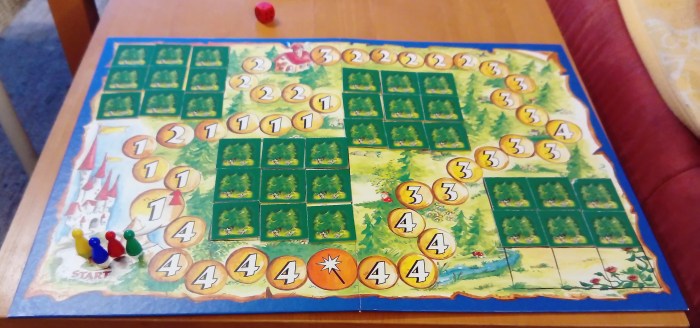
This game is pretty simple. You start by shuffling all the story tiles and laying them out, face-down, on the four gridded areas of the board. Each player then chooses a colour and places their token on the start space. In this game the youngest player starts.
The starting set up of the board. Note: this copy of the game is quite old and is missing one the stories.
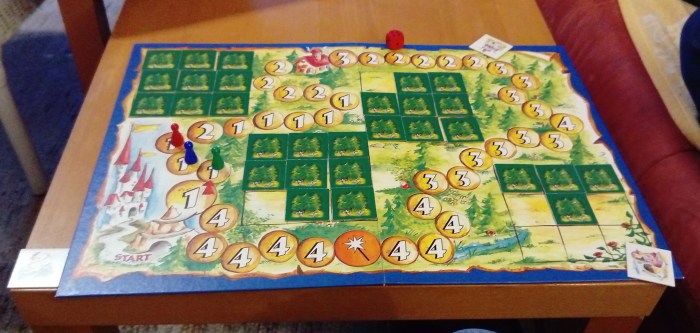
The first player then rolls the die and moves that number of spaces forward. Each circle that you can land on has a number in it (with the exception of the magic wand, which I’ll explain after), when you land on a circle you can turn over that number of story tiles and look at them. The first tile you turn over becomes the story that you’re trying to collect; after that when you turn over a tile you have to put it back if it doesn’t match your story. When you turn over a tile you have to show it to all the other players. This means that if you turn over a tile that belongs to a story another player is collecting it’s then easy for them to pick it up if they’ve a good memory. So the first time you land on a space you’re almost definitely going to pick up a tile that becomes your story, unless, weirdly, you manage to pick up a tile from a story that one of your opponents has just collected.
Here each player has collected their first story tile and are progressing around the board.
Until you pass the gingerbread house players cannot land on the same space as each other. They are allowed to pass each other if they roll a high enough number on the die, but if they roll a number that would allow them to land on the same space as another player they must remain one space behind. After passing the gingerbread house this rule changes and if a player lands on the same space as another player the unlucky other player has to go back to the start.
The only thing really left to explain is the magic wand symbol. This is on one space on the bottom of the board and on one side of the die. If this is rolled or landed on, the player whose turn it is has to swap places with another player. Now, if you’re lagging behind a bit and would really like to be up front where the others are, then you’re lucky if you roll this, however, if you’re doing well and roll this and the only options for places you can swap to are spaces that allow you to turn over 1 tile you’re probably not going to be so happy.
Winning The Game:
To win the game a player must collect all four story tiles from three stories before the other players. This means that players can keep going around the board for as long as is necessary to achieve this goal.
Strategy:
Have a good memory. A big part of the game is remembering where a tile is when another player turns over a tile that you need. This can enable you to win very quickly if you get lucky with the other players turning over tiles you need instead of ones that they need. It’s also good to keep an eye on one other story that no one else is collecting as a potential for your next story, as if you already know where two or three of the next story tiles are when you finish collecting the first one you’re likely to get ahead. Other than that this game is mostly luck of the roll and hoping that your opponents don’t roll magic wands if you’re in a good position.
History and Interesting Things:
This game was inspired by the stories written by the Brothers Grimm.
Märchenland translates to Fairy Land in English, though this isn’t a literal translation.
The Brothers Grimm were academics who were born in the late 18th century and specialized in collecting and publishing folklore during the early-mid 19th century.
Many of their stories are very commonly know still, although they are more commonly known in their romanticized, Disney form than in the form originally written in, which tended to be a little more gory and with slightly less happy endings.
During the 1930’s and 40’s the many of the stories were used as propaganda by the Third Reich.
The way the Gimm’s collected and rewrote stories before publishing them was regarded at the time by many to not be an accurate collection of the stories. However, this method of collecting folklore and legends has since been used throughout Europe.
As a result of the use of the book Kinder – und Hausmärchen Nazi party it was actually banned in Germany for a short time when the country was occupied by the allied forces after the war.
There is a current TV series called Grimm featuring a descendant of one of the brothers.
The Grimm stories provided the basis for many of Walt Disney’s early films, such as Snow White and the Seven Dwarfs(1937) and Sleeping Beauty(1959). It could be said that the Brothers Grimm provided the basis upon which Walt Disney built his film empire, which is still going strong today.
To Conclude:
I rated this game 4.5 because although I really like it and would definitely recommend it I think there’s not enough to it. If I were going to suggest an improvement to the game I would suggest that the stories that go with each set of tiles has to be told whilst they are being collected, or something similar. That way the game is an opportunity to do some creative storytelling as well as have a bit of fun.
Sphinx is a simple game for kids which incorporates the popular mythological creature. The Sphinx is a widely recognize creature; a lion with the head of a man. The most famous Sphinx in the world is the Great Sphinx of Giza in Egypt, which stands near the Great Pyramids of Giza on the west bank of the Nile. In popular mythology the Sphinx is a wise being which often demands the answer to a riddle. when this answer is given incorrectly the Sphinx eats the unfortunate person who couldn’t answer. However, the mini Sphinxes in this game are much less vicious.
What’s In The Box:
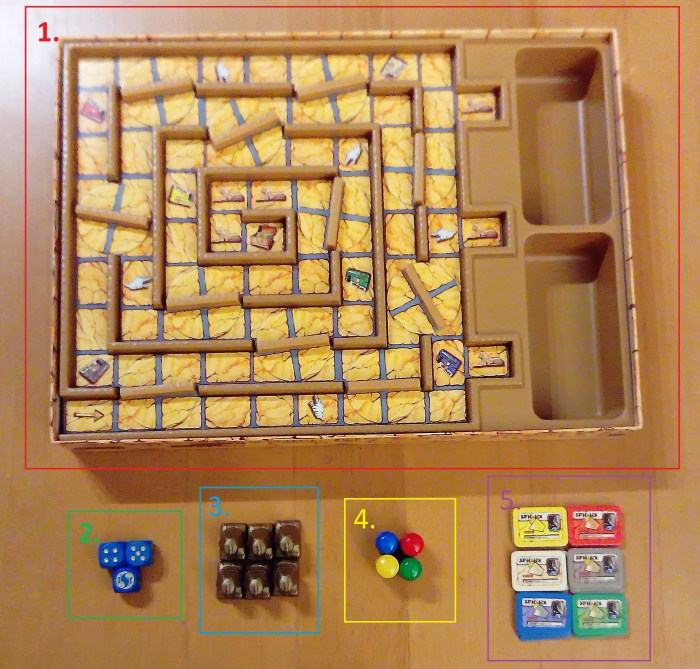
Game board
3 6-sided dice, one with a double snake image on one side
6 Sphinxes with different coloured bases
4 player tokens
6 coloured Sphinx cards
1 Rule book (not in the picture as someone was reading it at the time)
Playing the Game:
Objective: To collect the right coloured Sphinx cards and present them before the Sphinxes to collect the treasure.
Okay, that’s not a hugely clear way of writing the objective, but that’s why we write the rest of the post!
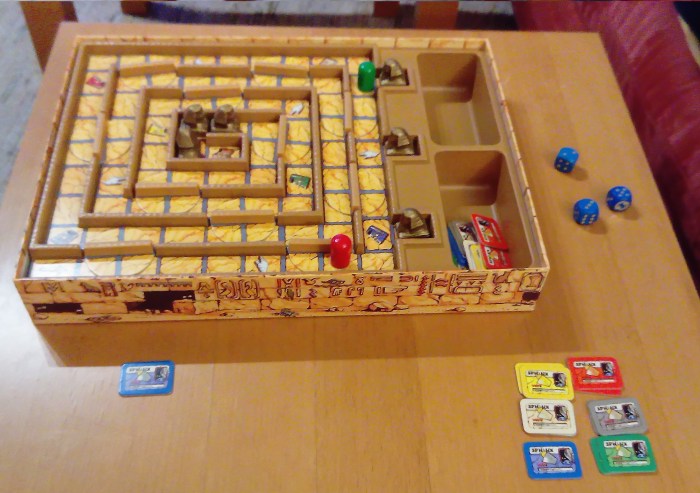
To begin the game each player chooses a token and places it on the square on the board with an arrow on it. The six Sphinxes are then randomly placed on each of the six squares with a Sphinx image on it. If you’re playing with less than four players you should remove the appropriate number of Sphinx cards from the stack by the side of the board so that there is one for each player. In this game the youngest player starts, and play then continues clockwise round the board.
To begin your turn you roll all three dice. In this game you do not total the number shown on the dice, instead you take each die as an independent section of your turn, in whichever order you choose. If you pass another player you can take a Sphinx card that you need from them. However you cannot take a card that you already have, if a player has Sphinx cards, but you already have all of them, they have to return one to the stack and recollect it.
An interesting thing about this game is the flexibility with which you can take each turn, when you move forward with the number on one die, you can then move backwards using the number on the next die.
Note:you cannot move forward an backward on the same number. For example I couldn’t split a five on one die into two three squares forward, one square back, I would have to move either five squares forward or backwards.
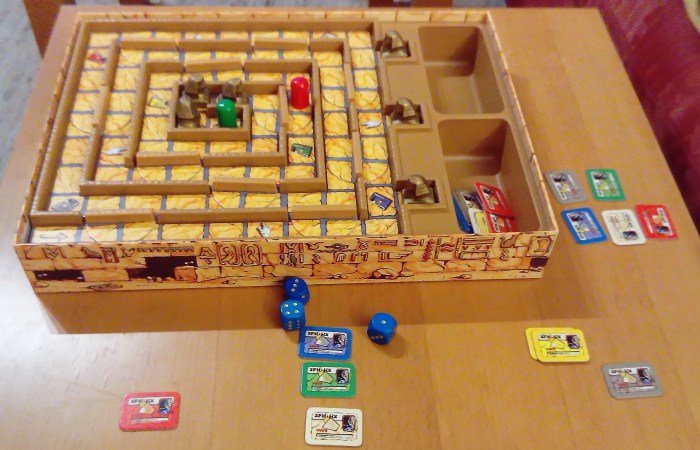
Okay, take this picture as an example of how I might take my turn. Say I’m green and I’ve just rolled a 2, 3 and 5. I could then proceed as follows: I could go forward two squares and collect the beige Sphinx card (to collect a card you can either land on, or pass over the correct square), I could then proceed a further five squares along in the same direction as I was previously going. This would pass me over a mummy hand, doing this means that I can look at the base of any one of the six Sphinxes on the board to know which colour it is. In addition to that, I also have to spin the section of board that I’ve landed on. It’s not clear in this picture, but some of the sections of wall in the maze are small 2×2 square turntables. If a player ends one of their moves on one of theses, they have to rotate it 180 degrees; if another player is on the next square, or the other side of the same wall section, they are also rotated. Lastly I have a 3 to use up, I can then go in whichever direction I choose, three either direction takes me to another turntable.
Oaky, so that’s how you would play a turn. Lastly, there’s a double-snake symbol on one of the sides of one of the dice. When this is rolled the player who rolls it has to swap one of the Sphinx from the center of the board with one of those situated down the right-hand side. When doing this they are not allowed to look at the base of either of the Sphinxes; that can only be done when a player passes over, or lands on a mummy hand.
Winning The Game!
To win the game a player must correctly discover (or guess) the colours and order of the three Sphinxes in the center of the board and proceed to the first Sphinx and present the correctly coloured Sphinx cards.
The Green player (me) is going for the win. I announced the first Sphinx to be blue, the second green and the third beige. I won. 😀
The optimistic player must then announce to all other players which Sphinx they think has each colour. They then look, without showing any other player what the colours are and announce whether they are right or wrong. If they are right they then show the Sphinx bases to all the other players. If they are wrong they remove their playing piece from the board, and stay quiet whilst everyone else keeps playing. The first player to get to the middle with the right Sphinx cards in the right order wins.
Strategy:
This is a pretty simple game, aimed at kids aged 8+. The only thing I really want to say in terms of strategy is that if you roll a double snake, the best thing to do on that turn is to try and pass over a mummy hand with your other two numbers, before swapping any of the Sphinxes. If you do this then you can look at one of the Sphinxes from the edge of the board, and then move that one into a space in the middle. When you do this you’re actually making it easier for you to win the game as you’ve played a Sphinx that you already know the colour of. Don’t forget that you have to collect Sphinx cards though, I generally try and pass over as many Sphinx cards as possible on my way around the board, as I can then proceed very quickly to the treasure in the middle once I’ve worked out the colours of the Sphinxes.
History and Interesting Things:
The word Sphinx was derived from the Greek word spingein, meaning to bind or squeeze, by Greek grammarians . However, the etymology of the word is unrelated to the legends that surround the creature, and therefore dubious.
The earliest Greek author to mention the creature was Hesiod, and he called it Phix.
The most famous Sphinx legend features the Winged Sphinx of Boeotian Thebes. This Sphinx was said to have terrorized people by demanding the answer to the following riddle, “What has one voice, but becomes four-footed, two-footed and three-footed?” and devouring anyone who answered incorrectly. Upon being given the correct answer: a man who crawls on four legs as an infant, walks on two when grown and leans on a staff in old age, she kills herself. Talk about a drama queen.
It is from this legend that the belief that Sphinxes are omniscient apparently arose.
The Great Sphinx of Giza is known by the Arabs as “Father of Terror”.
Although most images of the Sphinx don’t have enough information with them for their function or symbolism to be known it is generally believed that the Sphinx served a protective function.
Sphinxes were commonly carved with the heads of pharaohs on them.
Okay, I know this is only seven points, but there’s actually so much that can be read about Sphinxes in different parts of the world, in legend and in artistic representation and interpretation that I can’t go through more of it without my brain turning into jelly!
To Conclude:
This game is great. It’s complicated enough to be a challenge; the three-section turn means you have to think a little more tactically that if you simply moved the entire dice roll in one go. But simple enough that you can’t really get into any arguments about the rules or anything like that. It’s also a good memory game for children as in discovering the pattern of colours of the central Sphinxes they have to remember which Sphinx had which colour, and they have to be aware when Sphinxes are moved. This is challenging for children (and some adults) and encourages the development of focus, concentration and the short-term memory.
I rated this five because, in addition to the well-structured nature of the game, the box is also great. Every piece has a place and it’s tidy and efficient.
Creator(s): Milton Bradleydesigners, artists etc are uncredited.
The simplest and yet often the most frustrating of games!
Connect 4is a popular game played most often by children of primary school age (7-11). It has a very simple your-turn-my-turn game play and can be quite frustrating if your opponent keeps winning.
What’s In The Box:
1 Fold-out game grid
21 yellow and red counters
Playing The Game:
Objective: To create a line of four of your counters either horizontally, vertically or diagonally, before your opponent.
This game is incredibly simple in its original form. The yellow player takes the first turn, and places one of their counters into the top of any column on the grid, this then falls to the bottom, taking a position on the lowest line on the grid. The red player then follows suit.
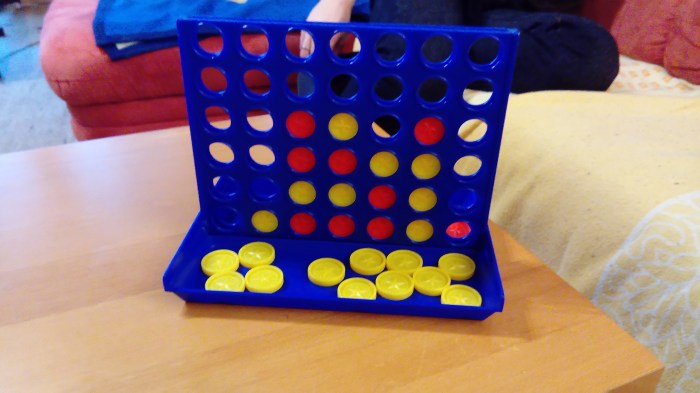
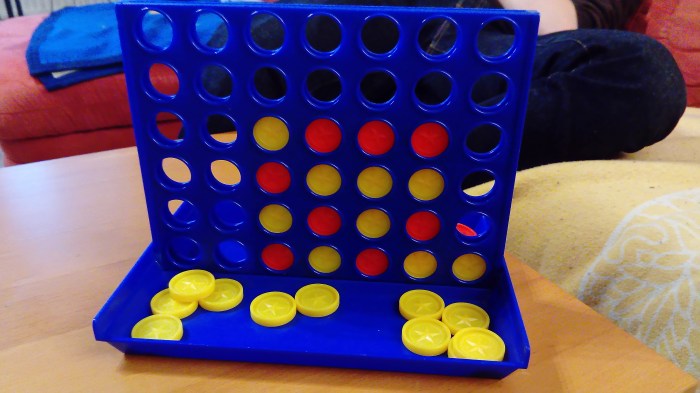
This is what a game that is about halfway through might look like.
The game continues in this manner, with players each dropping counters into whichever column they like, until either one player has succeeded in creating a line of four, or both players have run out of counters.
Winning The Game!
Winning the game is simple, and would look like this:
Yellow player (me) has successfully created a diagonal line through the red players attempt to create a line of four!
Strategy:
This game is one of a group of games that can always be won by the first player, provided they play correctly. Strategically the best starting position for the first player is the central column, as from there they can choose to play on either side of grid whilst knowing that they’ll be connected to their other counters. I generally play to block off my opponent at every turn, whilst simultaneously trying to create a position in which I can create two lines of four, meaning that my opponent, at that point, cannot stop me from winning.
History and Interesting Things:
The game was first sold under this name by Milton Bradley in February of 1974, but is also known by these names: Captain’s Mistress, Four Up, Plot Four, Find Four, Four in a Row, Four in a Line and Gravitaps (Soviet Union)
The game is a Solvedgame, meaning that its outcome can be correctly predicted from any position, assuming that both player play perfectly.
The game has been mathematically solved by several different people, the first of whom was James Dow Allen on October 1st, 1988.
There are several different variations of the game; Pop Out, Pop 10, 5-in-a-Row and Power Up. They can be read about in more detail here.
Hasbroproduces various sized outdoor versions of the game, the largest of which is built from weather-resistant wood, and measures 120cm in width and height.
A rumor that the game was created by David Bowie was started by NME broadcaster and reporter Stuart Maconie which then became an urban myth.
Another version of the game, Connect 4 Twist & Turn was published by Winning Movesin 2015. This version features a game tower instead of a grid, with five rings that twist independently. The objective, to create a row of four of your colour disc, is the same, however as a player can choose to twist a ring after they’ve played a disc a new level of strategy is added to the game.
Look at that! I managed to find quite a few interesting things about this game!
To Conclude:
This game is great, as a child I loved it (and am still good at it). I rated it 4.5 instead of 5 because of the problem where the first player can always win. Although there’s not much that can be done about it in the original form of the game it doesn’t still make the game technically unfair. Aside from that though, I have nothing to complain about, the game is great for kids as it makes them think a little tactically, plus, it’s simple enough that it can be learnt in a few minutes. I’d say that this a game to have in the house if you’ve got children, especially as it’s easy to tidy up due to not having lots of tiny pieces.
You’re going slower than the speed of a snail, could you hurry up!?
My parents and siblings all use this phrase when one of us is doing something stupidly slowly and they’re running out of patience. Fortunately for us the snails in this game are much speedier; like this racing snail:
The racing snail and his rider, Gluckukfrom The Neverending Story, a popular fantasy story written by Michael Ende. This image is a screenshot taken from the 1984 movie adaptation.
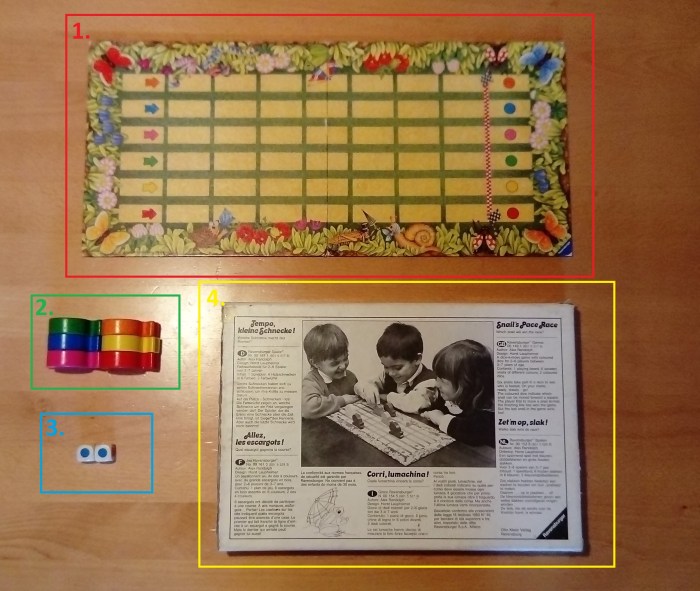
What’s In The Box:
Game Board
6 Coloured Snails
2 6-Sided Dice
Rules printed on the back of the box (technically not in the box, but still important)
Playing The Game:
Objective: To guess correctly which two snails will win and lose the race!
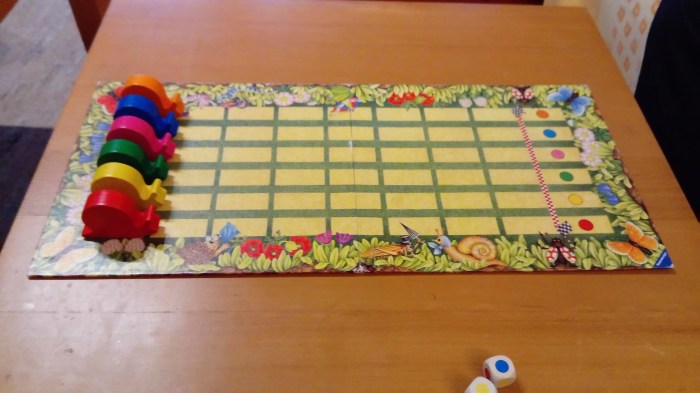
In this game it doesn’t matter how many people are playing, all six snails are still used. To begin the game line up the snails on their respective colours. Then each player has to place a bet on which snail they think will come first, and which will come last in the race. Players then take it in turns to roll the two dice, whichever colour is rolled, that snail is moved forward one space on the racetrack and if both dice show the same colour then that snail is moved forward two spaces. Every player does this until all the snails have crossed the finish line. The winner is then the person who guessed most accurately which snails would win and lose.
Starting Line-Up
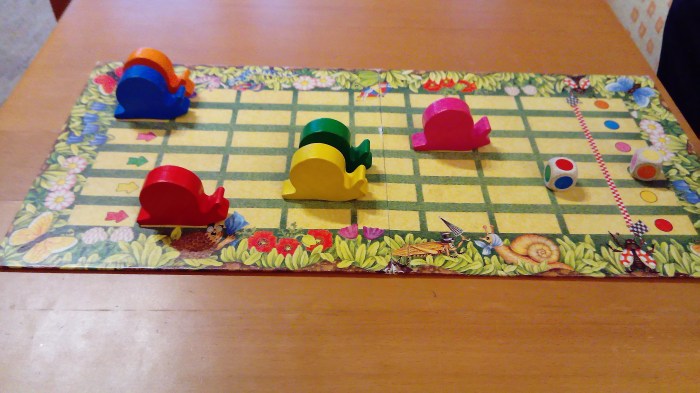
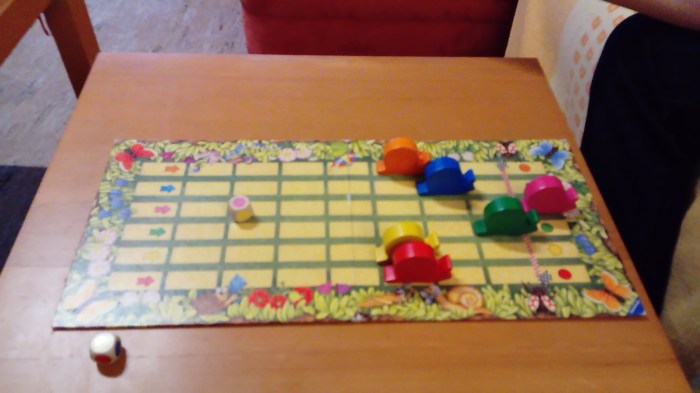
The game begins like this: say I bet that the Orange Snail will win, and the Blue Snail will lose and my opponent bets that the Blue Snail will win, and the Yellow Snail will lose, we then roll the dice and move the snails like this:
No Orange Snail, why are aren’t you moving!?!?
So far the Pink Snail is in the lead and both Blue and Orange Snails are having a nap or something. But due to the erratic and unpredictable way in which each snail is allowed to move the game can also change reasonably quickly, like this:
Please excuse the fuzzy quality of this photo…
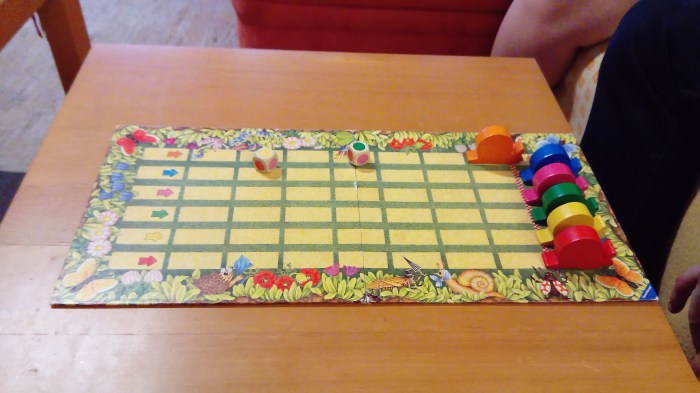
Okay, so Orange Snail hasn’t won here, but he’s caught up pretty well after a slow start! At this point Pink Snail has won, and as no one bet on her we have to see which snail loses the race to know if anyone’s managed to win the game.
Orange Snail loses the race. 😦
Because Orange Snail is the last to cross the line you could argue one of two things:
That I lose because the Snail I bet on to be first actually lost the race, or,
That no one won the race because neither of us guess winner or loser correctly.
I’m going with option number 2 on this one.
Strategy:
This is a guessing game, so I really can’t write anything about strategy except that you’ve probably got as much chance of winning the game as any of the other players.
History and Interesting Things:
This game is excellent for teaching colour recognition in children, as they have to identify each snail by its colour to be able to play the game.
It promotes sharing and because technically the snail wins the race, and not the player, it’s a good game for children who have issues with not coming first.
The game was originally published in German – hence my dual-language title for the post (also as the version of the game I’m playing is German).
That’s about all I can get for this section, so we’ll proceed now to the conclusion!
Conclusion:
I like this game a lot, I think it’s great for children, particularly those that are very young and can’t grasp a game with lots of rules. I’ve rated it only at a three for a few reasons. The first of which is the box. All the pieces are just loose in the box. We’ve said this on a lot of posts, but it’s still true, there are very few things more satisfying than a board game with a well-designed box. For a game with this few pieces it wouldn’t have been difficult to make a plastic insert that could hold the snails and dice, would it? As it is, everything rattles around inside the box, and whilst the snails are wooden, and so quite durable, they also get scratched, and bash up the dice if the game is moved around a lot. My second reason for not rating it higher is that it’s a betting game, and although you don’t bet anything on the snails, there are some children that would insist that they get given something by the other players if their snail wins, and I could foresee this becoming an argument-starter.
That said, it’s a good, simple game that can be played in five-ten minutes. The time each player needs to take their turn is maybe 10 seconds, so the pace of the game is also good as it doesn’t allow time for the children to get bored. All in all, I would recommend it!
First thing’s first. It’s the start of December and I am now going to officially announce that the Twelve Games of Christmas are going to happen again this year. We didn’t really have a theme to the games last time we did this, but this year I found myself surrounded by games that were great for kids. So an obvious theme appeared almost immediately. If you aren’t even slightly into kids games then I apologize and hope that you’ll find what I’ve got planned for the New Year more interesting!
Those plans are going to remain secret for the time being though, as they shall all be revealed in the January update post. All I’ll say is that I’m hoping for a pretty interesting/exciting board game year!
In other news avid readers (if they exist) may have noticed that we’ve changed the day and time that we post at. Statistically we realized that Sunday was the most popular day for people to view this blog. So instead of posting on Monday evenings at 8pm we’ve decided to try out posting on Sunday mornings at 10am so see if it makes any kind of a difference. Aside from that not much else has changed.
Enjoy Christmas, and the posts that go up in the interim!
There’s No One More Mindful Than Me Here, You Could Even Say I’m The Mastermind!
Okay, I know that’s a bad line, but we actually already wrote a post about this game which you can read here, so I didn’t have much creativity flowing through me. So, if we’ve already reviewed this game, why are we reviewing it again, I hear you ask. Well it’s simple really, the first Mastermindpost that we wrote was actually about Mastermind Juniorwhich is the simple-for-kids version of the game. Hence my second Mastermind post.
However, as this is a follow-on post it’s going to be quite short, as the fundamental way of playing the game is exactly the same.
Playing The Game And The Differences Between The Two Versions:
Adult Mastermind is exactly the same as Mastermind Junior in that one player makes a pattern or code using the colours and hides it from their opponent. The opponent then uses the remaining colours to try and crack the code. The first player indicates whether or not their guess is correct using the (in this game) black and white pegs. A white peg means a colour is right but in the wrong place, and a black peg means a colour is right and in the right place. This the where the difference between the two games comes in; in Mastermind Junior the first player indicates which colour is right by the placement of the pegs, but in regular Mastermind the second player doesn’t know which of the colours they’ve chosen is correct, only that one of them is.
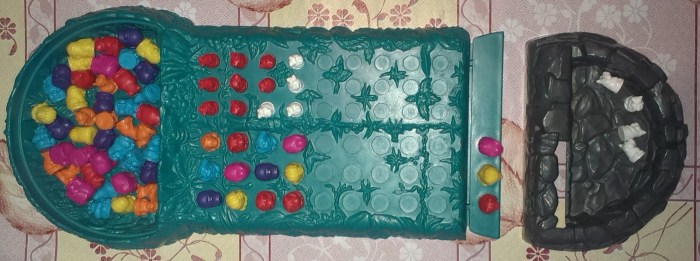
So here you can see how correct colours/placements are indicated in Mastermind Junior:
The white animals indicate correct colour and placement.
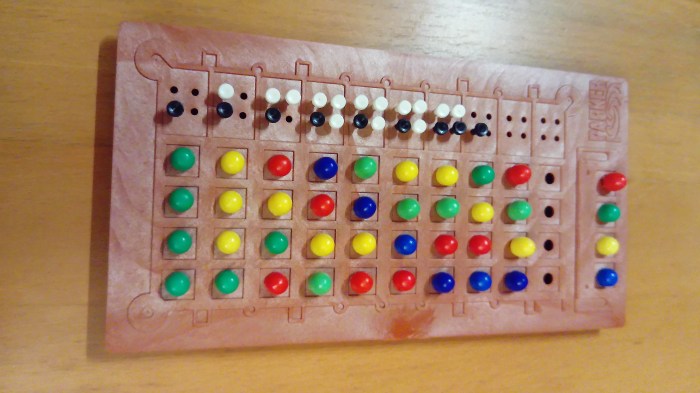
And here how they’re indicated in regular Mastermind:
I apologise for the weird angle of the photo, WordPress refuses to let make the photo vertical so that it looks less strange. But here black pegs indicate correct colour and place, and white correct colour but wrong place. You can see that there’s no way to tell which of your colours is correct with this layout.
There’s a slight difference. The first difference between the games is that in the adult version you play with one extra colour in the code, making it that little bit harder to crack. In addition to that your opponent doesn’t indicate to you which of your colours is correct, so you have more guessing to do.
Winning The Game:
Traditionally this game is played in rounds; the players decide before starting how many rounds are going to be played (always and even number) with the roles of code-maker and code-breaker alternating every round. The winner is the player with the most points at the end of this. Points are scored by the code-maker. S/he gets one point for each guess the code-breaker makes, and is given an extra point if the code-breaker doesn’t manage to accurately guess the entire code in their last move. Points are kept track of across the rounds and added up at the end.
Strategy:
In the Junior version of the game, not much strategy is required, as the code is only three pegs rather than four. In the adult version my preferred strategy is the one seen in the photo above. I like to start with four of one colour and see if any of them are right. This does seem pointless to some people but it’s a very quick and useful way of knowing, is this colour in the pattern. From that first one you simply continue in a similar pattern with other colours until you have the code. Though this strategy doesn’t crack the code in the optimal 5 moves most of the time I will say that I’ve never lost a game playing that way.
History and Interesting Things:
The modern game, played with pegs, closely resembles a pen and paper game called Bulls and Cows that may be over a century old.
The rights to the game have been held by Invicta Plastics since 1971, initially they manufactured it themselves, but have since licensed it to Hasbro, Pressman Toys and Orda Industries for production across the world.
The 1973 edition of the game features a well-dressed white man sitting in the foreground with an attractive Asian woman standing behind him. Bill Woodward and Cecilia Fung reunited in 2003 after 30 years to pose for another publicity photo.
In a standard set of the game, allowing a four-peg code, with six colour options, there are 1,296 different possible code patterns (including, and allowing for duplicates).
In 1977 Donald Knuthshowed that the code-breaker can solve in a maximum of five moves, using this algorithm.
There have been computer versions of the game produced, as well as multiple different editions released.
The difficulty level of the game is altered simply by changing the number of pegs allowed for the code, or the way in which the code-maker indicates a correct or incorrect guess.
Conclusion:
To conclude, I have to reaffirm how much I like this game. In both the child and adult forms. I think it’s a great game for kids because it’s quick, it’s easy to understand, and it promotes logic, problem-solving thinking. I think it’s a must-have if you have kids, or if you like quick games.
P.S. I know I borrowed the History section (and the winning section) from the previous Mastermind post, by they were still applicable, so please don’t be grumpy!
Is what my mum and grandma used to say to me when I was small and doing puzzles (I love puzzles, for the record, but I wasn’t a particularly patient child) and the piece I wanted to put in a certain place didn’t fit and I’d just stubbornly push it, trying to bend it to my will. Eventually one of them would intervene though, to stop me from destroying the puzzle.
Fortunately, Blokusisn’t a puzzle in that way. But it is a rather good, simple abstract strategy game.
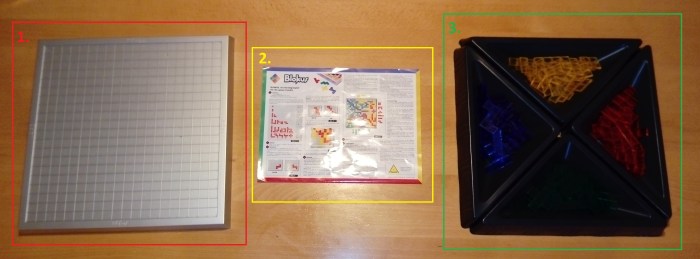
What’s In The Box:
Grid-Patterned Game Board
Game Rules
Four-Coloured Game Tiles
Playing The Game:
Objective: To play all your tiles onto the board.
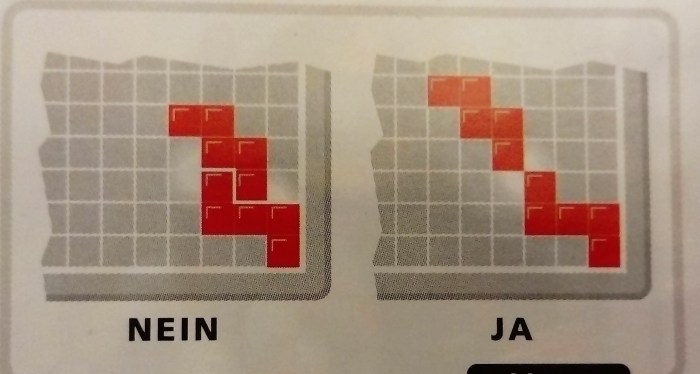
Blokus is a very straightforward game. Every player chooses a colour and takes all those pieces. Players then take it in turns to place one of their coloured pieces onto the board starting from the corner closest to them. However, pieces cannot be placed with the flat edges touching, but must be places point to point, as you can see in the picture below:
It may be noted that I’m using German rules for the game currently – that’s because I’m in Austria, so any photos of rules posted may not be in English.
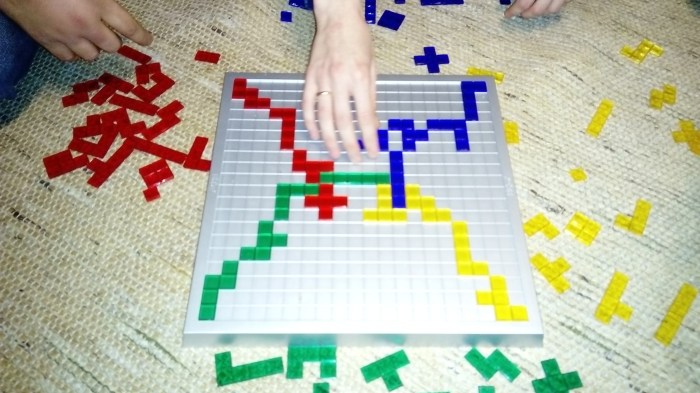
The idea is simply to manage to play all your pieces without getting blocked in by other players. With less than four players this game is very easy. Everyone usually manages to play all their tiles without any problems. However, with four people it does get more challenging, especially when you get closer to the end of the game.
I realize that the above is a pretty bad picture, but you can clearly see that the green and blue players have managed to create a kind of blockade in the middle of the board. I don’t have a picture, but this was quite problematic for the green player later in the game as they effectively sealed themselves off from one part of the board.
Strategy!
This game does require you to think a few steps ahead, as the further into the game you get, the harder to have to think about where you’re putting your pieces, and which way around is the best to place them. In my opinion the best strategy is to get rid of the biggest, most awkward-shaped pieces as quickly as possible, as these are the pieces that will really be difficult to get rid of when the board is fuller. On top of that if you can manage to get through to every section of the board then you’re doing very well. The more places you can reach, the more likely you are to be able to put down every tile. The best way to develop a tactic for this game is to just go for it. Play, watch your opponents, and give a reasonable amount of consideration to each of your moves.
Winning The Game!
It is possible for every player to win this game, so it may not be as appealing to some people, but to be honest I consider it more of a personal challenge to get all my pieces down. However, if no player is able to lay all their tiles then the player with the fewest squares (once counted up from their remaining pieces) left not on the board is declared the winner.
History and Interesting Things:
Blokus was first published in 2000, the inspiration for it was most likely the very popular retro game Tetris.
Between 2002 – 2005 it won five awards and was nominated for two others.
There is also a Solitaire version of the game where one player tries to get rid of all the pieces in one sitting.
To Conclude:
I rated the game 4.5 because although it’s very well thought-out and easy to understand and play, I think the 3/2- player variations are too easy. If I were developing the game I would add some kind of additional “2-3 Player Challenge!” to the game, so that it could be played in the original form, or with, for instance, white tiles randomly placed around the board in a few places that add an extra dimension of challenge to the game. Something like that. It seems to me that there’s room for improvement.
Having said that, I recommend this game. It’s quick, it’s easy, it’s good, old-fashioned fun!
In this classic variation of Pairs, the simple memory game Teddy Memoryis a cute and child-appealing version of the game, with adorable teddy cards.
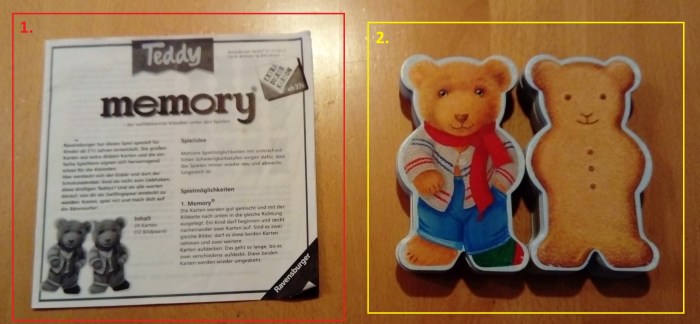
What’s In The Box?
Multi-lingual rulebook
24 Teddy cards (12 pairs)
Playing The Game:
Objective: To have the best memory and so collect the most pairs before the end of the game.
In normal Pairs there is only one way to play the game: you shuffle the cards and lay them all out face-down on the table. You then take it in turns to flip over two cards. If they match you can keep them and take another turn. If they don’t match you have to turn them over again and it is the next players turn. In Teddy Memory Ravensburger have suggested two additional ways to play this game, which are both interesting.
The first is this: Reaction Memory
I’m going to write here exactly what they wrote in the rulebook. “Shuffle all of the cards and place them face down in the same direction. The first player turns over one of the cards and leaves it face up. The next player then does the same, and the game continues in this manner until two matching cards are revealed. Then it’s up to the players to react – the first one to call out what the picture on these cards is takes them as his or her own. The game then carries on as before. The game is over when only two cards are left on the table. The player with the highest number of pairs is the winner.”
The second variation is: Describing Pictures “The Memory cards are shuffled well and placed face up on the table. One player chooses a card, describes it and then passes it on to the next player. The second player chooses the matching card from the table and keeps the pair. This player then chooses a new card and describes it before passing it on to the next player. The game is over when all the cards have been collected. There is no winner in this game.”
These are all simple and I don’t think they really need any extra explanation, so I’m going to go straight to the next part of the post.
Strategy!
Well, this is a game for children aged 2 and a half – 5 so there’s not much in the way of strategy. For the classic version of the game the best way to play is really to concentrate on what other people are turning over. I find that to collect a lot of pairs you should first turn over a card that you haven’t seen the other side of, and then try and remember if its pair has already been turned over somewhere. If it has, pick that one out, and if it hasn’t, turn over another random one to see if you can get lucky.
That’s basically it. Concentrate hard and you might be able to win. But also maybe not, that’s the beauty of simple games.
History and Other Interesting Things:
To be totally honest, this game is really old but it’s almost impossible to date it or to know anything interesting about it except that there’s hundreds of variations of it, with Bears, Disney Princesses, Barbie, Happy Families, Farm Animals… The list goes on.
Further Reading and Other Editions of the Game:
This is possibly the easiest game to find variations of ever. Online there are regular memory games, number memory games, letter memory games… Some more challenging and obviously educational than others, but fundamentally all the same.
Conclusion:
This game is great for kids, and for adults. It’s so simple that the rules have no ambiguity to them, and you can even make your own version of this game at home using paper and pens if you don’t have a properly published version. It’s also quick and straightforward, so although it’s always possible to get frustrated at a game I believe that this one generally remains fun and light-hearted. If you’ve got kids and you haven’t played this game with them you should get a copy, especially as it really helps them focus, therefore improving their concentration and memory skills from an early age.





 Tame The Board Game