Ticket To Ride

Number of Players: 2-5

Year of Publication: 2004

Creators: Alan R Moon (designer), Cyrille Daujean (artist) and Julien Delval (artist)

She’s Got A Ticket To Ri-iiide, She’s Got A Ticket To Ri-i-iiide, She’s Got A Ticket To RIDE, And She Don’t Care!!

Ticket To Ride is a straightforward route-building game featuring a lovely map of North America with major cities marked on them as route destinations, all the way from Miami, down in the South-East, to Vancouver, up in the North-West, and many in between. The objective is simple: score as many points as possible before the game ends. You play as an industrial railroad builder, who is trying to forge routes across North America, each hoping to build the most lucrative routes before their rivals.

“On a blustery autumn evening five old friends met in the backroom of one of the city’s oldest and most private clubs. Each had traveled a long distance – from all corners of the world – to meet on this very specific day… October 2, 1900 – 28 years to the day that the London eccentric, Phileas Fogg accepted and then won a £20,000 bet that he could travel Around the World in 80 Days.

When the story of Fogg’s triumphant journey filled all the newspapers of the day, the five attended University together. Inspired by his impetuous gamble, and a few pints from the local pub, the group commemorated his circumnavigation with a more modest excursion and wager – a bottle of good claret to the first to make it to Le Procope in Paris.

Each succeeding year, they met to celebrate the anniversary and pay tribute to Fogg. And each year a new expedition (always more difficult) with a new wager (always more expensive) was proposed. Now at the dawn of the century it was time of a new impossible journey. The stakes $1 Million in a winner-takes-all competition. The objective: to see which of them could travel by rail to the most cities in North America – in just 7 days. The journey would begin immediately…” – excerpt from the Rulebook

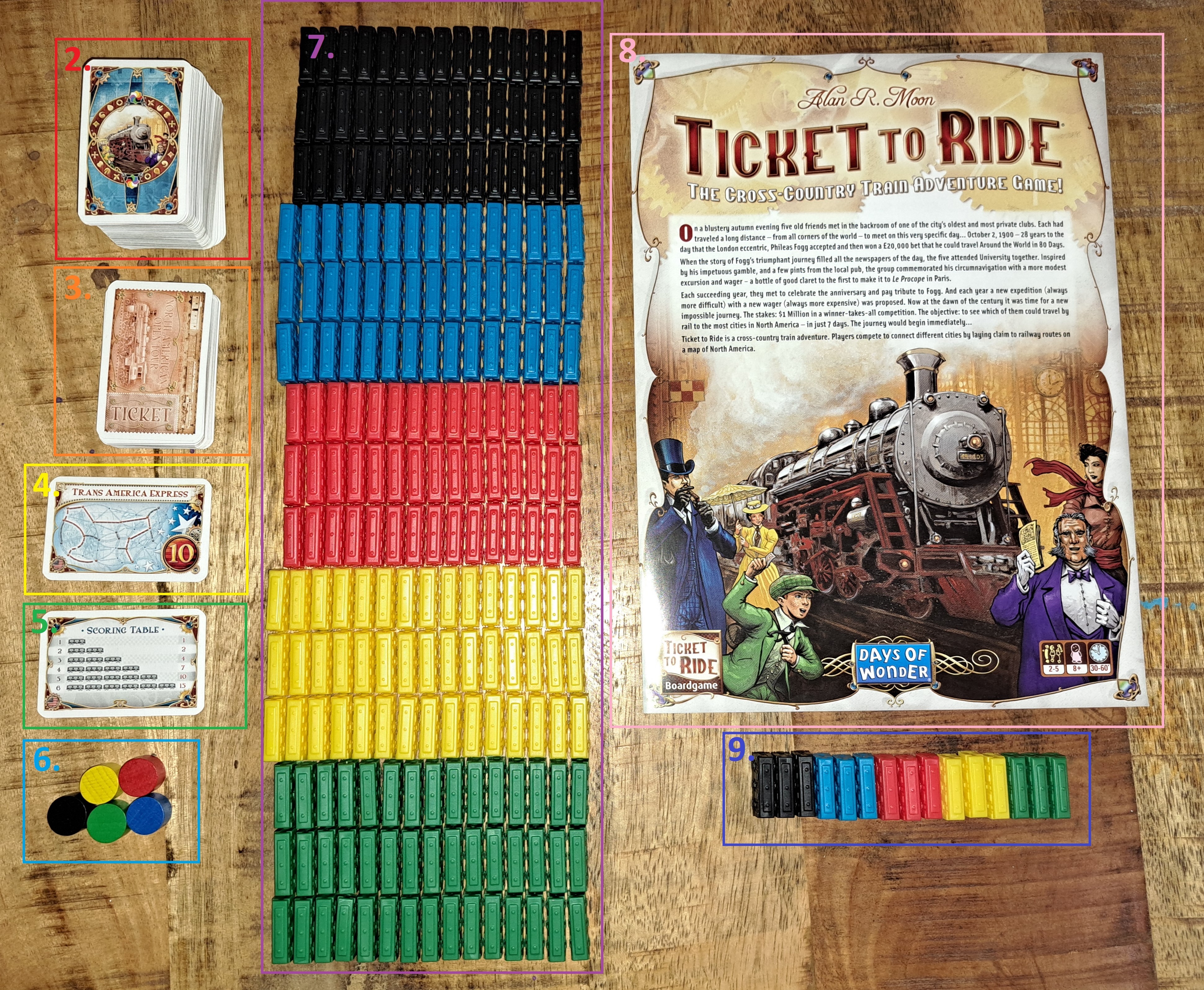
What’s In The Box:
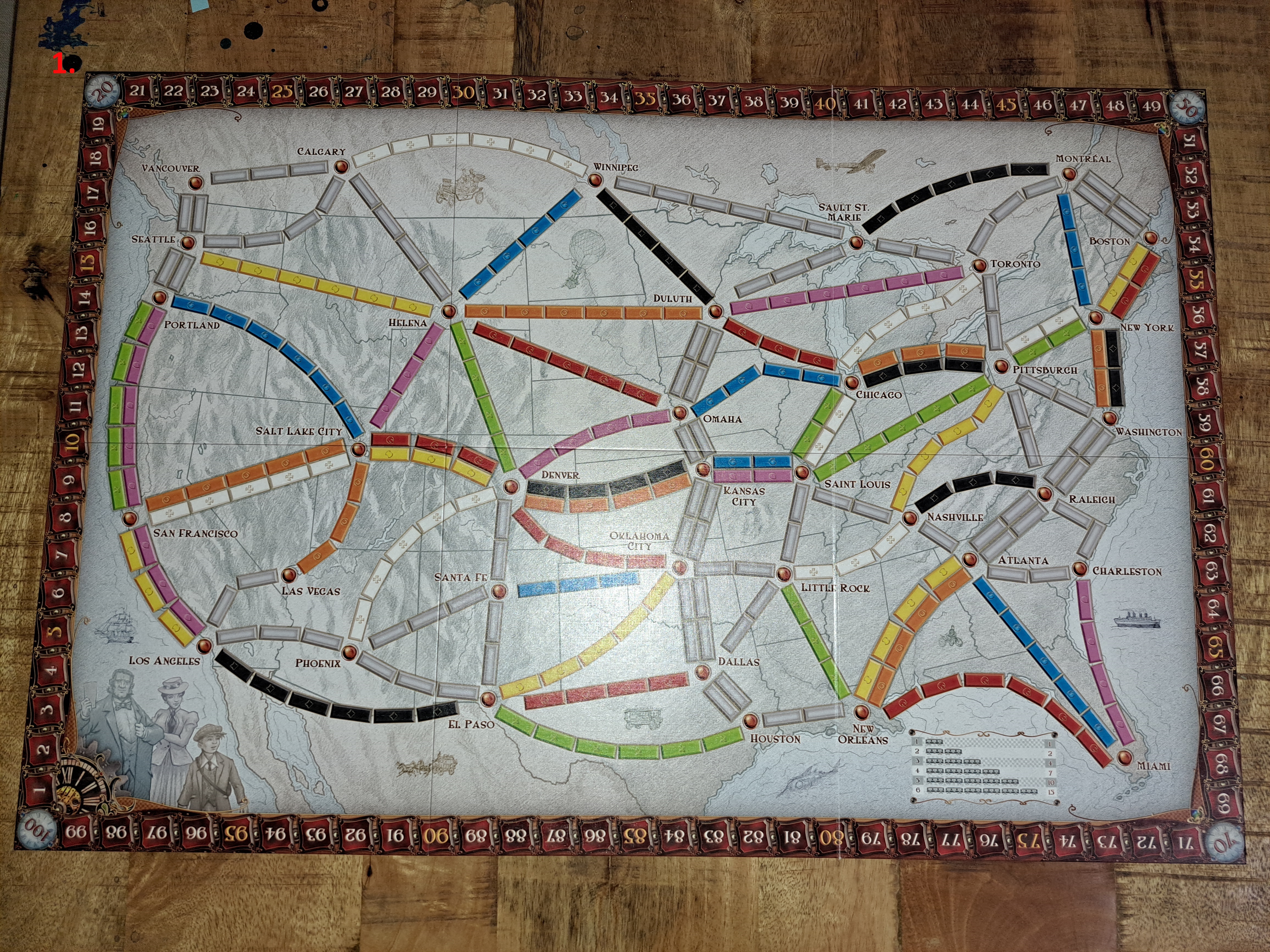
  1. Game Board
  2. 110 Train Car Cards
  3. 30 Destination Ticket Cards
  4. 1 Longest Continuous Path Bonus Card
  5. 1 Summary Card
  6. 5 Wooden Scoring Markers
  7. 225 Coloured Train Cars (45 of each colour)
  8. 1 Rules Booklet
  9. 15 Replacement Train Cars (3 of each colour)

Setting Up The Game:

To begin place the board in the middle of a decently large table. A largish table is necessary as the board itself is pretty big and you need space for all your train cars, as well as the Train Car and Destination Ticket Cards. Each player should choose a colour and take all the appropriate Train Cars, as well as the Wooden Scoring Marker that matches. The Scoring Marker should be placed on the 100 on the scoring track, which goes around the edge of the board. The 100 also doubles as 0 for the start of the game. The Train Car Cards are shuffled, and a starting hand of four cards is dealt to each player. The remaining cards are then placed, face-down, on one of the long edges of the board and the top five are turned face up, and laid out down the edge of the board, for all players to see. Place the Longest Path Card next to the board as well. Now shuffle the Destination Ticket Cards and deal three to each player. The players may now look at them, and decide which they want to keep. All three may be kept if a player wishes, or a maximum of one can be discarded. Discarded Destination Ticket cards are placed on the bottom of the pile, which is then put at the side of the board, once each player has finished deciding. You are now ready to begin and the most experienced traveller plays first, with play continuing clockwise after they have taken their turn.
Playing The Game:

On each players turn, they may perform one of the following three actions:

  • Draw Train Cards – a player may draw two cards; one either from the face-up cards lying on the table, or one from the top of the face-down pile of Train Car Cards. If they draw from the face-up cards a new card is immediately taken from the top of the face-down pile to replace it. There should always be five Train Car Cards face-up on the table. Once the first card has been drawn the player can then decide where they want to draw their second card from, as before. *See below for special rules applying to Locomotive Train Car Cards
    There is no limit on hand size in this game; a player may hold as many cards as they wish and continue to draw new cards. Only if the draw deck runs out will they be forced into one of the other two permitted actions.
  • Claim A Route – various routes are indicated across the board by small coloured rectangles connecting two cities. In order for a player to claim one they must lay down the appropriate number of cards for the route they wish to claim. Additionally, the rectangles are coloured, indicating which type of Train Car Card must be used to claim that particular route. A route can only be claimed if a player has the required number of cards all in the correct colour. If a route is comprised of grey rectangles then any colour of Train Car Cards may be used, as long as they are all the same. Once a route has been successfully claimed the player lays their Train Cars onto the route, discards the cards they used to claim it, and moves their Scoring Marker up the scoring track the appropriate number of spaces. How much each route is worth is indicated both on the board itself and on the small Summary Card. Special note regarding routes: on some sections of the board there are routes that show a double line of rectangles. This means that that route may be claimed twice during play. HOWEVER, in a two-player game, each double route may only be claimed once, in order to increase the challenge of the game a little, as there is less overall competition for routes. *Special Locomotive rules apply here too
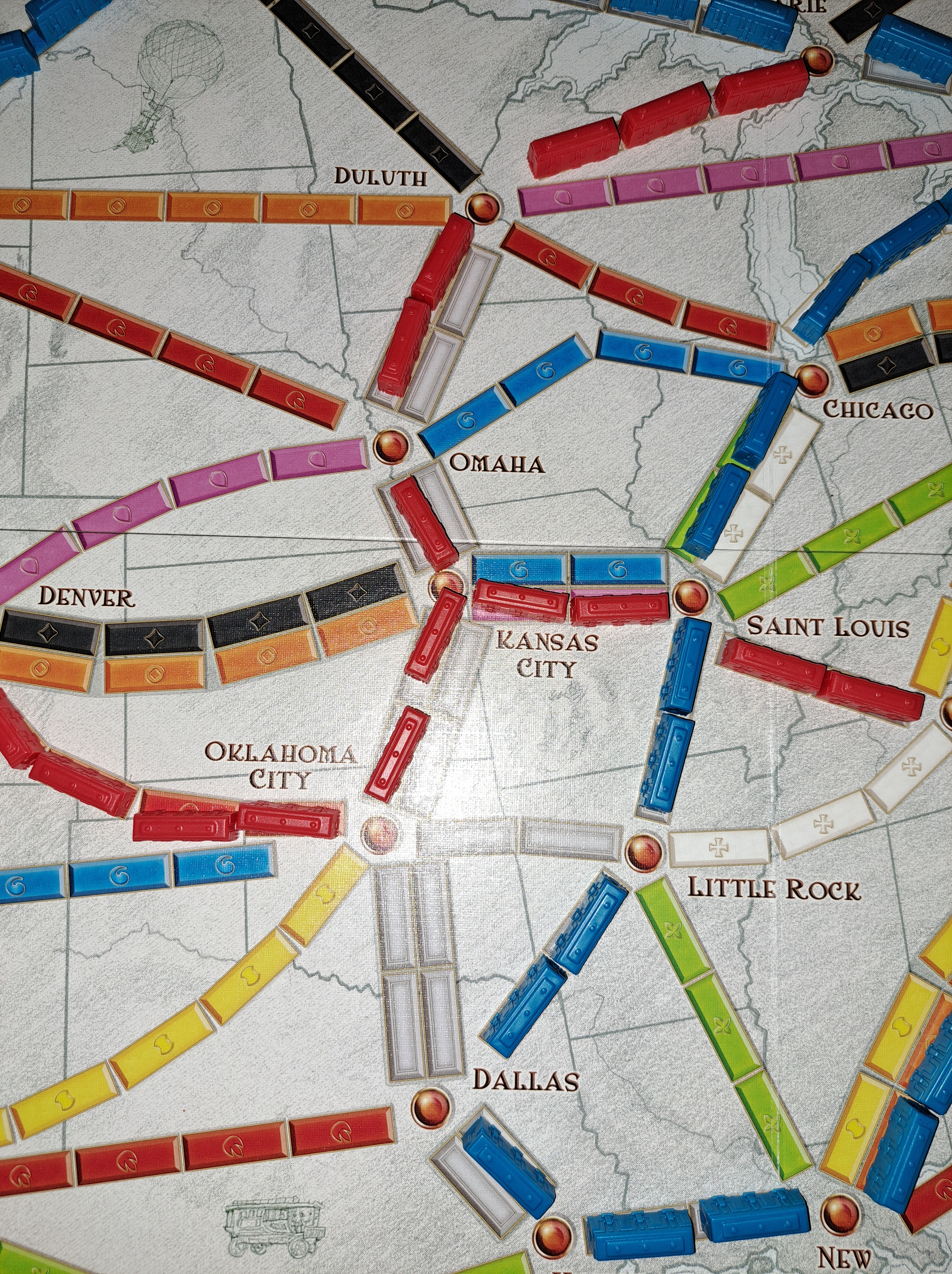
Here you can see a selection of short, double-grey routes. In a game with more than two players both sets of grey would be useable all the way from Duluth to Houston, however, as this was a two player game, once red had claimed most of them, they became inaccessible for blue.
  • Draw Destination Tickets – the player draws three new Destination Tickets from the top of the deck, looks at them, and decides which they want to keep. A minimum of one must be kept, but the player may keep two or all three if they so wish. Any discarded Destination Tickets are returned to the bottom of the deck.
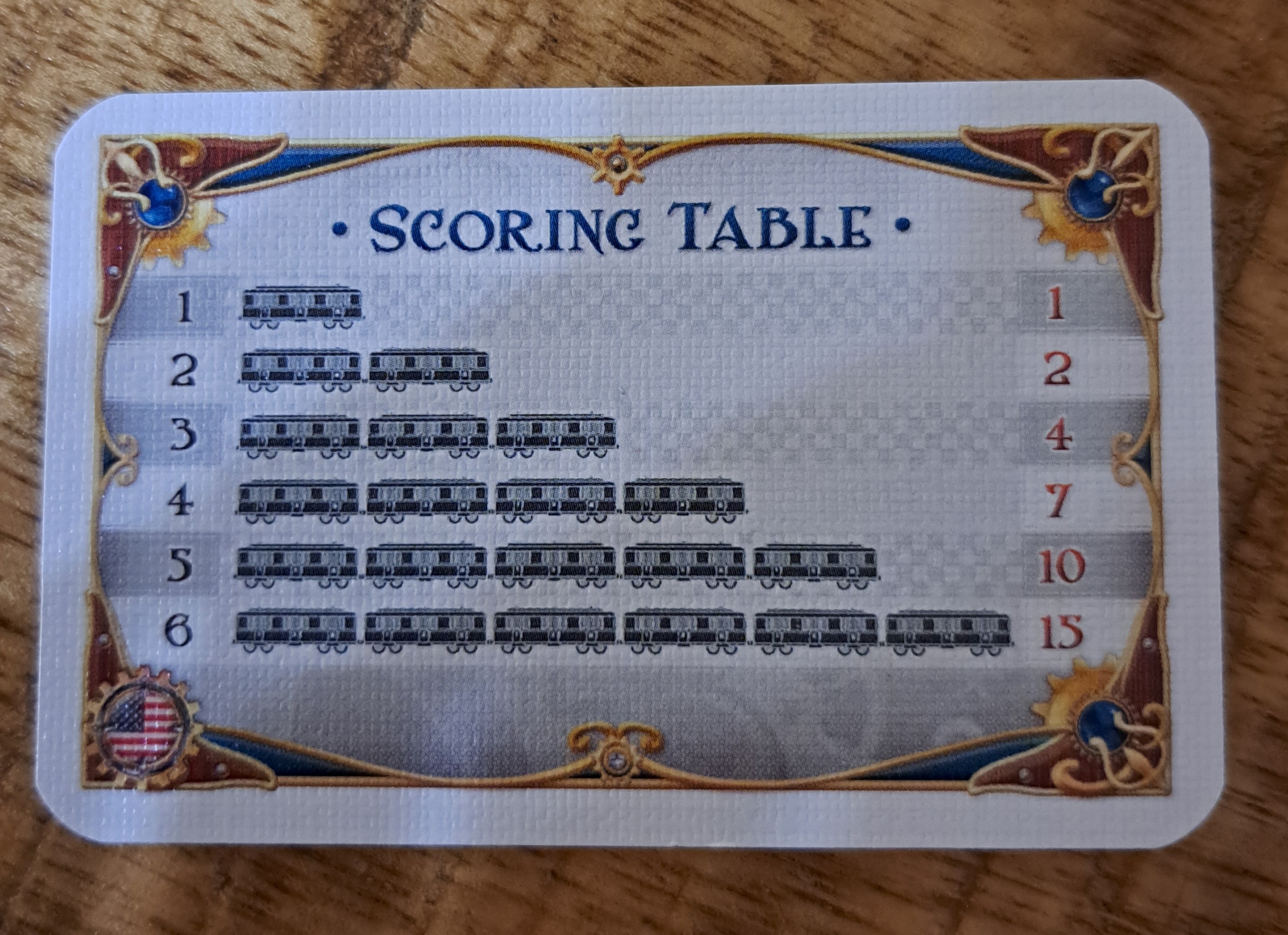
This card indicates how many points a player gains when claiming new routes. As you can see, a long route can be quite lucrative, if you have the right cards to claim one!

Special Locomotive Train Car Rules!

Locomotive Train Car Cards are easy to spot as they are multi-coloured. They act as a wild card and can be used in place of one regular Train Car Card of any colour when claiming a route. When drawing cards, if a Locomotive is one of the face-up cards on the table you may take it, HOWEVER if you do, you may NOT draw a second card. Additionally, if you draw a regular Train Car Card from the face-up five and the replacement card is a Locomotive, you MAY NOT take that card. If, however, a Locomotive is drawn blind as the first card taken from the draw deck, the player is lucky, and may still draw a second card either from the deck, or from the face-up cards.

IMPORTANT NOTE: IF AT ANY TIME THREE OF THE FIVE FACE-UP TRAIN CAR CARDS ON THE TABLE ARE LOCOMOTIVES ALL FIVE CARDS MUST IMMEDIATELY BE DISCARDED AND NEW ONES DRAWN TO REPLACE THEM.

An important thing to know regarding Destination Tickets is that they each have a point value. If the route indicated is completed by the player holding the card before the game ends, those points are added to their final score when the game has ended. If the route HAS NOT BEEN COMPLETED the player loses those points at the end instead. Destination Tickets are kept secret until the end of the game and the points from them are added only once play has finished, no matter when a player completed the route. As with hand size, there is no limit to the number of Destination Tickets a player may hold.

Ending The Game:

The game ends when one players supply of trains is either 0,1 or 2 at the end of their turn. After this each player, including the player who triggered the end of the game, may take one more turn before final scoring is done.
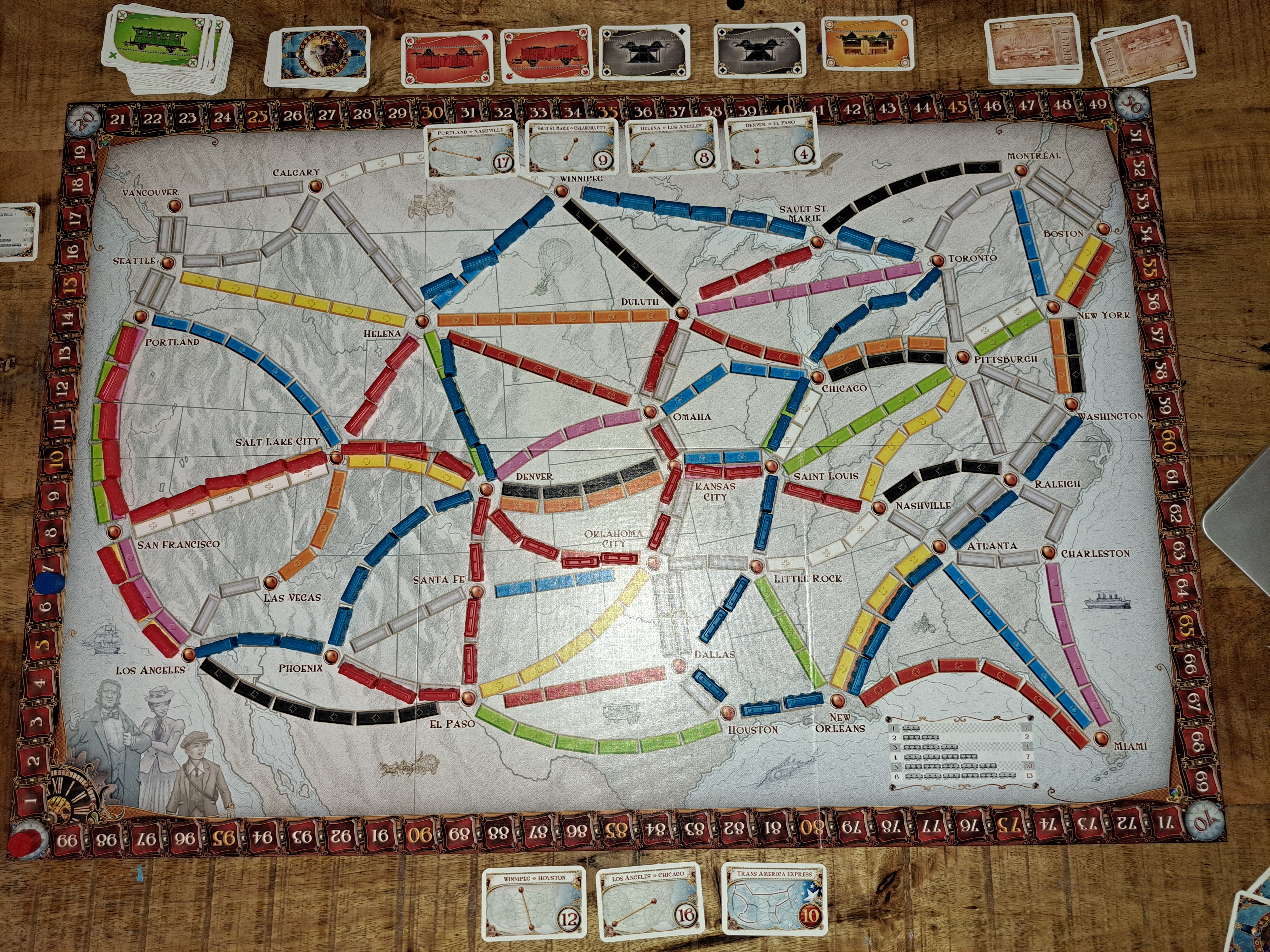
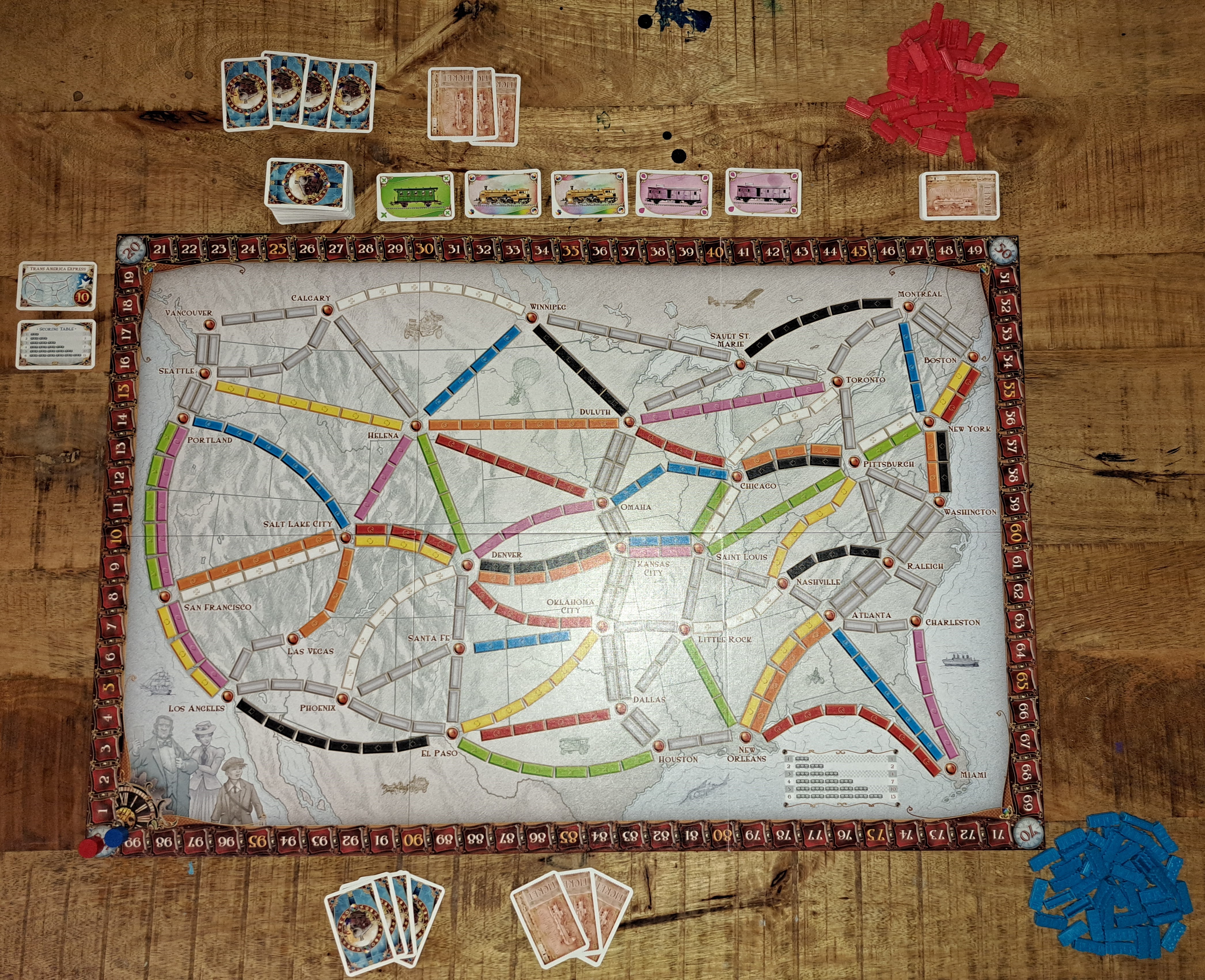
This was how our two-player game ended. Below you can see the routes that Blue (me) had claimed, plus the 10 point bonus for the Trans America Express. Total I had 107 points this time round. Above you can see the routes that Red (my husband) has claimed. Although he had more routes than me, he was unable to catch up points-wise, as they each (bar the Portland-Nashville route) only gave him a small number of points, and they did not connect well to form a long route. This is the first time I’ve ever beaten my husband at this game, and I am rather smug.

Strategy:

There is a limited amount of strategy that can be employed in a game as simple (relatively speaking) as this. We have found that completing routes, and often going for the Longest Continuous Path Bonus makes a large difference in final scoring. No matter how many individual routes a player has claimed they will most likely always be bested by someone who has one or two Destination Ticket routes completed. Especially as a few of these are rather high-scoring. It’s also worthwhile to claim routes as soon as you have the cards rather than waiting to hoard up more cards, as whilst you’re collecting cards there’s always a chance another player will steal away the route you had your eye on. If you’re approaching the end of the game and you’ve completed all your Destination Ticket routes and aren’t feeling brave enough to draw new ones, it’s worth it to try and extend your existing routes in order to claim the Longest Continuous Path Bonus, which gives you 10 extra points at final scoring. It is likewise worthwhile to lay claim to long routes, even if they do not connect you to anything particular, as these give you a good point-boost too.

To Conclude:

This is a lovely game. It’s good for a wide range of ages, so appropriate for families, and straightforward enough for both beginner and advanced board-gamers. The limited amount of reading required is very handy if younger children wish to play, though if you want to keep to the rules extremely strictly then children under the age of 6 probably cannot play alone, as they won’t be able to read the city names on their Destination Tickets. When we play with children we usually play open hand with all Destination Tickets face up on the table, in order to be able to help them plan their routes. It’s also a very nice choice if you want a relatively quick round of something, as each players’ turn doesn’t usually take more than a minute or two, and the game naturally progresses and ends quite speedily.

I personally like this game for several reasons:

  • Aesthetics – the board map is really nice to look at. City names are easy to read and the colours are bright, but not garish. The design is good. Playing pieces are also sturdy and simple, therefore unlikely to break.
  • Simplicity – the rulebook is a mere four sides, with plenty of pictures to explain, making it extremely easy to understand, and leaving little room for ambiguity or misunderstandings during gameplay.
  • Speed – my children often like to play board games, but their current ages mean that committing to a game can be a big deal, due to short attention spans. This game is fast enough that we can usually get through a round before anarchy descends.

I have rated this only a 3.5 though because, although the game is well thought-out, attractive and easy, I like a bit more challenge to my games. However, we have a later version of the game, Ticket To Ride: Europe too, and that version expands beautifully on the originally, introducing some new rules and one new game piece, which will likely, when we come to reviewing it, bump up the rating to a 4 or 5.
Update – January 2026

Happy New Year!

The last update I posted was September of 2018, and, as I spectacularly failed to post anything following that for five and a half years, I’m somewhat apprehensive about writing/posting this. However! An opportunity to regularly play board games, many of which are not completely new to me, but ARE new to the blog, has arisen, meaning that over the next few weeks I could theoretically play through a good number of games, and possibly (she writes, with much optimism) actually write posts about them!

Doing the post for Saboteur was fun, and a good way to break back into writing, as the post wasn’t all that long. We’ve got an expansion for that game, as well as several games we’ve owned for a while but haven’t managed to play yet. So, the possibility for a reasonable number of new posts to go up truly exists! Only time will tell whether or not my momentary enthusiasm actually holds momentum…

Watch this space for a review of the popular, classic game, Ticket To Ride

Mim

Update – September 2018

Hi everyone!

I have to say I’m quite pleased that I actually managed to get up the Mysterium post last month (even if I was cutting it a little fine in terms of date!). Summer is always a difficult time when one is busy playing in the sun and having holidays, so I feel like maybe I’m off to a good start.

So in keeping with that I’ll now announce the game for this month – Dragonology: The Game.

This is a bit more of a kids game than our last posts, but is nonetheless a really fun one. Hopefully you’ll enjoy the upcoming review!


Mim~

Update – August 2018

If anyone out there is still reading or looking at this blog, then this update would be directed at you.

I realized that since my last update post I have failed completely at everything I wanted to achieve for the blog. Dave and I even talked about taking it down since neither or us were writing on it. However, as the blog represents two years of hard work together, as well as a little over one year of me writing alone with Dave doing administrative and maintenance work, we decided that we’d keep it if only for the fact that we don’t want to lose the record of the work we put in.

I had hoped that last year would be a good blog year, but suffice it to say, I had a very difficult year for a mixture of reasons and it simply didn’t happen. HOWEVER! I have a new plan. My new aim is to post once a month on a game not reviewed here before and at the same time try to research into old games and so on so that every so often I can put up a slightly different post.

I’m not going to make an official timeline or impose any strict deadlines upon myself, because I think that’s a sure way to fail. But I am going to try and refresh the blog a bit over the next two-three months, because I really miss writing on it and playing lots of board games.

Watch this space!


Over and out~

Mim

Discworldathon – Ankh-Morpork

So! It’s the end of January, which is In The Beginning for the Discworldathon! Discussions and the reading of Wyrd Sisters have been going on all month on Bex’s blog anarmchairbythesea and the proclaimed Discworld game for this month is Ankh-Morpork. This game was chosen for this month because the city of Ankh-Morpork features in nearly all of the Discworld novel, and it usually still manages to sneak a mention in those it’s not featured in.

For anyone new to Discworld, here’s a little introduction to the city of Ankh-Morpork in two quotes:

“Ankh-Morpork! Pearl of cities! This is not a completely accurate description, of course — it was not round and shiny — but even its worst enemies would agree that if you had to liken Ankh-Morpork to anything, then it might as well be a piece of rubbish covered with the diseased secretions of a dying mollusc.”
– The Light Fantastic

“Poets have tried to describe Ankh-Morpork. They have failed. Perhaps it’s the sheer zestful vitality of the place, or maybe it’s just that a city with a million inhabitants and no sewers is rather robust for poets, who prefer daffodils and no wonder. So let’s just say that Ankh-Morpork is as full of life as an old cheese on a hot day, as loud as a curse in a cathedral, as bright as an oil slick, as colourful as a bruise and as full of activity, industry, bustle and sheer exuberant busyness as a dead dog on a termite mound.”
– Mort

So that’s the proud city of Ankh-Morpork. A full review of the game has already been published on this blog, and can be read hereBut to sum it up, the game is a power struggled between Lord Selachii, Lord Rust, Lord de Worde, Commander Vimes, Dragon King of Arms, Chrysoprase and Lord Vetinari. All players draw a personality secretly at the beginning of the game and then have to meet the objectives stated on the card to win.

The game is brilliant in many ways, but mostly because for those who are familiar with the city and it’s inhabitants it is so well constructed. Every card that you play can be identified as a character from one of the books, with the uses of the card being dependent on the personality of that character.

In the books Havelock Vetinari always comes out on top. Even if no one knew that he was in the running. And the game reflects that by stating that the state of the city has been induced by the disappearance of Lord Vetinari. The game itself is those in a position of power in the city attempting to seize control whilst the opportunity is there. Commonly the character of Commander Vimes wins the game, as all he has to do is balance the board, preventing other characters from gaining too much control or money, or making too much trouble, until the cards run out. As Lord Vetinari is one of the personalities available to the game players it’s clear that he has vanished entirely on his own terms and has some kind of long-term plan. Or maybe he just wanted a holiday, who knows?

Sir Terry Pratchett, the amazing creator of the Discworld series (among other things) has the same fail-safe clause for the end of several of his games. It’s partly what makes the games so brilliant. In every Terry Pratchett game it’s possible for any of the game players to win, but in Ankh-Morpork, Guards! Guards!, and Witches if certain conditions are met, then the game ends and nobody wins. Which is fantastic, because it almost adds a cooperative edge to game play as everyone wants to win individually, but definitely none of you want to lose to the game!

I will admit that I’m slightly at a loss as for what to write now. I’ve summed up the game and a bit about the books, and to be honest, I really think that the city of Ankh-Morpork is too big of a feature in the series of the Discworld to be really described or talked about without me insisting that anyone reading this post goes away immediately to read every Discworld book so as to fully understand the enormity of detail in which the city has been described and personified and used a backdrop for all sorts of events.

To tie in with what the re-readathoners have been discussing over on Goodreadsthe city of Ankh-Morpork features shortly in Wyrd Sisters, the novel that’s been the subject of this month. Anyone who’s read the book will know that Wyrd Sisters is a very entertaining, silly, and just all-round highly enjoyable version of Shakespeare’s Macbeth. Featuring a Duke who murders his cousin, the King, so that he can be king and then goes mad. There are some differences, obviously, between Shakespeare’s tragedy and Terry Pratchett’s hilarious novel. But the story can be seen there nonetheless. Ankh-Morpork features in the novel as the place where the rightful heir to the throne is living with the acting troupe he was adopted by as a baby. This troupe is hired by the court Fool to perform a play for the Duke portraying him favorably, and the witches, Granny Weatherwax, Nanny Ogg and Magrat Garlick badly so that the witches will lose their power and the people will like him.
The brief featuring of Ankh-Morpork is funny in this novel as the Fool is robbed when he enters the city. The thief performing the robbery expected him only to be carrying a few dollars, but instead he was carrying a vast amount of money given to him by the Duke to employ the acting troupe. The thief then freaks out because according to Guild law he’s not allowed to rob more than a certain amount off of one person. Tomjon, heir to the throne, steps in and resolves the situation. Although it’s a very brief appearance made it holds true to the way the city is, Ankh-Morpork, the city where there is a Guild for everything.

That about wraps us up for this game and this month! I intend to have next month’s post Guards! Guards! up by the middle of the month, rather than the second-last day!

I hope this post has been informative, and you’re now burning with the desire to read Discworld novels for the rest of the year.

Games You Can Make At Home – Nine Men’s Morris

Approx. Time Required: 30 minutes

Where Did The Game Come From?

No one really knows; Nine Men’s Morris is in the running with Chess and Go for one of the oldest games in the world. A board for it was found cut into a wall in the temple at Kurna, in Egypt which dates to 1440 BC. The dating of this is dubious as to its accuracy however, as Coptic Crosses were also found carved there which could not possibly have been put there by the Egyptians of the time. However, this game has achieved worldwide popularity across the ages, with three variations existing; Three Men’s Morris, Six Men’s Morris and Twelve Men’s Morris.

You Will Require:

dsc_0358
The Stuff.

  • A large A3 or similar sized pad of paper (in which you can store all the games you make)
  • A ruler, at least 30cm in length
  • A pencil (I recommend a mechanical one)
  • Coloured pens/pencils (optional)
  • Time – about half an hour
  • Plenty of space – either a clear table or big wooden floor

The Process:

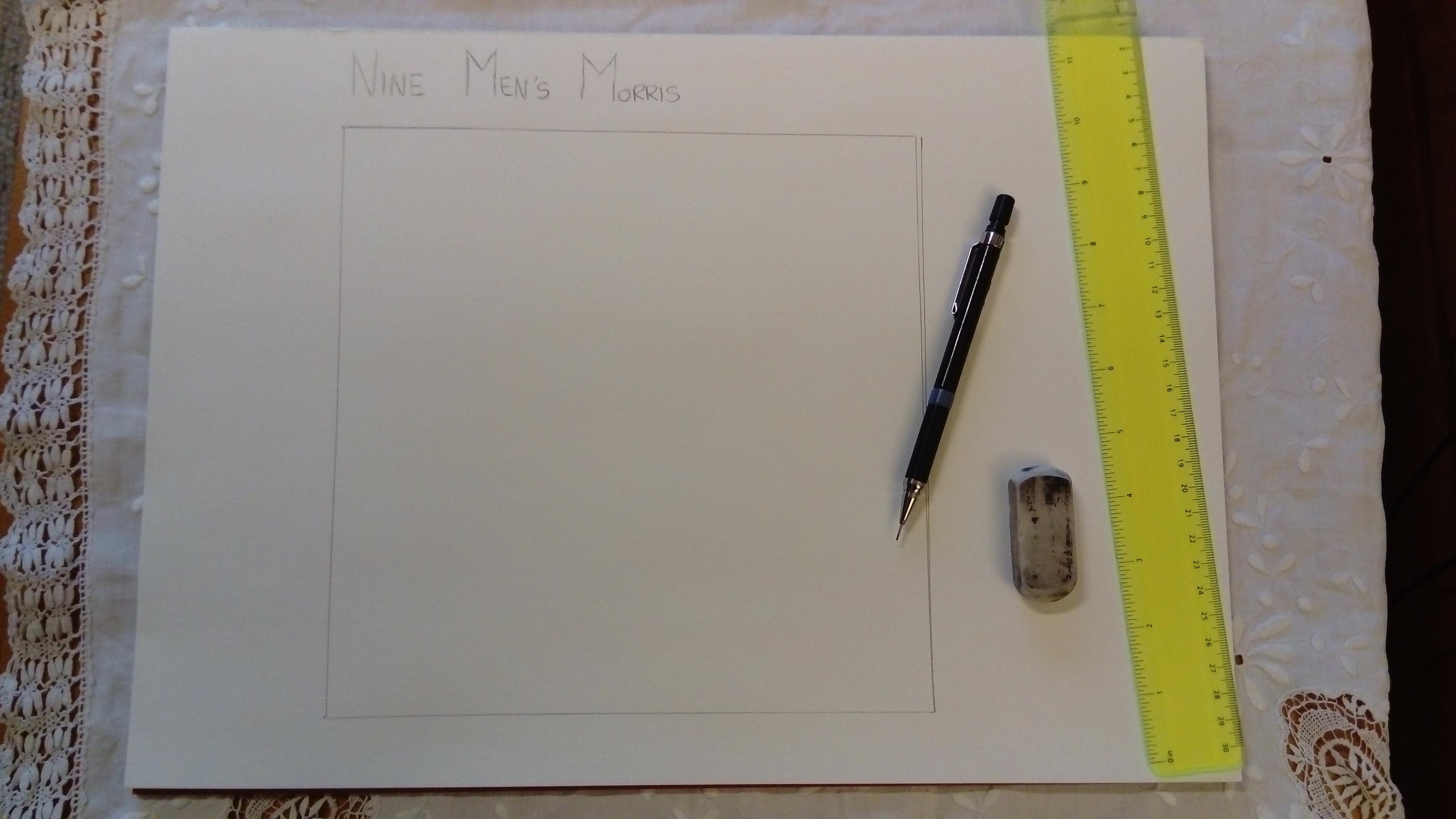
You should start by measuring out a square on your paper. I went for one that was 9″ x 9″ as it filled the space quite nicely without being too big.

dsc_0342
Standard, boring large square.

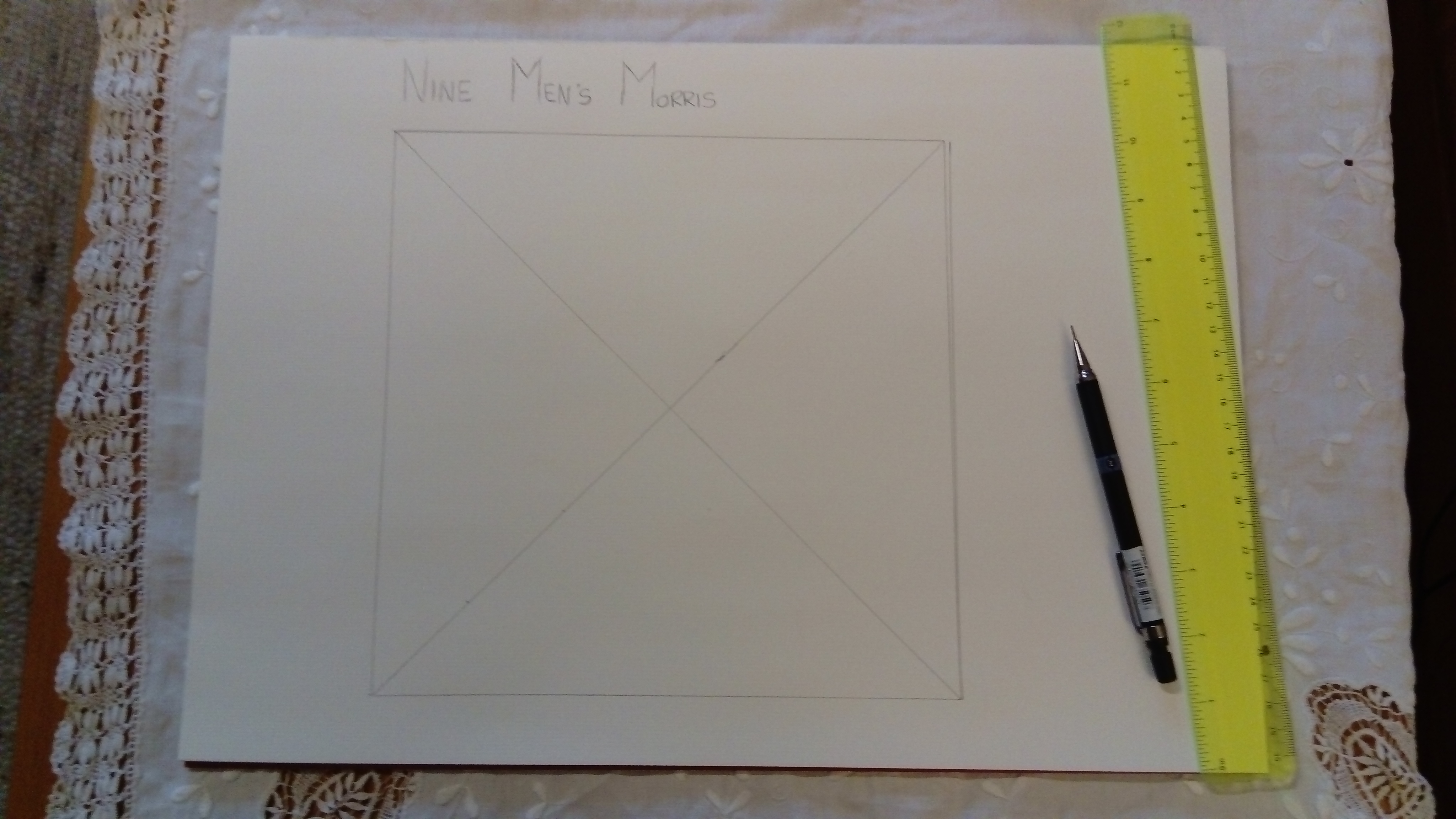
Because Nine Men’s Morris has three squares in it and I’m a little OCD, my next step was to ensure the proper spacing of the squares. So I drew two diagonal lines, dividing the square into four triangles:

dsc_0344

*NOTE: with a 9″ x 9″ square a regular 30cm ruler will not be long enough to draw these diagonal lines. I went hunting for something longer, and ended up using a box edge.*

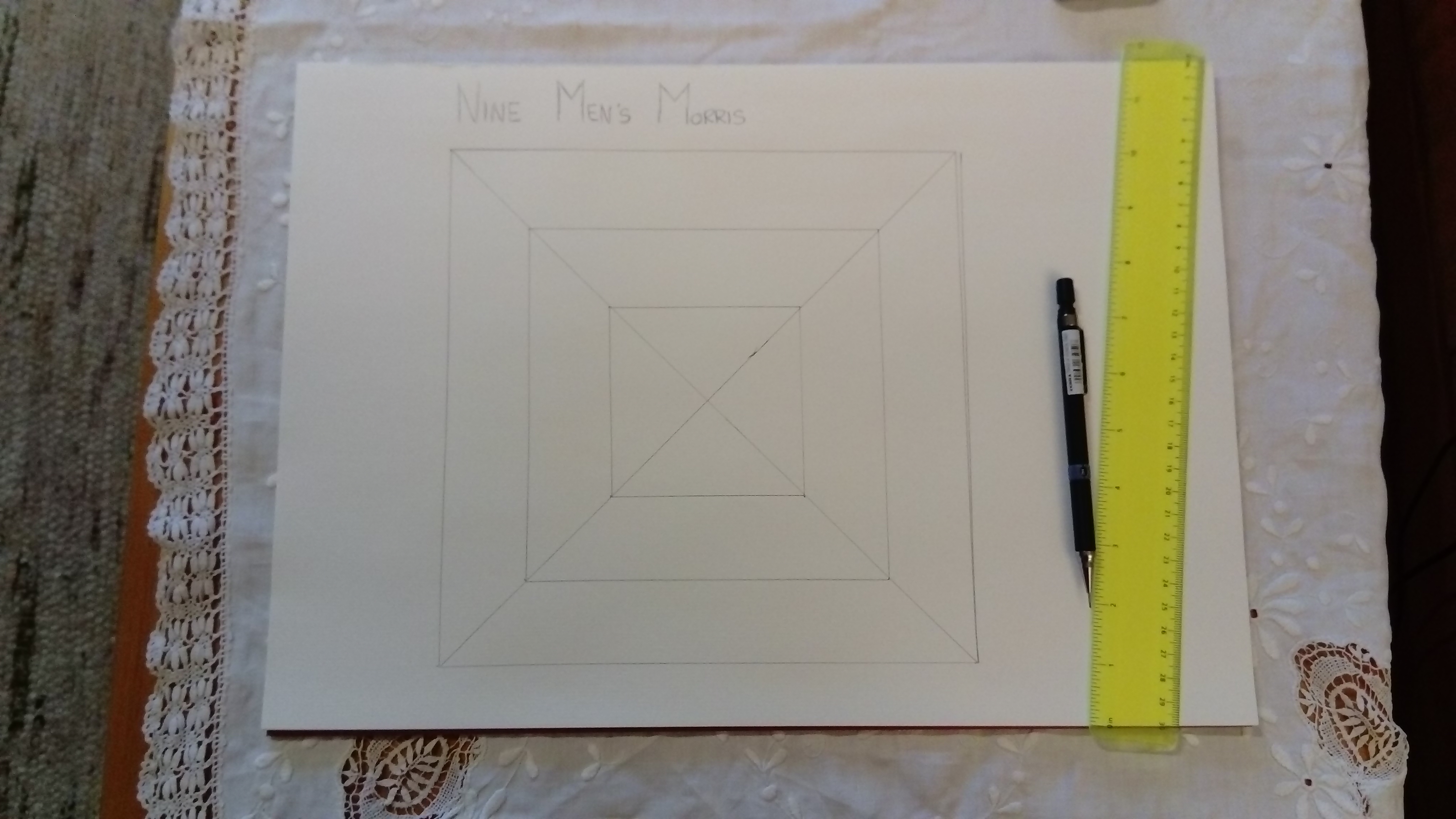
Once the diagonal lines are drawn in you need to measure up them and make two marks; one for the middle square, and one for the inner square. I measured 2 inches up each each line, from the outside corners for the middle square, and then another 2 inches for the inmost square.

As soon as you have all the marks, simply join them up nice and neatly and there you have all three squares – nearly finished!

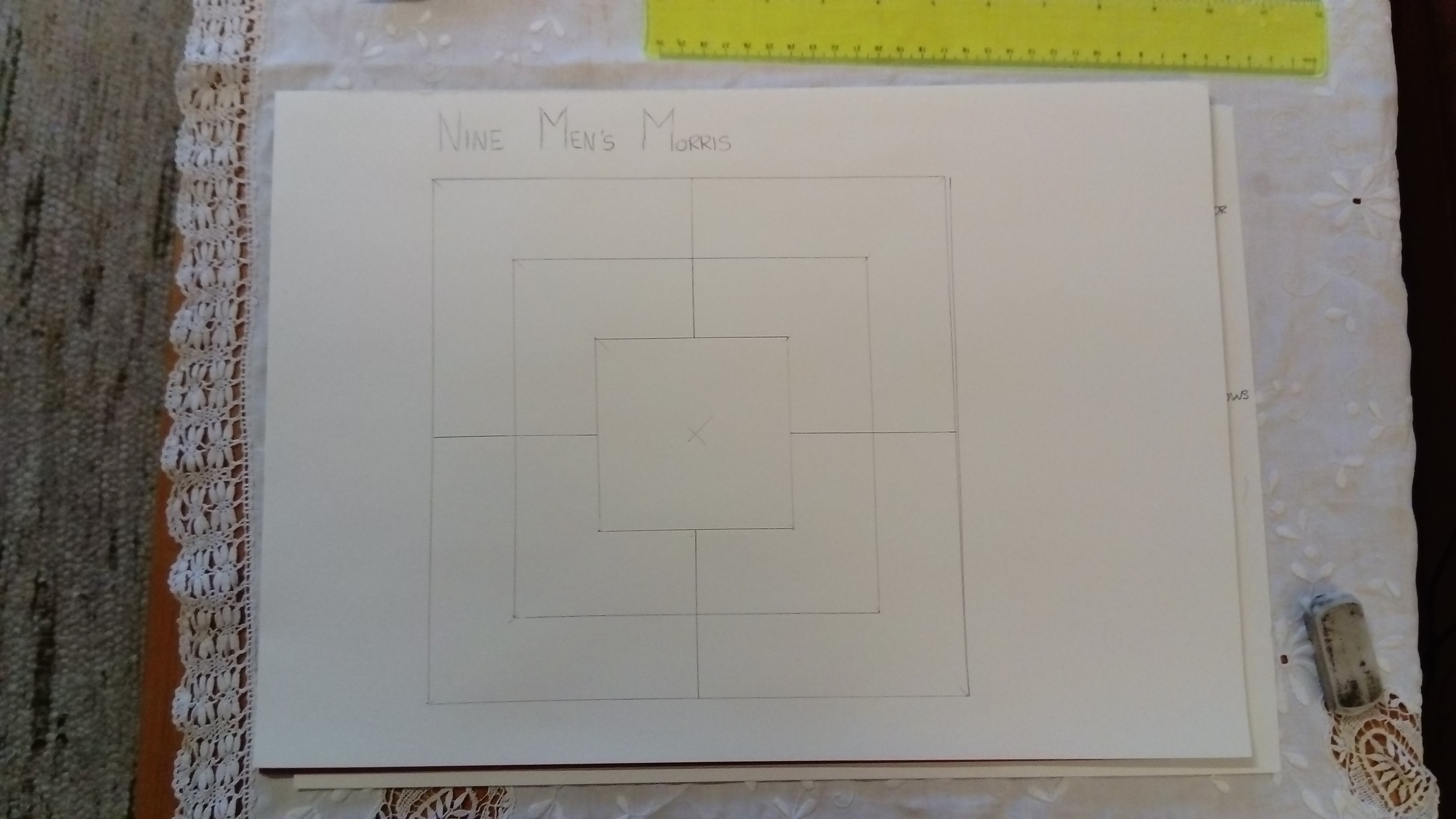
dsc_0349

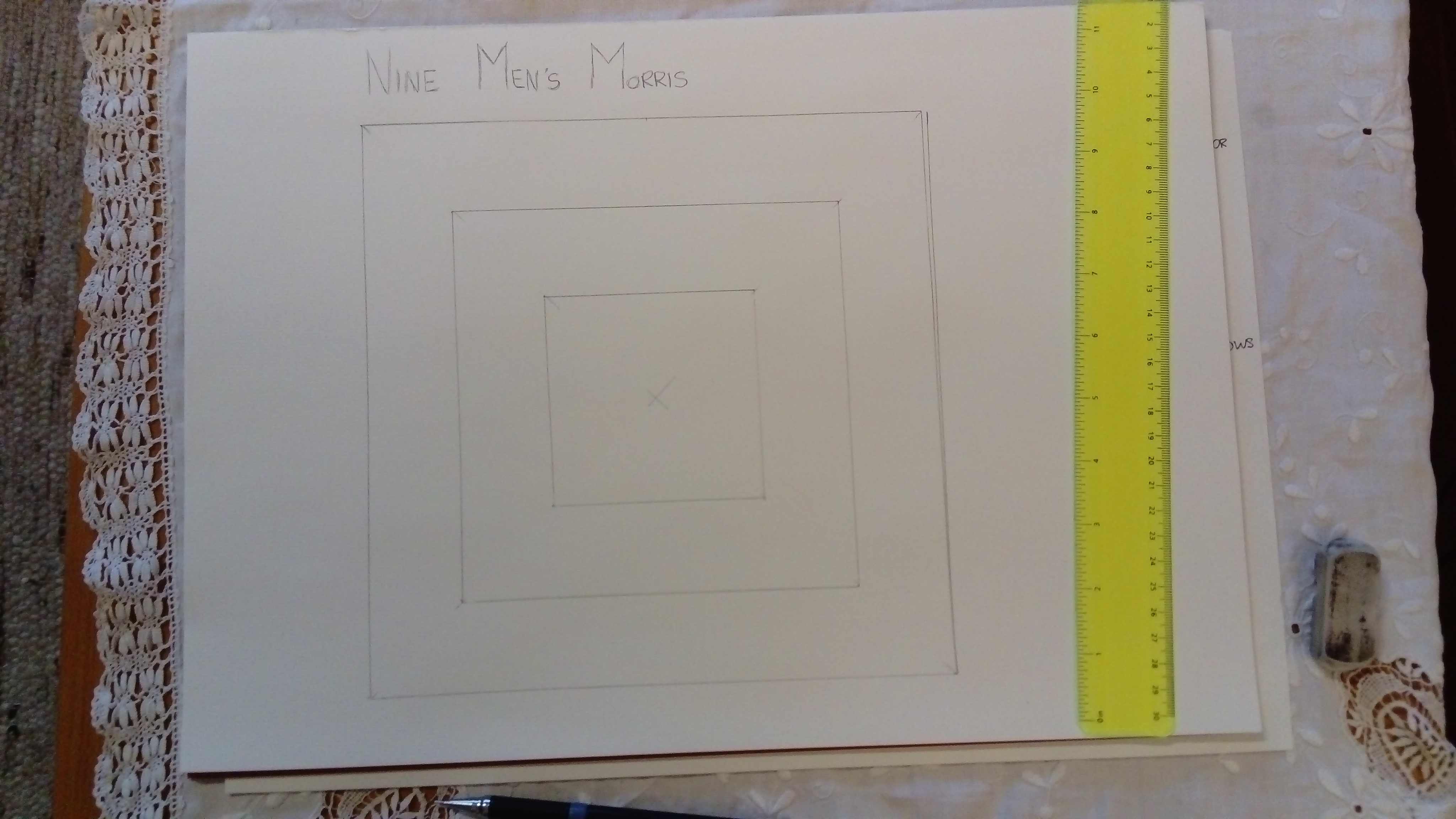
Okay, there’s only a few lines left to draw before you have a complete Nine Men’s Morris board, but before you draw them you should erase the diagonal lines, leaving only the small cross that marks the middle of the board, like this:

dsc_0350

The small cross in the middle is very useful for drawing the last lines. The board needs vertical and horizontal lines that go through the middle of each side of the board, essentially dividing it in half along the horizontal and vertical middle lines, but leaving the center of the smallest square completely blank. The small cross makes this easier by showing where the middle of the board is, so all you have to do is lay your ruler straight across it horizontally, and then vertically, and mark the lines.

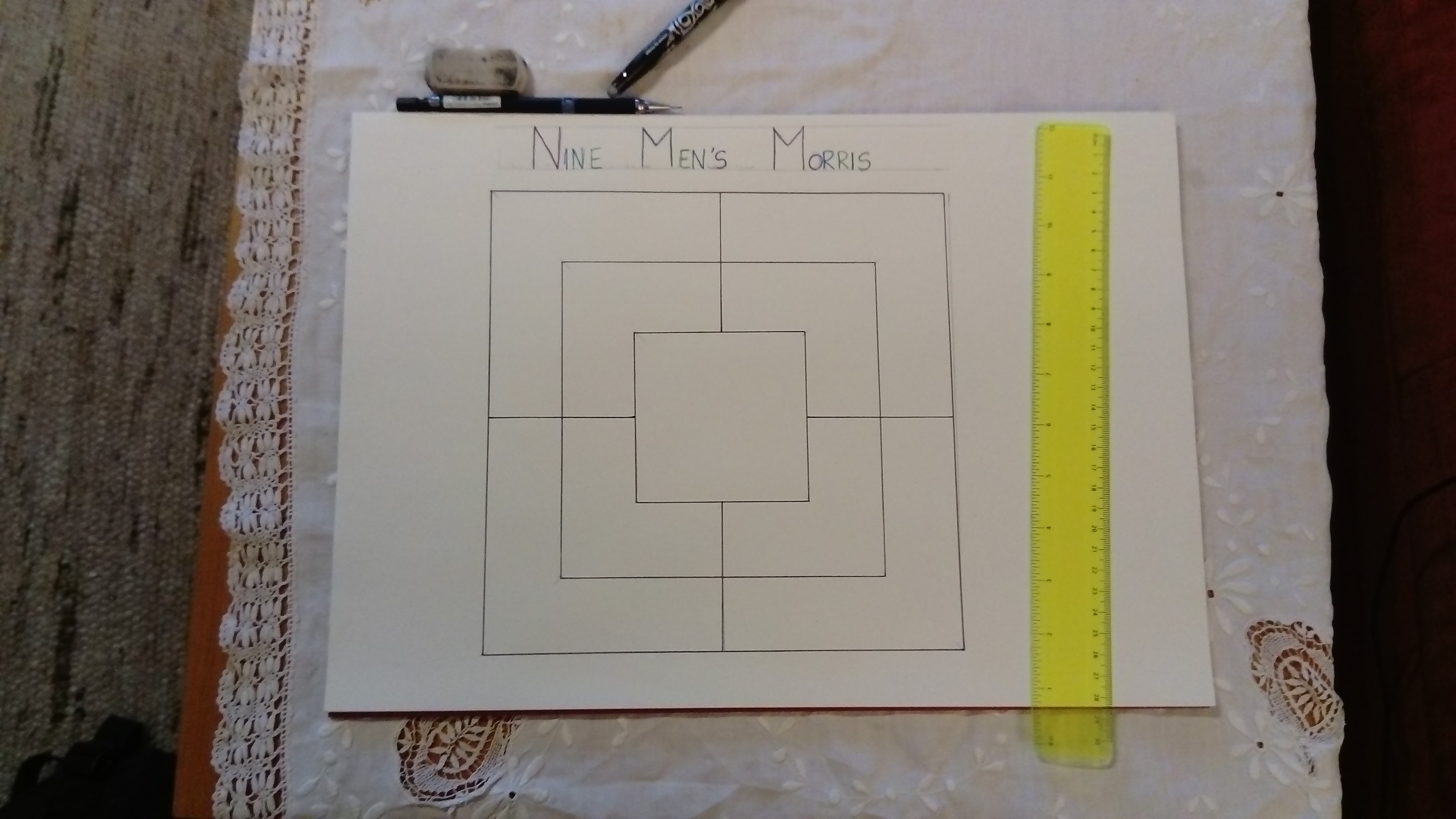
It should look like this:

dsc_0352

If you’re rushing to finish this then at the point you could declare yourself finished, and set about playing the game, but if you have a few more minutes, you should take the time to make it a bit prettier.

Finishing Up:

First thing’s first! Go over all your lines with your ruler and a black pen. This is the most important part of finishing up. Next go over the name of the game in nice colourful pens so that it stands out, and so you don’t forget which game it is in the future.

dsc_0355

Lastly, erase any still-visible pencil lines that mar the beauty of your finished game!

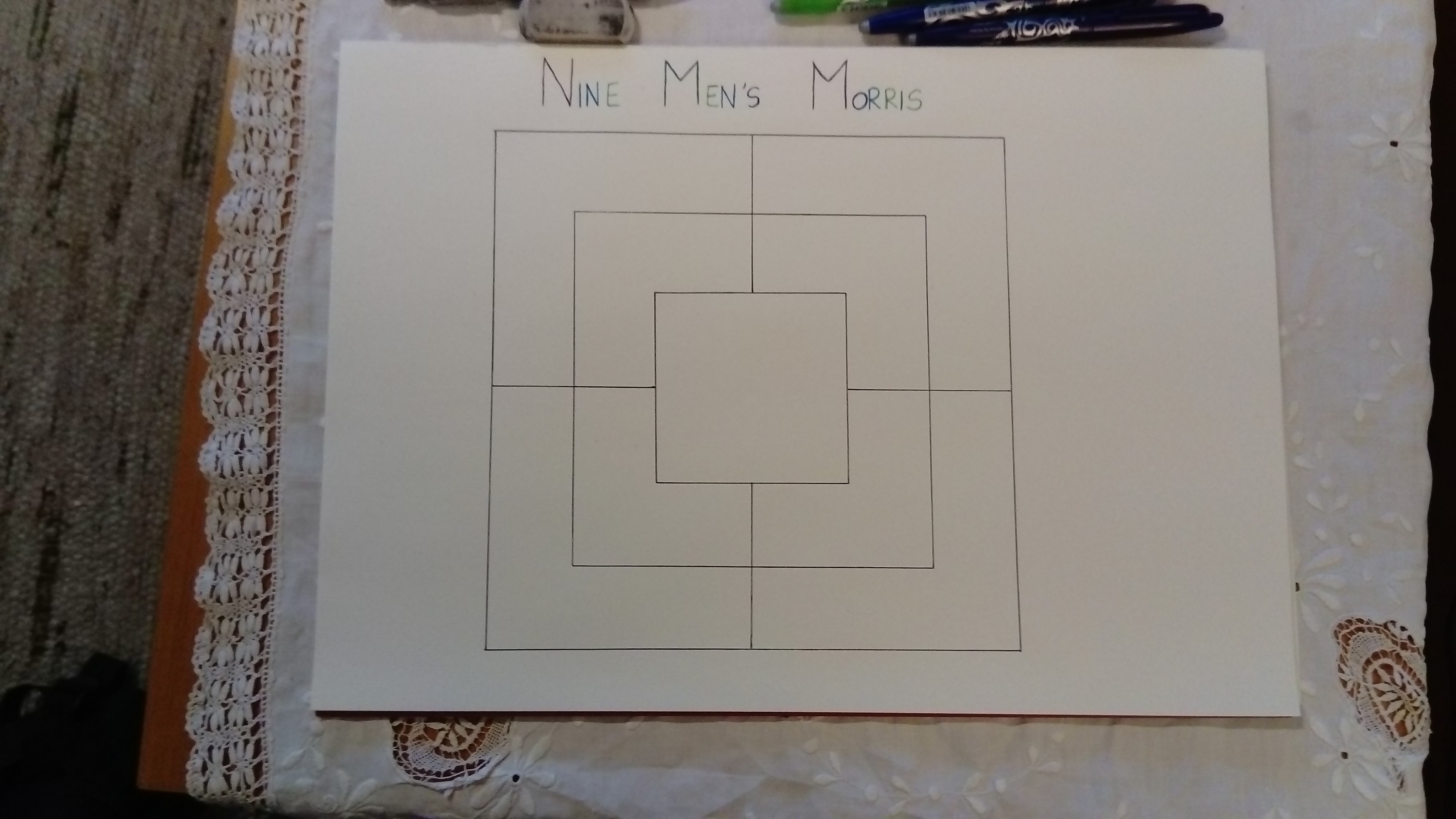
The Final Product:

dsc_0356

Okay, it doesn’t look like much I admit, but this game is really good fun – and quite challenging if your opponent is any good at it. The last thing you need is to either make or find twenty four flat tokens, twelve in one colour, and twelve in another (typically black and white similar to Checkers). I suggest buttons as an excellent substitute for actual tokens from another game. If you have any, a few large buttons would make perfect pieces for this game!

As with Snakes and Ladders you can make the game as colourful, or plain, as you like, there’s plenty of space around the edges for doodling or sketching, and you could even colour in the board if you felt so inclined!

I do intend to make copies of the three other variations of this game and post them here, although I may do them all in one post, as the the system will be fundamentally the same as how I drew out this one.

If you’re interested in how to play Nine Men’s Morris check out the full review post we wrote about it here.

One Last Note…

These posts are entirely non-profit, the idea behind them being to suggest creative ways that bring assorted games into the house if you don’t have the money/space to buy beautiful wooden, or printed copies. The games I am writing about are all old and in public domain.

The Seafarers of Catan

5 - 5

Year of Publication: 1997

In The Beginning…

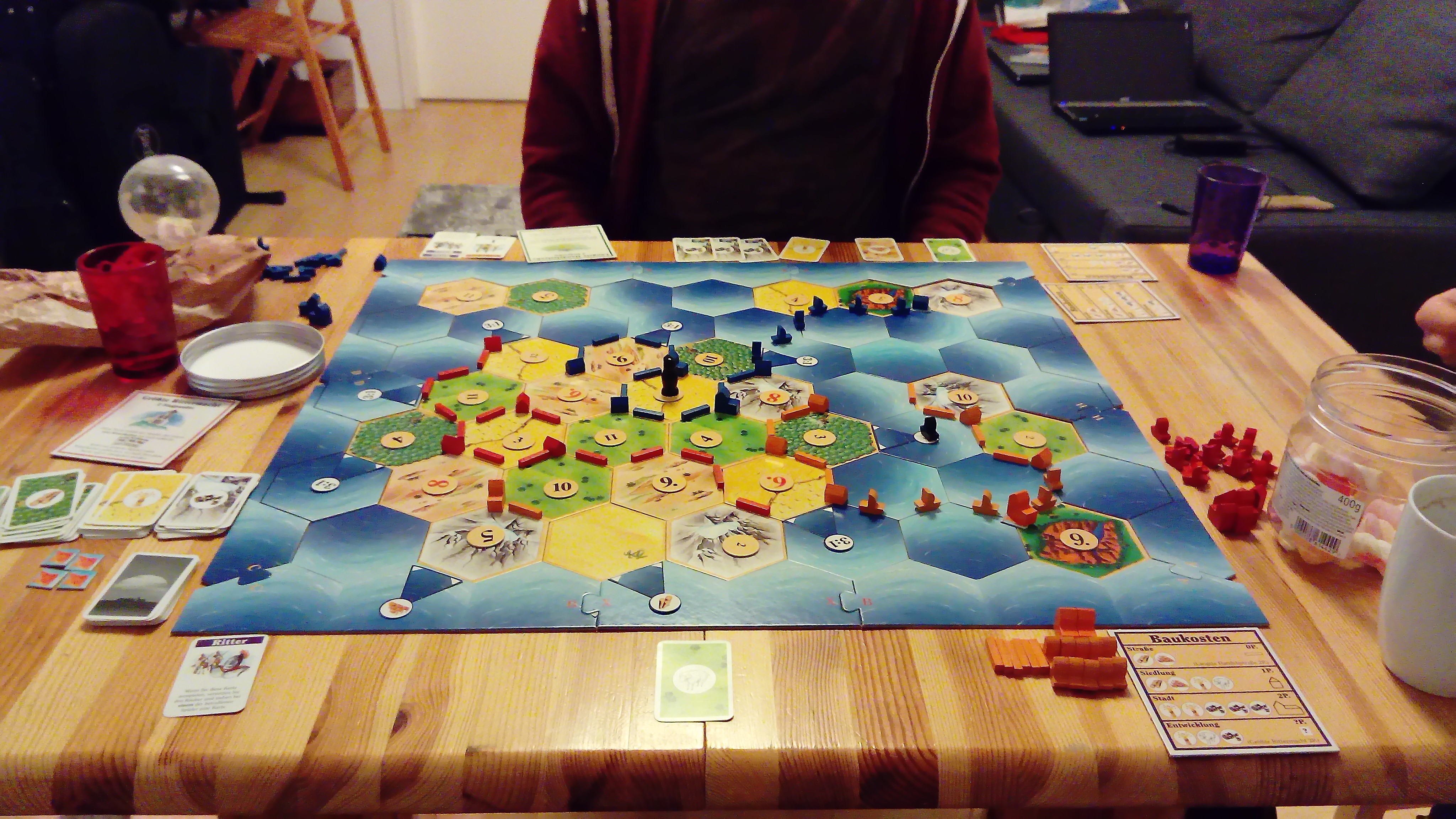
Was the island of Catan, and on that island small groups of people settled and expanded, becoming farmers, miners, shepherds and lumberjacks. However, the island proved to be too small to sustain multiple civilizations, so some of the people took to the seas to find new places to settle, and they became known as the Seafarers of Catan!

Okay, these Catan posts are going to be a little different to the normal reviews; as I’ve already done a full review post on the original Settlers of Catan I’m not going to do the “What’s In The Box” photos for any of the expansions or extensions, but instead only for the spin-off editions, like Starfarers of Catan or Star Trek Catan as those games are very different to the original. Instead all I’m going to do in these posts is to say which pieces are added to the base game to play the expansion and then review the differences in game play and give my opinion. All clear? Excellent! Without further ado:

What’s New?

Seafarers is obviously set over multiple islands, so each colour player is provided with 15 ships of their colour, which can be built by spending one sheep and one wood resource cards on your turn, and can then be used to travel to new places.

In addition to those the expansion also includes a large number of sea hexes and extra sea edge pieces to make the board bigger. Because several islands are involved in playing this game there are extra Catan Chits, with numbers on them to produce resources. There is also the new resource of gold, which allows a player who has a settlement built on one to claim one resource of their choice every time its number is rolled.

In original Catan each settlement gains a player one victory point, and a city is worth two. In Seafarers you get a bonus victory point for the first settlement you build that’s not on your original island, which is quite exciting. There are a few additional tiles that you put underneath such settlements so you don’t forget those points.

Lastly, in addition to the robber who lives in the desert, there is now also a pirate ship, which, obviously, lives in the sea.

Playing The Game:

As you can see from the above pictures, the way players begin the game is exactly the same as in the original Catan game, each player starts with 2 settlements, each with a road attached, and takes resources from one of those settlements to begin the game.

A players turn is exactly the same as in the original game; you roll the dice to claim resources (being wary of 7, which I’ll explain the differences of in a minute), then you build roads/settlements/cities/ships or development cards or trade for resources with other players and play development cards, and then you pass the dice to the next player, ending your turn.

Rolling Seven!

Rolling seven is the same as in the original Catan in that the player who rolls seven gets to move the robber, and can take a resource from any player effected by where they move it to. Additionally any player with seven or more cards in their hand still has to discard half of them (the lesser half in the case of an odd number, i.e. if I have 9 cards with a seven is rolled I must discard 4).

BUT!

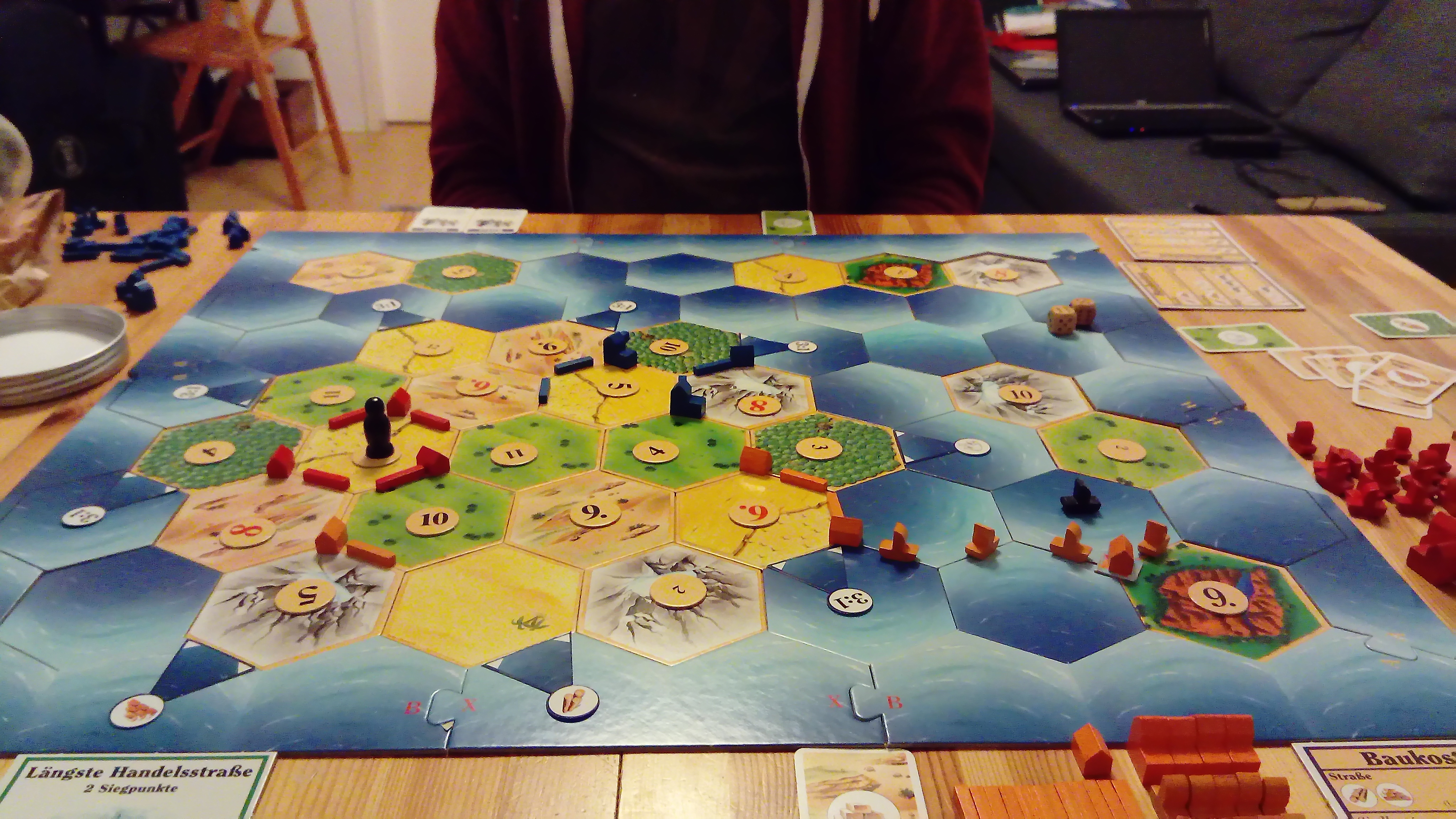
In the Seafarers version of Catan the player who rolls the seven has the choice of moving either the robber, or the pirate ship. The pirate ship works slightly differently to the robber – the robber prevents resources from being harvested in the hex it’s on, but doesn’t do anything else. The pirate ship however has to stay in the sea, and so, instead of preventing resource production, it prevents a player from building new ships that would sit on any of the sides of the hex it’s on.

dsc_0319

As you can see, in this picture the pirate ship has been moved onto a hex that the orange player (me) is currently trying to sail through. However, until the the pirate ship was moved I could not build any more ships there.

Game play proceeds in the normal way; each player tries to build settlements, roads, cities and development cards in order to collect the required number of Victory Points – in this edition 13 – to win the game.

dsc_0322
Blue wins the game!

The winning player is the first to reach 13 Victory Points and the game ends immediately when that happens.

Strategy:

I would say that getting to the coast is key in this game; with the addition of ships the possibility to extend your road is literally doubled and the extra Victory Points gained both from having the longest road, and from building settlements on new islands are valuable. The winning player when we played had a combination of luck (good dice rolls gaining him lots of resources), settlements upgraded to cities, the longest road, development card Victory Points and settlements on a new island – so literally every possibility in the game!

Also, if one player is in a much better position to win than the others, feel free to make an agreement with the other players to not trade any resources with them, there’s no shame in sabotaging someone else’s chances to further your own cause!

In Conclusion:

This expansion is, in my opinion, worth buying, as gives that little bit extra to the basic game, making it more interesting. This game also has many different scenarios, some of which I may write short reviews of over the coming year, which gives it more diversity than the original version, which can be altered, but not drastically.

I recommend this game as an excellent family game, and good for both board game nerds and board game likers who aren’t ready for anything more intense.

dsc_0325
The smug face of the winning player.


Games You Can Make At Home…

… A Brief Overview

This is my first proper post since the end of the Twelve Games of Christmas and I’m going to keep it short. The purpose of this post is to properly introduce my idea for the Games You Can Make At Home series of mini-posts that will be going up this year.

My inspiration for this came from two different places; about two years ago I bought a book in the Oxfam shop I worked in called Play The Game, which is literally a book in which every page, or double page spread is a game that you can play. This, to me, was a fantastic idea, as it provides at least fifty games that take up all the storage space of one large, hardcover book – genius! The second place inspiration came from was my husband – a few months ago he asked me to make him a Snakes and Ladders game for some of the kids in the class he was working in at the time (he’s training to be a teacher), and whilst making those boards I suddenly thought, “hey, this is a great way to save space if you live in a tiny house/flat but love games!” (at the time we were looking at moving into a very tiny flat) and so this mini-series was born.

At the moment my aim is for one of these posts to go up every month. I think this is a good amount of posts considering that this year should also (fingers crossed) hold the Discworldathon posts in addition to the regular, once a week reviews, which will hopefully be going up again from this coming Sunday.

How Are These Posts Going To Work?

Good question! I’m still kinda working that out, so I think the format of the posts is likely to change over the first few until I find the structure I like most. But the plan is to keep it reasonably simple, the posts won’t be that long and they will quite simply include a list of things you need, a brief background on the game (for those who are interested) and then a step-by-step instructions list, with accompanying photos.

If They’re Short, Why Only One A Month?

It’s quite likely that none of you were actually considering that question, but nonetheless I’m going to answer it. There are two reasons, the first is previously stated – there should be plenty of other posts going up around these ones, meaning that I won’t necessarily have time for more than one a month. The second reason is that I have to research each game for copyright reasons. I have to make sure that the writing and publishing of a post about recreating that particular game will not infringe any copyright laws, and that takes a little time.

Lastly…

The first post for this series will be going up tomorrow, and the subject game is Snakes and Ladders. This post has only the final product pictures in it, as I had the idea for this mini-series of posts as I finished making those. So please forgive me and don’t forget that there will be more photos in all the next posts!

Update! And Happy New Year!

Alright everyone!

It’s January and the Twelve Games of Christmas are now finished until December. Hopefully they’ve been an entertaining interlude over the holiday, but now it’s time to get back to business!

As promised I am now going to unveil all the plans and things that we’ve been preparing for this year.

The Plans:

Aesthetic Blog Changes:

First though, for anyone who’s been on the blog regularly, they might have noticed that we’ve had a bit of a makeover. Dave took an editorial walk around the blog and we decided that it was probably time for a change. So,  there’s a new banner, which is tied into part of my plan for the year, plus there are some updates on the About page, making our About info somewhat more up-to-date.

We now have a Contact page, which is quite exciting. Our official blog email is there and that’s checked at least three times a week by me. We’d like to invite anyone reading this to contact us if there’s a game you think we should review, or if you’re developing a game and would like us to play it for you, and help promote it!

Whilst Dave was wandering around editing stuff he thought that the blog looked somewhat like it was run by a pair of goths, hence the new, slightly less gray, colour scheme.
Okay, that’s all the aesthetic changes that have been made since November, now, onto the plans for the year!

The Games and Posts-Related Plans:

As you’re all aware from my November and December Updates there are interesting things happening this year.

The first of which is the already mentioned Discworldathon, which is happening on three blogs run by my family, and a fair few others run by people I don’t really know. Over the rest of this year there will be Discworld game posts going up, approximately every other month starting this month. These will be much shorter than our previous in-depth game reviews, and more tied to the books and films. These are a side-branch of what we normally do, as we thought a little cross-genre blog interaction could be a really good and interesting thing, definitely something with potential for the future. Discworld fans, keep an eye out for those posts!

The second plan for this year is to begin research into old games, from different countries around the world. To research the cultural history of those countries, and the developments of the games that they traditionally played. To be totally honest I don’t have any idea how that’s going to pan out, or even if it’s going to work. At the moment I don’t really know how much information is available to me and I don’t have tons of time to trawl through every resource or book or whatever. So, we’ll see how that goes. My intention is to try and post one research-based post per month, focusing on one country at a time. If there’s lots of information to be had I may extend it to two months focused on the same country.

The third plan is for a series of short posts, similar in nature to those about the Games We Made making suggestions for games you can make at home if you’re bored, or if you don’t have lots of storage space for boxes and such. My idea is make a collection of paper games that can be stored flat in one big folder, or something similar. Those posts will be a little sporadic, as they’re taking the back burner to all the other stuff at the moment, but I think they’ve got potential to go on for a decent amount of time.

Lastly, Games We’re Reviewing This Year!

I hereby proclaim this to be a Settlers of Catan year! I intend to find and play every expansion and spin-off of this game series over the next twelve months. Although there are a lot, there aren’t actually enough to post a different expansion or spin-off every week for twelve months, so the Catan posts will be mixed in with other Catan-ish games that I can find over the rest of the year.

Very very lastly: I can’t promise one post every week at the moment, as I’m in the throes of moving into a new flat, which doesn’t have any wifi yet, and might not have for quite a while. So I’m going to have to borrow wifi from other people for a while, or write all the posts on my phone (which isn’t an appealing idea to me). My new years blogolutions are:

  1. To try and post as regularly as I can, even if it means sitting in Starbucks for five hours writing posts.
  2. To follow through on all my plans for the year at least long enough to see if they’re worth making a permanent feature.

That’s everything! Hopefully this wasn’t long enough to bore you, and you’re still going to come back and read our first real post of the year, whenever I get it done!


On The Twelfth Day Of Christmas, My True Love Gave To Me…

Mastermind! And acted very suspiciously all day….

The Rules:

This game is very simple. One player makes a code using the coloured pegs provided and then hides it whilst the other player looks away/puts their face in a cushion. The second player then has to use the remaining coloured pegs to try and guess the code. The first player indicates when they are right or wrong using white and red pegs. The second player has to crack the code before they run out of lines. We already wrote a full review post of this game here if you want to read more about it.

For Christmas?

Definitely! This game is a fun quickie for two players, and fantastic for keeping the most rambunctious children occupied for a little while if you’re a family that been blessed with children with boundless energy! Although a two player game doesn’t sound the best for Christmas, when there’s usually vastly more than two people around it’s actually fantastic. Both for smaller families and big ones. It’s easy to make a Mastermind tournament if you have lots of interested people or, if there’s only a few of you it’s ideal for having a few quiet moments. It’ll also keep Aunt Jean happy – she’s not strong with tactical games, but if only two people are playing it at least there should be someone left to hear about her newest animal acquisition!

Happy Twelfth Day of Christmas! This brings us to the end of the Christmas period, and the end of this series of posts – at least until next year!