Labyrinth – and asked me to get lost in one when I won.
The Rules:
The board is laid out randomly with movable square pieces. One piece is left over on the side and the youngest player takes the first turn. Before the game begins you have to shuffle the Treasure Cards and put the pile face down by the side of the board. Then flip over the top card. The first player then pushes one row either vertically or horizontally down/up or left/right so that the spare piece is now on the board, and a different piece has fallen off. Next they move their coloured token to try and claim whichever treasure is shown on the face up card. A player can move any number spaces in any direction on their turn so long as there’s a path. If they succeed in claiming the treasure they take the card and the next one is turned over. Play then passes to the next player. The game continues like this until all the cards are claimed. The player with the most treasure wins.
For Christmas?
Yes and no, this game is good, fun and easy to play, so excellent for families of mixed ages. My only reservation is that it can drag on a little. So I would say, yes for Christmas, but put some kind of time limit on it so everyone doesn’t get bored – otherwise you’ll just give Aunt Jean something new to complain about. On the other hand, yesterday was New Years Eve and all the adults may be slightly hungover, so for that this is a good game – it’s got next to no rules, so isn’t difficult to think about, and it doesn’t make any noises!
Happy Eighth Day of Christmas and Happy New Year! Drink lots of water and try not to throw up if you were out partying last night!
Uno, and said in hushed tones that it’s the only child-friendly way of playing Blackjack early in the day…
The Rules:
The deck of cards is shuffled, and seven cards are dealt to each player, the remaining cards are placed face-down in the middle of the table and the top one turned over and placed next to it. Generally the youngest player begins and they start by putting a card on top of the face-up one that matches either the colour or the number of the card. If they aren’t able to do this, but they hold a wild card, they can play that instead and change the colour of the cards that are being played. There are a few other cards that change the direction of play and similar things, but those can mostly only be played when they match the colour. The objective of the game is to play all of your cards. If you are unable to play a card on your turn you must pick one up from the face-down pile and add it to your hand. When you only have one card left you have to say “UNO!!” as loudly as possible before you can put it down. If you play your last card without proclaiming Uno, you must draw new cards and continue playing as a punishment.
For Christmas?
Yes! Definitely! This game is great for large or small groups of players, and is all-ages inclusive. Aunt Jean could almost definitely grasp this one without too much trouble, and she might not even complain about it! On top of that, it’s a speedy play, so a good time filler.
Happy Seventh Day of Christmas! Keep the cheer and food flowing!
Das Kasperlspiel, and walked around like a puppet for the rest of the day.
The Rules:
This game is pretty straightforward; to play you just claim one Harlequin movable card and arrange its arms and legs into a starting position. Then shuffle the Harlequin cards and deal them out into three piles, which should then be turned face up. The youngest player begins and tries to make their Harlequin match one of the cards they can see by moving only one arm or leg one position. If you succeed in matching one of the images on your turn you get to claim that card from the top of the pile. If you don’t manage to match one of the cards it is the next players turn. The highest number of cards that any player can in one turn is two, and this is only possible if a players Harlequin matches a card that’s already face-up when their turn begins. They are then allowed to claim that card before moving their Harlequin to try and claim another. The game ends when all the cards have been claimed and the player with the most cards wins. If two players are tied for the most cards then the points (shown in a small coloured circle on each card) are added up and the player with the highest number of points wins.
For Christmas?
Maybe… To be honest, although I like this game, I also struggle with it a bit. It requires quite a lot more concentration than games from our previous posts of this years Twelve Games series to consider the most logical/efficient way of moving your Harlequin. On top of that, Aunt Jean definitely wouldn’t be able to cope with it, it’s likely she’d find it boring and too fiddly. I would recommend it to families who like serious, logical games. Not because it’s difficult, but simply because you have to concentrate that little bit harder on it.
Happy Sixth Day of Christmas! It’s around this time that people are starting to have to go back to work and there’s less time for games, but if you’ve got kids, or lots of holiday days, keep the games flowing!
Märchenland, and told me that I really needed to work on my storytelling skills!
The Rules:
The aim of the game is to collect all four story tiles from three different fairy tales before any other player. To do this you roll the die and move around the board turning over the number of story tiles indicated on the space you land on. A player who rolls a magic wand must switch places with another player, the same applies for a player who lands on the magic wand space. If a player rolls a number that would mean they land exactly on the same space as another player before the gingerbread house they have to remain one space behind the other player, but if they roll this after passing the gingerbread house they are able to force their opponent to go back to the start.
For Christmas?
This game is a good opportunity to tell a few stories, but you might not want to invite Aunt Jean to play if there are little kids around – she’s likely to tell the slightly more gory versions of the stories written by the Brothers Grimm, rather than the lovely, romantic Disney versions of each story. It’s a good memory game, and is relatively quick, with very few rules so can be easily learnt and played by players of mixed ages. I would recommend it.
Happy Fifth Day of Christmas! We hope no one in your house is bored of their presents yet!
Lotti Karotti – and asked if we could eat more vegetables in the next few days to help counteract the Christmas binge!
The Rules:
There are hardly any rules for this game. Basically everyone has four rabbits, and it’s a race up the mountain to get to the big carrot. You take it in turns to draw a card to see what your action is, for instance, how many spaces you can move, or whether you need to twist the carrot, and you then perform that action. If you get a “twist the carrot” card this will cause several spaces on the board to change from normal space to open hole. If your rabbit falls through one it’s lost and gone forever! The first player to reach the carrot wins.
For Christmas?
It’s a pretty nifty little game; it encourages kids to think a little bit ahead to try and make sure their rabbit doesn’t get swallowed, whilst being really nice and straightforward to play. I’d say yes, it’s great for Christmas if you’ve got little kids, as it can both interest and occupy them. It’s also so simple that even Aunt Jean can get involved! To add extra hilarity, you could get all the players to talk like Bugs Bunny for the duration of the game!
All six racing snails are placed on their colour on the board and players place bets on which two snails they think will come first and last in the race, respectively. Players then take it in turns to roll the dice and move the snail of the colour shown one space forward on the board. Generally two snails will be moved, as the dice will show different colours, however one snail will be moved forward two spaces if the dice show the same colour when they’re rolled. This continues until all snails have finished the race.The winner is the player who guessed most accurately the winning and losing snails.
For Christmas?
Yes! This game is great for everyone because there is no strategy or tactic to it; it’s not about skill, it’s about guessing and getting lucky with the dice rolls! Plus it would be funny to see Aunt Jean get frustrated over the apparent lack of any kind of method to the game, the very existence of it will upset her delicate world-view, which will add entertainment value to the overall experience of the game. Because every player has to guess which snails will win and lose you could make it interesting (if there are no kids playing) by placing bets on your snails to add a little edge to the game. After all, it’s Christmas, and there should be plenty of sweets around that could be used as chips.
Happy Third Day of Christmas! I hope you’re still trying to eat your way through the Christmas dinner leftovers and haven’t even thought about cooking anything fresh for the last few days!
Scwarzer Peter (Black Peter/Old Maid) and a book about German robbers and thieves.
The Rules!
The whole deck of cards is shuffled and then dealt out between all the players. Each player then looks through their cards and removes any pairs they already have in their hand and lays them on the table in front of them. Once this is done players take it in turns to draw one card at random from one other player and see if it makes a pair. Once all pairs have been laid down the player left with the Black Peter card is the loser.
For Christmas?
Yes! It’d be a good way of keeping the kids calm and in one place whilst you get dinner going, or out of the oven. Aunt Jean could even be enlisted to help play as it’s simple enough that she can’t get confused. This game would be a good stocking-filler for the kids as it’s pocket-sized. It can also be played with up to 6 players (when playing with one deck of cards) so it’s good for those times when there’s a group of people together!
Happy Second Day of Christmas! Keep playing games, keep eating sweets, keep opening presents and keep reading about our Christmas games!
Teddy Memory – and suggested that I work on my memory before buying him another present…
The Rules:
This game is just Pairs, but under a cuter name. Very simple and straightforward. You shuffle all the cards and lay them face-down on the table/floor/whatever surface you’re playing on. Then the first player picks two cards and turns them face up. If they’re the same that player gets to keep them and takes another turn. If they’re different they have to be turned over again and play passes to the next player on the left. The winner is the person with the most pairs when all the cards have been picked up.
For Christmas?
Well, why not? It’s a nice easy game that can be played by any number of people (provided you have enough cards and a big enough table or floor). It’s also fantastic for all ages because it forces you to exercise your memory muscles! Brain-active games have been shown to help prevent Alzheimer’s, so get all the oldies playing with the kids and then everyone can have healthier brains! It’s definitely a social game too, so Aunt Jean (see Twelve Games of Christmas – 2013) won’t be able to complain that no one wants to spend any time with her! (Unless of course she doesn’t want to play the game and then, well, what can you do?)
Anyone who was reading this blog as far back as 2013 will already have a feel for how these posts go. The only difference really is that this year they’re all kids/family games rather than just any game we really liked during the year.
Merry Christmas everyone! Play many games and bring joy and game-related arguments to all your family and friends!
Go back to whichever hole you jumped out of and leave us alone!
What do you call a happy rabbit? A hop-timist! (Not the place for bad rabbit jokes? Okay…)
Lotti Karotti(the German name for the game, the English is Funny Bunny) is a simple and fun game in which you race against the other players’ rabbits, and hop that little bit faster than everyone else!
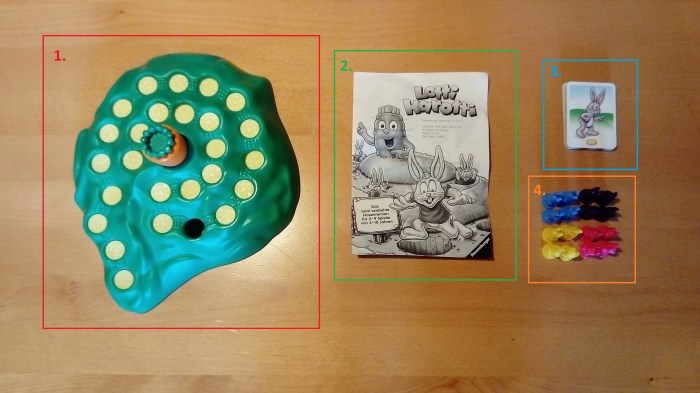
What’s In The Box:
Three-dimensional playing board
Game rules
Deck of action cards
4 x 4 coloured rabbits
Playing The Game:
Objective: To get one of your rabbits to the big carrot faster than anyone else.
To begin the game the deck of action cards should be shuffled and placed face-down at the side of the board and the carrot should be twisted until there are no holes showing in the board. Next each player should choose a colour of rabbit to be from the four available. As it doesn’t say in the rules who plays first we just did Rock, Paper, Scissors for it. Once a first player has been determined they draw the first card from the deck and turn it face up on the table. They then perform the action on the card which will be either, hop 1, 2 or 3 spaces, or twist the carrot.
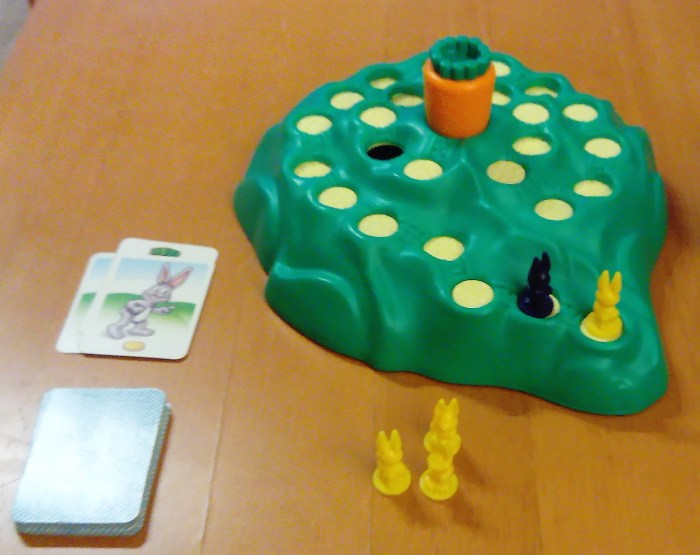
Normally players will place a rabbit onto the first, second or third spot on the board on their first turn. This normally creates a que of rabbits, like this:
Here two rabbits are adjacent to each other.
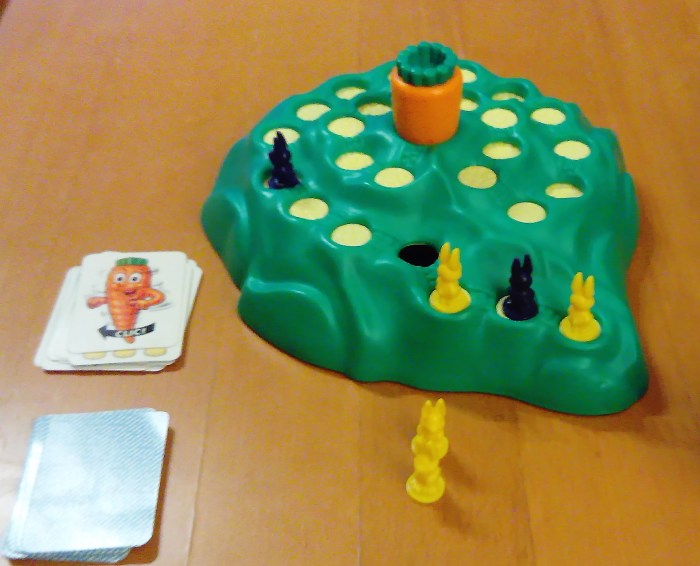
If this happens and the player in the middle or the back turns over a card that tells them to hop they are allowed to jump over any number of rabbits that are adjacent to them to get to the next empty space. Like this:
The second yellow rabbit has hopped over the first yellow rabbit and the purple one to reach the third space on the board.
When the carrot is turned it causes holes to open up at different points on the board. If one of your rabbits is on a hole when it is opened by another player (or yourself) it falls underneath the board and is immediately out of the game. Likewise if a hole is opened next to where one of your rabbits is and you turn up a card saying to hop one space you also have to hop into the hole, you cannot hop over it.
Winning The Game:
The first player to get a rabbit to the top of the carrot is the winner.
Strategy:
It’s not really possible to have a strategy for this game. This time round that we played it all my rabbits ended up in underneath the board and there was absolutely nothing I could have done about it. I would say just try and get your first rabbit as far along the board as possible. But otherwise don’t think it through too much, because it’s a game of chance with the cards really.
History and Interesting Things:
Between 2001 – 2002 this game was recommended for two awards and won 1.
I have absolutely nothing else interesting to write here.
To Conclude:
As kids games go this is pretty great. It doesn’t involve any complicated thinking but also, because of the nature of the ‘carrot’ cards, doesn’t get boring either. It’s a good quick play for children of all ages with a cute theme.
This a favorite to say to children when they’re obviously making something up instead of telling the truth, but this game is all about fairy tales!
What’s In The Box:
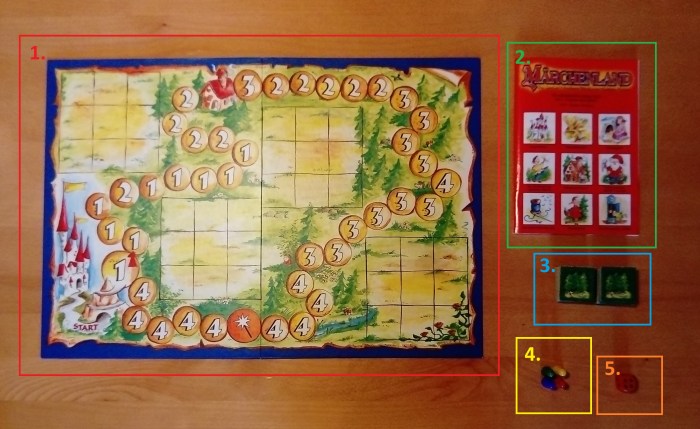
Game Board
Rules
36 Story Tiles
4 Player Pawns
6-Sided Die
Playing The Game:
Objective: To collect all four parts of the as many fairy tales as possible.
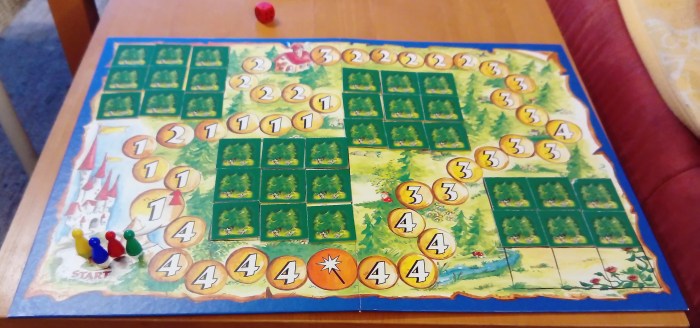
This game is pretty simple. You start by shuffling all the story tiles and laying them out, face-down, on the four gridded areas of the board. Each player then chooses a colour and places their token on the start space. In this game the youngest player starts.
The starting set up of the board. Note: this copy of the game is quite old and is missing one the stories.
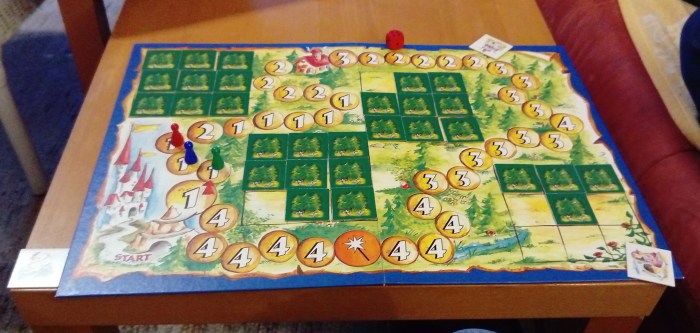
The first player then rolls the die and moves that number of spaces forward. Each circle that you can land on has a number in it (with the exception of the magic wand, which I’ll explain after), when you land on a circle you can turn over that number of story tiles and look at them. The first tile you turn over becomes the story that you’re trying to collect; after that when you turn over a tile you have to put it back if it doesn’t match your story. When you turn over a tile you have to show it to all the other players. This means that if you turn over a tile that belongs to a story another player is collecting it’s then easy for them to pick it up if they’ve a good memory. So the first time you land on a space you’re almost definitely going to pick up a tile that becomes your story, unless, weirdly, you manage to pick up a tile from a story that one of your opponents has just collected.
Here each player has collected their first story tile and are progressing around the board.
Until you pass the gingerbread house players cannot land on the same space as each other. They are allowed to pass each other if they roll a high enough number on the die, but if they roll a number that would allow them to land on the same space as another player they must remain one space behind. After passing the gingerbread house this rule changes and if a player lands on the same space as another player the unlucky other player has to go back to the start.
The only thing really left to explain is the magic wand symbol. This is on one space on the bottom of the board and on one side of the die. If this is rolled or landed on, the player whose turn it is has to swap places with another player. Now, if you’re lagging behind a bit and would really like to be up front where the others are, then you’re lucky if you roll this, however, if you’re doing well and roll this and the only options for places you can swap to are spaces that allow you to turn over 1 tile you’re probably not going to be so happy.
Winning The Game:
To win the game a player must collect all four story tiles from three stories before the other players. This means that players can keep going around the board for as long as is necessary to achieve this goal.
Strategy:
Have a good memory. A big part of the game is remembering where a tile is when another player turns over a tile that you need. This can enable you to win very quickly if you get lucky with the other players turning over tiles you need instead of ones that they need. It’s also good to keep an eye on one other story that no one else is collecting as a potential for your next story, as if you already know where two or three of the next story tiles are when you finish collecting the first one you’re likely to get ahead. Other than that this game is mostly luck of the roll and hoping that your opponents don’t roll magic wands if you’re in a good position.
History and Interesting Things:
This game was inspired by the stories written by the Brothers Grimm.
Märchenland translates to Fairy Land in English, though this isn’t a literal translation.
The Brothers Grimm were academics who were born in the late 18th century and specialized in collecting and publishing folklore during the early-mid 19th century.
Many of their stories are very commonly know still, although they are more commonly known in their romanticized, Disney form than in the form originally written in, which tended to be a little more gory and with slightly less happy endings.
During the 1930’s and 40’s the many of the stories were used as propaganda by the Third Reich.
The way the Gimm’s collected and rewrote stories before publishing them was regarded at the time by many to not be an accurate collection of the stories. However, this method of collecting folklore and legends has since been used throughout Europe.
As a result of the use of the book Kinder – und Hausmärchen Nazi party it was actually banned in Germany for a short time when the country was occupied by the allied forces after the war.
There is a current TV series called Grimm featuring a descendant of one of the brothers.
The Grimm stories provided the basis for many of Walt Disney’s early films, such as Snow White and the Seven Dwarfs(1937) and Sleeping Beauty(1959). It could be said that the Brothers Grimm provided the basis upon which Walt Disney built his film empire, which is still going strong today.
To Conclude:
I rated this game 4.5 because although I really like it and would definitely recommend it I think there’s not enough to it. If I were going to suggest an improvement to the game I would suggest that the stories that go with each set of tiles has to be told whilst they are being collected, or something similar. That way the game is an opportunity to do some creative storytelling as well as have a bit of fun.
 Tame The Board Game