Ticket To Ride

Number of Players: 2-5

Year of Publication: 2004

Creators: Alan R Moon (designer), Cyrille Daujean (artist) and Julien Delval (artist)

She’s Got A Ticket To Ri-iiide, She’s Got A Ticket To Ri-i-iiide, She’s Got A Ticket To RIDE, And She Don’t Care!!

Ticket To Ride is a straightforward route-building game featuring a lovely map of North America with major cities marked on them as route destinations, all the way from Miami, down in the South-East, to Vancouver, up in the North-West, and many in between. The objective is simple: score as many points as possible before the game ends. You play as an industrial railroad builder, who is trying to forge routes across North America, each hoping to build the most lucrative routes before their rivals.

“On a blustery autumn evening five old friends met in the backroom of one of the city’s oldest and most private clubs. Each had traveled a long distance – from all corners of the world – to meet on this very specific day… October 2, 1900 – 28 years to the day that the London eccentric, Phileas Fogg accepted and then won a £20,000 bet that he could travel Around the World in 80 Days.

When the story of Fogg’s triumphant journey filled all the newspapers of the day, the five attended University together. Inspired by his impetuous gamble, and a few pints from the local pub, the group commemorated his circumnavigation with a more modest excursion and wager – a bottle of good claret to the first to make it to Le Procope in Paris.

Each succeeding year, they met to celebrate the anniversary and pay tribute to Fogg. And each year a new expedition (always more difficult) with a new wager (always more expensive) was proposed. Now at the dawn of the century it was time of a new impossible journey. The stakes $1 Million in a winner-takes-all competition. The objective: to see which of them could travel by rail to the most cities in North America – in just 7 days. The journey would begin immediately…” – excerpt from the Rulebook

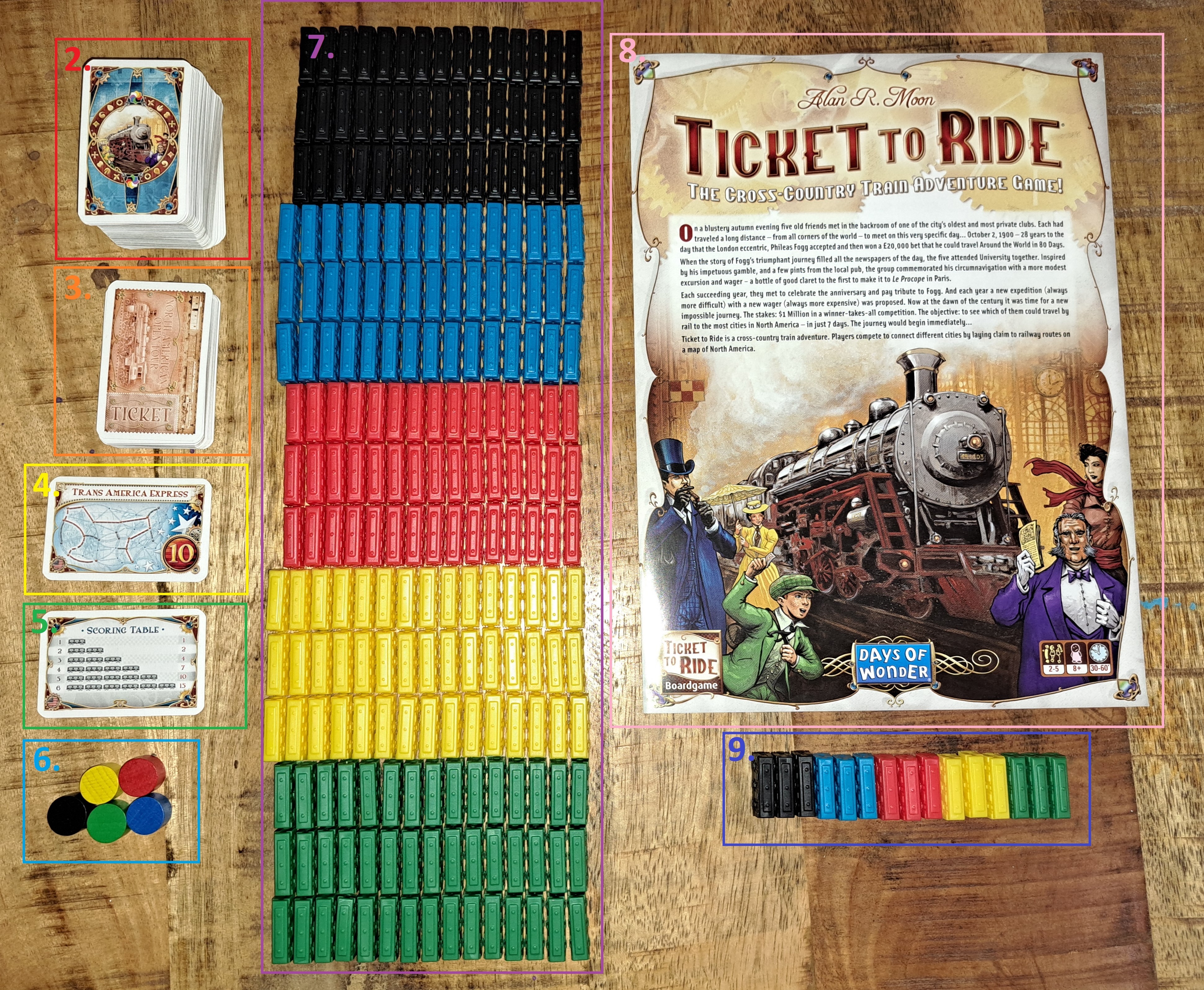
What’s In The Box:
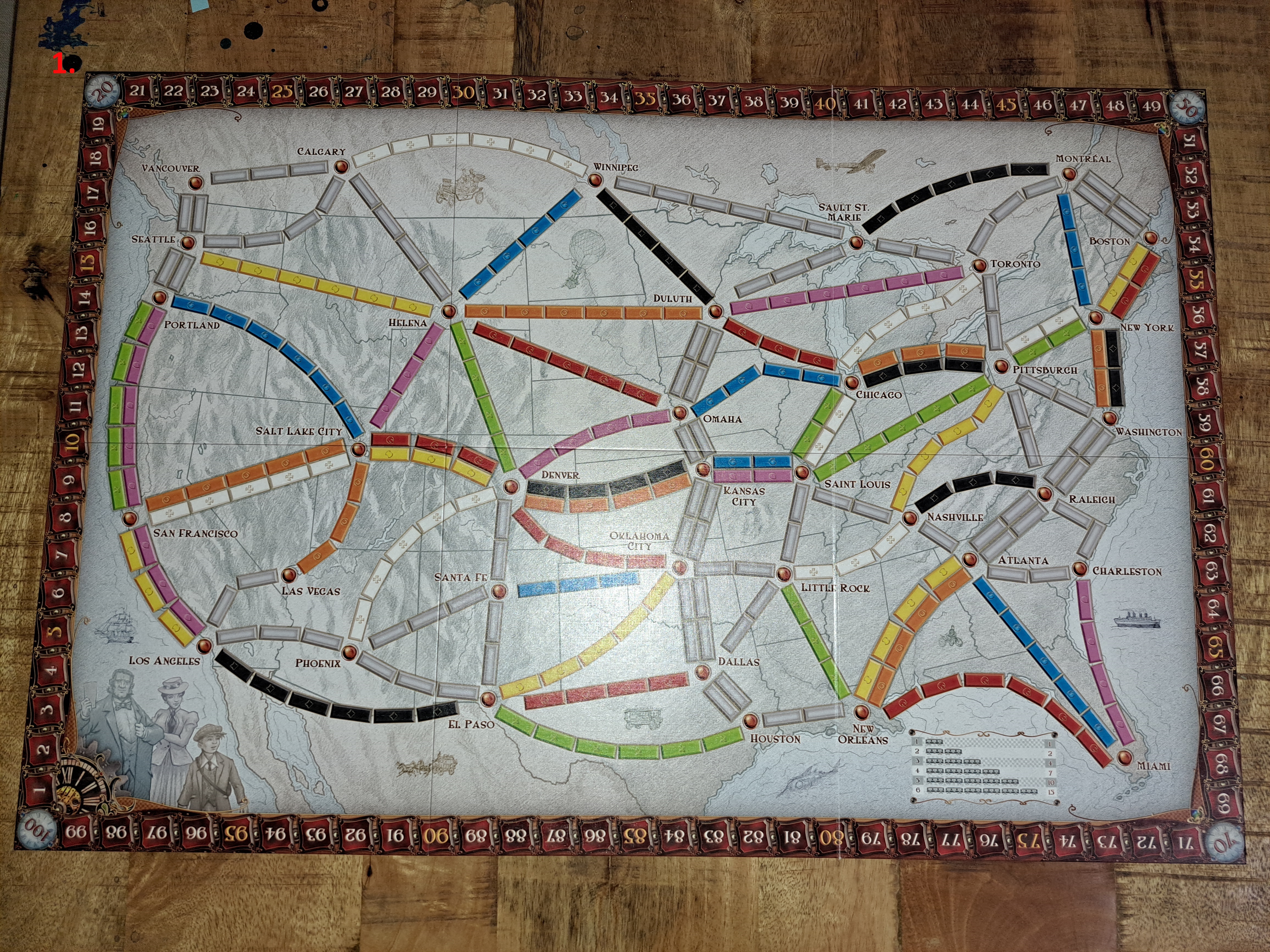
  1. Game Board
  2. 110 Train Car Cards
  3. 30 Destination Ticket Cards
  4. 1 Longest Continuous Path Bonus Card
  5. 1 Summary Card
  6. 5 Wooden Scoring Markers
  7. 225 Coloured Train Cars (45 of each colour)
  8. 1 Rules Booklet
  9. 15 Replacement Train Cars (3 of each colour)

Setting Up The Game:

To begin place the board in the middle of a decently large table. A largish table is necessary as the board itself is pretty big and you need space for all your train cars, as well as the Train Car and Destination Ticket Cards. Each player should choose a colour and take all the appropriate Train Cars, as well as the Wooden Scoring Marker that matches. The Scoring Marker should be placed on the 100 on the scoring track, which goes around the edge of the board. The 100 also doubles as 0 for the start of the game. The Train Car Cards are shuffled, and a starting hand of four cards is dealt to each player. The remaining cards are then placed, face-down, on one of the long edges of the board and the top five are turned face up, and laid out down the edge of the board, for all players to see. Place the Longest Path Card next to the board as well. Now shuffle the Destination Ticket Cards and deal three to each player. The players may now look at them, and decide which they want to keep. All three may be kept if a player wishes, or a maximum of one can be discarded. Discarded Destination Ticket cards are placed on the bottom of the pile, which is then put at the side of the board, once each player has finished deciding. You are now ready to begin and the most experienced traveller plays first, with play continuing clockwise after they have taken their turn.
Playing The Game:

On each players turn, they may perform one of the following three actions:

  • Draw Train Cards – a player may draw two cards; one either from the face-up cards lying on the table, or one from the top of the face-down pile of Train Car Cards. If they draw from the face-up cards a new card is immediately taken from the top of the face-down pile to replace it. There should always be five Train Car Cards face-up on the table. Once the first card has been drawn the player can then decide where they want to draw their second card from, as before. *See below for special rules applying to Locomotive Train Car Cards
    There is no limit on hand size in this game; a player may hold as many cards as they wish and continue to draw new cards. Only if the draw deck runs out will they be forced into one of the other two permitted actions.
  • Claim A Route – various routes are indicated across the board by small coloured rectangles connecting two cities. In order for a player to claim one they must lay down the appropriate number of cards for the route they wish to claim. Additionally, the rectangles are coloured, indicating which type of Train Car Card must be used to claim that particular route. A route can only be claimed if a player has the required number of cards all in the correct colour. If a route is comprised of grey rectangles then any colour of Train Car Cards may be used, as long as they are all the same. Once a route has been successfully claimed the player lays their Train Cars onto the route, discards the cards they used to claim it, and moves their Scoring Marker up the scoring track the appropriate number of spaces. How much each route is worth is indicated both on the board itself and on the small Summary Card. Special note regarding routes: on some sections of the board there are routes that show a double line of rectangles. This means that that route may be claimed twice during play. HOWEVER, in a two-player game, each double route may only be claimed once, in order to increase the challenge of the game a little, as there is less overall competition for routes. *Special Locomotive rules apply here too
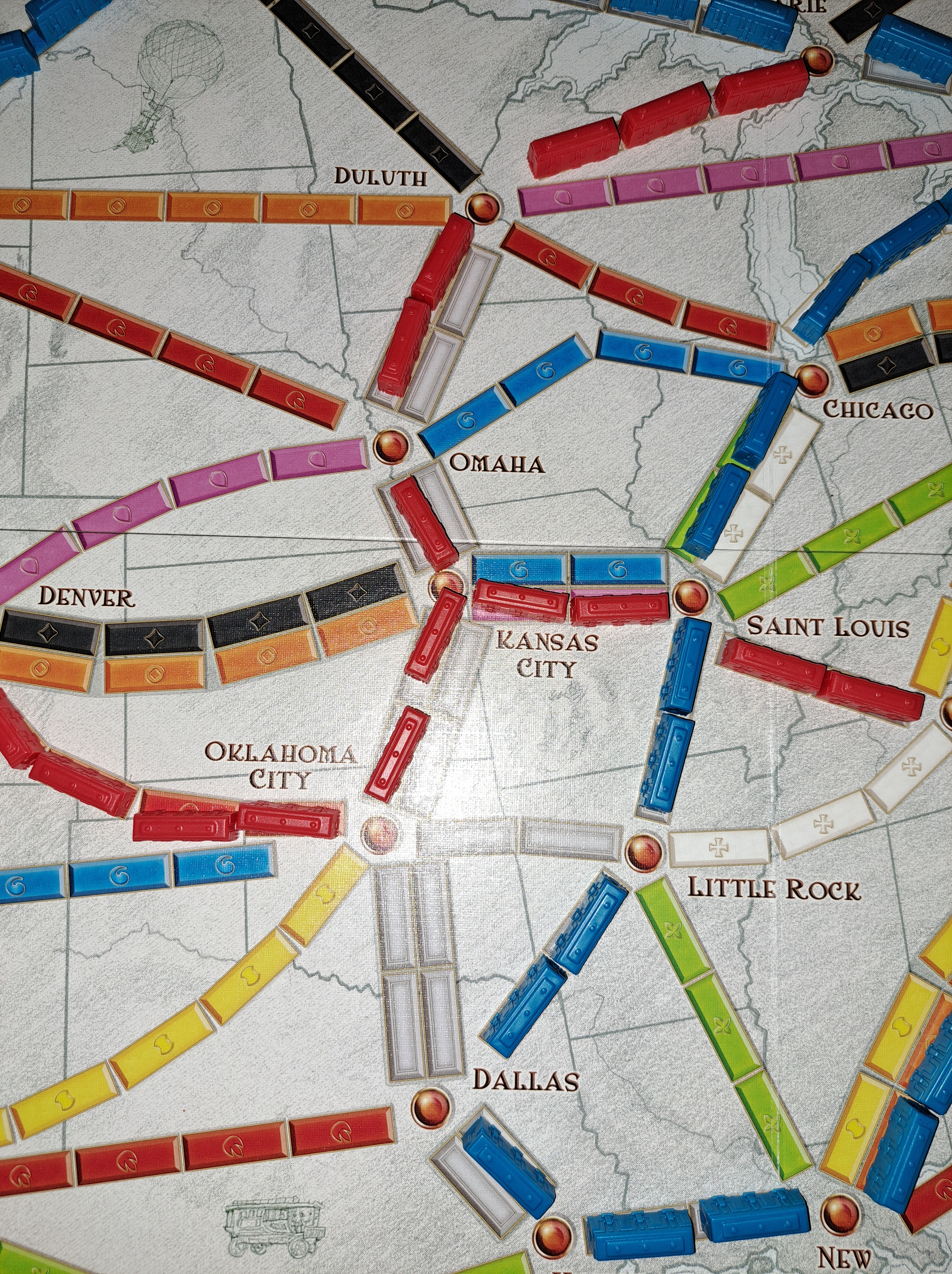
Here you can see a selection of short, double-grey routes. In a game with more than two players both sets of grey would be useable all the way from Duluth to Houston, however, as this was a two player game, once red had claimed most of them, they became inaccessible for blue.
  • Draw Destination Tickets – the player draws three new Destination Tickets from the top of the deck, looks at them, and decides which they want to keep. A minimum of one must be kept, but the player may keep two or all three if they so wish. Any discarded Destination Tickets are returned to the bottom of the deck.
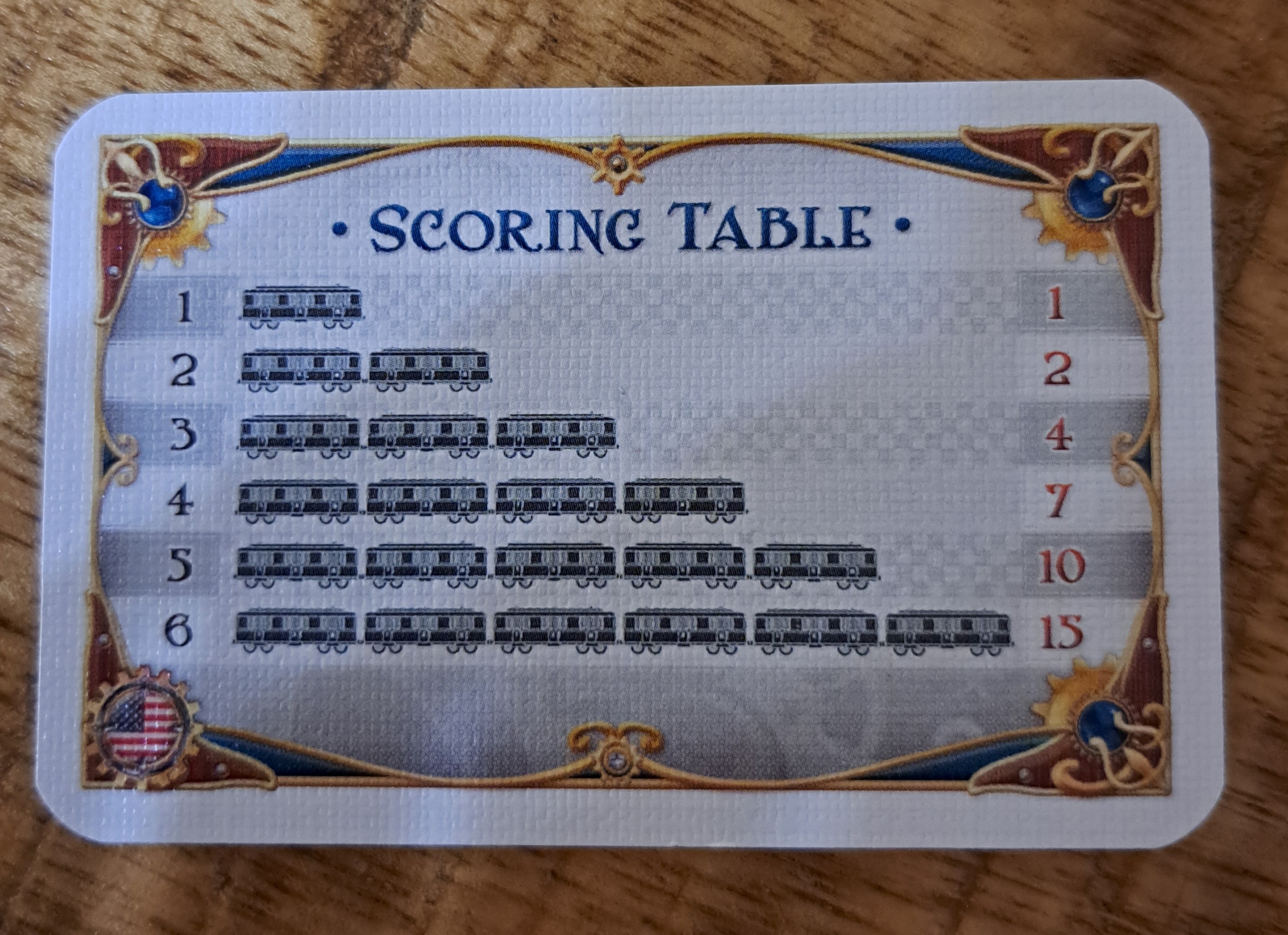
This card indicates how many points a player gains when claiming new routes. As you can see, a long route can be quite lucrative, if you have the right cards to claim one!

Special Locomotive Train Car Rules!

Locomotive Train Car Cards are easy to spot as they are multi-coloured. They act as a wild card and can be used in place of one regular Train Car Card of any colour when claiming a route. When drawing cards, if a Locomotive is one of the face-up cards on the table you may take it, HOWEVER if you do, you may NOT draw a second card. Additionally, if you draw a regular Train Car Card from the face-up five and the replacement card is a Locomotive, you MAY NOT take that card. If, however, a Locomotive is drawn blind as the first card taken from the draw deck, the player is lucky, and may still draw a second card either from the deck, or from the face-up cards.

IMPORTANT NOTE: IF AT ANY TIME THREE OF THE FIVE FACE-UP TRAIN CAR CARDS ON THE TABLE ARE LOCOMOTIVES ALL FIVE CARDS MUST IMMEDIATELY BE DISCARDED AND NEW ONES DRAWN TO REPLACE THEM.

An important thing to know regarding Destination Tickets is that they each have a point value. If the route indicated is completed by the player holding the card before the game ends, those points are added to their final score when the game has ended. If the route HAS NOT BEEN COMPLETED the player loses those points at the end instead. Destination Tickets are kept secret until the end of the game and the points from them are added only once play has finished, no matter when a player completed the route. As with hand size, there is no limit to the number of Destination Tickets a player may hold.

Ending The Game:

The game ends when one players supply of trains is either 0,1 or 2 at the end of their turn. After this each player, including the player who triggered the end of the game, may take one more turn before final scoring is done.
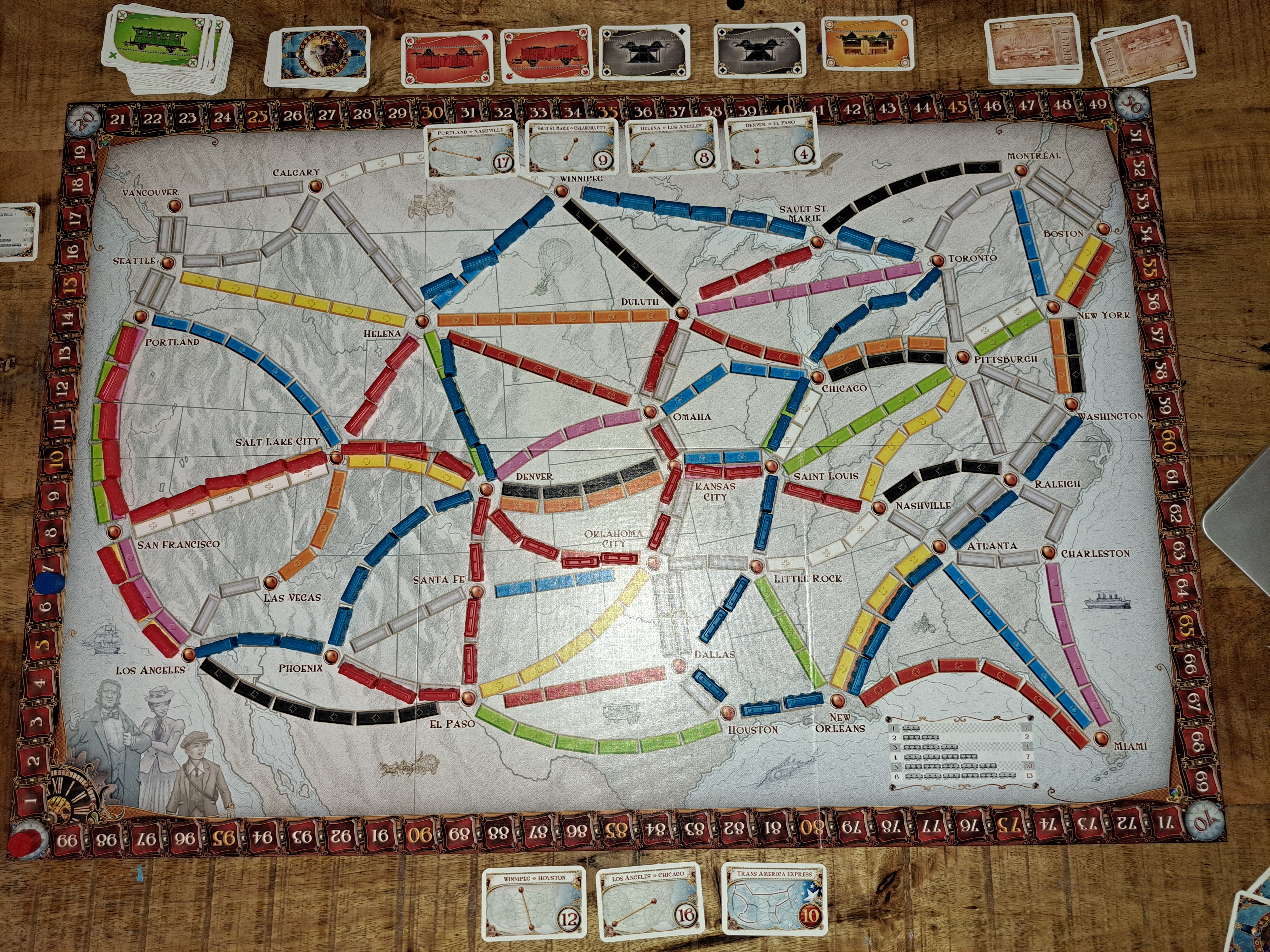
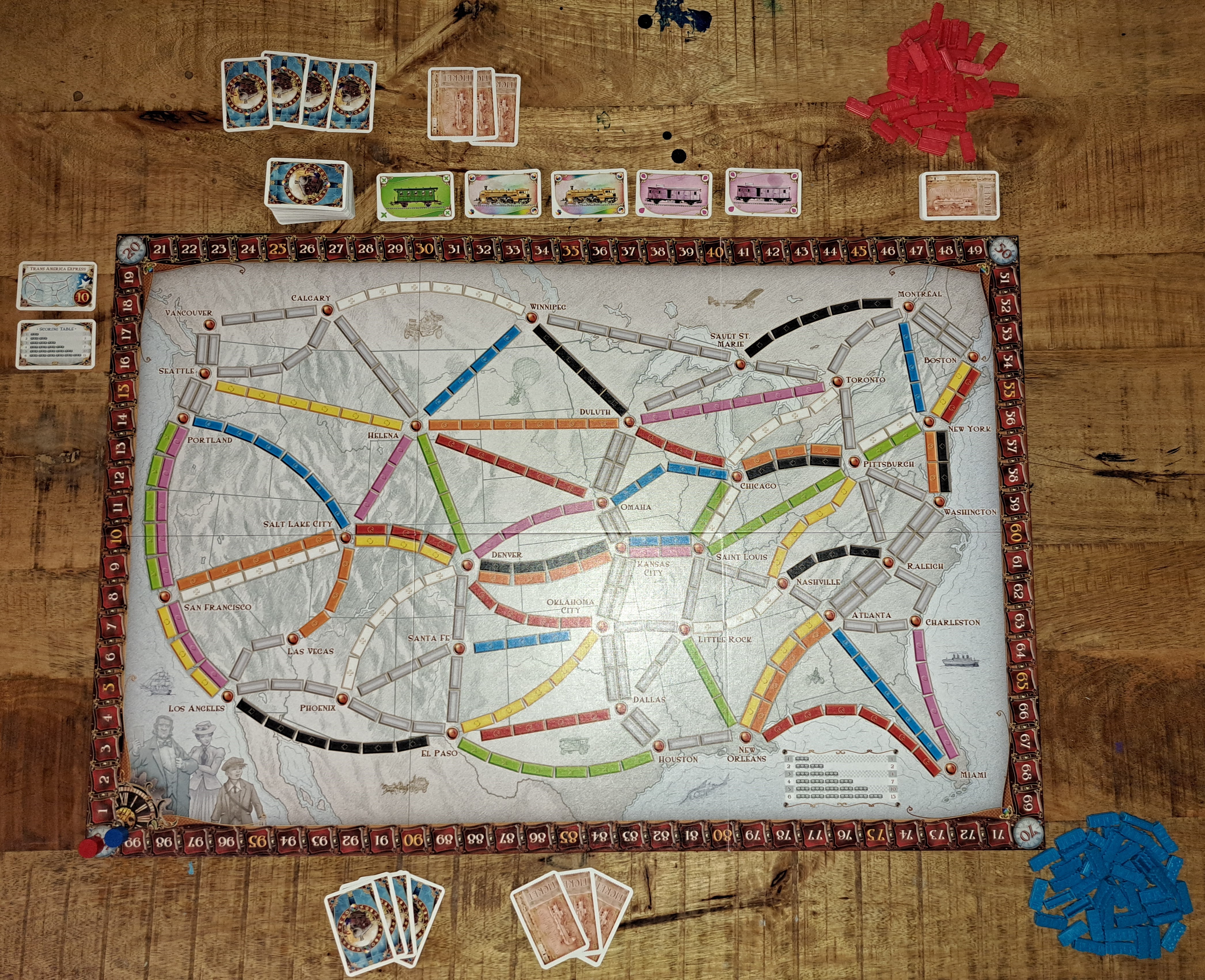
This was how our two-player game ended. Below you can see the routes that Blue (me) had claimed, plus the 10 point bonus for the Trans America Express. Total I had 107 points this time round. Above you can see the routes that Red (my husband) has claimed. Although he had more routes than me, he was unable to catch up points-wise, as they each (bar the Portland-Nashville route) only gave him a small number of points, and they did not connect well to form a long route. This is the first time I’ve ever beaten my husband at this game, and I am rather smug.

Strategy:

There is a limited amount of strategy that can be employed in a game as simple (relatively speaking) as this. We have found that completing routes, and often going for the Longest Continuous Path Bonus makes a large difference in final scoring. No matter how many individual routes a player has claimed they will most likely always be bested by someone who has one or two Destination Ticket routes completed. Especially as a few of these are rather high-scoring. It’s also worthwhile to claim routes as soon as you have the cards rather than waiting to hoard up more cards, as whilst you’re collecting cards there’s always a chance another player will steal away the route you had your eye on. If you’re approaching the end of the game and you’ve completed all your Destination Ticket routes and aren’t feeling brave enough to draw new ones, it’s worth it to try and extend your existing routes in order to claim the Longest Continuous Path Bonus, which gives you 10 extra points at final scoring. It is likewise worthwhile to lay claim to long routes, even if they do not connect you to anything particular, as these give you a good point-boost too.

To Conclude:

This is a lovely game. It’s good for a wide range of ages, so appropriate for families, and straightforward enough for both beginner and advanced board-gamers. The limited amount of reading required is very handy if younger children wish to play, though if you want to keep to the rules extremely strictly then children under the age of 6 probably cannot play alone, as they won’t be able to read the city names on their Destination Tickets. When we play with children we usually play open hand with all Destination Tickets face up on the table, in order to be able to help them plan their routes. It’s also a very nice choice if you want a relatively quick round of something, as each players’ turn doesn’t usually take more than a minute or two, and the game naturally progresses and ends quite speedily.

I personally like this game for several reasons:

  • Aesthetics – the board map is really nice to look at. City names are easy to read and the colours are bright, but not garish. The design is good. Playing pieces are also sturdy and simple, therefore unlikely to break.
  • Simplicity – the rulebook is a mere four sides, with plenty of pictures to explain, making it extremely easy to understand, and leaving little room for ambiguity or misunderstandings during gameplay.
  • Speed – my children often like to play board games, but their current ages mean that committing to a game can be a big deal, due to short attention spans. This game is fast enough that we can usually get through a round before anarchy descends.

I have rated this only a 3.5 though because, although the game is well thought-out, attractive and easy, I like a bit more challenge to my games. However, we have a later version of the game, Ticket To Ride: Europe too, and that version expands beautifully on the originally, introducing some new rules and one new game piece, which will likely, when we come to reviewing it, bump up the rating to a 4 or 5.

Village

4 - 5

Number of Players: 2-4

Year of Publication: 2011

Creator(s):  Inka Brand and Marcus Brand (designers), Dennis Lohausen (artist)

It’s a pretty small-town kind of a game…

Ever wanted to go travelling, but just didn’t have the time? Ever wanted to become a friar but you were too female to join a monastery? Well in Village you can fulfill all of those unfulfilled life dreams that you may have had any time in your life. Take control of four generations of one family to make your all dreams come true! (Okay, maybe I’m lying about all your dreams coming true, but it’s still good fun, okay?)

What’s In The Box:

whats-in-the-box

dsc_0055

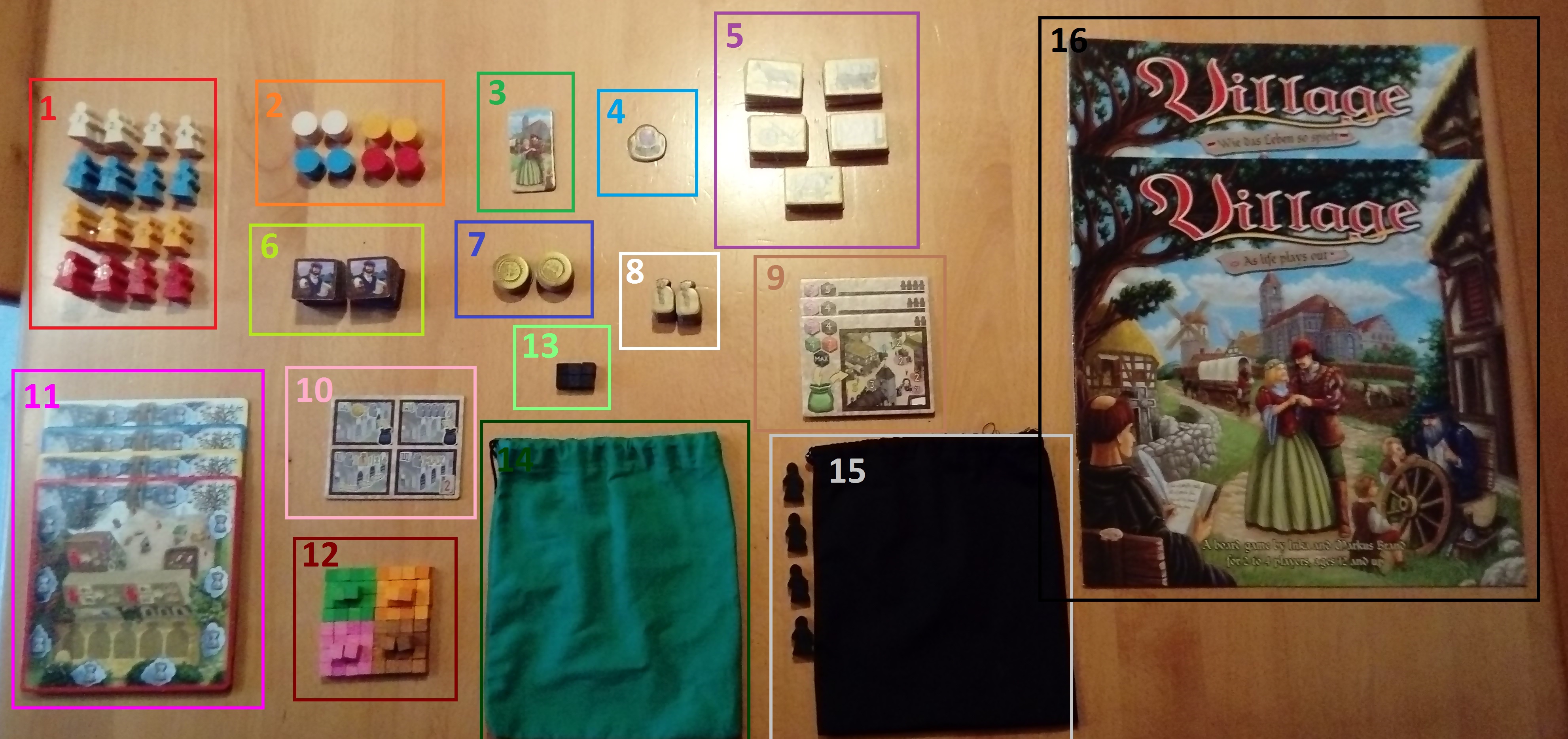
  1. 44 Family Members in four colours
  2. 32 Markers in four colours
  3. 1 Starting Player Marker
  4. 1 Next Starting Player Marker
  5. 40 Goods Tiles
  6. 24 Customer Tiles
  7. 15 Coins
  8. 20 Bags of Grain
  9. 3 Setup Cards
  10. 1 Mass Overview Card
  11. 4 Farmyards
  12. 72 Influence Cubes (Brown, Pink, Orange, Green)
  13. 6 Plague Cubes (Black)
  14. 1 Green Bag
  15. 1 Black Bag and 4 Black Monks
  16. 2 Rule Books (German and English)
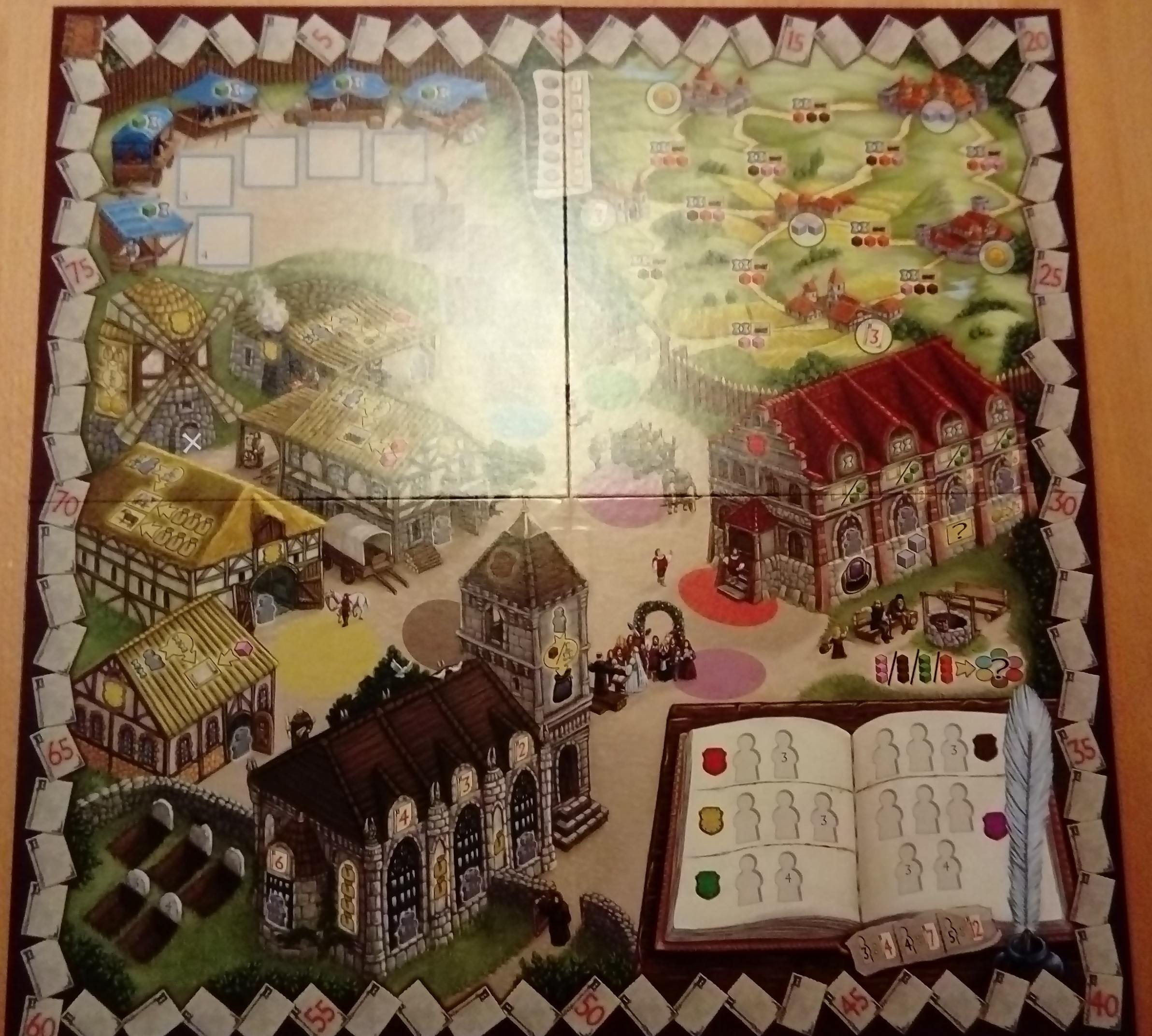
  17. 1 Game Board

Playing The Game:

Objective: To efficiently manage the lifespans of each of your family members so as to gain the maximum number of prestige points.

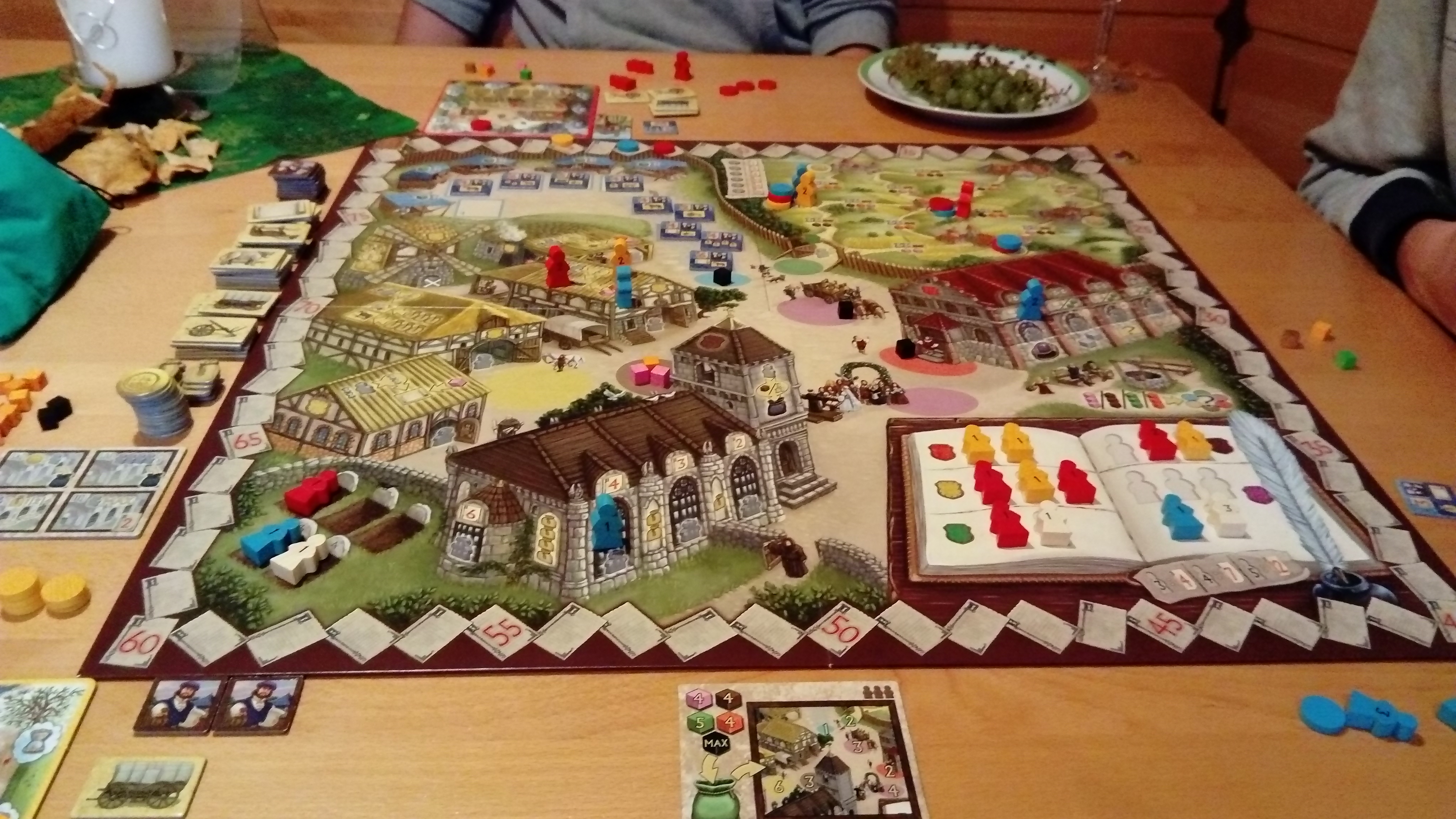
To start the game each player chooses a family, and is given a farmyard, one gold coin and all of their coloured markers. One marker is placed on the closed book symbol in the top left-hand corner of the board. Each family has four generations of people. To begin the game only the four people marked with a 1 are placed on the farmyard.

Setting Up The Board:

Once you’ve chosen your family and claimed all of the pieces you need to begin you then follow the instructions relevant to the number of players there are. As you can see there is a big book in the bottom right-hand corner of the board. This is call the Village Chronicle, it’s the dream of all the villagers to have their name written in this book when they die. When playing with less than four players there are spaces there, and in the unmarked graves (bottom left-hand corner) which are marked with a 3 or a 4. These spaces have to be filled with a member of an unclaimed family at the start of a two or three-player game. This helps to control how long the play time of the game is.

dsc_0061
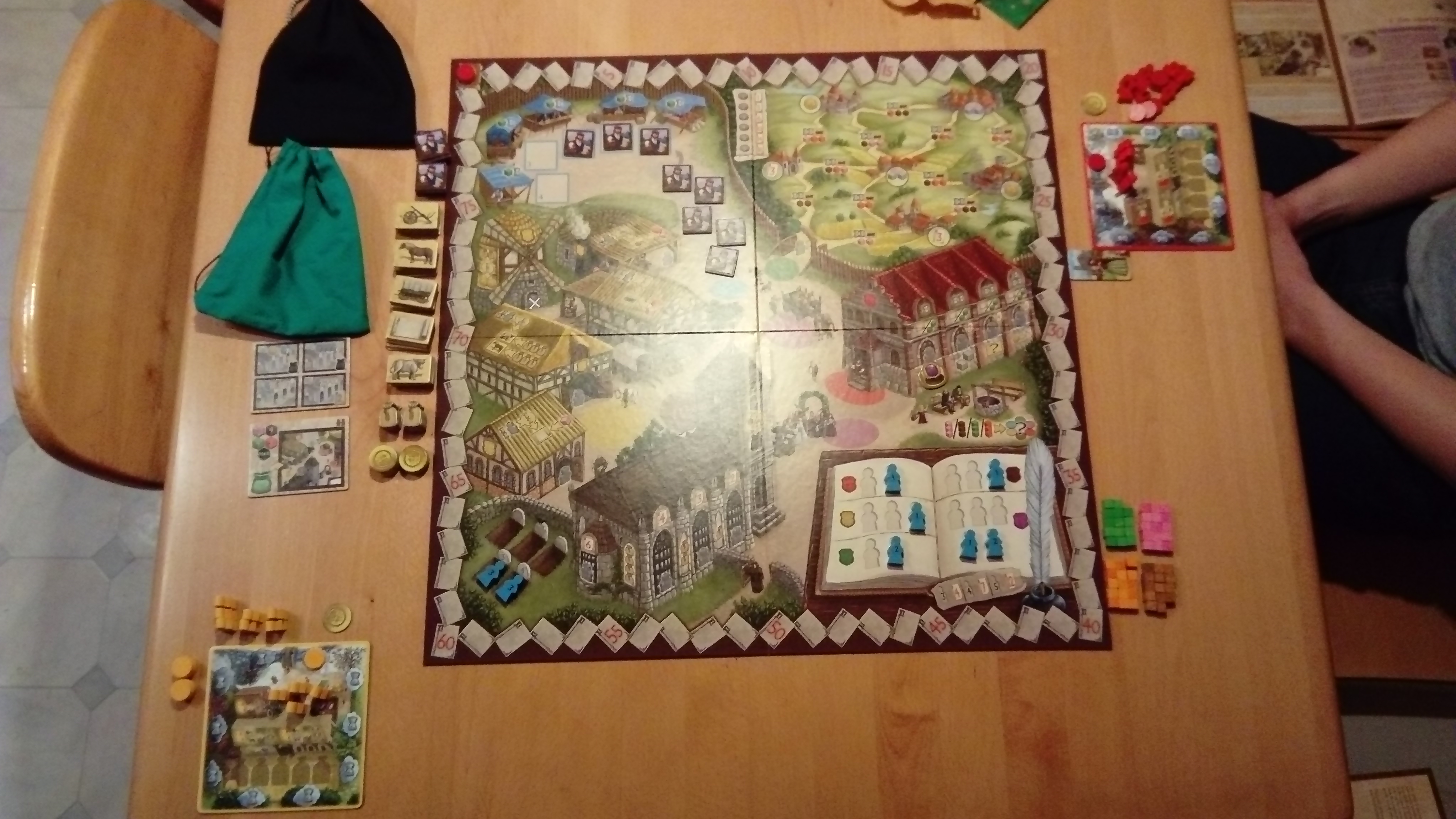
Basic starting setup for two players.

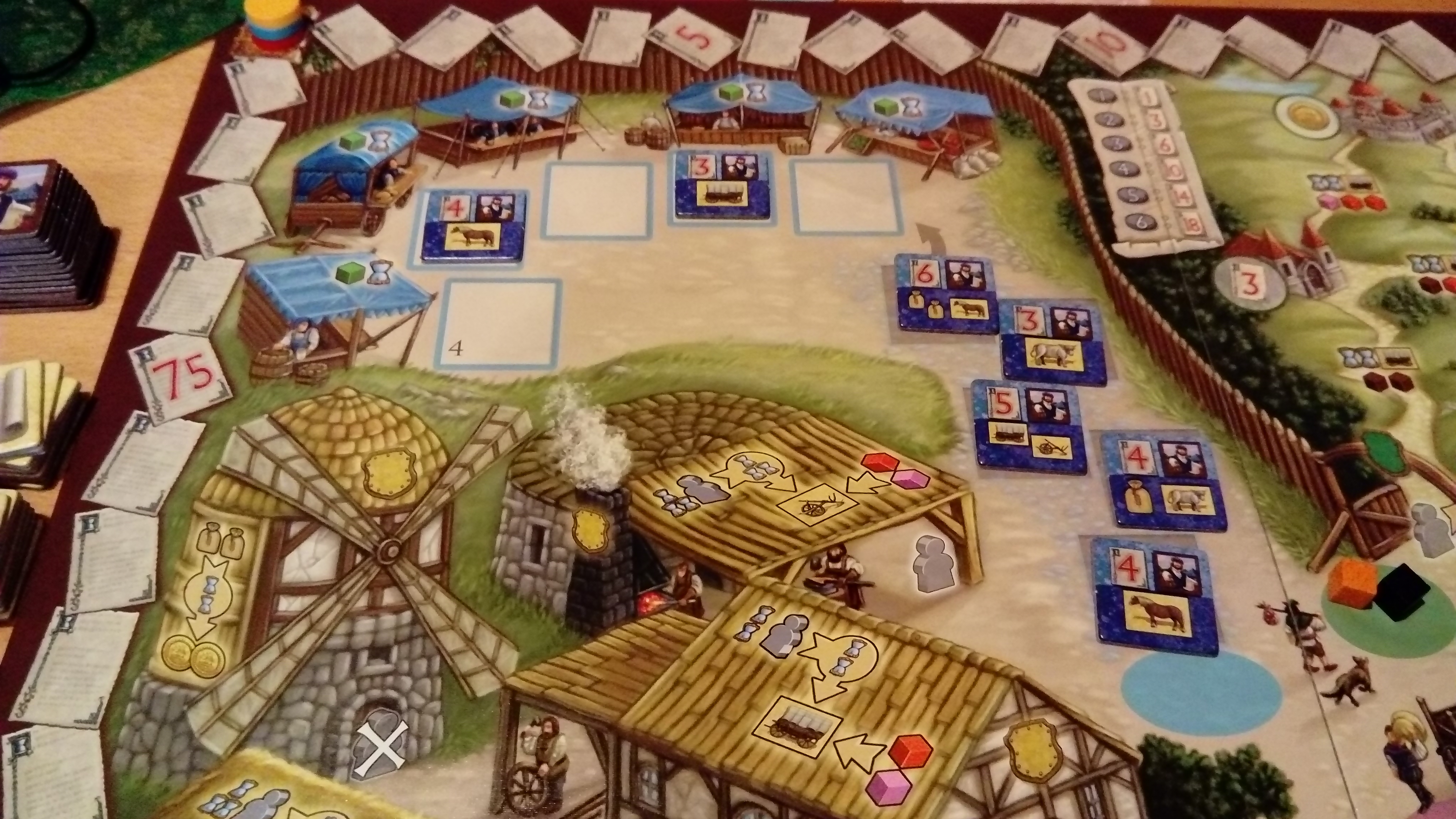
At the start of the game the oldest player immediately becomes first play (you can see the red player in this game has the strange marker with the couple on it next to his farm). This player then takes a pre-determined number of the coloured Influence Cubes from the pool at the side of board and puts them, and all the Plague Cubes into the green bag. These are then drawn at random and used to Seed the board. The Setup Card for the number of players indicates how many cubes should be placed on each coloured patch of the board. Each of these patches represents a potential action that you can take on your turn.

The only other thing left to do now is place customer tiles on the indicated number of marker squares on the board. Once this is done you’re ready to play!

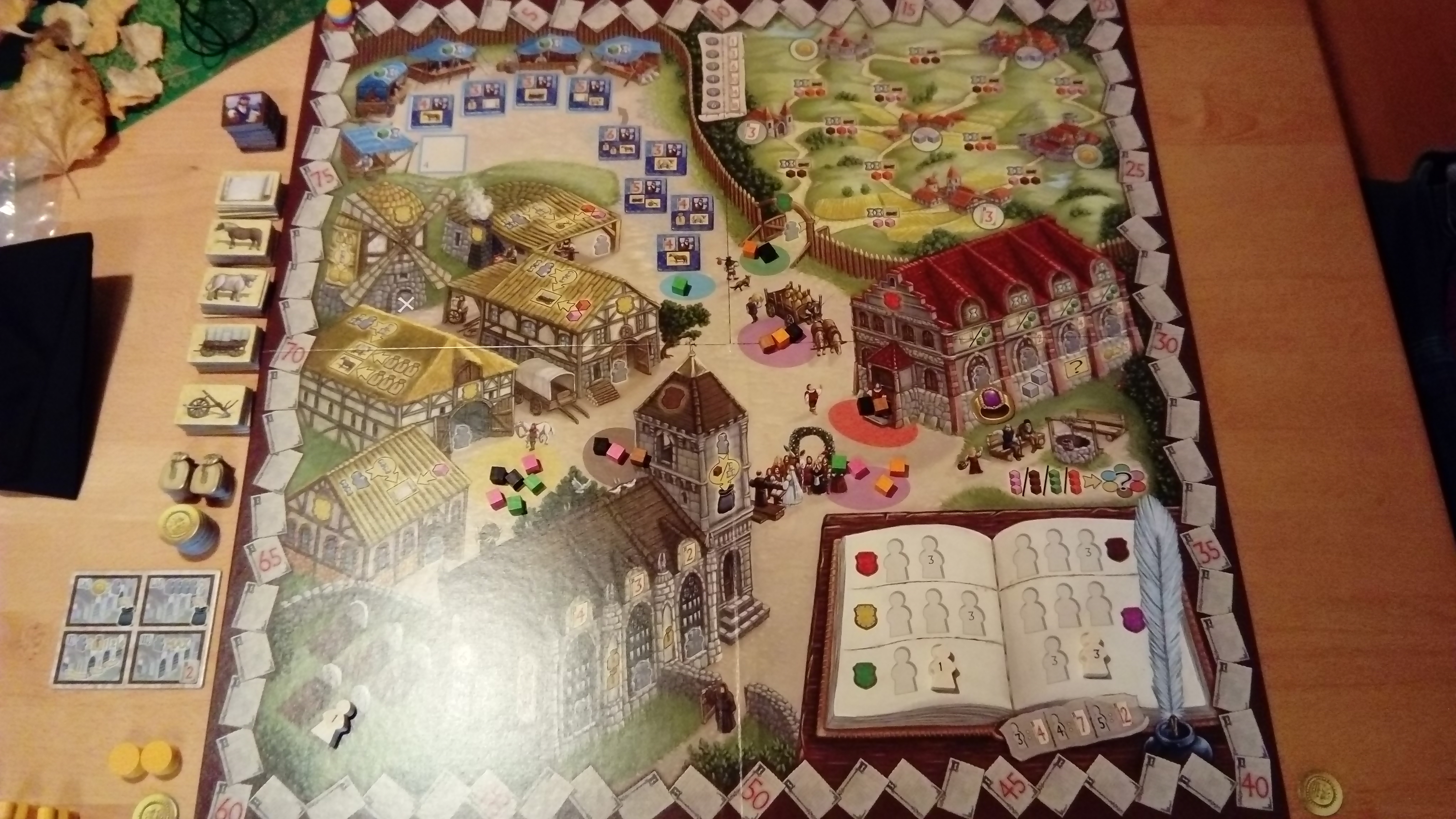
dsc_0052
As you can see, Influence Cubes and Plague Cubes have been randomly distributed to the different coloured patches on the board according to the Setup Card and Customer Tiles have been placed in the Market area.

The Rules:

We found that the rulebook for this game is very well written. It’s quite clear what is and isn’t allowed, and there’s very little ambiguity, this makes the game pretty straightforward to play as there’s little opportunity for argument about whether one action is or isn’t allowed.

Taking Your Turn:

This game is quite clever; because each round consists of a few turns for each player – but the actual turn itself is quite short – the game should keep going at a reasonable pace, making the impatient among us much happier as their turn comes round more often. To begin your turn you take an Influence or Plague Cub from the action spot of your choice, the choices are:

  • Grain Harvest – if you have one or more family members on your farmyard you can perform this action. Take an Influence or Plague Cube from the spot with the wagon on it and then immediately take 2 bags of grain from the supply. If you do not have any family members on your farmyard you cannot perform this action.
  • Family – when you perform this action a new family member is born! Take a cube from the patch with all the people standing next to it and then take a new family member from the next generation of your family (if you have all of the 1st generation on your farm or the board somewhere then take one from generation 2 and so on) and put them on your farm. Alternatively, instead of taking a new family member from the supply, you can also use this action to recall a family member  from somewhere on the game board to your farm.
  • Crafts – Take a cube from the yellow patch by the workshops. You can now send a family member to one of the workshops to learn a skill. Each workshop will show on it how much time must be spent to train a family member, and then again how much time must be put in to create. Note: the train cost of time only has to be paid once per family member in a workshop.
  • Market – when a Cube is taken from the blue patch by the market place a market day is immediately triggered. Each player has a chance now to trade at the market. However, only the spaces directly in front of a market stall can be traded with. The player who triggers the market day performs the first trade action and can perform this for free. Every other player who wishes to trade at the market must pay both one time and one green Influence Cube before they can trade.

dsc_0054
As you can see, we have only traded with the customers who were directly in front of the market stalls. No other customers have been served.

  • Travel – The green patch near the gate out of the village indicates travel. You can use this patch to send a family member to other villages. This gains you prestige points and other benefits depending on where you go.
  • Council Chamber – taking a Cube from the red patch by the council building allows you send a family member into the local council. As you train them they gain influence in the council and the benefits you receive from them increase.
  • Church – the brown patch nearest the church allows you send a family member to orders. Once sent this family member goes into the Black Bag with the Monks and is not used again until Mass is said at the end of the round.
A Family Member Dies:

As each action costs you time eventually someone will have to pay. On your farm you will see clouds with sand-timers in them around the edge of the farmyard. Each time you perform an action that requires time you must move your marker the requisite number of spaces. Every time your marker passes the bride at the top of your farm, a family member from your oldest generation has to die. When this happens you may complete the action that you were performing fully before choosing which family member to kill.

Note: with the exception of Market Day. If Market Day is trigger by taking a Plague Cube you must immediately pay the 2 time and if someone dies they must be removed from the board before completing the Market action.

It is beneficial to plan which family members will die as there are a certain number of spaces in the Village Chronicle for each profession. Once these are full no other people who die whilst in this occupation can go there and must be buried in the unmarked graves. This is important because you gain Prestige Points at the end of the game for the number of family members in the Village Chronicle, but you do not gain points for any in the unmarked graves.

dsc_0058
Here you can see family members in both the Village Chronicle and the Unmarked Graves. Orange and Red have here achieved the most strategic deaths so far.

Ending A Round And Saying Mass:

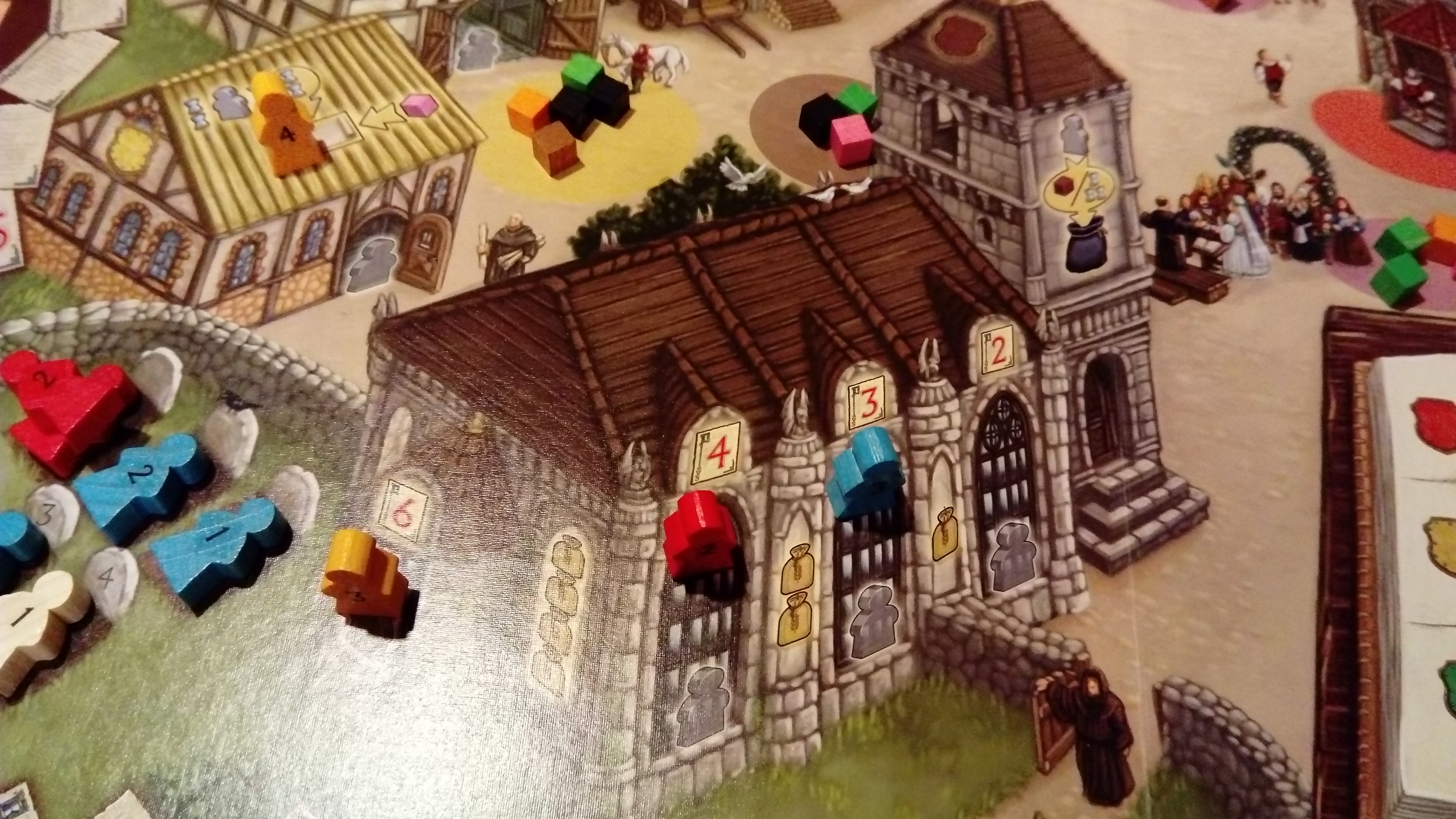
Once the last Influence or Plague Cube has been taken from the board the round ends once that player has completed their action. At this point Mass is said. Four monks are drawn from the Black Bag to say Mass. If any player has a family member in the bag they are allowed to pay one gold coin to have their family member definitely say Mass. If the players do not pay them those saying Mass are drawn randomly. Any coloured Monks drawn from the bag are placed on the first window of the church, and any black Monks are returned to the bag. Players may now move their Monks further up the church hierarchy by paying the indicated number of Bags of Grain back to the supply. Once this is done the player with the highest number of family members in the church is awarded two prestige points. If there’s a tie then the player with the highest ranking family member wins, if there is still a tie then the tied players all receive two Prestige Points.

dsc_0068
Here, Orange has paid the most grain and been made Abbot in exchange. Red is a senior Monk of some sort, and Blue is sadly just a Novice still.

Once Mass is ended the board is re-Seeded and a new round begins.

Ending The Game:

The game ends once either all the spaces in the Village Chronicle or the unmarked graves have been filled.

Winning The Game!

At the end of the game Prestige Points from all the different aspects of your life in the village are added up. The player with the most Prestige Points wins!

Note: The board is clearly marked with which actions will give you more Prestige Points when continued with for longer periods of time.

dsc_0061
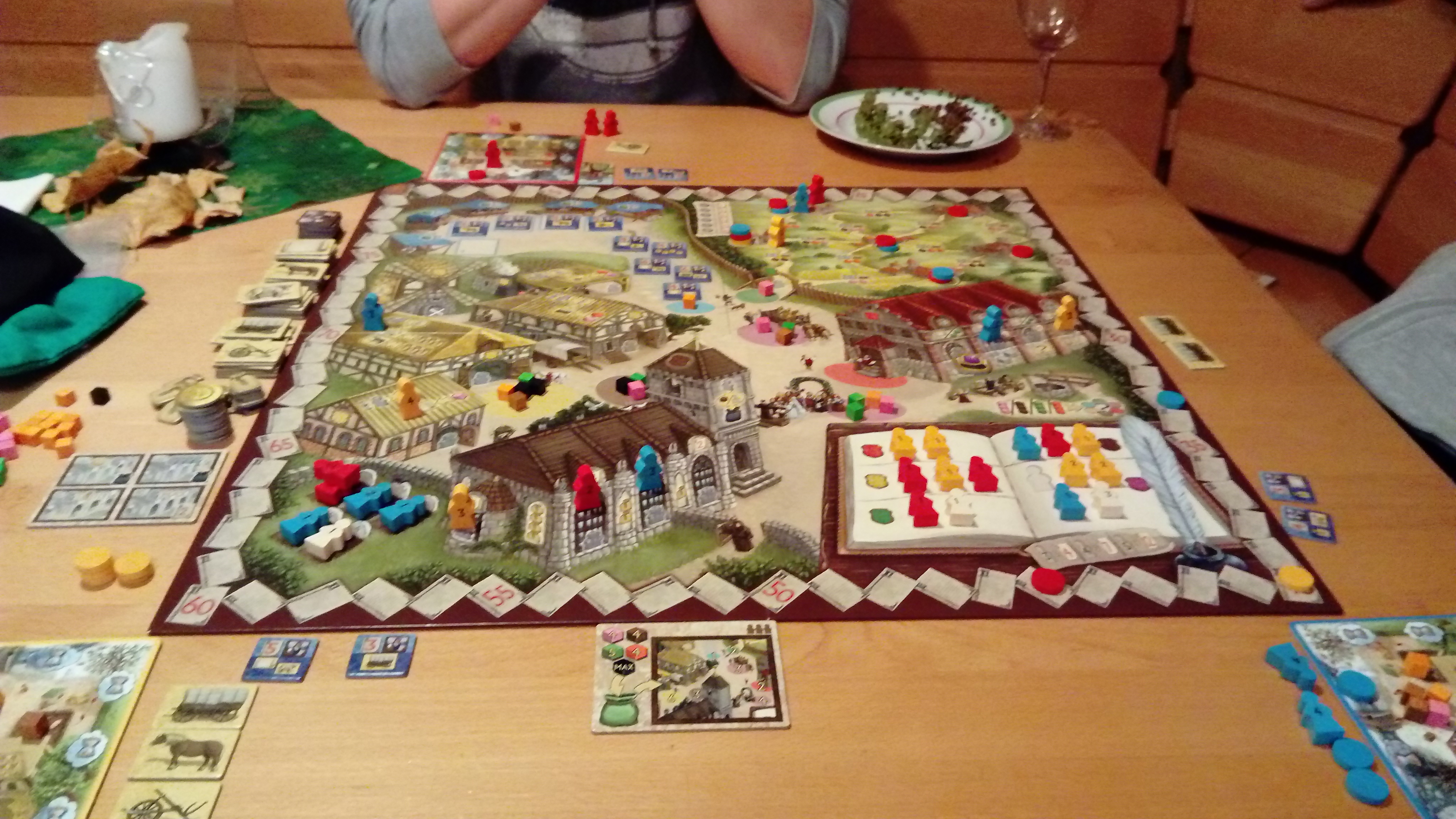
Red is victorious! Orange not far behind, and Blue seriously lacking in Prestige…

You can see that the score has been added up by moving each players coloured counter around the track on the edge of the board. Red has won, but not by much!

Strategy:

There are several different strategies that can be adopted for this game. The one I played (I was orange) was to try and have family members in as many different professions as possible, so as to be able to spend a lot of time and have them in the maximum number of available Village Chronicle spaces. I gained a lot of Prestige Points from this. The other aspect of my plan was to try and get reasonably high in the church, as you get points from this, and to have traveled a reasonable amount, for the same reason. I didn’t win the game though, the winning strategy was to build things using the Crafting action and to travel as much as possible. Although this strategy won, it only just won, so it would be worth playing again and seeing if I can alter my strategy a little to make it the winning one!
Both of us playing used the Market action. I had more Market points and I know from a previous time we played this game that if a player is focused enough it is also possible to win using only the Crafting and Market actions. But this requires serious dedication and single-mindedness.

Tactically it is also worth triggering a Market Day when you can trade but you know no-one else can. Even if you only have one thing to trade. You may only get a few points for this action, but no-one else gets any, which gives you a bit of an edge.

History and Interesting Things:

  1. Between 2011 – 2014 this game won 7 awards, and was nominated for 14!
  2. It’s set in a kind of 1700’s era Village.
  3. To be honest, the game was only published in 2011 and doesn’t have much extra-curricular information about it, so I’m going to have to fail at giving any extra points here!
Further Reading and Other Editions of the Game:

This game is still relatively new – only five years old – but it has four expansions:

  1. Village: Customer Expansion (2012)
  2. Village Inn (2013)
  3. Village: Customer Expansion 2 (2014)
  4. Village Port (2014)

In Conclusion:

As you can see, I have actually had very little to write about the history or background info to this game, but having said that, I would recommend the game. It’s not particularly complicated and it’s good for a chilled-out afternoon with family or friends. It’s also great for playing with friends who like board games, but aren’t fanatic enough about them to spend more than about 2 hours playing one. I particularly enjoyed it because you can explore so many different ways to win. Having played the game twice in the last three days I can say that at the moment one of the strongest win-strategies seems to be trying to travel to all six of the other towns.

Update – February 2014

This month is going to be themed Terry Pratchett month (or more like, board games inspired by works of Terry Pratchett) but that’s somewhat long winded! If anyone reading this is unaware of Terry Pratchett and his works, you must be educated now! Start by clicking THIS hyper link and picking a book, then buy it, then start reading. You could start at the beginning (a very good place to start) with The Colour of Magic. Then watch at least a couple of the films made from his books (I would suggest Hogfather followed by Going Postal) then even perhaps find the stop motion version of Truckers (which you can watch on YouTube HERE) and watch that (its not half bad) and then watch the animated TV series of Wyrd Sisters and of Soul Music. And after all that perhaps even listen to the Steeleye Span album Wintersmith inspired by the book of the same name. Then after you’re familiar with all that come and finish reading this post and then play the board games!

We’ve reviewed the games in publication order going from oldest to youngest and the last one will be the newest game we have looked at so far, having only been published in 2013.

Games for February: – Terry Pratchett

Monday the 3rd – Thud

Monday the 10th – Ankh-Morpork

Monday the 17th – Guards! Guards!

Monday the 24th – The Witches

Other Things to Note:

To my infinite disgust we now have a Twitter page. It took us a while, but we finally came to terms with the thought that it might be a good idea. Check it out HERE! Follow it etc.

The Twelve Games of Christmas – 2013 page is GONE! Having finally let go of the Christmas magic we took the stand alone page down. However the individual posts can still be found and brought together if you click on the category for them.

We have some very exciting ideas for future video blogs but are fundamentally stumped by our lack of a decent camera, but good ideas are in the works and will hopefully be a reality in a few months or less. SO, for now you’ll have to live with videos like the one we made of the game play of OSKA – which you can see HERE!

Along with Breach The Keep we have two other games in the works. One is a card game called Crush the Crown! Which we will be posting the rules for soon and hoping for (but not expecting) some feedback! There is another, far cooler, project in the works which will be posted about soon, so definitely look out for that.

This may be a premature announcement but we are having a website built to host internet versions of games we design starting with Breach The Keep. However, it’s in early stages, but is coming along nicely so expect it, but not for half a year or so.

And don’t forget to like us on facebook HERE!