
Number of Players: 3-10
Year of Publication: 2004
Creators: Frederic Moyersoen, (designer), Andrea Boekhoff, Alexander Jung, Frederic Moyersoen (artists)
Are you a dedicated miner, searching for the gold with your crew? Or a sneaky saboteur, trying to bring down the tunnels on the heads of your compatriots!?
Saboteur is a silly, easy, quick-to-play (average play time for one round is only 30 minutes, but can easily be less with experienced players) card game where each player randomly draws either a regular Dwarf card, or a Saboteur Dwarf card at the start of the game. These cards provide you with your goal. The objective is simple; Dwarves are mining, and, as you might expect, are searching for the gold; Saboteurs are trying to thwart their comrades, and prevent them from striking gold!
Nothing makes the heart of a dwarf race quite like a nice shiny gold nugget. As one of these intrepid folk, you naturally want to collect as much of the yellow stuff as you can. But are you a gold digger… or a saboteur? – excerpt from the game rulebook
What’s In The Box:
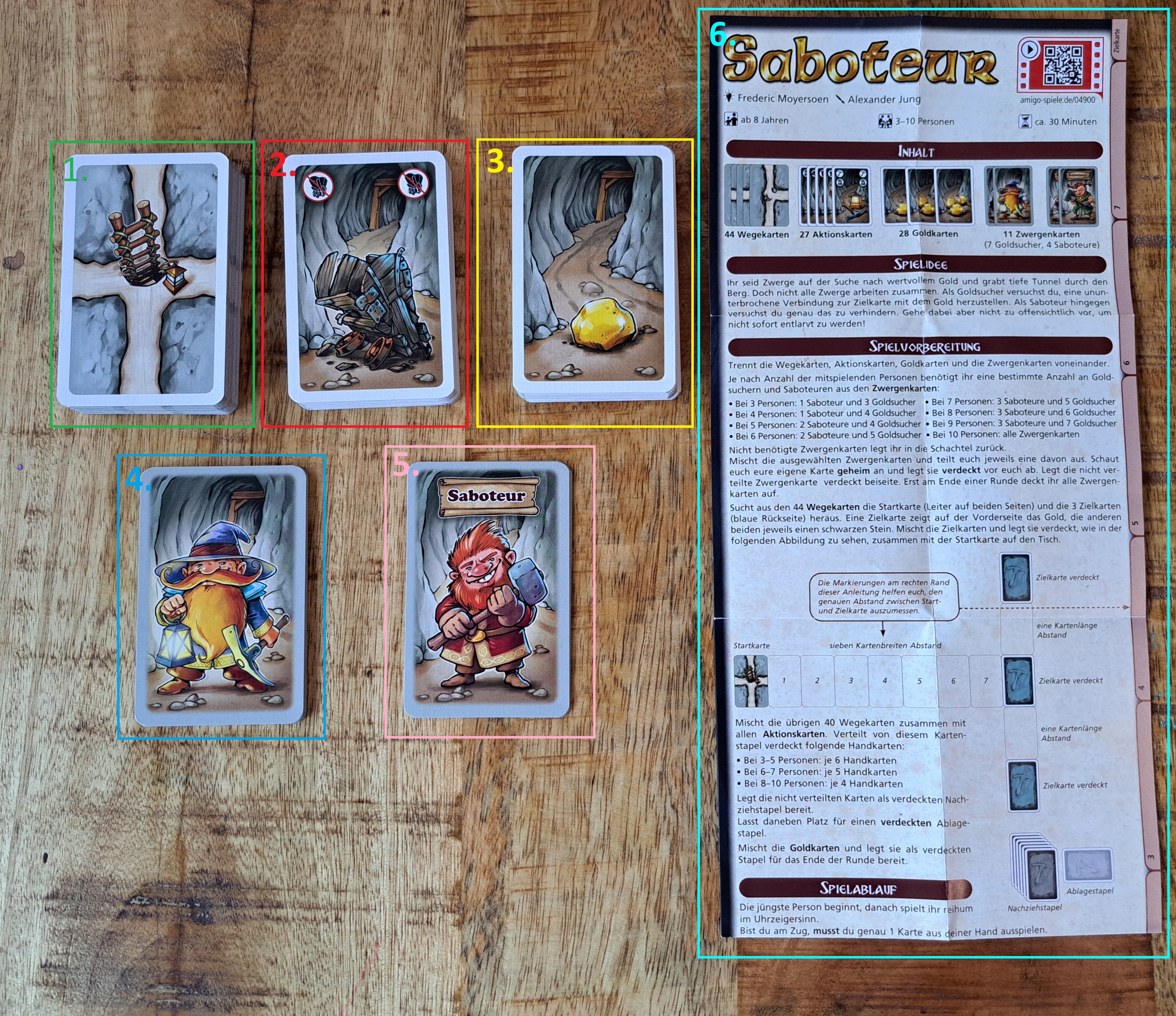
- 44 Path Cards
- 27 Action Cards
- 28 Gold Nugget Cards
- 7 Gold Miners
- 4 Saboteurs
- 1 Game Instructions sheet
Setting Up The Game:
Before the game begins there is a very small amount of setup required. You’ll need a reasonable sized table in order to lay out the cards that form the “mine map”. Cards must be separated into the above shown decks to begin, though regular Dwarf and Saboteur cards can remain in one pile. The number of Dwarfs and Saboteurs required for a round depends on the number of players, and is indicated clearly in the rulebook. The needed number are separated, and any unneeded player cards are returned to the box before the pile is shuffled. Each player then randomly receives a card which they should look at without showing the other players. Now you know if you’re a miner, or a saboteur. There will always be one Dwarf or Saboteur card leftover once all have been dealt; this is placed, face-down, to the side until the end of the round.
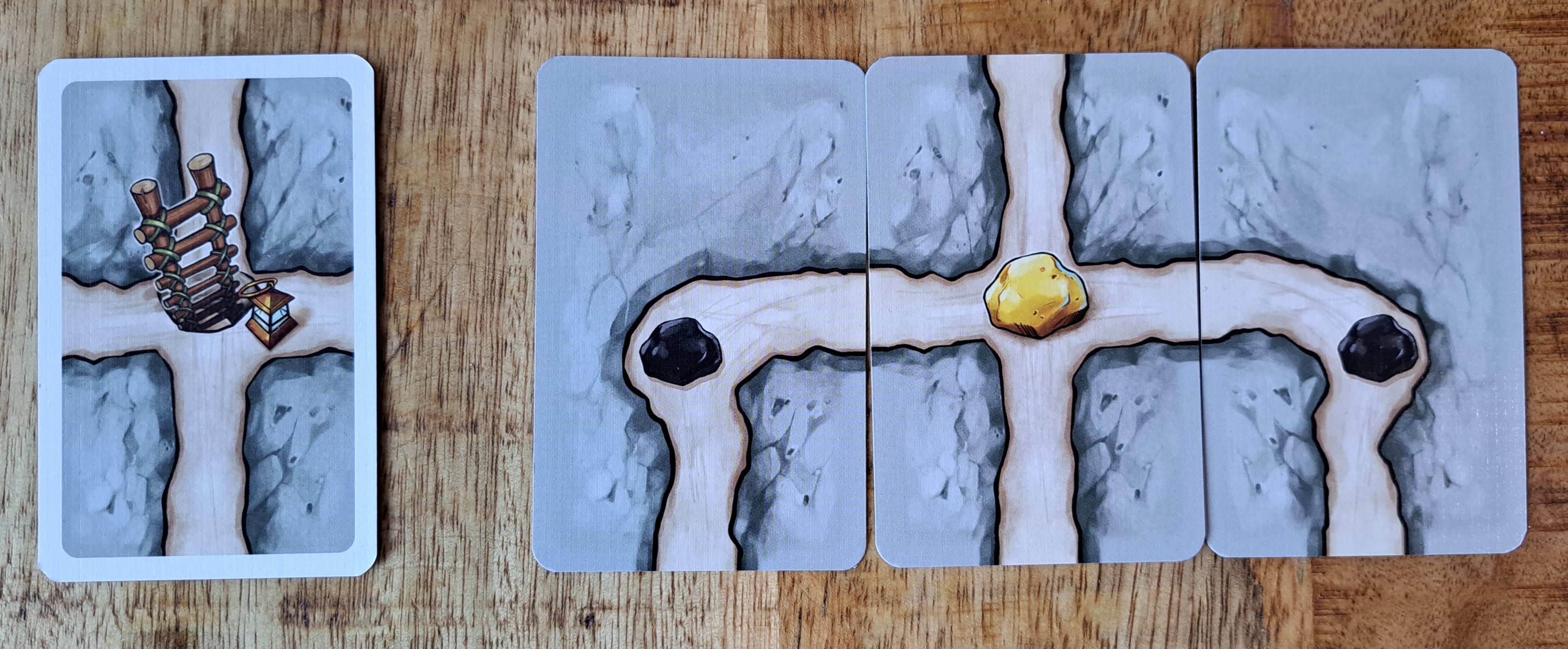
Next, you need to locate the Start Card, which is the only Path Card with a ladder on it, and the three Goal Cards, easy to spot, as one has a large gold nugget on it, and the other two a lump of coal each.
The three Goal Cards are then shuffled and placed face-down upon the table with one cards-length of space between the bottom of the top card and the next, making the width of the defined playing space five cards high. You then need to measure seven cards width across before placing the Start Card on the same row as the middle Goal Card. This represents the “edges” of the mine map. In total your map area will be nine playing cards wide, and five high, like this:
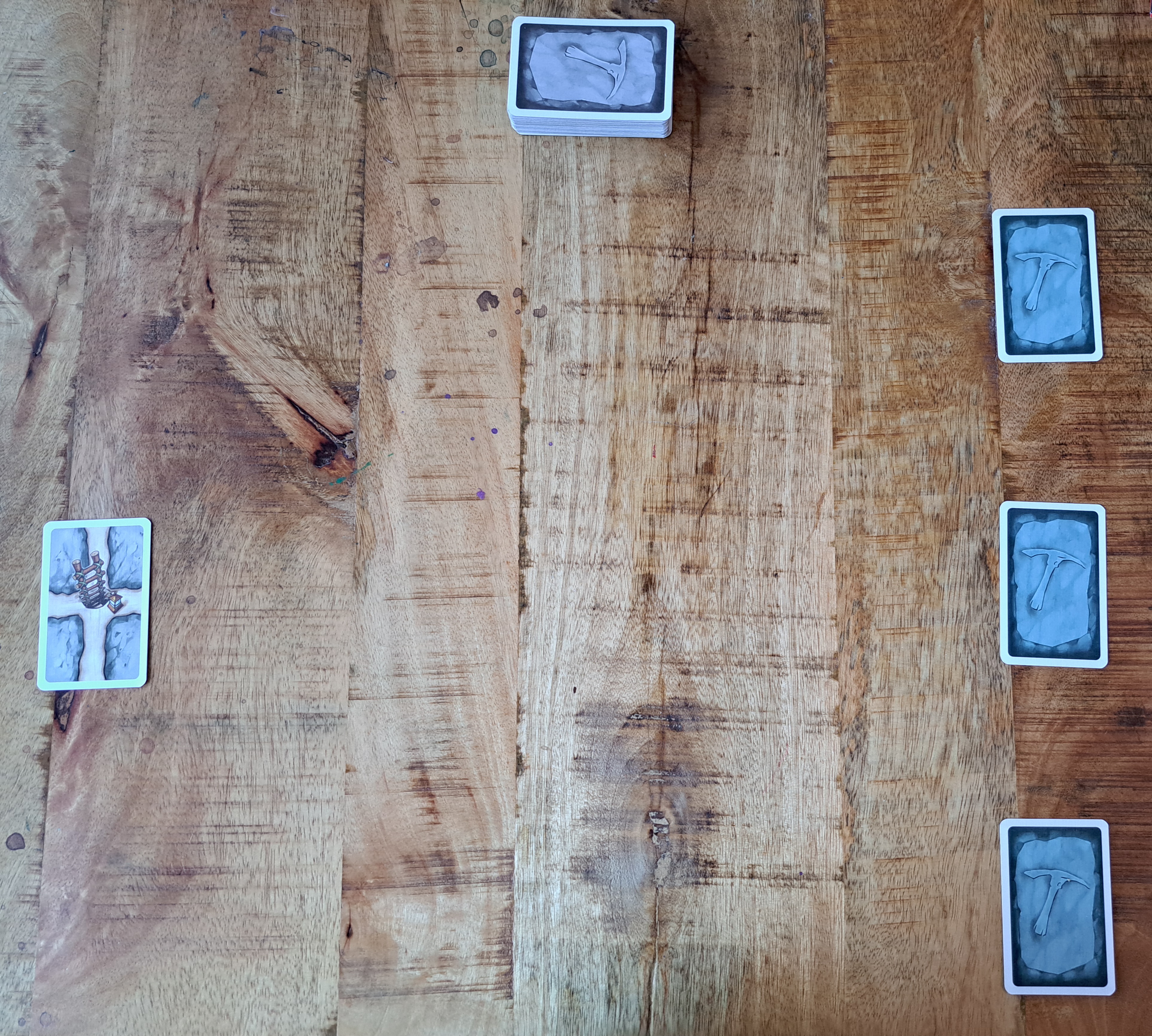
Now you’re ready to start the game, all that’s left to do is to shuffle together the remaining 40 Path Cards with the Action Cards, and deal a starting hand to each player. The number of cards each player receives is determined in the rulebook by the number of players present. Once each player has their hand the youngest player begins the round.
Playing The Game:
A players turn is very straightforward; you use the cards in your hand to further your goals. Each player must play a card on their turn. This means one of three things:
- add a Path Card to the maze,
- place an Action Card in front of yourself or another player,
- pass your turn by putting a card face down on the discard pile (this means the discard pile will have cards both face up and face down in it, this is completely okay)
When playing a Path Card you must connect it to the Start Card in a logical way, meaning, the tunnels shown must connect, and, if connecting to more than one card (either above, below or on either side) must connect properly to all adjoining tunnels. Like this:
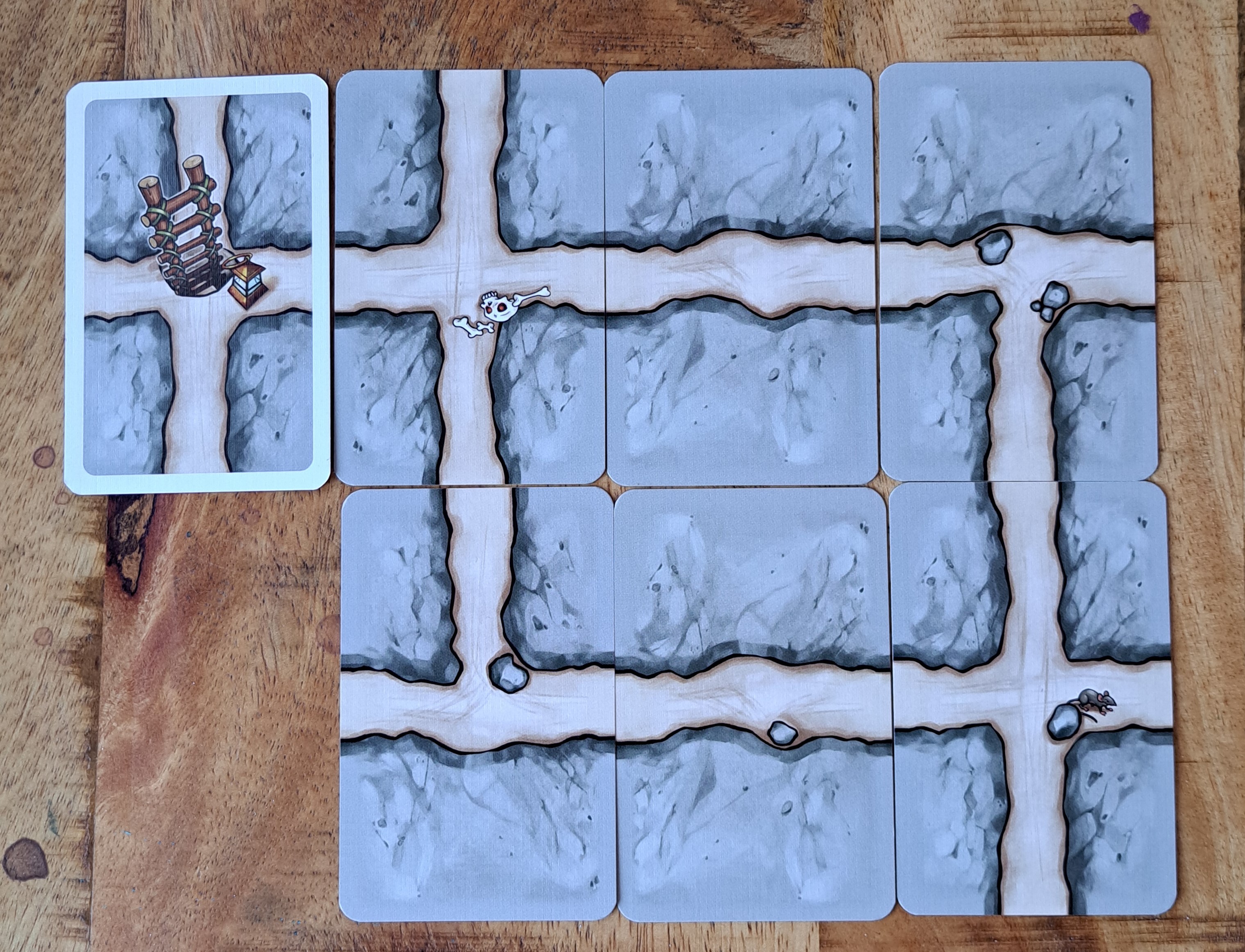
NOT LIKE THIS:
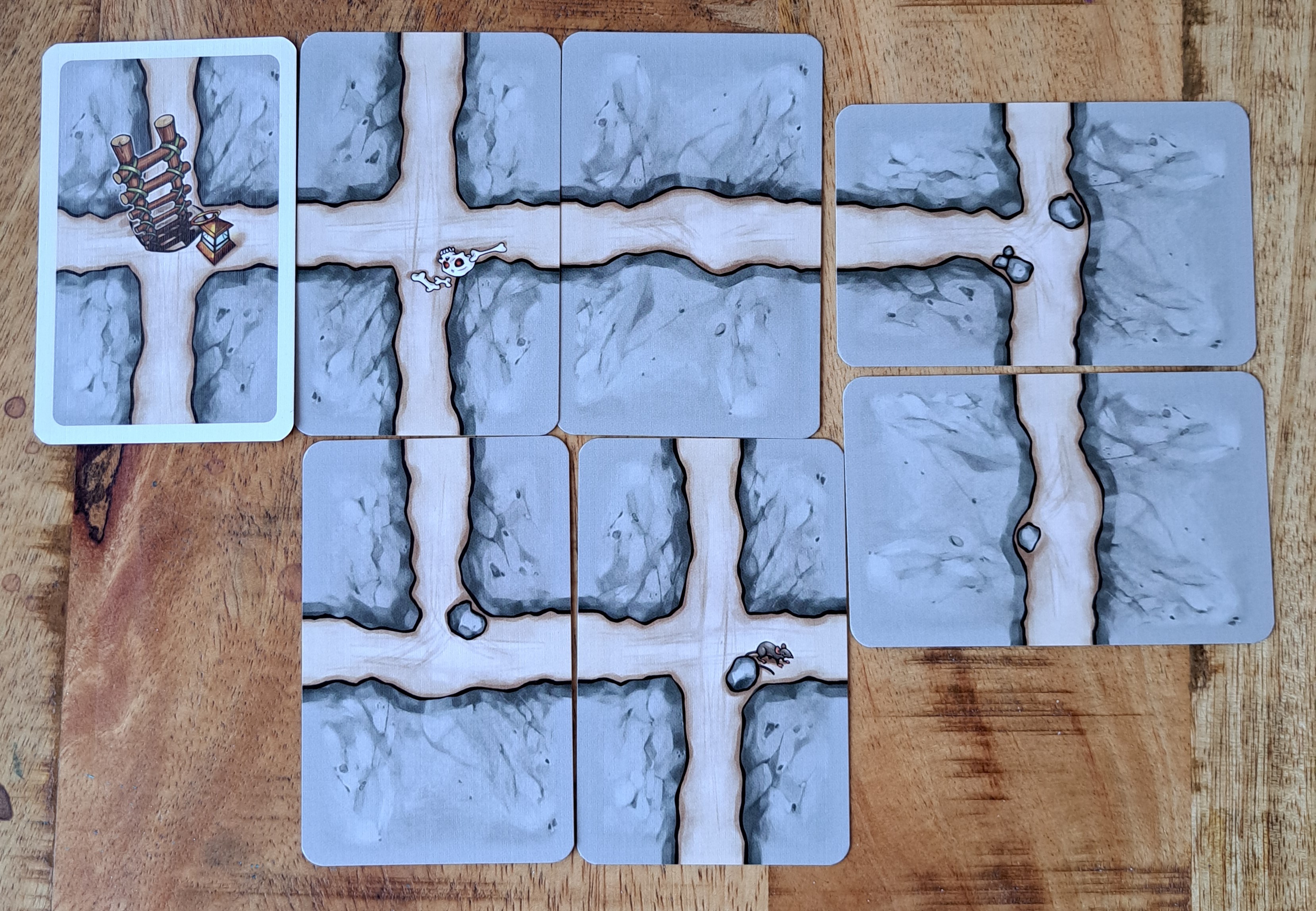
Path Cards must also be played long side to long side or short side to short side. It is not permitted to connect the long side of one tunnel card to the short side of another.
Playing An Action Card:
There are four types of Action Cards; Broken Tools, Fix Tools, Rockfall and Map
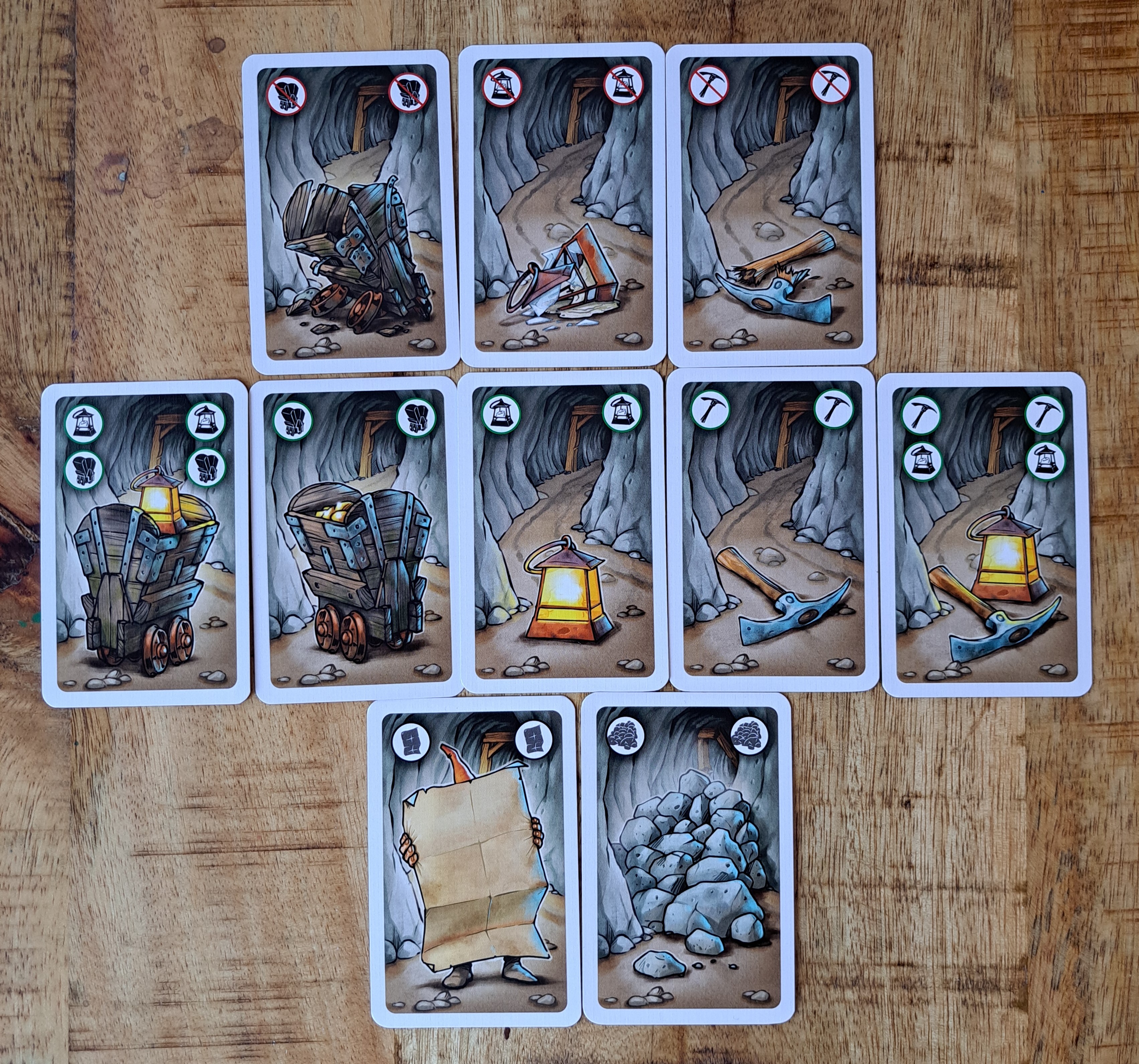
Broken Tools are useful cards both for Saboteurs and Miners; you can play them on another player by placing them in front of that player, and a player with Broken Tools is unable to build tunnels until they, or a different player, have been able to play the appropriate Fix Tools card.
Broken Tools do not completely hinder a player though, as Rockfall and Map can still be used until such time as your tools can be repaired. Rockfall is an excellent tool for a Saboteur, as it allows a player to remove one section of tunnel, effectively setting the Miners back one turn. As some Path Cards allow Saboteurs to build dead ends into the map the Rockfall can be a useful tool for the Miners too, as it will enable them to remove problem sections of the map created by nefarious Saboteurs and build functional tunnels. Map allows a player to chose one of the Goal Cards and look at it, without showing the other players, giving them an edge on potentially knowing where the chunk of gold is.
Ending A Round:
If a route is completed to a Goal Card, one of two things happens. Firstly the Goal Card is flipped over; if it’s revealed that the Goal Card reached was only a lump of coal, then the round continues as before. If, however, the Miners have struck gold, the round ends. At this point all Miner/Saboteur cards are flipped, revealing who was who all along.
If the draw pile is exhausted the round continues with each player continuing to play or discard cards as necessary until either a route to a Goal Card is achieved or no player remains able to play a card. At this point, if no route has been completed to gold, the Saboteurs win! At the end of a round, no matter who won, gold must be divided up between the victors.
When the Miners win the round the player who laid the last card to complete the path draws Gold Nugget cards equal in number to the number of Miners, looks at them secretly, chooses one to keep (not all Gold Nugget cards have the same value), then passes the remaining cards to the next player, going anti-clockwise, until all Miners have a Gold Nugget card to keep.
When the Saboteurs win the gold is divided up slightly differently. If only one Saboteur was playing they take Gold Nugget cards from the deck equaling four Gold Nuggets, if two or three are playing they each get three Gold Nuggets, and if four are playing each receives two Gold Nuggets.
Note: It is possible for a round to be played (in a game with only three or four players) in which no one is a Saboteur. If this happens and the gold is not reached before the round ends due to lack of cards, none of the Dwarfs receive any gold.
At the end of a round each player keeps their Gold Nuggets. The Miner and Saboteur cards are returned to one pile, including the one that was put aside at the beginning of the round, they are then shuffled and redealt, for the start of the new round. All Path and Action Cards are returned to the deck, and everything is shuffled together, for new hands to be drawn. Likewise the Goal Cards are shuffled and laid on the table again. The next round is played the same as the first.
At the end of three rounds the game is over and each player counts their Gold Nuggets. The player with the most wins! In the event of a tie, the players share the win.
Strategy:
This is not really a game in which a whole lot of strategy is required. Obviously you’re on the lookout for who might be Saboteur, and aiming to hinder them if you’re one of the Miners. Likewise, as a Saboteur you’re aiming to hinder the Miners without being immediately obvious, and also hoping not to accidentally hinder other Saboteurs if there are any playing. Other than that you mostly have to go with which cards are in your hand, available to play.
To Conclude:
I like this game a lot. It’s quick, easy to learn, easy to set up/put away and all-around good fun. It’s also good for kids, as there’s not any reading required, once the rules have been looked through, and the high player limit make it an excellent choice for a family game. The only slightly irritating thing is that the game is not playable with only two people, however, Saboteur 2, which we also have, and will be reviewing, expands on the base game, and gives new depth with teams added and new roles introduced.
This game is a solid 4.5 on our rating, as it’s interesting enough in structure to be fun, easy enough to learn quickly, and a good game for casual gamers, who might not be invested in the kind of games that require 1-2 hours of set up and rule reading before you even get to gameplay. The last .5 that would bring it to a 5 rating is that we wish it would be playable with just two people.
 Tame The Board Game
[…] the post for Saboteur was fun, and a good way to break back into writing, as the post wasn’t all that long. […]